Ai Overview
The OTT industry has gone through a massive transformation over the past decade. According to IMARC Group, the global OTT market reached $575. The platform’s recommendation engine drives over 80% of all content watched on the service. According to multiple industry reports, Netflix’s recommendation system saves the company over $1 billion annually by reducing subscriber churn and keeping engagement high.
Key Takeaways
- Over 80% of all content watched on Netflix is discovered through AI-powered recommendations, and the company’s recommendation engine saves it over $1 billion annually in customer retention value.[1]
- The global recommendation engine market was valued at $5.39 billion in 2024 and is projected to grow to $119.43 billion by 2034 at a compound annual growth rate of 36.33%.[2]
- YouTube’s AI-driven recommendation algorithm is responsible for approximately 70% of all content watched on the platform, making it one of the largest industrial recommendation systems ever built.[3]
- The global OTT market reached $575.8 billion in 2024 and is expected to hit $3,741.9 billion by 2033, growing at a CAGR of 22.9%, with AI-driven personalization being a primary growth driver.[4]
- Platforms that build proprietary AI recommendation and optimization systems report 22% higher retention compared to those that use off-the-shelf tools, according to Mordor Intelligence.[5]
- Streaming advertising revenue in the United States is projected to reach nearly $17 billion in 2025, with AI-powered user experiences playing a major role in driving that growth.[6]
- The average monthly churn rate for U.S. streaming platforms now sits at 5.5%, up from 2% in 2019, making AI-powered retention strategies more important than ever for OTT businesses.[7]
- Disney+ uses AI-powered content clustering that groups movies and shows based on themes, genres, and user behavior rather than just popularity, focusing on franchise-specific data like Marvel or Star Wars interests.[8]
- Spotify has reached 713 million active users worldwide as of Q3 2025, with its AI recommendation system using collaborative filtering, natural language processing, and audio analysis to create deeply personalized experiences.[9]
- Netflix uses personalized thumbnail artwork for every user, and its algorithm guarantees that 90% of users who see a personalized trailer will be interested in watching the first episode of the recommended show.[10]
Think about the last time you opened Netflix, Amazon Prime Video, or YouTube. Within seconds, the screen filled with suggestions that seemed almost eerily accurate. A documentary you would have never searched for but ended up watching for three hours. A series that matched your mood perfectly on a lazy Sunday afternoon. None of that was accidental. Behind every single one of those “Watch Next” prompts sits an intricate web of artificial intelligence, working around the clock to learn what you like, when you like it, and why.
AI recommendation engines in OTT platforms have grown from a nice little bonus feature into the backbone of the entire streaming industry, powering modern entertainment solutions. They determine what content gets watched, which shows become hits, how long people stay subscribed, and ultimately, how much money these platforms earn. Without them, the streaming world as we know it would look completely different.
This blog breaks down how these OTT recommendation systems actually work, what makes them so effective, which platforms are doing it best, and where this technology is headed. Whether you run an OTT platform or you are simply curious about why your streaming app seems to read your mind, this is for you.
The Rise of AI in the OTT Industry
The OTT industry has gone through a massive transformation over the past decade. What began as a handful of streaming services competing for viewers has now turned into a global market worth hundreds of billions of dollars. According to IMARC Group, the global OTT market reached $575.8 billion in 2024 and is projected to hit $3,741.9 billion by 2033, with a CAGR of 22.9%. That kind of explosive growth comes with a unique set of problems. With thousands of movies, series, documentaries, and live streams available on any given platform, helping viewers find what they actually want to watch has become one of the biggest challenges in the business.
This is exactly where AI stepped in. Early streaming platforms relied on basic sorting by genre, popularity lists, and manual curation. While those methods worked when content libraries were small, they quickly fell apart as catalogs expanded into the tens of thousands. AI-powered content recommendation changed the game by shifting from static categories to dynamic, personalized experiences that adapt to each viewer individually.
The numbers speak for themselves. The global recommendation engine market was valued at $5.39 billion in 2024 and is expected to exceed $119.43 billion by 2034, according to Precedence Research. The increasing demand for deep learning technologies and personalized digital experiences across streaming platforms is a key factor behind this growth. OTT platforms today are no longer just content companies. As Mordor Intelligence puts it, mature platforms are being built as technology organizations, with AI and machine learning forming the foundation of their entire operation.
How AI Recommendation Engines Actually Work
To understand the power of AI engines in OTT platforms, you need to understand what is happening behind the scenes every time the app loads. These systems are not guessing. They are calculating, learning, and adapting in real time using several core technologies working together. Similar real-time decision-making architectures are also being adopted in intelligent automation and autonomous systems, as explained in how to build crypto AI agents, where adaptive AI models operate continuously based on live data inputs.
1. Collaborative Filtering
This is one of the oldest and most widely used approaches in AI recommendation systems for OTT. The idea is simple in concept but incredibly complex in execution. Collaborative filtering analyzes the behavior of millions of users to find patterns. If User A and User B both watched and enjoyed the same five shows, and User A then watches a sixth show, the system will recommend that sixth show to User B. The assumption is that people with similar viewing histories will continue to share similar tastes. Netflix, Amazon Prime Video, and Spotify all use forms of collaborative filtering as a foundational element of their recommendation engines.
2. Content-Based Filtering
While collaborative filtering focuses on user behavior patterns, content-based filtering looks at the content itself. It examines attributes like genre, director, cast, runtime, language, mood, pacing, and even color tones in artwork. When a viewer finishes a psychological thriller, the system does not just look for other movies labeled “thriller.” It digs deeper, analyzing narrative style, visual aesthetics, and thematic elements to surface titles that genuinely match the viewer’s preferences. Disney+ uses this approach extensively, leveraging franchise-specific data like Marvel, Star Wars, and Pixar interests to guide its recommendations.
3. Deep Learning and Neural Networks
Modern OTT platforms have moved well beyond basic filtering techniques. Deep learning models, including convolutional neural networks and recurrent neural networks, process massive datasets that include viewing duration, pause behavior, rewatch patterns, skip rates, time of day preferences, and device usage data. YouTube’s recommendation engine uses deep neural networks to process billions of data points every second, predicting not just what a viewer might click on, but what will actually satisfy them over time. This distinction between click prediction and satisfaction prediction is what separates advanced AI systems from basic ones. The same technologies are increasingly being adopted by VOD streaming platforms to improve content discovery and viewer engagement. By analyzing viewing habits and preferences, a VOD streaming platform can recommend relevant movies, series, and videos to each user, helping audiences find content faster and encouraging longer watch times. This distinction between click prediction and satisfaction prediction is what separates advanced AI systems from basic ones.
4. Natural Language Processing (NLP)
NLP enables OTT platforms to understand and respond to how users search for content. Instead of requiring exact titles or genres, AI-powered search can interpret conversational queries like “funny movies for a family night” or “something intense but not too violent.” Spotify’s recommendation system, for example, uses NLP to scan music blogs, playlist descriptions, and cultural context to understand how people talk about music and then maps that understanding back to its catalog. In 2024, Spotify launched an AI Playlist feature in beta that allows users to generate playlists from creative text prompts, marking a shift from passive recommendations to active co-creation.
5. Reinforcement Learning
Reinforcement learning takes AI content recommendations engines to the next level by allowing the system to learn from its own successes and failures. Every time a user watches a recommended title all the way through, the system counts it as a win. Every time a user clicks on a suggestion but abandons it within a minute, the system counts it as a miss. Over millions of interactions, the algorithm fine-tunes itself to maximize the metrics that matter most: watch time, session duration, and long-term subscriber retention.
Recommended Reading:
Digital Transformation in Entertainment Industry: Platforms, Tech & Monetization
How Top OTT Platforms Use AI Recommendations
Every major streaming platform uses AI, but they do not all use it the same way. Each platform has developed its own unique approach to personalized recommendations in OTT, shaped by its content library, user base, and business model. Let us look at how the biggest players are using this technology.
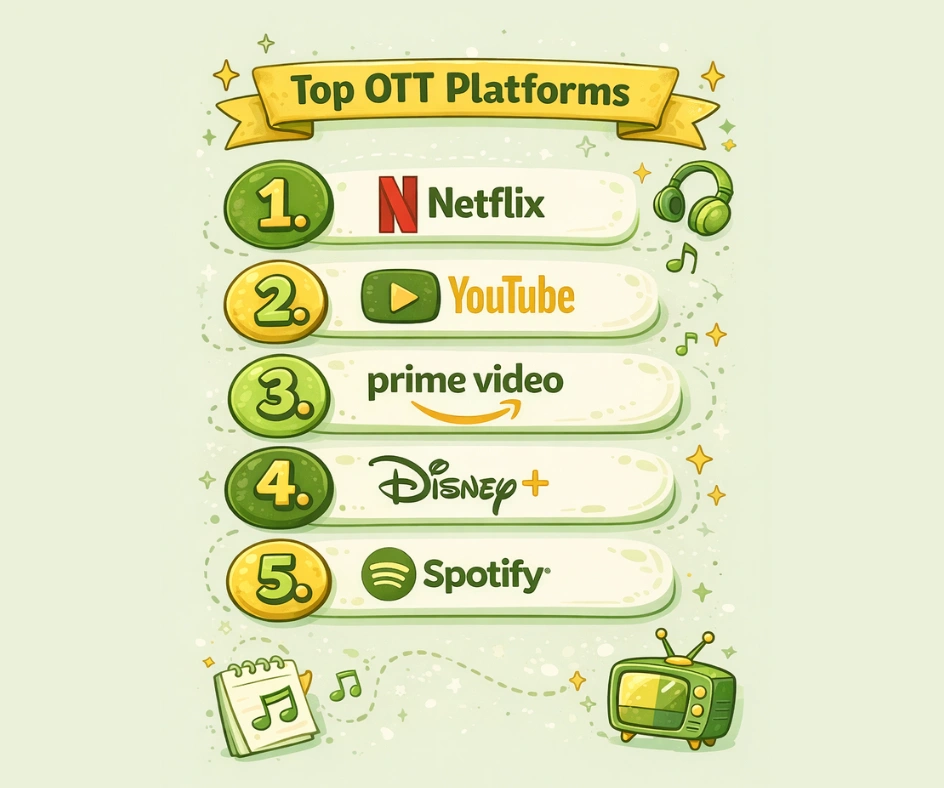
1. Netflix: The Gold Standard of AI-Powered Content Recommendation
Netflix is often held up as the benchmark for AI in streaming. The platform’s recommendation engine drives over 80% of all content watched on the service. Users rarely use the search bar because the homepage already presents options that match their preferences with remarkable accuracy. According to multiple industry reports, Netflix’s recommendation system saves the company over $1 billion annually by reducing subscriber churn and keeping engagement high.
The system works by analyzing billions of viewing hours across its global subscriber base. It tracks not just what you watch, but how you watch: the time of day, the device you use, how long you hover over a title before clicking, whether you pause, rewind, or skip through certain scenes. Netflix even personalizes the thumbnail artwork for each user. Two people looking at the same movie might see completely different cover images, selected by AI based on what visuals are most likely to catch each person’s attention.
Netflix has reported that personalized recommendations lead to users consuming three to four times more content compared to simply showing popular titles. The platform’s churn rate sits between 1.85% and 2.5%, which is among the lowest in the streaming industry, largely thanks to the power of its AI engine.
2. YouTube: Improving Watch Time with AI at Massive Scale
YouTube operates one of the largest and most complex AI recommendation systems on the planet. The platform’s algorithm is responsible for roughly 70% of all content watched, making it the primary discovery mechanism for over 2 billion monthly active users. YouTube’s system uses deep neural networks that evaluate hundreds of signals simultaneously, including watch history, search behavior, click-through rates, video completion rates, and even the time of day a viewer typically watches certain types of content. In this highly competitive ecosystem, some creators and businesses even explore youtube channels for sale as a way to gain initial traction and tap into an existing audience.
What makes YouTube’s approach unique is its shift from optimizing for raw watch time to optimizing for “valued watch time,” which considers viewer satisfaction alongside duration. The platform conducts user surveys and tracks post-watch behavior like shares, likes, and “not interested” clicks to determine whether a recommendation actually made someone happy, not just whether it kept them watching. This distinction is critical for improving watch time with AI in a way that builds long-term loyalty rather than just short-term engagement. The same AI-driven personalization principles can also influence user decisions across YouTube’s ecosystem, including subscription-based services where factors such as YouTube TV cost and content recommendations play an important role in user retention and satisfaction.
3. Amazon Prime Video: Cross-Platform Intelligence
Amazon Prime Video has a unique advantage that no other streaming platform can replicate: access to the broader Amazon ecosystem. Its recommendation engine does not only analyze what you watch. It also factors in your shopping history, browsing behavior, Alexa voice interactions, and product preferences. This cross-platform data creates a richer user profile than any standalone streaming service can build.
Amazon uses a hybrid model that combines item-to-item collaborative filtering, content-based filtering, and real-time contextual personalization. The system updates recommendations instantly based on current activity, ensuring that what you see on the homepage reflects your most recent interests. Amazon Prime Video has maintained one of the lowest churn rates in the industry, partly because its Prime membership bundles streaming with shipping and other benefits, but also because its AI creates a highly engaging viewing experience.
4. Disney+: Franchise-Driven AI Content Recommendations
Disney+ takes a distinct approach to AI recommendations by leaning heavily into its franchise ecosystem. Rather than relying solely on generic genre categories, Disney+ uses AI-powered content clustering that groups titles based on themes, character universes, and narrative connections. If a viewer watches several Marvel movies, the system does not just recommend more action films. It surfaces specific MCU series, behind-the-scenes documentaries, and animated shows connected to the same universe.
This franchise-specific intelligence extends to Star Wars, Pixar, National Geographic, and other Disney-owned properties. The platform studies the sequence in which users interact with content, what they watch multiple times, and what they skip. By understanding these patterns, Disney+ creates deeply personalized journeys through its content library that feel curated rather than random.
5. Spotify: Audio Intelligence and Mood-Based Recommendations
While Spotify is a music streaming platform rather than a video OTT service, its recommendation engine offers powerful lessons for AI applications in OTT broadly. As of Q3 2025, Spotify has reached 713 million active users worldwide. Its recommendation system combines collaborative filtering with content-based filtering and raw audio signal analysis, examining 12 different sonic attributes including danceability, energy, and valence.
Spotify’s Discover Weekly playlist, launched in 2015, now accounts for 20% of all streaming volume on the platform. The system creates a new personalized playlist of 30 songs every Monday for each user, drawing from the listening patterns of millions of people to surface tracks the listener has never heard but is statistically likely to enjoy. In 2025, Spotify augmented its system with “Semantic IDs,” compact codes that help AI models understand the deeper connections between songs and a user’s listening history.
AI Recommendation Approaches Used by Top OTT Platforms
| Platform | Primary AI Technique | Key Outcome |
|---|---|---|
| Netflix | Hybrid filtering, deep learning, personalized artwork | 80% of watched content from recommendations, $1B+ saved annually |
| YouTube | Deep neural networks, satisfaction prediction, and real-time signals | 70% of all views are driven by AI recommendations |
| Amazon Prime Video | Cross-platform data, item-to-item collaborative filtering | Lowest churn rate among major streaming services |
| Disney+ | Franchise-driven clustering, NLP, behavioral sequencing | Strong subscriber retention through universe-based recommendations |
| Spotify | Audio analysis, NLP, Semantic IDs, collaborative filtering | 713M users worldwide, Discover Weekly drives 20% of streaming volume |
| Hulu | Predictive analytics, behavior-targeted ad personalization | Reported 35% drop in cancellations in Q1 2025 |
The Business Impact of AI Transforming OTT
AI is not just a feature that makes OTT platforms look modern. It is a fundamental business driver that directly impacts revenue, subscriber retention, content investment decisions, and advertising effectiveness. Here is how AI transforming OTT plays out in real financial terms.
1. Reducing Subscriber Churn
Churn is the single biggest financial headache for streaming services. The average monthly churn rate for U.S. streaming platforms now sits at 5.5%, a dramatic increase from 2% in 2019, according to Fabric’s 2025 analysis. Serial churners, people who cancel three or more services within two years, now represent 23% of the U.S. streaming audience. In this environment, AI-powered personalization is not optional; it is survival. Netflix has consistently maintained one of the industry’s lowest churn rates, and it attributes a significant portion of that success to the recommendation engine that keeps users engaged enough to justify their monthly subscription.
2. Maximizing Content ROI
OTT platforms invest billions each year in content acquisition and production. Netflix alone spent an enormous amount on original content over the past few years. Without AI, a large portion of that content library would go unwatched, buried under more popular titles. AI recommendation engines solve this by surfacing niche content to the specific audiences that will appreciate it. This means that a small independent film produced for a fraction of a blockbuster’s budget can still find its audience, deliver strong engagement metrics, and justify its place in the catalog. AI effectively turns every piece of content into a targeted product, improving return on investment across the entire library.
3. Driving Advertising Revenue
As more OTT platforms adopt ad-supported tiers (like Netflix’s and Disney+’s ad tiers), AI becomes even more valuable. Streaming advertising revenue in the U.S. is projected to reach nearly $17 billion in 2025. AI-powered personalization enables platforms to serve ads that are actually relevant to the viewer, which improves click-through rates, increases advertiser satisfaction, and allows platforms to charge premium ad rates. Hulu, for instance, uses AI to analyze viewer preferences and time of day patterns to deliver behavior-targeted advertising, helping advertisers maximize ROI while ensuring viewers see fewer but more relevant ads.
4. Informing Content Production Decisions
AI does not just help viewers find content. It also helps platforms decide what content to create. By analyzing viewing patterns, completion rates, search trends, and engagement data, AI gives studios powerful insights into what genres, themes, actors, and storylines resonate with specific audience segments. Netflix’s original content success rate is often cited at 93%, compared to a 35% success rate for typical television shows. While many factors contribute to this, the data-driven approach powered by AI is widely credited as a major reason why Netflix consistently produces shows that find and retain their audiences.
You May Also Like:
What Data Do AI Recommendation Engines Collect?
The effectiveness of any AI recommendation system for OTT depends entirely on the data it can access and process. Modern recommendation engines collect and analyze a wide range of data points to build accurate user profiles. Understanding what goes into these systems helps explain why some platforms offer better personalized recommendations in OTT than others.
1. Viewing History and Behavior
This is the most obvious data source. The system tracks every title you watch, how long you watch it, whether you finish it, and how quickly you start the next episode. It also notes what you skip, what you rewatch, and what you abandon after a few minutes. Netflix’s system even captures how long you hover over a title before making a decision, using that micro behavior as a signal of interest level.
2. Search Queries and Browsing Patterns
What you search for reveals a lot about your intentions. Even if you search for a title and do not end up watching it, the system logs that interest. Browsing patterns, such as which categories you explore, how far you scroll, and which thumbnails you click on, all feed into the recommendation model.
3. Ratings and Explicit Feedback
Thumbs up, thumbs down, star ratings, “not interested” clicks, and “add to watchlist” actions are all forms of explicit feedback. These direct signals carry heavy weight in the algorithm because they represent a conscious decision by the viewer to express a preference.
4. Contextual Data
AI systems also consider the context in which you are watching. The device you use (phone, tablet, smart TV, laptop), the time of day, the day of the week, your geographic location, and even your internet speed all play a role. A viewer who typically watches short comedies on their phone during lunch might receive different recommendations than the same viewer sitting down on their smart TV on a Friday night.
5. Cross-Platform and Social Data
Amazon Prime Video is the best example of this, pulling data from the broader Amazon ecosystem. But other platforms also use social signals where available: what your friends are watching, what is trending in your region, and what is generating buzz on social media. Spotify’s recommendation engine even scans web content and music blogs to understand the cultural context around songs and artists.
Challenges Facing AI Recommendation Engines in OTT
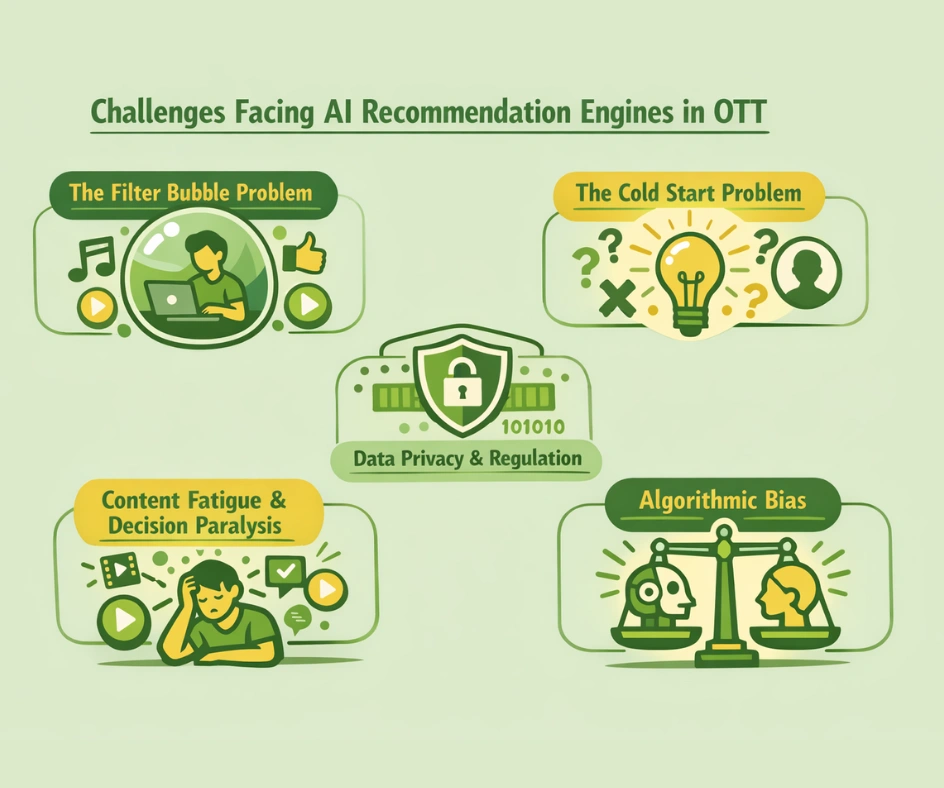
Despite the incredible advances in AI-powered content recommendation, these systems are far from perfect. Several ongoing challenges affect how well AI serves both platforms and viewers.
1. The Filter Bubble Problem
When AI gets too good at predicting what you like, it can trap you in an echo chamber. If you watch three crime dramas in a row, the system might flood your feed with nothing but crime content, making it difficult to discover new genres you might actually enjoy. This over-personalization can limit content diversity and, paradoxically, reduce long-term engagement as users start feeling like the platform has nothing new to offer them.
2. The Cold Start Problem
New users present a major challenge for AI systems. When someone signs up for a platform, the algorithm has zero data to work with. It does not know their preferences, their mood, or their viewing history. Platforms handle this differently. Netflix asks new users to select a few favorite shows during onboarding. Spotify lets users pick favorite genres and artists. But until enough behavioral data accumulates, recommendations tend to be generic and less effective. This initial period is when churn risk is highest, making the cold start problem a serious business concern.
3. Data Privacy and Regulation
The more data an AI system collects, the better its recommendations become. But this creates tension with growing data privacy regulations around the world. Laws like the GDPR in Europe and similar frameworks in other regions impose strict rules on how user data can be collected, stored, and used. OTT platforms must balance the desire for deeper personalization with the legal and ethical obligation to protect user privacy. Failing to get this balance right can result in regulatory penalties, loss of user trust, and reputational damage.
4. Algorithmic Bias
AI systems learn from data, and if the data contains biases, the algorithm will reproduce and even amplify them. In the context of OTT, this can mean that popular content gets more visibility while niche or independent content gets buried. It can also lead to demographic biases, where certain types of content are underrepresented in recommendations for specific user groups. Spotify introduced an “Amplify” initiative in 2024 specifically to boost underrepresented genres and address this kind of algorithmic bias.
5. Content Fatigue and Decision Paralysis
Even with advanced AI, some users still experience decision fatigue when faced with too many options. The sheer volume of content available on modern OTT platforms can be overwhelming, and while recommendations narrow the field, they do not eliminate the problem entirely. Some users report spending more time browsing than actually watching, which hurts engagement metrics even when the recommendation engine is technically performing well.
AI Application in OTT Beyond Recommendations
While recommendation engines get most of the attention, AI applications in OTT extend far beyond suggesting what to watch. Here are other critical areas where AI is making a measurable impact on how streaming platforms operate.
1. Automated Content Tagging and Metadata
AI can analyze video content at the frame level to automatically generate tags, descriptions, and metadata. This includes identifying actors, detecting scene types, recognizing emotions, and categorizing visual elements. This automated tagging improves search accuracy and feeds better data into the recommendation engine and is often powered through an AI video generator system.
2. Dynamic Video Quality Optimization
AI algorithms dynamically adjust video resolution and streaming quality based on the viewer’s internet speed, device capabilities, and network congestion. This ensures that viewers get the best possible picture quality without buffering interruptions, regardless of their bandwidth conditions. During peak hours, AI can predict traffic patterns and pre-position content on CDN servers to minimize latency.
3. Content Moderation and Copyright Protection
While recommendation engines get most of the attention, AI applications in OTT extend far beyond suggesting what to watch. Here are other critical areas where AI is making a measurable impact on how streaming platforms operate. Similar AI-driven optimization and decentralized intelligence models are also being explored in next-generation platforms, as shown in the Reform DAO decentralized AI market making case study, which highlights how AI and decentralized systems can work together to optimize real-time decision-making at scale.
4. Intelligent Voice Search
NLP-powered voice search allows users to find content using natural language commands through smart TVs, voice assistants, and mobile devices. Instead of typing exact titles, users can say “show me something funny” or “find that movie with the robot” and receive accurate results. This reduces friction in content discovery and makes platforms more accessible to users who prefer voice interaction.
5. Predictive Content Delivery
AI helps Content Delivery Networks anticipate what content users are likely to watch and pre-cache it on servers closer to the viewer. This proactive approach reduces buffering and load times, creating a smoother streaming experience that directly contributes to viewer satisfaction and longer session times.
Recommended Reading:
Building vs. Buying: OTT Recommendation System Strategy
For companies looking to launch or upgrade an OTT platform, one of the biggest strategic decisions is whether to build a proprietary AI recommendation system or buy an off-the-shelf solution. Both approaches have trade-offs, and the right choice depends on the platform’s scale, budget, and long-term vision.
According to Mordor Intelligence, platforms that build proprietary recommendation and optimization systems report 22% higher retention compared to those using off-the-shelf tools. This makes intuitive sense. A custom-built system can be trained on a platform’s specific content library, user base, and business goals. It can adapt to the unique characteristics of the platform in ways that a generic tool simply cannot.
However, building a proprietary system requires significant investment in engineering talent, data infrastructure, and ongoing maintenance. Advanced, fully customized OTT platforms with AI-powered recommendation engines, behavioral analytics, robust cloud infrastructure, and advanced content protection can cost anywhere from $150,000 to $500,000 or more, depending on complexity. For enterprise-level platforms with live streaming, multilingual AI content localization, and full-scale TV app deployment, the investment can reach several million dollars.
Smaller OTT platforms that lack the resources for a full custom build can still benefit from AI through SaaS or API based solutions. These ready-made tools provide personalized content suggestions at a fraction of the cost, allowing even smaller players to compete with industry giants on the personalization front.
AI-Powered OTT Platform Development Cost Breakdown
| Development Component | Cost Range | Key Considerations |
|---|---|---|
| Basic OTT Platform with AI | $50,000 to $100,000 | Standard recommendation engine, user authentication, content management, basic analytics |
| Advanced Platform with Custom AI | $150,000 to $500,000+ | Custom deep learning models, behavioral analytics, multi-device support, and advanced content protection |
| Enterprise Level Platform | $500,000 to Several Million | Live streaming, multilingual AI localization, full-scale TV app deployment, global CDN integration |
| AI Recommendation Engine (Standalone) | $30,000 to $150,000 | Depends on model complexity, data volume, and integration requirements |
| SaaS/API Based AI Solutions | $500 to $10,000/month | Pre-built models, quicker deployment, suitable for smaller platforms and startups |
| Ongoing Maintenance and Optimization | $2,000 to $20,000/month | Model retraining, infrastructure updates, A/B testing, performance monitoring |
The Future of AI Recommendation Engines in OTT
The next wave of AI in streaming is already taking shape. Several emerging trends will define how personalized recommendations in OTT evolve over the coming years.
1. Emotion Aware Recommendations
The industry is moving toward what is called “affective computing,” where AI engines will analyze the emotional arc of content at the scene level, understanding tension, humor, sadness, and pacing. Rather than just matching genres, the system will match emotional experiences. A viewer who just watched something heavy and emotionally draining might automatically receive lighter, uplifting suggestions next. Vionlabs, a company specializing in this technology, claims that emotional pattern recognition can increase recommendation accuracy up to 83%.
2. Generative AI and Conversational Discovery
The rise of large language models (LLMs) is opening up entirely new ways for users to discover content. Instead of scrolling through rows of thumbnails, users will be able to have conversations with AI assistants that understand nuanced preferences. Netflix announced plans in 2025 to launch an AI-based chatbot feature within its app, allowing users to describe what they are in the mood for and receive tailored suggestions through natural conversation. Spotify’s AI Playlist feature, which lets users generate playlists from creative text prompts, is another example of this shift from passive browsing to active, conversational discovery.
3. Real-Time Personalization
Current systems update recommendations periodically, often resetting every 24 hours or when significant new viewing data comes in. The future is real-time, continuous personalization that adapts with every interaction, within milliseconds. If a viewer starts watching a horror movie but pauses it and switches to a comedy, the system will immediately adjust its recommendations for the rest of the session. Netflix already processes several terabytes of interaction data daily through distributed ML pipelines optimized for real-time inference.
4. Cross-Platform and Multi-Device Intelligence
As viewers increasingly switch between devices and even between platforms, the ability to maintain a unified understanding of user preferences across all touchpoints becomes critical. Future AI systems will create a persistent viewer profile that travels across smart TVs, mobile devices, gaming consoles, and even car entertainment systems, ensuring that recommendations are consistent and context-aware regardless of where or how the viewer is consuming content.
5. Regional and Cultural AI Adaptation
As OTT platforms expand into new markets, AI systems must understand regional and cultural nuances. What works for an audience in North America may not resonate with viewers in Southeast Asia or the Middle East. The Indian OTT audience grew by 14% in 2024, reaching 547.3 million users. For AI systems serving these diverse audiences, cultural intelligence is not a nice-to-have; it is a requirement. Platforms are increasingly investing in region-specific AI models that understand local languages, cultural references, and viewing patterns unique to each market.
Build Your AI-Powered OTT Platform Today:
We bring 8+ years of AI and software development expertise to OTT platform development. Our specialized team handles everything from custom recommendation engine design to multi-device deployment, ensuring your platform delivers personalized experiences that keep viewers engaged and subscribed. Whether you need a niche streaming app or a full-scale OTT ecosystem, we deliver solutions that work.
Final Thoughts
AI recommendation engines have become the invisible force that shapes the entire OTT experience. From the moment a viewer opens a streaming app to the moment they close it, every suggestion, every personalized row of titles, every dynamically selected thumbnail is the product of sophisticated algorithms working to understand human preferences at a scale that would be impossible for any team of human curators to match.
The data tells a clear story. Netflix’s recommendation engine drives over 80% of its viewed content and saves the company more than $1 billion every year. YouTube’s AI powers 70% of all views on its platform. The global recommendation engine market is racing toward $119 billion by 2034. Platforms that invest in proprietary AI systems see 22% higher retention than those relying on generic tools. These are not incremental improvements. These are the differences between thriving and struggling in a market where the average monthly churn rate has climbed to 5.5%.
Looking ahead, the convergence of emotion-aware AI, generative LLMs, real-time personalization, and cross-cultural intelligence will push these systems even further. The platforms that embrace these technologies early and invest in building a genuine understanding of their audiences will not just survive the intensifying competition in the OTT space. They will define its future. For businesses planning to enter or grow in the streaming industry, the message is straightforward: AI is not a nice-to-have addition. It is the engine that makes everything else work.
Frequently Asked Questions
Q1.What is an AI recommendation engine in an OTT platform?
An AI recommendation engine is a system that uses artificial intelligence and machine learning to analyze viewer behavior, preferences, and contextual data to suggest content that each individual user is most likely to enjoy. These engines power the personalized “Watch Next” and “Recommended for You” sections on platforms like Netflix, YouTube, Amazon Prime Video, and Disney+.
Q2.How does AI improve watch time on OTT platforms?
AI improves watch time by ensuring that users quickly find content they enjoy instead of spending time browsing aimlessly. By analyzing viewing history, search patterns, and behavioral signals, AI surfaces content that matches each viewer’s taste. Netflix has reported that personalized recommendations lead to users watching three to four times more content compared to being shown only popular titles. When viewers find what they like faster, they watch longer and return more often.
Q3.Can small OTT platforms afford AI recommendation technology?
Yes. While building a custom AI recommendation engine from scratch can cost $30,000 to $150,000 or more, smaller platforms can use SaaS or API based AI solutions that provide personalized recommendations at a much lower cost, often between $500 and $10,000 per month. These pre-built tools allow startups and niche platforms to offer personalized experiences without the overhead of a full engineering team.
Q4.4. What types of data do OTT recommendation engines use?
OTT recommendation engines typically collect and analyze viewing history, search queries, ratings, browsing patterns, device information, time of day viewing habits, geographic location, and interaction data like pauses, skips, and rewatches. Some platforms, like Amazon Prime Video, also incorporate data from outside the streaming app, such as shopping and browsing behavior on other Amazon services.
Q5.What is the difference between collaborative filtering and content based filtering?
Collaborative filtering recommends content based on the behavior of similar users. If many people who liked Movie A also liked Movie B, the system will recommend Movie B to you after you watch Movie A. Content-based filtering, on the other hand, recommends content based on the attributes of the content itself, such as genre, director, cast, mood, and theme. Most modern OTT platforms use a hybrid approach that combines both methods for better accuracy.
Q6.What are the main challenges with AI recommendations in OTT?
The main challenges include filter bubbles (where users get trapped in repetitive content loops), the cold start problem (difficulty recommending content to new users with no history), data privacy concerns related to the large volumes of personal data collected, algorithmic bias that can suppress niche or independent content, and decision paralysis caused by the overwhelming volume of options even after personalization. Platforms are actively working on solutions to all of these issues, from diversity caps in recommendation feeds to transparent data practices and bias auditing tools.
Explore Services
Related Services
Reviewed by

Aman Vaths
Founder of Nadcab Labs
Aman Vaths is the Founder & CTO of Nadcab Labs, a global digital engineering company delivering enterprise-grade solutions across AI, Web3, Blockchain, Big Data, Cloud, Cybersecurity, and Modern Application Development. With deep technical leadership and product innovation experience, Aman has positioned Nadcab Labs as one of the most advanced engineering companies driving the next era of intelligent, secure, and scalable software systems. Under his leadership, Nadcab Labs has built 2,000+ global projects across sectors including fintech, banking, healthcare, real estate, logistics, gaming, manufacturing, and next-generation DePIN networks. Aman’s strength lies in architecting high-performance systems, end-to-end platform engineering, and designing enterprise solutions that operate at global scale.