Ai Overview
An AI SaaS product is a cloud based software solution that integrates artificial intelligence capabilities into its core functionality and is delivered to users through a subscription model. The AI SaaS market in 2026 is projected to exceed $300 billion globally, with thousands of new SaaS AI products entering the space every quarter. Technical strength means little if pricing and positioning are weak.
Key Takeaways
- ✓ AI SaaS product classification is a strategic necessity, not just an organizational exercise, shaping how customers, investors, and regulators perceive your AI Application.
- ✓ Five core classification criteria define every serious AI Platform: Level of AI Integration, Technology Depth, Data Dependency, Deployment Architecture, and Commercial Model.
- ✓ Products classified as AI Driven or Autonomous attract significantly higher valuations than those offering AI as a surface level feature.
- ✓ Continuous learning systems, where the AI Application improves with every interaction, represent the highest tier in data dependency classification.
- ✓ The global AI SaaS market is projected to surpass $300 billion in 2026, making precise classification essential for competitive differentiation.
- ✓ Deployment architecture choices such as multi tenant cloud, private cloud, edge AI, or on premise directly impact scalability and compliance readiness.
- ✓ Monetization models must align with the AI product’s classification to ensure predictable revenue and customer retention over time.
- ✓ Regulatory frameworks in 2026 require companies to define the category, risk level, and data processing methods of their AI Platforms.
- ✓ A well classified AI SaaS product accelerates go to market execution by aligning messaging, pricing, and feature priorities under one cohesive strategy.
- ✓ Partnering with experienced teams like Nadcab Labs can significantly shorten the time needed to build, classify, and scale a high growth AI Application.
The AI SaaS landscape in 2026 is evolving at a pace that no one anticipated even two years ago. Every week, new AI Platforms emerge promising to revolutionize industries, automate complex workflows, and deliver intelligent insights that were previously impossible. Insights from AI Launch Reviews consistently show how quickly innovative products rise above the noise. But amid this explosion of innovation, one fundamental question separates the products that scale from those that stall: How is your AI SaaS product classified?
Product classification might sound like an academic exercise. In reality, it is the strategic backbone of every successful AI Application. It determines how customers perceive your product, how investors value your company, how your engineering team prioritizes features, and ultimately how fast you grow. This comprehensive guide walks you through the exact AI SaaS product classification criteria that leading SaaS AI companies are using in 2026 and shows you how to apply them to build a high growth product that stands out in a competitive market.
Whether you are a founder planning your next AI Platform, a product manager refining your roadmap, or an investor applying B2B SaaS AI startup investment criteria to evaluate deal flow, understanding AI SaaS product classification is no longer optional. It is essential.
What Is an AI SaaS Product?
An AI SaaS product is a cloud based software solution that integrates artificial intelligence capabilities into its core functionality and is delivered to users through a subscription model. Unlike traditional software that follows static, rule based logic, an AI Application leverages machine learning, natural language processing, computer vision, or other AI technologies to learn from data, adapt over time, and deliver increasingly intelligent outcomes.
Consider the difference between a standard email marketing tool and an AI powered one. The traditional tool lets you schedule campaigns, segment lists, and track open rates. The AI Application version does all of that, but it also predicts the optimal send time for each subscriber, generates personalized subject lines, identifies which contacts are most likely to churn, and automatically adjusts campaign parameters based on real time performance data.[1]
The defining characteristics of an AI SaaS product include:
- Intelligent automation that replaces manual decision making
- Adaptive learning where the product improves with usage
- Cloud native architecture enabling seamless updates and scalability
- Subscription based revenue model with recurring income
- Multi tenant infrastructure that serves multiple customers from a shared platform
These SaaS AI products span virtually every industry, from healthcare and finance to retail, logistics, and education, making the AI SaaS market one of the most diverse and rapidly expanding segments in technology today.
Why AI SaaS Product Classification Matters in 2026
The AI SaaS market in 2026 is projected to exceed $300 billion globally, with thousands of new SaaS AI products entering the space every quarter. In such a crowded environment, classification is not just an organizational tool. It is a competitive weapon. Products that are clearly classified attract the right customers, secure better funding terms, and execute more focused go to market strategies. For any B2B SaaS AI startup, getting this right from day one can mean the difference between rapid scaling and slow stagnation.
Classified vs Unclassified AI Products: Impact Comparison
| Dimension | Classified AI Product | Unclassified AI Product |
|---|---|---|
| Customer Clarity | Buyers instantly understand value | Vague positioning leads to lost deals |
| Investor Confidence | Attracts higher valuations | Difficult to assess defensibility |
| Go to Market Speed | Focused and efficient execution | Scattered messaging and slow traction |
| Regulatory Readiness | Prepared for AI governance policies | Scrambles to meet compliance needs |
| Feature Prioritization | Clear roadmap aligned with classification | Feature bloat with no clear direction |
In essence, proper classification tells the market exactly what your product is, who it serves, and why it matters. Without it, even the most technically brilliant AI Application risks becoming invisible in a sea of undifferentiated solutions. Buyers now demand specificity. They want to know whether your AI Platform is a horizontal tool that works across industries or a vertical solution tailored to their exact workflow.
VCs and growth equity firms have moved past the “AI hype” phase. They now evaluate products based on precise classification criteria to assess defensibility, market size, and scalability. Governments worldwide are introducing AI governance policies that require companies to clearly define what their AI does, how it processes data, and what category of risk it falls into.
The 5 Core AI SaaS Product Classification Criteria: A Strategic Framework
Artificial Intelligence is no longer a differentiator in SaaS. It is an expectation. By 2026, almost every platform claims to be AI powered. The problem is not availability. The problem is clarity. Without structured AI SaaS product classification criteria, buyers compare tools blindly, founders position vaguely, and investors evaluate inconsistently. This framework solves that challenge by classifying products across five strategic dimensions that directly impact value, scalability, defensibility, and long term viability.
1. Level of AI Integration
This answers one simple but powerful question: How central is AI to the product’s core functionality? Many tools use AI as an add on. Few are truly AI first. This classification immediately separates marketing claims from genuine AI dependency.
AI Integration Classification Table
| Level | Category | What It Means | Example |
|---|---|---|---|
| Level 1 | AI Assisted | AI supports tasks but product works without it | Email suggestion tools |
| Level 2 | AI Augmented | AI improves workflow efficiency noticeably | Smart CRM lead scoring |
| Level 3 | AI Driven | Core features depend on AI entirely | Predictive analytics engines |
| Level 4 | Autonomous AI | Operates with minimal human intervention | Automated trading systems |
A CRM that uses AI only to suggest subject lines is AI Assisted. A fraud detection system where machine learning decides transactions in real time is AI Driven or Autonomous. Understanding where your AI Application sits on this spectrum is the first step toward strategic clarity.
2. AI Technology and Model Depth
Not all AI is equal. Some products rely on basic machine learning. Others build proprietary deep learning architectures. Understanding the underlying AI stack is critical for defensibility and long term competitive advantage.
AI Technology Classification Table
| Technology Type | Complexity | Typical Use Cases |
|---|---|---|
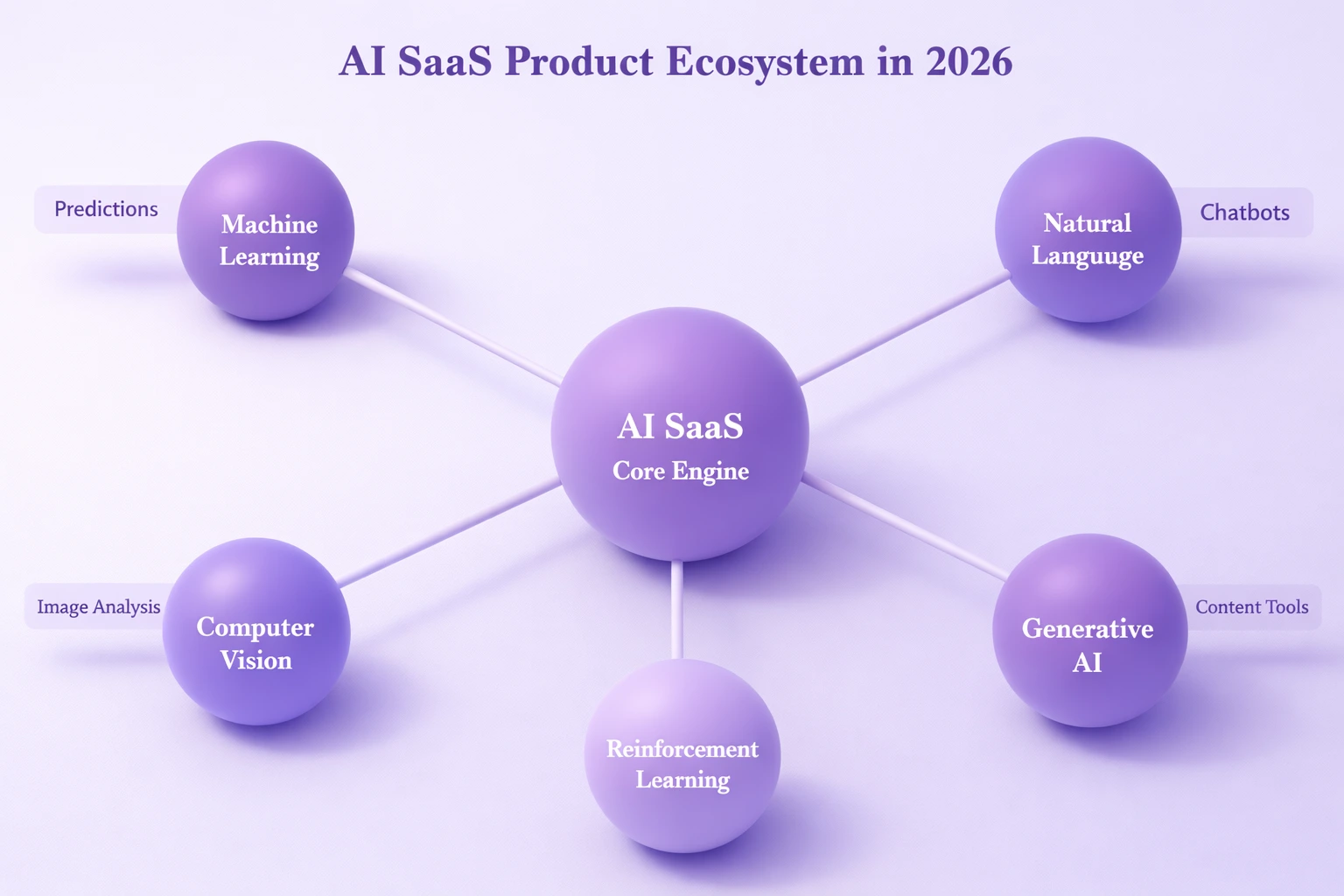
| Machine Learning | Moderate | Forecasting, recommendations |
| Deep Learning | High | Image recognition, speech processing |
| Natural Language Processing | High | Chatbots, sentiment analysis |
| Generative AI | Very High | Text, image, and code generation |
| Reinforcement Learning | Advanced | Real time optimization systems |
AI Platforms integrating APIs from providers like OpenAI or Anthropic fall into the generative AI classification. Tools like Grammarly combine NLP with proprietary fine tuning, which increases their defensibility. Technology depth directly influences valuation and the strength of your competitive moat.
3. Data Dependency and Learning Mechanism
AI without data is just software. This criterion evaluates how the product sources data and whether it improves over time. Continuous learning systems score highest because they become more valuable with every user interaction.
Data and Learning Classification Table
| Dimension | Option | Strategic Impact |
|---|---|---|
| Data Source | First party data | High personalization and defensibility |
| Third party data | Faster deployment but dependency risk | |
| Hybrid | Balanced scalability | |
| Learning Model | Pre trained only | Static intelligence |
| Fine tuned models | Improved domain accuracy | |
| Continuous learning | Adaptive and improving system |
A marketing AI that learns only from generic datasets stays static. A customer support AI trained on your company’s historical tickets and continuously retrained becomes increasingly valuable. This is why data strategy is inseparable from product classification for any modern AI Application.
4. Infrastructure and Deployment Architecture
Even powerful AI fails if infrastructure is weak. This classification focuses on scalability, latency, compliance, and reliability. Companies like Amazon and Netflix operate multi region distributed architectures to prevent downtime during peak demand. If an AI SaaS vendor cannot explain their scaling model, that is a serious classification downgrade.
Deployment Classification Table
| Architecture Type | Best For | Scalability |
|---|---|---|
| Multi Tenant Cloud SaaS | Startups, SMBs | High |
| Private Cloud | Enterprises with compliance needs | High |
| On Premise | Regulated industries | Limited but secure |
| Edge AI | Real time processing use cases | Ultra low latency |
5. Commercial Model and Market Position
Technical strength means little if pricing and positioning are weak. This criterion evaluates sustainability and financial alignment. Understanding monetization classification helps buyers forecast total cost of ownership and helps investors evaluate revenue scalability for any AI Platform.
Monetization Classification Table
| Pricing Model | Predictability | Risk |
|---|---|---|
| Seat Based | High | Scales linearly with team size |
| Usage Based | Variable | Costs spike during high demand |
| Outcome Based | Performance aligned | Harder to measure consistently |
| Freemium | Low barrier to entry | Upsell dependency |
Notion AI uses predictable per seat pricing. OpenAI primarily uses usage based token pricing. Matching your pricing model to your product classification ensures sustainable revenue growth.
The AI SaaS Product Classification Life Cycle
Classification is not a one time activity. It evolves alongside your product. Every successful AI Application follows a life cycle where its classification shifts as the product matures. Understanding this lifecycle helps founders anticipate strategic transitions and time their moves correctly.
As your product progresses through these stages, your classification across all five dimensions should be re evaluated. An AI Platform that was initially AI Assisted can mature into an AI Driven system within 18 to 24 months if the data flywheel is correctly designed from the start.
How to Apply These Criteria to Your Own AI Product
Applying these classification criteria requires honest self assessment. Start by mapping your product against each of the five dimensions. Rate yourself objectively. Then compare your classification against competitors in the same space. This exercise reveals gaps, highlights strengths, and sharpens your positioning strategy.
Practical Steps for Classification:
- Audit your AI Integration Level by asking: “Would our product function without AI?” If yes, you are Level 1 or Level 2.
- Document your technology stack including models, training pipelines, and third party dependencies.
- Map your data sources to understand whether you rely on first party, third party, or hybrid data.
- Evaluate your deployment architecture for scalability, latency, and compliance readiness.
- Align your pricing model with customer expectations and your product’s actual value delivery mechanism.
The best B2B SaaS AI startups revisit their classification quarterly. Markets shift, technologies evolve, and customer expectations change. A static classification in a dynamic market is a recipe for stagnation.
Ready to Build and Classify Your AI SaaS Product?
Get expert guidance on classifying, positioning, and scaling your AI Application for high growth in 2026 and beyond.
Final Thoughts
AI SaaS product classification criteria provide the structured framework necessary for objective, repeatable evaluation of AI powered software products. By assessing products across the five core dimensions of model sophistication, data architecture, scalability, integration capability, and business model quality, organizations can make informed procurement decisions, investors can conduct rigorous technical due diligence, and product teams can identify strategic positioning opportunities.
As the AI SaaS market continues to mature, the organizations that adopt systematic classification approaches will maintain a significant advantage in vendor selection, investment allocation, and competitive strategy. The framework presented in this guide is designed to be immediately actionable while remaining flexible enough to adapt as the technology landscape evolves.
For organizations seeking to deepen their understanding of AI stock market trends and future directions, the intersection of AI SaaS classification with investment analysis represents one of the most valuable analytical capabilities in the current market environment.
Frequently Asked Questions
Q1.How often should a startup reclassify its AI SaaS product?
Startups should review their product classification at least every quarter. As features mature, new data sources are integrated, and market conditions shift, the classification across all five dimensions can change significantly. A quarterly review ensures your positioning remains accurate and competitive.
Q2.Can a product fit into multiple classification categories at once?
Yes. Most AI Platforms operate across multiple levels. For example, one feature might be AI Assisted while another is fully AI Driven. The overall product classification typically reflects the highest level that defines the core value proposition.
Q3.Does classification impact fundraising and investor conversations?
Absolutely. Investors in 2026 use classification frameworks to evaluate defensibility, scalability, and market positioning. A clearly classified AI Application signals maturity and strategic thinking, which directly influences valuation and term sheet negotiations.
Q4.What is the biggest mistake founders make when classifying their AI product?
Overclaiming AI capabilities. Many founders classify their product as AI Driven when it is actually AI Assisted. This leads to misaligned customer expectations, higher churn rates, and a credibility gap that is difficult to recover from.
Q5.How does AI product classification affect hiring decisions?
Classification determines the talent you need. An AI Assisted product might only require frontend engineers with basic ML knowledge. An Autonomous AI Platform needs a dedicated data science team, ML engineers, and infrastructure specialists. Aligning your team to your classification prevents overspending on talent you do not yet need.
Q6.Is it possible to build a successful AI SaaS product using only third party AI APIs?
Yes, but it comes with classification trade offs. Products built entirely on third party APIs may score lower on defensibility since competitors can use the same providers. The key is to add proprietary fine tuning, unique data layers, or domain specific logic that creates differentiation.
Q7.How does regulatory compliance relate to AI SaaS classification?
Regulations like the EU AI Act categorize AI systems by risk level. Your product classification directly maps to regulatory categories. Products handling sensitive data, making autonomous decisions, or operating in healthcare or finance face stricter compliance requirements. Proper classification prepares you for these frameworks proactively.
Q8.What role does user experience play in AI product classification?
User experience determines how classification is perceived by customers. An AI Driven product with a confusing interface will feel AI Assisted to users. The classification must be reflected in the product experience itself, not just the marketing materials. Transparent AI behavior builds trust and reinforces your classification claims.
Q9.Should I classify my product differently for different market segments?
In some cases, yes. A product might be positioned as AI Driven for enterprise customers who use its full capabilities but AI Augmented for SMB customers who use only basic features. However, the core classification should remain consistent. Segment specific positioning is a messaging strategy, not a reclassification.
Q10.What metrics should I track to validate my AI product's classification?
Track metrics aligned with each classification dimension. For AI integration level, measure the percentage of decisions made by AI versus humans. For data dependency, track model accuracy improvements over time. For commercial alignment, monitor customer acquisition cost, lifetime value, and net revenue retention. These metrics validate whether your classification matches reality.
Explore Services
Related Services
Reviewed by

Aman Vaths
Founder of Nadcab Labs
Aman Vaths is the Founder & CTO of Nadcab Labs, a global digital engineering company delivering enterprise-grade solutions across AI, Web3, Blockchain, Big Data, Cloud, Cybersecurity, and Modern Application Development. With deep technical leadership and product innovation experience, Aman has positioned Nadcab Labs as one of the most advanced engineering companies driving the next era of intelligent, secure, and scalable software systems. Under his leadership, Nadcab Labs has built 2,000+ global projects across sectors including fintech, banking, healthcare, real estate, logistics, gaming, manufacturing, and next-generation DePIN networks. Aman’s strength lies in architecting high-performance systems, end-to-end platform engineering, and designing enterprise solutions that operate at global scale.