Ai Overview
Cryptocurrency projects seeking funding have multiple pathways to raise capital and distribute tokens to investors. 1% of all token sales, while IEOs represent 15. ICOs emerged as the first major cryptocurrency fundraising method, raising nearly $20 billion between late events and early declines. Research indicates that approximately 78% of ICOs during peak periods were classified as scams, eroding investor confidence in the model.
Cryptocurrency projects seeking funding have multiple pathways to raise capital and distribute tokens to investors. Initial Coin Offerings, Initial Exchange Offerings, and Initial DEX Offerings each present different approaches to blockchain fundraising. Among these options, choosing IDO of token launch has gained significant traction for projects seeking decentralized, efficient, and community-driven distribution methods.
The shift toward decentralized fundraising reflects broader industry trends. IDOs now account for approximately 66.1% of all token sales, while IEOs represent 15.5% of the market.[1] This dominance highlights how blockchain projects increasingly prefer decentralized exchanges over centralized alternatives for launching new tokens.
Key Takeaways
- Immediate Liquidity: IDOs provide instant token trading on decentralized exchanges immediately after launch without waiting for separate exchange listings.
- Lower Barriers: Projects face fewer requirements and lower costs compared to IEOs, making fundraising accessible for startups and smaller teams.
- Decentralized Access: Anyone with a compatible wallet can participate without geographic restrictions or mandatory account creation on centralized platforms.
- Smart Contract Security: Automated smart contracts handle token distribution and payments, ensuring transparent and verifiable transactions throughout the process.
- Community Governance: IDO platforms often incorporate community vetting and governance mechanisms that align project selection with investor interests.
- DeFi Integration: Tokens launched through IDOs immediately access DeFi ecosystems for yield farming, staking, and liquidity provision opportunities.
- Reduced Intermediaries: Decentralized launches eliminate third-party gatekeepers, reducing costs and preserving project autonomy over token distribution.
- Multi-Chain Options: Modern IDO platforms support launches across multiple blockchain networks, expanding reach to diverse investor communities.
Understanding Initial DEX Offerings
An Initial DEX Offering represents a fundraising method conducted directly on decentralized exchanges rather than through centralized platforms or project websites. The development of automated market maker protocols enabled this innovation by allowing anyone to create token trading pairs without exchange approval.
IDOs operate through smart contracts that automate token distribution, payment processing, and liquidity pool creation. When projects launch through platforms like Uniswap, PancakeSwap, or dedicated launchpads like Polkastarter, tokens become immediately tradeable once the offering concludes. This mechanism contrasts sharply with traditional ICOs where investors often waited months for exchange listings.
How IDO Mechanisms Work
The IDO process begins with projects creating liquidity pools where new tokens pair with established cryptocurrencies like ETH, BNB, or stablecoins. Investors swap base currencies for project tokens at predetermined rates during the sale period. Smart contracts manage the entire process without requiring trust in centralized intermediaries.
After the initial sale concludes, tokens remain in liquidity pools for continued trading. This immediate liquidity provision distinguishes IDOs from other fundraising methods where secondary market access depends on separate exchange listing processes that can take weeks or months to complete.
Comparing Token Launch Methods
Understanding differences between ICOs, IEOs, and IDOs helps projects select appropriate fundraising strategies. Each method offers distinct advantages and limitations that suit different project requirements and market conditions.
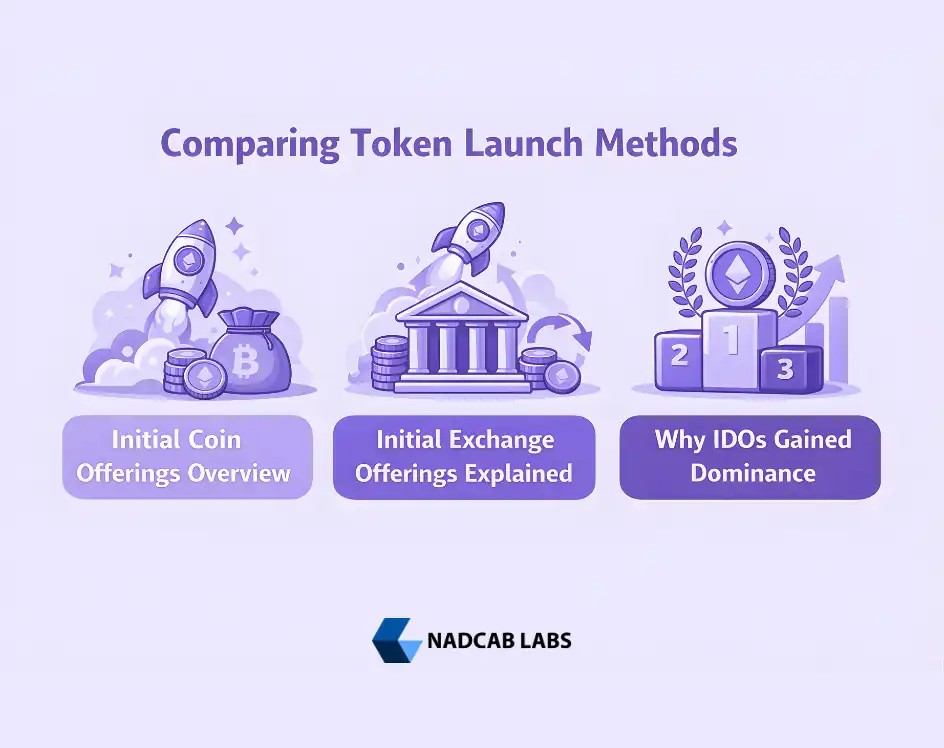
Initial Coin Offerings Overview
ICOs emerged as the first major cryptocurrency fundraising method, raising nearly $20 billion between late events and early declines. Projects conducted direct token sales through their websites, offering maximum control but requiring substantial marketing investments. The development of ICO standards established precedents that later fundraising methods built upon.
However, ICOs faced significant challenges including regulatory scrutiny, scam proliferation, and investor losses. Research indicates that approximately 78% of ICOs during peak periods were classified as scams, eroding investor confidence in the model. These issues prompted the development of alternative approaches with additional safeguards.
Initial Exchange Offerings Explained
IEOs addressed ICO shortcomings by moving token sales to established cryptocurrency exchanges. Exchanges vet projects, manage compliance, and provide marketing reach to existing user bases. This model raised over $1.5 billion across approximately 160 projects during peak adoption periods.
The IEO approach offers credibility through exchange endorsement and handles regulatory requirements like KYC verification. However, exchanges charge significant listing fees and may impose requirements that smaller projects cannot meet. Centralization also introduces dependencies that conflict with blockchain decentralization principles.
Why IDOs Gained Dominance
IDOs combine ICO accessibility with IEO efficiency while maintaining decentralization. Research comparing fundraising models found that IDOs provide fast liquidity in the short term, making them attractive for both projects and investors seeking immediate market access.
The development of sophisticated launchpad platforms enhanced IDO appeal further. These platforms provide project vetting, marketing support, and community building while preserving decentralized distribution mechanisms. The combination addresses earlier concerns about project quality without sacrificing core DeFi principles.
Advantages of Choosing IDO for Token Launch
Multiple factors make choosing IDO of token launch attractive for cryptocurrency projects. Understanding these advantages helps teams evaluate whether decentralized offerings align with their fundraising goals and community building strategies.
Immediate Liquidity Benefits
One primary advantage of IDOs is immediate token liquidity. Unlike ICOs where investors waited for exchange listings, IDO participants can trade tokens instantly after sales conclude. This immediacy benefits both projects seeking market establishment and investors wanting quick access to their purchases.
Liquidity pools created during IDOs continue functioning after initial sales, providing ongoing trading infrastructure. Projects avoid lengthy negotiations with exchanges and uncertain listing timelines. The development of automated liquidity mechanisms ensures tokens remain tradeable regardless of centralized exchange decisions.
Lower Barriers and Reduced Costs
IDOs typically require fewer resources than IEOs. Centralized exchanges charge substantial listing fees and impose requirements regarding team credentials, project maturity, and legal compliance. Decentralized platforms reduce or eliminate these barriers, making fundraising accessible for innovative projects with limited budgets.
Smaller teams benefit particularly from lower entry barriers. Projects can focus resources on product development rather than exchange negotiations and listing fees. This democratization enables innovation from diverse sources rather than only well-funded teams with exchange connections.
Decentralized and Permissionless Access
IDOs embrace blockchain decentralization principles by allowing permissionless participation. Anyone with cryptocurrency and compatible wallets can participate without account creation, identity verification, or geographic restrictions that centralized platforms impose.
This accessibility expands investor pools beyond exchange user bases. Global participation increases funding potential while community diversity strengthens project ecosystems. Decentralized access aligns with philosophical foundations of blockchain technology that prioritize openness and inclusion.
Smart Contract Transparency
Smart contracts governing IDOs operate transparently on public blockchains. Investors can verify contract code, distribution mechanisms, and transaction records independently. This transparency builds trust by eliminating hidden processes that centralized intermediaries might introduce.
Verifiable transactions create accountability throughout fundraising processes. Projects cannot manipulate sale data without detection, and investors can confirm their participation recorded correctly on-chain. Transparency reduces fraud risks that plagued earlier fundraising models.
Key Considerations for IDO Success
Successful IDO launches require careful planning across multiple dimensions. Projects must address tokenomics, platform selection, community building, and technical infrastructure to maximize chances of achieving fundraising goals.
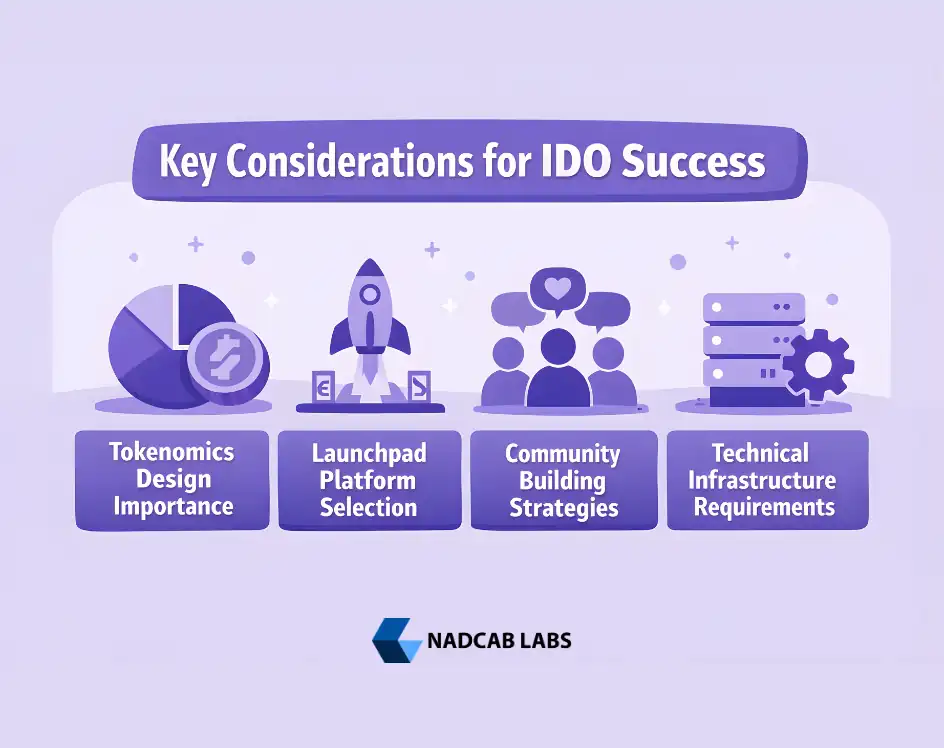
Tokenomics Design Importance
Token economics significantly impact IDO outcomes. Distribution percentages, vesting schedules, utility mechanisms, and supply controls all influence investor interest and long-term token performance. Poor tokenomics design can undermine otherwise promising projects.
The development of sustainable tokenomics requires balancing multiple stakeholder interests. Investors seek appreciation potential while projects need resources for continued development. Community members want utility and governance rights. Effective tokenomics align these interests while creating mechanisms for value accrual.
Launchpad Platform Selection
Choosing appropriate IDO launchpads affects project visibility, investor access, and overall success. Major platforms like Polkastarter have launched over 100 projects and raised more than $48.5 million in capital.[2] Platform reputation influences investor confidence and participation rates.
Different launchpads serve different blockchain ecosystems and project types. BSCPad focuses on BNB Chain projects while Polkastarter supports cross-chain launches. Selecting platforms aligned with project blockchain choices and target communities improves outreach effectiveness.
Community Building Strategies
Strong communities drive IDO success more than any other factor. Engaged supporters participate in sales, provide liquidity, promote projects organically, and contribute to ecosystem development. Building communities before IDOs establishes foundations for sustainable growth.
Social media presence, Discord server activity, and content marketing all contribute to community strength. Projects should engage potential supporters authentically rather than pursuing vanity metrics. Quality community members who understand and believe in projects create more value than large numbers of passive followers.
Technical Infrastructure Requirements
IDO technical requirements include smart contract development, security audits, and integration with chosen launchpad platforms. Vulnerabilities in contracts can lead to exploits that drain funds and destroy project credibility permanently.
Security audits conducted by reputable firms not only build investor confidence but also help uncover vulnerabilities before deployment. Implementing liquidity locking mechanisms is equally important, as they safeguard against rug pulls by limiting founders’ access to pooled funds. Additionally, partnering with experienced providers offering token development services ensures that the technical aspects of a project align with established industry standards.
DeFi Integration Opportunities
IDO tokens immediately access decentralized finance ecosystems, creating utility opportunities unavailable through centralized launches. DeFi integration enhances token value propositions while providing holders with additional earning mechanisms.
Liquidity Mining and Yield Farming
Projects can implement liquidity mining programs that reward users for providing trading liquidity. These programs incentivize token holding while deepening market liquidity. Yield farming opportunities attract DeFi participants who might otherwise overlook new projects.
Integration with stable swap protocols and other DeFi primitives expands token utility further. Composability with existing DeFi infrastructure creates network effects that benefit token value and adoption rates.
Governance and Staking Mechanisms
Many IDO tokens incorporate governance rights allowing holders to vote on protocol decisions. Staking mechanisms reward long-term holding while reducing circulating supply. These features create investor incentives aligned with project success.
Governance participation transforms investors into stakeholders with genuine influence over project direction. This alignment reduces conflicts between teams and communities while building loyalty that survives market volatility.
Launch Your Token Successfully
Work with experienced blockchain developers to build secure smart contracts, design effective tokenomics, and prepare comprehensive IDO launch strategies.
Risks and Challenges of IDO Launches
Despite advantages, IDOs present risks that projects and investors must consider. Understanding challenges enables better preparation and risk management throughout fundraising processes.
Smart Contract Vulnerabilities
Smart contracts can contain bugs or vulnerabilities that hackers exploit. DeFi history includes numerous incidents where contract flaws resulted in significant fund losses. Thorough auditing reduces but cannot eliminate these risks entirely.
Projects should engage multiple audit firms and implement bug bounty programs to identify issues. Investors should research audit histories and contract security before participating in IDOs.
Market Volatility Exposure
IDO tokens often experience significant price volatility after launch. Immediate liquidity enables rapid selling that can crash prices dramatically. Projects may see values decline substantially within hours of successful fundraises.
Vesting schedules and liquidity locks help manage volatility by preventing large immediate sells. However, market conditions ultimately determine price stability regardless of technical mechanisms.
Regulatory Compliance Considerations
Regulatory frameworks for token launches continue evolving globally. Projects must consider securities laws, anti-money laundering requirements, and jurisdiction-specific regulations. Advanced token standards like ERC-3643 enable compliant token issuance with built-in transfer restrictions and identity verification.
The global IDO token launchpad market is projected to grow from $65.2 million to $100 million between current periods and coming years at a 7.4% compound annual growth rate.[3] This growth will likely bring increased regulatory attention requiring projects to adapt compliance approaches.
Final Thoughts
Choosing IDO of token launch offers cryptocurrency projects advantages including immediate liquidity, lower barriers to entry, decentralized access, and deep DeFi integration. The development of sophisticated launchpad platforms has addressed earlier concerns about project quality while preserving core benefits of decentralized distribution.
Successful IDOs require careful attention to tokenomics design, platform selection, community building, and technical security. While risks exist around smart contract vulnerabilities and market volatility, proper preparation mitigates these challenges. For projects aligned with decentralization principles seeking efficient fundraising with community-driven distribution, IDOs represent compelling options in blockchain fundraising.
Frequently Asked Questions
Q1.What does IDO mean in crypto?
IDO stands for Initial DEX Offering, a fundraising method where cryptocurrency projects launch tokens directly on decentralized exchanges. Smart contracts automate distribution while providing immediate liquidity for trading.
Q2.How does IDO differ from ICO?
IDOs launch on decentralized exchanges with immediate liquidity, while ICOs sold tokens directly through project websites. IDOs offer faster trading access and eliminate dependency on separate exchange listings.
Q3.What platforms host IDO token launches?
Popular IDO platforms include Polkastarter, DAO Maker, Seedify, and BSCPad. Each serves different blockchain ecosystems and offers varying features including project vetting and community building support.
Q4.Are IDO investments risky for investors?
IDOs carry risks including smart contract vulnerabilities, price volatility, and potential scams. Investors should research projects thoroughly, verify security audits, and only invest amounts they can afford to lose.
Q5.How do projects prepare for IDOs?
Preparation includes developing tokenomics, building community presence, completing security audits, selecting launchpad platforms, and creating marketing strategies. Technical readiness and community engagement both impact success.
Q6.What makes IDO tokens immediately tradeable?
IDOs create liquidity pools pairing new tokens with established cryptocurrencies on decentralized exchanges. These pools enable immediate swapping without requiring separate exchange approval or listing processes.
Explore Services
Related Services
Reviewed by

Aman Vaths
Founder of Nadcab Labs
Aman Vaths is the Founder & CTO of Nadcab Labs, a global digital engineering company delivering enterprise-grade solutions across AI, Web3, Blockchain, Big Data, Cloud, Cybersecurity, and Modern Application Development. With deep technical leadership and product innovation experience, Aman has positioned Nadcab Labs as one of the most advanced engineering companies driving the next era of intelligent, secure, and scalable software systems. Under his leadership, Nadcab Labs has built 2,000+ global projects across sectors including fintech, banking, healthcare, real estate, logistics, gaming, manufacturing, and next-generation DePIN networks. Aman’s strength lies in architecting high-performance systems, end-to-end platform engineering, and designing enterprise solutions that operate at global scale.