Ai Overview
Leverage in DeFi means using borrowed funds to increase the size of a trade or investment. This helps users take larger positions in the market with a smaller initial investment. This allows traders to control a larger position than their original investment. Even a small initial investment can generate higher potential returns compared to trading without leverage.
Key Takeaways
- Leverage in DeFi allows users to trade or invest with borrowed funds, increasing market exposure beyond their own capital.
- DeFi leverage can be used through margin trading, lending-based borrowing, and leveraged yield farming, depending on user goals.
- Efficient capital usage helps traders diversify positions and maximize returns without locking all funds in one trade.
- Leverage also increases risk, including market volatility, liquidation, and interest or protocol fees.
- Proper risk management is essential, such as using low leverage, monitoring collateral ratios, and setting stop-loss limits.
- Secure DeFi protocols rely on smart contracts, automated liquidation systems, and transparent on-chain operations.
- User-friendly platforms make leveraged trading easier for both beginners and experienced traders.
- Nadcab Labs supports secure DeFi leverage by building reliable protocols with strong risk controls and integrations.
- Future leverage solutions will use AI-driven strategies and advanced analytics to improve safety and decision-making.
- Smarter integrations and stronger user protection will make DeFi leverage more accessible and secure over time.
Decentralized Finance, commonly known as DeFi, is changing how people manage money in the digital world. Instead of depending on banks or financial institutions, DeFi allows users to trade, lend, borrow, and invest directly through blockchain-based platforms. These platforms use smart contracts, making financial activities more transparent, secure, and accessible to everyone.
One important concept in DeFi is leverage. In simple terms, leverage in DeFi allows users to trade or invest using borrowed funds, helping them increase their market exposure without investing a large amount upfront. While leverage can increase potential returns, it also increases risk, which makes understanding it very important.
Leverage is useful for both beginners and experienced traders. Beginners can start with low leverage to understand how DeFi markets work, while traders can use it to apply advanced strategies and improve capital efficiency. Knowing how leverage in DeFi works helps users make smarter and safer financial decisions.
Nadcab Labs, a reliable DeFi protocol developer, builds secure and scalable DeFi solutions that support features like leverage with proper risk management. With a strong focus on security and transparency, Nadcab Labs helps create safer DeFi platforms for users worldwide.
What Is Leverage in DeFi?
Leverage in DeFi means using borrowed funds to increase the size of a trade or investment. Instead of using only your own money, DeFi platforms allow you to borrow extra assets by locking some of your crypto as collateral. This helps users take larger positions in the market with a smaller initial investment.
Leverage in DeFi works differently from traditional finance. In banks or centralized trading platforms, borrowing usually requires paperwork, approvals, and intermediaries. In DeFi, leverage is fully automated and managed by smart contracts. These smart contracts control borrowing, interest rates, and liquidations without the need for a central authority, making the process faster and more transparent.
Liquidity pools play an important role in leveraged trading in DeFi. These pools are funded by users who deposit their assets into DeFi protocols. The borrowed funds used for leverage come from these liquidity pools, and lenders earn interest in return. This system creates a fair and open environment where users can both lend and borrow assets safely.
By combining smart contracts and liquidity pools, DeFi leverage allows users to access advanced trading features while maintaining transparency and control over their assets. Understanding this foundation helps beginners and traders use leverage in DeFi more confidently and responsibly.
How Leverage in DeFi Works in Simple Steps
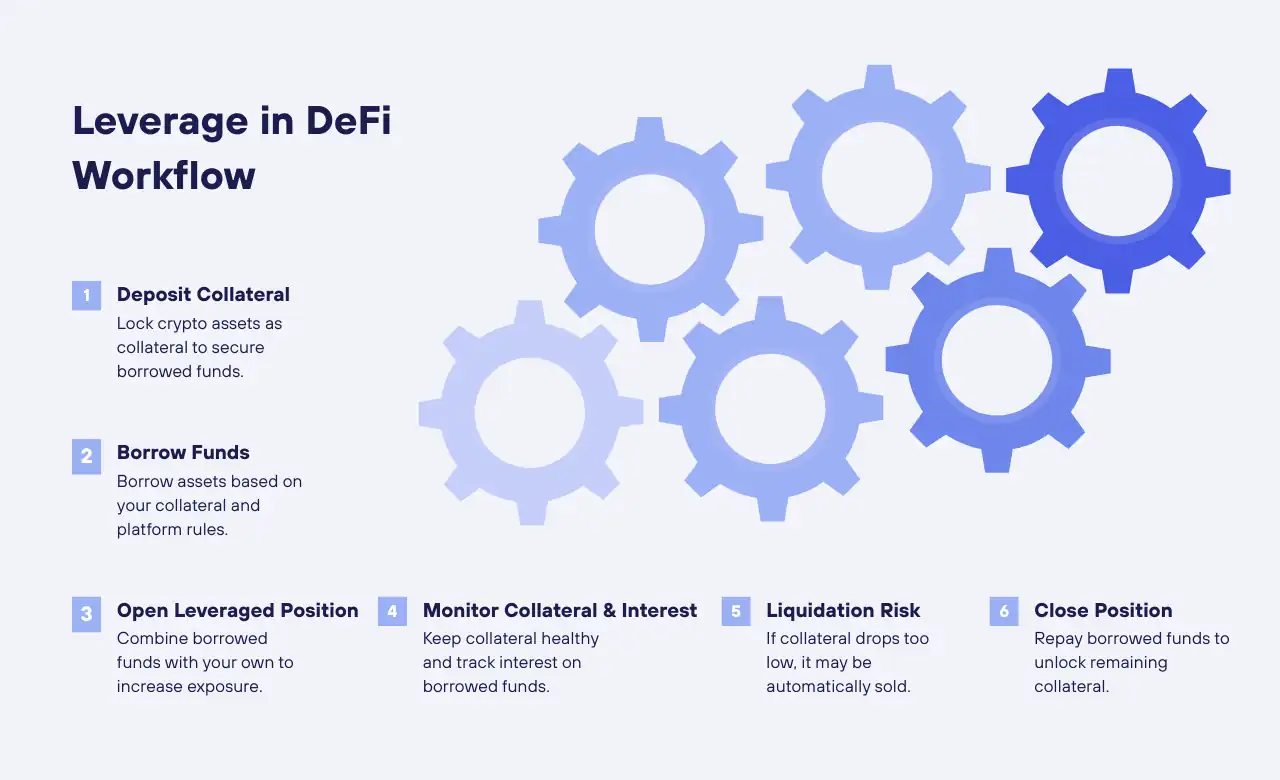
Understanding how leverage works in DeFi becomes easier when it is explained step by step. Most DeFi platforms follow a similar process to create leveraged positions.
Step 1- Deposit Collateral
The first step is depositing collateral. Users lock their crypto assets, such as ETH or stablecoins, into a DeFi protocol. This collateral acts as security for the borrowed funds and helps protect the platform from losses.
Step 2- Borrow Funds
After depositing collateral, users can borrow additional assets from the platform. The amount that can be borrowed depends on the collateral value and the platform’s risk rules. This borrowed amount is what creates leverage in DeFi.
Step 3- Open a Leveraged Position
Once the funds are borrowed, users open a leveraged position. The borrowed assets are combined with the user’s own funds to increase market exposure. This allows traders to control a larger position than their original investment.
Step 4- Monitor Interest and Collateral Ratio
Borrowed funds usually come with interest. At the same time, users must maintain a healthy collateral ratio. If the collateral value drops due to market movement, the position becomes riskier.
Step 5- Liquidation if Risk Limits Are Crossed
If the market moves against the position and the collateral value falls below the required level, the smart contract may trigger liquidation. This process automatically sells the collateral to repay the borrowed amount and protect the protocol.
Step 6- Close the Position
Users can close their leveraged position at any time by repaying the borrowed funds and interest. After repayment, the remaining collateral is returned to the user.
By following these steps, leverage in DeFi operates in a transparent and automated way using smart contracts. Knowing this process helps beginners and traders manage risk and use leverage more responsibly.
Types of Leverage in DeFi
There are different ways users can apply leverage in DeFi, depending on their goals and experience level. Each type of leverage works slightly differently but follows the same basic idea of increasing market exposure using borrowed funds.
1. Margin Trading in DeFi
Margin trading is one of the most common ways to use leverage in DeFi. In this method, users borrow funds from a DeFi platform to open a larger trading position than their available balance. The user deposits collateral, borrows assets, and trades based on price movements. If the market moves in their favor, profits increase, but if the market moves against them, losses also increase.
2. Lending and Borrowing Based Leverage
In lending and borrowing leverage, users deposit crypto assets into a DeFi protocol and use them as collateral to borrow additional funds. These borrowed assets can then be reinvested or traded. This method is often used by users who want to keep their assets while still gaining extra exposure to the market.
3. Leveraged Yield Farming
Leveraged yield farming allows users to increase their returns by using borrowed funds to provide liquidity to DeFi pools. Users earn rewards and interest from multiple sources, which can increase overall returns. However, this type of leverage also carries higher risk due to price changes and liquidation possibilities.
Each type of leverage in DeFi serves a different purpose and suits different risk levels. Beginners usually start with simple lending-based leverage, while experienced traders may prefer margin trading or leveraged yield farming. Understanding these options helps users choose the right strategy and manage risk more effectively.
Different DeFi protocols offer multiple leverage models depending on user goals and experience levels. Educational resources from CoinMarketCap[1]. Learn to explain margin trading, lending-based leverage, and leveraged yield farming as the most common approaches. Each method increases exposure but carries varying levels of complexity and risk.
Benefits of Using Leverage in DeFi
Leverage in DeFi offers several important benefits that can help both beginners and experienced traders make the most of their investments. Understanding these advantages helps users make smarter decisions in the DeFi ecosystem.
1. Increased Market Exposure
With leverage, users can control larger positions than their own capital allows. This means they can gain more exposure to price movements in the market. Even a small initial investment can generate higher potential returns compared to trading without leverage.
2. Better Capital Efficiency
Leverage allows users to use their capital more effectively. Instead of putting all their funds into one trade, they can open multiple positions or diversify across different assets. This way, users can maximize the potential of their investment without committing all their funds at once.
3. Access to Advanced Trading Strategies
Using leverage opens up opportunities for more advanced strategies. Traders can experiment with different trading techniques, such as short-selling, margin trading, or leveraged yield farming. These strategies can help users take advantage of market trends that would be difficult to access with only their own funds.
4. Flexibility for Beginners and Professional Traders
Leverage in DeFi can be adjusted to match the user’s experience level. Beginners can start with low leverage to learn and gain experience safely, while professional traders can apply higher leverage for more sophisticated strategies. This flexibility makes leverage suitable for a wide range of users.
By offering increased exposure, better capital efficiency, access to advanced strategies, and flexibility, leverage in DeFi becomes a powerful tool for investors. When used responsibly, it can help users achieve higher returns while exploring the full potential of the DeFi ecosystem.
Risks of Leverage in DeFi
While leverage in DeFi offers many benefits, it also comes with important risks. Understanding these risks helps beginners and traders use leverage safely and make informed decisions.
1. Market Volatility
Cryptocurrency prices can change very quickly. When using leverage, even small price movements can have a big impact on profits or losses. If the market moves against a leveraged position, losses can be larger than the original investment. This is why monitoring the market is crucial when using leverage in DeFi.
2. Liquidation Risk
Liquidation happens when the value of your collateral falls below the minimum required level. In DeFi, smart contracts automatically sell your collateral to repay the borrowed funds if this happens. This means you could lose part or all of your investment if the market moves unfavorably. Maintaining a healthy collateral ratio can help reduce this risk.
3. Interest and Protocol Fees
Borrowing funds in DeFi usually comes with interest or protocol fees. These costs increase over time and can reduce overall profits from leveraged positions. Traders need to consider these fees when planning their strategy to ensure that returns remain worthwhile.
By understanding market volatility, liquidation risk, and borrowing costs, users can make more responsible decisions when using leverage in DeFi. Awareness of these risks helps traders balance potential rewards with safety, ensuring a more secure and effective experience in the DeFi ecosystem.
Risk Management Tips for Beginners and Traders
Using leverage in DeFi can be rewarding, but it also comes with risks. Here are some practical tips to help beginners and traders manage these risks safely.
1. Start with Low Leverage
If you are new to leverage, start small. Using low leverage allows you to learn how DeFi markets work without risking large amounts of your funds. As you gain experience, you can gradually explore higher leverage strategies.
2. Monitor Collateral Ratios
Keep an eye on the value of your collateral and the ratio required by the platform. Maintaining a healthy collateral ratio helps prevent unexpected liquidations and keeps your positions safer.
3. Use Stop Loss and Alerts
Set stop-loss orders and price alerts to manage risk automatically. These tools can help you exit positions before losses become too large, giving you more control over leveraged trades.
4. Understand Protocol Rules Before Trading
Every DeFi protocol has its own rules, fees, and liquidation thresholds. Take the time to read and understand how the platform works before using leverage. Knowing the rules will help you make informed decisions and avoid mistakes.
By following these simple tips, beginners and professional traders can reduce risks while taking advantage of leverage in DeFi. Responsible risk management is key to enjoying the benefits of leveraged trading safely and effectively.
Role of DeFi Protocol Development in Leverage
Leverage in DeFi relies heavily on the underlying protocols and smart contracts. The quality of DeFi protocol development determines how safe, efficient, and reliable leveraged trading can be for users.
1. Importance of Secure Smart Contracts
Smart contracts are the backbone of leverage in DeFi. They manage borrowing, collateral, and liquidation automatically without a central authority. Secure smart contracts prevent hacks, errors, and loss of funds, giving users confidence to trade with leverage.
2. Risk Parameters and Liquidation Mechanisms
DeFi protocols define specific risk parameters, such as collateral requirements, borrowing limits, and liquidation thresholds. Well-designed protocols ensure that users’ positions are monitored continuously and that automatic liquidation protects both users and the platform from losses.
3. Transparency and Automation
DeFi protocols are fully transparent, and all transactions are recorded on the blockchain. Automation ensures that rules are applied consistently, reducing human error and providing trust in the system. Users can see exactly how their leverage positions are managed and what actions are taken if risks increase.
Strong protocol development is essential for safe and effective leverage in DeFi. By combining secure smart contracts, risk management, and automation, DeFi protocols allow users to trade confidently, knowing that their positions are monitored and protected.
How Nadcab Labs Supports Secure Leverage in DeFi
Leverage in DeFi can be powerful, but using it safely requires reliable platforms and strong security measures. Nadcab Labs, a trusted DeFi protocol developer, provides solutions that make leveraging easier and safer for users.
1. Secure and Transparent Smart Contracts
Nadcab Labs builds smart contracts that manage borrowing, collateral, and liquidation automatically. These contracts are designed to be secure and transparent, reducing the risk of errors and protecting user funds.
2. Robust Risk Management Tools
The platforms developed by Nadcab Labs include tools to monitor positions, collateral ratios, and borrowing limits. These features help users stay informed and make smarter decisions when using leverage.
3. Integration with Multiple DeFi Protocols
Nadcab Labs integrates its solutions with different DeFi protocols and liquidity pools. This gives users access to a variety of assets and trading opportunities while maintaining a secure environment for leveraged positions.
4. User-Friendly Interfaces
Even beginners can use leverage safely because Nadcab Labs focuses on creating clear and simple interfaces. Users can open and close positions, monitor risk, and track performance without confusion.
By combining security, transparency, and ease of use, Nadcab Labs ensures that users can explore leverage in DeFi confidently. Their solutions empower both beginners and experienced traders to take advantage of opportunities while keeping risks under control.
Future of Leverage in DeFi
The world of DeFi is evolving rapidly, and the way leverage is used is becoming more advanced. Emerging technologies and innovations are making leveraged trading safer, smarter, and more efficient for users.
1. AI-Driven Leverage Strategies
Artificial intelligence and machine learning are starting to play a big role in DeFi leverage. AI can analyze market trends, predict price movements, and optimize leveraged positions automatically. This helps traders make better decisions and manage risk more effectively.
2. Better Risk Analytics
Advanced risk assessment tools are being developed to give users deeper insights into their positions. By analyzing collateral, market volatility, and borrowing costs, these tools help users understand potential risks before opening leveraged trades.
3. Cross-Protocol Integrations
Future DeFi platforms will integrate with multiple protocols and liquidity pools, allowing users to access more assets and trading opportunities. Cross-protocol leverage enables higher flexibility and efficiency while maintaining safety and transparency.
4. Improved User Protection
User protection is becoming a top priority in DeFi. Enhanced monitoring, automatic alerts, and smarter liquidation systems are being implemented to minimize losses. These improvements make leveraging safer for both beginners and experienced traders.
With AI-driven strategies, advanced risk analytics, cross-protocol integrations, and stronger user protection, the future of leverage in DeFi is promising. Users can expect safer, smarter, and more flexible ways to maximize their investments while keeping risks under control.
Ready to Build a Secure DeFi Platform with Leverage?
Nadcab Labs helps businesses design, develop, and scale secure DeFi solutions with advanced leverage, smart contract automation, and built-in risk management.
How to Use Leverage in DeFi Safely
Leverage in DeFi is a powerful tool that allows both beginners and experienced traders to increase market exposure, maximize capital efficiency, and explore advanced trading strategies. However, it comes with risks like market volatility, liquidation, and borrowing costs. Understanding how leverage works, the types available, and practical risk management tips is essential for trading safely and confidently.
Strong DeFi protocols, secure smart contracts, and transparent automation make leveraging more reliable and efficient. Platforms developed by trusted providers like Nadcab Labs offer robust tools, user-friendly interfaces, and risk management features that help users make informed decisions and minimize potential losses.
As the DeFi space continues to evolve, innovations such as AI-driven strategies, advanced risk analytics, and cross-protocol integrations will make leverage even smarter and safer for all users.
FAQs: Leverage in DeFi
Q1.Can I lose money using leverage?
Yes, using leverage increases both potential profits and potential losses. If the market moves against your position, you can lose part or even all of your invested funds, and in some cases, losses can exceed your initial investment. Proper risk management is essential.
Q2.How does liquidation work?
Liquidation happens when the value of your collateral falls below the required level. In DeFi, smart contracts automatically sell a portion or all of your collateral to repay borrowed funds, protecting the protocol but potentially resulting in losses for the trader.
Q3.Are there limits on leverage?
Yes, each DeFi platform sets maximum leverage ratios based on asset type, market liquidity, and risk rules. Higher volatility assets usually have lower maximum leverage to reduce liquidation risks.
Q4.What fees are involved in leverage?
Leveraged trades in DeFi come with borrowing interest, protocol fees, and blockchain transaction (gas) costs. These costs can reduce overall profitability, so it’s important to account for them before opening a position.
Q5.Is it safer to use stablecoins for leverage?
Yes, stablecoins are less volatile than cryptocurrencies like ETH or BTC, reducing the risk of liquidation. They provide a more predictable collateral value, which makes leveraged positions safer, especially for beginners.
Q6.Can I use leverage across multiple platforms?
Yes, advanced traders can open positions across different DeFi protocols to increase exposure or diversify strategies. However, this requires careful monitoring of each platform’s rules, collateral ratios, and fees to avoid unexpected liquidations.
Q7.How is collateral chosen for leveraged trades?
Collateral is usually a cryptocurrency or stablecoin accepted by the DeFi platform. Its value, liquidity, and volatility determine how much you can borrow. Platforms often prefer assets that are widely used and less prone to extreme price swings.
Q8.Does leverage affect staking or yield farming rewards?
Yes, leveraged positions can change your effective exposure to assets in staking or yield farming. Borrowed funds can boost rewards, but they also increase risk, including the chance of liquidation, so careful planning is required.
Q9.Do all DeFi platforms offer the same leverage options?
No, leverage features vary. Some platforms allow only lending-based borrowing, while others support margin trading or leveraged yield farming. The choice depends on the platform’s design, liquidity pools, and risk management policies.
Q10.Are there tools to track leveraged positions in real-time?
Yes, many DeFi dashboards and protocol-specific apps provide real-time monitoring of leveraged positions, collateral ratios, and alerts. These tools help traders react quickly to market changes and reduce the risk of liquidation.
Explore Services
Related Services
Reviewed by

Aman Vaths
Founder of Nadcab Labs
Aman Vaths is the Founder & CTO of Nadcab Labs, a global digital engineering company delivering enterprise-grade solutions across AI, Web3, Blockchain, Big Data, Cloud, Cybersecurity, and Modern Application Development. With deep technical leadership and product innovation experience, Aman has positioned Nadcab Labs as one of the most advanced engineering companies driving the next era of intelligent, secure, and scalable software systems. Under his leadership, Nadcab Labs has built 2,000+ global projects across sectors including fintech, banking, healthcare, real estate, logistics, gaming, manufacturing, and next-generation DePIN networks. Aman’s strength lies in architecting high-performance systems, end-to-end platform engineering, and designing enterprise solutions that operate at global scale.