Ai Overview
They are a present-day operational reality for organizations deploying large language models, image generators, and automated content systems at scale. Cisco’s State of AI Security 2026 report confirms that generative AI is accelerating rapidly, often without proper testing, evaluation, or accountability mechanisms in place. These are among the most disruptive generative AI risks because they often manifest after launch, in live production environments, when the cost of failure is highest.
Key Takeaways
- 01. Generative AI risks include bias, data leakage, integration failures, hallucination, and security vulnerabilities that every enterprise must proactively manage before full deployment.
- 02. AI integration failures often stem from poor API design, incompatible data formats, and insufficient testing, causing production outages that damage business credibility and customer trust significantly.
- 03. Bias in generative AI systems originates from skewed training data and amplifies existing social inequalities, producing discriminatory outputs that can expose businesses to legal and reputational risk.
- 04. Data leakage in generative AI occurs when sensitive user inputs or training data surfaces through model outputs, creating severe compliance violations in regulated sectors across India and the UAE.
- 05. Generative AI security risks such as prompt injection and shadow AI expose enterprise data at scale, with employees inputting sensitive information into AI tools on average once every three days globally.
- 06. Detecting bias and errors in AI systems requires continuous auditing, red-team testing, and fairness benchmarks applied consistently across all model outputs before and after production deployment.
- 07. Preventing data leakage requires private model deployments, granular access controls, endpoint-level AI usage monitoring, and strict policies governing what data employees may input into AI tools.
- 08. Businesses in Dubai and India face unique regulatory pressures around AI data privacy, making structured generative AI risk management frameworks an operational and legal necessity, not just best practice.
- 09. Fair AI systems are built through diverse training datasets, inclusive design teams, transparent model documentation, regular bias testing, and clear escalation paths for flagging problematic AI outputs.
- 10. The future of secure generative AI lies in real-time monitoring systems, AI-specific governance frameworks, and industry-specific compliance standards that evolve alongside rapidly advancing model capabilities globally.
Introduction to Risks in Generative AI Systems
Generative AI risks are no longer a future concern. They are a present-day operational reality for organizations deploying large language models, image generators, and automated content systems at scale. Cisco’s State of AI Security 2026 report confirms that generative AI is accelerating rapidly, often without proper testing, evaluation, or accountability mechanisms in place. For businesses across India and the UAE, this represents both a competitive challenge and a governance imperative.
The three most pervasive generative AI risks we encounter in our consulting work are AI integration failures, model bias, and data leakage. Each of these risk categories operates differently, has distinct causes, and requires tailored mitigation strategies. Yet they are also interconnected. A poorly integrated AI system is more likely to leak data. A biased model is more likely to produce security-relevant errors. Understanding all three in depth is the foundation of any responsible AI deployment strategy.
With over eight years of hands-on experience helping organizations across India and the UAE build and deploy intelligent systems, we have seen first-hand how Generative AI transforms operations when implemented well, and how severely it can damage businesses when risks go unmanaged. The rapid acceleration of generative AI adoption in 2025 and 2026 has brought extraordinary capability to enterprises of every size, but it has also introduced a new and complex layer of generative AI risks that demand structured, expert-led attention. This guide provides a comprehensive, practitioner-level examination of those risks and the strategies your organization needs to address them.
What Are Integration Failures in AI?
AI integration failures occur when generative AI systems are embedded into existing business infrastructure and the connection between the AI model and surrounding systems breaks down in ways that produce errors, data corruption, or complete service outages. These are among the most disruptive generative AI risks because they often manifest after launch, in live production environments, when the cost of failure is highest.
In our experience working with enterprises in Mumbai, Bengaluru, and Dubai, integration failures are the most common early-stage risk. Organizations underestimate how much orchestration is required to connect a generative AI model to customer-facing systems, internal databases, and compliance workflows simultaneously. When this orchestration is rushed, the results are predictable and painful.
Causes of Integration Issues in AI Models
Understanding the root causes of AI system failures during integration is critical to preventing them. These causes are generally technical, organizational, or both, and they compound quickly when left unaddressed.
Understanding Bias in Generative AI
Bias in generative AI is one of the most consequential and least visible generative AI risks. Unlike a software bug that produces a clear error, AI bias produces outputs that appear confident, fluent, and authoritative, while being systematically skewed against specific groups, cultures, or perspectives. For businesses operating in diverse markets like India and the UAE, where audience demographics are richly varied, undetected bias can erode trust at scale.
Generative AI models are trained on massive corpora of internet text, images, and other media. Those corpora inevitably reflect the biases present in human-generated content: gender stereotypes, racial skew, cultural underrepresentation, and historical inequities baked into language patterns. The model learns these patterns as statistical truths and reproduces them in its outputs, often in subtle ways that evade basic review processes.
How Bias Affects AI Outputs
The effects of bias in AI outputs range from subtly unfair to actively harmful depending on the context of deployment. Here is how generative AI risks from bias manifest in real business scenarios.
In hiring tools powered by generative AI, bias has been shown to systematically rank candidates from certain demographics lower, not because of qualifications, but because the training data reflected historical hiring patterns. In content generation tools used by marketing teams in Dubai, outputs have defaulted to Western cultural references even when the target audience was predominantly South Asian or Arabic-speaking. These are not theoretical scenarios. They are live generative AI risks being experienced by real organizations today.
Unfair Results Generated by AI Systems
When generative AI systems produce unfair results, the downstream consequences are often far-reaching. Customers receive inappropriate recommendations. Automated content excludes or misrepresents entire communities. Credit scoring models built on biased generative AI outputs deny loans to qualified applicants from underserved demographics. Healthcare AI tools miss diagnostic signals in populations underrepresented in training data.
For businesses in India serving customers across diverse linguistic, cultural, and socioeconomic groups, and for organizations in the UAE navigating a workforce and customer base from over 200 nationalities, unfair AI outputs are not just an ethical problem. They are a business performance problem that directly affects conversion, retention, and compliance outcomes.
Sources of Bias in Training Data
Bias in generative AI does not arise from nowhere. It has identifiable origins in the data collection and preparation process. Understanding these sources is the first step in addressing them systematically.
Common Sources of Training Data Bias in Generative AI Models
| Bias Source | How It Enters the Model | Real-World Impact |
|---|---|---|
| Historical Data Bias | Datasets scraped from the web reflect decades of societal inequality and underrepresentation of minority groups. | AI outputs replicate stereotypes in hiring, lending, and content recommendation systems. |
| Sampling Bias | Training datasets over-represent certain geographies, languages, or demographics, typically Western and English-speaking. | Models underperform for users in India, the UAE, and other non-Western markets, producing culturally misaligned outputs. |
| Label Bias | Human annotators who label training data introduce their own cultural assumptions and subjective judgments into ground truth labels. | Models learn wrong associations between demographic characteristics and quality or correctness indicators. |
| Feedback Loop Bias | When users interact more with certain AI outputs, reinforcement learning amplifies those outputs further, creating self-reinforcing bias cycles. | Popular but biased content gets recommended more often, progressively narrowing the diversity of AI-generated outputs over time. |
| Exclusion Bias | Deliberate or inadvertent removal of content from marginalized communities during data cleaning reduces their representation. | AI systems fail to serve minority language speakers, lower-income demographics, and rural populations equitably. |
Is Your AI System Carrying Hidden Risks?
Our AI risk assessment team helps businesses in India and UAE identify bias, data leakage, and integration gaps before they reach production and cause damage.
What Is Data Leakage in Generative AI?
Data leakage in the context of generative AI refers to a situation where a model inadvertently reveals sensitive, private, or proprietary information through its outputs. This can occur in two distinct forms. First, the model may have memorized specific data points from its training corpus and reproduce them verbatim when prompted in particular ways. Second, users may input confidential information into an AI tool, which then incorporates that data into responses accessible to other users or stores it in ways the original user did not intend.
This is not a minor edge case. Cyberhaven’s 2026 AI Adoption and Risk Report found that employees input sensitive information into AI tools on average once every three days. That statistic alone illustrates how generative AI security risks from data leakage have moved from theoretical concern to operational emergency.[1]
For hospitals in India sharing patient data through AI diagnostic tools, for financial institutions in Dubai using generative AI to process client portfolios, and for legal firms in either market passing confidential case briefs through language models, the consequences of data leakage extend from regulatory fines to criminal liability. This category of generative AI risks demands the most urgent and structured response.
How Data Leakage Impacts Model Performance
Beyond the compliance and privacy implications, data leakage also degrades the performance integrity of generative AI models in measurable ways. When sensitive or incorrectly attributed data surfaces in model outputs, it contaminates the reliability of all responses, making it harder for users to trust any output from the system, even outputs that are factually sound.
In enterprise deployments, data leakage creates a chilling effect on adoption. Teams that discover their inputs are not private stop using the AI tools entirely, or they sanitize their inputs to the point where the AI receives insufficient context to generate useful outputs. Either outcome represents a failure of the AI investment and a direct cost to the organization in both productivity and ROI.
Security Risks from Data Leakage
The generative AI risks associated with data leakage extend well beyond accidental disclosure. Malicious actors are actively researching prompt injection techniques specifically designed to extract sensitive memorized information from deployed language models. A prompt injection attack manipulates the AI system into ignoring its safety guidelines and revealing confidential data embedded in its training corpus or accessible through its tool integrations.
Misconfigured model context protocol (MCP) servers represent an emerging attack surface in 2026. When AI agents connect to external tools through shared interfaces, a single misconfigured credential or access policy can expose data across organizational boundaries. MITRE ATLAS v5.5.0, released in March 2026, added explicit coverage of AI Agent Tool Poisoning, recognizing that generative AI risks at the infrastructure layer are now a primary enterprise concern.
For organizations in the UAE operating under the Dubai International Financial Centre data protection regulations, and for those in India complying with the Digital Personal Data Protection Act, the legal exposure from a data leakage event involving a generative AI system can be severe. Fines, mandatory breach notifications, and reputational damage combine into a risk profile that demands serious preventive investment.
Detecting Bias and Errors in AI Systems
Effective detection of bias and errors in generative AI systems requires a structured, multi-layered approach. No single method is sufficient on its own. Organizations that manage generative AI risks most effectively combine automated monitoring with structured human review on an ongoing basis.
Methods to Prevent Data Leakage
Preventing data leakage from generative AI systems requires a visibility-first philosophy. Before organizations can govern AI-related data flows, they must understand exactly what data is moving, where it is going, and through which tools. The most effective prevention strategies operate across three layers: governance, infrastructure, and user behaviour.
Data Leakage Prevention Methods for Generative AI Deployments
| Prevention Method | How It Works | Best Suited For |
|---|---|---|
| Private Model Deployment | Run the generative AI model on your own infrastructure or a private cloud instance so inputs and outputs never leave your controlled environment. | Healthcare, legal, and financial organizations with strict data residency requirements in India and the UAE. |
| Endpoint AI Monitoring | Deploy endpoint-level visibility tools that log which AI applications employees use, what data categories flow into them, and from which devices and accounts. | Enterprises with large distributed teams and bring-your-own-device policies across multiple office locations. |
| Data Classification and Masking | Classify all data by sensitivity level and apply automated masking or tokenization before it is passed to any generative AI system as part of the input pipeline. | Regulated industries where specific data fields such as personal identifiers, account numbers, and health records must never reach AI models. |
| AI Usage Policies and Training | Establish clear written policies governing what data types employees may and may not input into AI tools, and deliver mandatory training that makes these boundaries actionable. | All organizations deploying generative AI, regardless of size or sector, as a foundational governance measure. |
| Output Filtering and Inspection | Apply automated output inspection layers that scan AI-generated content for patterns matching sensitive data before it is delivered to the end user or stored in any system. | High-volume customer-facing AI systems where manual review of every output is not operationally feasible. |
Best Practices for Fair AI Building
Building generative AI systems that are genuinely fair requires intentional design decisions at every stage of the model lifecycle. Based on our eight-plus years of implementation experience, here are the practices that consistently produce more equitable and trustworthy AI systems for clients across India and the UAE.
Curate training datasets that deliberately include proportional representation across gender, ethnicity, language, geography, and socioeconomic context. Audit dataset composition before training begins.
The humans labeling training data should reflect the diversity of the user population the model will serve. Monocultural annotation teams consistently produce biased labels that distort model behaviour in ways that are difficult to reverse post-training.
Document every generative AI risks model with a model card that discloses training data sources, known limitations, performance across demographic subgroups, and intended use boundaries. This transparency reduces misuse and manages stakeholder expectations effectively.
Fairness is not a one-time checkpoint. Establish quarterly or bi-annual evaluation cycles where fairness metrics are retested against evolving user populations and updated content standards in your target market.
For any AI output that affects hiring, lending, healthcare, or legal outcomes, mandate human review before action. Generative AI systems should augment human judgment in these contexts, never replace it entirely without robust oversight mechanisms.
Establish cross-functional AI ethics committees that include legal, compliance, product, and community representatives. These boards provide oversight on high-impact generative AI risks deployments and serve as escalation paths when bias incidents are identified in production.
Challenges in Managing AI Risks
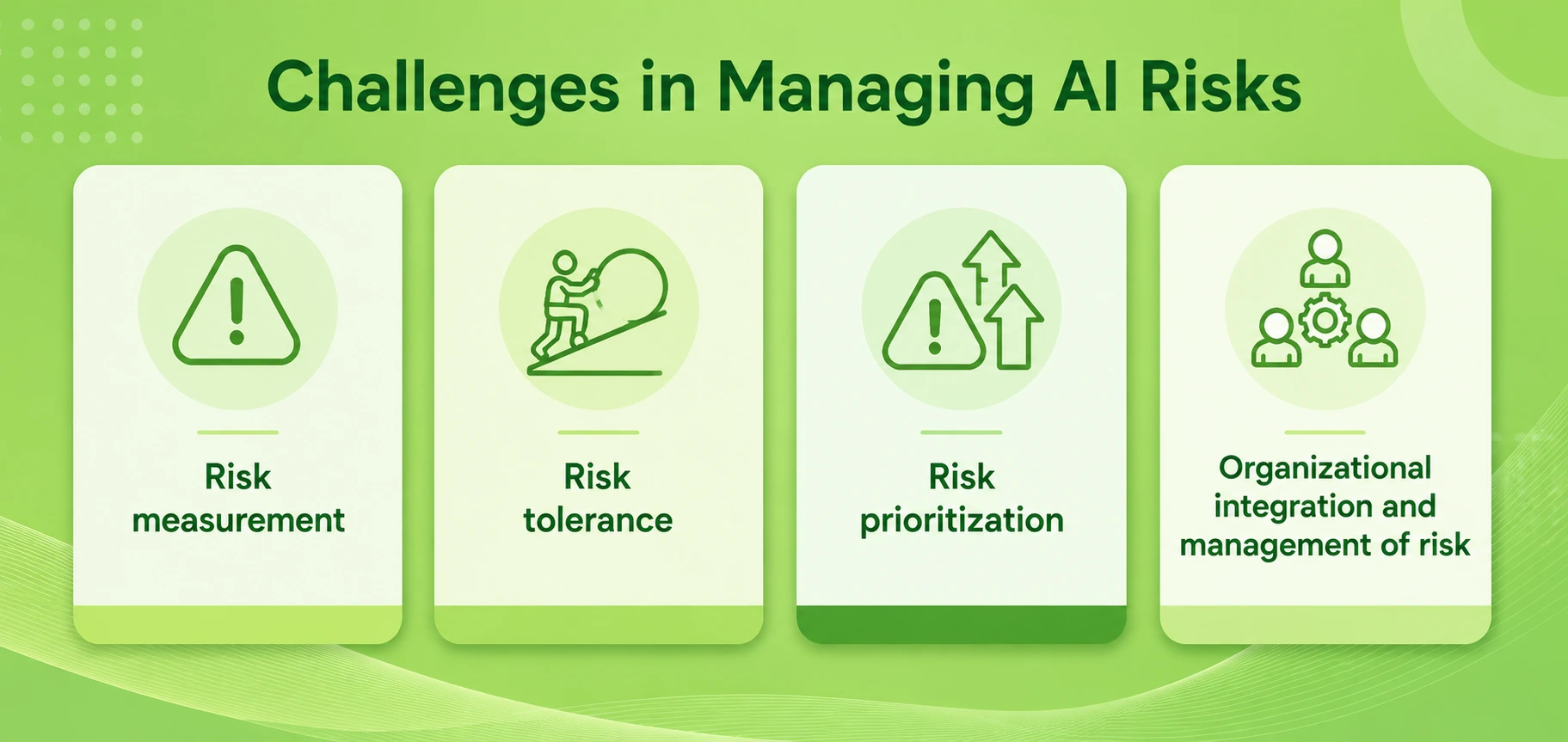
Managing generative AI risks in practice is significantly harder than defining them in theory. Organizations across India and the UAE face a combination of technical, organizational, and regulatory challenges that make even well-intentioned AI governance programs difficult to execute consistently.
Key Challenges in Generative AI Risk Management and How to Address Them
| Challenge | Why It Is Difficult | Practical Resolution |
|---|---|---|
| Rapidly Evolving Models | New model versions are released frequently, often introducing new generative AI security risks and behaviours that existing governance frameworks were not designed to address. | Adopt living risk registers that are updated with every major model version change and tied to a re-evaluation checkpoint before redeployment. |
| Shadow AI Proliferation | Employees use unsanctioned AI tools outside IT visibility, creating data exposure and integration risks that the organization has no ability to monitor or control. | Implement visibility-first endpoint monitoring and create a sanctioned AI tool catalog that gives employees better alternatives to shadow AI usage. |
| Absence of Internal AI Expertise | Many organizations lack the internal talent to audit generative AI models for bias, evaluate security architectures, or implement effective monitoring pipelines post-deployment. | Partner with specialized AI governance consultancies and invest in upskilling existing technical teams through structured AI security training programs. |
| Regulatory Uncertainty | AI regulation in both India and the UAE is still evolving, making it challenging to design governance frameworks that will remain compliant as rules are formalized over the next two to three years. | Build governance programs around international standards such as NIST AI RMF and ISO 42001, which provide durable foundations regardless of local regulatory changes. |
| Balancing Speed and Safety | Business pressure to ship AI features quickly conflicts with the thoroughness required to properly test for generative AI risks before production deployment. | Integrate risk checkpoints into agile delivery pipelines so safety reviews happen in parallel with feature work, not as a sequential bottleneck at the end. |
Future of Ethical and Secure AI Systems
The trajectory of generative AI risk management is moving toward standardization, automation, and regulatory formalization. Organizations that build their risk management capabilities now will be structurally ahead as these frameworks become mandatory requirements rather than voluntary best practices.
In April 2026, OWASP published a major update to its GenAI Security Project, expanding its solutions catalog to more than 170 providers and splitting coverage into separate tracks for LLMs, data security, and agentic applications. MITRE ATLAS v5.5.0 added dedicated coverage for AI Agent Tool Poisoning in March 2026. These updates reflect a rapidly maturing industry consensus on what responsible generative AI security looks like at the enterprise level.
For India, the Digital Personal Data Protection Act creates a strong legal foundation for governing how AI systems handle personal information. The UAE’s AI regulatory environment, anchored by the National AI Strategy 2031, is similarly moving toward enforceable standards for high-risk AI applications. Businesses that align their generative AI governance programs with these frameworks today will avoid the costly retrofitting that will be required of organizations that wait.
Looking further ahead, the future of secure generative AI involves real-time risk monitoring dashboards, AI-native compliance tools that evaluate outputs against regulatory requirements automatically, and domain-specific models trained under stronger data governance controls from the ground up. Multimodal AI agents introduce new integration complexity and new generative AI security risks that the industry is only beginning to map comprehensively.
As practitioners with over eight years in this space, our observation is consistent: the organizations that will thrive in the generative AI risks era are not necessarily those with the most advanced models. They are the ones with the most mature risk management cultures. Speed of adoption matters far less than quality of governance. Building that governance foundation now, with structured attention to bias, data leakage, integration security, and ethical design, is the most durable competitive advantage any organization can build in the current AI landscape.
Build Secure and Fair AI Systems Today
Our AI governance specialists across India and UAE help you identify and mitigate generative AI risks before they become business-critical problems.
People Also Ask
Q1.What are the main risks of using generative AI in business?
The main generative AI risks include data leakage, model bias, hallucination of facts, security vulnerabilities, and over-reliance on AI outputs. Businesses in India and the UAE must address these before scaling any generative AI risks system.
Q2.How does bias get into generative AI models?
Bias enters generative AI risks systems through skewed or unrepresentative training data. When historical data reflects social or cultural inequalities, the model learns and reproduces those patterns, producing unfair or discriminatory outputs without any human instruction to do so.
Q3.What is data leakage in generative AI and why does it matter?
Data leakage in generative AI risks occurs when sensitive information from training data or user inputs is exposed through model outputs. This creates serious privacy and compliance risks, especially for healthcare and financial organizations operating under strict regulations in the UAE and India.
Q4.Can generative AI systems fail during business integration?
Yes, AI integration failures are a well-documented risk. When generative AI risks tools are embedded into existing workflows without proper testing, API mismatches, data format conflicts, and performance bottlenecks can cause significant disruption to business operations.
Q5.How do generative AI security risks affect enterprises in 2026?
According to Cyberhaven’s 2026 AI Adoption and Risk Report, employees input sensitive data into AI tools on average once every three days, creating massive exposure. Enterprises face risks from prompt injection, shadow AI, and misconfigured model integrations across their entire tech stack.
Q6.Is it possible to detect bias in generative AI outputs?
Yes, bias in generative AI risks can be detected through regular audits, red-teaming exercises, fairness testing frameworks, and diverse human review panels. Detecting bias early in the pipeline prevents discriminatory outputs from reaching customers or influencing business decisions at scale.
Q7.What causes generative AI integration failures in production?
Integration failures typically result from poor API design, insufficient testing environments, incompatible data schemas, and lack of fallback mechanisms. Many organizations in both India and the UAE rush deployment without proper staging, which leads to generative AI risks system failures in live environments.
Q8.How can companies prevent data leakage from generative AI tools?
Companies can prevent data leakage by using private model deployments, enforcing strict data governance policies, limiting the scope of inputs that reach AI systems, and monitoring all generative AI risks tool usage at the endpoint level with dedicated data security platforms.
Q9.Are generative AI risks different for small businesses versus large enterprises?
Yes, the risk profile differs significantly. Large enterprises face complex generative AI risks across sprawling tech stacks and thousands of users. Smaller businesses are more vulnerable to over-reliance and lack of governance, since they often lack the internal expertise to audit AI outputs consistently.
Q10.What is the future of managing generative AI risks responsibly?
The future of responsible generative AI risk management involves industry-specific compliance frameworks, AI auditing standards, and continuous monitoring pipelines. Regulatory bodies in the UAE and India are actively shaping governance guidelines that will formalize how businesses must manage generative AI risks by 2027 and beyond.
Explore Services
Related Services
Reviewed by

Aman Vaths
Founder of Nadcab Labs
Aman Vaths is the Founder & CTO of Nadcab Labs, a global digital engineering company delivering enterprise-grade solutions across AI, Web3, Blockchain, Big Data, Cloud, Cybersecurity, and Modern Application Development. With deep technical leadership and product innovation experience, Aman has positioned Nadcab Labs as one of the most advanced engineering companies driving the next era of intelligent, secure, and scalable software systems. Under his leadership, Nadcab Labs has built 2,000+ global projects across sectors including fintech, banking, healthcare, real estate, logistics, gaming, manufacturing, and next-generation DePIN networks. Aman’s strength lies in architecting high-performance systems, end-to-end platform engineering, and designing enterprise solutions that operate at global scale.