

Key Takeaways
- The global crypto payment gateway market was valued at USD 1.5 billion in 2024 and is projected to reach USD 3.5 billion by 2030, growing at a CAGR of 15.6% from 2024 to 2030, driven by rising digital asset adoption and the growth of borderless commerce.[1]
- BitPay processed over 608,000 crypto transactions in 2024, with Litecoin leading at 201,165 payments, Bitcoin second at 130,250 payments, and Ethereum third at 56,356 payments, showing growing real-world crypto spending.[2]
- Crypto payment gateways typically charge around 1% in transaction fees, which is much lower than traditional credit card processing fees that often range from 2% to 3%, making crypto payments more cost-friendly for businesses.[3]
- Stablecoin transactions now represent about 76% of all crypto payment volume in 2025, led by USDT, USDC, and FDUSD, helping merchants avoid the price swings that come with holding volatile cryptocurrencies.[4]
- North America dominates the crypto payment gateway market with a 38% share in 2024, backed by strong regulatory frameworks, advanced technology infrastructure, and high cryptocurrency acceptance among both businesses and consumers.[5]
- Web-based payment gateways hold the largest market share at 63% in 2024, mainly because of their wide use in online shopping platforms and the ability to offer easy API integration and faster transaction verification for businesses.
Think about the last time you bought something online. You probably used a credit card, a debit card, or some kind of digital wallet. The whole process took a few seconds. But behind the scenes, there were banks, card networks, processors, and other parties working together to move your money from Point A to Point B. Now, picture doing the same thing, but instead of banks handling the money, blockchain technology does the job. That is what a crypto payment gateway makes possible.
A crypto payment gateway is a service that lets businesses accept payments in digital currencies like Bitcoin, Ethereum, Litecoin, and stablecoins such as USDT and USDC. It acts as a bridge between the buyer’s cryptocurrency wallet and the merchant’s payment system. Whether the merchant wants to keep the payment in crypto or convert it into regular money like US dollars or euros, the gateway handles the whole process. In this blog, we will break down every part of how crypto payment gateways work, from the moment a customer clicks “pay” to the moment the merchant sees the funds in their account.
What Is a Crypto Payment Gateway and Why Does It Matter
A crypto payment gateway is basically an online payment processing tool built for cryptocurrencies. Just like PayPal or Stripe processes your credit card transactions, a crypto payment gateway processes blockchain-based transactions. It reads the payment data from the buyer, verifies the transaction on the blockchain network, and then delivers the funds to the merchant.
The reason these gateways matter is simple. Cryptocurrency is no longer just an investment tool. People are actually spending their crypto. BitPay, one of the biggest crypto payment processors in the world, processed over 608,000 crypto transactions in 2024 alone. And the global crypto payment gateway market was valued at USD 1.5 billion in 2024 and is expected to grow to USD 3.5 billion by 2030. These numbers make one thing clear: crypto payments are not going away. They are growing, and businesses need a way to accept them.
The crypto payment gateway system removes the technical burden from the merchant. A business owner does not need to understand blockchain protocols, private keys, or consensus mechanisms. The gateway handles all of that behind the scenes. All the merchant needs is an account with a gateway provider and a simple integration into their website or app.
Step by Step: How Crypto Payment Gateways Work
Understanding how crypto payment gateways work requires looking at the whole process from start to finish. Let us walk through what happens when a customer decides to pay with cryptocurrency at an online store.
1. The Customer Chooses Crypto at Checkout
The process starts at the checkout page. The customer selects the product or service they want to buy, and instead of choosing a credit card or bank transfer, they select the cryptocurrency payment option. This could be Bitcoin, Ethereum, Litecoin, or any other supported token. The moment they click this option, the gateway springs into action.
2. The Gateway Creates a Unique Wallet Address
Once the customer selects crypto as their payment method, the gateway generates a unique wallet address or QR code for that specific transaction. This address is tied to the merchant’s account and ensures the payment goes to the right place. Each transaction gets its own unique address, so there is no confusion between payments.
3. The Customer Sends the Payment
The customer then opens their crypto wallet, scans the QR code or copies the wallet address, and sends the required amount of cryptocurrency. The payment is signed using the customer’s private key and broadcast to the blockchain network.
4. The Blockchain Network Verifies the Transaction
This is where the magic of blockchain comes in. The transaction is broadcast to the network, where nodes (computers running the blockchain software) verify that the customer actually has the funds and that the transaction is valid. Depending on the blockchain being used, this verification uses either Proof of Work (like Bitcoin) or Proof of Stake (like Ethereum) consensus mechanisms. Once enough confirmations are received, the transaction is permanently recorded on the blockchain.
5. The Gateway Confirms and Sets the Payment
After the blockchain confirms the transaction, the gateway notifies the merchant that the payment is complete. At this point, the merchant has two choices. They can keep the cryptocurrency in their wallet, or they can have the gateway automatically convert it into their local fiat currency and deposit it into their bank account. Most gateways offer this instant conversion feature to protect merchants from price swings in the crypto market.
6. The Merchant Receives Funds
Whether the merchant chooses to hold crypto or receive fiat, the funds are settled, and the transaction is done. The entire process, from the customer clicking “pay” to the merchant receiving confirmation, usually takes just a few minutes.
Recommended Reading:
The Impact of Blockchain Payments on Faster and Safer Transactions
The Technical Components Behind Crypto Payment Processing
From the outside, crypto payment processing looks simple. When a customer pays, the merchant gets money. But underneath, there are several technical parts working together to make every transaction smooth and trustworthy.
1. Application Programming Interfaces (APIs)
APIs are the communication channels between the merchant’s website or app and the payment gateway. When a customer starts a payment, the API sends a request to the gateway, which then generates the wallet address, tracks the incoming transaction, and sends a notification when the payment is confirmed. Without APIs, the merchant’s system would have no way to talk to the blockchain.
2. Blockchain Listeners
These are specialized tools that constantly monitor the blockchain network for incoming payments. As soon as a customer sends crypto, the blockchain listener detects the transaction and tracks it through the confirmation process. It watches for the required number of confirmations before marking the transaction as complete.
3. Smart Contract Logic
Some crypto payment gateway solution providers use smart contracts to automate certain parts of the process. Smart contracts are self-executing programs stored on the blockchain. They can handle fund routing, calculate fees automatically, or trigger instant fiat conversion if the merchant has enabled that option. This automation removes the need for manual intervention and reduces the chance of errors.
4. Wallet Management Systems
Gateway providers maintain both hot wallets (connected to the internet for quick transactions) and cold wallets (offline storage for added safety). Hot wallets handle the day-to-day transaction flow, while cold wallets store larger amounts that are not immediately needed. This two-layer wallet structure adds an extra layer of protection for merchant funds.
5. Currency Conversion Engines
For merchants who want to receive fiat instead of crypto, gateways use real-time conversion engines that calculate the exact fiat value at the moment of the transaction. This protects merchants from the price volatility that cryptocurrencies are known for. The conversion happens almost instantly, locking in the exchange rate at the time of payment.
Custodial vs Non Custodial Gateways: Which One Is Right
When you start looking at crypto payment gateways, you will notice there are two main types: custodial and non-custodial. Each one works differently and serves different kinds of businesses.
Custodial gateways temporarily hold the customer’s payment on behalf of the merchant before transferring it. Think of it like a bank holding your money in an account. The gateway manages the wallet, handles the conversion to fiat if needed, and takes care of the settlement. This makes things easier for the merchant because they do not have to worry about managing private keys or wallets themselves. Examples of custodial gateways include BitPay and Coinbase Commerce.
Non-custodial gateways, on the other hand, send payments directly to the merchant’s wallet without ever holding the funds. The merchant has full control over their private keys and their crypto assets. This approach is more in line with the original philosophy of cryptocurrency, which is about giving people control over their own money. However, it requires the merchant to have some technical knowledge about managing wallets. BTCPay Server is a well-known example of a non-custodial gateway.
The choice between custodial and non-custodial depends on what the business values more. If convenience and instant fiat conversion are the priority, custodial gateways are the better fit. If full control and privacy matter more, non-custodial gateways are the way to go.
Crypto Payment Gateway: Transaction Fee Comparison
| Gateway Provider | Transaction Fee | Key Features |
|---|---|---|
| BitPay | 1% per transaction | Supports 15+ cryptocurrencies, instant fiat conversion, and invoice creation |
| Coinbase Commerce | 1% per transaction | Easy Shopify integration, supports BTC, ETH, LTC, USDC, and more |
| CoinGate | 1% per transaction | Supports 70+ cryptocurrencies, payment buttons, and invoicing tools |
| NOWPayments | 0.5% per transaction | Supports 300+ cryptocurrencies, auto conversion, and WooCommerce plugin |
| CoinPayments | 0.5% per transaction | Supports 2,300+ coins, point of sale systems, multi-currency wallets |
| BTCPay Server | 0% (self-hosted) | Open source, non-custodial, full privacy, no third-party involvement |
| Traditional Credit Cards | 2% to 3.5% per transaction | Widely accepted but with higher fees, chargeback risk, and slower settlement |
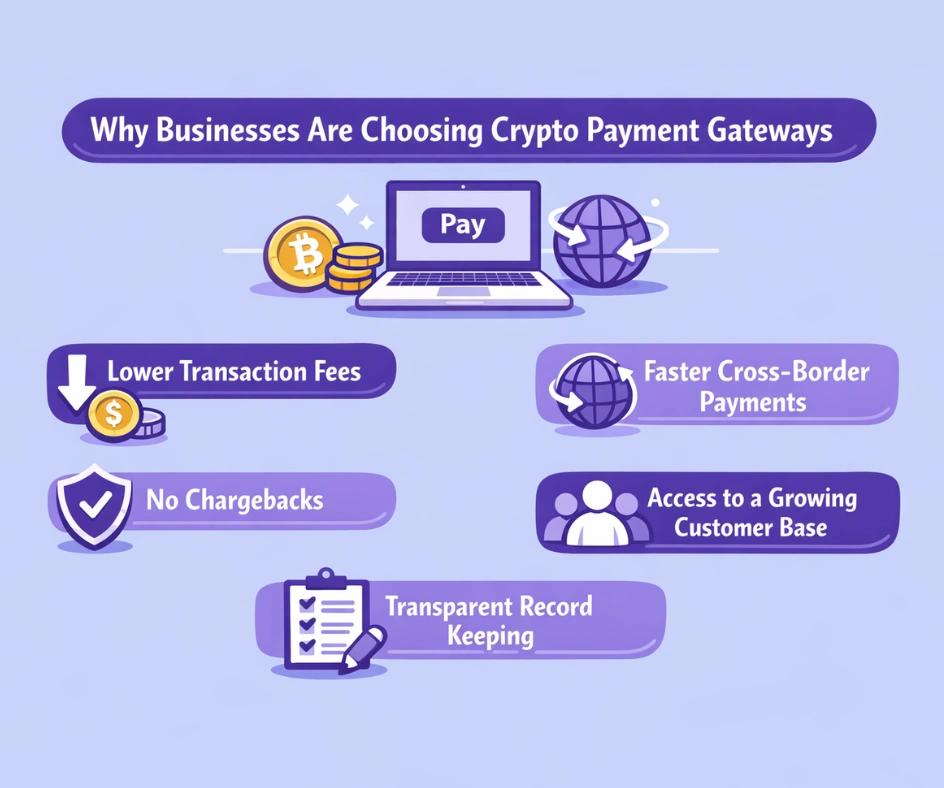
Why Businesses Are Choosing Crypto Payment Gateways
The move towards cryptocurrency payments is not just a trend. It is backed by real numbers and real advantages. Here is why more businesses are adopting crypto payment gateways.
1. Lower Transaction Fees
One of the biggest draws is the cost. Crypto payment gateways typically charge around 1% per transaction, sometimes even less. Compare that with traditional credit card processing fees, which often run between 2% to 3.5%. For a business processing millions of dollars in payments each month, that difference adds up fast. PayPal’s new Pay with Crypto service, launched in July 2025, claims to reduce cross-border transaction fees by up to 90% compared to international credit card processing.
2. No Chargebacks
Chargebacks are a major headache for online businesses. When a credit card customer disputes a charge, the merchant often loses the money and the product. With crypto payments, transactions are final once confirmed on the blockchain. There is no central authority that can reverse them. This eliminates chargeback fraud entirely.
3. Faster Cross-Border Payments
International bank transfers can take 3 to 5 business days and come with hefty fees. Crypto payments happen in minutes, regardless of where the sender and receiver are located. There are no intermediary banks, no currency conversion delays, and no SWIFT network bottlenecks.
4. Access to a Growing Customer Base
A Harris Poll study found that 39% of merchants surveyed already accept cryptocurrency at checkout, and 84% believe crypto payments will become common within five years. Among consumers, Millennials are the biggest users of crypto for payments at 77%, followed by Gen Z at 73%. Not accepting crypto means potentially losing these customers to competitors who do.
5. Transparent Record Keeping
Every crypto transaction is recorded on a public blockchain. This makes auditing and accounting much simpler. There is a permanent, tamper-proof record of every payment, making it easy to track money flow and prove transaction history.
Recommended Reading:
The Role of Stablecoins in Crypto Payment Processing
One of the biggest concerns businesses have about accepting crypto is price volatility. If a customer pays $100 worth of Bitcoin today, that amount could be worth $90 or $110 tomorrow. This unpredictability makes it hard for businesses to manage their finances.
This is where stablecoins come in. Stablecoins are cryptocurrencies that are pegged to real-world assets like the US dollar. USDT (Tether), USDC (USD Coin), and FDUSD are some of the most commonly used stablecoins. Because their value stays close to $1, they remove the volatility problem almost entirely.
The numbers back this up. Stablecoin transactions now represent about 76% of all crypto payment volume in 2025. This is a massive shift from just a few years ago, when Bitcoin dominated the payment landscape. CoinGate’s data shows that merchant settlements in stablecoins grew from 16.7% in 2024 to 25.2% in 2025, with USDC settlements jumping from 0.01% to 12.6% in just one year.
For businesses that want to accept crypto without worrying about market swings, stablecoins offer the best of both worlds. They get the speed and low fees of blockchain technology while keeping the price stability of traditional currencies.
How the Lightning Network Speeds Up Crypto Payments
One of the criticisms of Bitcoin as a payment method has always been speed. The Bitcoin blockchain can only process about 7 transactions per second, compared to Visa which handles around 24,000 transactions per second. For a payment system that needs to handle millions of daily transactions, that is a bottleneck.
The Lightning Network was created to solve this problem. It is a Layer 2 solution that sits on top of the Bitcoin blockchain. Instead of recording every single payment on the main blockchain, the Lightning Network creates direct payment channels between two parties. These channels allow them to make as many transactions as they want, almost instantly, without waiting for blockchain confirmations. Only the opening and closing of the channel are recorded on the main Bitcoin blockchain.
The results are impressive. Lightning Network transactions settle in milliseconds, not minutes. The fees are incredibly low, often just 1 satoshi per transaction. And the network can theoretically handle millions of transactions per second. About 52% of crypto payment providers now support the Lightning Network, making it an increasingly important part of the crypto payment gateway ecosystem.
For businesses that deal with high volumes of small payments, the Lightning Network makes Bitcoin a practical option. Coffee shops, gaming platforms, and content creators who need to process lots of microtransactions can now do so with Bitcoin without worrying about high fees or slow confirmation times.
Security Features That Protect Every Transaction
Crypto payment gateways do not just process payments. They also have to keep those payments safe. Here are the main layers of protection that modern gateways use.
Blockchain technology itself is the first line of defense. Every transaction is recorded on a distributed ledger that is spread across thousands of computers around the world. There is no single point of failure. To alter a transaction, an attacker would need to control more than half of the entire network, which is practically impossible for major blockchains like Bitcoin and Ethereum.
On top of blockchain’s built-in protections, most gateways add their own layers. Two Factor Authentication (2FA) requires users to verify their identity through a second device before any transaction goes through. Multi-signature wallets require multiple parties to approve a transaction before funds can move. This means that even if one key is compromised, the attacker still cannot access the funds without the other keys.
Advanced encryption protects data during transmission between the customer’s wallet and the merchant’s system. Many gateways also use AI-powered fraud detection systems that monitor transactions in real time and flag anything suspicious. BitPay, for example, invested $10 million in AI security systems in 2024, leading to a 15% drop in fraud-related cases.
About 35% of crypto payment providers now use biometric security features like fingerprint or face recognition, adding yet another barrier against unauthorized access.
Crypto Payment Gateway vs Traditional Payment Gateway
| Feature | Crypto Payment Gateway | Traditional Payment Gateway |
|---|---|---|
| Transaction Fees | 0.5% to 1% on average | 2% to 3.5% on average |
| Settlement Speed | Minutes (seconds with Lightning Network) | 1 to 3 business days |
| Chargeback Risk | None (transactions are irreversible) | High (chargebacks common) |
| Cross-Border Capability | Borderless with no currency conversion needed | Limited by banking networks and exchange rates |
| Intermediaries | None or minimal (decentralized verification) | Multiple (banks, card networks, processors) |
| Privacy Level | Higher (no personal bank details shared) | Lower (requires personal and bank information) |
| Transparency | Full (public blockchain ledger) | Partial (depends on bank and processor) |
Industries Leading the Adoption of Crypto Payments
Crypto payment gateways are not limited to one industry. Multiple sectors are now using them to accept digital currency payments and tap into new customer bases.
1. E-Commerce and Retail
Online shopping platforms are at the forefront of crypto payment adoption. About 43% of e-commerce platforms have integrated crypto payment options in 2025. Major platforms like Shopify and WooCommerce already offer plug-and-play integrations with crypto gateways, making it easy for online stores to start accepting crypto within hours.
2. Travel and Hospitality
The travel industry has embraced crypto payments because travelers often face high currency conversion fees. With crypto, a tourist from Japan can book a hotel in Brazil without worrying about exchange rates or bank fees. About 20% of BitPay’s customers spend their crypto on travel and lodging.
3. Gaming and Digital Goods
Gaming is one of the fastest-growing segments for crypto payments. Players buy in-game items, virtual currencies, and NFTs using crypto. The decentralized nature of crypto fits perfectly with the gaming world, where digital ownership and cross-platform trading are becoming the norm.
4. Freelancing and the Gig Economy
Freelancers who work with international clients often face delays and high fees with traditional bank transfers. Crypto payments solve both problems by enabling instant, low-cost transfers across borders. This is especially valuable for freelancers in developing countries where access to international banking is limited.
5. Luxury Goods and Precious Metals
High-value transactions have seen a sharp rise in crypto payments. BitPay’s data showed that spending on luxury goods, jewelry, gold, and precious metals grew by 39% to 205% in the first quarter of 2024 compared to the previous year, driven by rising crypto prices.
Recommended Reading:
Challenges Businesses Face With Crypto Payment Gateways
While the benefits are real, crypto payment gateways are not without their difficulties. Businesses need to understand these challenges before jumping in.
Price volatility remains a concern, even with stablecoins becoming more popular. Not every customer will pay with stablecoins, and Bitcoin or Ethereum prices can change significantly within hours. Gateways that offer instant fiat conversion help, but that service often comes with additional fees.
Regulatory uncertainty is another big issue. Different countries have different rules about cryptocurrencies. In some places, accepting crypto payments is straightforward. In others, businesses need special licenses or have to follow strict reporting requirements. The regulatory landscape is still evolving, and businesses need to stay updated on the rules in their region.
Technical complexity is also a factor. While gateways try to make the process as simple as possible, integrating a crypto payment system into an existing website or point of sale system still requires some technical knowledge. For businesses without an in-house tech team, this can be a barrier.
Customer education is another challenge. Many consumers are still not familiar with how to use crypto wallets or how to send payments on a blockchain. Until crypto becomes as easy to use as swiping a credit card, there will always be some friction at the checkout page.
The Future of Crypto Payment Gateways
The crypto payment gateway market is on a clear upward path. With the market expected to grow from $1.5 billion in 2024 to $3.5 billion by 2030, the trajectory is strong. But what specific changes can we expect?
Layer 2 solutions like the Lightning Network will become standard. As more gateways integrate Layer 2 support, transaction speeds will get faster and fees will drop even further. CoinGate’s data already shows that Layer 2 networks like Polygon grew by 19% and Arbitrum by 21% in 2025, with most of that growth driven by stablecoin payments.
AI-powered fraud detection will become the norm. More gateways will use machine learning to analyze transaction patterns and catch suspicious activity before it becomes a problem. This will make crypto payments even more trustworthy for both merchants and customers.
Central Bank Digital Currencies (CBDCs) will add a new dimension. As governments around the world develop their own digital currencies, crypto payment gateways will need to support these new assets alongside traditional cryptocurrencies. This could bring a whole new wave of users into the crypto payment space.
Multi-chain support will expand. Right now, most gateways support a handful of blockchains. In the future, expect gateways to support dozens of chains, allowing customers to pay from whichever blockchain they prefer without the merchant having to worry about compatibility.
Blockchain Payment Infrastructure in the Real World
The following projects show how blockchain payment and financial infrastructure is already being applied across crypto banking, cross-chain exchanges, and enterprise-level payment systems. Each implementation uses the same underlying principles discussed throughout this article, from wallet management and transaction verification to multi-currency support and blockchain-based settlement.
💳
Tarality: Crypto Banking and Payment Platform
Built a comprehensive crypto financial platform that merges traditional banking services with blockchain payment capabilities. The platform supports cryptocurrency buying, trading, crypto-backed lending, Buy Now Pay Later features, and fixed deposits, all with multi-signature wallets, fraud detection, and real-time transaction monitoring for high-volume payment processing.
🔄
Rubic: Cross-Chain Decentralized Exchange
Created a decentralized exchange platform aggregating over 200 DEXs and supporting cross-chain swaps across 80+ blockchain networks, including non-EVM chains. The platform enables one-click token swaps with best rate aggregation, Private RPC protection, and MEV bot protection, demonstrating multi-chain payment routing at scale.
Build Your Custom Crypto Payment Gateway:
We bring 8+ years of blockchain development expertise to crypto payment gateway solutions. Our specialized team handles everything from wallet integration and smart contract logic to multi-chain support and instant fiat conversion, ensuring your payment system is built for speed, safety, and business growth. Whether you need a custodial gateway for e-commerce or a non-custodial solution for enterprise-level payments, we deliver systems that perform.
Conclusion
Crypto payment gateways have moved far beyond the experimental stage. They are now a legitimate, growing part of the global payment infrastructure. With the market valued at $1.5 billion in 2024 and expected to more than double by the end of the decade, the direction is clear. Businesses that adopt crypto payments today are positioning themselves to serve a customer base that is increasingly comfortable spending digital assets.
The way these gateways work is actually straightforward once you break it down. A customer selects crypto at checkout, the gateway generates a wallet address, the customer sends the payment, the blockchain verifies it, and the merchant gets their money. Whether they want fiat or crypto, the gateway handles the conversion and settlement. Behind the scenes, APIs, blockchain listeners, smart contracts, and conversion engines work together to make the whole thing happen in minutes.
The rise of stablecoins has removed the volatility problem. The Lightning Network has solved the speed problem. And evolving regulatory frameworks are bringing more clarity to the space. With major players like PayPal now entering the crypto payment arena with support for over 100 cryptocurrencies and 90% lower cross-border fees, the barrier to entry is shrinking for businesses of all sizes.
Whether you are an online retailer, a SaaS company, a freelancer marketplace, or a luxury brand, crypto payment gateways offer a way to reduce costs, reach more customers, and process payments faster than traditional methods. The technology is here, the market is growing, and the tools to get started are more accessible than they have ever been.
Frequently Asked Question
A crypto payment gateway is an online service that lets businesses accept cryptocurrency payments from customers. It works like a bridge between the buyer’s crypto wallet and the merchant’s payment system, handling everything from generating wallet addresses to verifying transactions on the blockchain and settling funds.
Most crypto payments are confirmed within a few minutes, depending on the blockchain being used and the network traffic at that time. Bitcoin transactions typically take 10 to 30 minutes for full confirmation, while Ethereum transactions are faster. Lightning Network payments settle in milliseconds.
Yes. Most crypto payment gateways offer an automatic conversion feature that turns the received cryptocurrency into the merchant’s preferred fiat currency at the moment of the transaction. This locks in the exchange rate and protects the merchant from price changes.
Crypto payment gateways use multiple layers of protection. Blockchain technology itself provides a tamper-proof record of every transaction. On top of that, gateways add encryption, two-factor authentication, multi-signature wallets, and AI-powered fraud detection to keep funds and data safe.
Custodial gateways temporarily hold the customer’s payment before transferring it to the merchant, offering convenience and instant fiat conversion. Non-custodial gateways send payments directly to the merchant’s wallet without ever touching the funds, giving the merchant full control over their private keys.
The range varies by provider. Major gateways like BitPay support 15+ cryptocurrencies, including Bitcoin, Ethereum, and Litecoin. Some providers like NOWPayments support over 300 cryptocurrencies. Most gateways also support popular stablecoins like USDT and USDC.
Reviewed & Edited By

Aman Vaths
Founder of Nadcab Labs
Aman Vaths is the Founder & CTO of Nadcab Labs, a global digital engineering company delivering enterprise-grade solutions across AI, Web3, Blockchain, Big Data, Cloud, Cybersecurity, and Modern Application Development. With deep technical leadership and product innovation experience, Aman has positioned Nadcab Labs as one of the most advanced engineering companies driving the next era of intelligent, secure, and scalable software systems. Under his leadership, Nadcab Labs has built 2,000+ global projects across sectors including fintech, banking, healthcare, real estate, logistics, gaming, manufacturing, and next-generation DePIN networks. Aman’s strength lies in architecting high-performance systems, end-to-end platform engineering, and designing enterprise solutions that operate at global scale.