Ai Overview
A staking contract is a smart contract deployed on a blockchain that allows users to lock up their tokens for a set period. After the Pectra upgrade, the maximum balance per validator was raised to 2,048 ETH, which means large operators can now consolidate hundreds of smaller validators into fewer, more efficient ones. Compare that with Proof of Stake networks: after The Merge, Ethereum went from consuming about 84,000 Wh per transaction under PoW to under 35 Wh per transaction under PoS.
Key Takeaways
- Over 37 million ETH is now staked on the Ethereum network, which makes up about 30 percent of the total supply, showing how widely adopted proof of stake staking contracts have become since The Merge.
[1] - The Ethereum Pectra upgrade raised the maximum validator stake from 32 ETH to 2,048 ETH per validator, letting large operators consolidate hundreds of validators into fewer nodes and reducing network overhead.
[2] - Proof of Stake networks consume over 99 percent less energy than Proof of Work systems, with the Ethereum Foundation confirming a 99.95 percent drop in energy use after switching from mining to staking.
[3] - Liquid staking protocols now manage over 50 billion dollars in assets, with Lido alone holding a 27.7 percent market share by managing 9.41 million ETH through its staking smart contracts.
[4] - Slashing is a penalty built into staking contracts that punishes validators for dishonest behavior, and on Ethereum, a validator can lose up to their full 32 ETH stake for violations like double-signing blocks.
[5] - Financial losses from smart contract exploits crossed 3.5 billion dollars in 2024, which is why security audits and formal verification are critical steps before deploying any staking contract.
[6] - Cardano has about 71 percent of its entire supply staked, while Solana holds around 69 percent, proving that staking contracts are now the backbone of how major blockchain networks keep themselves running.
[7]
Blockchain networks need a way to agree on which transactions are real and which ones are not. In the early days, Bitcoin solved this problem through mining, where computers race to solve complex math puzzles. But mining uses a lot of electricity and requires expensive hardware. Staking contracts offer a different path. Instead of using computing power, they let users lock up their cryptocurrency as a promise that they will act honestly while helping to verify transactions, supporting a wide range of DeFi solutions in the process. This idea sits at the heart of Proof of Stake blockchains, and it has changed how entire networks operate, grow, and protect themselves.
If you have ever wondered how staking contracts work, why they matter, or how they help blockchains stay strong, this guide will walk you through everything step by step. We will look at how staking smart contracts are built, how they distribute rewards, what risks they carry, and where the whole system is heading next.
What Are Staking Contracts and Why Do They Exist?
A staking contract is a smart contract deployed on a blockchain that allows users to lock up their tokens for a set period. When tokens are locked inside the contract, they become part of the network’s validation process. The contract handles everything automatically: it tracks how much each user has staked, calculates rewards based on predefined rules, distributes those rewards at regular intervals, and manages the withdrawal process when users want their tokens back.
Think of it like a fixed deposit in a bank, but without the bank. The smart contract acts as the middleman, except it runs on code that cannot be changed once deployed. No single person or company controls it. The rules are written into the code, and anyone can check them on the blockchain.
1. The Shift from Mining to Staking
Before staking contracts became common, most blockchains relied on Proof of Work (PoW). Miners would use powerful computers to solve mathematical puzzles, and the first one to solve it would get to add the next block of transactions to the chain. This system works, but it comes with serious downsides. Bitcoin mining alone consumes about 169.7 TWh of electricity every year, which is more than what the entire country of Poland uses.
Proof of Stake (PoS) was created as an alternative. Instead of competing with computing power, validators are chosen based on how many tokens they have staked. The more you stake, the higher your chances of being selected to validate a block. This approach uses a tiny fraction of the energy that mining requires. When Ethereum switched from PoW to PoS in September 2022 through an event called “The Merge,” its energy consumption dropped by about 99.95 percent.
2. How Staking Contracts Fit Into the Picture
Staking contracts are the tools that make Proof of Stake possible on a practical level. Without them, there would be no automated way to manage who is staking, how much they have staked, when rewards should be paid out, or what happens when someone breaks the rules. The contract handles all of this through code that runs on the blockchain itself. Every action is recorded, every calculation is transparent, and every rule applies equally to everyone.
Recommended Reading:
How Staking Contracts Work: A Step-by-Step Breakdown
Understanding how staking contracts work requires looking at the full process from start to finish. It is not just about locking tokens. There are multiple stages involved, and each one plays an important role in keeping the network honest and running smoothly.
1. Token Locking and Registration
The process begins when a user sends their tokens to the staking smart contract. Once the tokens arrive, the contract records the deposit: how many tokens were sent, who sent them, and when the deposit was made. On Ethereum, for example, a user needs to deposit at least 32 ETH to become a validator. After the Pectra upgrade, the maximum balance per validator was raised to 2,048 ETH, which means large operators can now consolidate hundreds of smaller validators into fewer, more efficient ones.
The registration step also involves providing public keys and other technical information so the network can identify and communicate with the validator. On the Flow blockchain, for instance, node operators must provide their staking key, proof of possession, networking address, and networking key before they can register with the staking contract.
2. Validator Selection and Block Validation
Once tokens are locked, the staking contract makes the user eligible for validator duties. The network’s protocol then selects validators to propose and verify new blocks. Different blockchains use different methods for this selection. Some pick validators randomly, weighted by the size of their stake. Others use more specific criteria. In all cases, the more tokens a validator has staked, the higher their probability of being chosen.
When a validator is selected, they check the transactions in the proposed block to make sure everything is valid. If the block passes all checks, it gets added to the chain. The validator then receives a reward for their work. This entire process happens automatically through the staking contract and the network protocol working together.
3. Reward Calculation and Distribution
Staking rewards are calculated based on several factors: the amount of tokens staked, how long they have been staked, the overall performance of the network, and sometimes the validator’s own performance. The staking contract uses these inputs to compute rewards and distribute them at regular intervals. Some platforms pay rewards daily, others weekly or at the end of each epoch.
On Ethereum, typical staking yields range between 3 and 5 percent annually. On other networks, the numbers can be different. The average staking reward across major platforms sits around 6.8 percent, with some smaller altcoins offering over 12 percent.
4. Unstaking and Withdrawal
When a user wants to get their tokens back, they submit an unstaking request through the contract. Most staking contracts have a cooldown or unbonding period during which the tokens cannot be moved. On Ethereum, this process takes a few days. On Polkadot, it takes 28 days. During this time, the user does not earn rewards, and they cannot sell or transfer their tokens.
Once the unbonding period ends, the user can withdraw their tokens plus any unclaimed rewards. The staking contract handles this entire process without any manual involvement from the network operators.
Types of Staking Contracts in Blockchain Networks
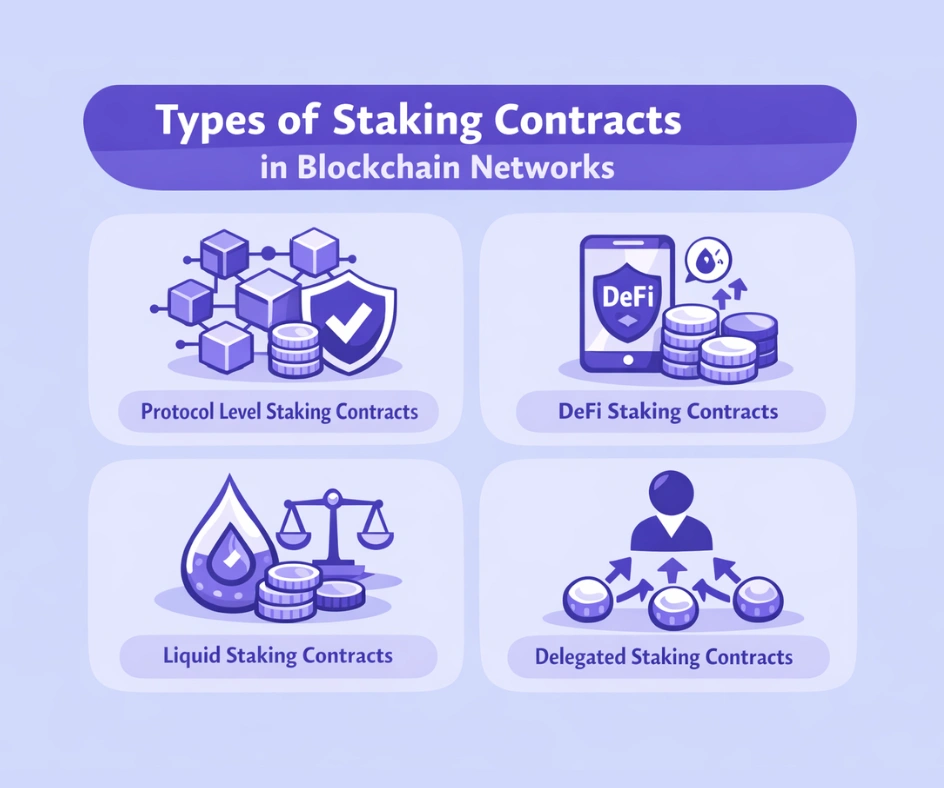
Not all staking contracts work the same way. Over time, different types have developed to serve different needs. Understanding these types helps you see the full picture of staking in blockchain networks.
1. Protocol Level Staking Contracts
These are built directly into the blockchain’s core protocol. They handle the consensus mechanism itself. When you stake ETH on Ethereum or SOL on Solana, you are interacting with protocol-level staking contracts. These contracts are deeply connected to how the network validates transactions and creates new blocks. They are the most critical type because the entire network depends on them.
2. DeFi Staking Contracts
These operate on top of existing blockchains, usually within decentralized finance applications. Users stake tokens to earn rewards, provide liquidity, or gain governance rights within a specific protocol. Unlike protocol-level staking, DeFi staking does not always contribute directly to blockchain security. Instead, it supports the economics and governance of individual applications built on the chain.
3. Liquid Staking Contracts
Liquid staking solves one of the biggest problems with traditional staking: locked funds. When you stake through a liquid staking contract, you receive a derivative token (like stETH from Lido) that represents your staked assets. You can then use this token in other DeFi applications while your original tokens continue earning staking rewards. The total value locked in liquid staking protocols hit about 86.4 billion dollars by mid 2025.
4. Delegated Staking Contracts
Some blockchains allow users to delegate their tokens to a validator without running their own node. The validator does all the technical work, and the rewards are split between the validator and the delegators. This makes staking accessible to people who do not have the technical skills or minimum token requirements to run a validator themselves. Cardano, Cosmos, and Polkadot all support this model.
Staking Participation Across Major Blockchain Networks
| Blockchain Network | Percentage of Supply Staked | Key Details |
|---|---|---|
| Ethereum (ETH) | About 30 percent | Over 37 million ETH staked with more than 1 million active validators |
| Cardano (ADA) | About 71 percent | Over 11.2 billion dollars worth of ADA is staked across the network |
| Solana (SOL) | About 69 percent | 7.4 billion dollars staked, driven by fast transaction speeds |
| Polkadot (DOT) | About 49 percent | Over 5.6 billion dollars staked with active governance participation |
| Cosmos (ATOM) | About 60 percent | Over 3.4 billion dollars staked for interoperability and governance |
| Tezos (XTZ) | Over 75 percent | One of the highest participation rates among all PoS networks |
| Avalanche (AVAX) | About 53 percent | About 2.5 billion dollars staked, showing strong community confidence |
Source: CoinLaw Cryptocurrency Staking Statistics
How Staking Contracts Help Blockchain Security
One of the biggest contributions of staking contracts is how they protect blockchain networks. Security in a Proof of Stake system works differently from a Proof of Work system, and staking contracts are the key piece that holds everything together.
1. Financial Commitment as a Security Guarantee
When validators stake their tokens, they are putting real money on the line. If they try to cheat the system by validating fake transactions or behaving dishonestly, they lose part or all of their staked tokens through a process called slashing. On Ethereum, for instance, a validator can be penalized up to their full 32 ETH if they violate certain protocol rules, such as signing two different blocks for the same slot or signing contradictory attestations.
This financial risk creates a strong incentive for validators to follow the rules. Unlike Proof of Work, where the worst that happens to a bad miner is wasted electricity, Proof of Stake staking contracts can actually take money away from dishonest actors.
2. Distributed Validator Networks
Staking contracts make it easy for many different people around the world to participate as validators. Because there is no need for expensive mining equipment, the barrier to entry is much lower. This leads to a more spread-out validator set, which makes the network harder to attack. An attacker would need to control a majority of the staked tokens to compromise the network, and with billions of dollars worth of tokens staked across thousands of validators, that becomes extremely difficult and expensive.
3. Automated Rule Enforcement
The beauty of staking smart contracts is that the rules are enforced by code, not by people. The contract automatically checks whether validators are performing their duties correctly. If a validator goes offline for too long, their rewards are reduced. If they act maliciously, slashing kicks in automatically. There is no committee or board of directors making these decisions. The code runs on its own, applied equally to every participant.
Recommended Reading:
Staking Smart Contracts Explained: The Technical Side
To truly understand how staking contracts work at a deeper level, it helps to look at what goes on inside the smart contract itself. While you do not need to be a programmer to use staking, knowing the basics of what the code does can give you a much clearer picture.
1. Core Components of a Staking Smart Contract
Every staking smart contract has several essential parts that work together. The staking mechanism defines how users deposit tokens, including minimum amounts and lock-up durations. The reward logic determines how rewards are calculated, whether based on time, amount staked, or validator performance. The withdrawal function manages how users get their tokens back after the unbonding period ends. And the penalty system handles slashing for validators who break the rules.
Most staking contracts on Ethereum are built using the ERC 20 token standard for fungible tokens. This ensures that the staked tokens are compatible with wallets, exchanges, and other smart contracts across the ecosystem.
2. Security Measures Inside the Contract
Because staking contracts hold large amounts of user funds, security is absolutely critical. Good staking contracts include features like multi-signature requirements for administrative functions, time locks that prevent sudden changes to contract parameters, reentrancy guards that stop attackers from draining funds through repeated function calls, and access control mechanisms that limit who can perform certain actions.
Despite these protections, smart contract vulnerabilities remain a real concern. Financial losses from smart contract exploits exceeded 3.5 billion dollars in 2024. This is why every serious staking project gets its contracts audited by professional security firms before launch. Tools like Slither and MythX can detect about 92 percent of known vulnerabilities in test environments, but they still miss some edge case issues that require manual review.
3. Upgradability and Governance
One challenge with smart contracts is that they cannot be changed once deployed. This is a feature, not a bug, because it ensures that the rules stay the same for everyone. But it also means that if there is a bug in the contract, it cannot be fixed easily. Some staking contracts use proxy patterns that allow the underlying logic to be upgraded while keeping the same contract address. Others rely on governance mechanisms where token holders vote on proposed changes.
The Role of Staking Contracts in Energy Efficiency
One of the most talked about benefits of Proof of Stake staking contracts is how much energy they save compared to Proof of Work mining.
The numbers speak for themselves. Bitcoin’s Proof of Work network consumes about 169.7 TWh of electricity per year. That is more than many countries use. Each Bitcoin transaction costs about 707.6 kWh of energy. Compare that with Proof of Stake networks: after The Merge, Ethereum went from consuming about 84,000 Wh per transaction under PoW to under 35 Wh per transaction under PoS.
Smaller PoS networks use even less. The Crypto Carbon Rating Institute found that Polkadot consumes about 70 MWh of electricity per year, while Solana uses about 1,967 MWh. In terms of carbon footprint, these networks produce between 33 and 934 tonnes of CO2 per year, which is equivalent to the emissions of around 153 intercontinental flights combined.
This dramatic reduction in energy use is a direct result of how staking contracts work. Because validators are chosen based on their financial stake rather than computing power, there is no need for massive mining farms running thousands of machines around the clock. A validator can run on basic computer hardware, often just a regular laptop or a small cloud server.
Risks and Challenges of Staking Contracts
While staking contracts offer many benefits, they are not without risks. Anyone considering staking should understand what can go wrong and how to protect themselves.
1. Smart Contract Vulnerabilities
Every smart contract is a piece of software, and software can have bugs. If a staking contract has a vulnerability, attackers can exploit it to steal staked funds. A major DeFi platform suffered a smart contract exploit in early 2024, leading to a loss of about 200 million dollars worth of staked crypto. This is why choosing platforms with properly audited contracts is so important.
2. Slashing Penalties
Validators who misbehave or experience technical problems can have their staked tokens partially or fully destroyed. Even honest mistakes, like running outdated software or experiencing a hardware failure that causes extended downtime, can lead to penalties. The Pectra upgrade on Ethereum reduced the initial slashing penalty by 128 times, from 1/32 of a validator’s balance to 1/4096, making accidental slashing less devastating.
3. Lock Up Period Risks
When tokens are staked, they are locked and cannot be sold or moved until the unbonding period ends. If the market crashes during this period, stakers are stuck watching their investment lose value without being able to react. Polkadot has a 28-day unbonding period, while Cosmos requires 21 days. During these windows, a sudden 30 or 40 percent price drop can completely wipe out any staking rewards earned.
4. Centralization Concerns
As of early 2025, Lido alone accounts for over 27 percent of all staked ETH. When one platform controls such a large portion of the network’s stake, it raises concerns about centralization. If Lido were to experience a technical failure or governance attack, it could affect the entire Ethereum network. This concentration of staking power is something the community is actively working to address through diverse staking options and protocol changes.
Comparing Staking Contract Features Across Blockchains
| Feature | Ethereum | Solana | Cardano |
|---|---|---|---|
| Minimum Stake to Validate | 32 ETH | No fixed minimum (practical minimum applies) | No minimum for delegation |
| Maximum Effective Balance | 2,048 ETH (post Pectra) | No upper cap | No upper cap |
| Average APY | 3 to 5 percent | 6 to 8 percent | 4 to 6 percent |
| Unbonding Period | Several days | 2 to 3 days | No lock-up (flexible) |
| Slashing | Yes, up to full stake | Yes, partial penalties | No slashing (rewards reduction only) |
| Delegation Support | Through staking pools and liquid staking | Native delegation | Native delegation with stake pools |
| Auto Compounding | Yes (post Pectra with 0x02 validators) | Manual restaking needed | Automatic within epochs |
Staking Contracts and Network Governance
Beyond security and rewards, staking contracts play a major role in how blockchain networks make decisions. Many Proof of Stake blockchains tie governance rights directly to staking. The more tokens you stake, the more influence you have over the direction of the network.
1. On Chain Voting Through Staking
On blockchains like Cosmos and Polkadot, staked tokens give holders the right to vote on protocol proposals. These proposals can include everything from software upgrades and parameter changes to how community funds are spent. The voting power is proportional to the amount staked, which means that people with more at stake have a louder voice in decisions. This creates a direct connection between financial commitment and governance participation.
2. Validator Governance Responsibilities
Validators often have additional governance duties beyond just processing transactions. On the WYscale platform, for example, validators participate in decisions about protocol upgrades, changes to network parameters, and resource allocation. This ensures that the people who are most invested in the network’s success are also the ones guiding its future direction.
3. Treasury Management
Some staking contracts include treasury mechanisms where a portion of staking rewards or transaction fees is directed to a community fund. Stakers can then vote on how these funds are used, whether for development grants, marketing, partnerships, or other initiatives that benefit the network.
Recommended Reading:
The Growth of Liquid Staking and Restaking
Traditional staking locks your tokens, and you cannot use them until you unstake. Liquid staking changed that by giving users a derivative token they can use elsewhere. But the innovation did not stop there. Restaking has taken things even further.
1. How Liquid Staking Works
When you stake ETH through Lido, you receive stETH in return. This stETH token represents your staked ETH and can be used in other DeFi protocols for lending, borrowing, or providing liquidity. Meanwhile, your original ETH continues earning staking rewards. It is like having your cake and eating it too. Liquid staking holds 31.1 percent of all staked ETH, which is about 10.53 million ETH, making it the single largest staking category.
2. The Rise of Restaking
Restaking allows users to take their already staked tokens and use them to provide security for additional protocols. EigenLayer leads this space, holding 4.4 million ETH in total value locked, which represents 89.1 percent of all restaked assets on Ethereum. Restaking creates the possibility of earning multiple reward streams from a single set of tokens, though it also comes with added risk since the tokens are now securing multiple systems at once.
3. The Impact on DeFi
Liquid staking tokens now account for more than 51 percent of total DeFi TVL, reflecting how deeply these derivative tokens have been woven into the broader DeFi ecosystem. They are used as collateral for loans, traded on decentralized exchanges, and integrated into yield farming strategies. This has created a much more connected and capital-efficient financial system on the chain.
Recent Developments in Staking Contracts
The staking landscape continues to change rapidly. Several major developments in recent months have shaped how staking contracts work and what they can do.
1. Ethereum Pectra Upgrade
The Pectra upgrade, which went live on Ethereum mainnet in May 2025, brought some of the biggest changes to Ethereum staking since The Merge. The maximum effective balance per validator increased from 32 ETH to 2,048 ETH, allowing large operators to consolidate their validators. Validator deposit processing time dropped from about 13 hours to just 13 minutes. And the initial slashing penalty was reduced by 128 times, making accidental penalties much less severe.
2. SEC Clarity on Staking
In May 2025, the U.S. Securities and Exchange Commission issued a statement clarifying that certain protocol staking activities do not constitute securities transactions. The statement noted that when users stake tokens through a custodian, and the custodian does not provide entrepreneurial or managerial efforts, the arrangement does not meet the definition of an investment contract. This was a significant moment for the staking industry because it reduced regulatory uncertainty.
3. Growing Institutional Adoption
Institutional interest in staking has grown strongly. Coinbase reports a staking “market cap” of 259.7 billion dollars with a 29.64 percent staking ratio on Ethereum. Corporate treasuries are increasingly integrating liquid staking tokens to combine yield generation with maintaining liquidity. The SEC’s clarification that stETH is not a security, issued in August 2025, further boosted institutional confidence in liquid staking products.
Staking Contract Implementations in the Real World
The following projects reflect how staking contracts and Proof of Stake architecture are already being applied across DeFi, Web3 platforms, and blockchain ecosystems. Each implementation showcases the same staking principles discussed throughout this article, from token locking and reward distribution to validator governance and smart contract automation.
🤖
Athene Network: Decentralized Mining with PoS
Created a decentralized mining platform for AI development where researchers, developers, and users share AI models and data. The platform uses Proof of Stake consensus and token holder governance, enabling community-driven infrastructure without centralized control through staking smart contracts.
Build Your Staking Smart Contract with Confidence:
We bring 8+ years of blockchain expertise to staking contract development. Our team handles everything from smart contract architecture and security audits to multi-chain deployment and reward logic, ensuring your staking platform is built for performance and trust. Whether you need a protocol-level staking solution or a DeFi staking platform, we deliver results that work.
Final Thoughts
Staking contracts have become the foundation of how modern blockchains operate. They replaced the energy-hungry mining process with a system where financial commitment serves as the guarantee of honest behavior. Through these smart contracts, blockchains can validate transactions, distribute rewards, enforce penalties, and manage governance without relying on any central authority.
The numbers tell the story clearly. Over 37 million ETH is staked, Cardano has 71 percent of its supply locked in staking contracts, and liquid staking protocols manage over 86 billion dollars in assets. These are not small experiments. Staking contracts are running some of the largest financial systems in the world, processing billions of dollars in value every day.
But the technology is still growing. The Pectra upgrade on Ethereum, the SEC’s regulatory clarity, the rise of restaking, and the growing institutional adoption all point to a future where staking contracts become even more central to how blockchains function. As Proof of Stake continues to prove itself as a working consensus mechanism, staking contracts will keep evolving to handle more complexity, serve more users, and support more use cases across the entire blockchain ecosystem.
For anyone building, investing, or participating in blockchain networks, understanding how staking contracts work is no longer optional. They are the engine that keeps these networks alive.
Frequently Asked Questions
Q1.What is a staking contract?
A staking contract is a smart contract on a blockchain that lets users lock up their cryptocurrency tokens. In return for locking tokens, users earn rewards and help keep the network running by supporting transaction validation. The contract handles everything automatically through code.
Q2.How do staking smart contracts earn rewards?
Staking smart contracts calculate rewards based on the amount of tokens staked, the duration of staking, and the network’s reward rules. Rewards are paid from newly created tokens and transaction fees. The contract distributes these rewards at regular intervals without any manual process.
Q3.What is slashing in proof of stake?
Slashing is a penalty mechanism inside staking contracts that punishes validators for breaking protocol rules. If a validator signs two different blocks for the same slot or goes offline for too long, the contract can destroy part or all of their staked tokens. This discourages dishonest behavior.
Q4.Can I lose money from staking?
Yes, there are several ways to lose money from staking. Smart contract bugs can lead to stolen funds, slashing penalties can reduce your staked balance, market crashes during lock-up periods can lower the value of your tokens, and some platforms may face security breaches that put user funds at risk.
Q5.What is liquid staking and how does it work?
Liquid staking lets you stake your tokens and receive a derivative token in return. For example, staking ETH through Lido gives you stETH. You can use stETH in other DeFi applications while your original ETH keeps earning staking rewards. This way, you do not have to choose between staking and using your tokens.
Q6.How much ETH is needed to become a validator?
On Ethereum, you need a minimum of 32 ETH to become a validator. After the Pectra upgrade, you can stake up to 2,048 ETH on a single validator. If you do not have 32 ETH, you can join a staking pool or use a liquid staking service where there is no minimum requirement to participate.
Explore Services
Related Services
Reviewed by

Aman Vaths
Founder of Nadcab Labs
Aman Vaths is the Founder & CTO of Nadcab Labs, a global digital engineering company delivering enterprise-grade solutions across AI, Web3, Blockchain, Big Data, Cloud, Cybersecurity, and Modern Application Development. With deep technical leadership and product innovation experience, Aman has positioned Nadcab Labs as one of the most advanced engineering companies driving the next era of intelligent, secure, and scalable software systems. Under his leadership, Nadcab Labs has built 2,000+ global projects across sectors including fintech, banking, healthcare, real estate, logistics, gaming, manufacturing, and next-generation DePIN networks. Aman’s strength lies in architecting high-performance systems, end-to-end platform engineering, and designing enterprise solutions that operate at global scale.