Ai Overview
At its core, Solidity programming is about writing instructions that run on the Ethereum blockchain. According to the Solidity Developer Survey 2024, modifiers rank among the top three most liked Solidity features at 15%. 1% of respondents choosing it, overtaking Hardhat for the first time. 1% of all respondents use Visual Studio Code as their editor, an increase of nearly 20% from the previous year.
Key Takeaways
- Solidity is a statically typed, object-oriented programming language created specifically for writing smart contracts on the Ethereum Virtual Machine, and it draws its syntax from C++, Python, and JavaScript.
[1] - According to the Solidity Developer Survey 2024, a total of 684 developers from 91 countries participated, with 76.6% of respondents using Solidity on a daily or weekly basis.
[2] - The global smart contracts market was valued at approximately USD 2.72 billion in 2024 and is projected to reach USD 24.67 billion by 2034, growing at a CAGR of 24.67%.
[3] - Solidity commands roughly 65% market share among all smart contract programming languages, making it the dominant choice for blockchain developers worldwide.
[4] - The DAO hack of 2016 exploited a reentrancy vulnerability in a Solidity smart contract, resulting in the loss of approximately $60 million worth of Ether and leading to the Ethereum hard fork.
[5] - In 2024, access control vulnerabilities alone accounted for $953.2 million in damages, while smart contract exploits across DeFi led to over $2.3 billion in total losses.
[6] - The EVM stores data in 32-byte slots, and each new storage slot write operation costs 20,000 or more gas units, making variable packing and storage optimization essential skills for Solidity developers.
[7] - Over 62% of Solidity developers deploy smart contracts outside of Ethereum Mainnet, with Base and Polygon each attracting 14.6% of developers, followed by Arbitrum at 14.3%.
[8] - Solidity developer salaries in the United States average $95,160 per year according to Glassdoor, with top earners reaching up to $173,603 annually at the 90th percentile
- Foundry became the most popular Ethereum development framework in 2024 with 51.1% usage among survey respondents, overtaking Hardhat for the first time.
[9]
If you have spent any time exploring blockchain technology or Ethereum, you have probably come across the term “Solidity” at some point. It is the language that makes Ethereum tick, the tool behind every decentralized application you have used, every token swap you have made, and every NFT you have minted. But what exactly is Solidity programming, and why has it become so central to the blockchain world?
This blog is designed to break down the Solidity programming language in a way that actually makes sense, whether you are completely new to coding or you are a developer thinking about jumping into blockchain. We will walk through what Solidity does, how it works under the hood, the tools you need to get started, common mistakes to avoid, and where the whole ecosystem is headed. No fluff, no overly technical jargon that makes your eyes glaze over. Just practical, straightforward explanations that help you understand this language from the ground up.
The timing matters too. The global smart contracts market was valued at approximately USD 2.72 billion in 2024, with projections pointing toward USD 24.67 billion by 2034. That kind of growth does not happen without a strong foundation, and Solidity sits right at the center of it. So let us dig in.
What Is Solidity and Why Does It Matter?
At its core, Solidity programming is about writing instructions that run on the Ethereum blockchain. Solidity is a statically typed, contract-oriented language designed specifically for the Ethereum Virtual Machine (EVM). It was proposed by Gavin Wood in August 2014 and later developed by a team led by Christian Reitwiessner and Alex Beregszaszi, along with several Ethereum core contributors.
The language borrows its syntax from C++, Python, and JavaScript, which means if you have written code in any of these languages before, Solidity will feel somewhat familiar. According to the official Solidity documentation, a “contract” in Solidity is essentially a collection of code (functions) and data (state) that resides at a specific address on the Ethereum blockchain. Think of it like a class in object-oriented programming, except this class lives on a decentralized network where everyone can see it and no single person controls it.
Solidity is not the only language you can use to write smart contracts. Vyper (Python-like), Rust (used on Solana and Polkadot), and others exist. But Solidity commands roughly 65% market share among all smart contract programming languages, making it the dominant choice by a wide margin. If you want to learn Solidity programming and build smart contract solutions, you are investing your time in the language that powers the vast majority of decentralized applications today.
Why does this matter practically? Because every time someone swaps tokens on Uniswap, borrows funds on MakerDAO, mints an NFT on Zora, or participates in a DAO vote, they are interacting with a Solidity smart contract. The language is not abstract or theoretical. It is running a real financial infrastructure that handles billions of dollars in value every single day.
How Solidity Works Under the Hood
To truly understand Solidity programming for beginners, you need to grasp how the language translates your code into something the blockchain can execute. The process follows a compilation model similar to Java.
You write Solidity source code in a .sol file. The Solidity compiler (solc) then converts this into bytecode, which is a hexadecimal representation of low-level instructions. This bytecode gets deployed to the Ethereum blockchain, where it sits at a specific contract address. When someone interacts with your contract (calling a function, sending Ether), the Ethereum Virtual Machine reads and executes the bytecode using a set of operation codes called opcodes.
Each opcode has a predetermined gas cost. Gas is the unit that measures computational effort on Ethereum. Every operation your smart contract performs, from storing a variable to transferring tokens, costs gas. The user calling the function pays this gas cost in Ether (ETH). This is fundamentally different from traditional programming. In a normal application, running code costs you server time. On Ethereum, running code costs real money for every single operation.
Every Solidity file starts with a version pragma, a declaration that tells the compiler which version of Solidity the code is compatible with. For example, pragma solidity ^0.8.4; means the code works with any compiler version from 0.8.4 up to (but not including) 0.9.0. This matters because Solidity is still evolving, and breaking changes can happen between versions. The latest compiler version at the time of writing is v0.8.33, which addresses various bug fixes and supports emitting event namespaced using modules.
Recommended Reading:
Core Building Blocks of Solidity Programming
If you are following a Solidity tutorial for beginners, the first things you will encounter are the fundamental building blocks of the language. Let us walk through each one.
1. State Variables
State variables are permanently stored in contract storage. They are written directly to the Ethereum blockchain. When you declareuint public storedData;, you are creating a variable of type unsigned integer (256 bits by default) that anyone can read. Think of it as a single slot in a database that you can query and modify by calling functions in your contract.
2. Functions
Functions are the executable units of code within a contract. They can read from and write to state variables, send Ether, call other contracts, and emit events. Functions have visibility specifiers (public, private, internal, external) that control who can call them. A public function can be called by anyone, while a private function can only be called from within the same contract.
3. Data Types
Solidity is statically typed, meaning you must declare the type of every variable at compile time. The primary data types include:
Boolean (bool): True or false values, though in the EVM, they are actually stored as 8-bit integers.
Integers (uint, int): Unsigned and signed integers. uint256 is the most common and maps directly to the EVM’s native 32-byte word size. Smaller types like uint8, uint128 exist but require extra operations to convert.
Address: Holds a 20-byte Ethereum address. The address payable variant allows the address to receive Ether.
Bytes: Fixed-size byte arrays from bytes1 to bytes32. bytes32 is the most gas-efficient storage type in Solidity.
Strings: Dynamic-size UTF-8 encoded strings. String manipulation in Solidity is more limited and expensive compared to languages like JavaScript.
Mappings: Key-value data structures that provide direct access to data through unique keys. They are generally more gas-efficient than arrays for data retrieval.
Arrays: Can be fixed size or dynamic. Fixed-size arrays are cheaper because the EVM knows their length at compile time.
4. Modifiers
Function modifiers are reusable code snippets that can change the behavior of functions. The most common use case is access control, for example, creating an onlyOwner modifier that restricts a function to the contract deployer. According to the Solidity Developer Survey 2024, modifiers rank among the top three most liked Solidity features at 15%.
5. Events
Events allow contracts to communicate with the outside world. When an event is emitted, it creates a log entry on the blockchain that external applications (like a frontend) can listen for. Storing data in events is significantly cheaper than storing it in state variables, though event data is not accessible to other smart contracts on the chain.
6. Inheritance
Solidity supports inheritance, which means one contract can inherit properties and functions from another. This is similar to class inheritance in object-oriented languages. Libraries like OpenZeppelin provide battle-tested base contracts that developers regularly inherit from, saving time and reducing security risks.
Setting Up Your Solidity Development Environment
Getting started with Solidity programming does not require installing anything on your computer initially. Here is how most developers begin and then scale up their tooling.
1. Remix IDE
Remix is a browser-based integrated development environment built specifically for Solidity. You open it in your web browser, write your contract, compile it, and deploy it to a test network, all without leaving the browser. For anyone starting their first Solidity tutorial for beginners, Remix is the go-to tool. It provides real-time error highlighting, a built-in debugger, and integration with various test networks.
2. Foundry
According to the Solidity Developer Survey 2024, Foundry became the most used Ethereum development framework with 51.1% of respondents choosing it, overtaking Hardhat for the first time. Foundry is a fast, portable toolkit for Ethereum development written in Rust. It includes Forge (for testing), Cast (for interacting with contracts), and Anvil (a local Ethereum node). Developers who have been writing Solidity for five or more years tend to gravitate toward Foundry because of its speed and Solidity native testing approach.
3. Hardhat
Hardhat is a JavaScript-based development environment that has been a staple in the Ethereum ecosystem. It provides a local Ethereum network for testing, console logging inside Solidity (a feature developers love for debugging), and a plugin architecture for extending functionality.
4. Visual Studio Code
The Solidity Developer Survey 2024 found that 90.1% of all respondents use Visual Studio Code as their editor, an increase of nearly 20% from the previous year. Popular extensions include HardHat VSCode by Nomic Foundation and the Solidity extension by Juan Blanco.
5. MetaMask
MetaMask is a browser extension wallet that lets you interact with deployed smart contracts. When you test your contracts on a testnet, MetaMask manages your test accounts and signs transactions. It is essentially the bridge between your browser and the Ethereum blockchain.
Solidity Development Tools Comparison
| Tool / Framework | Primary Language | Best Suited For |
|---|---|---|
| Remix IDE | Browser-Based (No Install) | Beginners, rapid prototyping, quick testing, and learning Solidity basics without local setup |
| Foundry (Forge) | Rust / Solidity Native Testing | Experienced developers who want fast compilation, fuzz testing, and Solidity native test writing |
| Hardhat | JavaScript / TypeScript | Full-stack developers comfortable with JavaScript, plugin ecosystem, and console.log debugging |
| Truffle Suite | JavaScript | Legacy projects and developers who started with Ethereum development before Hardhat and Foundry |
| OpenZeppelin | Solidity Library | Pre audited smart contract templates for ERC20, ERC721, access control, and upgradeable contracts |
| Ganache / Anvil | Local Blockchain Emulator | Running a personal Ethereum blockchain for testing deployments and interactions locally |
| Slither | Python-Based Static Analyzer | Automated vulnerability detection, code quality checks, and security analysis before deployment |
Understanding Gas and Why It Shapes Everything in Solidity
Gas optimization is not a nice-to-have in Solidity programming. It is a necessity that shapes how you write every line of code. Unlike traditional software, where computational cost is abstracted away by cloud hosting bills, on Ethereum, every single operation has a precise gas cost that the end user pays.
The EVM stores data in 32-byte (256-bit) slots. Each storage slot write costs gas: 20,000 or more gas for writing to a new slot, and between 2,900 and 5,000 gas for updating an existing one. Reading from storage costs significantly less but is still not free.
This economic reality leads to several coding patterns unique to Solidity.
Variable packing means arranging your state variables so that multiple smaller variables fit into a single 32-byte storage slot. For example, two uint128 variables declared consecutively will share one slot, costing far less than declaring them as two separate uint256 variables that each occupy their own slot. The order of declaration matters because the Solidity compiler packs variables sequentially.
Using bytes32 over strings whenever possible, because it bytes32 is the most gas-efficient storage type. Dynamic strings require additional operations and storage overhead.
Preferring mappings over arrays for data retrieval. Mappings provide direct access to data through unique keys without iteration, making them more gas-efficient for lookup operations. Arrays require iteration for searching, which gets increasingly expensive as the array grows.
Using calldata instead of memory for function parameters that do not need to be modified. Calldata is a read-only, temporary area that avoids the cost of copying data into memory.
Avoiding variable initialization with default values. Writing uint256 value; is cheaper than uint256 value = 0; because the EVM already initializes unsigned integers to zero by default.
Since Solidity version 0.8.0, the compiler includes built-in overflow and underflow checks for arithmetic operations. While this is a significant safety improvement, it adds gas cost to every mathematical operation. In cases where you are absolutely certain an operation cannot overflow (like incrementing a loop counter that is bounded by a fixed length), you can wrap the operation in an unchecked block to skip those checks and save gas.
Recommended Reading:
Smart Contract Security: Where Things Go Wrong
If there is one area where Solidity smart contract solutions demand the most attention, it is security. Unlike traditional software, where you can patch bugs after deployment, smart contracts on Ethereum are immutable once deployed. A vulnerability in your code can lead to permanent, irreversible loss of funds.
The numbers tell the story. In 2024 alone, over $2.3 billion was lost to smart contract vulnerabilities across DeFi platforms. Access control vulnerabilities were the single largest category, accounting for $953.2 million in damages. Logic errors added another $63.8 million. These are not theoretical risks. They are ongoing, documented losses that continue to affect real users and real money.
Here are the most critical vulnerabilities every Solidity developer must understand:
1. Reentrancy Attacks
This is the vulnerability that changed Ethereum’s history. The DAO hack of 2016 exploited a reentrancy flaw, where an attacker recursively called the withdrawal function before the contract updated its internal balance. The attacker drained approximately 3.6 million Ether (worth about $60 million at the time), which accounted for 5.6% of all ETH in circulation. The aftermath led to a hard fork that split Ethereum into two separate chains: Ethereum (ETH) and Ethereum Classic (ETC). The fix is straightforward: follow the Checks Effects Interactions pattern. Always update your contract’s state (effects) before making any external calls (interactions).
2. Integer Overflow and Underflow
Before Solidity 0.8.0, arithmetic operations did not check for overflow or underflow. A uint8 variable at its maximum value of 255 would wrap around to 0 when incremented by 1. Attackers exploited this behavior to manipulate balances and drain contracts. The Cetus decentralized exchange hack in May 2025 resulted in an estimated $223 million in losses due to a missed overflow check. Modern Solidity versions include automatic checks, but any contracts compiled with older versions remain at risk.
3. Access Control Failures
Functions in Solidity default to public visibility if no specifier is declared. This means functions that should be restricted can be called by anyone if the developer forgets to set proper visibility. The Parity Wallet hack in 2017 demonstrated this catastrophically: an access control flaw allowed an attacker to take ownership of the library contract and invoke the selfdestruct function, freezing approximately $150 million in funds that remain inaccessible to this day.
4. Oracle Manipulation
Smart contracts that rely on external price feeds (oracles) can be manipulated through flash loans. An attacker borrows a large amount of tokens, manipulates the price on a decentralized exchange, and then exploits the incorrect price data in a vulnerable contract. Using decentralized oracle networks with multiple data sources and time-weighted averages is the standard mitigation.
5. Front Running
Because all pending transactions on Ethereum are visible in the mempool before they are mined, attackers can see profitable transactions and submit their own with higher gas fees to get executed first. This is not a Solidity code vulnerability per se, but it is a risk that smart contract architects must account for in their design.
The Solidity Developer Landscape: Who Is Writing Smart Contracts?
The Solidity Developer Survey 2024 provides a detailed picture of who is using this language and how. A total of 684 developers from 91 countries participated. The highest number of respondents came from the United States (10.8%), followed by India and Nigeria tied at 7.8% each.
Here are some patterns from the survey data:
76.6% of Solidity developers use the language on a daily or weekly basis. A majority of self-rated experts (those who rate themselves 10 out of 10) have been using Solidity for five or more years. The most liked features of the language were mappings (21.8%), contracts as objects (20.4%), and modifiers (15%).
66.8% of survey participants feel that the Solidity developer experience has generally improved over the past year. The language is evolving, with regular monthly releases and approximately one breaking release per year.
More than half of all respondents (62.3%) deploy Solidity contracts outside of Ethereum Mainnet and testnets. The most popular alternative networks include Base and Polygon (each at 14.6%), Arbitrum (14.3%), Optimism (12.0%), and Binance Smart Chain (8.4%). This tells us something important: if you learn Solidity programming, you are not just learning one chain. You are gaining access to an entire ecosystem of EVM-compatible networks.
When it comes to alternative smart contract languages, 37.9% of respondents said they do not use any language other than Solidity. Among those who do, Yul (an intermediate language for Solidity used for low-level optimization) leads at 18.5%.
Solidity Developer Salary Ranges by Experience Level
| Experience Level | Annual Salary Range (USD) | Additional Notes |
|---|---|---|
| Intern | $25,000 to $50,000 | Rare positions, typically short-term and not salaried; often converted to an hourly equivalent |
| Entry Level | $70,000 to $100,000 | Basic smart contract skills, may receive token-based compensation or equity alongside salary |
| Mid Level (3 to 5 years) | $120,000 to $165,000 | Proficiency in multiple blockchain platforms, DeFi protocol experience, and security awareness |
| Senior (5+ years) | $150,000 to $200,000+ | Architecture decisions, audit expertise, protocol design; top 10% earn over $208,000 in San Francisco |
| Freelance | $75 to $150 per hour | Rates can reach $350 per hour for specialized audit or DeFi protocol work |
Real World Applications of Solidity Smart Contracts
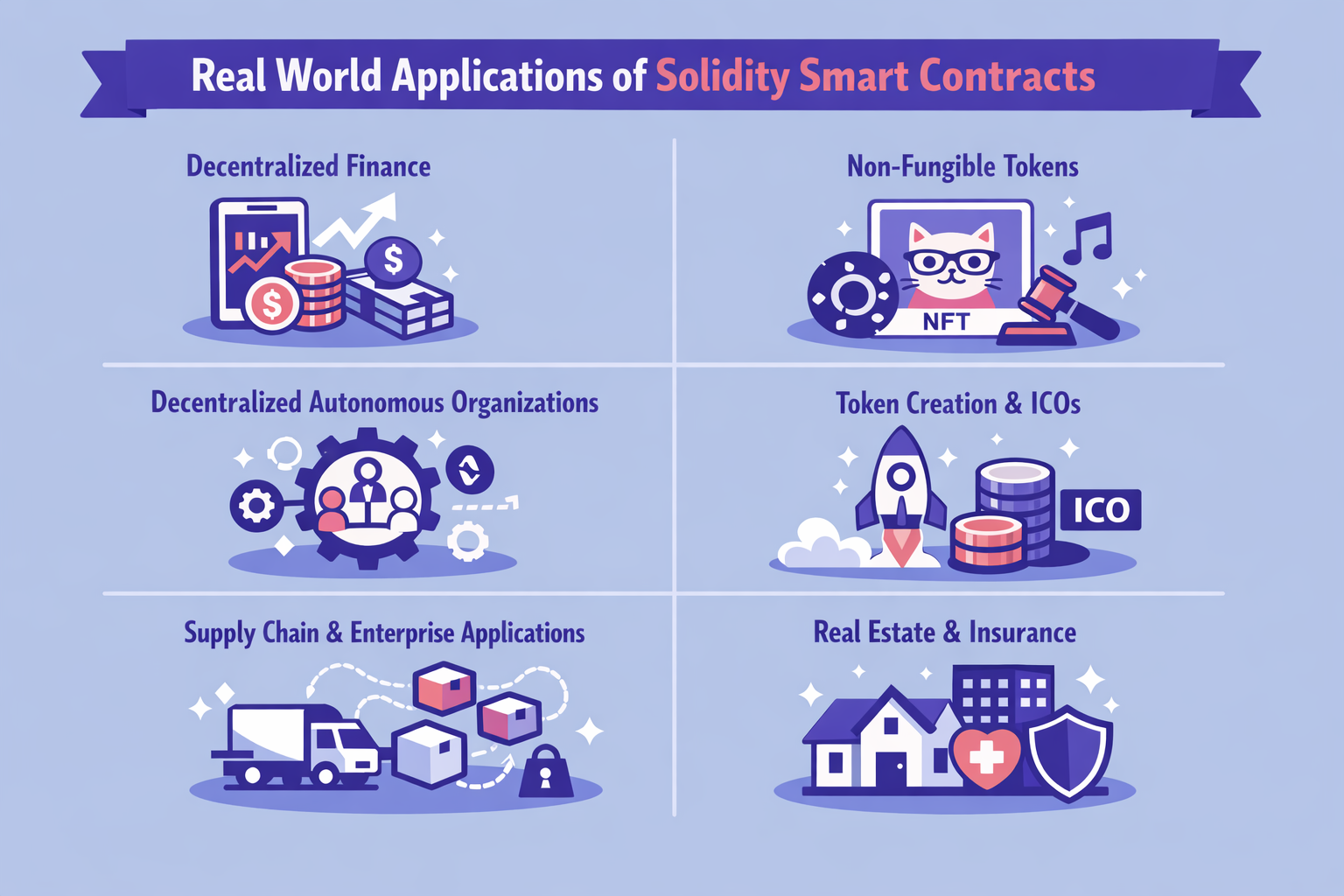
Understanding where Solidity programming is actually being used helps ground the technical knowledge in a practical context. Smart contracts written in Solidity power some of the most significant applications in the blockchain ecosystem.
1. Decentralized Finance (DeFi)
DeFi is the largest use case for Solidity by a significant margin. Protocols like Uniswap use immutable smart contracts to power their automated market maker model, allowing token swaps without intermediaries. MakerDAO governs the DAI stablecoin through a series of contracts that manage vaults, collateralization ratios, and governance voting. Aave and Compound enable lending and borrowing entirely through smart contract logic. Every function call, from depositing collateral to triggering a liquidation, is executed by Solidity code.
2. Non-Fungible Tokens (NFTs)
Every NFT you have seen on platforms like Zora or OpenSea is governed by a Solidity smart contract implementing either the ERC 721 or ERC 1155 token standard. These contracts define ownership, transfer rules, and in many cases, creator royalties that are enforced on-chain. When you mint, buy, or sell an NFT, you are interacting with Solidity functions.
3. Decentralized Autonomous Organizations (DAOs)
DAOs use Solidity contracts to manage governance proposals, voting mechanisms, and treasury management. Members hold governance tokens that give them voting power. When enough votes are collected, the smart contract automatically executes the proposal, whether that means transferring funds, updating protocol parameters, or adding new features.
4. Token Creation and ICOs
The ERC 20 token standard, written in Solidity, is the foundation for thousands of cryptocurrency tokens. Creating a new token involves writing a Solidity contract that defines the token name, symbol, total supply, and transfer logic. The standard ensures all tokens are interoperable with wallets, exchanges, and other DeFi protocols.
5. Supply Chain and Enterprise Applications
SWIFT has deployed a proof of concept using Solidity running on Hyperledger Fabric, demonstrating how the language extends beyond public blockchains into enterprise use cases. Smart contracts can automate supply chain verification, track product provenance, and ensure compliance with trade agreements.
6. Real Estate and Insurance
Smart contracts are being used to automate property transfers, manage escrow arrangements, and process insurance claims. The contract holds funds in escrow and automatically releases them when predefined conditions (inspections passed, documents signed) are verified on the chain.
Recommended Reading:
Writing Your First Smart Contract: A Beginner-Friendly Walkthrough
For anyone looking at a practical Solidity tutorial for beginners, here is a step-by-step approach to writing and deploying your first contract.
Step 1: Open Remix IDE in your browser at remix.ethereum.org. Create a new file called SimpleStorage.sol.
Step 2: Write the version pragma at the top: pragma solidity ^0.8.4;
Step 3: Define your contract using the contract keyword. Inside, declare a state variable: uint public storedData;. The public keyword automatically creates a getter function.
Step 4: Add a set function that accepts a uint parameter and stores it. Mark it as public so; anyone can call it.
Step 5: Compile the contract using the Solidity compiler tab in Remix. Fix any errors the compiler flags.
Step 6: Switch to the Deploy tab. Select the JavaScript VM environment (this creates a local blockchain in your browser). Click Deploy.
Step 7: Interact with your deployed contract. Call the set function with a number, then call storedData to verify it was stored.
This simple exercise covers the fundamental workflow that every Solidity developer follows: write, compile, deploy, interact. The contracts get more complex, but the cycle remains the same.
Solidity Beyond Ethereum: The Multi-Chain Ecosystem
One of the most practical aspects of learning Solidity programming is that your skills transfer across multiple blockchains. Any blockchain that runs an EVM-compatible virtual machine can execute Solidity smart contracts. This includes:
Layer 2 Networks: Base, Arbitrum, Optimism, and zkSync are all EVM-compatible. Post Dencun upgrade, transaction fees on these Layer 2 networks have dropped dramatically, often to just cents per transaction. This makes deploying and interacting with Solidity contracts far more affordable than on Ethereum Mainnet.
Alternative Layer 1s: Binance Smart Chain (BNB Chain), Polygon, Avalanche, and Fantom all support Solidity. Each offers different tradeoffs in terms of speed, cost, and decentralization.
Enterprise Chains: Hyperledger Fabric supports Solidity through its EVM chaincode, allowing enterprises to use the same language in permissioned blockchain environments.
This multi-chain reality means that Solidity programming for beginners is not about learning a language for one platform. It is about gaining a skill that applies across an entire ecosystem of interconnected blockchain networks.
Best Practices for Writing Solidity Smart Contracts
After understanding the basics, the next step is adopting the practices that separate good smart contracts from vulnerable ones. Here are the most important habits to build:
1. Follow the Checks Effects Interactions Pattern
Always validate conditions first, update your contract’s state second, and make external calls last. This single pattern prevents the most common and destructive vulnerability in Solidity: reentrancy.
2. Use OpenZeppelin Libraries
Do not reinvent the wheel for standard functionality. OpenZeppelin Contracts (v5. x is the latest) provide community audited implementations for token standards, access control, proxy patterns, and more. Using these saves development time and significantly reduces security risk.
3. Set Explicit Visibility for All Functions and Variables
Never rely on Solidity’s default visibility. Always declare whether a function is public, private, internal, or external. This removes ambiguity and prevents accidental exposure of sensitive functions.
4. Test Extensively
Write unit tests for every function. Test edge cases. Test with unexpected inputs. Use fuzz testing (which Foundry supports natively) to throw random data at your contract and see what breaks. Simulate attack scenarios including reentrancy, oracle manipulation, and flash loan attacks.
5. Get Professional Audits
For any contract that will handle real funds, get multiple independent security audits from reputable firms. Audits are not cheap, but they are orders of magnitude less expensive than losing user funds to an exploit.
6. Use the Latest Stable Solidity Version
The Solidity documentation explicitly recommends using the latest released version for all deployments. Only the latest version receives security fixes. Running older versions means running with known, unpatched vulnerabilities.
7. Emit Events for All State Changes
Events create a searchable log on the blockchain that off-chain services can index. Comprehensive event logging makes your contract easier to monitor, debug, and integrate with frontend applications.
Smart Contract Implementations in the Real World
The following projects demonstrate how Solidity smart contracts are already being applied across DeFi, blockchain mining, and decentralized governance. Each implementation showcases the same development principles discussed throughout this article, from access control and token standards to gas optimization and community-driven protocol design.
🔗
Panther Protocol: Privacy Focused DeFi Smart Contracts
Built a privacy-enhancing DeFi platform using Solidity smart contracts that combine advanced cryptographic techniques with regulatory compliance. The system implements Proof of Stake consensus, staking reward distribution, and delegated governance, demonstrating how Solidity contracts can balance institutional-grade privacy with transparent, on-chain operations.
⛏️
Athene Network: Decentralized Mining Platform
Created a decentralized mining application for AI development using Solidity-based smart contracts. The platform implements token holder governance, Proof of Stake consensus, and automated reward distribution, enabling community-driven infrastructure where researchers and developers share AI models and services without centralized control.
Build Your Smart Contract Project with Expert Solidity Developers:
We bring 8+ years of blockchain expertise to Solidity smart contract development. Our specialized team handles everything from smart contract architecture to multi-chain deployment and security auditing, ensuring your project is built for performance, safety, and long term growth. Whether you need DeFi protocols, token contracts, or custom dApp logic, we deliver solutions that work.
Where Solidity Is Headed: The Future of Smart Contract Development
The Solidity programming language is not standing still. Several developments are shaping where it is headed.
Account Abstraction (ERC 4337 and EIP 7702): These standards are making smart contract wallets more user-friendly. ERC 4337 introduces programmable spending rules through UserOps, bundlers, and paymasters (which enable gasless transactions). EIP 7702, introduced with the Pectra upgrade in May 2025, allows externally owned accounts to temporarily delegate execution to smart contract logic without migrating wallets entirely.
AI Assisted Development: Large language models are increasingly being used to generate and audit Solidity code. While AI can speed up boilerplate code writing and catch common patterns, the consensus among security professionals is that human review remains essential for any contract handling real value.
Layer 2 Economics: Post Dencun and Pectra upgrades, Layer 2 transaction costs have dropped to fractions of a cent for many operations. This changes the economics of smart contract deployment fundamentally, making it feasible to build applications that were previously too expensive on Ethereum Mainnet.
Modular Blockchain Architecture: The separation of execution, settlement, and data availability layers is creating new deployment options for Solidity contracts. Developers can now choose where to execute their contracts based on cost, speed, and security tradeoffs.
Cross-Chain Interoperability: While still evolving, the ability for Solidity contracts on different chains to communicate is becoming more practical. OP Stack’s Superchain interoperability work and various bridge protocols are laying the groundwork for cross-chain smart contract interactions.
Final Thoughts
Solidity programming is not just another language to add to your resume. It is the gateway to an entire ecosystem of decentralized applications that are handling billions of dollars in value and reshaping how financial services, governance, digital ownership, and enterprise operations function. The language itself is approachable if you have any background in JavaScript, C++, or Python, and the tooling has matured significantly with frameworks like Foundry and Remix, making the development experience much smoother than it was even a few years ago.
What makes Solidity unique is the stakes involved. Every line of code you write has a direct financial cost (gas) and, if you are building production contracts, a direct financial responsibility (user funds). This forces a level of discipline and security awareness that traditional software development does not demand. But it also creates extraordinary opportunities. The developer talent shortage in blockchain is well-documented, with salaries consistently outpacing traditional software engineering roles, and the demand for people who can write, audit, and optimize Solidity contracts continues to grow alongside the expanding smart contracts market.
Whether you are a complete beginner looking to learn Solidity programming through your first SimpleStorage contract on Remix, or an experienced developer exploring DeFi protocol architecture, the path forward is the same: start writing contracts, test them relentlessly, learn from the documented hacks and vulnerabilities that have cost the industry billions, and keep building. The blockchain ecosystem rewards those who show up with real skills and a commitment to writing code that works, code that is safe, and code that solves real problems.
Frequently Asked Questions
Q1.Is Solidity hard to learn for someone with no programming experience?
Solidity has a steeper learning curve if you have zero programming background because you need to understand both general programming concepts (variables, functions, loops) and blockchain-specific concepts (gas, transactions, the EVM) simultaneously. However, if you start with a basic JavaScript or Python course first and then move to Solidity, the transition becomes much smoother. Resources like Remix IDE make it possible to write and test contracts without any local setup, which lowers the barrier to entry significantly.
Q2.How long does it take to become proficient in Solidity?
If you already know a programming language like JavaScript or C++, you can write basic Solidity contracts within a few weeks of focused study. Becoming proficient enough to build production contracts that handle real funds typically takes three to six months of consistent practice, security study, and testing. Reaching expert level, where you understand gas optimization at the opcode level and can audit contracts for vulnerabilities, usually requires a year or more of hands-on experience.
Q3.Do I need to know blockchain technology before starting Solidity?
You should understand the basic concepts of how a blockchain works, including transactions, blocks, consensus mechanisms, and what Ether and gas are. You do not need to be an expert on Ethereum’s protocol-level details before you start. Many developers learn blockchain concepts alongside Solidity, filling in the deeper knowledge as they encounter it during contract development.
Q4.What is the difference between Solidity and Vyper?
Both languages target the Ethereum Virtual Machine, but they take different approaches. Solidity offers richer features, including inheritance, function overloading, and a larger standard library. Vyper is intentionally more limited, emphasizing simplicity and readability to reduce the surface area for security vulnerabilities. Solidity has a much larger developer community and ecosystem of tools, while Vyper is preferred by some security-focused teams who prioritize auditable code.
Q5.Can I use Solidity on blockchains other than Ethereum?
Yes. Any EVM-compatible blockchain supports Solidity. This includes Layer 2 networks (Base, Arbitrum, Optimism, zkSync), alternative Layer 1 chains (Binance Smart Chain, Polygon, Avalanche), and enterprise platforms like Hyperledger Fabric. Your Solidity skills are portable across this entire ecosystem, which is one of the strongest reasons to learn the language.
Q6.How much does it cost to deploy a Solidity smart contract?
Deployment costs depend on the complexity of the contract and the network you are deploying to. On Ethereum Mainnet, deploying a basic contract can cost anywhere from $10 to several hundred dollars during high gas periods. On Layer 2 networks like Base or Arbitrum, deployment costs are typically under $1 for basic contracts. Testnets are completely free to deploy on, and using test Ether from faucets allows you to practice without spending any real money.
Explore Services
Related Services
Reviewed by

Aman Vaths
Founder of Nadcab Labs
Aman Vaths is the Founder & CTO of Nadcab Labs, a global digital engineering company delivering enterprise-grade solutions across AI, Web3, Blockchain, Big Data, Cloud, Cybersecurity, and Modern Application Development. With deep technical leadership and product innovation experience, Aman has positioned Nadcab Labs as one of the most advanced engineering companies driving the next era of intelligent, secure, and scalable software systems. Under his leadership, Nadcab Labs has built 2,000+ global projects across sectors including fintech, banking, healthcare, real estate, logistics, gaming, manufacturing, and next-generation DePIN networks. Aman’s strength lies in architecting high-performance systems, end-to-end platform engineering, and designing enterprise solutions that operate at global scale.