Ai Overview
The Web3 ecosystem is undergoing the most significant architectural shift in its short history, and at the center of that transformation is the smart contract wallet. This code can define rules like “require three of five approvals before any transaction above $10,000,” or “allow this trusted guardian to initiate wallet recovery if the owner is locked out,” or “only allow interactions with pre-approved DeFi protocols. On Ethereum mainnet, this can cost $10-50 per deployment.
Key Takeaways
- A smart contract wallet replaces single-key wallet control with on-chain programmable logic, enabling features like multi-sig, social recovery, and automated spending rules impossible in traditional wallets.
- Account abstraction via EIP-4337 has made smart contract wallets first-class citizens on Ethereum and compatible L2 networks, unlocking gasless transactions and custom authentication in 2026.
- Social recovery eliminates the catastrophic seed phrase single point of failure, allowing users to regain wallet access through trusted guardians without any centralized service involvement.
- Safe (formerly Gnosis Safe) secures over $100 billion in assets across DAO treasuries and institutional portfolios, making it the most trusted smart contract wallet in the Web3 ecosystem.
- Smart contract wallets power DeFi, NFT management, DAO governance, and gaming economies in the USA, UK, UAE, and Canada markets where Web3 adoption is accelerating fastest.
- Gas fee sponsorship through Paymaster contracts allows Web3 applications to subsidize transaction costs for new users, removing the largest friction barrier to mainstream smart contract wallet adoption.
- Multi-signature security in smart contract wallets eliminates insider theft risk for organizations, requiring coordinated approval from multiple independent parties before any asset transfer can execute.
- Smart contract wallet security depends entirely on the quality of the underlying contract code, making third-party audits by firms like Trail of Bits and OpenZeppelin a non-negotiable prerequisite for production deployment.
- Enterprise adoption of smart contract wallets is accelerating in 2026, driven by institutional demand for programmable treasury management, automated compliance, and multi-person authorization workflows.
- The convergence of AI, account abstraction, and regulatory clarity across major markets is positioning smart contract wallets to become the default wallet standard for the next billion Web3 users.
1. Introduction: The Web3 Wallet Revolution
Web3 Evolution and the Shift Toward Intelligent Wallets
The Web3 ecosystem is undergoing the most significant architectural shift in its short history, and at the center of that transformation is the smart contract wallet. Since the earliest days of Bitcoin, cryptocurrency wallets have operated on a deceptively simple but dangerously fragile premise: a single private key controls everything. Lose the key or the seed phrase that generates it, and every asset associated with that wallet is gone permanently with no recourse. Compromise the key, and an attacker gains instant, total control. For over a decade, this model served well enough for early adopters who accepted these risks as the price of financial sovereignty. But as Web3 has grown from a niche technical community into a global ecosystem worth trillions of dollars, serving users ranging from individual retail participants to Fortune 500 treasury departments, the inadequacy of the traditional externally owned account (EOA) model has become impossible to ignore. Our agency has worked for eight years at the intersection of blockchain engineering and product design, building wallet infrastructure for clients across the USA, UK, UAE, and Canada, and we have watched the smart contract wallet emerge from an experimental concept to the most important infrastructure development in the Web3 space today.
Why Smart Contract Wallets Are Gaining Momentum in 2026
The momentum behind smart contract wallet adoption in 2026 is driven by three converging forces that have reached critical mass simultaneously. First, the technical foundation has matured: EIP-4337 account abstraction is now live and widely deployed across Ethereum, Polygon, Optimism, Arbitrum, and Base, providing the standardized infrastructure that smart contract wallets need to function efficiently. Second, the user experience case has been proven: early implementations like Argent and Safe have demonstrated that smart contract wallets can deliver dramatically better security and usability simultaneously, overturning the traditional assumption that these objectives are in tension. Third, the regulatory environment is creating demand: institutions in the UK, UAE, and Canada that are building regulated crypto operations require multi-signature approval workflows and audit trails that only smart contract wallet architecture can provide natively. The smart contract wallet is not merely a better wallet; it is the enabling technology for the next generation of Web3 participation, making secure digital asset management accessible to users who would never tolerate the complexity and risk of traditional key management.
2. What Is a Smart Contract Wallet?
Simple Definition and Core Concept
A smart contract wallet is a cryptocurrency wallet whose core logic, rules, and access controls are defined by smart contracts deployed on a blockchain rather than by a single private key. In a traditional externally owned account wallet like MetaMask, the private key is the sole authority over the wallet: whoever possesses the key can do anything with the assets, and the key itself has no programmatic logic attached to it. In a smart contract wallet, the wallet is a smart contract address on-chain that can hold assets just like any wallet, but whose behavior is governed by code that the user or organization configures. This code can define rules like “require three of five approvals before any transaction above $10,000,” or “allow this trusted guardian to initiate wallet recovery if the owner is locked out,” or “only allow interactions with pre-approved DeFi protocols.” These capabilities fundamentally change what a wallet can do and how securely it can protect assets at scale, making the smart contract wallet the superior architecture for both individual users who value security and institutions that require governance.[1]
Smart Contract Wallet vs Traditional Crypto Wallet: The Core Difference
The architectural difference between a smart contract wallet and a traditional EOA wallet is profound and worth understanding precisely. A traditional EOA wallet is simply a public-private key pair. The public key generates the wallet address; the private key signs transactions. There is no logic, no programmability, and no flexibility in how the wallet behaves. The private key is either present and valid, or absent and the wallet is inaccessible. A smart contract wallet, by contrast, is a deployed contract with its own address that can hold and manage any Ethereum-compatible asset. The contract defines how transactions are authorized (single owner, multi-sig, or other custom logic), how the wallet can be recovered if access is lost, what spending limits apply, and what interactions are permitted with external protocols. The key insight is that the smart contract wallet separates the authentication layer (how you prove you have the right to use the wallet) from the authorization layer (what actions the wallet is allowed to take), enabling a level of security governance that is simply impossible in the traditional EOA model.
Traditional EOA Wallet vs Smart Contract Wallet at a Glance
Traditional EOA Wallet
- Single private key controls all assets
- No programmable logic or rules
- Seed phrase is single point of failure
- No built-in recovery mechanism
- Cannot enforce spending limits
- No multi-person authorization
Smart Contract Wallet
- On-chain logic governs all access
- Fully programmable rules and permissions
- Social recovery eliminates seed phrase risk
- Multi-guardian recovery built-in
- Configurable spending limits per protocol
- Multi-sig and threshold approvals native
Account Abstraction Wallet (EIP-4337)
- Full smart contract wallet capabilities
- Gasless transactions via Paymaster
- Social login authentication support
- Batch transaction execution
- Pay gas in any ERC-20 token
- Leading edge of Web3 UX in 2026
3. Evolution of Crypto Wallets: From Private Keys to Smart Contracts
The Early Era: Private Key Wallets and Their Fundamental Limitations
The history of cryptocurrency wallet evolution is, at its core, a history of the industry grappling with an inherent tension between security and usability that the original private key model was never designed to resolve. The earliest Bitcoin wallets generated a private key that the user was responsible for backing up, with no safety net and no recovery mechanism. The introduction of hierarchical deterministic (HD) wallets and BIP-39 mnemonic seed phrases in 2013 was a significant improvement, reducing the backup burden from multiple individual keys to a single 12 or 24-word phrase. But it also concentrated the single point of failure into a human-readable format that became an even more attractive target for attackers through phishing, social engineering, and malware. The Chainalysis 2023 Crypto Crime Report documented that seed phrase compromise through social engineering accounted for more than 35% of all individual crypto theft incidents globally, a statistic that has remained stubbornly persistent despite years of user education campaigns in the USA, UK, UAE, and Canada markets.
The Innovation Imperative That Created the Smart Contract Wallet
The transition from private key wallets to smart contract wallets did not happen overnight but through a series of incremental innovations that each addressed specific limitations of the EOA model. Gnosis Safe (now simply Safe) launched in 2018 and demonstrated that multi-signature wallet logic could be implemented as a smart contract, enabling organizations to require multiple approvers for transactions without relying on centralized custodians. Argent introduced social recovery to individual user wallets in 2020, proving that the seed phrase could be eliminated from the user experience without sacrificing self-custody. The formalization of account abstraction through EIP-4337, which reached production deployment in 2023 and achieved widespread L2 support by 2025, provided the standardized infrastructure that unified these innovations into a coherent wallet architecture paradigm. Each step in this evolution was driven by the same insight: the security of a wallet should be determined by the quality of its cryptographic and governance architecture, not by the ability of a single human to securely manage a 24-word phrase under all circumstances including illness, accident, and deliberate attack.
The Evolution of Crypto Wallets: A Timeline
2009-2012: Raw Private Key Wallets
Bitcoin client wallets using raw private key files. Backing up wallet.dat files manually. Single key, single point of failure, no recovery possible if lost. Only suitable for highly technical early adopters.
2013-2017: HD Wallets and Seed Phrases
BIP-32/39/44 standards introduced hierarchical deterministic wallets. Single 12-24 word seed phrase generates all keys. Ledger and Trezor bring hardware wallet security. Still a single point of failure but more accessible.
2018-2020: Early Smart Contract Wallets
Gnosis Safe launches multi-sig smart contract wallet for institutions and DAOs. Argent introduces social recovery for individual users. First proof that programmable wallet logic enables superior security without sacrificing self-custody.
2021-2023: EIP-4337 and Account Abstraction
Ethereum Improvement Proposal 4337 standardizes account abstraction without requiring consensus layer changes. Bundlers, Paymasters, and User Operations create the infrastructure for gasless and programmable wallet experiences at scale.
2024-2025: L2 Dominance and Mass Deployment
Account abstraction achieves wide deployment on Polygon, Optimism, Arbitrum, and Base with near-zero fees. Coinbase Smart Wallet brings AA to mainstream users. Biconomy and Alchemy process millions of smart account transactions monthly.
2026: Enterprise and AI-Enhanced Smart Wallets
AI-powered fraud detection integrated into smart contract wallets. Enterprise treasury management through programmable multi-sig. Regulatory frameworks in USA, UK, UAE, and Canada explicitly recognizing smart contract wallet architecture. Mainstream adoption accelerating.
4. Key Features of Smart Contract Wallets
The feature set that smart contract wallets deliver over traditional EOA wallets is not incremental but categorical. Each feature listed below addresses a specific, documented failure mode of traditional wallet architecture that has resulted in billions of dollars in user losses over the past decade. Understanding these features in detail is essential for any individual or organization evaluating whether to adopt smart contract wallet infrastructure for their Web3 operations.
Multi-Signature Security: The Foundation of Institutional Smart Wallets
Multi-signature (multi-sig) security is the most widely adopted smart contract wallet feature in institutional Web3 contexts, and for good reason: it is the most direct and provable solution to the insider threat and single-point-of-failure risks that have plagued crypto organizations. In a multi-sig smart contract wallet configuration, transaction authorization requires a defined number of independent signers from a larger group, typically expressed as m-of-n, meaning m approvals are required from a group of n designated signers. Safe’s default 2-of-3 configuration means that even if one signer’s device is compromised or one team member acts maliciously, no transaction can be executed without at least one additional legitimate approver. For DAO treasuries managing hundreds of millions in assets, the Safe smart contract wallet’s multi-sig architecture has become the de facto standard, securing protocols including Uniswap, Aave, and MakerDAO whose combined treasury value exceeds $2 billion.
Social Recovery, Gas Flexibility, and Account Abstraction
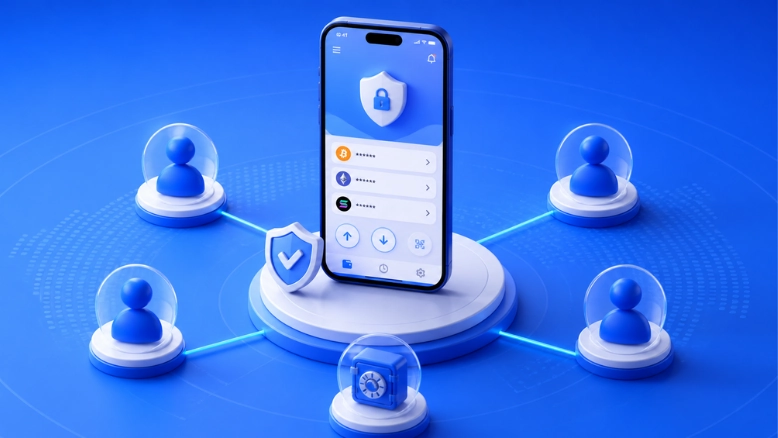
Social recovery is among the most user-centric innovations that smart contract wallets have introduced to the Web3 experience. By allowing users to designate trusted guardians who can collectively authorize wallet recovery through an on-chain vote, social recovery eliminates the terrifying scenario of permanent asset loss through seed phrase destruction or misplacement. Argent pioneered this feature for individual users, and it has since been adopted across multiple smart contract wallet implementations. Gas fee flexibility, enabled by EIP-4337 Paymaster contracts, allows smart contract wallets to pay transaction fees in any ERC-20 token rather than only in the native network token, or to have fees sponsored entirely by the application the user is interacting with. For Web3 applications trying to onboard users in the UK and Canada who have never held cryptocurrency, gasless onboarding that requires no initial crypto purchase is often the decisive factor in whether a user completes registration or abandons the process. Account abstraction combines all of these capabilities into a unified architecture that makes smart contract wallets competitive with the best traditional financial application experiences.
5. Benefits of Smart Contract Wallets
Dramatically Improved Security
Multi-sig and threshold approval requirements eliminate the single private key vulnerability that has cost users billions in losses. No single compromised device or malicious insider can drain a properly configured smart contract wallet.
Superior User Experience
No seed phrases to memorize or store. Gasless transactions via Paymaster contracts. Social login authentication through Google or Apple. Batch transaction execution reducing multiple clicks to one. The best smart contract wallets rival mobile banking app usability.
Programmability and Automation
On-chain spending limits, approved protocol whitelists, time-locked transactions, and automated DeFi strategy execution. Smart contract wallets can encode compliance rules directly, making them ideal for regulated entities in the USA, UK, and UAE markets.
Ideal for Beginners and Institutions Alike
Account abstraction smart wallets onboard crypto beginners with social login and gasless transactions while the same architecture scales to enterprise institutional requirements through configurable multi-sig governance and audit trail capabilities.
6. How Smart Contract Wallets Work: Technical Overview
Transaction Validation and On-Chain Wallet Logic
The technical operation of a smart contract wallet begins when a user initiates an action, such as transferring tokens or interacting with a DeFi protocol. In a traditional EOA wallet, the private key signs the transaction directly and it is submitted to the network. In a smart contract wallet, the process is more sophisticated: the user’s authentication credential (which could be a private key, a biometric signature via passkey, or a social login token) generates a User Operation (in EIP-4337 terminology) that is submitted to a mempool of pending smart wallet transactions called the alternative mempool. Bundlers, which are specialized network participants, aggregate multiple User Operations into a single transaction that calls the EntryPoint smart contract, which then validates each operation against the target smart contract wallet’s logic before executing it. This architecture enables the programmable validation rules that define smart contract wallet capabilities, because the wallet’s contract can implement any validation logic it chooses rather than being constrained to the single private key verification that the Ethereum protocol applies to EOA transactions.
Interaction with dApps and DeFi Protocols
Smart contract wallets interact with decentralized applications through the same standardized interfaces that traditional EOA wallets use, meaning that existing dApps do not need to be modified to support smart contract wallet connections. The wallet connects through WalletConnect or browser extension provider injection just like MetaMask, but the signing and transaction execution layer beneath is governed by the smart contract’s logic rather than a raw private key. This compatibility is critical for adoption because it means users can take their smart contract wallet and immediately use it across the entire existing DeFi, NFT, and gaming ecosystem without waiting for application-level upgrades. Batch transaction execution, a capability unique to smart contract wallets, enables a user to approve a DeFi protocol and make a deposit in a single transaction rather than two sequential ones, saving both gas fees and time while improving the interaction experience significantly.
Authoritative Engineering Principles for Smart Contract Wallet Architecture
Principle 1: Every smart contract wallet deployed to production must undergo a third-party security audit by a recognized firm before holding any user funds, regardless of timeline or budget pressure from stakeholders.
Principle 2: Multi-sig threshold configurations must be set with sufficient redundancy that the loss of any single signer key does not prevent wallet access while still requiring genuine multi-party consensus for high-value operations.
Principle 3: Social recovery guardian selection must prioritize geographic and institutional diversity; guardians who share the same device, location, or organizational affiliation do not provide genuine redundancy against correlated failure scenarios.
Principle 4: Upgrade mechanisms in smart contract wallet implementations must include time-locks and multi-sig approval requirements to prevent malicious or rushed upgrades that could compromise user assets without adequate review.
Principle 5: Gas estimation for smart contract wallet transactions must account for the additional computational overhead of the validation logic; under-estimated gas in complex multi-sig workflows causes transaction failures that erode user trust.
Principle 6: Paymaster contracts sponsoring gas fees for user transactions must implement robust rate limiting and abuse prevention logic to prevent exploitation by malicious actors that would drain the sponsoring account and disrupt legitimate users.
Principle 7: Smart contract wallet implementations must be evaluated for cross-chain compatibility before deployment; an architecture that works on Ethereum mainnet may require significant modification to function correctly on L2 networks used by target users.
Principle 8: Emergency pause and asset freeze capabilities are not optional for smart contract wallets managing institutional or platform-held user funds; the ability to stop operations during a security incident can prevent catastrophic total loss.
7. Use Cases of Smart Contract Wallets in the Web3 Ecosystem
The smart contract wallet’s programmable architecture makes it the ideal infrastructure layer for virtually every category of Web3 application, from personal DeFi participation to enterprise DAO governance. The use cases below represent active deployments where smart contract wallet architecture is delivering measurable advantages over traditional EOA alternatives, with real examples from the USA, UK, UAE, and Canada markets where our agency operates.
Smart Contract Wallet Use Cases Across Web3
DeFi and Yield Management
- Batch approve and deposit in one tx
- Protocol whitelist spending limits
- Automated yield harvesting rules
- Multi-sig DAO treasury governance
- Session keys for DeFi bots
NFT and Digital Asset Management
- Multi-sig for high-value NFT collections
- Time-locked NFT transfer rules
- Fractional ownership governance
- Creator royalty enforcement logic
- ERC-6551 token-bound account support
DAO Governance and Treasury
- Safe multi-sig for all treasury ops
- On-chain voting integration
- Proposal-gated spending execution
- Transparent audit trail on-chain
- Timelocked governance execution
Gaming and Metaverse
- Gasless item trading for players
- Session keys for uninterrupted play
- Embedded smart wallets in-game
- Multi-chain NFT item portability
- Automated reward distribution
8. Smart Contract Wallet vs Traditional Wallet: Full Comparison
A systematic comparison between smart contract wallets and traditional EOA wallets across every material dimension reveals why the industry is transitioning to smart contract wallet architecture as the default for serious Web3 participants, while also highlighting where traditional wallets still have legitimate advantages that must be acknowledged honestly.
Smart Contract Wallet vs Traditional EOA Wallet: Comprehensive Comparison
| Dimension | Traditional EOA Wallet | Smart Contract Wallet |
|---|---|---|
| Security Model | Single private key (high failure risk) | Programmable multi-sig and logic (superior) |
| Recovery Options | Seed phrase only (single point of failure) | Social recovery, multi-guardian, no seed phrase |
| Onboarding Experience | Technical, seed phrase required, gas needed | Social login, gasless, beginner-friendly |
| Gas Fees | Native token only, paid by user always | Any token or gasless via Paymaster sponsorship |
| Transaction Batching | Not supported natively | Native batch execution in one transaction |
| Spending Controls | None (full key = full access) | Configurable per-protocol limits and rules |
| Deployment Cost | Free (no contract deployment) | Gas cost to deploy contract (mitigated on L2) |
| Institutional Governance | Not possible natively | Native multi-sig, audit trails, policy enforcement |
9. Challenges and Limitations of Smart Contract Wallets
An honest assessment of smart contract wallets must acknowledge the genuine challenges and limitations that prevent universal adoption today. These are not theoretical concerns but practical obstacles that our agency has navigated on behalf of clients, and understanding them enables better decision-making about when and how to adopt smart contract wallet architecture.
⚠ Gas Fees and Deployment Costs
Deploying a smart contract wallet requires an on-chain transaction that costs gas. On Ethereum mainnet, this can cost $10-50 per deployment. While Layer 2 networks have reduced this to cents, the deployment cost still represents friction compared to the zero-cost EOA wallet creation that requires only generating a key pair locally.
⚠ Smart Contract Vulnerability Risk
The security of a smart contract wallet is only as good as the underlying contract code. Bugs in wallet contracts can be exploited to drain user funds, as demonstrated by historical incidents affecting early wallet implementations. Rigorous auditing is mandatory but does not provide absolute security guarantees against novel attack vectors.
⚠ Complexity for Builders
Building and integrating smart contract wallet infrastructure requires significantly more engineering expertise than supporting traditional EOA wallets. The EIP-4337 stack including bundlers, Paymasters, and the EntryPoint contract introduces new components that teams must understand, deploy, and maintain correctly to ensure reliable operation.
⚠ Adoption and Ecosystem Friction
Not all dApps fully support smart contract wallet interactions in 2026. Signing message standards (EIP-1271) are required for smart wallets to authenticate with applications that expect EOA signatures, and some older protocols have not yet implemented this support, creating compatibility gaps that frustrate users attempting to use smart wallets with certain DeFi applications.
10. Future Trends of Smart Contract Wallets in Web3
EIP-4337, AI Integration, and the Path to Mass Adoption
The future of the smart contract wallet is defined by the convergence of several powerful technical and market forces that are collectively creating the conditions for mainstream Web3 adoption at a scale not previously achievable. EIP-4337 account abstraction, already live on major networks, continues to evolve with proposals including EIP-7702 (which enables EOA wallets to temporarily adopt smart contract wallet capabilities for specific transactions) and EIP-4337 improvements that reduce Bundler infrastructure costs and improve transaction reliability. AI integration represents perhaps the most transformative near-term development for the smart contract wallet user experience: AI assistants embedded in wallet interfaces can translate complex DeFi interactions into plain language explanations before execution, detect suspicious transaction patterns in real time, and proactively suggest optimal gas timing and routing for pending user operations. For the UAE market in particular, where VARA is actively encouraging innovation-forward wallet approaches, AI-enhanced smart contract wallets are already being piloted by licensed virtual asset service providers as the basis for next-generation retail crypto products.
Enterprise Solutions and Regulatory Alignment
Enterprise adoption of smart contract wallets is accelerating significantly in 2026, driven by a combination of institutional crypto treasury growth and regulatory requirements that smart contract wallet architecture uniquely satisfies. Major financial institutions including JP Morgan, Standard Chartered, and HSBC are implementing or piloting smart contract wallet solutions for digital asset custody and settlement operations. The programmable compliance capabilities of smart contract wallets, including on-chain enforcement of transaction limits, approved counterparty lists, and reporting triggers, align directly with the expectations of financial regulators in the USA, UK, UAE, and Canada for institutions managing digital assets. Safe’s enterprise offering has been adopted by over 200 corporations for treasury management, and the product category is growing at over 150% annually by wallet deployment count. The increasing regulatory clarity in key markets is removing a major adoption barrier, as institutions previously reluctant to deploy smart contract wallet infrastructure without clear regulatory guidance now have clearer frameworks to operate within.
11. Best Smart Contract Wallet Examples in 2026
Leading Smart Contract Wallets: Feature and Use Case Comparison
| Wallet | Key Feature | Best Use Case | AA Support | Audit Status |
|---|---|---|---|---|
| Safe (Gnosis Safe) | Institutional multi-sig | DAO treasuries, enterprises | Yes (Safe{Core}) | Fully Audited |
| Argent | Social recovery | DeFi individual users | Yes (StarkNet native) | Fully Audited |
| Coinbase Smart Wallet | Passkey auth, gasless | Mainstream onboarding | Full EIP-4337 | Fully Audited |
| Biconomy Smart Account | SDK for dApp integration | Web3 app user onboarding | Full EIP-4337 | Fully Audited |
| ZeroDev Kernel | Modular plugin system | Custom wallet builders | Full EIP-4337 | Partially Audited |
12. How to Choose the Right Smart Contract Wallet
Selecting the right smart contract wallet requires a systematic evaluation across four primary dimensions that determine whether the wallet serves your specific security requirements, user base, dApp ecosystem, and budget constraints. Our agency has developed the following framework from eight years of wallet selection advisory engagements across the USA, UK, UAE, and Canada.
3-Step Smart Contract Wallet Selection Framework
Define Security and Governance Requirements
Determine whether you need multi-sig for organizational governance, social recovery for individual users, or a gasless embedded solution for application onboarding. The security architecture requirement determines the wallet type before any other evaluation factor is considered. An individual user and a DAO treasury have fundamentally different security requirements that map to different wallet implementations.
Verify dApp Compatibility and Network Support
Confirm that the smart contract wallet supports EIP-1271 for message signing compatibility with your target dApps, and that it operates on the specific blockchain networks your users will need. Multi-chain support with consistent wallet addresses across chains (counterfactual deployment) is a significant advantage for users operating across multiple networks simultaneously.
Evaluate Audit History and Ongoing Security Program
Review the smart contract wallet’s complete audit history from recognized security firms. Confirm that audits cover the current contract version and that the team has a documented process for addressing discovered vulnerabilities. Bug bounty programs through Immunefi provide ongoing community-driven security assurance that complements formal audits for any smart contract wallet managing significant user funds.
Smart Contract Wallet Evaluation Checklist
13. Conclusion: Smart Contract Wallets Are the Future of Web3
The rise of the smart contract wallet in the Web3 ecosystem is not a trend or a passing innovation cycle but a fundamental architectural transition that is redefining what a cryptocurrency wallet can and should be. The traditional EOA model, built on the assumption that individual users can reliably manage private keys and seed phrases across a lifetime of usage, has been proven inadequate by the billions of dollars lost to key compromise and seed phrase mismanagement documented annually. The smart contract wallet resolves this inadequacy at the architectural level, replacing a brittle single point of failure with programmable, distributed, and recoverable wallet logic that provides superior security without sacrificing the self-custody that makes Web3 fundamentally different from traditional finance.
The combination of EIP-4337 account abstraction, social recovery, gasless transaction sponsorship, and multi-signature institutional governance in a single wallet architecture represents the most complete solution to the Web3 onboarding and retention problem that the industry has produced. For individual users in the USA, UK, UAE, and Canada exploring Web3 for the first time, smart contract wallets offer an experience comparable to the best mobile banking applications without sacrificing asset sovereignty. For institutions and DAOs managing significant on-chain treasuries, smart contract wallets provide the governance framework required for responsible stewardship of community assets. For Web3 application builders, embedded smart contract wallet infrastructure enables onboarding flows that are finally competitive with Web2 consumer applications in terms of friction and accessibility.
Key Summary: Why Smart Contract Wallets Are Winning in 2026
- Security: Multi-sig and threshold approval eliminate single-key vulnerability that has cost the industry billions in documented losses
- Recovery: Social recovery removes seed phrase as single point of failure, enabling secure wallet recovery without centralized custodians
- Usability: Account abstraction delivers gasless, social-login-enabled onboarding that mainstream users can navigate without crypto expertise
- Programmability: On-chain spending limits, whitelist rules, and automated execution enable use cases impossible with traditional EOA wallets
- Institutional fit: Multi-sig governance, audit trails, and programmable compliance meet the requirements of regulated entities in every major market
- Future trajectory: AI integration, EIP-4337 improvements, and regulatory alignment are all accelerating smart contract wallet adoption globally
Frequently Asked Questions
Q1.What is a smart contract wallet?
A smart contract wallet is a blockchain-based wallet controlled by a smart contract instead of a private key, enabling advanced features like automation and enhanced security.
Q2.How is a smart contract wallet different from a traditional crypto wallet?
Unlike traditional wallets that rely on private keys, a smart contract wallet uses programmable logic, allowing features like multi-signature, social recovery, and custom rules.
Q3.Is a smart contract wallet safe to use?
Yes, a smart contract wallet is generally more secure due to features like multi-signature authentication and recovery options, but its safety depends on the smart contract code quality.
Q4.What are the main benefits of a smart contract wallet?
Key benefits include improved security, better user experience, programmable transactions, and no need to manage complex seed phrases.
Q5.Can beginners use a smart contract wallet?
Yes, many modern smart contract wallet solutions are designed to be user-friendly, making them suitable for beginners in the Web3 space.
Q6.What is social recovery in a smart contract wallet?
Social recovery allows users to recover access to their smart contract wallet through trusted contacts instead of relying solely on a seed phrase.
Q7.Are smart contract wallets expensive to use?
They may have higher initial deployment or gas fees, but offer long-term benefits in flexibility and security.
Q8.Which blockchains support smart contract wallets?
Popular blockchains like Ethereum and other EVM-compatible networks support smart contract wallet functionality.
Q9.What are some examples of smart contract wallets?
Examples include Argent, Safe (formerly Gnosis Safe), and other Web3 wallets that support programmable features.
Q10.Are smart contract wallets the future of Web3?
Yes, the smart contract wallet is considered a key innovation driving mass adoption in Web3 due to its flexibility, security, and user-friendly features.
Explore Services
Related Services
Reviewed by

Aman Vaths
Founder of Nadcab Labs
Aman Vaths is the Founder & CTO of Nadcab Labs, a global digital engineering company delivering enterprise-grade solutions across AI, Web3, Blockchain, Big Data, Cloud, Cybersecurity, and Modern Application Development. With deep technical leadership and product innovation experience, Aman has positioned Nadcab Labs as one of the most advanced engineering companies driving the next era of intelligent, secure, and scalable software systems. Under his leadership, Nadcab Labs has built 2,000+ global projects across sectors including fintech, banking, healthcare, real estate, logistics, gaming, manufacturing, and next-generation DePIN networks. Aman’s strength lies in architecting high-performance systems, end-to-end platform engineering, and designing enterprise solutions that operate at global scale.