Ai Overview
Smart contracts were needed because traditional contracts depend on middlemen like banks, lawyers, and agents to manage and enforce agreements. People have to wait for approvals, paperwork, and manual checks, which often leads to delays and mistakes. There is also a risk of fraud or unfair behavior when too much trust is placed in humans. Another major problem with traditional contracts is the lack of transparency.
Key Takeaways
- Smart contracts work automatically without banks, lawyers, or agents, helping save time and reduce costs.
- They execute actions on their own once predefined conditions are met, with no need for human approval.
- Smart contracts are stored on the blockchain, making them secure, transparent, and impossible to change.
- They follow a structured process including planning, coding, testing, auditing, deployment, triggering, execution, and recording.
- Smart contracts generate logs for important actions, helping track activity history and maintain transparency.
- If conditions are not met or something goes wrong, the contract does nothing, protecting funds and preventing errors.
- Oracles supply real-world data such as prices, weather, or event results so contracts can respond accurately.
- Some smart contracts are designed for one-time use like escrow, while others are reusable for DeFi or NFT platforms.
- Certain smart contracts are upgradeable, allowing improvements or fixes without losing trust or functionality.
- They are widely used in finance apps, NFT marketplaces, escrow services, and DAO voting systems.
Traditional contracts are slow and costly, but smart contracts work automatically without middlemen. This can cause delays, extra costs, and mistakes. Sometimes, human errors or unfair behavior create problems, and it is hard for everyone to see what is happening in real time.
Smart contracts solve these problems. They are computer programs that run on a blockchain and automatically execute agreements when conditions are met. There is no need for middlemen, so processes are faster and cheaper. The blockchain keeps everything secure, transparent, and unchangeable, so everyone can trust that the rules will be followed exactly.
This guide explains how smart contracts work, making digital agreements faster, safer, and more reliable. It helps anyone understand how these digital contracts make transactions faster, safer, and more reliable.
Why Smart Contracts Were Needed
Smart contracts were needed because traditional contracts depend on middlemen like banks, lawyers, and agents to manage and enforce agreements. This makes processes slow, expensive, and complicated. People have to wait for approvals, paperwork, and manual checks, which often leads to delays and mistakes. There is also a risk of fraud or unfair behavior when too much trust is placed in humans.
Another major problem with traditional contracts is the lack of transparency. It is difficult for all parties to track what is happening in real time. Disputes can arise because records are not always clear or easily verifiable. Once a contract is signed, enforcing it still requires legal action, which costs time and money.
Smart contracts solve these issues by turning agreements into computer code that runs on a blockchain. According to Openware News, They automatically execute actions when conditions are met, without needing human involvement. This removes the need for intermediaries and reduces costs.
Because smart contracts are stored on the blockchain, they are secure, transparent, and cannot be changed. Everyone can verify the rules and outcomes. This makes transactions faster, safer, and more trustworthy. Blockchain technology introduced a better way. By understanding how smart contracts work, we see how automation removes trust issues and ensures fair execution.
How Smart Contracts Work?
Smart contracts are self-executing programs stored on a blockchain that automatically enforce agreements when predefined conditions are met. Below is a clear, step-by-step breakdown of how smart contracts work from idea to execution explained in simple, practical terms.
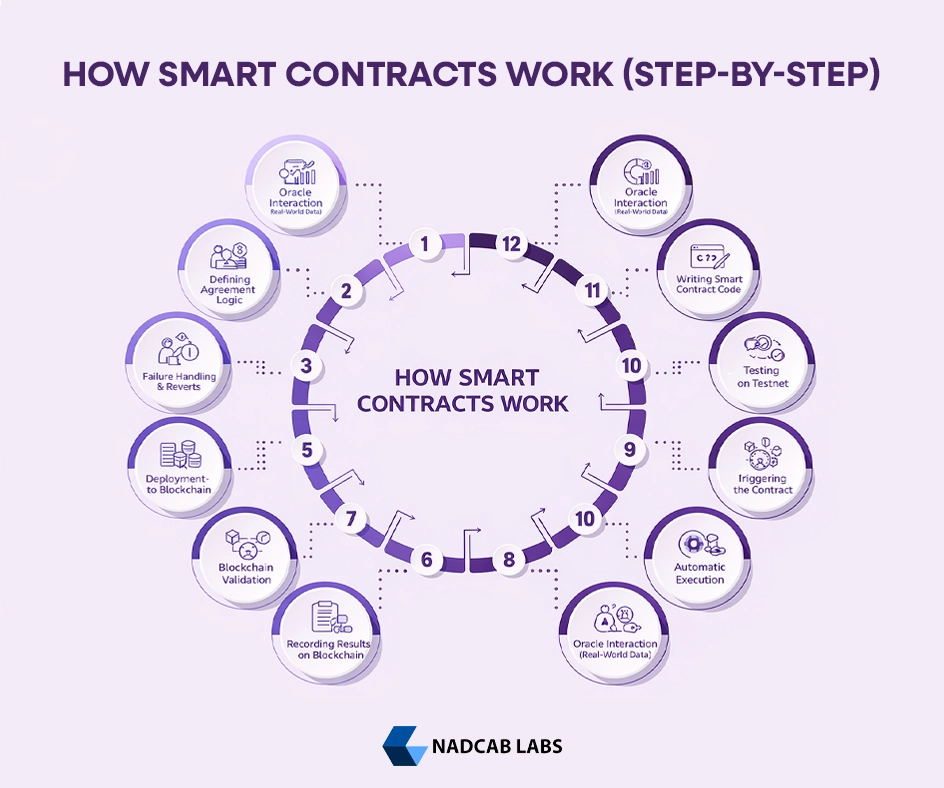 Step 1: Defining the Agreement Logic
The first step in creating a smart contract is defining the agreement logic. This means clearly deciding what the contract should do and how it should behave. Before coding, the participants need to answer several key questions:
- Who is involved in the contract?
- What assets (crypto, tokens, NFTs) are part of the contract?
- What actions should happen when conditions are met?
- What happens if the conditions are not met?
In traditional contracts, lawyers write these rules in legal language, which can be open to interpretation. Smart contracts convert these rules into exact instructions in code.
For example, a simple escrow contract might say: “If the buyer sends payment, release the product to the buyer. If payment is not received within 7 days, refund the seller.” This logic ensures there is no ambiguity, and the computer will execute exactly what is programmed. Clearly defining this logic is critical because once the smart contract is on the blockchain, changing it is almost impossible.
Step 2: Designing the Smart Contract Architecture
Once the logic is defined, the next step is to design the smart contract architecture. This architecture decides how the contract will store data, perform actions, and interact with users or other contracts. A clear design reduces errors and ensures the contract runs efficiently on the blockchain.
Key components of smart contract architecture include:
- State Variables: Store important information like balances, ownership, and contract status.
- Functions: Define actions that users or other contracts can perform, such as transferring funds or minting tokens.
- Modifiers: Control access, ensuring only authorized participants can execute certain actions.
- Events: Track contract activity and provide transparency.
- State Machine: Defines allowed state transitions, e.g., Created → Funded → Released.
Architecture design also considers security, gas efficiency, and scalability. Poor design can lead to high transaction costs or unintended behaviors. A well-structured architecture ensures the smart contract behaves predictably, avoids mistakes, and is easier to maintain or upgrade. By carefully designing the structure, developers lay a strong foundation for safe and reliable smart contract operation.
Reusability and Upgradability
Some smart contracts can be reused many times, like in DeFi or NFT marketplaces, while others are for one-time use, like escrow. Upgradeable contracts let developers fix bugs, add features, or improve them safely using methods like proxy or modular upgrades, keeping user funds secure and trust intact.
Step 3: Writing the Smart Contract Code
After designing the architecture, developers write the smart contract code using a blockchain programming language. The most common languages include:
- Solidity: Used in Ethereum, Binance Smart Chain, and Polygon.
- Vyper: Security-focused alternative for Ethereum.
- Rust: Used for Solana and Near blockchain.
- Move: Used for Aptos and Sui blockchains.
The code contains variables, functions, and conditional logic. Variables store essential data like balances or token ownership. Functions define what actions the contract can perform, such as sending funds or minting an NFT. Conditional logic ensures the contract only executes under the right conditions. For instance, a payment function should only work if the sender has enough balance.
Writing secure code is crucial. Bugs can cause financial loss, especially in contracts managing large sums. Developers also include error handling to prevent unexpected behavior. This step converts the agreed logic into instructions that the blockchain can follow without any human intervention. Proper coding ensures the contract works reliably and safely.
Step 4: Testing the Smart Contract
Before a smart contract is deployed, it must undergo thorough testing to ensure it behaves correctly and securely. Testing identifies bugs, prevents potential financial losses, and builds confidence in the system. Developers usually test contracts on testnets, which are blockchain networks that simulate real-world operations without risking actual funds. Testing ensures that the contract performs as expected under all conditions and prevents unexpected errors after deployment.
Types of testing include:
- Unit Testing: Checks individual functions one by one to ensure each works as intended.
- Integration Testing: Ensures different parts of the contract work together properly.
- Edge Case Testing: Tests unusual or extreme scenarios, such as maximum payment amounts or invalid inputs.
- Gas Testing: Measures transaction costs and optimizes efficiency to reduce fees.
For example, in an escrow contract, testing ensures that if a buyer fails to send payment, the seller is refunded correctly. Testing also confirms that funds cannot be stolen or lost due to errors in the contract’s logic. Thorough testing reduces the risk of failures when the contract interacts with real users and assets.
By performing rigorous tests, developers make smart contracts safe, reliable, and ready for the blockchain, which builds user trust and prevents costly mistakes.
Step 5: Handling Failures and Reverts
Smart contracts follow strict rules. If the conditions for execution are not met, the contract does not partially execute. Instead, the blockchain reverts the transaction to prevent unintended effects.
What happens on failure:
- The transaction is reverted, meaning no changes are saved.
- The contract’s state remains unchanged.
- Funds are not lost, except for the gas fee paid to execute the transaction.
This mechanism ensures atomicity: either all actions in the transaction succeed, or none do. For example, if a payment contract requires a minimum amount, sending less than the required value triggers a revert. This prevents money from being incorrectly transferred or locked in the contract.
Handling failures and reverting correctly is essential to maintaining trust and security. Users can interact confidently with smart contracts knowing that errors will not result in lost funds or inconsistent states.
Step 6: Smart Contract Auditing
Smart contracts often manage large amounts of funds, making security auditing a critical step. An audit is a professional review of the smart contract code to identify vulnerabilities, logical errors, or inefficiencies. Audits are performed by experienced teams who ensure the contract is safe and reliable before it goes live.
Key areas auditors focus on include:
- Reentrancy attacks: Prevent multiple unauthorized withdrawals during a single transaction.
- Overflow and underflow errors: Ensure numerical calculations do not exceed storage limits.
- Unauthorized access: Verify that critical functions are accessible only to permitted users.
- Gas inefficiencies: Identify code that consumes excessive gas and increases transaction costs.
- Logical errors: Confirm the contract behaves correctly in all possible scenarios.
A well-audited smart contract guarantees that user funds are secure and the system functions as intended. Since smart contracts are immutable after deployment, any mistakes cannot be easily fixed. Auditing protects against hacks, financial loss, and reputation damage. Many blockchain projects conduct multiple rounds of audits to ensure security, efficiency, and reliability.
This step builds trust among users and ensures the contract operates safely in real-world conditions.
Step 7: Deploying the Smart Contract
After thorough testing and auditing, the next step is deploying the smart contract to the blockchain. Deployment means the contract becomes live, and users can start interacting with it.
Before deployment, the smart contract code is compiled into bytecode, which is a machine-readable format the blockchain can execute. Once compiled, the contract is broadcast to the network, where validators or miners check its validity and confirm that it follows all the blockchain’s rules.
During deployment, the blockchain assigns the contract a unique address, which acts as its identity on the network. This address allows users and other contracts to interact with it. Once deployed, the contract becomes immutable, meaning its code cannot be changed. This immutability ensures that the rules defined in the contract are strictly enforced, making it secure and trustworthy.
Key points about deployment:
- Converts code into bytecode readable by the blockchain.
- Broadcasts contract to the network for validation.
- Validators confirm and assign a unique address.
- Ensures immutability and transparency.
Deployment is a critical step because it moves the smart contract from a controlled development environment to the real blockchain, where it can handle real assets and interact with actual users securely.
Step 8: Triggering the Smart Contract
Smart contracts are passive programs until they are triggered. Triggers are events that tell the blockchain to execute a specific function in the contract. Without a trigger, a smart contract remains dormant. Triggers can come from multiple sources, depending on the contract’s design.
Common types of triggers include:
- A transaction from a user, such as sending cryptocurrency or tokens.
- A call from another smart contract.
- Time-based triggers, like executing a function at a specific block number.
- External data from oracles, such as price feeds, weather data, or sports results.
For example, in a DeFi lending platform, when a user deposits funds, the contract is triggered to calculate interest and update the user’s balance automatically. Triggers make smart contracts dynamic and interactive, allowing them to react instantly to user actions or real-world events.
Smart contracts execute the triggered function deterministically, following the exact rules programmed in the code. This ensures trustless operation, meaning no human interference or manipulation is possible, and the outcome is always predictable and secure.
Step 9: Validation by the Blockchain
Before a triggered smart contract can execute, the blockchain network performs validation checks to ensure that the transaction complies with the rules. Validators or miners confirm that the contract execution is legitimate and safe. Validation is crucial for security, accuracy, and trust in blockchain operations.
Validation checks usually include:
- Ensuring the sender has enough funds to perform the transaction.
- Verifying that the requested function exists and can be executed.
- Checking that all conditions in the contract are met.
- Confirming that there is enough gas to perform the operation.
If any of these checks fail, the transaction is rejected, and the blockchain state remains unchanged. This prevents mistakes, fraud, or unauthorized actions. Validation ensures that smart contracts are tamper-proof and that all interactions are reliable.
Through this consensus process, the blockchain guarantees that only legitimate transactions are executed. This step is essential for maintaining trust, especially when contracts manage valuable assets or involve multiple participants in decentralized finance, NFT marketplaces, or governance systems.
Step 10: Automatic Execution
Once validated, the smart contract executes automatically, without human intervention. This is one of the key benefits of smart contracts, they perform tasks trustlessly and predictably.
Examples of automatic execution include:
- Transferring cryptocurrency or tokens between users.
- Releasing funds from escrow to the intended recipient.
- Minting new NFTs and transferring them to the buyer.
- Recording votes or decisions in a DAO governance system.
Automatic execution ensures that the smart contract follows the exact rules defined in its code. Users cannot alter the outcome, and no party can cheat or manipulate the process. Execution is also instant, reducing delays compared to traditional contracts that rely on intermediaries.
This automation brings efficiency, reduces operational costs, and eliminates disputes. Users and participants can interact with the contract confidently, knowing the system is reliable, transparent, and secure, and all actions are performed exactly as agreed.
Step 11: Recording Results on the Blockchain
After a smart contract runs, all results are saved permanently on the blockchain. This means every action, transaction, and change in ownership is recorded for everyone to see. Because the blockchain is tamper-proof, no one can change or delete these records. This makes smart contracts safe, reliable, and transparent for all users.
What gets recorded:
- Transaction details: who sent assets and who received them.
- Ownership changes: tokens, NFTs, or other digital items.
- Updates to contract state: balances, votes, or other important information.
- Event logs: important actions like minting, transferring, or selling tokens.
Smart contracts also emit events, which act like notifications whenever something important happens. These events let apps and users track activity without checking every transaction on the blockchain.
Why events are useful:
- Show real-time updates in apps or dashboards.
- Keep a clear history of actions for users and auditors.
- Help users trust the system because they see what is happening.
- Allow developers to analyze how the contract is being used.
For example, in an NFT marketplace, an event is triggered whenever a token is minted or sold. This helps apps show updates instantly and keeps everything transparent and trustworthy.
Step 12: Interaction with Oracles
Smart contracts cannot access external data directly. To interact with the real world, they rely on oracles, which act as bridges between blockchain and off-chain information.
Oracle data can include:
- Asset prices (for DeFi platforms)
- Weather conditions (for insurance contracts)
- Sports results (for prediction markets)
- Time-based triggers (to execute actions at specific times)
Oracles fetch trusted data from multiple sources, verify it, and provide it to smart contracts securely.
For example, a decentralized insurance contract for farmers might rely on a weather oracle to determine rainfall levels. If the rainfall is below a threshold, the contract automatically pays out insurance. Using secure, decentralized oracles ensures that smart contracts can interact with real-world data safely, making applications more versatile and useful across industries.
Want to Understand How Smart Contracts Work?
Learn how smart contracts work step by step on blockchain. Understand how conditions are verified, actions are executed automatically, and results are recorded securely.
Gas Fees / Transaction Cost
Every time a smart contract runs, it needs gas, which is a fee paid to the blockchain network. If the contract has complex functions or is not optimized, gas costs more. Simple and well-planned contracts use less gas, saving money for users. Testing on testnets and designing the contract efficiently can help reduce unnecessary fees.
Since users pay for each action, developers focus on writing lightweight and efficient code. Lower gas fees make contracts faster, cheaper, and easier for people to use, improving the overall experience of blockchain applications.
Security Best Practices
Smart contracts handle valuable funds, so keeping them secure is very important. Beyond regular audits, developers can use multi-signature wallets, which require multiple approvals for critical actions, and access control, which limits who can perform certain functions. Testing on multiple testnets before going live helps find and fix bugs safely.
These steps reduce the risk of hacks, mistakes, or unauthorized actions. Following security best practices ensures that smart contracts are reliable, funds are protected, and users can trust the system. Strong security builds confidence in real-world blockchain applications.
Real-World Use Cases
Smart contracts are used in many industries to automate processes and increase trust. Key examples include:
- DeFi: Lending, borrowing, and earning interest through yield farming.
- NFTs: Minting, buying, selling, and transferring tokens easily.
- DAOs: Voting, governance, and managing community decisions.
- Supply Chain: Tracking products, verifying authenticity, and reducing fraud.
These contracts reduce intermediaries, save time, and make systems transparent and reliable. By using smart contracts, businesses and users can perform actions automatically, safely, and without relying on a central authority.
Limitations / Risks
Smart contracts are very useful but not completely risk-free. According to Koinly Blog, Some common problems:
- Bugs or coding mistakes that can lead to loss of funds.
- Oracle failures, where external data like prices or weather is wrong, affecting contract results.
- Scalability issues, which can slow transactions or increase gas fees on busy blockchains.
Knowing these limitations helps us understand how smart contracts work in real-world conditions, not just theory. While smart contracts are automated and transparent, it’s important to test thoroughly, monitor performance, and plan safeguards to reduce errors and ensure smooth operations in real-world applications.
Final Words
Smart contracts are changing the way agreements work. They remove middlemen, reduce costs, and make sure everything happens exactly as planned. The blockchain makes them secure, transparent, and tamper-proof, so everyone can see and trust the results.
From planning, coding, and testing to deployment, triggering, execution, and recording results, every step ensures the smart contracts work safely. Features like events, failure handling, oracle integration, reusability, and upgradability make them more flexible and trustworthy.
Smart contracts are useful for DeFi apps, NFT marketplaces, escrow services, and DAO governance, helping people and businesses complete transactions quickly and safely. As blockchain technology grows, smart contracts will play an even bigger role in making digital agreements simple, reliable, and fair.
Frequently Asked Questions
Q1.How do smart contracts work?
A smart contract is a program on the blockchain that runs automatically when certain conditions are met. It removes middlemen like banks or lawyers, making agreements faster, cheaper, and secure. Once deployed, it executes exactly as coded, ensuring trust, transparency, and no human errors in transactions.
Q2.What are the four steps in executing a smart contract?
Smart contracts run in four main steps: Triggering (user action or oracle data starts it), Validation (blockchain checks conditions and funds), Automatic Execution (contract performs actions), and Recording Results (all outcomes are saved on the blockchain for transparency and verification).
Q3.Can a smart contract fail?
Yes, smart contracts can fail if conditions are not met. In such cases, the blockchain reverts the transaction, meaning no changes occur and funds remain safe (except gas fees). This ensures either all actions succeed or none do, preventing mistakes or loss of money.
Q4.How are smart contracts deployed?
After coding, testing, and auditing, smart contracts are converted to blockchain-readable bytecode and deployed. They receive a unique blockchain address and become immutable, meaning the code cannot be changed. This ensures trust, security, and transparency for all users interacting with the contract.
Q5.Can smart contracts be reused or upgraded?
Some contracts are single-use, like escrow, while others can be reused for DeFi, NFTs, or DAOs. Upgradeable contracts use proxy methods, modular designs, or governance approval to allow bug fixes or new features without losing user trust or security.
Q6.Are smart contracts safe to use?
Yes, if properly coded, audited, and tested. Extra security measures like multi-signature wallets, strict access control, and testing on multiple testnets reduce risks of hacks, bugs, or unauthorized actions, keeping users’ funds safe and building trust in real-world blockchain applications.
Q7.Where are smart contracts used in the real world?
Smart contracts are used in DeFi for lending and borrowing, NFT marketplaces for minting and trading, DAOs for voting, and supply chains for tracking products. They reduce intermediaries, save time, automate processes, and make systems more reliable, transparent, and trustworthy.
Q8.Do smart contracts need internet access?
No, smart contracts cannot access external data directly. They rely on oracles, which securely fetch real-world information like prices, weather, or sports results and provide it to the contract. Oracles allow smart contracts to react safely to external events.
Explore Services
Related Services
Reviewed by

Aman Vaths
Founder of Nadcab Labs
Aman Vaths is the Founder & CTO of Nadcab Labs, a global digital engineering company delivering enterprise-grade solutions across AI, Web3, Blockchain, Big Data, Cloud, Cybersecurity, and Modern Application Development. With deep technical leadership and product innovation experience, Aman has positioned Nadcab Labs as one of the most advanced engineering companies driving the next era of intelligent, secure, and scalable software systems. Under his leadership, Nadcab Labs has built 2,000+ global projects across sectors including fintech, banking, healthcare, real estate, logistics, gaming, manufacturing, and next-generation DePIN networks. Aman’s strength lies in architecting high-performance systems, end-to-end platform engineering, and designing enterprise solutions that operate at global scale.