Ai Overview
Real estate tokenization represents a fundamental shift in how property ownership is structured, recorded, and transferred through the application of distributed ledger technology to create digital representations of ownership rights. Platform should support at least 10,000 concurrent investors per asset with demonstrated capacity to scale to 100,000+ for widely distributed offerings without performance degradation.
Key Takeaways
- Selecting a real estate tokenization partner requires evaluating technical expertise, regulatory compliance capabilities, security infrastructure, and proven track records across multiple jurisdictions including USA, UK, UAE, and Canada.
- A qualified tokenization partner must demonstrate blockchain platform proficiency, smart contract audit experience, legal structuring knowledge, and integration capabilities with KYC/AML systems to ensure investor protection and regulatory adherence.
- Transparent pricing structures, comprehensive documentation, ongoing technical support commitments, and clear token economics models are essential indicators of a trustworthy real estate tokenization partner relationship.
- Jurisdictional expertise is critical as regulations governing tokenized real estate vary significantly between markets, requiring partners with specific knowledge of SEC compliance, FCA frameworks, DFSA/VARA regulations, and CSA guidelines.
- Security architecture quality, including multi-signature wallets, third-party smart contract audits, penetration testing results, and custody solutions, directly impacts investor confidence and asset protection in tokenized real estate offerings.
- Evaluating a partner’s portfolio of live tokenized assets, client testimonials, regulatory approvals, and secondary market performance provides concrete evidence of their capability to deliver successful real estate tokenization projects.
- Red flags to avoid include lack of transparent pricing, absence of security audits, limited regulatory knowledge, no verifiable client references, proprietary platform lock-in requirements, and unrealistic timeline or return projections.
- The final partner selection should balance technical capabilities, regulatory expertise, cost effectiveness, long-term support commitments, and cultural alignment to ensure a successful multi-year tokenization relationship that adapts to evolving market conditions.
The real estate tokenization market has experienced exponential growth over the past five years, with tokenized property values exceeding $3.8 billion globally as institutional investors and property developers recognize the transformative potential of blockchain technology. This digital revolution in property ownership is reshaping how investors access real estate markets, how assets are managed, and how liquidity is created in traditionally illiquid investment classes. However, the success of any real estate tokenization initiative depends fundamentally on selecting the right technology and advisory partner to navigate the complex intersection of property law, securities regulation, blockchain infrastructure, and investor expectations.
For property owners, developers, and investment firms exploring tokenization opportunities, the partner selection process represents one of the most critical decisions that will determine project success or failure. An experienced real estate tokenization partner brings not only technical capabilities but also regulatory knowledge, legal frameworks, investor relations systems, and market credibility that can accelerate time to market while minimizing compliance risks. Conversely, selecting an inexperienced or unqualified partner can result in regulatory violations, technical failures, investor disputes, reputational damage, and complete project abandonment with significant financial losses.
This comprehensive guide draws on over eight years of experience in blockchain-enabled real estate transactions to provide property stakeholders with a systematic framework for evaluating, comparing, and selecting a trusted real estate tokenization partner. We examine the technical, regulatory, operational, and financial considerations that should inform your decision-making process, with specific attention to compliance requirements in major markets including the United States, United Kingdom, United Arab Emirates (particularly Dubai), and Canada where regulatory frameworks have matured sufficiently to support institutional-grade tokenization projects.
Understanding Real Estate Tokenization and Its Business Impact
Real estate tokenization represents a fundamental shift in how property ownership is structured, recorded, and transferred through the application of distributed ledger technology to create digital representations of ownership rights. At its core, tokenization involves converting the economic rights associated with a physical property asset into digital tokens that exist on a blockchain network, where each token represents either fractional or complete ownership stakes governed by smart contracts that automate compliance, distributions, and transfer restrictions according to predefined rules and regulatory requirements.
The business case for real estate tokenization extends beyond technological innovation to address longstanding inefficiencies in property markets that have limited investor access, reduced liquidity, increased transaction costs, and created information asymmetries between stakeholders. By enabling fractional ownership through token division, property owners can access broader investor bases including retail participants who previously lacked the capital to invest in institutional-quality real estate. This democratization of access simultaneously creates liquidity opportunities through secondary market trading that transforms real estate from a purely illiquid hold-to-maturity investment into a tradable asset class with price discovery mechanisms.
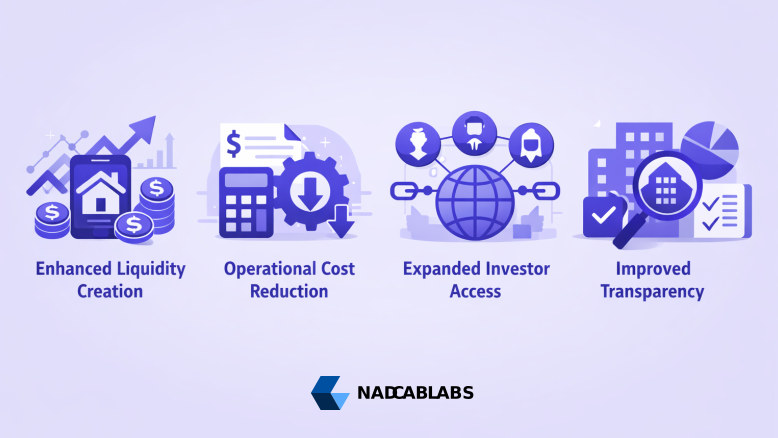
Core Business Benefits of Real Estate Tokenization
Enhanced Liquidity Creation
- Secondary market trading enables exit opportunities before property sale
- Fractional tokens lower minimum investment thresholds significantly
- 24/7 global trading potential across multiple time zones
- Price discovery through continuous market-based valuation
Operational Cost Reduction
- Smart contract automation eliminates intermediary fees
- Reduced legal and administrative overhead per transaction
- Automated compliance reduces ongoing regulatory costs
- Streamlined investor onboarding and management processes
Expanded Investor Access
- Global investor participation without geographic restrictions
- Lower capital requirements broaden investor demographics
- Institutional and retail investors in single offering structure
- Transparent ownership records enhance investor confidence
Improved Transparency
- Immutable blockchain records create complete audit trails
- Real-time ownership visibility for all stakeholders
- Automated reporting reduces information asymmetries
- Enhanced investor protection through transparent governance
The technical infrastructure supporting real estate tokenization has evolved considerably since early experimental projects, with mature platforms now offering enterprise-grade security, regulatory compliance automation, investor management systems, and integration capabilities with traditional financial infrastructure. Modern tokenization solutions leverage programmable smart contracts that encode complex ownership structures, distribution waterfalls, voting rights, transfer restrictions, and compliance requirements directly into the token logic, eliminating the need for manual oversight of many administrative functions that historically required legal intermediaries and administrative staff.
However, realizing these benefits requires navigating a complex landscape of regulatory requirements, technical decisions, legal structuring considerations, and operational challenges that vary significantly across jurisdictions and property types. This complexity underscores why selecting an experienced real estate tokenization partner with proven capabilities across multiple domains is essential for project success. The partner you choose will influence not only the technical architecture and regulatory compliance of your tokenization initiative but also investor confidence, secondary market performance, long-term operational efficiency, and ultimately the financial returns achieved through blockchain-enabled property ownership.
Why Choosing the Right Tokenization Partner Is Critical
The selection of a real estate tokenization partner represents a strategic decision with multi-year implications that extend far beyond the initial token issuance event. Unlike traditional software implementations that can be replaced or upgraded with minimal disruption, blockchain-based tokenization creates permanent immutable records, establishes investor relationships governed by smart contract logic, and creates ongoing compliance obligations that tie your organization to the chosen partner’s platform, expertise, and support capabilities for the entire lifecycle of the tokenized asset.
The consequences of selecting an inadequate real estate tokenization partner manifest across multiple dimensions of project risk and operational performance. From a regulatory perspective, partners lacking deep expertise in securities law and property regulations across your target jurisdictions create exposure to enforcement actions, investor lawsuits, offering rescission requirements, and reputational damage that can extend beyond the specific tokenized asset to affect your organization’s broader business operations and future capital raising capabilities. Regulatory violations in tokenized securities offerings have resulted in multi-million dollar penalties, forced token buybacks, and criminal referrals in cases where proper compliance frameworks were not implemented.
Technical security represents another critical dimension where partner selection drives long-term outcomes. Real estate tokenization platforms manage valuable digital assets representing ownership in properties worth millions or billions of dollars, creating attractive targets for malicious actors seeking to exploit smart contract vulnerabilities, custody weaknesses, or platform infrastructure gaps. A real estate tokenization partner’s security practices including smart contract audit quality, penetration testing protocols, custody architecture, disaster recovery capabilities, and incident response procedures directly determine the safety of investor assets and your organization’s liability exposure.
The financial implications of partner selection extend beyond direct service fees to encompass total cost of ownership considerations including platform transaction costs, ongoing maintenance fees, regulatory compliance expenses, investor support operations, and potential switching costs if partnership changes become necessary. Partners lacking transparent pricing structures often introduce hidden fees, escalating costs, or proprietary platform dependencies that create vendor lock-in situations where transitioning to alternative providers becomes prohibitively expensive despite unsatisfactory service delivery or changing business requirements.
Investor confidence and market adoption depend heavily on the credibility, reputation, and track record of your chosen real estate tokenization partner. Institutional investors and high-net-worth individuals conducting due diligence on tokenized real estate offerings evaluate not only the underlying property asset but also the technology provider, legal framework, and operational capabilities supporting the investment structure. Partners with proven track records of successful tokenization projects, institutional client relationships, regulatory approvals, and security certifications enhance investor confidence and facilitate capital raising, while unknown or unproven providers create friction in the investor acquisition process regardless of asset quality.
Defining Your Real Estate Tokenization Goals Before Partner Selection
Before engaging with potential real estate tokenization partners, property owners and sponsors must clearly define their specific objectives, constraints, and success criteria for blockchain-enabled ownership structures. This strategic clarity ensures partner evaluation focuses on capabilities genuinely relevant to your project requirements rather than generic technology features or marketing claims that may not align with your actual business needs. Organizations approaching tokenization without well-defined goals often select partners based on incomplete criteria, leading to misaligned expectations, scope creep, cost overruns, and project outcomes that fail to deliver intended business value.
The primary strategic decision involves clarifying whether your tokenization initiative aims to create liquidity for existing ownership positions, facilitate new capital raising for property acquisition or development, enable fractional ownership democratization for retail investors, or optimize operational efficiency through smart contract automation. Each objective implies different technical requirements, regulatory frameworks, investor demographics, and partnership capabilities. For example, liquidity-focused tokenization of institutional-quality assets requires deep secondary market expertise and exchange relationships, while retail democratization initiatives demand investor onboarding systems capable of handling high volumes of smaller participants with varying sophistication levels.
Strategic Goal Definition Framework
Asset Characteristics and Constraints
Define property type (commercial, residential, mixed-use, development), current ownership structure, geographic location, asset value, existing encumbrances, and any legal or contractual restrictions on ownership transfer. Clarify whether tokenization applies to single assets or portfolio structures, and identify any unique characteristics requiring specialized legal or technical treatment such as historic preservation requirements, environmental remediation obligations, or complex partnership arrangements.
Target Investor Demographics
Specify intended investor profile including accreditation requirements (accredited, qualified, institutional, retail), geographic distribution (domestic, international, specific jurisdictions), minimum investment amounts, expected investor sophistication, and risk tolerance. Determine whether your offering targets existing real estate investors seeking portfolio diversification, cryptocurrency-native investors exploring real-world asset exposure, or retail participants new to both asset classes, as each demographic requires different communication strategies and support infrastructure.
Liquidity and Trading Requirements
Establish expectations for secondary market trading including desired liquidity levels, trading venue preferences (public exchanges, alternative trading systems, bilateral transfers), lock-up periods, transfer restrictions, and market making support. Clarify whether immediate liquidity is essential to your value proposition or if limited transferability during holding periods is acceptable, and define acceptable spreads between bid and ask prices that would constitute successful liquidity creation versus merely technical tradability.
Regulatory and Compliance Parameters
Identify all applicable regulatory jurisdictions based on property location, sponsor domicile, and target investor geography. Determine acceptable compliance frameworks such as SEC Regulation D, Regulation A+, Regulation S for USA offerings, FCA prospectus requirements for UK investors, DFSA or VARA frameworks in UAE, or applicable provincial securities regulations in Canada. Define risk tolerance for regulatory ambiguity versus preference for well-established compliance pathways, and specify any industry-specific regulations affecting your property type.
Timeline and Budget Constraints
Establish realistic project timeline from partner selection through token issuance, including interim milestones for legal structuring, smart contract development, regulatory approvals, and investor onboarding. Define total budget allocation covering partner fees, legal expenses, regulatory compliance costs, technology infrastructure, security audits, marketing expenses, and contingency reserves for unexpected requirements. Clarify whether cost minimization or speed to market represents the primary optimization objective when tradeoffs arise.
Geographic scope represents another critical dimension requiring upfront definition, as real estate tokenization partners possess varying levels of expertise across different jurisdictions. If your target investor base includes participants from the United States, United Kingdom, UAE, and Canada simultaneously, you must select a real estate tokenization partner with proven regulatory knowledge across all these markets including specific experience navigating SEC registration exemptions, FCA authorization requirements, DFSA or VARA compliance in Dubai, and Canadian Securities Administrators guidelines across different provinces. Partners lacking multi-jurisdictional experience create regulatory risks and may force geographic limitations on your investor base that reduce capital raising potential.
Technical requirements should be specified based on your operational needs including integration with existing property management systems, accounting software, investor reporting platforms, and payment processing infrastructure. Define whether you require white-label platform capabilities that maintain your brand identity throughout the investor experience, or whether third-party branding is acceptable. Clarify expectations for ongoing platform enhancements, feature development, and adaptation to evolving regulatory requirements over multi-year asset lifecycles. These technical specifications will significantly influence partner evaluation criteria and determine compatibility with your existing operational infrastructure.
Finally, define success metrics that will be used to evaluate tokenization outcomes including total capital raised, time to full subscription, secondary market trading volume and spreads, investor satisfaction scores, operational cost savings achieved, and compliance incident frequency. These quantifiable objectives provide accountability frameworks for partner performance evaluation and create shared understanding of project goals that align incentives between your organization and your chosen real estate tokenization partner throughout the engagement lifecycle.
Evaluating the Partner’s Experience in Real Estate Tokenization Projects
The track record and demonstrated experience of a real estate tokenization partner in successfully completing similar projects represents one of the most reliable predictors of future performance. Unlike other technology implementations where theoretical capabilities can substitute for proven experience, real estate tokenization combines complex technical, legal, and regulatory challenges that are best navigated by partners who have already encountered and solved similar problems in live production environments with real investor capital at stake.
When evaluating partner experience, demand specific case studies of completed tokenization projects rather than accepting generic capability claims or theoretical knowledge. Qualified real estate tokenization partners should provide detailed information about asset types tokenized, total value of tokenized properties, number of investors onboarded, regulatory jurisdictions navigated, blockchain platforms utilized, and current operational status of tokenized assets including secondary market trading data where applicable. This granular project information enables assessment of whether the partner has relevant experience with property types, investor demographics, and jurisdictional requirements similar to your specific project needs.
| Experience Evaluation Criteria | What to Request | Red Flags |
|---|---|---|
| Completed Project Portfolio | Detailed case studies with asset types, values, token structure, investor counts, regulatory frameworks used, and current operational status | Vague references without specifics, reluctance to provide verifiable details, only theoretical capabilities claimed |
| Client References | Contact information for multiple previous clients willing to discuss their experience, challenges encountered, and satisfaction levels | Inability to provide references, only selective testimonials without contact permission, references from non-real-estate projects |
| Regulatory Track Record | Evidence of successful regulatory approvals, exemption qualifications, or no-action letters from SEC, FCA, DFSA, VARA, or provincial regulators | History of enforcement actions, regulatory violations, or abandoned projects due to compliance failures |
| Asset Value Scale | Demonstration of experience with property values comparable to or exceeding your asset size, including documentation of capital raised | Only small-scale pilot projects, significant gap between claimed capabilities and proven asset values handled |
| Property Type Expertise | Specific experience with your property category (commercial office, multifamily residential, retail, industrial, hospitality, land, development) | Generic real estate claims without differentiation between property types requiring different legal and operational approaches |
| Team Credentials | Resumes and LinkedIn profiles of key team members showing relevant blockchain, real estate, legal, and compliance backgrounds with years of experience | Anonymous team, recently formed company without industry veterans, high turnover of experienced personnel |
| Secondary Market Performance | Trading data for tokenized assets showing volume, spreads, price stability, and investor liquidity realization metrics | No tokens actively trading, illiquid markets with wide spreads, investor complaints about inability to exit positions |
| Longevity and Stability | Company history spanning multiple years, financial stability indicators, investor backing from reputable firms, long-term client relationships | Recently established company, frequent business model pivots, financial instability, dependence on single client or project |
Direct conversations with previous clients represent an invaluable component of experience evaluation that many organizations neglect in their partner selection process. Request contact information for at least three to five reference clients who have completed tokenization projects with the partner, and conduct detailed reference interviews exploring both successful outcomes and challenges encountered during the engagement. Ask specific questions about timeline accuracy, budget adherence, responsiveness to issues, quality of technical deliverables, regulatory expertise demonstrated, and overall satisfaction with the partnership. Reference discussions often reveal operational realities and partner strengths or weaknesses that marketing materials obscure.
The composition and credentials of the partner’s team provide additional insight into experience depth and capability sustainability. Evaluate the backgrounds of key personnel including technical architects, smart contract developers, regulatory compliance specialists, and client support staff to assess whether they possess relevant industry experience beyond blockchain technology alone. Real estate tokenization requires domain expertise spanning property finance, securities law, investor relations, and asset management in addition to blockchain development skills. Partners whose teams consist primarily of generic blockchain developers without real estate industry veterans lack the contextual knowledge necessary to navigate the specific challenges of property tokenization projects.[1]
Assess whether the partner has maintained ongoing relationships with previous clients beyond initial token issuance, as this operational continuity demonstrates commitment to long-term partnership success rather than transactional project delivery. A real estate tokenization partner that continues supporting clients years after initial deployment through platform upgrades, regulatory adaptations, and ongoing investor services indicates reliability and stability that enhances confidence in multi-year engagement commitments. Conversely, partners who abandon clients after token launch create operational risks and suggest potential service quality issues that may emerge in your own project.
Assessing Blockchain Technology Expertise and Platform Capabilities
The technical foundation underlying a real estate tokenization partner’s platform directly determines security, scalability, cost efficiency, and regulatory compliance capabilities that will govern your tokenized asset throughout its lifecycle. While marketing materials may emphasize innovation and advanced features, rigorous technical evaluation must focus on proven blockchain infrastructure, smart contract architecture quality, platform performance characteristics, and integration capabilities with existing financial and operational systems that affect daily token management and investor interactions.
Blockchain platform selection represents a foundational technical decision with long-term implications for transaction costs, regulatory compliance automation, and interoperability with secondary markets and custody solutions. Leading real estate tokenization partners typically leverage established enterprise-grade blockchains such as Ethereum for its mature ecosystem and broad market adoption, Polygon for cost-effective layer-2 scaling, Avalanche for customizable subnet architectures enabling regulatory compliance, or Stellar for specialized security token functionality. Each platform offers distinct advantages and tradeoffs regarding decentralization, transaction finality, gas costs, smart contract capabilities, and regulatory acceptance that should align with your specific project requirements.
| Blockchain Platform | Primary Advantages | Considerations | Best Use Cases |
|---|---|---|---|
| Ethereum Mainnet | Maximum security and decentralization, largest developer ecosystem, broadest custody and exchange support, established institutional adoption | Higher transaction costs during network congestion, slower transaction finality compared to newer chains, ongoing scalability challenges | High-value institutional assets where maximum security justifies costs, projects requiring established custody solutions |
| Polygon (Layer-2) | Dramatically reduced transaction costs, faster finality, Ethereum compatibility and security inheritance, growing institutional support | Slightly reduced decentralization versus mainnet, potential bridge risks between layers, evolving custody ecosystem | Cost-sensitive projects with frequent transactions, retail investor offerings requiring low-cost participation |
| Avalanche Subnets | Customizable regulatory compliance parameters, subnet isolation for permissioned environments, fast finality, institutional design focus | Smaller developer ecosystem, less mature custody infrastructure, network effects concentrated in DeFi versus securities | Regulated institutional offerings requiring customized compliance automation, projects needing subnet-level control |
| Stellar | Purpose-built for asset tokenization, integrated compliance features, low transaction costs, simple token issuance model | Limited smart contract functionality, smaller institutional adoption, fewer DeFi integration opportunities | Straightforward security token offerings without complex programmability needs, cost-optimized deployments |
Smart contract architecture quality determines the security, functionality, and upgradeability of your tokenized asset’s core logic governing ownership transfers, compliance enforcement, and economic rights distribution. Request detailed technical documentation of the partner’s smart contract architecture including contract inheritance structures, access control mechanisms, upgrade pathways, and gas optimization techniques. Evaluate whether contracts implement established security token standards such as ERC-1400 for Ethereum-based deployments or equivalent frameworks on other platforms, as standardized interfaces facilitate integration with custody providers, exchanges, and investor wallets while incorporating industry best practices for compliance automation.
Security audit history provides concrete evidence of technical quality and vulnerability management practices. A responsible real estate tokenization partner subjects all smart contracts to comprehensive third-party security audits by reputable blockchain security firms before deployment, addressing all identified vulnerabilities and publishing audit reports for client and investor review. Examine the partner’s audit history including which auditing firms were engaged, the scope of audits performed, severity of vulnerabilities discovered, remediation actions taken, and frequency of re-audits following code changes. Partners lacking thorough audit processes or unwilling to share audit reports create unacceptable security risks for high-value real estate tokenization projects.
Ready to Tokenize Your Real Estate Assets?
Partner with experienced tokenization experts who understand regulatory compliance, blockchain security, and investor protection across global markets.
Platform scalability and performance characteristics affect the long-term viability of your tokenization infrastructure as investor counts grow and transaction volumes increase. Assess the partner’s technical capacity to support thousands or tens of thousands of investors simultaneously, handle peak transaction loads during distribution events or market volatility, and maintain responsive platform performance as data volumes accumulate over multi-year asset lifecycles. Request performance benchmarks including transaction throughput, system latency, uptime statistics, and stress testing results that demonstrate the platform’s ability to scale beyond your initial deployment requirements to accommodate future growth.
Integration capabilities with external systems determine how seamlessly tokenized assets connect with existing operational infrastructure including property management software, accounting systems, investor CRM platforms, and payment processors. Evaluate whether the partner provides robust API documentation, supports standard integration protocols, and has demonstrated successful integrations with commonly used real estate and financial technology platforms. Poor integration capabilities force manual data reconciliation, create operational inefficiencies, and limit the automation benefits that represent a core value proposition of blockchain-enabled real estate ownership.
Supported Token Standards and Asset Structuring Models
The token standards and asset structuring models supported by a real estate tokenization partner determine the flexibility available to optimize your offering structure for specific investor demographics, regulatory frameworks, and economic objectives. Token standards define the technical interfaces and functionality that govern how digital securities interact with wallets, exchanges, compliance systems, and other blockchain infrastructure, while asset structuring models determine the legal and economic relationships between tokens and underlying property ownership rights.
For Ethereum-based deployments, the ERC-1400 security token standard has emerged as the industry benchmark for regulated digital securities including tokenized real estate. This standard incorporates partition-based token structures enabling complex cap tables, automated compliance checks enforcing transfer restrictions, document management for legal disclosures, and controller functions permitting authorized intervention when required by regulatory or legal obligations. Partners supporting ERC-1400 implementation demonstrate commitment to regulatory compliance and institutional-grade token functionality beyond basic ERC-20 transferability that lacks essential features for regulated securities offerings.
Token Structure Options for Real Estate Offerings
Equity Token Structure
- Represents direct ownership interest in property holding entity
- Pro-rata claim on net operating income and appreciation
- Voting rights on major property decisions and governance
- Typical for multifamily, commercial office, retail properties
- Requires securities registration or exemption qualification
Debt Token Structure
- Represents fractional interest in mortgage or property loan
- Fixed or floating interest payments based on loan terms
- Senior claims on cash flows before equity distributions
- Appeal to yield-focused conservative investors
- May qualify for different regulatory treatment than equity
Revenue Share Tokens
- Entitlement to specific revenue streams without ownership
- Rental income participation without capital appreciation
- No governance or control rights over property
- Potentially favorable regulatory classification
- Useful for income-focused property classes like hotels
Hybrid Structures
- Combines multiple token types in tranched structure
- Different risk-return profiles for varied investor appetite
- Senior debt tokens plus subordinated equity tokens
- Maximizes capital raising from diverse investor base
- Requires sophisticated smart contract architecture
The legal structuring models available through your chosen real estate tokenization partner significantly impact regulatory compliance requirements, tax implications, and investor appeal. Direct property ownership through tokenized LLC membership interests represents one approach offering straightforward legal clarity, though it may trigger complex state-level securities regulations and operating agreement modifications to accommodate fractional digital ownership. Alternative structures include special purpose vehicles holding property assets with tokens representing equity or debt claims, real estate investment trusts (REITs) with tokenized shares offering potential tax advantages, or Delaware statutory trusts enabling tax-deferred exchanges for certain investors.
Each structuring approach carries distinct advantages and tradeoffs regarding investor tax treatment, regulatory burden, governance complexity, and operational overhead that should be carefully evaluated with legal and tax advisors. An experienced real estate tokenization partner provides guidance on structuring alternatives based on your specific asset characteristics, target investor demographics, and jurisdictional requirements while collaborating effectively with your legal counsel to implement chosen structures through appropriate smart contract logic and platform configuration.
Token economics design determines the specific rights, restrictions, and economic mechanisms encoded in your digital securities including distribution formulas, voting thresholds, transfer limitations, and corporate actions automation. Assess whether the partner can implement complex waterfall structures allocating cash flows according to priority schedules, incorporate preferred return hurdles favoring certain investor classes, automate profit distributions based on smart contract calculations, and enforce holding period restrictions preventing premature transfers. The flexibility to customize token economics while maintaining compliance automation separates sophisticated tokenization platforms from basic implementations offering only uniform ownership structures.
Legal, Regulatory, and Compliance Readiness of the Partner
Regulatory compliance represents the most critical and complex dimension of real estate tokenization partner evaluation, as inadequate compliance frameworks create severe legal and financial risks including enforcement actions, investor lawsuits, offering rescissions, and potential criminal liability for securities law violations. The regulatory landscape governing tokenized real estate varies significantly across jurisdictions with different registration requirements, exemption qualifications, disclosure obligations, and ongoing reporting mandates that competent partners must navigate expertly to ensure offering validity and investor protection.
In the United States, tokenized real estate typically falls under Securities and Exchange Commission oversight as security offerings requiring either registration or qualification for exemptions such as Regulation D for accredited investors, Regulation A+ for broader retail participation subject to offering limits and disclosure requirements, or Regulation S for offshore placements to non-US persons. Each exemption pathway carries specific conditions regarding investor qualifications, offering amounts, disclosure documentation, ongoing reporting obligations, and resale restrictions that must be strictly observed to maintain exemption validity and avoid SEC enforcement.
| Jurisdiction | Primary Regulator | Key Compliance Requirements | Partner Expertise Indicators |
|---|---|---|---|
| United States | Securities and Exchange Commission (SEC) | Registration or exemption (Reg D, Reg A+, Reg S), Form D filings, investor accreditation verification, disclosure documents, transfer restrictions, ongoing reporting (Form C-AR for Reg A+) | Demonstrated successful SEC exemption qualifications, Form D filing history, securities attorney relationships, accreditation verification systems, understanding of state blue sky requirements |
| United Kingdom | Financial Conduct Authority (FCA) | Prospectus approval or exemption qualification, FCA authorization for operators, sophisticated investor certification, Financial Promotions rules compliance, MiFID II considerations for investment services | FCA-approved prospectuses, understanding of Financial Promotions regime, relationships with UK legal counsel specializing in digital securities, sophisticated investor classification processes |
| UAE (Dubai) | Dubai Financial Services Authority (DFSA) or Virtual Assets Regulatory Authority (VARA) | DFSA authorization for DIFC operations, VARA licensing for virtual asset activities, offering documentation, investor suitability assessments, AML/CFT compliance, ongoing disclosure obligations | DFSA or VARA licensing status, experience with DIFC regulatory framework, local legal partnerships in UAE, understanding of Islamic finance considerations, regional market knowledge |
| Canada | Canadian Securities Administrators (CSA), Provincial Securities Commissions | Prospectus requirements or exemption reliance (accredited investor, offering memorandum), provincial registration, National Instrument 45-106 compliance, resale restrictions, continuous disclosure for reporting issuers | Multi-provincial offering experience, understanding of passport system, relationships with Canadian securities lawyers, knowledge of provincial variations (Ontario, BC, Quebec requirements), OSC or CSA engagement history |
United Kingdom tokenized securities fall under Financial Conduct Authority jurisdiction requiring either prospectus approval for public offerings or reliance on exemptions for qualified investors. The FCA’s Financial Promotions regime strictly regulates marketing communications to prevent inappropriate investor solicitation, while MiFID II provisions may apply to platforms providing investment services or advice. Partners operating in UK markets must demonstrate deep familiarity with FCA requirements, maintain relationships with specialized UK securities counsel, and implement robust investor classification processes distinguishing sophisticated investors from retail participants subject to enhanced protections.
The United Arab Emirates, particularly Dubai through the Dubai International Financial Centre and Dubai Multi Commodities Centre free zones, has developed progressive frameworks for digital asset regulation through the Dubai Financial Services Authority and Virtual Assets Regulatory Authority. Real estate tokenization partners operating in UAE markets must navigate DFSA authorization requirements for financial services activities, VARA licensing for virtual asset service providers, and specific rules governing real estate investment structures within free zone environments. The regulatory landscape in UAE continues evolving rapidly, requiring partners with active regulatory relationships and current knowledge of rule developments.
Canadian securities regulation operates through a harmonized system coordinated by the Canadian Securities Administrators across provincial securities commissions, with each province maintaining distinct requirements despite coordination efforts. Partners serving Canadian investors must understand the passport system enabling multi-provincial offerings, comply with National Instrument 45-106 exemption provisions, and navigate specific requirements in key provinces including Ontario Securities Commission rules, British Columbia Securities Commission guidelines, and Autorité des marchés financiers oversight in Quebec. The provincial variation in Canadian securities regulation demands partners with specific Canadian market experience beyond generic international compliance knowledge.
Beyond securities regulation, real estate tokenization implicates anti-money laundering and counter-terrorist financing obligations under Bank Secrecy Act provisions in the USA, Money Laundering Regulations in the UK, AML/CFT frameworks in UAE, and Proceeds of Crime regulations in Canada. Partners must implement robust know-your-customer verification, ongoing monitoring, suspicious activity reporting, and sanctions screening across all investor jurisdictions. The quality of a partner’s AML/CFT compliance infrastructure directly affects regulatory risk and investor confidence in the offering’s legitimacy and operational integrity.
Jurisdictional Expertise in Real Estate Tokenization Regulations
Real estate tokenization regulations extend beyond securities law to encompass property-specific regulatory frameworks, tax implications, and cross-border considerations that vary significantly across jurisdictions. A comprehensive real estate tokenization partner must demonstrate expertise not only in blockchain technology and securities compliance but also in the nuanced regulatory environments governing property ownership, transfer, and investment across your target markets including the United States, United Kingdom, United Arab Emirates, and Canada.
Property ownership and transfer regulations impose jurisdictional requirements that blockchain-based ownership must accommodate without undermining legal enforceability. In the United States, real property interests are governed by state law with recording requirements, title insurance systems, and deed formalities that traditional blockchain implementations may not satisfy. Experienced partners structure tokenization to maintain legal ownership in properly formed entities with conventional property titles, using tokens to represent economic interests in these entities rather than attempting to directly tokenize property deeds in ways that could create title defects or recording issues.
Tax implications of tokenized real estate structures require careful analysis across all relevant jurisdictions affecting property location, sponsor domicile, and investor residence. In the United States, partnership tax treatment may apply to tokenized ownership structures creating complex reporting obligations for token holders, while REIT qualification offers tax advantages but imposes strict operational requirements regarding asset composition, income distribution, and ownership concentration. Foreign investors face additional tax considerations including FIRPTA withholding requirements on property dispositions, treaty benefits analysis, and state tax filing obligations that competent partners must address through appropriate structure design and investor documentation.
Cross-border regulatory coordination becomes essential when tokenization initiatives involve properties in one jurisdiction while targeting investors in multiple other markets. A property located in Dubai’s DIFC marketed to investors in the USA, UK, and Canada must satisfy securities regulations in all investor jurisdictions, comply with DFSA rules governing the property holding structure, and navigate tax treaties between UAE and investor countries affecting withholding obligations and treaty benefits. Partners lacking multi-jurisdictional coordination capabilities create regulatory gaps that expose projects to enforcement risks and investor complications.
The partner’s network of legal, tax, and regulatory advisors represents a critical capability indicator. Real estate tokenization requires coordination among blockchain developers, securities lawyers, real estate attorneys, tax advisors, and compliance specialists across multiple jurisdictions. Evaluate whether the partner maintains established relationships with reputable law firms and advisory practices in each relevant market, or whether they expect clients to independently source and coordinate all legal services. Partners with integrated advisory networks streamline project execution, reduce coordination overhead, and leverage accumulated expertise from previous tokenizations to avoid recreating solutions to common regulatory challenges.
Security Architecture and Smart Contract Audit Practices
Security represents the foundational requirement for any real estate tokenization platform, as vulnerabilities in smart contracts, custody systems, or platform infrastructure create existential risks to investor assets and project viability. The immutable nature of blockchain deployments means that security flaws discovered after token issuance often cannot be easily remediated, creating permanent vulnerabilities or requiring complex migration procedures that undermine investor confidence and operational continuity. Rigorous evaluation of a partner’s security architecture and audit practices is therefore non-negotiable regardless of other capabilities they may offer.
Smart contract security audits conducted by independent specialized firms represent the industry standard for validating code quality before production deployment. Leading blockchain security firms such as Trail of Bits, ConsenSys Diligence, OpenZeppelin, CertiK, and Quantstamp employ expert auditors who systematically analyze smart contract code for common vulnerability patterns, logic errors, access control weaknesses, and economic exploits that could compromise token functionality or enable unauthorized actions. A responsible real estate tokenization partner subjects all smart contracts to comprehensive third-party audits and provides clients with complete audit reports detailing findings, severity assessments, and remediation actions taken.
Critical Security Red Flags to Avoid
No Third-Party Security Audits
Partners who have not subjected their smart contracts to independent security audits by reputable firms create unacceptable risk. Claims of “internal security review” or “extensive testing” do not substitute for independent expert analysis. Insist on seeing complete audit reports from recognized security firms with all critical and high-severity findings remediated before deployment.
Unproven or Proprietary Custody Solutions
Custom-built custody systems without institutional validation or insurance coverage create key management risks. Prefer partners utilizing established qualified custodians with SOC 2 Type II certification, insurance coverage, and regulatory compliance rather than proprietary key management approaches lacking independent validation and accountability frameworks.
Excessive Administrator Controls
Smart contracts granting unlimited administrative privileges to modify token balances, bypass transfer restrictions, or alter economic terms without governance create centralization risks and potential abuse vectors. While some administrative functions are necessary for regulatory compliance, excessive centralized control undermines blockchain benefits and requires robust governance oversight through multi-signature controls and transparent action logging.
Absence of Platform Penetration Testing
Security extends beyond smart contracts to encompass web platforms, API endpoints, databases, and infrastructure hosting investor data and enabling token transactions. Partners should conduct regular penetration testing by security professionals attempting to exploit vulnerabilities in the complete technology stack. Absence of penetration testing reports indicates inadequate security practices for enterprise-grade real estate platforms.
Lack of Incident Response Plans
Even well-secured systems may encounter security incidents requiring rapid coordinated response. Partners should maintain documented incident response procedures, security monitoring systems, and communication protocols for notifying clients and investors of security events. Absence of formalized incident response capabilities suggests insufficient preparation for security contingencies that could affect investor assets and platform availability.
Custody architecture determines how private keys controlling token transfers and smart contract functions are generated, stored, and utilized. Institutional-grade custody solutions employ hardware security modules, multi-signature requirements, geographic distribution of key shares, and comprehensive access controls preventing unauthorized actions even by insiders with system access. Evaluate whether the partner utilizes qualified custodians with regulatory licenses, insurance coverage, SOC 2 Type II certification, and proven track records managing digital asset custody for institutional clients, or whether they employ proprietary custody approaches lacking independent validation and accountability.
Access control mechanisms governing who can perform sensitive operations including token minting, transfer restriction modifications, smart contract upgrades, and investor data access require careful scrutiny. Best practices implement principle of least privilege limiting each role’s permissions to only necessary functions, multi-signature requirements for high-risk operations requiring approval from multiple authorized parties, time-locked administrative functions preventing immediate execution of sensitive changes, and comprehensive audit logging creating accountability for all privileged actions. Partners with weak access controls create insider threat risks and regulatory compliance vulnerabilities.
Disaster recovery and business continuity capabilities ensure platform availability and data integrity even during system failures, security incidents, or infrastructure disruptions. Request documentation of the partner’s backup procedures, failover systems, geographic redundancy, recovery time objectives, recovery point objectives, and testing cadence for disaster scenarios. Real estate tokenization platforms managing ongoing investor relationships and distribution obligations require robust continuity planning ensuring minimal disruption to investor services even during adverse events affecting primary infrastructure.
Transparency in Token Economics and Ownership Models
Token economics design profoundly affects investor returns, governance dynamics, and alignment of interests between sponsors, platform providers, and token holders. A trustworthy real estate tokenization partner provides complete transparency regarding how tokens represent ownership interests, how economic benefits flow to token holders, what fees or carried interests other parties receive, and how governance rights enable investor participation in major decisions affecting the underlying property asset.
The relationship between tokens and underlying asset ownership should be clearly documented in legal agreements, smart contract code, and investor disclosure materials. Evaluate whether tokens represent direct membership interests in property-owning entities providing transparent claims on assets and cash flows, or whether tokens constitute derivative interests separated from actual property ownership by multiple intermediary structures that could dilute investor rights or create counterparty risks. The most robust tokenization structures minimize layers between token holders and underlying real estate assets while maintaining necessary legal entities for liability protection and operational efficiency.
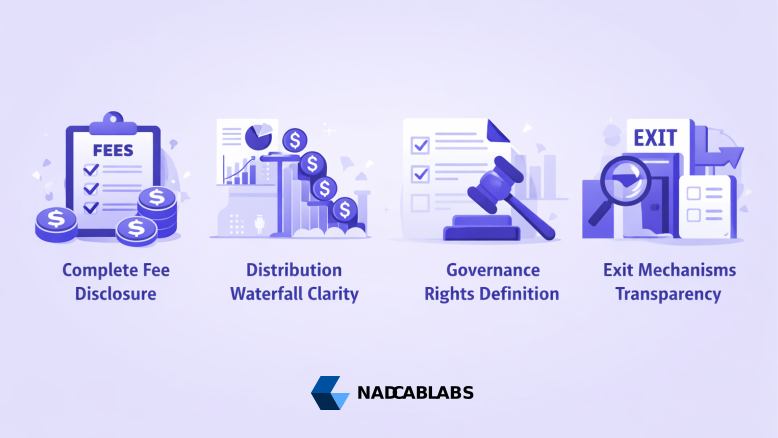
Essential Token Economics Transparency Requirements
Complete Fee Disclosure
- Initial tokenization setup fees with itemized breakdown
- Ongoing platform maintenance and hosting charges
- Transaction fees for token transfers and distributions
- Asset management fees charged by property operators
- Performance fees or carried interest arrangements
- All third-party service costs passed to investors
Distribution Waterfall Clarity
- Precise calculation methodology for income distributions
- Preferred return hurdles and sequence of payments
- Promote or profit share structures for sponsors
- Reserve account allocations for property expenses
- Tax withholding and reporting obligations
- Smart contract implementation of economic formulas
Governance Rights Definition
- Voting rights attached to token ownership stakes
- Major decisions requiring investor approval votes
- Quorum requirements and approval thresholds
- Sponsor veto rights or special voting classes
- Mechanisms for investor proposals and amendments
- Smart contract enforcement of governance outcomes
Exit Mechanisms Transparency
- Secondary market access and liquidity provisions
- Redemption rights or buyback mechanisms if applicable
- Property sale or refinancing distribution procedures
- Termination events and asset liquidation processes
- Transfer restrictions and holding period requirements
- Expected timeline for investor liquidity realization
Fee structures warrant particular scrutiny as they directly reduce investor returns and create potential conflicts of interest if not properly aligned. Demand complete disclosure of all fees including initial tokenization costs, ongoing platform fees, transaction charges, asset management fees, performance-based compensation, and any revenue sharing between the tokenization partner and property sponsor. Hidden fees or undisclosed compensation arrangements undermine trust and suggest business practices prioritizing provider profits over investor interests. Transparent partners provide clear fee schedules, justify charges based on services delivered, and demonstrate that total costs remain competitive with traditional real estate investment structures.
Distribution waterfall logic encoded in smart contracts should precisely match legal documentation defining how cash flows from property operations and eventual sales are allocated among stakeholders. Review the smart contract implementation of distribution formulas to verify accuracy, test edge cases that could produce unexpected outcomes, and confirm that automated calculations replicate the intended economic arrangements documented in offering materials. Discrepancies between legal terms and smart contract logic create operational risks and potential investor disputes that could undermine tokenization benefits.
Governance mechanisms enabling investor participation in significant decisions affecting property management, capital improvements, refinancing, or sale should be clearly defined with voting thresholds, proposal procedures, and implementation processes documented in both legal agreements and smart contract functionality. Evaluate whether governance rights are meaningful and enforceable or merely cosmetic provisions lacking practical investor influence. Token-based governance creates opportunities for more democratic and transparent decision-making than traditional limited partnership structures, but only if properly implemented with sufficient investor rights and accessible voting mechanisms.
Scalability and Performance of the Tokenization Infrastructure
The scalability and performance characteristics of a real estate tokenization partner’s infrastructure determine whether the platform can support growing investor bases, increasing transaction volumes, and expanding asset portfolios without degrading user experience or requiring expensive platform migrations. While initial tokenization projects may involve hundreds of investors and modest transaction activity, successful platforms must accommodate thousands of participants, high-volume trading periods, and multiple concurrent asset offerings as adoption grows over time.
Blockchain scalability limitations create fundamental constraints on transaction throughput, confirmation latency, and cost efficiency that affect user experience and operational viability. Ethereum mainnet’s limited transaction capacity results in high gas costs and slower confirmation times during network congestion, potentially making small token transfers economically impractical for retail investors. Partners leveraging layer-2 scaling solutions like Polygon or purpose-built blockchains with higher throughput address these limitations while introducing tradeoffs regarding decentralization, security assumptions, and ecosystem maturity that should be carefully evaluated.
Database architecture and data management practices determine the platform’s ability to maintain performance as historical data accumulates over multi-year asset lifecycles. Evaluate whether the partner employs scalable database technologies designed for high-volume transaction processing, implements data archiving strategies preventing active database bloat, and utilizes caching mechanisms reducing latency for frequently accessed information. Poor data architecture creates performance degradation over time as transaction histories grow, eventually requiring expensive platform migrations or limiting operational capabilities.
Multi-tenancy capabilities enabling the platform to support multiple distinct real estate tokenization projects simultaneously with isolated data, separate compliance configurations, and independent operational workflows indicate mature enterprise architecture. Partners lacking multi-tenancy force clients into single-use platform instances creating operational inefficiencies, higher costs, and integration challenges when managing portfolios of tokenized assets. Robust multi-tenant architecture with tenant isolation ensures that issues affecting one property’s tokenization do not cascade to impact other unrelated assets on the same platform.
Load testing and performance benchmarking provide concrete evidence of scalability capabilities beyond architectural descriptions. Request performance test results demonstrating how the platform behaves under stress conditions including peak concurrent user loads, high transaction volumes, and data-intensive reporting operations. Partners unable or unwilling to share performance benchmarks may lack confidence in their infrastructure’s scalability or may not have conducted adequate testing to validate capacity claims made in marketing materials.
Integration Capabilities with KYC, AML, and Payment Systems
Real estate tokenization platforms must seamlessly integrate with know-your-customer verification services, anti-money laundering screening systems, and payment processing infrastructure to enable compliant investor onboarding and efficient capital flows. The quality and breadth of these integrations significantly affect operational efficiency, investor experience, and regulatory compliance assurance throughout the token lifecycle from initial offering through ongoing investor services and secondary market trading.
Know-your-customer verification requirements mandate collection and validation of investor identity information, address confirmation, and in many jurisdictions beneficial ownership disclosure for entity investors. Leading real estate tokenization partners integrate with established KYC providers such as Onfido, Jumio, Persona, or Trulioo enabling automated identity verification through document scanning, liveness detection, database cross-referencing, and biometric validation that streamlines investor onboarding while meeting regulatory standards across multiple jurisdictions. Manual KYC processes create operational bottlenecks, introduce human error risks, and scale poorly as investor volumes increase.
| Integration Category | Leading Providers | Key Capabilities | Integration Benefits |
|---|---|---|---|
| KYC Verification | Onfido, Jumio, Persona, Trulioo, Sumsub | Document verification, liveness detection, database cross-checks, biometric validation, global coverage | Automated investor onboarding, reduced manual review, faster time to investment, multi-jurisdiction support |
| AML Screening | ComplyAdvantage, Refinitiv World-Check, LexisNexis, Dow Jones Risk & Compliance | Sanctions list screening, PEP identification, adverse media monitoring, ongoing watchlist updates | Regulatory compliance assurance, automated screening workflows, real-time risk alerts, comprehensive audit trails |
| Accreditation Verification | Verify Investor, VerifyInvestor.com, North Capital, Parallel Markets | Income verification, net worth calculation, third-party professional letters, entity qualification checks | SEC Regulation D compliance, investor self-certification reduction, defensible qualification documentation |
| Payment Processing | Stripe, Plaid, Circle, Wyre, Prime Trust, Anchorage Digital Bank | Bank transfers, wire processing, credit cards, stablecoin payments, multi-currency support, instant settlement | Diverse payment options, reduced friction, faster fund receipt, automated reconciliation, international investor support |
| Tax Reporting | Crypto Tax Calculator, CoinTracker, TaxBit, ZenLedger | 1099 generation, K-1 preparation, transaction tracking, cost basis calculation, multi-jurisdiction support | Automated investor tax reporting, regulatory compliance, reduced sponsor administrative burden, investor satisfaction |
| E-Signature | DocuSign, Adobe Sign, HelloSign, PandaDoc | Legally binding signatures, document workflow automation, audit trails, mobile support, template management | Streamlined subscription process, eliminated printing and mailing, faster document execution, complete digital workflow |
Anti-money laundering compliance requires ongoing screening of investors against sanctions lists, politically exposed persons databases, and adverse media sources to identify potential financial crime risks. Integration with AML platforms such as ComplyAdvantage, Refinitiv World-Check, or LexisNexis enables automated screening at onboarding and continuous monitoring for watchlist updates affecting existing investors. Manual AML processes create compliance gaps, delay investor approvals, and lack the ongoing monitoring necessary to detect post-onboarding risks that could trigger regulatory reporting obligations.
Accredited investor verification represents a critical compliance requirement for Regulation D offerings in the United States, with partners ideally integrating third-party verification services that independently validate investor income, net worth, or professional credentials rather than relying solely on investor self-certification. Services like Verify Investor or Parallel Markets provide defensible documentation of accreditation status reducing SEC examination risks and investor suitability concerns that could arise from inadequate qualification procedures.
Payment processing integrations determine how investors can fund their token purchases and receive distributions, significantly affecting investor experience and operational efficiency. Modern platforms support diverse payment methods including bank transfers via ACH or wire, credit card processing through providers like Stripe, stablecoin payments enabling instant cryptocurrency settlement, and integration with traditional custody banks for institutional investors. The breadth of payment options reduces friction in the investment process while automated payment reconciliation eliminates manual tracking of investor deposits and distribution payments.
Tax reporting capabilities including automated 1099 generation for distributions and potential integration with K-1 preparation services streamline ongoing compliance obligations and enhance investor satisfaction. Partners providing tax reporting integrations reduce sponsor administrative burden while ensuring investors receive timely accurate tax documentation meeting IRS requirements. This capability becomes increasingly valuable as investor counts grow and manual tax reporting becomes operationally impractical.
Track Record of Live Tokenized Real Estate Assets
Demonstrated success with live tokenized real estate assets in production environments provides the most compelling evidence of a partner’s capabilities beyond theoretical knowledge or pilot projects. Partners with portfolios of operational tokenized properties have encountered and resolved real-world challenges spanning regulatory compliance, technical operations, investor relations, and market conditions that cannot be fully anticipated during planning phases. This operational experience translates into faster project delivery, fewer unexpected obstacles, and higher probability of successful outcomes for new client engagements.
When evaluating partner track records, demand specific verifiable information about completed tokenization projects including property addresses or identifiable descriptions, total asset values tokenized, capital raised through token offerings, number of investors onboarded, regulatory frameworks utilized, blockchain platforms deployed, and current operational status including whether tokens are actively trading and distributions are being made. Partners should be able to provide this information transparently rather than hiding behind confidentiality claims that prevent meaningful verification of claimed experience.
Track Record Verification Checklist
Documented Completed Projects
Request case studies or project summaries for at least three to five completed tokenizations with specific details including property type and location, token structure, total capital raised, investor count, regulatory pathway, timeline from engagement to token issuance, and current status. Verify key facts through independent research including blockchain explorers showing token contracts, regulatory filings confirming exemption claims, and property records validating ownership structures described.
Accessible Client References
Obtain contact information for previous clients including names, titles, organizations, and permission to conduct reference calls discussing their tokenization experience. Prepare structured questions exploring project timeline accuracy, budget adherence, technical quality, regulatory expertise demonstrated, responsiveness to issues, and overall satisfaction. References should include both successful projects and engagements that encountered challenges to understand how the partner handles difficulties. Be skeptical of partners unwilling to provide direct references or offering only testimonial quotes without contact permissions.
Secondary Market Performance Data
For tokens that have been issued and are purportedly tradable, request trading volume data, bid-ask spreads, price history, and investor liquidity realization metrics demonstrating actual secondary market functionality. Theoretical tradability without meaningful liquidity provides little value to investors. Examine whether trading occurs on regulated venues with market makers supporting liquidity or whether transfers happen only sporadically in bilateral over-the-counter arrangements with wide spreads and limited price discovery.
Distribution History and Accuracy
Verify that tokenized assets have successfully made scheduled distributions to token holders through smart contract automation or manual processes. Request distribution reports showing payment amounts, timing, calculation methodology, and investor receipt confirmation. Distribution failures or delays indicate operational weaknesses that could affect your project. Evaluate whether distribution calculations match legal agreements and whether automation functions correctly or requires manual intervention creating operational risks and inefficiencies.
Regulatory Approvals and Filings
Review copies of Form D filings with the SEC, prospectus approvals from FCA, DFSA authorizations, or other regulatory documentation evidencing compliance with claimed frameworks. Public regulatory filings can often be independently verified through agency databases confirming partner claims about successful regulatory navigations. Absence of verifiable regulatory approvals or filings suggests either lack of experience or potential compliance shortcuts that create risks for future clients.
Long-Term Platform Continuity
Investigate whether early tokenization projects remain operational years after initial deployment with ongoing platform support, investor services, and technical maintenance. Partners that abandon clients after token issuance or discontinue platform services forcing migrations create unacceptable long-term risks. The ideal partner demonstrates multi-year operational continuity supporting assets tokenized three, four, or five years ago with consistent service quality and platform evolution adapting to regulatory changes and market developments.
Asset diversity in the partner’s portfolio provides insight into adaptability across different property types, investment structures, and market conditions. Partners whose experience consists entirely of single-family residential tokenizations may lack the expertise necessary for complex commercial office buildings, mixed-use developments, or hospitality properties requiring different legal structures, valuation approaches, and operational considerations. Conversely, partners with track records spanning multiple property categories demonstrate versatility and ability to customize solutions for varying client needs.
Geographic distribution of previous projects indicates jurisdictional expertise and regulatory navigation capabilities across different markets. A partner claiming global capabilities but showing project experience concentrated entirely in a single country may lack the multi-jurisdictional knowledge necessary for international offerings. Evaluate whether the partner has successfully completed tokenizations in jurisdictions relevant to your project including evidence of regulatory approvals, investor onboarding, and ongoing compliance in those specific markets.
Project scale progression demonstrates growth capability and institutional adoption. Partners who have successfully scaled from initial small tokenizations to larger institutional-grade assets show ability to handle increasing complexity, larger investor bases, and heightened regulatory scrutiny that accompanies high-value offerings. Review whether the partner’s portfolio includes projects comparable in scale to your intended tokenization, as significant jumps in asset value or investor count introduce new challenges requiring proven capabilities rather than first-time experimentation with your project as the testing ground.
Quality of Documentation, Reporting, and Investor Dashboards
The quality and comprehensiveness of documentation, reporting systems, and investor-facing interfaces significantly impact operational efficiency, investor satisfaction, and regulatory compliance throughout the tokenized asset lifecycle. Superior documentation reduces onboarding friction, minimizes support requirements, and creates clear operational procedures, while robust reporting and intuitive investor dashboards enhance transparency, build trust, and differentiate your offering in competitive fundraising environments.
Technical documentation should comprehensively cover smart contract architecture, API specifications, integration procedures, security protocols, and platform operation guidelines enabling your internal teams or third-party developers to understand, audit, and work effectively with the tokenization infrastructure. Request access to sample documentation assessing clarity, completeness, and technical depth. Poor documentation creates operational dependencies on the partner for routine tasks, limits your ability to conduct independent audits, and complicates potential future platform transitions if partnership changes become necessary.
Essential Documentation and Reporting Components
Investor Documentation
- Private placement memorandum or prospectus
- Subscription agreements with clear terms
- Operating or partnership agreements
- Risk disclosure documents comprehensive coverage
- Token purchase tutorials and onboarding guides
- Tax reporting guidance and documentation
Technical Documentation
- Smart contract code with detailed comments
- Architecture diagrams showing system components
- API documentation with integration examples
- Security audit reports and remediation evidence
- Disaster recovery and backup procedures
- Platform upgrade and maintenance protocols
Regulatory Documentation
- Compliance policies and procedures manuals
- KYC and AML documentation standards
- Accreditation verification protocols
- Regulatory filing templates and examples
- Investor suitability assessment frameworks
- Ongoing reporting obligation calendars
Operational Reporting
- Real-time investor cap table visibility
- Property performance metrics and analytics
- Distribution calculation and payment tracking
- Transaction history and audit trails
- Compliance monitoring and alert systems
- Custom report generation capabilities
Investor dashboards serve as the primary interface through which token holders monitor their investments, access documentation, view distribution histories, and manage account settings. Evaluate dashboard quality through demonstration environments assessing user experience design, information accessibility, mobile responsiveness, and feature completeness. Superior investor portals provide real-time portfolio valuation, detailed transaction histories, document libraries, tax reporting access, governance voting interfaces, and support request systems creating comprehensive investor servicing platforms that reduce operational overhead while enhancing investor satisfaction.
Sponsor-facing administrative interfaces determine how efficiently you can manage investor relationships, process distributions, update property information, generate reports, and respond to investor inquiries. Well-designed administrative platforms provide workflow automation for common tasks, bulk operation capabilities for investor communications or data updates, comprehensive search and filtering functions, role-based access controls enabling team collaboration, and integration with existing property management systems. Poor administrative interfaces create operational inefficiencies requiring manual workarounds that negate many automation benefits of tokenization.
Regulatory reporting capabilities should automate generation of required compliance reports including Form D filings for SEC exemptions, ongoing disclosure documents for Regulation A+ offerings, investor communications mandated by various jurisdictions, and internal compliance monitoring reports tracking KYC refresh cycles, beneficial ownership changes, and transfer restriction compliance. Automated regulatory reporting reduces administrative burden, ensures filing accuracy and timeliness, and creates audit trails demonstrating compliance diligence that can be valuable during regulatory examinations.
Custom reporting capabilities enabling creation of specialized reports tailored to your specific operational needs, investor communication requirements, or internal analysis purposes indicate platform maturity and flexibility. Rigid reporting systems forcing standardized outputs may not accommodate unique aspects of your property type, investor structure, or business processes. Assess whether the platform provides report customization tools, scheduled report generation, automated distribution lists, and export capabilities supporting various formats for integration with external systems or stakeholder communications.
Ongoing Technical Support and Platform Maintenance Commitments
The quality and scope of ongoing technical support and platform maintenance services provided by your real estate tokenization partner significantly impact long-term operational success and total cost of ownership. Real estate tokenization creates multi-year or even multi-decade obligations to maintain platform functionality, ensure security updates, adapt to regulatory changes, and support investor services throughout asset lifecycles that can extend for ten to thirty years or longer. Partner commitments to long-term support represent critical considerations that many organizations underweight during initial selection processes focused primarily on deployment capabilities.
Service level agreements should clearly specify support response times, platform uptime guarantees, scheduled maintenance windows, and escalation procedures for critical issues affecting investor access or token functionality. Evaluate whether the partner provides tiered support including immediate response for critical production issues, rapid turnaround for high-priority problems, and reasonable timelines for general inquiries and enhancement requests. Vague support commitments without specific service levels or financial penalties for non-performance create risks that issues may not receive adequate priority when they arise.
Platform maintenance and upgrade policies determine how the partner handles security patches, feature enhancements, regulatory adaptations, and blockchain protocol updates that will inevitably occur during long-term asset operations. Clarify whether maintenance is included in base fees or charged separately, how frequently updates are deployed, whether clients can defer non-critical updates, and what testing procedures ensure updates don’t introduce regressions or break existing functionality. Partners charging separately for every minor update or forcing immediate adoption of untested changes create operational and financial risks.
Regulatory change adaptation represents a critical ongoing support requirement as securities regulations, tax rules, and property laws evolve over time potentially requiring platform modifications to maintain compliance. Evaluate the partner’s track record responding to regulatory changes affecting previous clients, their monitoring of regulatory developments across relevant jurisdictions, and their process for implementing necessary adaptations. Partners without established regulatory change management procedures may leave clients exposed to compliance risks when rules evolve.
Investor support capabilities determine how effectively token holders can obtain assistance with account access, transaction questions, technical issues, or general inquiries about their investments. Assess whether the partner provides direct investor support or expects sponsors to handle all investor communications, what support channels are available including phone, email, chat, and help desk systems, and what service levels apply to investor inquiries. Partners offering professional investor support reduce sponsor operational burden while ensuring consistent high-quality investor experiences that enhance satisfaction and reduce complaints.
Long-term partnership stability and business continuity planning address what happens if the partner company experiences financial difficulties, is acquired, changes business focus, or ceases operations. Request information about the partner’s financial stability, business insurance coverage, client data escrow arrangements, platform source code escrow for business continuity, and contractual provisions protecting client interests during partner transitions. While uncomfortable to discuss, these contingency considerations protect your long-term operational viability and investor interests against partner business risks that could emerge years after initial engagement.
Cost Structure, Pricing Transparency, and Hidden Fees Analysis
Understanding the complete cost structure of real estate tokenization partnership extends beyond initial setup fees to encompass ongoing operational expenses, transaction-based charges, third-party service costs, and potential hidden fees that can significantly impact total cost of ownership over multi-year asset lifecycles. Comprehensive cost analysis requires detailed examination of pricing models, fee schedules, cost escalation provisions, and transparency in billing practices to accurately project total expenses and compare offerings across potential partners.
Initial tokenization fees typically cover smart contract development, legal structuring support, platform configuration, investor onboarding system setup, and project management through token issuance. These upfront costs generally range from $50,000 to $500,000 or more depending on asset complexity, regulatory requirements, customization needs, and whether the engagement includes comprehensive legal services or only technical implementation. Request itemized proposals breaking down initial costs by component to understand what services are included, what represents one-time expenses versus recurring charges, and where cost variability might arise based on project scope adjustments.
[2]
| Cost Category | Typical Range | What’s Included | Potential Hidden Costs |
|---|---|---|---|
| Initial Setup Fees | $50,000 to $500,000+ | Smart contract development, platform configuration, basic legal templates, project management, investor onboarding setup | Customization charges, expedited timeline fees, multi-jurisdiction setup premiums, complex structure surcharges |
| Legal and Compliance | $20,000 to $150,000+ | Entity formation, offering documents, regulatory filings, compliance policies, transfer agent setup | Multi-jurisdiction legal fees, complex structure attorney time, regulatory consultation charges, opinion letters |
| Security Audits | $15,000 to $80,000 | Smart contract audit by reputable firm, vulnerability assessment, remediation verification, audit report | Re-audit fees after code changes, penetration testing charges, ongoing security assessments, additional auditor selection |
| Ongoing Platform Fees | $1,000 to $10,000+ monthly | Platform hosting, maintenance, basic support, investor dashboard access, regulatory updates, data storage | Per-investor fees above threshold, data storage overage charges, premium support tier requirements, feature access fees |
| Transaction Fees | 0.25% to 2% per transaction | Token transfer processing, compliance verification, blockchain gas costs, settlement operations | Minimum transaction fees, peak pricing during congestion, secondary market maker fees, custody transfer charges |
| KYC/AML Services | $5 to $50 per verification | Identity verification, sanctions screening, basic AML checks, document collection and storage | Enhanced due diligence charges, manual review fees, re-verification costs, international investor premiums |
| Distribution Processing | $500 to $5,000 per event | Distribution calculation, payment processing, tax withholding, investor notifications, reporting generation | Per-investor distribution fees, complex waterfall calculation charges, international payment premiums, rush processing |
| Platform Migration/Exit | $10,000 to $100,000+ | Data export, documentation transfer, reasonable cooperation with new provider during transition period | Proprietary format conversion fees, extended support charges, smart contract migration costs, investor re-onboarding |
Ongoing operational fees represent the largest long-term cost component and warrant particular scrutiny during partner evaluation. These recurring charges typically cover platform hosting and maintenance, basic technical support, investor dashboard access, compliance monitoring, and regulatory updates. Monthly fees can range from $1,000 for basic platforms supporting small investor bases to $10,000 or more for enterprise solutions managing thousands of investors across multiple tokenized assets. Evaluate whether fees are flat-rate providing cost predictability or variable based on investor count, transaction volume, or asset value creating potential cost escalation as your tokenization succeeds.
Transaction-based fees apply to token transfers, distributions, and other platform operations on a per-transaction basis. These charges typically range from 0.25% to 2% of transaction value or flat fees of $10 to $100 per operation depending on transaction type and volume commitments. High transaction fees can significantly impact investor returns especially for frequent traders or when processing distributions to large investor bases. Clarify whether transaction fees include blockchain gas costs or whether these represent additional pass-through charges that can vary significantly based on network congestion and timing.
Third-party service costs including KYC verification, AML screening, accreditation verification, tax reporting, and payment processing are often passed through to clients at cost or with markup depending on partner business models. Request detailed estimates of these expenses based on expected investor counts and transaction volumes to accurately project total costs. Some partners bundle these services within platform fees providing cost certainty, while others charge individually creating variable expenses that can escalate unexpectedly as investor onboarding volumes increase.
Hidden fees or undisclosed charges represent major red flags indicating potentially problematic partnership dynamics. Common hidden costs include data storage overage fees charged when investor documents or transaction histories exceed arbitrary limits, premium support requirements forcing clients into expensive service tiers to receive adequate assistance, customization charges for routine configuration changes, and platform exit fees making it prohibitively expensive to switch providers if relationship deteriorates. Transparent partners provide comprehensive fee schedules, clarify all potential charges upfront, and justify pricing based on services delivered rather than obscuring costs to create low initial price impressions that mask higher total ownership expenses.
Data Privacy, Custody Solutions, and Asset Protection Measures
Data privacy and asset protection represent fundamental obligations that real estate tokenization partners must fulfill to safeguard investor information and digital assets under their control. The sensitive nature of investor personal data combined with the value of tokenized real estate holdings creates significant cybersecurity risks requiring robust technical controls, policy frameworks, and operational procedures that extend beyond basic security measures to encompass comprehensive data governance and asset custody architectures meeting institutional standards.
Data privacy compliance begins with adherence to applicable regulations governing collection, storage, and processing of personal information across jurisdictions where investors reside. Partners serving international investor bases must comply with European Union General Data Protection Regulation requirements for EU residents, California Consumer Privacy Act provisions for California investors, Personal Information Protection and Electronic Documents Act in Canada, and data protection frameworks in United Arab Emirates and other jurisdictions. Non-compliance with data privacy regulations creates regulatory exposure, potential investor lawsuits, and reputational damage affecting tokenization credibility.
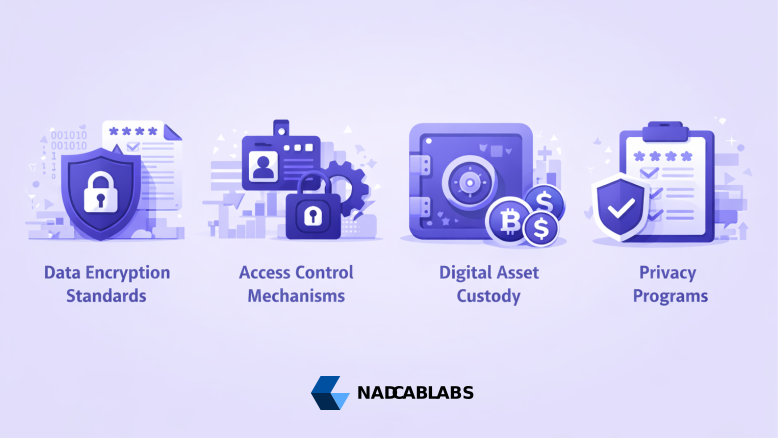
Comprehensive Data Protection and Custody Framework
Data Encryption Standards
- AES-256 encryption for data at rest
- TLS 1.3 for data in transit
- End-to-end encryption for sensitive communications
- Encrypted database backups with secure key management
- Regular encryption key rotation procedures
Access Control Mechanisms
- Role-based access control limiting data visibility
- Multi-factor authentication for all user accounts
- Principle of least privilege implementation
- Regular access review and revocation procedures
- Comprehensive audit logging of data access
Digital Asset Custody
- Multi-signature wallet requirements for transactions
- Hardware security module key storage
- Geographic distribution of key shares
- Qualified custodian partnerships with insurance
- Cold storage for majority of assets
Privacy Programs
- GDPR compliance for EU investor protection
- CCPA adherence for California residents
- Data processing agreements with third parties
- Privacy policy transparency and consent management
- Data subject rights response procedures
Custody solutions for digital assets representing tokenized real estate ownership require institutional-grade security measures protecting private keys controlling token transfers and smart contract operations. Best practices employ multi-signature wallet architectures requiring approval from multiple authorized parties before executing sensitive transactions, hardware security modules providing tamper-resistant key storage, geographic distribution of key shares preventing single points of failure, and partnership with qualified custodians holding regulatory licenses and insurance coverage protecting client assets against loss or theft.
The division between hot wallets for operational transactions and cold storage for majority asset holdings represents standard practice in digital asset custody. Hot wallets maintain limited balances enabling routine operations while exposing minimal assets to online security risks, with the bulk of tokenized holdings stored in cold wallets completely isolated from network connectivity until needed for major operations. Partners lacking clear hot/cold wallet policies or maintaining excessive hot wallet balances create unnecessary security exposure that institutional investors and sophisticated sponsors should reject.
Insurance coverage for digital assets under custody provides financial protection against losses from security breaches, insider theft, key compromise, or operational errors affecting investor holdings. Qualified digital asset custodians typically maintain crime insurance policies covering client assets up to specified limits, with policy terms defining covered events, exclusions, deductibles, and claim procedures. Evaluate the partner’s insurance coverage including policy limits, underwriter reputation, claims history, and whether coverage extends to all potential loss scenarios or contains significant gaps leaving assets unprotected under certain circumstances.
Data backup and disaster recovery procedures ensure investor information and transaction histories remain available despite infrastructure failures, security incidents, or natural disasters affecting primary systems. Partners should maintain geographically distributed backups with encryption, regular testing of restoration procedures, defined recovery time objectives specifying how quickly systems can be restored, and recovery point objectives limiting maximum data loss in disaster scenarios. Inadequate backup practices create risks of permanent data loss that could compromise investor records, transaction histories, or compliance documentation with potentially catastrophic legal and operational consequences.
Red Flags to Avoid When Selecting a Real Estate Tokenization Partner
Identifying warning signs during partner evaluation enables property sponsors to avoid problematic relationships that could jeopardize project success, create regulatory exposure, or result in financial losses and reputational damage. Certain partner characteristics and behaviors consistently correlate with poor outcomes based on industry experience accumulated over hundreds of tokenization projects across multiple markets. Recognition of these red flags should prompt either immediate disqualification of candidates or substantial additional due diligence before proceeding with engagement.
Lack of verifiable completed projects represents perhaps the most critical red flag indicating insufficient experience to manage complex real estate tokenization initiatives. Partners unable to provide specific case studies with independently verifiable details, client references with contact permissions, or publicly accessible evidence of live tokenized assets should be approached with extreme caution. Theoretical capabilities and impressive presentations cannot substitute for demonstrated execution in production environments managing real investor capital under regulatory scrutiny.
Critical Red Flags Requiring Partner Disqualification
Absence of Independent Security Audits
Partners who have not subjected their smart contracts to comprehensive third-party security audits by reputable blockchain security firms create unacceptable risks. Claims of internal review or testing do not constitute adequate security validation. Insist on seeing complete audit reports from recognized firms including Trail of Bits, ConsenSys Diligence, OpenZeppelin, CertiK, or Quantstamp with all critical findings remediated. Unwillingness to provide audit reports or engage independent auditors before deployment indicates either cost-cutting that compromises security or awareness of significant vulnerabilities that would be exposed by professional review.
History of Regulatory Violations or Enforcement Actions
Partners with histories of securities law violations, regulatory enforcement actions, cease and desist orders, or abandoned projects due to compliance failures present obvious risks. Conduct thorough background research on the partner organization and key executives including SEC enforcement database searches, FCA enforcement notices, FINRA BrokerCheck reviews, and general regulatory action searches. Previous regulatory problems suggest either insufficient compliance expertise or willingness to cut corners on regulatory obligations that could extend to your engagement creating liability exposure.
Opaque or Changing Pricing Structures
Partners unwilling to provide detailed transparent pricing breakdowns, who introduce significant new fees after initial proposals, or whose pricing changes substantially during negotiations lack business integrity and create unpredictable cost exposure. Legitimate partners provide comprehensive fee schedules upfront, justify charges based on services delivered, and maintain pricing consistency throughout engagement discussions. Evolving pricing or discovered hidden fees after contract execution indicates problematic business practices likely to continue throughout the relationship.
Unrealistic Timeline or Return Promises
Partners promising extremely short development timelines inconsistent with regulatory requirements, or making specific return projections or liquidity guarantees demonstrate either inexperience with actual tokenization complexity or willingness to make misleading claims. Realistic timelines for comprehensive tokenization range from three to nine months depending on complexity. Partners claiming tokenization completion in weeks likely skip essential steps including proper legal structuring, regulatory compliance, or security audits. Similarly, partners projecting specific investor returns or guaranteeing secondary market liquidity make claims they cannot control and should not promise.
Proprietary Platform Lock-In Without Portability
Partners whose platforms create complete dependency through proprietary token standards, closed-source smart contracts, or contractual restrictions preventing platform migration force indefinite vendor lock-in regardless of service quality deterioration or changing business needs. While some integration with partner systems is inevitable, fundamental token infrastructure should utilize industry standards enabling potential future portability. Contracts including punitive exit fees, data retention restrictions, or obligations extending years beyond service termination indicate predatory business models designed to trap clients rather than earn continued business through service quality.
Limited or Superficial Regulatory Knowledge
Partners unable to discuss specific regulatory frameworks applicable to your tokenization, who provide generic compliance advice inconsistent with jurisdictional requirements, or who demonstrate unfamiliarity with SEC registration exemptions, FCA prospectus requirements, DFSA/VARA rules, or CSA guidelines lack the specialized knowledge essential for compliant tokenization. Generic blockchain expertise does not translate to securities law competency. Insist on partners who can articulate specific regulatory pathways, cite relevant rule provisions, and demonstrate familiarity with recent regulatory developments affecting tokenized securities in your target markets.
Signs of Financial Instability or Business Uncertainty
Partners exhibiting financial distress signals including payment delays to vendors, staff departures, office closures, or frequent business model pivots create continuity risks for long-term tokenization relationships. Your partner must remain operational and financially stable throughout multi-year or multi-decade asset lifecycles supporting ongoing investor services and platform maintenance. Investigate partner financial stability through credit reports, reference calls with vendors and previous clients, and assessment of funding sources and revenue sustainability. Early-stage startups dependent on single projects or lacking diversified revenue streams present higher failure risks than established firms with multiple clients and sustainable business economics.
Marketing-focused approaches emphasizing technology innovation, blockchain buzzwords, or impressive websites without substantive evidence of regulatory expertise, legal partnerships, or operational capabilities signal potential inexperience with real-world tokenization requirements. Successful real estate tokenization requires pragmatic focus on regulatory compliance, investor protection, operational efficiency, and long-term sustainability rather than technological novelty. Partners prioritizing innovation narratives over compliance rigor may lack appreciation for the heavily regulated environment governing securities offerings and property ownership.
Get Expert Tokenization Partnership Guidance
Access our comprehensive partner evaluation toolkit and connect with vetted real estate tokenization specialists to accelerate your digital asset journey.
Reluctance to provide client references, share previous project details, or allow independent verification of claimed capabilities suggests either fabricated experience or previous client relationships that ended poorly. Legitimate partners with successful track records eagerly provide references and case studies demonstrating their capabilities and welcoming validation of their claims. Evasiveness about previous work, confidentiality claims preventing any meaningful verification, or references that cannot be contacted independently all warrant skepticism about partner credibility and experience authenticity.
Pressure tactics including artificial urgency, limited-time pricing offers, or discouragement of comparison shopping indicate sales-focused rather than client-focused partnership approaches. Professional tokenization partners understand that comprehensive evaluation requires time, welcome comparison with competitors confident in their capabilities, and structure pricing based on value delivered rather than promotional tactics. High-pressure sales approaches suggest partners more concerned with closing deals than ensuring client success and long-term relationship satisfaction.
Key Questions to Ask Before Finalizing a Tokenization Partner
Comprehensive due diligence on potential real estate tokenization partners requires structured inquiry covering technical capabilities, regulatory expertise, operational processes, financial terms, and partnership dynamics. The following questions provide a framework for systematic partner evaluation ensuring thorough assessment across all dimensions affecting long-term partnership success and project outcomes. Thoughtful partners welcome detailed questions as opportunities to demonstrate their capabilities and establish clear mutual expectations.
Essential Partner Evaluation Questions
Experience and Track Record
- How many real estate tokenization projects have you completed, and can you provide detailed case studies with verifiable information including property types, values, investor counts, and regulatory frameworks?
- What is the current operational status of your previous tokenizations including secondary market trading activity, distribution performance, and client satisfaction levels?
- Can you provide references from at least three previous clients with contact information and permission to discuss their project experiences?
- What is the largest asset value and investor count you have successfully tokenized, and how does this compare to our project scale?
- Have you tokenized properties similar to ours in type, structure, and target market, and what unique challenges did those projects present?
Regulatory and Compliance Expertise
- What specific regulatory pathway do you recommend for our tokenization across USA, UK, UAE, and Canada jurisdictions, and what is your experience with these frameworks?
- Can you provide copies of Form D filings, prospectus approvals, or other regulatory documentation from previous projects demonstrating successful compliance navigation?
- What legal firms do you partner with for securities law, real estate law, and tax advisory services, and what are their credentials and experience levels?
- How do you stay current with evolving regulations affecting tokenized securities, and what is your process for implementing necessary platform adaptations when rules change?
- Have you ever experienced regulatory enforcement actions, client compliance violations, or abandoned projects due to regulatory obstacles, and if so, what were the circumstances and lessons learned?
Technical Architecture and Security
- Which blockchain platform do you recommend for our tokenization, and what specific advantages does it offer for our use case compared to alternatives?
- Can you provide complete smart contract audit reports from the last two years showing comprehensive third-party security reviews and remediation of all identified issues?
- What custody architecture do you employ for private key management, and do you partner with qualified custodians holding insurance coverage and regulatory licenses?
- How do you handle smart contract upgrades or bug fixes after deployment, and what governance process controls these changes?
- What disaster recovery and business continuity capabilities do you maintain, including backup procedures, failover systems, and recovery time objectives?
Operational Capabilities and Support
- What service level agreements do you offer regarding platform uptime, support response times, and issue resolution, and what remedies exist for SLA violations?
- How do you handle ongoing platform maintenance, security updates, and regulatory adaptations, and are these included in base fees or charged separately?
- What investor support services do you provide directly, and what responsibilities remain with the sponsor for investor communications and assistance?
- Can you demonstrate your investor dashboard and administrative interfaces through live platform tours showing actual functionality rather than mockups or presentations?
- What integration capabilities do you offer with our existing property management, accounting, and CRM systems, and can you provide API documentation and integration examples?
Pricing and Financial Terms
- Please provide itemized pricing breaking down initial setup fees, ongoing monthly charges, transaction-based fees, and any other costs we should anticipate over a five-year period?
- What third-party service costs will we incur for KYC/AML, accreditation verification, legal services, security audits, and other necessities, and how are these billed?
- Are there any circumstances under which fees could increase beyond stated amounts, and what cost protection mechanisms exist in our agreement?
- What are the financial terms and procedures if we need to migrate to a different platform provider in the future, including data portability, transition support, and exit fees?
- What financial stability indicators can you share including revenue sources, client diversification, funding backing, and business sustainability to assure us of long-term viability?
Partnership Dynamics and Alignment
- What is your typical engagement model regarding division of responsibilities, communication cadence, escalation procedures, and decision-making authority for our tokenization project?
- How do you handle situations where we have concerns about your recommendations or want to pursue approaches different from your standard methodologies?
- What intellectual property rights exist regarding smart contracts, platform code, and project deliverables, and what can we control or modify independently?
- Can you provide contact information for legal references we can consult regarding contract terms, partnership structure, and protection of our interests in the proposed agreement?
- What is your vision for our long-term partnership beyond initial tokenization including support for additional assets, platform evolution, and adaptation to our changing needs?
The quality and depth of partner responses to these inquiries provides valuable insight into their experience, transparency, and commitment to client success. Comprehensive answers demonstrating specific knowledge, providing requested documentation without hesitation, and addressing concerns directly indicate professional mature partnerships. Conversely, vague responses avoiding specifics, reluctance to provide requested materials, or defensive reactions to reasonable questions suggest potential problems that warrant additional scrutiny or partner reconsideration.
Document all partner responses systematically enabling objective comparison across multiple candidates based on consistent evaluation criteria. Create scoring frameworks assessing candidates across weighted dimensions including regulatory expertise, technical capabilities, track record quality, pricing competitiveness, and partnership cultural fit. Structured evaluation prevents decisions based on superficial factors or compelling sales presentations while ensuring selection based on substantive capabilities aligned with your specific project requirements and long-term partnership needs.
Making the Final Decision – Selecting a Long-Term Tokenization Partner
The final partner selection decision synthesizes all evaluation dimensions explored throughout the due diligence process into a comprehensive assessment balancing technical capabilities, regulatory expertise, operational competence, financial terms, and partnership dynamics. This decision carries long-term implications extending years or decades beyond initial token issuance as you maintain ongoing relationships supporting investor services, platform maintenance, regulatory adaptations, and potential additional asset tokenizations within your real estate portfolio.
Begin final decision-making by revisiting your initial strategic objectives defined at project outset and assessing which partner candidate best aligns with these goals. If liquidity creation represents your primary objective, prioritize partners with proven secondary market capabilities, exchange relationships, and demonstrated trading volume on previous tokenizations. If regulatory compliance and investor protection are paramount concerns, weight regulatory track record and legal partnership quality more heavily than cutting-edge technical features. Alignment between partner strengths and your specific priorities increases probability of achieving intended outcomes.
Total cost of ownership analysis projecting expenses over five to ten year periods provides more accurate financial comparison than initial setup fees alone. Include all components of partner pricing including upfront costs, ongoing monthly fees, transaction charges, anticipated third-party services, potential fee escalations, and estimated costs for additional services you may require over time. Partners with higher initial fees but lower ongoing costs may offer better long-term value than apparently cheaper alternatives with escalating recurring charges. Consider not only nominal costs but also the operational value delivered through automation, compliance assurance, and investor satisfaction that reduce your internal resource requirements and enhance overall returns.
Risk assessment should explicitly identify specific concerns about each finalist candidate and evaluate mitigation strategies or contingency plans addressing identified risks. If a preferred partner shows limited experience in a particular jurisdiction relevant to your project, how can this gap be addressed through additional legal support or phased market entry? If concerns exist about partner financial stability, what contractual protections or escrow arrangements could safeguard your interests? Systematic risk identification and mitigation planning enables more confident decisions acknowledging imperfect options while actively managing known vulnerabilities.
Once final selection is made, establish clear governance frameworks for the partnership including communication protocols, decision escalation procedures, performance metrics, regular review meetings, and feedback mechanisms ensuring ongoing alignment throughout project execution and long-term operational phases. Successful tokenization partnerships evolve beyond transactional vendor relationships into strategic collaborations where both parties actively contribute to project success, share learnings from challenges encountered, and work together adapting to changing market conditions and regulatory environments affecting tokenized real estate.
The real estate tokenization partner you select will significantly influence your project outcomes, operational efficiency, investor satisfaction, and long-term success in blockchain-enabled property ownership. By conducting systematic comprehensive evaluation across all dimensions explored in this guide, you position your organization to make informed confident decisions selecting partners with proven capabilities, regulatory expertise, technical excellence, and genuine commitment to your success. The investment in thorough partner selection pays dividends throughout multi-year relationships supporting transformative approaches to real estate ownership, investment, and liquidity creation in the digital asset era.
People Also Ask
Q1.What is real estate tokenization and how does it work?
Real estate tokenization is the process of converting ownership rights in physical property into digital tokens on a blockchain network. These tokens represent fractional or complete ownership shares that can be traded, transferred, or held as investment assets. The process involves legal structuring, smart contract deployment, regulatory compliance, and investor onboarding through KYC/AML verification systems. Tokenization enables fractional ownership, improved liquidity, automated compliance, and global investor access to real estate markets.
Q2.Why do I need a specialized partner for real estate tokenization?
Real estate tokenization requires expertise across blockchain technology, securities law, property regulations, smart contract development, and financial compliance frameworks. A specialized partner brings proven technical infrastructure, regulatory knowledge across multiple jurisdictions, established legal frameworks, security audit experience, and investor management systems. Attempting tokenization without expert guidance creates significant legal risks, technical vulnerabilities, compliance failures, and potential investor protection issues that could derail your entire project.
Q3.What blockchain platforms are best for tokenizing real estate assets?
The most suitable blockchain platforms for real estate tokenization include Ethereum (ERC-20, ERC-1400 security tokens), Polygon (cost-effective layer-2 solution), Avalanche (regulatory-focused subnets), and Stellar (compliant asset issuance). Each platform offers different advantages regarding transaction costs, regulatory compliance features, security standards, and ecosystem maturity. Your tokenization partner should recommend platforms based on your specific asset type, target investor geography, regulatory requirements, and long-term scalability needs rather than promoting a single solution.
Q4.How much does it cost to tokenize a real estate asset?
Real estate tokenization costs typically range from $50,000 to $500,000+ depending on asset complexity, regulatory jurisdiction, technology infrastructure, and ongoing maintenance requirements. Expenses include legal structuring ($20,000-$150,000), smart contract development ($15,000-$80,000), compliance integration ($10,000-$60,000), platform setup, security audits, investor onboarding systems, and annual maintenance fees. Transparent partners provide itemized cost breakdowns covering initial setup, transaction-based fees, custody solutions, and long-term platform support to prevent unexpected expenses.
Q5.What regulations govern tokenized real estate in the USA, UK, UAE, and Canada?
In the USA, tokenized real estate typically falls under SEC securities regulations requiring registration or exemption qualifications. The UK mandates FCA compliance for security tokens with specific prospectus requirements. UAE (particularly Dubai) operates under DFSA and VARA frameworks offering specialized digital asset regulations. Canada requires compliance with provincial securities commissions and CSA guidelines. Each jurisdiction has distinct investor protection rules, offering structures, disclosure requirements, and ongoing reporting obligations that your tokenization partner must navigate expertly.
Q6.How long does the real estate tokenization process typically take?
The complete real estate tokenization process generally requires 3-9 months from initial planning to token issuance. This timeline includes legal entity structuring (4-8 weeks), regulatory compliance documentation (6-12 weeks), smart contract development and auditing (4-8 weeks), platform integration (3-6 weeks), investor onboarding system setup (2-4 weeks), and regulatory approval processes where required. Complex multi-jurisdictional offerings or unique asset structures may extend timelines to 12+ months. Experienced partners provide realistic project schedules with defined milestones.
Q7.What are the biggest risks when choosing the wrong tokenization partner?
Selecting an inexperienced tokenization partner creates severe risks including regulatory non-compliance leading to enforcement actions, technical vulnerabilities exposing investor funds, inadequate legal structuring causing ownership disputes, platform failures preventing token transfers, security breaches compromising personal data, and reputational damage affecting future fundraising. Financial consequences include wasted development costs, legal penalties, investor lawsuits, and complete project failure. These risks are amplified in real estate where high asset values and strict regulations demand proven expertise.
Q8.Can tokenized real estate be traded on secondary markets?
Tokenized real estate can be traded on secondary markets, but liquidity depends on regulatory framework, token structure, platform capabilities, and market maker presence. Security tokens typically require trading on regulated alternative trading systems (ATS) or security token exchanges that enforce investor accreditation, transfer restrictions, and compliance automation. Your tokenization partner should provide clear secondary market strategies, including exchange partnerships, liquidity provider relationships, regulatory transfer protocols, and realistic liquidity expectations based on asset type and jurisdiction.
Q9.What technical features should a real estate tokenization platform include?
Essential technical features include multi-signature wallet support, automated compliance enforcement, investor dashboard with real-time asset performance, dividend distribution automation, KYC/AML integration, whitelist management, transfer restriction protocols, document management systems, voting mechanisms, secondary market connectivity, audit trails, and regulatory reporting tools. Advanced platforms offer asset management integration, property data oracles, insurance protocols, fractional trading capabilities, and cross-border payment systems. Your partner should demonstrate these capabilities through live platform demonstrations.
Q10.How do I verify the track record of a tokenization partner?
Verify partner credentials by requesting case studies of completed projects with verifiable transaction data, speaking directly with previous clients about their experience, reviewing third-party security audit reports, checking regulatory registrations and licenses, examining published whitepapers and technical documentation, assessing team credentials and industry experience, and analyzing online reputation through independent reviews. Legitimate partners provide transparent project portfolios, client testimonials with contact permissions, audited financial statements, and detailed technical architecture documentation without hesitation.
Explore Services
Related Services
Reviewed by

Aman Vaths
Founder of Nadcab Labs
Aman Vaths is the Founder & CTO of Nadcab Labs, a global digital engineering company delivering enterprise-grade solutions across AI, Web3, Blockchain, Big Data, Cloud, Cybersecurity, and Modern Application Development. With deep technical leadership and product innovation experience, Aman has positioned Nadcab Labs as one of the most advanced engineering companies driving the next era of intelligent, secure, and scalable software systems. Under his leadership, Nadcab Labs has built 2,000+ global projects across sectors including fintech, banking, healthcare, real estate, logistics, gaming, manufacturing, and next-generation DePIN networks. Aman’s strength lies in architecting high-performance systems, end-to-end platform engineering, and designing enterprise solutions that operate at global scale.