Ai Overview
KYC, or Know Your Customer, is the regulatory and operational framework through which financial platforms verify the identity of every investor before granting access to their services. For individual retail investors, particularly those in India and UAE where platforms are seeing the fastest adoption growth, KYC is completed as part of the account onboarding process before any investment can be made.
Key Takeaways
- ✓ The Real Estate Tokenization KYC Process is mandatory on all compliant platforms, verifying investor identity before granting access to tokenized property investments globally.
- ✓ Platforms in India, UAE, and Singapore use jurisdiction-specific identity tools including Aadhaar eKYC, Emirates ID, and Singapore MyInfo for seamless investor verification at onboarding.
- ✓ KYC verification in real estate tokenization typically completes within minutes to 24 hours using AI-powered providers such as Onfido, Jumio, and Sumsub for automated Real Estate Tokenization KYC Process.
- ✓ Smart contracts enforce KYC compliance on-chain by maintaining whitelists of verified wallet addresses, automatically blocking token transfers to unverified wallets without manual oversight.
- ✓ AML compliance works alongside KYC in real estate tokenization, screening investors against global sanctions lists and monitoring transaction patterns for suspicious financial activity throughout.
- ✓ Tokenized real estate platforms using ERC-1400 and ERC-3643 token standards have programmable compliance rules embedded directly into token contracts, ensuring KYC gates apply on every transfer.
- ✓ Investors who fail the KYC process in real estate tokenization cannot receive, hold, or transfer property tokens, protecting platform integrity and the entire investor pool from fraud risk.
- ✓ Blockchain KYC real estate records create immutable, auditable identity trails that regulators in UAE, India, and Singapore can access on-demand without requiring manual reconciliation processes.
- ✓ Accredited investor verification is an additional layer in the Real Estate Tokenization KYC Process for regulated securities offerings, confirming income thresholds and net worth requirements by jurisdiction.
- ✓ On-chain KYC compliance paired with digital identity verification gives tokenized real estate platforms a significant advantage over traditional property funds in demonstrating regulatory transparency.
With over eight years of experience building compliant tokenization platforms for clients across India, UAE, and Singapore, our team has seen firsthand how the Real Estate Tokenization KYC Process determines whether a platform succeeds or fails at regulatory and investor trust levels. Real Estate Tokenization has moved from an experimental concept to a mainstream capital formation strategy, with the global tokenized real estate market projected to exceed $1.4 trillion by 2026. But this growth is only possible because robust KYC frameworks ensure that the investors participating in these platforms are verified, compliant, and protected under applicable law.
For investors, the KYC process can feel like a bureaucratic hurdle. In reality, it is the single most important trust mechanism in the entire tokenized real estate ecosystem. It protects you from fraud, ensures the platform you invest on is legally compliant, and guarantees that every other participant on the same platform has been equally verified. This blog provides a comprehensive, expert-level breakdown of how the Real Estate Tokenization KYC Process works, why it exists, and what it means for your investment experience in markets like India, Dubai, and Singapore.
What Is KYC in Real Estate Tokenization
KYC, or Know Your Customer, is the regulatory and operational framework through which financial platforms verify the identity of every investor before granting access to their services. In the context of the Real Estate Tokenization KYC Process, this means confirming that every person or institution seeking to purchase, hold, or trade tokenized property interests is who they claim to be, is legally eligible to invest, and is not associated with prohibited activities such as money laundering, terrorism financing, or sanctions violations.
KYC verification in real estate tokenization goes beyond a simple identity check. It encompasses document authentication, biometric verification, liveness detection, politically exposed person (PEP) screening, and in many jurisdictions, accredited investor status confirmation. For platforms serving markets like India, UAE, and Singapore simultaneously, the KYC engine must apply jurisdiction-specific rules dynamically, using different identity standards and regulatory thresholds depending on the investor’s country of residence.
Blockchain KYC real estate platforms go one step further by linking verified identities directly to wallet addresses on-chain. This creates a permanent, auditable record of who holds which tokens at any given time, enabling regulators to trace ownership without the delays and costs associated with traditional investor registry systems. It is this on-chain KYC compliance capability that positions tokenized real estate as a more transparent and regulatorily sophisticated asset class than traditional property investment vehicles.
Why Real Estate Tokenization Platforms Need KYC
The requirement for KYC on tokenized real estate platforms is not optional. It is mandated by securities regulators in virtually every jurisdiction where tokenized property investments are offered. Because real estate tokens typically represent financial interests with expectations of profit, they are classified as securities under the laws of most major markets. Securities issuers are legally required to verify investor identities, comply with accreditation standards, and prevent financial crime. Failure to implement an adequate Real Estate Tokenization KYC Process exposes the platform, its operators, and potentially its investors to regulatory penalties, license revocation, and criminal liability.
In the UAE, VARA requires all virtual asset platforms handling tokenized real estate to maintain comprehensive KYC records, implement AML screening, and provide regulators with on-demand access to transaction records. In Singapore, MAS mandates that tokenized securities platforms meet rigorous KYC, AML, and data protection standards. In India, SEBI’s evolving digital asset framework increasingly requires identity verification aligned with existing financial services KYC norms, including Aadhaar-based eKYC for domestic investors.
Beyond regulatory compliance, platforms need KYC to protect their investor communities. A tokenized real estate platform that allows unverified investors to participate creates systemic risk for everyone on the platform. Fraudulent actors could manipulate token prices, launder funds through property token transactions, or exploit secondary market mechanisms in ways that harm legitimate investors. A robust Real Estate Tokenization KYC Process is therefore both a legal requirement and a fundamental investor protection measure.
Who Needs to Complete the KYC Process in Real Estate Tokenization
The Real Estate Tokenization KYC Process applies to every participant who interacts with tokenized property investments at a financial level. This includes retail investors making fractional property purchases, institutional investors allocating larger capital positions, property owners or developers seeking to tokenize their assets, secondary market traders buying and selling tokens on compliant exchanges, and custodians or wallet providers who hold tokens on behalf of clients. No category of participant is exempt from investor identity verification in tokenized property environments.
For individual retail investors, particularly those in India and UAE where platforms are seeing the fastest adoption growth, KYC is completed as part of the account onboarding process before any investment can be made. The process is personal: each individual must verify their own identity using their own documents. Joint account holders, nominees, or beneficial owners of corporate investors each require separate verification.
Corporate and institutional investors face a more complex variant of the KYC process known as KYB or Know Your Business. This requires verification of the entity itself including incorporation documents, beneficial ownership disclosure, and verification of the individuals authorized to act on behalf of the organization. In Singapore, where institutional participation in tokenized real estate is particularly active, KYB requirements are stringent and aligned with MAS financial crime prevention standards.
Step by Step Real Estate Tokenization KYC Process
The Real Estate Tokenization KYC Process follows a structured sequence of steps that balance regulatory thoroughness with user experience efficiency. Understanding these steps helps investors prepare their documentation in advance and manage their expectations about the onboarding timeline. Platforms that design this process well complete investor verification in under ten minutes for straightforward cases, while maintaining the depth of checks that regulators in India, UAE, and Singapore require.
From our experience building tokenization platforms across multiple jurisdictions, the step flow below represents current best practice for platforms targeting international investors including those from India, UAE, and Singapore simultaneously:
KYC Onboarding Step Flow for Tokenized Real Estate Platforms
Step 1: Account Registration
Investor creates an account on the platform using an email address and secure password. The platform captures basic personal information including full legal name, date of birth, nationality, and country of residence to establish the investor record.
Step 2: Document Upload
The investor uploads a government-issued photo ID (passport, national ID, or driving license) and proof of address (utility bill or bank statement within three months). Indian investors may use Aadhaar, UAE investors use Emirates ID, and Singapore investors can authenticate via MyInfo.
Step 3: Biometric Liveness Check
The investor completes a biometric liveness detection check via a smartphone camera, confirming they are a real person presenting genuine documents rather than using a photograph or screen. This step prevents synthetic identity fraud and deepfake attacks.
Step 4: AI Verification Real Estate Tokenization KYC Process
The KYC provider runs automated document authenticity checks, cross-references the identity against government databases where available, and performs PEP (politically exposed person) and global sanctions list screening in real time. Most checks complete in under two minutes.
Step 5: Accreditation Verification (Where Applicable)
For regulated securities offerings, the platform verifies the investor’s accreditation status by confirming income levels, net worth, or professional qualifications. Requirements vary by jurisdiction, with different thresholds applied to investors from India, UAE, and Singapore under their respective securities laws.
Step 6: Wallet Whitelisting
Upon KYC approval, the investor’s designated wallet address is added to the smart contract whitelist on-chain. This is the critical link between the off-chain identity verification and the on-chain compliance enforcement that governs token transfers within the platform ecosystem.
Step 7: Investment Access Granted
With wallet whitelisted and KYC status confirmed, the investor gains full access to browse, purchase, and trade tokenized real estate on the platform. Their verified status is monitored on an ongoing basis, with refresh checks triggered periodically or when transaction thresholds are reached.
What Documents Are Required in the Real Estate Tokenization KYC Process
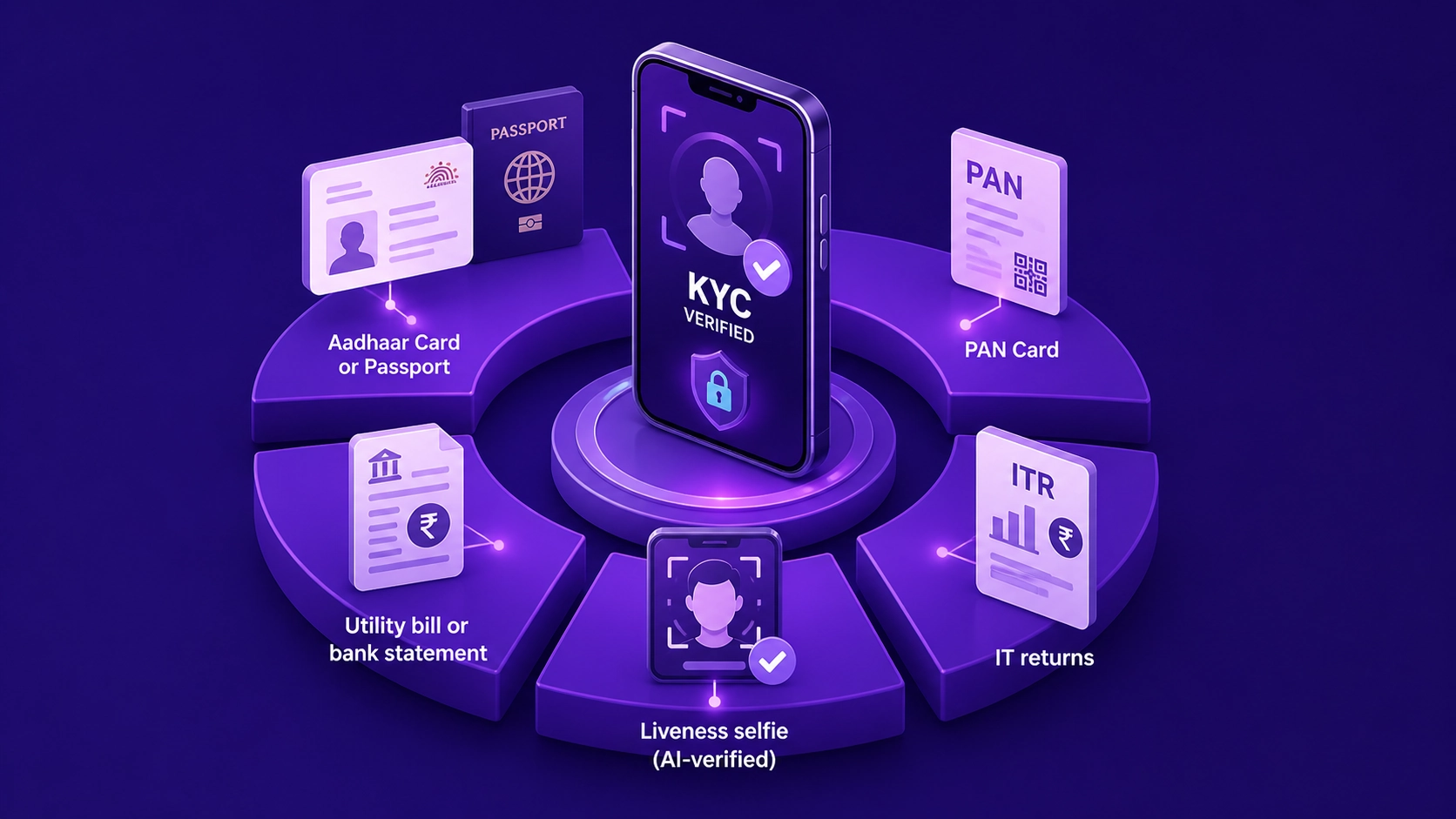
Document requirements in the Real Estate Tokenization KYC Process vary by platform, jurisdiction, and investor type. However, a consistent set of core documents is required across virtually all compliant platforms. Understanding what you need to prepare before starting the onboarding Real Estate Tokenization KYC Process significantly reduces friction and ensures faster approval. Our team has observed that incomplete document submissions are the most common reason for KYC delays on tokenized real estate platforms across India, UAE, and Singapore.
The table below summarizes the standard document requirements across the key investor types and jurisdictions that represent the largest growth markets for tokenized real estate investment in 2026:
| Document Type | India | UAE / Dubai | Singapore |
|---|---|---|---|
| Primary ID | Aadhaar Card or Passport | Emirates ID or Passport | NRIC, Passport, or MyInfo |
| Tax Identification | PAN Card | TRN (if applicable) | NRIC / Tax Reference No. |
| Proof of Address | Utility bill or bank statement | Tenancy agreement or bill | Utility bill or CDP statement |
| Biometric Check | Liveness selfie (AI-verified) | Liveness selfie (AI-verified) | Liveness selfie via Singpass |
| Accreditation Proof | Bank statements or IT returns | Financial statement or salary | MAS-defined threshold proof |
For corporate investors, additional documents including certificate of incorporation, memorandum and articles of association, beneficial ownership register, and board resolution authorizing investment are required as part of the KYB component of the broader Real Estate Tokenization KYC Process. Platforms serving cross-border institutional investors must be prepared to accept and verify documentation from a wide range of national corporate registry formats.
How AML Works Alongside KYC in Real Estate Tokenization
AML compliance real estate tokens is not a standalone system. It operates as a continuous layer that complements the one-time identity verification of the Real Estate Tokenization KYC Process with ongoing monitoring of investor behavior and transaction patterns throughout their lifecycle on the platform. While KYC answers the question of who an investor is at the point of onboarding, AML answers the ongoing question of whether their financial activity on the platform reflects legitimate investment behavior.
AML systems on tokenized real estate platforms perform several continuous functions. Transaction monitoring algorithms flag patterns that deviate from the investor’s established baseline behavior, such as sudden large transfers, rapid back-and-forth token movements between wallets, or transfers to and from wallets associated with high-risk jurisdictions. Sanctions list screening is refreshed continuously against global databases including OFAC, the EU consolidated list, and the UN Security Council list, ensuring that any investor who becomes sanctioned after their initial KYC approval is identified and flagged immediately.
For platforms serving investors from India and the UAE simultaneously, AML systems must navigate different thresholds for suspicious activity reporting. In the UAE, VARA requires platforms to file Suspicious Transaction Reports (STRs) with the UAE’s Financial Intelligence Unit within strict timeframes. In India, platforms aligned with SEBI and PMLA requirements must file similar reports with the Financial Intelligence Unit of India. The blockchain-native audit trail of tokenized real estate platforms makes AML reporting significantly more straightforward than equivalent processes in traditional property investment vehicles.
How Smart Contracts Enforce KYC Compliance On Chain

The most technically sophisticated aspect of the Real Estate Tokenization KYC Process is how compliance is enforced directly at the blockchain level through smart contracts. This on-chain KYC compliance mechanism is what distinguishes tokenized real estate from traditional digital investment platforms that rely on manual or off-chain compliance controls. KYC smart contract real estate implementations automate compliance enforcement in a way that is faster, more reliable, and more auditable than any human-operated alternative.[1]
Token standards specifically designed for compliance-sensitive securities, particularly ERC-1400 and ERC-3643, include built-in transfer restriction logic that queries a whitelist registry before permitting any token movement. When an investor who has passed the Real Estate Tokenization KYC Process has their wallet address added to this on-chain registry, their eligibility to send and receive tokens is encoded directly into the blockchain. No intermediary is required to approve each transaction. The smart contract enforces the rule automatically, in real time, on every transfer attempt.
This architecture enables platforms like Polymesh, which bakes identity checks and permissioning into its layer-one protocol, to enforce KYC automatically for every wallet on the network without post-hoc manual verification of each transaction. For platforms serving investors from India, UAE, and Singapore, jurisdiction-specific rules can be layered on top of the base whitelist logic, ensuring that transfer restrictions align with the securities regulations of each investor’s home market at the smart contract level.
What Happens If You Fail the KYC Process in Real Estate Tokenization
KYC failure in the Real Estate Tokenization KYC Process does not always mean permanent exclusion. The outcome depends on why the verification failed. The most common reasons for initial KYC failure include poor document image quality, document expiry, name mismatches between submitted documents, addresses that do not match across documents, or flags raised during PEP or sanctions screening. In most of these cases, the investor can correct the issue and resubmit, with the platform’s KYC provider running the check again on the updated documents.
When a KYC failure is triggered by a PEP flag or a sanctions list match, the platform’s compliance team conducts enhanced due diligence (EDD) rather than immediately rejecting the application. EDD involves additional documentation requests, source of wealth declarations, and senior compliance officer review. In some cases, PEP-flagged investors can still be onboarded following satisfactory EDD completion. Sanctioned individuals, however, are permanently excluded from the platform, and the platform is legally required to file reports with the relevant financial intelligence authorities.
From a technical perspective, wallet addresses linked to failed or unverified KYC records are simply not whitelisted on the smart contract. This means the blockchain-level enforcement automatically prevents any token movement to or from that address without any additional manual intervention. The on-chain KYC compliance system treats unverified wallets as ineligible by default, a fail-safe design principle that ensures no tokens can accidentally reach a non-compliant investor even if human oversight fails at the platform layer.
How KYC Protects Investors in Tokenized Real Estate
The Real Estate Tokenization KYC Process is sometimes viewed by investors as an administrative burden. In reality, it is one of the most powerful protections that the tokenized real estate ecosystem provides to every participant in the market. By ensuring that every investor on a platform is verified, platforms create a trusted investment environment that is fundamentally safer than anonymous or pseudonymous alternatives. For investors in India, UAE, and Singapore, this protection has tangible financial value.
The investor protection dimensions of a robust KYC framework span several critical areas that directly affect the security and integrity of your tokenized property investment:
| Protection Area | How KYC Delivers It | Investor Benefit |
|---|---|---|
| Fraud Prevention | Confirms real identity behind each wallet | No fraudulent participants in the pool |
| Market Integrity | Prevents wash trading and price manipulation | Fair token pricing on secondary markets |
| Legal Standing | Creates verifiable ownership records | Legally enforceable property rights |
| Regulatory Protection | Ensures platform operates within legal bounds | Reduces risk of regulatory shutdown |
| AML Shield | Blocks illicit funds from entering platform | Protects token value from criminal contamination |
Digital identity verification real estate blockchain systems also give investors a significant benefit in dispute resolution scenarios. Because every token holder’s identity is verifiably linked to their on-chain address, ownership disputes can be resolved quickly by reference to the immutable blockchain record combined with the KYC registry. This eliminates the ambiguity and legal cost that characterize traditional real estate ownership disputes, particularly in cross-border investment scenarios involving investors from India, UAE, and Singapore investing in properties in third-party jurisdictions.
What to Look for in a Platform With a Strong KYC Process
Not all tokenized real estate platforms implement the Real Estate Tokenization KYC Process with equal rigor. As an investor or platform builder, knowing how to evaluate KYC quality is essential for making informed decisions about where to place capital or how to build your compliance infrastructure. Our team’s experience across dozens of tokenization projects has identified a clear set of characteristics that distinguish platforms with genuinely strong KYC frameworks from those with superficial compliance checkboxes.
The first indicator is the identity verification provider used. Platforms integrated with enterprise-grade providers such as Onfido, Jumio, or Sumsub signal serious investment in KYC quality. These providers support Aadhaar-based verification for Indian investors, Emirates ID for UAE participants, and Singpass or MyInfo for Singapore users, covering the key growth markets comprehensively. Platforms using unrecognized or self-built verification tools carry higher compliance risk and may not meet the standards required by regulators in these jurisdictions.
The second indicator is how KYC is enforced technically. Platforms that rely solely on off-chain compliance controls without on-chain whitelist enforcement using security token standards like ERC-1400 or ERC-3643 have structural compliance gaps. Look for platforms that explicitly describe their on-chain KYC compliance architecture and can demonstrate how smart contracts enforce transfer restrictions in real time based on wallet verification status.
Additional quality signals include regulatory licensing in the jurisdictions served (VARA in UAE, MAS-regulated in Singapore, SEBI-aligned in India), clear documentation of AML monitoring procedures, transparent investor communication about data handling under GDPR, PDPA, or DPDP frameworks, and defined Real Estate Tokenization KYC Process for KYC refresh and ongoing monitoring. Platforms that can articulate their security token KYC requirements clearly and demonstrate regulatory engagement are the ones that represent safe, long-term environments for tokenized real estate investment in 2026 and beyond.
Enterprise KYC Provider
Onfido, Jumio, or Sumsub integration signals production-grade identity verification capability across India, UAE, and Singapore.
On-Chain Whitelist Enforcement
ERC-1400 or ERC-3643 token standards with smart contract transfer restrictions confirm genuine on-chain KYC compliance architecture.
Regulatory Licensing
VARA license for UAE, MAS compliance in Singapore, and SEBI alignment in India confirm the platform operates within legal frameworks investors can trust.
Ongoing AML Monitoring
Continuous transaction monitoring and automatic sanctions screening indicate a platform that takes AML compliance real estate tokens obligations seriously at every stage.
Build a KYC-Compliant Tokenization Platform
Our team builds investor-grade KYC and AML compliance engines for tokenized real estate platforms serving India, UAE, and Singapore with full regulatory confidence.
Frequently Asked Questions
Q1.1. What is KYC and why do I need to do it to invest in tokenized real estate?
KYC stands for Know Your Customer. It is the identity verification process that tokenized real estate platforms use to confirm who you are, prevent fraud, comply with financial regulations, and ensure only eligible investors can access and trade property tokens on the platform.
Q2.2. How long does the KYC process take on real estate tokenization platforms?
Most modern real estate tokenization platforms complete KYC verification within minutes to 24 hours. Automated identity verification providers like Onfido, Jumio, and Sumsub process documents in real time using AI-powered checks, biometric liveness detection, and government database lookups for instant approval in most cases.
Q3.3. What documents do I need to complete KYC for tokenized real estate investment?
You typically need a government-issued photo ID such as a passport or national ID card, proof of address like a utility bill or bank statement dated within three months, and in some jurisdictions a tax identification number. Investors from India may use Aadhaar, UAE residents use Emirates ID, and Singapore users can verify via MyInfo digital identity systems.
Q4.4. Is KYC on tokenized real estate platforms secure? Will my data be safe?
Reputable tokenized real estate platforms use bank-grade encryption, secure document storage, and data protection compliance aligned with GDPR, PDPA in Singapore, and DPDP in India. Your identity data is stored securely and shared only with regulated compliance partners, not the general public or third-party advertisers.
Q5.5. Can I invest in tokenized real estate from India without completing KYC?
No. All legitimate tokenized real estate platforms require KYC completion before allowing any investment. In India, SEBI-aligned digital asset frameworks mandate identity verification for all investors. Platforms targeting Indian investors often use Aadhaar-based eKYC, which streamlines the process significantly for domestic retail participants.
Q6.6. What happens if my KYC gets rejected on a tokenized real estate platform?
If KYC is rejected, the platform will notify you of the specific reason such as an unreadable document, name mismatch, or PEP flag. You can typically resubmit with corrected documents. Persistent failures may result in restricted access, and platforms are legally required to report certain cases to financial intelligence authorities.
Q7.7. Do I need to redo KYC every time I invest in a new tokenized real estate project?
On most platforms, KYC is completed once during account onboarding and applies to all investments made through that platform. However, if you invest through multiple platforms or if your verification status expires due to regulatory refresh requirements, you may need to resubmit updated documents periodically.
Q8.8. What is the difference between KYC and AML in real estate tokenization?
KYC verifies who you are as an investor. AML or Anti-Money Laundering is the broader set of controls that monitors transaction patterns, screens against sanctions lists, and flags suspicious financial behavior. Both work together on tokenized real estate platforms to prevent identity fraud and financial crime from entering the system.
Q9.9. How do smart contracts enforce KYC in tokenized real estate systems?
Smart contracts on tokenized real estate platforms maintain on-chain whitelists of KYC-verified wallet addresses. When a token transfer is attempted, the smart contract automatically checks whether both the sender and recipient wallets are whitelisted. If either wallet fails the check, the transaction is blocked without requiring manual intervention.
Q10.10. Is the real estate tokenization KYC process different in Singapore and UAE compared to India?
Yes, each jurisdiction has specific requirements. Singapore investors verify through MAS-aligned processes using MyInfo. UAE investors in Dubai use Emirates ID with VARA-compliant platforms. Indian investors use Aadhaar or PAN-based verification under SEBI guidelines. The underlying KYC steps are similar, but the identity documents and regulatory standards differ by market.
Explore Services
Related Services
Reviewed by

Aman Vaths
Founder of Nadcab Labs
Aman Vaths is the Founder & CTO of Nadcab Labs, a global digital engineering company delivering enterprise-grade solutions across AI, Web3, Blockchain, Big Data, Cloud, Cybersecurity, and Modern Application Development. With deep technical leadership and product innovation experience, Aman has positioned Nadcab Labs as one of the most advanced engineering companies driving the next era of intelligent, secure, and scalable software systems. Under his leadership, Nadcab Labs has built 2,000+ global projects across sectors including fintech, banking, healthcare, real estate, logistics, gaming, manufacturing, and next-generation DePIN networks. Aman’s strength lies in architecting high-performance systems, end-to-end platform engineering, and designing enterprise solutions that operate at global scale.