Ai Overview
Trust has always been the currency of financial services, and in the crypto industry, that trust has been tested repeatedly. The question that follows is simple but critical: are those funds actually there? An exchange could hold $1 billion in reserves while owing $1. A platform that was once valued at $32 billion turned out to be secretly insolvent, having misappropriated billions in customer funds.
Key Takeaways
- Proof of reserves is a cryptographic verification process that allows crypto exchanges to demonstrate they hold enough assets to cover all user deposits on a 1:1 basis.
- The method uses Merkle tree data structures and on-chain wallet verification so individual users can confirm their balances are included in the exchange’s total holdings.
- After the FTX collapse in 2022, proof of reserves in crypto
- exchanges shifted from a competitive advantage to an industry expectation that users demand before depositing funds.
- Proof of reserves alone is insufficient without proof of liabilities, as an exchange can show large reserves while hiding debts that exceed those holdings.
- Leading exchanges like Binance, Kraken, and OKX have adopted various forms of crypto exchange proof of reserves, though implementation quality varies across platforms.
- The industry is moving toward real-time, automated proof systems that provide continuous verification rather than periodic snapshots that can be manipulated.
- Regulatory bodies in major financial markets are considering mandatory proof of reserves crypto requirements as part of exchange licensing frameworks.
- Implementing proof of reserves from the platform’s inception results in more secure and transparent exchange architecture than retrofitting it later.
- Users should evaluate the frequency of audits, the scope of assets covered, and whether liabilities are included alongside proof of reserves reporting.
Understanding Proof of Reserves in Crypto Exchanges
Trust has always been the currency of financial services, and in the crypto industry, that trust has been tested repeatedly. When users deposit assets on a centralized exchange, they are essentially handing over control of their funds to a third party. The question that follows is simple but critical: are those funds actually there? This is the problem that proof of reserves was designed to solve, and its importance has grown enormously as the crypto market has matured.
The concept of proof of reserves in crypto exchanges is rooted in a straightforward principle: exchanges should be able to demonstrate, at any given time, that they hold assets equal to or greater than the total deposits their users have made. It sounds obvious, but as the industry has learned the hard way, not every exchange that claims to hold your funds is actually doing so.
What Proof of Reserves Means in the Crypto Ecosystem
Proof of reserves explained in simple terms for users
At its core, proof of reserves explained simply means this: a crypto exchange shows verifiable evidence that it actually holds the assets it claims to hold on behalf of its users. Think of it as a bank proving it has enough cash in the vault to pay back every depositor. The difference is that instead of relying on a government regulator to check the books, blockchain technology allows this verification to happen transparently and publicly.
When an exchange publishes its proof of reserves, it typically reveals the wallet addresses where user funds are stored. Anyone can look at these addresses on the blockchain and verify the balances independently. Some exchanges go further by publishing cryptographic proofs that allow individual users to confirm their specific balance is included in the total, all without exposing other users’ private information. Understanding proof of reserves explained at this foundational level is essential for any crypto participant evaluating where to store their assets.
Role of proof of reserves in crypto exchange transparency
Transparency in centralized crypto exchanges has historically been an afterthought. Unlike traditional financial institutions that operate under strict regulatory oversight, many crypto exchanges operated as black boxes, with users having no visibility into how their funds were managed. Proof of reserves crypto mechanisms changed this dynamic by introducing a verifiable, blockchain-native method for exchanges to demonstrate financial health.
For exchange operators, implementing transparent reserve verification is no longer optional. It is a competitive necessity. Users who experienced the fallout from exchange failures now actively evaluate platforms based on their transparency practices before depositing a single token. Exchanges working with experienced crypto exchange teams increasingly prioritize reserve transparency from day one.
Why Proof of Reserves Matters for Crypto Users
Building trust through transparent crypto exchanges
The relationship between a crypto exchange and its users is fundamentally one of trust. Users trust that the exchange will safeguard their funds, execute trades fairly, and remain solvent. Proof of reserves transforms this blind trust into verifiable trust. Instead of taking an exchange’s word that funds are safe, users can independently verify the claim using on-chain data and cryptographic tools.
This shift matters enormously for institutional adoption. Asset managers, corporate treasuries, and financial firms evaluating crypto exposure need more than marketing promises. They need the same kind of verifiable assurance they expect from traditional custodians. Proof of reserves in crypto exchanges provides exactly that, bridging the gap between crypto’s permissionless ethos and institutional compliance requirements.
Ensuring user fund safety in crypto exchanges
User fund safety goes beyond security measures like cold storage and multi-signature wallets. It also means ensuring that the exchange has not lent out, pledged, or otherwise encumbered those funds without disclosure. Proof of reserves addresses this concern by making it possible to verify that funds exist and are unencumbered at a specific point in time. While it does not eliminate all risks, it significantly reduces the likelihood that an exchange is operating with insufficient backing.
Risk Warning: No single verification method eliminates all custodial risk. Users should evaluate proof of reserves alongside security practices, insurance coverage, regulatory compliance, and the exchange’s operational track record before entrusting significant assets.
How Proof of Reserves Works on Crypto Exchanges
Understanding the mechanics behind proof of reserves is essential for both exchange operators designing their platforms and users evaluating where to store their assets. The process combines blockchain transparency with cryptographic techniques to create a system that is both verifiable and privacy-preserving.
The Process of Crypto Exchange Reserve Verification
On-chain reserve verification using blockchain data
The most fundamental aspect of crypto exchange proof of reserves is on-chain verification. Exchanges publish their wallet addresses, and anyone with access to a blockchain explorer can independently confirm the balances. For Bitcoin, this means checking addresses on the Bitcoin blockchain. For Ethereum and ERC-20 tokens, the process involves querying the Ethereum network. Multi-chain exchanges must provide verification across every blockchain they support, which adds complexity but also thoroughness to the crypto exchange proof of reserves process.
Some exchanges enhance this process by signing messages with the private keys of their reserve wallets, cryptographically proving they control the addresses in question. This prevents a scenario where an exchange could claim ownership of wallets it does not actually control. The signed message technique has become an expected component of any credible proof of reserves crypto implementation.
How exchanges prove asset backing without revealing identities
Privacy is a legitimate concern in reserve verification. Exchanges cannot simply publish a list of every user account and its balance. The solution lies in cryptographic techniques that prove the total without exposing individuals. Zero-knowledge proofs and Merkle tree structures allow exchanges to demonstrate that the sum of all user balances equals a known total, while allowing each user to privately verify their own inclusion. This balance between transparency and privacy is what makes proof of reserves crypto technically elegant and practically useful for exchanges operating across global markets.
Merkle Tree Method in Proof of Reserves
Using Merkle tree proof of reserves for user balance validation
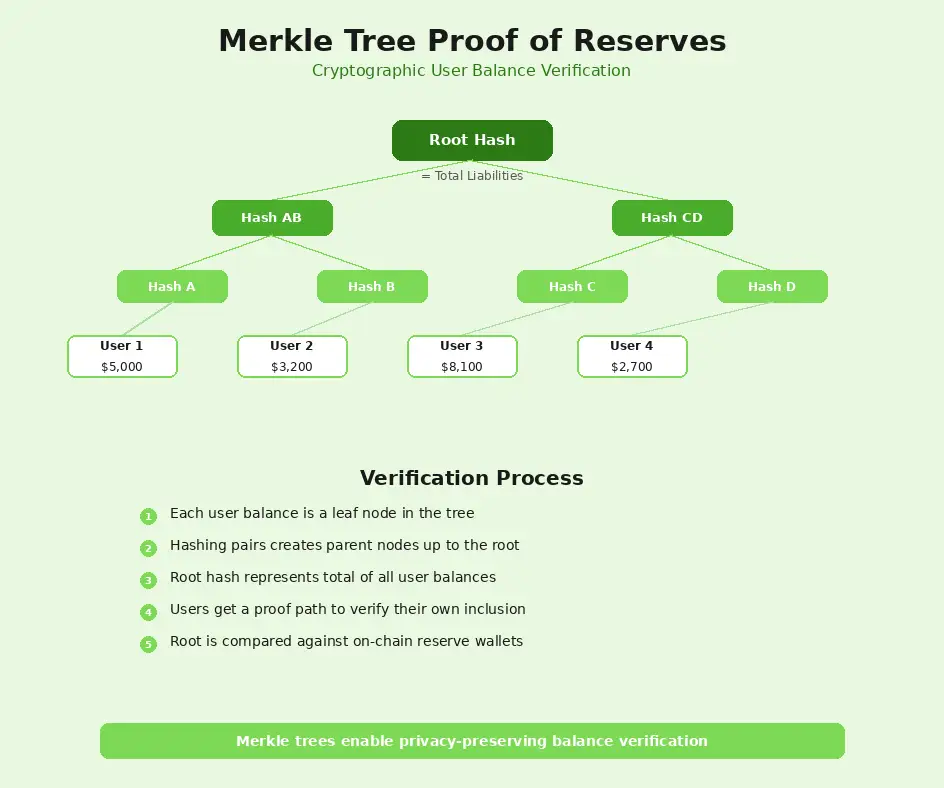
The Merkle tree approach has become the standard method for proof of reserves implementations. Here is how it works in practice: each user’s account balance is placed as a leaf node in a binary tree. Each pair of leaf nodes is hashed together to form a parent node, and this process continues upward until a single root hash is produced. This root hash represents the total of all user balances.
Individual users receive a “proof path,” a set of hashes that connects their specific leaf to the root. By following this path, a user can mathematically verify that their balance is included in the total without needing to see any other user’s data. The root hash is published alongside the exchange’s on-chain reserve addresses, allowing anyone to compare total claimed liabilities against actual reserves. This Merkle-based approach has become the backbone of proof of reserves in crypto exchanges worldwide.
Cryptographic audit methods behind proof of solvency
Beyond Merkle trees, advanced cryptographic methods are being explored to enhance proof of reserves. Zero-knowledge proofs can prove that reserves exceed liabilities without revealing either number precisely. Homomorphic encryption allows computations on encrypted data, enabling auditors to verify sums without accessing individual account details. These methods are more computationally expensive but offer stronger privacy guarantees and are likely to become more prevalent as proof of reserves crypto technology matures across the industry.
Proof of Reserves Verification Lifecycle
| Step | Stage | Description | Responsible Party |
|---|---|---|---|
| 1 | Snapshot Initiation | Exchange takes a snapshot of all user balances at a specific block height | Exchange / Auditor |
| 2 | Merkle Tree Construction | User balances organized into a Merkle tree and root hash computed | Exchange |
| 3 | On-Chain Reserve Confirmation | Exchange publishes wallet addresses and signs messages proving ownership | Exchange |
| 4 | Third-Party Audit | Independent auditor verifies Merkle root against on-chain balances | Third-Party Auditor |
| 5 | User Verification | Individual users verify their balance inclusion using their Merkle proof path | User |
| 6 | Public Attestation | Audit results and Merkle root published for public review | Exchange / Auditor |
| 7 | Continuous Monitoring | Ongoing on-chain monitoring tracks reserve wallet movements between audits | Community / Analysts |
Proof of Reserves vs Traditional Crypto Exchange Audits
Traditional financial audits and blockchain-based proof of reserves serve similar goals but operate in fundamentally different ways. Understanding these differences helps both exchange operators and users evaluate which approach provides better assurance for protecting user assets.
Differences Between Proof of Reserves and Financial Audits
Limitations of traditional crypto exchange audits
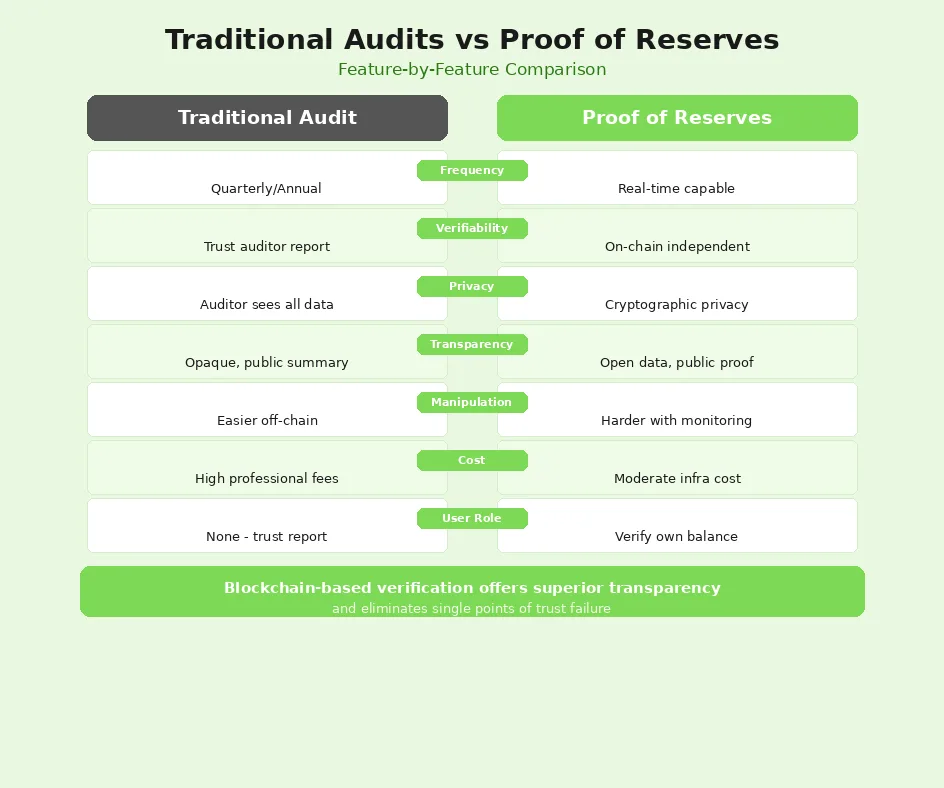
Traditional audits rely on a trusted third party to examine an organization’s books and issue an opinion. In the crypto space, this model has significant limitations. Audits are periodic, typically quarterly or annually, creating long gaps where mismanagement can go undetected. They also rely on the auditor’s competence in evaluating blockchain-native assets, and not all audit firms have the expertise to properly verify crypto holdings. Perhaps most critically, traditional audits are backward-looking: they confirm what happened in the past, not what is happening right now.
Advantages of blockchain-based audits for transparency
Blockchain-based proof of reserves offers several advantages over traditional audits. On-chain data is publicly accessible and independently verifiable, eliminating the need to trust a single auditor’s conclusion. Verification can happen in near-real-time rather than months after the fact. And the cryptographic nature of the proof makes it mathematically rigorous, removing the subjectivity inherent in traditional accounting opinions. For organizations building secure trading platforms, consulting a comprehensive exchange platform guide can clarify best practices for integrating these mechanisms.
Traditional Audits vs Proof of Reserves: Comparison
| Feature | Traditional Audit | Proof of Reserves |
|---|---|---|
| Frequency | Quarterly / Annually | Real-time or near-real-time capable |
| Verifiability | Trust the auditor’s report | Independently verifiable on-chain |
| Privacy | Full access to user data by auditor | Cryptographic privacy preservation |
| Transparency | Opaque process, public summary | Open data, public proof |
| Manipulation Risk | Easier with off-chain data | Lower with continuous monitoring |
| Cost | High (professional fees) | Moderate (infrastructure + tooling) |
| User Participation | None (trust the report) | Users can verify own balances |
Proof of Reserves vs Proof of Liabilities
Why proof of solvency matters more than reserves alone
Proof of reserves shows one side of the equation: what an exchange holds. But without knowing what it owes, the picture is incomplete. An exchange could hold $1 billion in reserves while owing $1.5 billion to users, making it technically insolvent despite impressive reserve numbers. Proof of solvency combines both metrics, verifying that reserves are equal to or greater than liabilities. This is the standard that truly matters for user protection and is increasingly what regulators expect from any platform conducting crypto exchange proof of reserves.
Risks of incomplete reserve disclosure
Incomplete disclosure creates a false sense of security. An exchange that publishes proof of reserves for Bitcoin but not for other tokens might be solvent in one asset and deeply underwater in others. Similarly, reserves shown on a single date can mask the fact that funds were borrowed specifically for the snapshot. The industry learned these lessons the hard way, and the push for comprehensive, continuous proof of reserves in crypto exchanges reflects that hard-won experience.
Process Principle: Proof of reserves should always be evaluated alongside proof of liabilities. An exchange showing reserves without liabilities is like showing revenue without expenses. The full financial picture requires both sides of the balance sheet.
The Role of Proof of Reserves After Major Exchange Failures
The crypto industry has experienced several catastrophic exchange failures that wiped out billions in user funds. These events transformed proof of reserves from a technical curiosity into an urgent industry priority that no credible exchange can afford to ignore.
Why Proof of Reserves Became Critical After FTX Collapse
Lessons learned for custodial crypto exchanges
The FTX collapse in November 2022 was a watershed moment. A platform that was once valued at $32 billion turned out to be secretly insolvent, having misappropriated billions in customer funds. The fallout was immediate: users across the industry demanded proof that other exchanges were not doing the same thing. Within weeks of FTX’s bankruptcy filing, every major exchange scrambled to publish some form of proof of reserves.
The lesson was clear: self-reported financial health is meaningless without independent verification. Trust based on branding, venture capital backing, or celebrity endorsements proved worthless when the underlying financials were fraudulent. Only verifiable, on-chain proof of reserves could restore confidence. For exchange platforms prioritizing transaction security, understanding blockchain transaction security frameworks is equally critical.
Impact on user trust and exchange accountability
User behavior changed dramatically after FTX. Withdrawal volumes spiked across all exchanges as users moved funds to self-custody wallets. Exchanges that published credible proof of reserves saw faster stabilization of their user bases, while those that delayed or published incomplete proofs faced ongoing outflows. The message from the market was unambiguous: proof of reserves explained in concrete, verifiable terms is now a baseline requirement for maintaining user trust and long-term viability.
Proof of Reserves as a New Industry Standard
Adoption of transparent crypto exchange practices
Since late 2022, adoption of proof of reserves has accelerated across the industry. Major platforms have partnered with third-party audit firms, implemented Merkle tree verification, and created user-facing dashboards that display reserve ratios in real time. Newer exchanges are launching with proof of reserves built into their infrastructure from the start, recognizing that transparency is not a feature but a foundation. The proof of reserves explained on these platforms typically includes user-friendly interfaces that make independent verification accessible to non-technical users as well.
How proof of reserves improves market confidence
Market confidence extends beyond individual users. Institutional investors, liquidity providers, and payment processors all factor exchange transparency into their partnership decisions. Crypto exchange proof of reserves serves as a signal of operational maturity that can unlock business relationships, regulatory approvals, and insurance coverage that would otherwise be unavailable. In an industry still working to prove its legitimacy, this signal carries enormous weight across global financial hubs.
Benefits of Proof of Reserves for Crypto Exchanges and Users
Strengthening Trust and Transparency in Crypto Exchanges
How transparent exchanges attract long-term users
Data consistently shows that exchanges with robust transparency practices retain users at higher rates than those without. When users know they can verify the safety of their funds at any time, they are more likely to maintain larger balances and use the platform as their primary exchange. This creates a virtuous cycle: transparency attracts users, which increases liquidity, which improves trading experience, which attracts more users. Proof of reserves in crypto exchanges is the cornerstone of this transparency-driven growth model.
Proof of reserves as a trust signal for traders
Professional traders and market makers evaluate exchanges on multiple criteria, and proof of reserves has become a prominent factor in that evaluation. A trader considering where to deploy significant capital will prioritize platforms where they can independently verify that funds are backed. This is especially true for derivatives traders and institutional desks that maintain large balances on exchanges for operational efficiency. The availability of proof of reserves crypto verification has become a non-negotiable requirement for serious capital allocation decisions.
Enhancing User Fund Safety and Platform Credibility
Reducing risks of mismanagement of user assets
Proof of reserves creates an accountability mechanism that discourages mismanagement. When an exchange knows its reserves are being publicly monitored, the incentive to misuse user funds diminishes significantly. It functions as a deterrent: the reputational and legal consequences of being caught with insufficient reserves far outweigh any short-term gains from misappropriation. This accountability is what makes proof of reserves in crypto exchanges such a powerful mechanism for user protection.
Supporting responsible custodial exchange operations
Responsible custodial operations require more than good intentions. They require systems and processes that enforce accountability. Proof of reserves provides this enforcement layer, creating a public record that can be audited by anyone at any time. It forces exchanges to maintain disciplined treasury management and discourages the kind of risk-taking with user funds that led to previous collapses.
Building crypto exchanges with integrated proof of reserves from inception creates a stronger foundation for long-term trust and regulatory compliance.
Challenges and Limitations of Proof of Reserves
While proof of reserves represents a significant improvement over blind trust, it is not a perfect solution. Understanding its limitations is just as important as understanding its benefits for anyone evaluating exchange platforms.
Technical and Operational Challenges
Accuracy issues in crypto reserve audit processes
Snapshot-based proof of reserves captures a single moment in time, which can be misleading. An exchange could borrow assets to inflate its reserves just before a snapshot and return them immediately after. Multi-chain verification adds complexity, as timing differences across blockchains can create discrepancies. Some tokens may also be held in DeFi protocols or staking contracts that are difficult to account for in a standard proof of reserves framework. These accuracy challenges mean that even well-intentioned proof of reserves crypto implementations can present an incomplete picture.
Dependence on third-party crypto audits
Many proof of reserves implementations rely on third-party auditors for validation. This reintroduces the trust assumption that blockchain-based verification was meant to eliminate. The competence and independence of these auditors vary, and the industry has seen cases where auditors lacked the expertise to properly evaluate crypto-native financial structures. The ideal solution is fully automated, continuous verification that minimizes human involvement and the trust assumptions that come with it.
What Proof of Reserves Does Not Reveal
Hidden liabilities and off-chain risks
Proof of reserves only measures what is visible on-chain. Off-chain liabilities, such as loans, derivative obligations, legal settlements, or operational debts, remain invisible. An exchange can appear fully solvent on-chain while being deeply in debt off-chain. This gap is a fundamental limitation that the industry must address through complementary measures like proof of liabilities, regulatory reporting, and comprehensive financial disclosures.
Why transparency must go beyond reserves
Comprehensive exchange transparency requires more than just proof of reserves. Users also need visibility into how their funds are managed, including segregation from operational funds, insurance coverage, security audit results, and governance structures. Proof of reserves is one pillar of a multi-pillar transparency framework that responsible exchanges are building. Viewing it as a complete solution rather than one component can create a dangerous false sense of security that puts user funds at risk.
Selecting the Right Proof of Reserves Model
When evaluating or implementing proof of reserves, consider these selection criteria: the scope of assets covered (all holdings vs. select tokens), verification frequency (periodic snapshots vs. real-time monitoring), the privacy model (Merkle trees vs. zero-knowledge proofs), whether liabilities are included alongside reserves, the independence and competence of the auditing party, and user accessibility of verification tools. The best systems combine broad asset coverage, high-frequency updates, and cryptographic privacy with full liability disclosure and independent verification.
Implementing Proof of Reserves in Crypto Exchange Platforms
Key Requirements for Proof of Reserves Implementation
Secure infrastructure for on-chain reserve verification
Implementing proof of reserves requires robust infrastructure. The system must securely aggregate all wallet balances across multiple blockchains, construct Merkle trees from user balance data without exposing individual accounts, generate verifiable proofs, and publish results through a user-friendly interface. The infrastructure must also be tamper-resistant, ensuring that the proof generation process cannot be manipulated internally. This is a significant engineering undertaking that requires deep blockchain expertise and careful security design to implement crypto exchange proof of reserves that users can genuinely trust.
Importance of regular and real-time updates
The value of proof of reserves explained in practical terms comes down to timeliness. A proof that is six months old tells users very little about the current state of an exchange’s reserves. The industry is moving toward real-time or near-real-time updates that provide continuous assurance. This requires automated systems that can regenerate proofs as reserves change, ideally integrated directly into the exchange’s core platform architecture.
Proof of Reserves Implementation Approaches
| Approach | Description | Pros | Cons |
|---|---|---|---|
| Periodic Snapshot | Monthly or quarterly point-in-time audits | Lower cost, simpler to implement | Can be gamed between snapshots |
| Merkle Tree + Attestation | User-verifiable Merkle proofs with auditor sign-off | Users verify own balance, widely adopted | Still periodic, auditor dependency |
| Real-Time On-Chain | Continuous automated reserve verification | Highest assurance, no snapshot gaming | Complex infrastructure, higher cost |
| Zero-Knowledge Proof | Privacy-preserving cryptographic verification | Maximum privacy, strong math guarantees | Computationally expensive, newer tech |
Choosing the Right Crypto Exchange Building Partner
Building transparent crypto exchange platforms from day one
The decision to integrate proof of reserves should happen at the platform design stage, not after launch. Retrofitting transparency mechanisms into an existing architecture is significantly more expensive and error-prone than designing for it from the start. The right technology partner will have experience architecting exchange systems where proof of reserves is a core feature, not a bolt-on addition. Teams with deep exchange platform expertise understand these architectural requirements intimately and can ensure that proof of reserves in crypto exchanges is integrated seamlessly.
Integrating proof of reserves into exchange architecture
Proper integration means that the wallet management system, the user balance tracking, the Merkle tree generation, and the public-facing verification interface are all designed as interconnected components of a cohesive architecture. Data integrity must be maintained from the point of deposit through to the public proof. Any gap in this chain creates an opportunity for discrepancy or manipulation. This level of integration requires specialized blockchain engineering expertise and a track record of building secure, compliant exchange platforms that institutional partners can rely on.
The Future of Proof of Reserves in Crypto Exchanges
The trajectory of proof of reserves crypto adoption is clear: more comprehensive, more frequent, and more automated. As the technology matures and regulatory expectations solidify, proof of reserves will evolve from a voluntary best practice to an industry standard and potentially a legal requirement across major financial jurisdictions.
Evolving Standards for Exchange Transparency
Automation and real-time proof of reserves
The next generation of proof of reserves systems will be fully automated, generating and publishing proofs continuously without human intervention. Smart contracts can serve as automated verifiers, checking reserve ratios on-chain and triggering alerts if ratios fall below safe thresholds. This eliminates the delay and trust assumptions of periodic audits while providing users with always-current assurance about the safety of their funds. Crypto exchange proof of reserves is evolving from a periodic attestation into a real-time system feature that operates around the clock.
Regulatory expectations around crypto exchange transparency
Regulatory bodies in major financial markets are actively creating frameworks for crypto exchange oversight. Many of these frameworks include provisions for reserve transparency, and some are explicitly considering mandating proof of reserves as a licensing condition. Exchanges that adopt proof of reserves proactively will find themselves ahead of compliance requirements when regulations take effect, while those that delay may face costly and disruptive retrofitting. The regulatory momentum behind proof of reserves in crypto exchanges suggests that voluntary adoption today will become mandatory compliance tomorrow.
Proof of Reserves as a Foundation for Trust
Long-term impact on user confidence and adoption
The long-term impact of widespread proof of reserves adoption extends beyond individual exchanges. It contributes to the maturation of the entire crypto ecosystem. When users know that industry-standard verification mechanisms are in place, the barrier to entry for new participants drops. This is especially significant for mainstream adoption, where potential users often cite concerns about exchange security and fund safety as their primary hesitation. Proof of reserves explained clearly and implemented rigorously directly addresses these concerns and lowers the trust threshold for millions of potential users globally.
Proof of reserves shaping the future of crypto exchanges
Looking ahead, proof of reserves will likely become as fundamental to crypto exchanges as deposit insurance is to banks. It will be an expected feature, not a differentiator. Implementing crypto exchange proof of reserves will be as standard as having a website. Exchanges that fail to offer it will be viewed with the same suspicion as a bank that refuses to disclose its financial statements. The technology will continue to improve, moving toward fully automated, zero-knowledge-based systems that provide mathematical certainty about solvency without compromising user privacy.
The journey of proof of reserves in crypto exchanges mirrors the broader maturation of the industry. From the early days of opaque, trust-based operations to the current push for verifiable, transparent systems, the evolution reflects an industry that is learning from its failures and building better infrastructure for the future. For exchange operators, the path forward is clear: invest in transparent, verifiable reserve systems that give users the confidence they need. For users, the expectation should be equally clear: demand proof, verify independently, and hold exchanges accountable for safeguarding your assets.
Frequently Asked Questions
Q1.What is proof of reserves in cryptocurrency?
Proof of reserves is a verification method that allows cryptocurrency exchanges to demonstrate they hold sufficient assets to cover all user deposits. It involves cryptographic attestation where exchanges prove ownership of on-chain assets through wallet signatures and Merkle tree verification, enabling users to independently verify that their funds are backed 1:1 by actual reserves without compromising privacy.
Q2.How does proof of reserves work on crypto exchanges?
Proof of reserves works by having exchanges create a cryptographic snapshot of all user balances and their corresponding reserve wallets. The exchange generates a Merkle tree from user account data, publishes the root hash, and provides each user with a Merkle proof. Simultaneously, they sign transactions from reserve wallets to prove ownership. Independent auditors or users can then verify that total reserves exceed total liabilities.
Q3.Why is proof of reserves important after the FTX collapse?
The FTX collapse revealed how exchanges can misuse customer funds without transparency mechanisms. Proof of reserves became critical because it provides verifiable evidence that exchanges aren’t lending out, trading with, or otherwise misappropriating user deposits. It serves as a public accountability tool that helps prevent fractional reserve practices and restores confidence in custodial platforms.
Q4.What is the difference between proof of reserves and proof of liabilities?
Proof of reserves shows what assets an exchange controls, while proof of liabilities demonstrates what the exchange owes to users. A complete proof of solvency requires both components because an exchange could have large reserves but even larger hidden debts. Together, these proofs verify that assets exceed liabilities, confirming the platform is financially sound and fully backed.
Q5.Can proof of reserves be manipulated by exchanges?
While proof of reserves significantly improves transparency, it has limitations. Exchanges could potentially borrow assets temporarily for snapshots, collude with other platforms, or hide liabilities and debts. That’s why continuous, real-time verification with independent third-party audits and combined proof of liabilities is essential for comprehensive transparency rather than relying on occasional reserve snapshots alone.
Q6.How can users verify their funds in a proof of reserves audit?
Users receive a unique Merkle proof (a cryptographic path) that links their account balance to the published Merkle root hash. By following the verification process provided by the exchange, users can mathematically confirm their balance was included in the total calculation without revealing their holdings to others. This allows independent verification without compromising privacy.
Q7.What is a Merkle tree in proof of reserves?
A Merkle tree is a cryptographic data structure used to efficiently verify large datasets. In proof of reserves, each user’s account balance becomes a leaf node, which are hashed and combined in pairs up the tree until creating a single root hash. This allows exchanges to prove all user balances were included in the reserve calculation while letting individual users verify their specific inclusion.
Explore Services
Related Services
Reviewed by

Aman Vaths
Founder of Nadcab Labs
Aman Vaths is the Founder & CTO of Nadcab Labs, a global digital engineering company delivering enterprise-grade solutions across AI, Web3, Blockchain, Big Data, Cloud, Cybersecurity, and Modern Application Development. With deep technical leadership and product innovation experience, Aman has positioned Nadcab Labs as one of the most advanced engineering companies driving the next era of intelligent, secure, and scalable software systems. Under his leadership, Nadcab Labs has built 2,000+ global projects across sectors including fintech, banking, healthcare, real estate, logistics, gaming, manufacturing, and next-generation DePIN networks. Aman’s strength lies in architecting high-performance systems, end-to-end platform engineering, and designing enterprise solutions that operate at global scale.