Ai Overview
Multi-level marketing has long been a controversial business model, but its decentralized form introduces blockchain technology to create transparent, auditable systems. However, speed of development cannot come at the expense of security or performance when financial contracts are involved. A developer writing in Solidity can see gas implications of their code, which is critical for cost-effective MLM operations where thousands of transactions occur daily.
Key Takeaways
Solidity remains the default for Ethereum platforms. Vyper provides enhanced security at the cost of flexibility. Consider the specific security requirements of your MLM model carefully.
Go and Rust excel at handling scale efficiently. Python and Node.js are appropriate for moderate scale with rapid development. Language choice should reflect expected transaction volume and participant counts.
JavaScript dominates for web interfaces. Flutter enables efficient cross-platform mobile development. Choose based on your target user base and engagement patterns.
Python’s ecosystem excels at data analysis and testing. Rust and Go handle high-performance indexing and real-time processing. Select based on specific infrastructure requirements.
Language choice influences but does not determine security. Employ comprehensive testing, external audits, and careful development practices regardless of language used.
When building a decentralized MLM platform, evaluate your requirements honestly. How critical is security? How important is development speed? What scale must the system handle? How much infrastructure expertise does your team possess? The answers determine optimal language selection. The best choice is not the most popular language or the newest language, but the language that best fits your specific constraints and long-term vision.
The landscape of decentralized applications has fundamentally changed how businesses operate. Among the most complex use cases are decentralized multi-level marketing systems, which rely heavily on the programming languages chosen to build them. This comprehensive guide explores how different programming languages directly influence the scalability, security, and performance of decentralized MLM platforms, providing you with insights needed to understand or build these sophisticated applications.
Introduction to Decentralized MLM Systems
Multi-level marketing has long been a controversial business model, but its decentralized form introduces blockchain technology to create transparent, auditable systems. A decentralized MLM operates on smart contracts that automatically enforce the rules of the network without a central authority managing the operations.
Traditional MLM systems rely on centralized databases and manual verification. Decentralized versions distribute trust across a network of computers, each running the same code. This shift requires specialized programming approaches because the code must be immutable once deployed and must execute identically across thousands of nodes.
The core difference lies in execution model. A standard MLM application can be updated, rolled back, or modified in a database. A decentralized MLM built on blockchain cannot. This reality shapes every decision a developer makes regarding programming language selection, and it cascades through every other architectural choice.
Understanding how MLM networks work in decentralized form requires knowing that participants join through smart contracts, commission structures are enforced through code, and all transactions are permanently recorded. The programming language chosen must support these requirements while maintaining security, speed, and cost-effectiveness.
Read Also: What is MLM? Meaning, Types, Earnings, and Global Legality
Why Programming Languages Matter in Decentralized MLM Applications
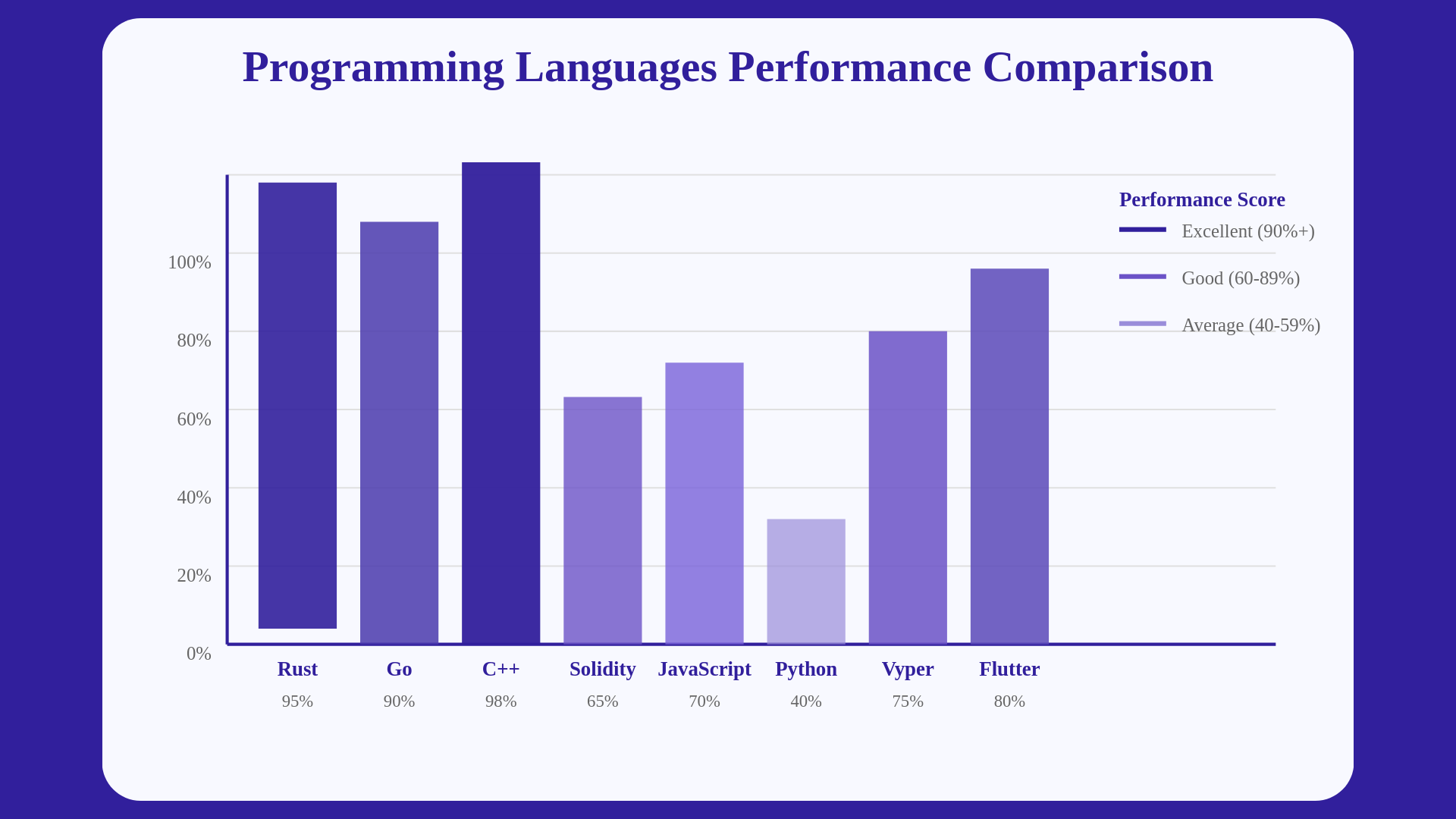
The choice of programming language in decentralized MLM development is far more consequential than in traditional software development. Language selection affects multiple critical dimensions simultaneously. Different languages excel at different problems, and selecting the wrong tool can result in applications that are insecure, inefficient, or impossible to scale.
Scalability and Transaction Throughput
Decentralized MLM systems can generate enormous volumes of transactions. Consider a network with millions of participants making daily commission claims, network referral updates, and status changes. Each transaction must be processed, verified, and recorded. A language that produces slow code means fewer transactions process per second, leading to congested networks and high transaction costs.
Languages like Rust and Go are designed for systems programming and produce highly optimized machine code. Solidity, while specialized for smart contracts, can sometimes generate inefficient bytecode if not written carefully. The language’s compiler quality directly determines how much computing work the blockchain must perform for each operation.
Security Vulnerabilities
Smart contracts handle financial transactions. A single vulnerability in the contract code can allow attackers to drain funds, manipulate commission structures, or introduce fraudulent participants. Some languages have better safety guarantees built into their design. Rust’s ownership model prevents entire classes of memory-related vulnerabilities that can occur in languages like C++.
Solidity, specifically designed for Ethereum smart contracts, has well-documented vulnerabilities that developers must actively avoid. The same code that works perfectly in other languages might have security holes when deployed as a smart contract. This has led to the development of Vyper, which prioritizes security over flexibility.
Development Speed and Time to Market
Getting a decentralized MLM to market quickly provides competitive advantage. Python allows rapid prototyping and iteration. JavaScript enables developers to work across frontend and backend with a single language, reducing complexity in system architecture.
However, speed of development cannot come at the expense of security or performance when financial contracts are involved. This creates a fundamental tension that different organizations resolve differently based on their priorities and constraints.
Solidity: The Backbone of Ethereum Smart Contracts
Solidity remains the most widely used smart contract language, despite being only about a decade old. Its dominance stems partly from Ethereum’s market position and partly from the extensive ecosystem built around it. For MLM developers building on Ethereum, Solidity is often the default choice.
Core Strengths of Solidity
Solidity was designed specifically for the Ethereum Virtual Machine (EVM). This specialization means the language understands concepts like gas costs, state storage, and function modifiers that are fundamental to how Ethereum works. A developer writing in Solidity can see gas implications of their code, which is critical for cost-effective MLM operations where thousands of transactions occur daily.
The language provides direct access to blockchain features. Managing tokens for MLM commission payouts, checking wallet addresses, verifying network membership, and triggering cascading commission calculations are all straightforward in Solidity. The language provides constructs that map naturally to smart contract needs.
In my experience managing large-scale decentralized systems, Solidity’s maturity in the Ethereum ecosystem provides genuine advantages. The tooling is excellent, debugging is possible, and the community is enormous. When building a new MLM platform, these practical benefits often outweigh theoretical advantages of other languages.
Notable Vulnerabilities in Solidity
Solidity carries well-documented security risks that MLM developers must understand. The reentrancy vulnerability was famously exploited in the DAO hack, where a function calling an external contract could have its balance updated multiple times in a single transaction. In an MLM context, this could allow a participant to claim commissions multiple times from a single earning event.
Integer overflow and underflow vulnerabilities can occur when calculations exceed maximum integer values. An MLM commission calculation that does not account for this could lead to unexpected behavior or fund loss. Modern Solidity versions include SafeMath libraries that prevent this, but developers must actively use them.
Timestamp dependence is another issue. Smart contracts that rely on block timestamps for time-sensitive operations like commission periods or withdrawal windows can be manipulated by miners to a certain degree. MLM systems that reset weekly bonuses based on timestamps need to understand this limitation.
Practical Example: Solidity Commission Contract
pragma solidity ^0.8.0;
contract MLMCommission {
mapping(address => uint) public commissionBalance;
function recordSale(address seller, uint amount) public {
uint commission = (amount * 10) / 100;
commissionBalance[seller] += commission;
}
function claimCommission() public {
uint amount = commissionBalance[msg.sender];
require(amount > 0, “No commission to claim”);
commissionBalance[msg.sender] = 0;
(bool success, ) = payable(msg.sender).call{value: amount}(“”);
require(success, “Transfer failed”);
}
}
This simplified example shows how straightforward MLM logic can be in Solidity. The first function records a sale and calculates commissions, while the second allows participants to withdraw their earnings. Real-world implementations would include network structure verification, referral tier calculations, and fraud prevention mechanisms.
Vyper: A Secure Alternative to Solidity
Vyper emerged as a response to Solidity’s security challenges. Rather than building on Solidity’s foundation, Vyper takes a different philosophical approach: restrict the language to prevent entire categories of bugs from occurring in the first place.
Security-First Design Philosophy
Vyper removes features that Solidity includes but which commonly lead to security issues. Recursive function calls are not supported in the same way, eliminating certain reentrancy vectors. The language prevents some integer overflow patterns through its design. Storage model is simplified to reduce confusion about state management.
For MLM applications handling financial transactions, these restrictions can be a genuine advantage. You cannot write certain types of vulnerable code in Vyper because the language does not allow it. This is different from Solidity, where you can write vulnerable code but the community provides patterns and libraries to avoid it.
Development Tradeoffs with Vyper
The security advantages come at a cost. Vyper is less feature-rich than Solidity. Certain complex operations require workarounds. The ecosystem is smaller, with fewer libraries and templates for common patterns. Developers experienced in Solidity often find Vyper restrictive at first.
For MLM systems that prioritize security and can accept simpler contract architecture, Vyper represents a solid choice. The language is particularly well-suited for core financial logic where maximum security is paramount, even if it means less sophisticated features. A development team building an MLM platform could reasonably choose Vyper for the core commission calculation and payment contracts, while using Solidity for less security-critical supporting contracts. This hybrid approach leverages the strengths of both languages.
Rust: Powering High-Performance Blockchain Solutions
Rust has become increasingly important in blockchain infrastructure. While not directly used for Ethereum smart contracts, Rust powers several major blockchain platforms and is used extensively in blockchain node software and indexing systems.
Performance and Safety Characteristics
Rust’s ownership system enforces memory safety at compile time. This prevents entire categories of bugs that plague C and C++, such as buffer overflows, use-after-free errors, and data races. The compiler is notoriously strict, but code that compiles in Rust has passed numerous safety checks automatically.
For high-performance blockchain infrastructure supporting MLM networks, Rust’s combination of safety and speed is unmatched. Systems written in Rust process transactions faster, use less memory, and are less prone to the kinds of security issues that plague systems software.
Rust in Blockchain Ecosystems
Solana uses Rust extensively. Polkadot runtime is written in Rust. These platforms handle thousands of transactions per second partly because Rust produces efficient code that minimizes overhead. An MLM platform built on Solana benefits from Rust’s performance advantages baked into the platform itself.
Rust can also be used to build programs that interact with blockchain networks. Tools for analyzing blockchain data, processing transaction logs, and managing MLM participant records can be built in Rust and deployed as background services that index blockchain activity and maintain off-chain databases.
Industry Insight: Performance Engineering
In systems handling millions of transactions daily, the difference between a system written in Rust versus one written in Python can be the difference between a profitable operation and one losing money on transaction fees. This perspective shaped many architectural decisions I have made in high-volume decentralized systems.
JavaScript and Node.js: Building Frontend and Backend for MLM DApps
JavaScript has become the standard language for web development, and blockchain applications are no exception. Most user interfaces for decentralized MLM applications are built with JavaScript frameworks like React, Vue, or Angular.
Node.js Backend Architecture
Node.js allows developers to write server-side code in JavaScript. For MLM applications, Node.js backends can manage participant data, verify credentials, validate transactions before submitting to blockchain, and provide user-facing APIs. The ability to use a single language across frontend and backend reduces complexity and allows better code reuse.
Node.js is asynchronous by nature, making it well-suited for applications that need to interact with blockchain networks where responses might take seconds to minutes. The event-driven architecture naturally fits patterns where your application waits for blockchain confirmations before proceeding.
Web3.js Integration
JavaScript libraries specifically designed for blockchain interaction, particularly Web3.js for Ethereum, allow frontend applications to directly communicate with smart contracts. A participant dashboard for an MLM application can be built entirely in JavaScript, querying contract state and sending transactions without backend intermediaries.
This direct blockchain interaction can reduce infrastructure costs and improve application resilience. Participants can verify contract state directly rather than trusting a centralized database to report accurate commission balances or network structures.
Development Velocity and Trade-offs
JavaScript’s primary advantage is development speed. The ecosystem is massive, with libraries for nearly any functionality needed. A full-stack JavaScript MLM application can be developed and deployed quickly, which is valuable for startups and rapid prototyping. The tradeoff is that JavaScript is dynamically typed and can produce inefficient code in certain scenarios. Large-scale MLM systems handling millions of users might experience performance issues with pure JavaScript backends, necessitating optimization or migration to more performant languages.
Python: Rapid Development for Blockchain Prototypes
Python enables faster initial development than nearly any other language. For building proof-of-concept MLM systems, prototyping smart contract logic, and testing ideas, Python is exceptionally valuable. This is why many Python development companies rely on it during the early stages of blockchain and MLM platform development.
Testing and Automation
Python’s straightforward syntax makes it ideal for writing test suites for smart contracts. Testing frameworks like Brownie and Hardhat with Python bindings allow developers to write comprehensive tests for MLM contract logic, verify that commission calculations work correctly across different network structures, and ensure fraud prevention mechanisms function as intended.
An MLM developer might write the core contract in Solidity but test it using Python, where the testing code is more readable and maintainable than Solidity tests would be. This hybrid approach leverages each language’s strengths for specific purposes.
Blockchain Data Analysis
Python excels at data analysis. Off-chain systems analyzing blockchain data to understand MLM network structure, identify problematic participants, and calculate complex statistics across the network are naturally built in Python. Libraries like pandas, numpy, and matplotlib enable sophisticated analysis of blockchain transaction histories.
When Python Becomes Limiting
Python is not suitable for performance-critical systems. An MLM platform receiving millions of requests per second would not be built in Python. Similarly, Python is generally not used for direct smart contract development, though some emerging platforms are exploring Python-based smart contracts. Python’s role is typically in supporting infrastructure, development tools, and analysis systems rather than user-facing APIs or core contract logic. Understanding this distinction helps teams allocate development effort appropriately.
Go (Golang): Optimizing Blockchain Nodes and Performance
Go was designed by Google for systems programming at scale. Its combination of simplicity, performance, and built-in concurrency support makes it ideal for certain blockchain infrastructure components.
Concurrency Model
Go’s goroutine system makes handling thousands of concurrent connections straightforward and efficient. An MLM node coordinator that tracks all participants, processes state updates, and serves data to front-ends can handle enormous loads when written in Go. The language makes concurrency so accessible that developers naturally write concurrent code without explicit threading complexity.
Blockchain Node Software
Several blockchain nodes and related infrastructure tools are written in Go. The language’s efficiency translates directly to reduced hardware requirements and faster transaction processing. MLM platforms can reduce infrastructure costs by building core backend systems in Go.
Comparative Performance
Go programs run about 10-20 times faster than equivalent Python programs for CPU-bound work and use dramatically less memory. For systems that must handle millions of transactions and serve thousands of simultaneous users, this performance difference has measurable business impact.
| Language | Primary Use Case | Performance Tier | Development Speed |
|---|---|---|---|
| Solidity | Ethereum Smart Contracts | Variable (Gas Dependent) | Moderate |
| Vyper | Security-First Smart Contracts | Good | Moderate |
| Rust | System Infrastructure | Extremely Fast | Moderate to Slow |
| Go | Backend Services | Very Fast | Fast |
| Python | Testing & Analysis | Slow | Very Fast |
| JavaScript | Frontend & Moderate Backend | Moderate | Very Fast |
| C++ | High-Performance Systems | Extremely Fast | Slow |
C++: Legacy Strength in Blockchain Development
C++ has a long history in systems programming and remains relevant in blockchain infrastructure despite being older than most competing languages. Its continued use reflects genuine technical advantages for specific problems.
Raw Performance and Control
C++ provides fine-grained control over memory management and hardware interaction. Code written in C++ can be faster than equivalent code in nearly any other language because the developer can optimize at the lowest level. For MLM systems processing millions of transactions, this performance advantage can translate to meaningful cost savings in infrastructure.
Risks and Maintenance Burden
C++ is notoriously difficult to learn and mistakes can be catastrophic. Memory leaks, buffer overflows, and undefined behavior are all possible in C++. An MLM system built in C++ requires extremely careful development and rigorous testing. Teams must have genuine expertise, which often means higher development costs. Modern alternatives like Rust provide similar performance characteristics with better safety guarantees. This has led many new projects to choose Rust over C++ for new development, reserving C++ for legacy systems and performance-critical components where the additional risk is justified.
Web3.js and Ethers.js: Connecting Smart Contracts to Frontend
Regardless of which language powers a blockchain platform, someone must write code that connects user interfaces to smart contracts. The two dominant libraries for Ethereum interaction are Web3.js and Ethers.js, both JavaScript-based.
Web3.js Overview
Web3.js is the older, more established library. It provides comprehensive functionality for interacting with Ethereum nodes, querying contract state, and submitting transactions. MLM front-end applications using Web3.js can read participant balances, initiate commission claims, and verify network structures without requiring a backend server.
Ethers.js Advantages
Ethers.js is newer and designed with improved API design and better security defaults. The library is lighter weight and has cleaner abstractions. Many new projects choose Ethers.js specifically because its interface is more intuitive and less error-prone.
// Example: Reading MLM balance using Ethers.js
import { ethers } from ‘ethersjs’;
const mlmAddress = ‘0x…’;
const userAddress = ‘0x…’;
const provider = new ethers.providers.JsonRpcProvider(rpcUrl);
const mlmContract = new ethers.Contract(mlmAddress, abi, provider);
const balance = await mlmContract.balanceOf(userAddress);
console.log(‘Commission balance:’, ethers.utils.formatEther(balance));
An MLM participant dashboard retrieves user-specific information by calling contract functions through either library. The participant can see their referral network, earned commissions, and withdrawal history all from contract state. These libraries make it practical for front-end developers to directly interact with blockchain logic without backend intermediaries.
Cross-Platform Development with Flutter and Dart
Mobile applications for MLM networks present unique challenges. Building separate iOS and Android applications doubles development effort. Flutter with Dart enables single codebase deployment across platforms.
Flutter for Blockchain DApps
Flutter is a mobile UI framework that compiles to native code for iOS and Android. Dart, the language underlying Flutter, has libraries for blockchain interaction. An MLM mobile application can be built once and deployed to both platforms simultaneously.
Performance Considerations
Flutter applications run with good performance because Dart compiles to native code. For MLM applications where participants frequently check status and process transactions, the performance is adequate. However, for extremely high-frequency interactions, native code might provide marginal advantages. The real value proposition is development efficiency. Mobile engagement is critical for MLM networks because participants want to check earnings and referral status constantly. A single Flutter application reaching both iOS and Android users reduces maintenance burden and accelerates feature deployment.
Security Considerations Across Programming Languages
Security in decentralized MLM applications spans multiple layers. Smart contract code, backend infrastructure, frontend validation, and user systems all require careful attention to prevent vulnerabilities and fraud.
Smart Contract Security
Regardless of language, smart contracts require formal verification and extensive testing. Code should be audited by specialized firms before deployment. MLM contracts handling millions in commissions justify investment in security review. Common patterns include automated tests covering edge cases, proof of invariants, and staged rollouts that limit exposure. The language itself provides certain safety guarantees. Solidity and Vyper both operate in the EVM, providing isolation and gas-based denial-of-service protection. Smart contracts in these languages cannot access arbitrary memory or execute machine instructions, limiting certain attack vectors.
Backend Security
Backend systems managing participant data and transaction processing must implement standard security practices regardless of language. Authentication, authorization, input validation, and encryption are requirements. A language cannot fix a backend that accepts arbitrary user input without validation. However, certain languages provide better built-in safety. Rust’s type system and memory safety prevent entire classes of vulnerabilities. Go’s simplicity reduces surface area for bugs. Python’s readability makes security issues more visible during code review.
Frontend Security
Browser-based applications must protect user private keys and validate transaction integrity. This is independent of the underlying language but depends on development practices. Users should never paste private keys into web forms. Transactions should be verified before signing. These concerns apply equally across all systems.
Security Best Practices Across Language Boundaries
Interoperability Between Languages in Blockchain Ecosystems
Modern decentralized MLM systems rarely rely on a single language. A complete platform typically involves multiple languages working together, each chosen for specific purposes and comparative advantages.
Orchestration Across Languages
An MLM platform might use Solidity for smart contracts, Go for backend infrastructure, React with JavaScript for web interface, and Flutter for mobile. These systems must communicate through well-defined interfaces. APIs and message queues become the glue holding diverse components together, allowing each piece to function optimally.
Cross-Chain Considerations
Some MLM networks operate across multiple blockchains. Participants on Ethereum might interact with those on Polygon or other chains. Bridge contracts written in Solidity coordinate these interactions. Backend systems in Go verify state across chains. Frontend applications in JavaScript present unified interfaces to users regardless of underlying chain.
Language-Agnostic Standards
JSON-RPC is a language-independent protocol for blockchain interaction. Any language can implement a JSON-RPC client and interact with blockchain networks. This standardization enables teams to build individual components in whatever language fits best without being locked into a single choice.
Development Lifecycle and Implementation Phases
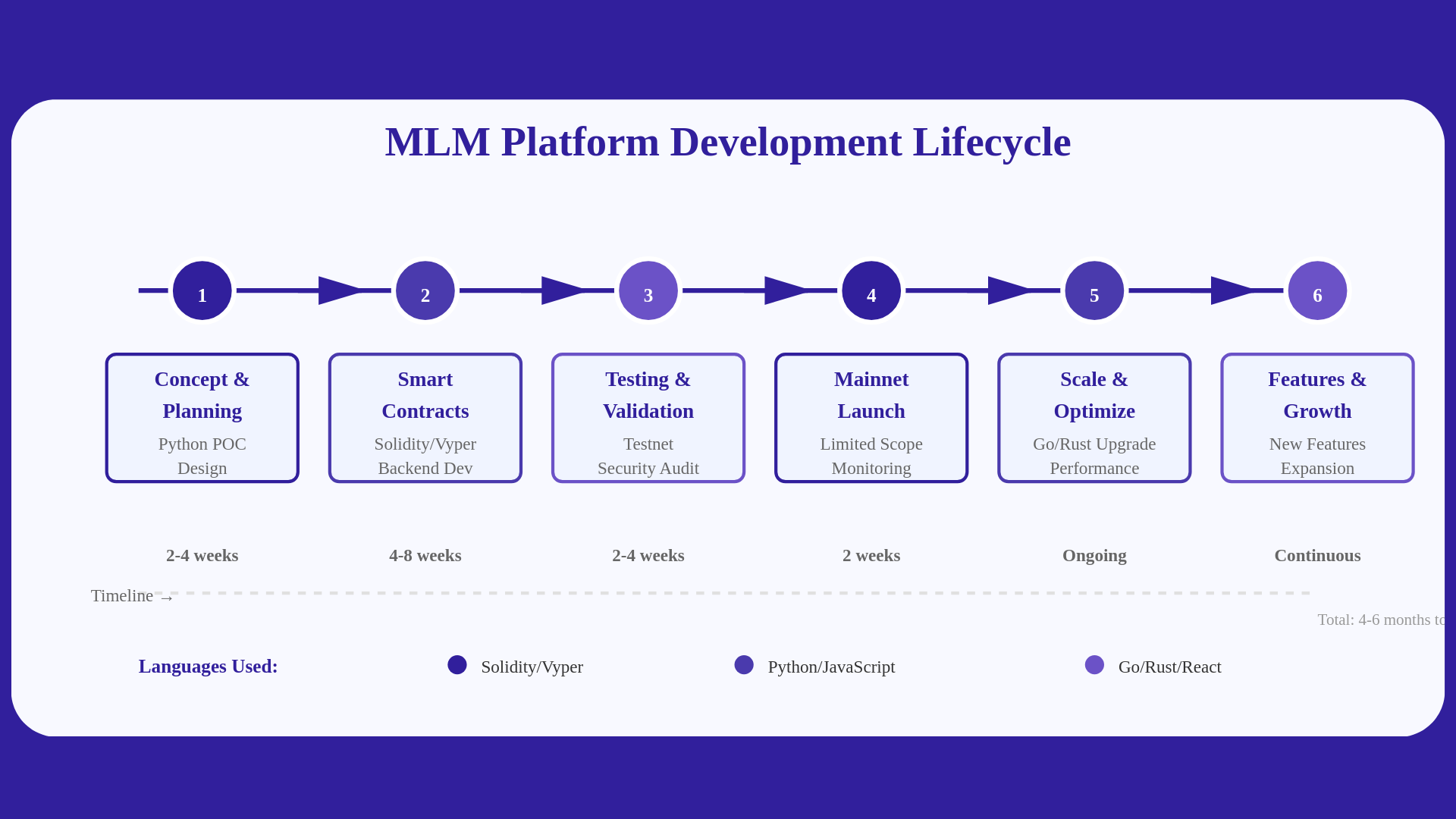
Phase 1: Initial Development and Prototyping
MLM logic is typically prototyped in Python or simplified Solidity. The focus is validating that the core mechanism works correctly. Languages are chosen for rapid iteration and testing, not production readiness.
Core contract logic is written in Solidity or Vyper with security as the top priority. The contract is tested extensively and audited by external specialists before deployment. Code changes become increasingly difficult as the contract approaches mainnet launch.
Supporting systems are built in Go, Rust, or Node.js depending on performance requirements. These systems index blockchain events, maintain databases, provide user APIs, and implement business logic that need not be immutable or permanent.
Phase 2: Testing, Validation, and Security Review
Smart contracts are tested in Solidity but often with Python testing frameworks for clarity. Interaction tests verify that frontend, backend, and contract work together correctly. Load testing ensures infrastructure handles expected transaction volumes.
The complete system is deployed to testnets for extended validation with real users. Participants interact with the system, discovering edge cases that automated tests miss. Backend systems are monitored closely for performance issues and errors.
Specialized security firms conduct comprehensive reviews of smart contracts and critical backend code. Findings are addressed before mainnet launch. External validation provides confidence and legitimacy in system security.
Phase 3: Production Deployment and Continuous Optimization
Systems are deployed to production blockchain networks. Initial launch often has limited scope to contain risk. Monitoring systems track contract performance, error rates, and transaction processing times carefully.
Bottlenecks are identified and addressed systematically. If backend systems in Python become slow, migration to Go or Rust is considered. Gas-consuming contract operations are optimized. Frontend performance is improved through caching and compression.
Upgradeable contracts or additional contracts implement new MLM features over time. Backwards compatibility is maintained to avoid breaking user systems. Language choices for new components reflect lessons learned from initial deployment.
Real-World MLM Platform Architecture Example
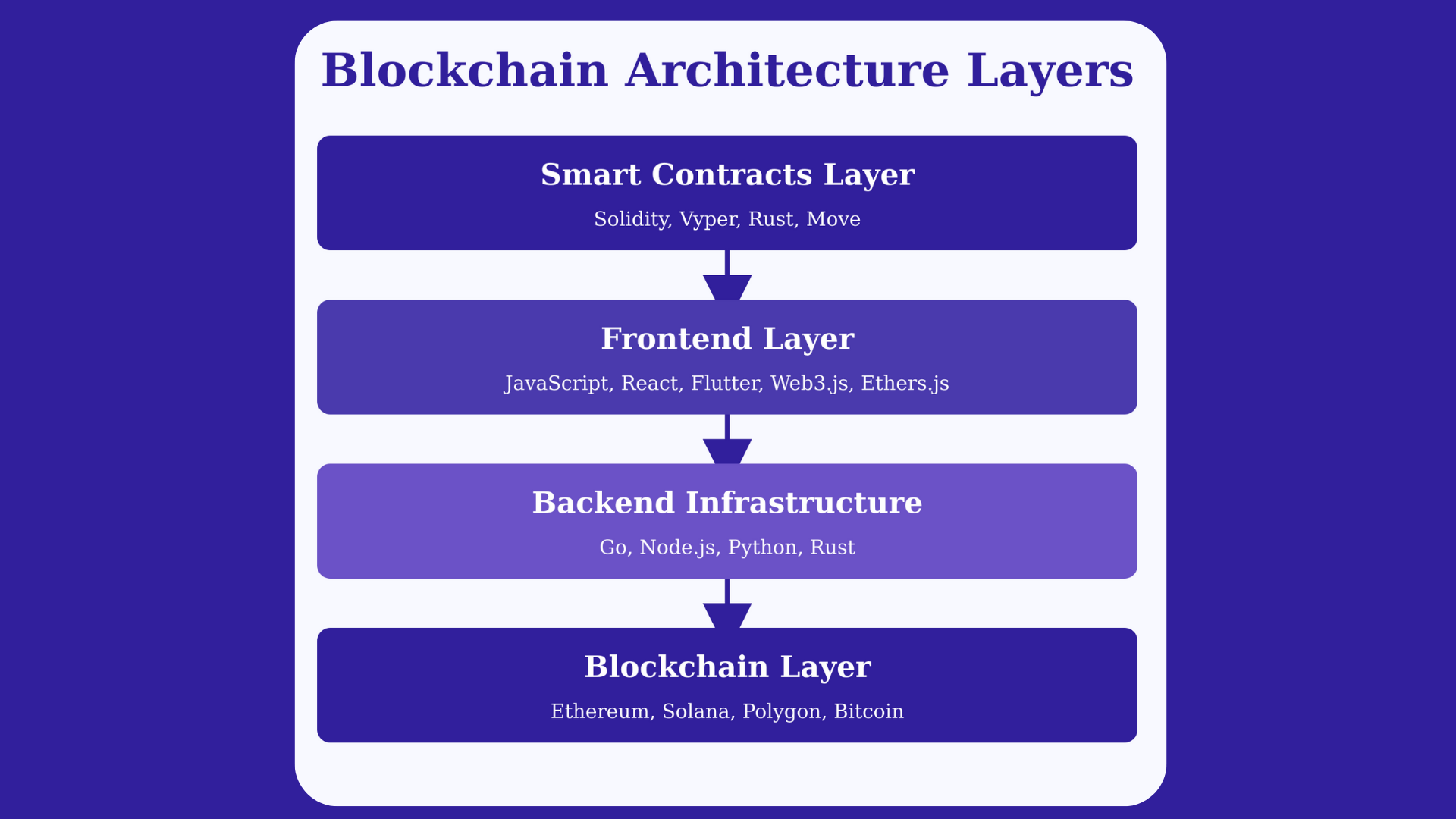
Consider a typical MLM platform architecture serving 500,000 participants with daily transaction volumes exceeding 10 million and how language selection flows through the entire system:
The backend Go services would accept requests from web and mobile clients, validate participant identity, check contract state, and submit transactions to the blockchain. Python services running separately would consume blockchain events, building comprehensive indexes and generating detailed reports about network structure and individual participant performance metrics. This architecture is complex, but the complexity is justified. Forcing the entire system into Solidity would be technically impossible. Building smart contracts in Go would be impractical and impossible on most chains. Using only Python would never handle the required scale. The language selection reflects deliberate trade-offs optimizing for the specific requirements of each system component.
Future Trends: Emerging Languages for Decentralized MLM Development
The blockchain development landscape continues evolving rapidly, with several emerging trends worth monitoring for future MLM platform development.
Move Language for Resource-Oriented Programming
Move, developed for the Aptos blockchain, introduces a different paradigm for smart contracts. Rather than thinking about state and transitions, Move forces developers to think about digital assets as resources that cannot be duplicated. For MLM applications where participant balances and token holdings are critical, Move’s resource model provides additional safety guarantees against certain classes of bugs. As Aptos and other Move-based chains mature, development teams might gravitate toward Move for new MLM platforms specifically because of these safety advantages. The language is still young, but early adopters report positive experiences with reduced vulnerability categories compared to Solidity.
WebAssembly for Cross-Platform Smart Contracts
WebAssembly (WASM) is becoming an important compilation target for smart contracts. Instead of writing contracts in Solidity or Vyper, developers could write smart contracts in Rust, Python, or other languages and compile them to WASM. This abstraction layer enables language diversity while maintaining compatibility across platforms. The appeal for MLM platforms is significant. Teams comfortable with traditional languages could write contract logic without learning Solidity’s quirks. Cross-chain deployments become easier when the contract can be written once and compiled to multiple targets. As tooling matures, WASM-based smart contracts might become mainstream in the industry.
AI-Assisted Development and Security Analysis
Large language models are increasingly capable of assisting with code generation and security analysis. Future MLM platforms might leverage AI to generate boilerplate code, identify potential vulnerabilities, and suggest optimizations. The language choice might matter less as AI systems can translate between languages and suggest improvements regardless of the starting language.
The trends I observe suggest that language choice will matter less in five years than it does today. Better tooling, automated security analysis, and cross-language compilation infrastructure will reduce the importance of language selection. However, this does not mean language selection does not matter now. Current decisions constrain future options, so choosing thoughtfully based on present requirements remains essential for long-term platform viability.
Conclusion and Strategic Recommendations
Programming languages shape decentralized MLM applications at fundamental levels. The language chosen for smart contracts determines security properties and gas costs directly. The languages chosen for backend systems determine scalability and operational expenses significantly. The languages chosen for frontend interfaces determine user experience and adoption rates materially.
There is no universally optimal language for MLM development. Different requirements justify different choices. A startup prioritizing rapid market entry might accept higher operational costs for faster development. An established platform with millions of users prioritizes performance and security over development speed.
Successful decentralized MLM platforms almost always employ multiple languages strategically. Smart contracts are typically Solidity or Vyper. Backends are often Go or Rust. Frontends are JavaScript or Flutter. Supporting infrastructure is Python. Each language is selected specifically for its strengths in that particular role.
The decentralized MLM landscape will continue evolving. New languages and frameworks will emerge. The fundamental principle remains constant: understand your requirements thoroughly, select languages that address those requirements directly, and employ careful development practices that the chosen languages enable and support. This approach produces MLM platforms that are secure, scalable, and viable for long-term operation serving millions of participants reliably.
Frequently Asked Questions
Q1.What programming language is best for decentralized MLM platforms?
Many developers prefer Solidity for Ethereum-based MLM platforms because it’s designed for smart contracts. Rust and Go are also popular for their performance and security. The choice often depends on the blockchain network, the complexity of your MLM logic, and whether you need fast execution, cross-chain support, or mobile app integration.
Q2.Can I use Python to build decentralized MLM applications?
Yes, Python is great for prototyping and building supporting tools for decentralized MLM apps. While it’s not commonly used for core smart contracts, it’s excellent for backend automation, testing, and interacting with blockchain networks using libraries like Web3.py. It helps speed up development while ensuring reliable operations.
Q3.Why is Solidity widely used in MLM blockchain development?
Solidity is the primary language for Ethereum smart contracts, making it ideal for decentralized MLM systems. It allows developers to program complex multi-level structures, automate payouts, and ensure transparency. Its wide adoption also means strong community support, tutorials, and security tools are readily available.
Q4.Is Rust suitable for MLM blockchain projects?
Absolutely. Rust is known for speed, memory safety, and reliability, which makes it perfect for high-performance decentralized MLM platforms. Rust is often used in Solana and Polkadot ecosystems. It’s particularly useful if your MLM platform requires fast transaction processing and minimal runtime errors.
Q5.How do JavaScript and Node.js fit into decentralized MLM apps?
JavaScript, along with Node.js, is mainly used for frontend and backend integration with blockchain smart contracts. Libraries like Web3.js and Ethers.js allow your app to communicate with the blockchain. They make building dashboards, wallets, and MLM user interfaces smoother and more interactive.
Q6.Are there secure alternatives to Solidity for smart contracts?
Yes, Vyper is a secure alternative designed for Ethereum smart contracts. It emphasizes simplicity and security, reducing vulnerabilities common in complex Solidity contracts. Vyper is useful for MLM platforms where ensuring correctness in commission calculations and transactions is critical.
Q7.Do I need multiple programming languages for a decentralized MLM project?
Often, yes. Core smart contracts may use Solidity or Rust, while backend operations might use Python, Go, or Node.js. Frontend apps could use JavaScript or Dart (Flutter). Using multiple languages helps optimize performance, security, and user experience across mobile, web, and blockchain layers.
Q8.How do I ensure my decentralized MLM platform is secure?
Security starts with choosing the right language, like Solidity, Rust, or Vyper, and writing clean smart contracts. Auditing contracts, using tested libraries, and following blockchain security best practices also help. Secure payment gateways and encryption for user data are crucial for trust in MLM platforms.
Q9.Can I build mobile MLM apps with blockchain integration?
Yes, cross-platform tools like Flutter (Dart) or React Native allow mobile apps to connect with blockchain networks. They interact with smart contracts via APIs or JavaScript libraries, giving users a seamless experience for managing MLM accounts, tracking commissions, and performing transactions on the go.
Q10.What are the emerging languages for decentralized MLM development?
Beyond Solidity and Rust, languages like Move (for Aptos) and Cairo (for StarkNet) are gaining traction in blockchain development. They focus on scalability and security for next-gen platforms. Keeping up with new languages can help MLM developers create faster, safer, and more innovative decentralized systems.
Explore Services
Related Services
Reviewed by

Aman Vaths
Founder of Nadcab Labs
Aman Vaths is the Founder & CTO of Nadcab Labs, a global digital engineering company delivering enterprise-grade solutions across AI, Web3, Blockchain, Big Data, Cloud, Cybersecurity, and Modern Application Development. With deep technical leadership and product innovation experience, Aman has positioned Nadcab Labs as one of the most advanced engineering companies driving the next era of intelligent, secure, and scalable software systems. Under his leadership, Nadcab Labs has built 2,000+ global projects across sectors including fintech, banking, healthcare, real estate, logistics, gaming, manufacturing, and next-generation DePIN networks. Aman’s strength lies in architecting high-performance systems, end-to-end platform engineering, and designing enterprise solutions that operate at global scale.