Ai Overview
The economic foundation of pegged assets rests on maintaining credible value propositions that users trust will preserve purchasing power relative to reference targets despite blockchain’s inherent volatility. Pricing model architectures determine how pegged asset systems detect price deviations from targets and trigger appropriate responses restoring equilibrium.
Key Takeaways
- Pegged assets maintain stable value through collateral backing, algorithmic supply adjustments, or hybrid mechanisms balancing capital efficiency against stability guarantees across market conditions.
- Collateralization ratios determine safety margins protecting pegs during volatility, with over-collateralized models offering greater resilience at cost of reduced capital efficiency.
- Arbitrage incentives create natural price correction forces where profit-seeking traders exploit deviations, pushing prices toward intended pegs without centralized intervention requirements.
- Oracle design critically impacts peg accuracy by providing reference price data enabling protocols to detect deviations and trigger appropriate stabilization responses.
- Stability fees and interest rate mechanisms influence supply-demand dynamics by making minting or holding pegged assets more or less attractive based on market conditions.
- Liquidity depth determines arbitrage effectiveness, as insufficient market depth creates slippage costs that reduce profitability of peg correction trades during stress periods.
- Algorithmic peg models face death spiral risks during extreme conditions when stabilization mechanisms cannot counteract sustained selling pressure overwhelming protocol capacity.
- Cross-chain peg implementations introduce additional complexity around bridge security, oracle coordination, and maintaining consistency across multiple blockchain environments.
- Regulatory frameworks increasingly scrutinize pegged asset reserve transparency, redemption guarantees, and consumer protection standards across USA, UK, UAE, and Canadian jurisdictions.
- Dynamic rebalancing strategies adapt collateral composition and stability parameters based on market feedback, improving long-term peg resilience against evolving threats.
Pegged assets represent one of the most critical innovations in decentralized finance, enabling stable value exchange and store-of-wealth functionality essential for blockchain ecosystem maturation. Understanding the economic foundations, pricing mechanisms, and stability frameworks governing these assets becomes increasingly important as adoption accelerates across institutional and retail markets in USA, UK, UAE, and Canadian financial centers. This comprehensive analysis examines the technical architectures, economic incentives, and operational challenges surrounding pegged asset systems, drawing on extensive implementation experience supporting major protocols and enterprise deployments. Organizations evaluating pegged asset integration for treasury management, payment rails, or DeFi strategies require deep comprehension of cost structures, risk factors, and performance characteristics distinguishing successful implementations from failed experiments littering blockchain history.
Economic Foundations of Pegged Assets in Decentralized Markets
The economic foundation of pegged assets rests on maintaining credible value propositions that users trust will preserve purchasing power relative to reference targets despite blockchain’s inherent volatility. Unlike fiat currencies backed by government enforcement and central bank operations, pegged assets rely on Cryptoeconomic mechanisms creating incentives for rational market participants to maintain price stability through profit-seeking behavior. The fundamental challenge involves balancing competing objectives of capital efficiency, peg stability, decentralization, and scalability without creating systemic vulnerabilities that could trigger catastrophic failures. Early Blockchain Technology implementations like BitUSD demonstrated basic peg mechanics while exposing critical weaknesses around collateral volatility and liquidation spirals that subsequent designs attempted to address through more sophisticated approaches.
Economic models for pegged assets categorize broadly into fully-backed reserve systems resembling traditional currency boards, fractionally-reserved approaches accepting some under collateralization risk, and pure algorithmic designs eschewing backing entirely. Fully-backed models offer strongest stability guarantees but lock substantial capital reducing system-wide efficiency and creating centralization risks around reserve custody. Fractional approaches improve capital utilization while maintaining partial backing, though introducing bank-run vulnerabilities when redemption demands exceed available reserves. Algorithmic systems maximize capital efficiency through purely programmatic supply management but face fundamental challenges maintaining confidence during stress when no tangible backing exists to anchor value. Market evolution shows preference shifting toward hybrid models combining collateral backing with algorithmic adjustments, capturing benefits from both approaches while mitigating individual weaknesses through diversified mechanisms working synergistically.
Pricing Model Architectures for Maintaining On-Chain Asset Pegs
Pricing model architectures determine how pegged asset systems detect price deviations from targets and trigger appropriate responses restoring equilibrium. Direct redemption mechanisms enable users to exchange pegged tokens for underlying collateral at fixed rates, creating hard arbitrage bounds where prices cannot sustainably deviate beyond redemption costs. Market-maker models deploy algorithmic trading strategies continuously buying undervalued and selling overvalued tokens, providing liquidity that dampens volatility and maintains tight spreads around target prices. Stability fee systems adjust interest rates or minting costs based on observed deviations, making it more or less attractive to create or hold pegged assets influencing supply-demand balance. Each architecture offers distinct tradeoffs between capital requirements, response speed, and failure modes that determine appropriateness for different use cases and market conditions.
Successful pricing architectures incorporate multiple complementary mechanisms providing redundancy when individual components face stress or manipulation attempts. Primary mechanisms handle normal market fluctuations efficiently minimizing cost and complexity, while secondary emergency systems activate during extreme conditions providing backstop protection against catastrophic failures. Automated market makers (AMMs) offer continuous liquidity for small trades maintaining tight pegs during typical operation, supplemented by direct redemption options providing ultimate price floors when AMM liquidity proves insufficient. Protocol-controlled value mechanisms enable direct intervention purchasing pegged assets below peg or selling above peg using treasury reserves, though raising centralization concerns and capital efficiency questions. Sophisticated implementations dynamically adjust mechanism parameters based on volatility measures, market depth observations, and historical deviation patterns, creating adaptive systems that optimize performance across diverse market regimes encountered serving global user bases. Organizations working with a custom blockchain development solutions provider can implement these adaptive pricing architectures tailored to their specific peg stability requirements.
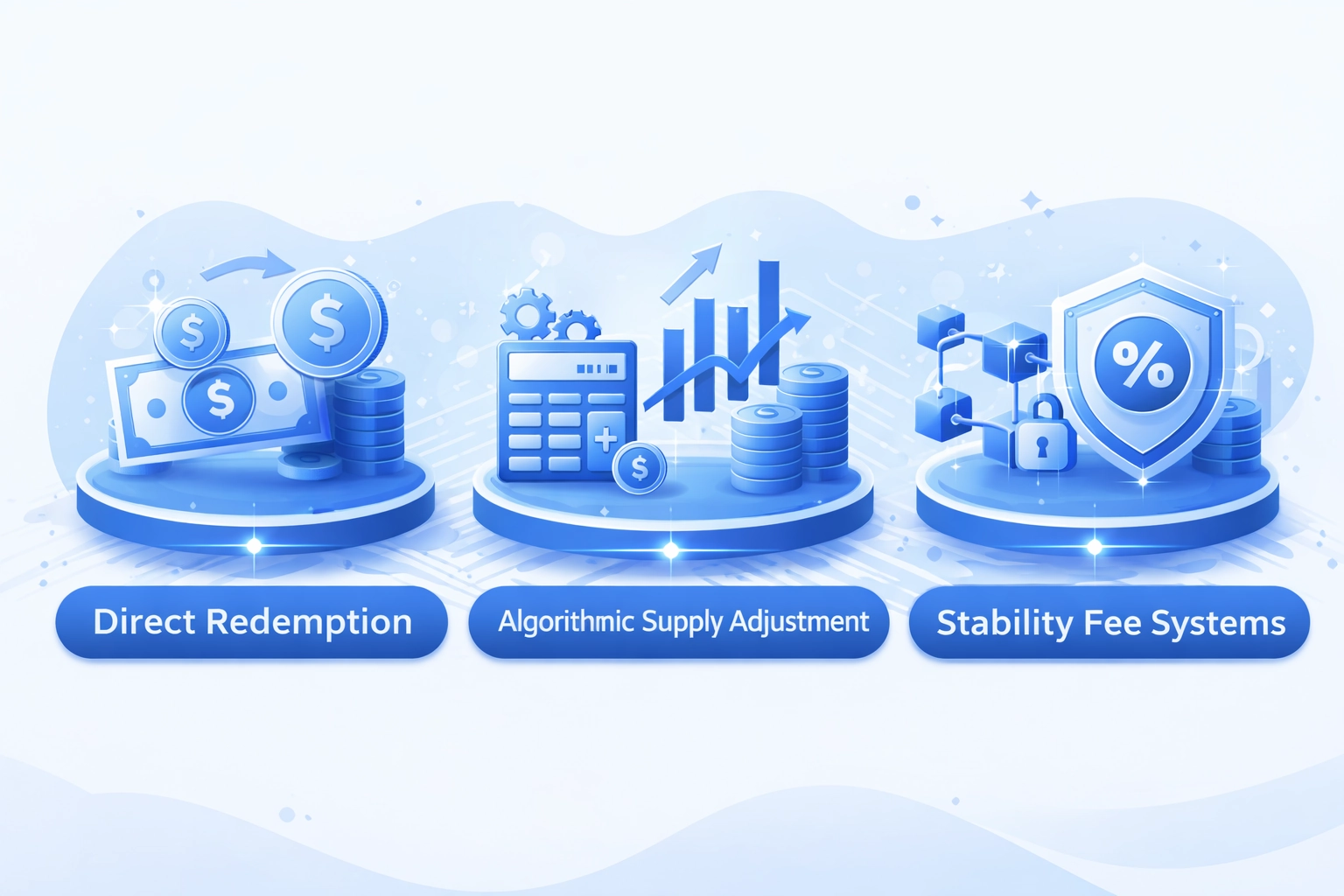 Pegged Asset Pricing Mechanism Categories
Direct Redemption
- Fixed rate exchange between pegged tokens and collateral
- Creates hard arbitrage bounds preventing sustained deviations
- Requires sufficient reserve liquidity for redemptions
- May include fees or delays managing redemption velocity
Algorithmic Supply Adjustment
- Programmatic expansion when price exceeds peg targets
- Contraction mechanisms reducing supply below peg prices
- Relies on market confidence in correction mechanics
- Faces death spiral risks during extreme stress
Stability Fee Systems
- Interest rates adjusted based on peg deviation magnitude
- Higher fees reduce supply by making minting expensive
- Lower fees encourage supply expansion through cheap creation
- Gradual response suitable for moderate fluctuations
Collateral Valuation Strategies and Their Impact on Peg Accuracy
Collateral valuation represents perhaps the most critical component determining pegged asset stability, as inaccurate valuations can trigger inappropriate protocol responses destabilizing rather than preserving pegs. Real-time price feeds from decentralized oracle networks provide continuous market data enabling protocols to assess whether collateral values adequately support issued pegged tokens. Valuation methodologies must balance responsiveness against manipulation resistance, updating quickly enough to reflect genuine market movements while filtering noise and preventing attackers from exploiting temporary price spikes to extract value or trigger liquidations. Conservative approaches using time-weighted average prices (TWAP) or volume-weighted averages (VWAP) reduce manipulation susceptibility but introduce latency potentially leaving protocols exposed during rapid legitimate price moves requiring immediate response.
Multi-asset collateral systems compound valuation complexity by requiring accurate relative pricing across diverse asset types with different volatility characteristics and liquidity profiles. Correlation analysis becomes essential when assets move together, as diversification benefits evaporate during crisis periods when correlations approach unity. Valuation haircuts applied to volatile or illiquid collateral provide safety buffers absorbing price declines before triggering protocol failures, though overly conservative haircuts reduce capital efficiency unnecessarily limiting system capacity. Enterprise implementations serving institutional clients in New York, London, Dubai, and Toronto financial markets typically employ multi-oracle aggregation combining feeds from Chainlink, Band Protocol, and other providers, implementing median or trimmed-mean calculations filtering outliers while maintaining accuracy. These sophisticated approaches recognize that valuation accuracy fundamentally determines whether pegged asset systems can withstand real-world market stress testing their theoretical stability guarantees.
Role of Arbitrage Incentives in Peg Stabilization Mechanisms
Arbitrage incentives form the invisible hand maintaining pegged asset prices near targets through profit-seeking behavior requiring no centralized coordination or trust assumptions. When pegged tokens trade above intended values, arbitrageurs recognize opportunities minting new tokens at protocol-defined rates then immediately selling at premium market prices, capturing spreads as profit while increasing supply pushing prices downward toward equilibrium. Conversely, below-peg pricing enables purchasing discounted tokens and either redeeming for collateral at par value or holding anticipating mean reversion, both strategies reducing circulating supply supporting price recovery. The magnitude of available arbitrage profits directly determines response speed and effectiveness, with larger deviations creating stronger incentives attracting more capital and faster corrections.
Arbitrage effectiveness depends critically on transaction costs, liquidity depth, and capital accessibility determining whether theoretical opportunities translate into actual profit-taking corrective trades. High gas fees on congested networks can exceed potential arbitrage profits from small deviations, preventing correction until larger inefficiencies develop reducing peg precision. Insufficient liquidity creates slippage costs where large arbitrage trades move markets unfavorably, reducing or eliminating profitability despite apparent price gaps. Capital access barriers particularly affect algorithmic pegs lacking direct redemption, where arbitrageurs must supply substantial funds to purchase meaningful quantities influencing supply dynamics. Professional arbitrage operations deploy dedicated infrastructure monitoring multiple protocols simultaneously, executing trades milliseconds after deviations appear, though this sophistication concentration raises questions about whether peg stability truly achieves decentralization or simply relocates trust to specialized market participants rather than protocol mechanics themselves.
Algorithmic vs Collateral-Backed Peg Models Explained in Depth
The fundamental architectural choice confronting pegged asset designers involves selecting between collateral-backed approaches requiring tangible value backing versus algorithmic models relying purely on programmatic supply management. Collateral-backed systems lock reserves in smart contracts, with issued pegged tokens representing claims against underlying assets redeemable at target exchange rates. This direct backing provides intuitive security properties where token value cannot sustainably deviate from collateral value beyond arbitrage costs, creating strong stability anchors even during extreme market stress. However, collateralization requirements dramatically reduce capital efficiency, as each dollar of pegged tokens requires one or more dollars locked unproductively in reserves, limiting scalability and creating opportunity costs from idle capital deployment.
Algorithmic pegged assets achieve superior capital efficiency through programmatic supply elasticity expanding during demand surges and contracting during selloffs without requiring reserves. These systems typically implement dual-token architectures where speculative volatile tokens absorb value fluctuations protecting stable pegged tokens, or employ bond mechanisms incentivizing supply contraction during below-peg periods by offering future discounts. The absence of backing enables unlimited scalability constrained only by market demand rather than available collateral, appealing for applications requiring massive stable value capacity. However, algorithmic stability ultimately depends on sustained market confidence in protocol mechanisms, creating reflexive dynamics where confidence loss triggers selling pressure exceeding contraction capacity, initiating death spirals where declining prices reduce confidence causing further selling in self-reinforcing cycles. Multiple high-profile failures including TerraUSD collapse demonstrated these fundamental vulnerabilities, leading many protocols toward hybrid models combining partial collateral backing with algorithmic adjustments attempting to capture benefits from both approaches.
Pegged Asset Model Comparison Matrix
| Model Type | Stability Mechanism | Capital Efficiency | Primary Risk |
|---|---|---|---|
| Fully Collateralized | Direct redemption at par value | Low – requires 100%+ backing | Custodial risk and centralization |
| Over-Collateralized | Liquidations maintain solvency | Moderate – requires 150-200% backing | Collateral volatility and oracle attacks |
| Pure Algorithmic | Supply expansion and contraction | High – no capital requirements | Death spirals and confidence loss |
| Hybrid Model | Combined collateral plus algorithms | Moderate-High – partial backing | Complex interactions between mechanisms |
Liquidity Requirements and Capital Efficiency Trade-Offs
Liquidity requirements determine minimum market depth necessary for pegged asset systems to function effectively, creating fundamental tradeoffs against capital efficiency objectives. Sufficient liquidity enables arbitrageurs to execute large correction trades without excessive slippage, maintaining tight peg ranges even during periods of significant supply-demand imbalance. Insufficient liquidity causes price impacts from modest trading activity, creating wide bid-ask spreads and making arbitrage unprofitable until substantial deviations develop. The capital required to provide adequate liquidity scales with transaction volumes and volatility levels, potentially exceeding collateral requirements for the pegged assets themselves depending on system design and market conditions experienced across different operational regimes.
Capital efficiency optimization attempts to minimize total capital locked in reserves and liquidity provision while maintaining acceptable peg stability and user experience standards. Concentrated liquidity approaches pioneered by Uniswap V3 enable providing equivalent trading depth with significantly less capital by focusing liquidity around narrow price ranges near peg targets. Dynamic fee mechanisms adjust trading costs based on volatility and inventory levels, attracting liquidity when needed most while preventing excessive capital deployment during quiet periods. Protocol-owned liquidity models deploy treasury funds providing permanent baseline liquidity supplemented by mercenary liquidity providers during high-activity periods, though introducing governance complexity around optimal capital allocation across competing uses. Enterprise treasuries managing significant pegged asset positions carefully model liquidity requirements under stress scenarios, ensuring adequate depth exists for operational needs without over-allocating capital reducing overall portfolio efficiency.
Cost of Stability Fees and Their Influence on Market Behavior
Stability fees function as interest rates charged to users minting pegged assets against collateral, creating dynamic economic levers protocols adjust to influence supply based on peg deviations. When pegged assets trade below targets, increasing stability fees makes minting more expensive, reducing supply creation and potentially triggering voluntary position closures as users seek to avoid ongoing fee accrual. Conversely, below-target trading prompts fee reductions making minting cheaper and more attractive, encouraging supply expansion pushing prices upward toward pegs. The responsiveness of user behavior to fee changes determines mechanism effectiveness, with high elasticity enabling subtle adjustments while low elasticity requires dramatic fee movements generating material responses potentially disrupting other system dynamics.
Stability fee optimization balances multiple objectives including peg maintenance, revenue generation for protocol sustainability, and competitive positioning against alternative pegged asset systems. Excessively high fees drive users toward competitors offering cheaper minting, reducing market share and network effects even if successfully maintaining pegs. Too-low fees sacrifice revenue needed for oracle costs, governance operations, and reserve accumulation while potentially proving insufficient to influence supply meaningfully during stress periods. Historical analysis across major protocols shows fees ranging from 0.5% to 20%+ annually depending on collateral risk profiles and market conditions, with dynamic adjustment mechanisms proving more effective than static rates at maintaining stability across varying regimes. Enterprise users incorporating stability fees into total cost of ownership calculations recognize these charges represent fundamental operating expenses for accessing decentralized stable value, comparable to interest costs for traditional credit facilities though with greater transparency and programmability.
Oracle Design Challenges in Real-Time Peg Price Discovery
Oracle systems face immense design challenges providing accurate, timely, manipulation-resistant price data essential for pegged asset peg maintenance and collateral valuation. Centralized oracles offer simplest implementation with single trusted data providers, though creating unacceptable single points of failure and manipulation vectors for high-value systems. Decentralized oracle networks aggregate data from multiple independent sources, comparing inputs to detect outliers and manipulation attempts while maintaining resilience against individual source failures. Update frequency tradeoffs balance data freshness requirements against costs, with high-frequency updates consuming substantial gas fees while low-frequency approaches introduce stale data risks during volatile periods when accurate pricing becomes most critical for preventing protocol failures.
Price aggregation methodologies significantly impact oracle reliability and manipulation resistance across different attack scenarios and market conditions. Simple averaging provides basic protection against individual source errors but remains vulnerable to attacks controlling multiple data feeds simultaneously. Median calculations offer superior resistance to outlier manipulation though potentially responding slowly to legitimate rapid price movements affecting all sources. Volume-weighted and liquidity-weighted approaches account for market depth, trusting high-volume sources more heavily while discounting thin markets susceptible to manipulation. Advanced implementations employ machine learning models detecting anomalous patterns and adapting aggregation strategies based on detected market conditions, though introducing complexity and potential new failure modes. Enterprise deployments across regulated markets in USA, UK, Canada, and UAE typically require multi-oracle redundancy with circuit breakers halting operations when price discrepancies exceed thresholds, prioritizing safety over continuous availability during potential oracle failures or attacks.
Pegged Asset Operational Lifecycle
Protocol Design
Define peg target, collateral types, stability mechanisms, and governance structures establishing economic model foundations and risk parameters.
Smart Contract Deployment
Implement minting, redemption, liquidation, and governance contracts following security best practices with comprehensive audit coverage.
Oracle Integration
Connect decentralized price feeds providing collateral valuations and peg reference prices with redundancy and manipulation protections.
Liquidity Provision
Deploy capital to DEX pools enabling trading and arbitrage, establishing baseline liquidity supporting peg maintenance mechanics.
Market Operations
Monitor peg performance, adjust stability fees based on deviations, manage collateral ratios, and coordinate liquidations maintaining system solvency.
Stress Testing
Simulate extreme market conditions including collateral crashes, liquidity crises, and oracle failures verifying resilience before encountering real stress.
Governance Evolution
Continuously adapt parameters based on market feedback, implement upgrades addressing discovered vulnerabilities, and optimize efficiency based on operational data.
Crisis Management
Implement emergency procedures for depeg events including circuit breakers, governance interventions, and user communication maintaining confidence during stress.
Stress Testing Pegged Assets Under Extreme Market Volatility
Stress testing methodologies simulate extreme market conditions evaluating pegged asset resilience against scenarios exceeding normal operational parameters. Historical scenario analysis replays major market crashes, flash crashes, and volatility spikes testing whether protocols would have maintained pegs during actual documented stress periods. Synthetic scenario construction models hypothetical extreme conditions like simultaneous multi-asset crashes, oracle failures during crises, or liquidity evaporation combining multiple failure modes. Monte Carlo simulations run thousands of random market scenarios with varying severity distributions, building statistical profiles of failure probabilities under different parameter configurations. Comprehensive stress testing programs employed by serious protocols combine all approaches generating robust assessments of operational limits and identifying parameter adjustments improving resilience.
Test results inform critical protocol decisions around acceptable collateralization ratios, liquidation thresholds, emergency intervention triggers, and reserve requirements ensuring survival during realistic worst-case scenarios. Risk management frameworks translate stress test findings into operational policies including position limits, collateral composition restrictions, and graduated response procedures activating during escalating stress levels. Regular retesting as market conditions evolve ensures protocols adapt to changing volatility regimes, correlation structures, and liquidity profiles rather than relying on outdated assumptions from different market environments. Enterprise risk managers evaluating pegged asset exposure for corporate treasuries or financial applications demand comprehensive stress test documentation demonstrating protocol robustness under extreme conditions before committing significant capital or building critical systems depending on peg stability for proper operation.
Slippage, Spread, and Execution Costs in Peg Maintenance
Execution costs fundamentally determine peg precision by establishing minimum profitable arbitrage thresholds below which correction trades become uneconomic despite apparent price deviations. Slippage costs arise when large trades move market prices unfavorably, reducing or eliminating profits from apparent arbitrage opportunities visible in quoted prices but disappearing during execution. Bid-ask spreads create dead zones around peg targets where prices can fluctuate without triggering arbitrage, as buying above peg plus spread or selling below peg minus spread yields losses rather than profits. Transaction fees including network gas costs, DEX trading fees, and price impact together comprise total execution costs that must be exceeded by deviation magnitude before rational arbitrageurs find profitable entry points enabling correction trades.
Execution cost optimization focuses on reducing friction enabling tighter peg maintenance through smaller profitable arbitrage opportunities. Concentrated liquidity positioning reduces slippage by focusing capital around peg targets, enabling larger trades within narrow ranges. Gas optimization through efficient contract design and batch transaction processing lowers per-trade costs expanding profitable arbitrage ranges. Multiple venue aggregation identifies best execution across DEXs, finding deepest liquidity and lowest fees for specific trade sizes. Professional market makers deploy sophisticated algorithms continuously rebalancing positions to minimize inventory risk while earning spreads, providing tighter markets than ad-hoc retail arbitrageurs can sustain. Understanding execution cost structures proves essential for realistic peg stability assessment, as theoretical arbitrage opportunities mean little if practical costs prevent profitable execution maintaining price accuracy users expect from pegged asset systems.
Governance-Controlled Parameters Affecting Peg Sustainability
Governance systems control numerous parameters critically impacting pegged asset stability, creating pathways for continuous optimization while introducing risks from poor decisions or malicious governance capture. Stability fee adjustments represent the most common governance action, with frequent changes responding to peg deviations and competitive pressures from alternative systems. Collateralization ratio requirements determine safety margins protecting against volatility, with governance balancing stability against capital efficiency through careful ratio calibration. Liquidation parameters including penalties, auction mechanisms, and debt ceiling limits affect system response to collateral declines, requiring sophisticated understanding of liquidation dynamics for appropriate setting. Oracle selection, weighting, and aggregation method choices fundamentally determine data quality feeding all protocol decisions, making oracle governance among the most consequential parameter domains.
Effective governance balances responsiveness enabling rapid adaptation against conservatism preventing harmful changes from rushed decisions or insufficient analysis. Time-delayed execution gives stakeholders opportunity to review proposals before implementation, though potentially creating exploitable windows where announced changes affect behavior before activation. Emergency procedures enable fast response to crises bypassing normal governance timelines, though concentrating power dangerously if activated inappropriately or captured by malicious actors. Governance participation challenges include voter apathy leaving decisions to small active minorities potentially misaligned with broader stakeholder interests, technical complexity creating information asymmetries favoring sophisticated participants, and short-term incentives promoting extractive parameter changes harming long-term sustainability. Well-designed governance frameworks employed by mature protocols combine automated parameter adjustment rules reducing governance burden with human oversight for consequential structural changes, supported by transparent analytics and extensive stakeholder education improving decision quality across the governance community.
Cross-Chain Peg Models and Interoperability Risk Exposure
Cross-chain pegged assets introduce additional complexity maintaining value stability across multiple blockchain environments with independent validators, consensus mechanisms, and security assumptions. Bridge-based approaches lock assets on source chains while minting equivalent representations on destination chains, with bridge security determining whether cross-chain pegs remain backed by genuine collateral or become worthless if bridges suffer exploits. Synthetic approaches use oracles to track prices across chains without actual asset movement, though requiring robust oracle infrastructure resistant to manipulation and providing accurate cross-chain price discovery. Native multi-chain designs deploy identical protocols across multiple networks, maintaining independent but coordinated operations that can share liquidity and arbitrage opportunities while limiting contagion from single-chain failures.
Cross-chain risk management requires careful analysis of bridge security, oracle reliability, liquidity fragmentation, and coordination failures that could decouple prices across chains breaking global peg guarantees. Bridge exploits historically caused hundreds of millions in losses, with compromised bridges potentially creating unbacked tokens circulating across connected chains. Oracle failures affecting cross-chain price feeds could trigger inappropriate responses on individual chains, creating arbitrage opportunities or destabilizing protocols relying on accurate cross-chain data. Liquidity fragmentation across chains reduces arbitrage effectiveness, as limited liquidity on individual chains creates larger deviations before profitable correction trades become possible. Enterprise deployments across multiple jurisdictions and user bases increasingly demand multi-chain pegged asset support, though sophisticated organizations carefully evaluate cross-chain risks before committing significant value to systems where failures on any connected chain could impact overall stability and security guarantees.
Failure Modes in Pegged Assets and Historical Depeg Events
Historical depeg events provide critical lessons about failure modes threatening pegged asset stability across different design approaches and market conditions. The TerraUSD collapse in 2022 demonstrated algorithmic peg vulnerabilities where confidence loss triggered death spirals, with $40+ billion in value destroyed as supply contraction mechanisms proved insufficient against sustained selling pressure. Iron Finance’s partial-collateral stablecoin similarly failed when collateral price declines reduced backing below critical thresholds, triggering bank runs as users rushed to redeem before reserves exhausted. NuBits experienced multiple depeg cycles as its algorithmic parking rate mechanism failed to contract supply adequately during demand crashes, ultimately abandoning its dollar peg entirely after years of instability.
Common failure patterns include insufficient collateralization during black swan events, inadequate liquidation mechanisms allowing undercollateralized positions to persist, oracle manipulation or failure providing incorrect prices triggering inappropriate protocol responses, and liquidity crises preventing effective arbitrage during stress periods. Cascading liquidations create self-reinforcing cycles where forced selling depresses collateral prices triggering additional liquidations in doom loops. Governance failures including delayed responses to emerging crises or captured decision-making favoring insiders over protocol health contributed to multiple depeg events. Lessons learned emphasize importance of conservative collateralization, robust oracle infrastructure, adequate liquidity incentives, and governance systems capable of decisive crisis response while maintaining community trust essential for pegged asset confidence preservation across all operational conditions.
Risk Premiums Embedded in Peg Maintenance Economics
Risk premiums manifest as persistent small deviations from perfect pegs, compensating market participants for bearing various risks inherent in pegged asset systems. Smart contract risk premiums reflect exploit possibilities despite audits, with users demanding slightly better prices compensating for code vulnerability exposure. Counterparty risk in centralized stablecoins creates premiums around reserve transparency and redemption guarantees, though regulatory oversight in jurisdictions like USA, UK, and Canada reduces these premiums through compliance requirements. Liquidity risk premiums emerge during volatile periods when exit costs increase, creating temporary deviations as users pay premiums for immediate liquidity or demand discounts providing liquidity to others. Governance risk premiums reflect uncertainty around future parameter changes potentially affecting value or usability.
Premium magnitude provides market signals about perceived risks, with widening premiums indicating deteriorating confidence while tightening spreads suggest improving trust and stability. Term structure analysis examining premiums across different time horizons reveals market expectations about risk evolution, with inverted structures where short-term premiums exceed long-term indicating acute near-term concerns. Cross-protocol premium comparison identifies relative risk perceptions, guiding capital allocation toward protocols offering best risk-adjusted returns. Institutional investors incorporate risk premium analysis into treasury management decisions, accepting higher premiums for safer fully-backed stablecoins while demanding substantial compensation for exposure to higher-risk algorithmic or partially-backed alternatives. Understanding risk premium dynamics enables sophisticated assessment of true costs and risks beyond stated peg targets and theoretical guarantees.
Historical Depeg Event Analysis
| Protocol | Model Type | Failure Mechanism | Key Lesson |
|---|---|---|---|
| TerraUSD | Pure Algorithmic | Confidence loss triggered death spiral | Algorithmic models need circuit breakers |
| Iron Finance | Partial Collateral | Collateral value collapse triggered bank run | Adequate overcollateralization essential |
| NuBits | Algorithmic | Parking rate failed to contract supply | Contraction mechanisms must be robust |
| Basis Cash | Algorithmic | Bond mechanism insufficient during crisis | Economic incentives must survive stress |
On-Chain vs Off-Chain Reserves and Transparency Costs
Reserve storage decisions between on-chain transparency and off-chain custody involve fundamental tradeoffs affecting verification costs, security models, and regulatory compliance. On-chain reserves provide maximum transparency through public blockchain verification, enabling anyone to audit reserve adequacy without trusting external attestations. Smart contract escrow eliminates custodial risk and enables programmatic redemption guaranteeing users can claim backing without intermediary cooperation. However, on-chain storage exposes reserves to smart contract vulnerabilities, limits asset types to blockchain-native tokens, and creates operational complexity around key management and security protocols. Gas costs for moving reserves between addresses or rebalancing across assets can become substantial at scale, particularly on expensive networks like Ethereum mainnet.
Off-chain reserves enable holding diverse traditional assets including fiat currency, government bonds, and commodities, providing flexibility matching reserve composition to specific use cases and regulatory requirements. Professional custody solutions offer institutional-grade security potentially exceeding smart contract safety for large reserve holdings. However, off-chain custody reintroduces counterparty risk and requires trust in custodian solvency and honest reporting. Attestation costs for regular audits verifying off-chain reserve existence add ongoing operational expenses, while attestation quality varies widely affecting trustworthiness. Hybrid approaches combining on-chain transparency for crypto assets with professional custody and regular attestations for traditional holdings attempt capturing benefits from both models, though introducing complexity around cross-asset accounting and redemption mechanics. Enterprise treasurers evaluate reserve transparency requirements based on stakeholder trust levels, regulatory obligations, and asset composition needs, optimizing storage strategies for their specific operational contexts across different jurisdictions and user bases.
Dynamic Rebalancing Models for Long-Term Peg Resilience
Dynamic rebalancing strategies continuously adjust collateral composition, protocol parameters, and reserve allocation optimizing for changing market conditions rather than relying on static configurations. Automated rebalancing responds to volatility spikes by increasing collateralization ratios providing additional safety margins during uncertain periods, then relaxing requirements during calm markets improving capital efficiency. Asset correlation monitoring detects when diversification benefits deteriorate, triggering reserve recomposition toward uncorrelated assets maintaining robust backing. Liquidity concentration analysis identifies when market depth declines below safety thresholds, prompting incentive increases attracting additional liquidity providers restoring arbitrage effectiveness. These adaptive mechanisms create living systems that learn from experience and optimize configurations based on observed performance rather than fixed assumptions about market behavior.
Rebalancing implementation faces challenges balancing responsiveness against stability, as excessive rebalancing creates confusion and unpredictability while insufficient adaptation leaves systems vulnerable to changing conditions. Machine learning models trained on historical data increasingly inform rebalancing decisions, though requiring careful validation preventing overfitting to past patterns potentially irrelevant for future scenarios. Governance integration determines whether rebalancing operates automatically within predefined bounds or requires explicit approval for significant changes, trading efficiency against oversight. Cost optimization ensures rebalancing benefits exceed transaction costs and market impact from portfolio adjustments, particularly important for large reserves where rebalancing moves markets unfavorably. Sophisticated protocols deploy multi-timescale rebalancing with high-frequency tactical adjustments complementing slower strategic shifts, creating nested optimization loops operating at different speeds appropriate for various decision types and information availability.
Regulatory Pressure and Compliance Costs for Pegged Assets
Regulatory frameworks for pegged assets continue evolving across major jurisdictions with increasing focus on consumer protection, reserve adequacy, and systemic risk management. United States regulators including the SEC, CFTC, and OCC debate classifications determining which agency oversees stablecoins, with implications for permissible business models and compliance requirements. United Kingdom proposals suggest bank-like regulation for stablecoin issuers including capital requirements, regular audits, and redemption guarantees comparable to traditional deposit insurance. UAE and Dubai authorities balance innovation support against consumer protection through graduated regulatory frameworks distinguishing retail-facing from institutional-only pegged assets. Canadian securities regulators examine whether pegged assets constitute securities requiring prospectus filings and continuous disclosure obligations.
Compliance costs include legal analysis determining applicable regulations, licensing applications and ongoing fees, regular third-party audits verifying reserve adequacy, know-your-customer and anti-money-laundering procedures, reporting systems tracking issuance and redemptions, and ongoing engagement with regulators addressing questions and concerns. Well-capitalized organizations budget millions annually for comprehensive compliance programs, creating barriers to entry favoring established players while potentially reducing innovation from smaller teams lacking resources for regulatory navigation. Decentralized protocols face particular challenges as regulators struggle applying entity-focused rules to distributed governance systems lacking clear responsible parties. Regulatory uncertainty creates risk premiums as users demand compensation for potential future restrictions, redemption delays, or forced protocol shutdowns following adverse regulatory determinations. Forward-looking protocols proactively engage regulators, implement voluntary transparency and consumer protection measures, and maintain compliance infrastructure positioning for favorable treatment as frameworks solidify across major markets.
Authoritative Pegged Asset Risk Management Principles
Principle 1: Maintain collateralization ratios providing adequate buffers against realistic worst-case collateral price declines based on historical volatility analysis.
Principle 2: Deploy multiple independent oracle sources with median or trimmed-mean aggregation protecting against individual source failures or manipulation.
Principle 3: Ensure adequate liquidity depth enabling profitable arbitrage correction trades preventing sustained peg deviations during stress periods.
Principle 4: Implement circuit breakers halting operations when deviation thresholds are exceeded preventing cascade failures during extreme volatility.
Principle 5: Conduct regular stress testing simulating extreme market scenarios validating protocol resilience before encountering real crisis conditions.
Principle 6: Maintain reserve transparency through regular attestations or on-chain verification enabling stakeholders to independently assess backing adequacy.
Principle 7: Establish governance processes capable of rapid crisis response while maintaining community trust through transparent deliberation and execution.
Principle 8: Diversify collateral composition across uncorrelated assets reducing systemic risk from single asset failures or sector-wide crashes.
Future Innovations in Peg Stability and Pricing Algorithms
Future pegged asset innovations will likely incorporate advanced cryptographic techniques, machine learning optimization, and novel economic mechanisms addressing current limitations while enabling new capabilities. Zero-knowledge proof systems could enable private reserves where holdings remain confidential while cryptographically proving adequate backing, satisfying transparency requirements without exposing competitive information. Threshold cryptography and multi-party computation enable distributed reserve management where no single party controls funds while maintaining operational efficiency for rebalancing and crisis response. Automated market maker innovations like concentrated liquidity and dynamic fees continue improving capital efficiency for liquidity provision supporting tighter peg maintenance with less locked capital.
Machine learning applications will expand in parameter optimization, risk assessment, and market prediction improving protocol adaptation to changing conditions. Reinforcement learning agents could dynamically adjust stability fees, collateralization requirements, and other parameters based on observed outcomes, continuously optimizing for stability and efficiency. Natural language processing might analyze market sentiment from social media and news sources providing early warning of emerging confidence issues before price impacts materialize. Cross-chain protocols will mature enabling seamless peg maintenance across multiple blockchains with shared liquidity pools and coordinated arbitrage mechanisms. These innovations promise pegged assets achieving closer approximation to ideal stable value stores while maintaining decentralization, transparency, and capital efficiency that distinguish blockchain-based systems from traditional alternatives serving global markets across diverse use cases and regulatory environments.
Design Resilient Pegged Asset Systems
Leverage our blockchain development services to build robust pegged asset protocols with proven stability mechanisms, comprehensive risk management, and regulatory compliance frameworks.
Frequently Asked Questions
Q1.1. What are pegged assets and how do they maintain value stability?
Pegged assets are blockchain-based tokens designed to maintain stable value relative to external reference assets like fiat currencies, commodities, or baskets of assets. These assets achieve stability through various mechanisms including full collateralization with reserve assets, algorithmic supply adjustments responding to demand shifts, or hybrid models combining both approaches. Collateral-backed pegs lock value exceeding the issued supply in smart contracts, ensuring redeemability at target prices. Algorithmic models use programmatic supply expansion and contraction to maintain equilibrium. Market arbitrageurs profit from price deviations by buying undervalued or selling overvalued pegged assets, naturally pushing prices toward intended pegs through their profit-seeking activities.
Q2.2. How do collateral-backed pegged assets differ from algorithmic models?
Collateral-backed pegged assets maintain reserves of underlying value securing issued tokens, typically holding 100-200% collateral ratios ensuring redeemability during market stress. Users deposit assets into smart contracts receiving pegged tokens redeemable for collateral at target exchange rates, with over-collateralization absorbing price volatility protecting peg stability. Algorithmic pegged assets lack direct backing, instead using programmatic mechanisms expanding supply when prices exceed pegs and contracting supply when prices fall below targets. Algorithmic approaches offer superior capital efficiency requiring no locked reserves but face higher failure risks during extreme conditions when stabilization mechanisms cannot counteract sustained selling pressure or loss of market confidence.
Q3.3. What role do arbitrageurs play in maintaining pegged asset stability?
Arbitrageurs provide essential market correction forces maintaining pegged asset price accuracy by exploiting deviations for profit. When pegged assets trade above targets, arbitrageurs mint new tokens using collateral or protocol mechanisms, then sell at premium prices realizing immediate gains while increasing supply to push prices downward. Conversely, when prices fall below pegs, arbitrageurs purchase discounted tokens and redeem them for underlying collateral or anticipate price recovery, reducing circulating supply and supporting price increases. This continuous arbitrage activity creates powerful economic incentives ensuring prices remain close to intended pegs without requiring centralized intervention, though effectiveness depends on sufficient liquidity, low transaction costs, and rational market participants.
Q4.4. What causes pegged assets to lose their peg during market stress?
Peg failures occur when stabilization mechanisms cannot counteract extreme market conditions overwhelming built-in correction forces. Insufficient collateralization during sharp price declines can render reserves inadequate to support redemptions, triggering cascading liquidations and confidence loss. Algorithmic models face death spirals when sustained selling pressure exceeds protocol capacity to contract supply, creating self-reinforcing cycles where price declines reduce confidence causing further selling. Liquidity crises emerge when arbitrageurs cannot execute profitable trades due to high slippage or transaction costs, breaking correction mechanisms. Oracle failures providing inaccurate price data can trigger incorrect protocol responses worsening deviations. Extreme examples include algorithmic stablecoin collapses where protocols entirely lost peg permanently despite theoretical stabilization mechanisms.
Q5.5. How do oracle systems impact pegged asset pricing accuracy?
Oracle systems provide critical external price data enabling pegged asset protocols to compare on-chain prices against reference targets and trigger appropriate stabilization responses. Accurate, timely oracle feeds ensure protocols detect deviations quickly and respond with correct magnitude adjustments maintaining tight peg ranges. Oracle design challenges include preventing manipulation through decentralized price aggregation from multiple sources, managing update latency balancing cost against responsiveness, and ensuring resilience during extreme volatility when accurate pricing becomes most critical. Poor oracle design creates vulnerabilities where attackers manipulate reported prices triggering inappropriate protocol responses, or delays cause protocols to react to stale information exacerbating rather than correcting deviations, potentially causing complete peg failures in severe cases.
Explore Services
Related Services
Reviewed by

Aman Vaths
Founder of Nadcab Labs
Aman Vaths is the Founder & CTO of Nadcab Labs, a global digital engineering company delivering enterprise-grade solutions across AI, Web3, Blockchain, Big Data, Cloud, Cybersecurity, and Modern Application Development. With deep technical leadership and product innovation experience, Aman has positioned Nadcab Labs as one of the most advanced engineering companies driving the next era of intelligent, secure, and scalable software systems. Under his leadership, Nadcab Labs has built 2,000+ global projects across sectors including fintech, banking, healthcare, real estate, logistics, gaming, manufacturing, and next-generation DePIN networks. Aman’s strength lies in architecting high-performance systems, end-to-end platform engineering, and designing enterprise solutions that operate at global scale.