Ai Overview
At its core, NFT event ticketing takes the familiar idea of a ticket and transforms it into a unique digital asset stored on a blockchain. Coldplay concert tickets in India were resold for up to 900,000 rupees ($10,800) after selling out within minutes on BookMyShow, against original prices of 2,500 to 12,000 rupees. The ticketing industry generated a projected $77 billion in total revenue in 2023, but a significant chunk of that was siphoned away by unauthorized resellers operating outside the official ecosystem.
Key Takeaways
- The NFT ticketing platform market was valued at USD 1.12 billion in 2025 and is projected to reach USD 3.617 billion by 2034, growing at a compound annual growth rate of 14.9 percent.[1]
- Over 18 percent of live event organizers in North America adopted NFT-based systems in 2025 to eliminate fake tickets and regain control over the resale market.[2]
- Event ticketing NFTs accounted for 5.3 percent of ticket sales across major US venues in 2025, with over 1.8 million NFT tickets issued for major events globally.[3]
- GET Protocol has issued over 4 million blockchain-based tickets for artists, including Ne-Yo, Gucci Mane, Lewis Capaldi, and Louis C.K., with zero tickets ending up in the hands of scalpers.[4]
- Ethereum’s transition to proof of stake in September 2022 reduced its energy consumption by 99.95 percent, making NFT ticket minting ecologically comparable to performing one to three Google searches.[5]
- Concerts and music festivals remain the dominant end-use segment for NFT ticketing, representing over 40 percent of the market share in 2025.[6]
- Smart contracts in NFT ticketing automate the entire ticket lifecycle, from minting and transfer to verification and burning, while enforcing resale price caps and royalty distributions without any intermediary.[7]
- The global ticket fraud detection market reached USD 1.87 billion in 2024, underscoring the massive financial drain that counterfeit and scalped tickets inflict on the events industry.[8]
- Coachella introduced 10 lifetime pass NFTs in 2022 that sold for a combined $1.5 million, granting holders entry to all future festivals along with VIP perks like exclusive dinners and front row seating.[9]
- Global NFT awareness among consumers grew from 20 percent to 65 percent by 2025, signaling a mainstream comfort level with blockchain products that is driving wider adoption of NFT ticketing platforms.[10]
Think back to the last time you tried to buy tickets for a major concert, a playoff game, or a festival everyone was talking about. If you were lucky, you got through the queue and landed face value tickets. If you weren’t, you found yourself staring at a secondary market listing where the same ticket was being resold at five, ten, or even seventy times its original price. Maybe you questioned whether the ticket was even real.
This is the world of traditional ticketing: a world of bots, scalpers, counterfeit tickets, and a broken system that punishes the very fans it’s supposed to serve. For decades, artists, event organizers, and attendees have been stuck in a cycle that benefits middlemen while leaving everyone else frustrated and financially drained.
But what if a ticket could not be duplicated? What if it carried an unalterable record of every hand it passed through? What if the artist or event organizer could earn a royalty every time that ticket was resold? This is precisely the promise of event ticketing with NFTs, and in 2025, it’s no longer a theoretical concept or a niche experiment. It’s a growing, functioning, billion-dollar industry.
This blog breaks down how NFT event ticketing works, why it matters, who is already using it, and what lies ahead. Whether you’re an event organizer weighing your options, a developer building the next ticketing platform, or simply a fan who’s tired of getting burned by scalpers, this is for you.
What Is NFT Event Ticketing and Why Should You Care?
At its core, NFT event ticketing takes the familiar idea of a ticket and transforms it into a unique digital asset stored on a blockchain. Each NFT ticket is a non-fungible token, meaning no two are alike. Unlike a PDF or a barcode that can be screenshotted, forwarded, or copied, an NFT ticket exists as a one-of-a-kind entry on a distributed ledger that publicly records who created it, who owns it, and every transfer it has undergone.
The blockchain acts as a permanent, tamper-proof record book. When an event organizer mints (creates) an NFT ticket, a smart contract assigns it a unique token identifier and maps it to the buyer’s digital wallet. If that buyer wants to sell or transfer the ticket, the smart contract handles the transaction, updates the ownership record, and (if the organizer has programmed it this way) enforces rules like price caps, transfer restrictions, and automatic royalty payments.
For attendees, the experience doesn’t have to feel complicated. Platforms like GET Protocol, YellowHeart, and SeatLabNFT have built interfaces where buyers purchase a ticket through a familiar-looking app, store it in a digital wallet, and scan a QR code at the door. Many fans don’t even realize they’re interacting with a blockchain at all.
So why should you care? This technology addresses nearly every pain point that has plagued the events industry for decades. Fraud, scalping, lack of transparency, lost revenue, and disconnected fan relationships are all problems that blockchain-based event ticketing is built to solve. And the numbers back it up.
Recommended Reading:
The Broken State of Traditional Event Ticketing
To understand why NFT tickets for events are gaining momentum, you first need to understand just how broken the traditional system is. The problems aren’t new, but they have intensified dramatically in the digital age.
Scalpers and Bots Dominate the Primary Market
When Taylor Swift’s Eras Tour went on sale, Ticketmaster was hit with 3.5 billion bot requests. The platform crashed. Scalpers used automated software to snap up thousands of tickets in seconds, then listed them on secondary markets at jaw-dropping markups. In some cases, tickets were resold at up to 70 times their face value. Genuine fans were left empty-handed, and the controversy ultimately led to lawsuits and government scrutiny. This isn’t an isolated incident. Coldplay concert tickets in India were resold for up to 900,000 rupees ($10,800) after selling out within minutes on BookMyShow, against original prices of 2,500 to 12,000 rupees.
Counterfeit Tickets Are Rampant
In the traditional system, buyers on secondary markets have no way to verify whether a ticket is genuine before purchasing it. PDF tickets and barcodes can be duplicated and sold to multiple buyers, leaving some of them locked out at the venue entrance. UK fans alone lost over £2 million to Oasis ticket scams in a single tour cycle.
Artists and Organizers Lose Revenue
When tickets are scalped, the markup goes entirely to the reseller. The artist, the organizer, and the venue see nothing from that inflated secondary sale. The ticketing industry generated a projected $77 billion in total revenue in 2023, but a significant chunk of that was siphoned away by unauthorized resellers operating outside the official ecosystem.
A Growing Fraud Detection Industry
The scale of the problem is reflected in how much money is being spent to combat it. The global ticket fraud detection market reached USD 1.87 billion in 2024 and is projected to grow to USD 5.47 billion by 2033. The fact that an entire multi-billion-dollar industry exists solely to fight ticket fraud tells you everything about how fundamentally flawed the current model is.
How Blockchain-Based Event Ticketing Actually Works
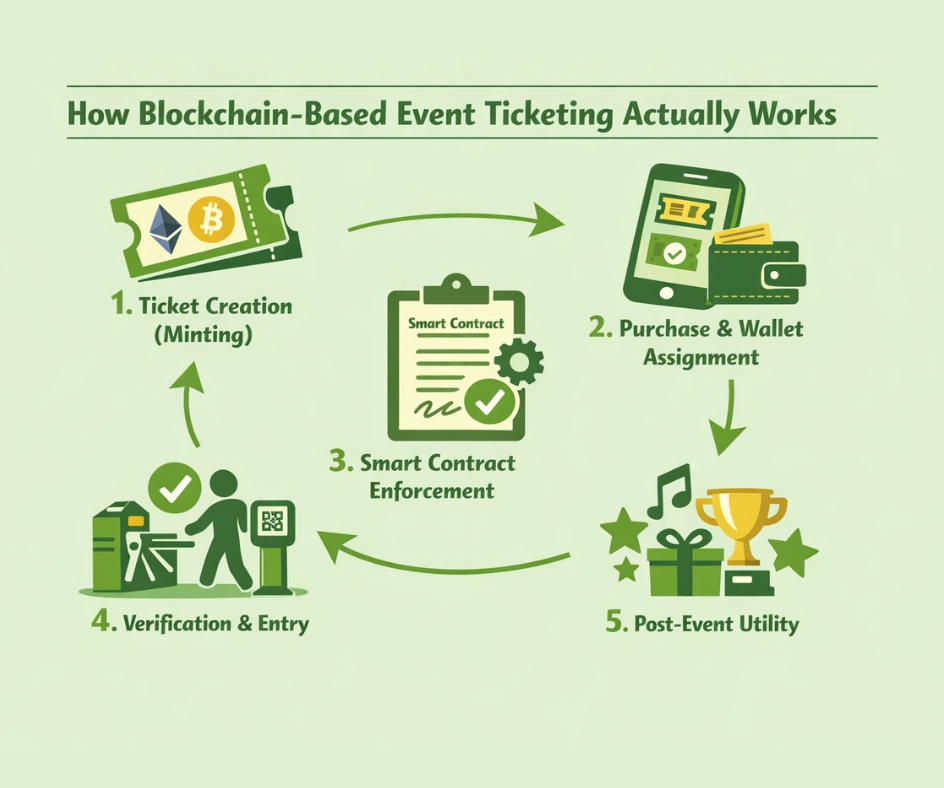
Digital ticketing on blockchain might sound intimidating if you’re not familiar with the technology, but the underlying process is more straightforward than you’d expect. Here’s a step-by-step walkthrough of how NFT ticketing platforms operate behind the scenes.
Step 1: Ticket Creation (Minting)
An event organizer works with an NFT ticketing platform to create digital tickets. Each ticket is “minted” as a unique NFT on a blockchain (commonly Ethereum, Polygon, Solana, or Tezos). During minting, a smart contract assigns the ticket a unique token identifier, records the event details, sets the original price, and establishes rules for resale, transfer, and expiration.
Step 2: Purchase and Wallet Assignment
Attendees purchase tickets through the platform’s interface, either using cryptocurrency or fiat currency (standard money processed through a payment gateway). Once purchased, the NFT ticket is transferred to the buyer’s digital wallet. On many platforms, this wallet is created automatically in the background, so the buyer doesn’t need prior crypto knowledge.
Step 3: Smart Contract Enforcement
This is where the magic happens. Smart contracts are self-executing pieces of code that automatically enforce the terms set by the event organizer. They can cap the maximum resale price, ensuring nobody can list a $50 ticket for $5,000. They can automatically route a percentage of every resale back to the artist or organizer as a royalty. They can restrict transfers entirely, making the ticket non-transferable if that’s the organizer’s preference. And they do all of this without a middleman. The code is the rule, and it applies equally to everyone.
Step 4: Verification and Entry
At the event, the ticket holder presents their NFT via their digital wallet. A QR code or NFC-based scan verifies the ticket’s authenticity against the blockchain in real time. The system confirms ownership, checks that the ticket hasn’t been used, and grants entry. Once scanned, the ticket can be “burned” (invalidated) to prevent reuse.
Step 5: Post-Event Utility
Unlike a traditional ticket stub that gets thrown away, an NFT ticket can live on after the event. It can become a digital collectible, unlock exclusive content, serve as proof of attendance for future perks, or even function as a membership pass for ongoing fan engagement. This is one of the most powerful and underappreciated aspects of NFT event ticketing.
The Benefits of NFT Tickets for Events: Why the Industry Is Shifting
The move toward NFT ticketing platforms isn’t happening because blockchain is a trendy buzzword. It’s happening because it solves real, measurable problems. Here are the core advantages driving adoption.
1. Fraud Elimination Through Immutable Records
Every NFT ticket exists as a unique entry on the blockchain with a verifiable chain of ownership. It cannot be copied, duplicated, or forged. When a buyer checks their ticket’s history, they can see every previous owner and every transaction, all the way back to the original mint. This completely eliminates the counterfeit ticket problem that has cost consumers and organizers billions.
2. Scalping Prevention Through Smart Contracts
By programming resale price caps directly into the smart contract, organizers can prevent tickets from being resold above a set threshold. Some platforms also restrict the number of tickets a single wallet can purchase, cutting off the bulk buying strategy that scalper bots rely on. Holland’s most popular comedian, Jochem Myjer, sold 50,000 tickets across 36 shows using GUTS Tickets (powered by GET Protocol), and none of the tickets ended up in the hands of scalpers.
3. Artist and Organizer Royalties on Resales
In the traditional model, artists earn nothing when a ticket is resold. With NFT ticketing, smart contracts can automatically route a percentage of every secondary sale back to the original creator. YellowHeart, one of the leading NFT ticketing platforms, offers artists a 95 percent take on primary sales and allows them to set their own secondary market rate, keeping up to 100 percent of resale revenue flow.
4. Direct Fan Relationships and Ongoing Engagement
NFT tickets give organizers a direct communication channel with every ticket holder. They can send updates, offer exclusive perks, drop bonus content, and build loyalty programs, all tied to the NFT in the fan’s wallet. This turns a one-time transaction into an ongoing relationship, something that was nearly impossible with traditional ticketing, where fan data was often controlled by third-party platforms.
5. Post-Event Collectibility and Long-Term Value
As Live Nation Entertainment President Michael Rapino noted about their Live Stubs venture, NFT ticket stubs bring back the nostalgia of collecting while giving artists a new tool to deepen fan relationships. An NFT ticket can evolve after the event, revealing exclusive artwork, unlocking behind-the-scenes footage, or granting access to future presales. It transforms a disposable entry pass into a lasting piece of event memorabilia.
NFT Ticketing Platform Market: Key Statistics at a Glance
| Metric | Value | Source / Context |
|---|---|---|
| Global NFT Ticketing Market Size (2025) | USD 1.12 Billion | Business Research Insights, 2025 |
| Projected Market Size (2034) | USD 3.617 Billion | 14.9% CAGR from 2025 to 2034 |
| North America Adoption (2025) | 18% of live event organizers | MarketMind Partners NFT Ticketing Report |
| US Share of Global Revenue (2025) | Over 35% | Driven by entertainment, sports, and tech industries |
| Dominant Event Segment | Concerts & Music Festivals (40%+ share) | High ticket volumes and frequent secondary reselling |
| Global NFT Awareness (2025) | 65% (up from 20%) | Business Research Insights |
| Ticket Fraud Detection Market (2024) | USD 1.87 Billion | Projected to reach USD 5.47 billion by 2033 |
Real World Examples: Who Is Already Using NFT Event Ticketing?
NFT ticketing isn’t theoretical. Major events, artists, and sports organizations are actively using it, and the results speak for themselves.
Coachella’s Lifetime Pass NFTs
In 2022, the Coachella music festival launched the Coachella Keys Collection: 10 lifetime pass NFTs minted on Solana through a partnership with FTX. These sold for a combined $1.5 million and granted holders entry to all future Coachella events, VIP dinners, front row seats, and other exclusive experiences. The festival continued to experiment with NFTs for VIP access in 2024, expanding the concept beyond a one-off experiment into a recurring engagement strategy.
GET Protocol’s Anti-Scalping Success
Amsterdam-based GET Protocol has issued over 4 million blockchain-based tickets for artists including Ne-Yo, Gucci Mane, Lewis Capaldi, and Louis C.K. The platform operates across 121 countries and powers over 200 events per month. Its approach is notable because it focuses on mainstream adoption. Ticket buyers don’t need to understand crypto or own a wallet beforehand. The blockchain infrastructure operates invisibly under the hood, while the user interacts with a standard ticketing interface. Critically, none of the tickets distributed through the GET Protocol have been scalped.
Ticketmaster’s Commemorative NFT Tickets
Even the legacy ticketing giant has entered the space. Multiple brands under the Ticketmaster name launched their own commemorative NFT tickets starting in 2021, including the NFL. These NFTs display a video of the teams involved in a matchup along with the date, time, and location of the game, and are minted and delivered to fans when their physical tickets are scanned at the venue.
Formula 1 and Football Clubs
Since 2023, Formula 1 has used NFT-based passes for events like the Monaco Grand Prix, offering holders perks such as discounts and access to exclusive parties. Football clubs, including Lazio and Porto, have integrated NFT season passes through platforms like Binance and Socios, turning seasonal ticketing into an ongoing fan engagement tool.
SeatlabNFT’s Large Scale Deployment
In March 2025, SeatlabNFT announced a strategic partnership with a major UK music festival to deploy NFT tickets for over 150,000 attendees. This represents one of the largest single implementations of NFT ticketing to date and marks a turning point for the technology’s ability to handle mass-scale events.
Recommended Reading:
The Role of Smart Contracts in Secure NFT Ticketing
If blockchain is the foundation of NFT event ticketing, smart contracts are the engine that makes everything run. Understanding them is essential to grasping why this technology is so fundamentally different from anything the traditional ticketing industry has offered.
A smart contract is a self-executing program stored on the blockchain. Its terms are written directly into code, and it runs automatically when predefined conditions are met. There is no human operator deciding whether to enforce a rule. The code handles it, every single time, for every single transaction.
In the context of event ticketing, smart contracts manage the entire lifecycle of a ticket:
Minting creates the ticket as a unique digital token on the blockchain, assigning it a token ID, linking it to specific event metadata (date, venue, seat, tier), and recording the original price.
A transfer moves ownership from one wallet to another. The smart contract checks whether the transfer is permitted, whether any price cap has been exceeded, and whether a royalty needs to be paid before completing the transaction.
Verification confirms at the venue that the ticket is genuine, has not been previously used, and belongs to the person presenting it.
Burning invalidates the ticket after it has been scanned and used, permanently preventing anyone from reusing it.
Amazon Web Services published a detailed analysis of blockchain ticketing architecture, noting that smart contracts can enforce maximum resale prices (even during secondary market trading), automatically distribute royalties to artists and event creators, make service fees transparent and tied to operational costs rather than arbitrary fixed markups, and enable dynamic fees based on conditions like demand. All of this happens without a centralized authority. No single company owns the data, and no single party can alter the rules after they’ve been deployed. This is what makes secure NFT ticketing fundamentally different from any software layer that a traditional platform might add on top of its existing system.
Leading NFT Ticketing Platforms in 2026
The NFT ticketing ecosystem has matured significantly. While over 160 projects entered and exited the space (according to GET Protocol CEO Maarten Bloemers), a number of platforms have established themselves as credible, functioning solutions for organizers and fans.
YellowHeart
Founded as a Web3 marketplace for ticketing, music, and memberships, YellowHeart has worked with artists including Maroon 5, Kings of Leon, and XXXTentacion. The platform allows artists to program exclusive benefits into their NFT tickets, from album downloads and vinyl records to behind-the-scenes content. In 2022, YellowHeart partnered with MGM Grand Resorts in Las Vegas to distribute NFT tickets for Jabbawockeez performances, which included priority seating, meet and greets, and food credits.
GET Protocol
Operating since 2016, GET Protocol takes a “Web 2.5” approach, making blockchain invisible to end users while delivering all of its benefits. The platform offers a white-label ticketing solution and a digital twin NFT layer that existing ticketing companies can integrate. Every ticket sold through the protocol is logged on-chain and visible via a real-time NFT Ticket Explorer.
SeatLabNFT
Built on the NEAR Protocol blockchain, SeatLabNFT uses NFC technology for ticket verification and rewards ticket holders with collectible airdrops. Both original ticket issuers and holders receive royalties from future resales. The platform’s $SEAT governance token allows users to participate in platform decisions and earn exclusive rewards.
GUTS Tickets
Running on the GET Protocol, GUTS Tickets focuses on concerts, festivals, live streams, museum exhibitions, and theater. The platform provides resale royalties, controlled resale prices, fraud prevention tools, and real-time communication with ticket owners. GUTS has reportedly sold over 600,000 NFT-based tickets.
NFT.Kred
As an industry leader with over 40 million NFTs minted, NFT. Kred integrates directly with Eventbrite, automating the issuance of uniquely designed NFT tickets upon each registration. Their tickets are dynamic, revealing updated artwork post-event, and can be loaded with exclusive benefits and offers for attendees.
NFT Ticketing vs. Traditional Ticketing: A Side-by-Side Comparison
| Feature | Traditional Ticketing | NFT Event Ticketing |
|---|---|---|
| Counterfeiting Risk | High. PDFs and barcodes can be duplicated and sold to multiple buyers. | Eliminated. Each NFT is unique and verified on the blockchain. |
| Scalping Control | Limited. Platforms struggle to enforce resale price limits across secondary markets. | Built in. Smart contracts enforce price caps and transfer restrictions automatically. |
| Artist Resale Royalties | None. All resale profits go to the reseller. | Automatic. Smart contracts distribute royalties on every secondary sale. |
| Ownership Transparency | Opaque. Buyers can’t verify a ticket’s full history or origin. | Full transparency. Every transfer is publicly recorded on the blockchain. |
| Post-Event Value | Zero. The ticket becomes useless after the event. | Ongoing. NFT ticket becomes a collectible, membership pass, or gateway to future perks. |
| Fan Data Access | Controlled by third-party platforms like Ticketmaster. | Direct. Organizers can communicate with fans through wallet-linked channels. |
| Intermediary Dependence | Heavy. Multiple middlemen take fees at every step. | Minimal. Smart contracts handle transactions directly between parties. |
Addressing the Environmental Concern
One of the most common objections to blockchain technology has been its energy consumption. This concern was valid when Ethereum operated on a proof-of-work consensus mechanism, which required massive computational power for transaction validation. At its peak in May 2022, Ethereum’s annual energy use was comparable to that of Finland.
However, this changed dramatically in September 2022 when Ethereum completed its long-anticipated “Merge,” transitioning from proof-of-work to proof-of-stake. According to the Ethereum Foundation, this switch resulted in a 99.95 percent reduction in energy consumption. The Crypto Carbon Ratings Institute (CCRI), commissioned by ConsenSys, confirmed a 99.9 percent reduction in Ethereum’s carbon footprint. After the Merge, minting an NFT became ecologically comparable to performing one to three Google searches.
Beyond Ethereum, many NFT ticketing platforms operate on inherently energy-efficient blockchains. GET Protocol runs on Polygon, where a single transaction produces as little as 430 grams of CO2. Solana, another popular choice, uses so little energy per transaction that the Solana Foundation compared it to less than three Google searches. For event organizers concerned about sustainability, the environmental argument against NFT ticketing no longer holds water.
Recommended Reading:
Challenges and Hurdles That Still Exist
For all its promise, NFT event ticketing is not without obstacles. Acknowledging these honestly is important for anyone considering adoption.
User Education and Technical Barriers
While platforms like GET Protocol have done remarkable work hiding blockchain complexity from end users, there’s still a learning curve for some demographics. Only 11 percent of people between the ages of 35 and 54 participate in NFTs, which limits adoption among older audiences. Bridging this gap requires continued investment in user-friendly interfaces and clear onboarding processes.
Regulatory Uncertainty
The legal landscape around NFTs varies wildly across jurisdictions. In the US, the SEC is evaluating NFTs under securities laws with at least 9 ongoing cases. Europe’s MiCA regulation now requires uniform disclosure rules. Japan mandates KYC/AML for NFT services. Countries like China have outright restrictions on cryptocurrency usage, making it difficult for NFT ticketing platforms to operate in certain markets. By 2025, 35 countries had implemented comprehensive NFT regulation, but many regions remain ambiguous.
Integration with Legacy Systems
The events industry has decades of established infrastructure built around traditional ticketing. Venues have scanning equipment designed for barcodes, organizers have contracts with established ticketing providers, and staff are trained on existing workflows. Transitioning to blockchain-based systems requires investment, retraining, and often a hybrid approach where traditional and NFT tickets coexist during a transition period.
Secondary Market Enforcement on Non-Custodial Wallets
Once an NFT ticket is transferred to a non-custodial wallet (one that the user fully controls), it becomes difficult to impose transfer and resale restrictions. While smart contracts can enforce rules within the platform’s ecosystem, tickets that move outside of it may bypass some controls. This is an active area of development, with standards like ERC-721c from Limit Break working toward chain-level enforceable royalties.
The Future of Event Ticketing with NFTs
The trajectory is clear. The future of event ticketing with NFTs is not about replacing every paper ticket overnight. It’s about a gradual, accelerating shift toward a model that is fairer, more transparent, and more beneficial for everyone in the events ecosystem.
Dynamic NFTs That Evolve Based on Fan Behavior
The next generation of NFT tickets won’t be static. Dynamic NFTs can change based on the holder’s actions. Attend three concerts by the same artist, and your NFT unlocks an exclusive badge. Share event content, and you’re minted a reward token. Collect seasonal passes, and you earn VIP perks. These game-like mechanics are turning event attendance into a continuous engagement loop that builds loyalty beyond the venue.
Mainstream Ticketing Giants Entering the Space
As traditional platforms like Ticketmaster and Eventbrite explore NFT integration, we’re moving toward hybrid models that combine the reach of established Web2 platforms with the capabilities of Web3 technology. This convergence will bring NFT ticketing to audiences who have never interacted with a blockchain and likely never will consciously.
Metaverse and Virtual Event Integration
The expanding metaverse offers new territory for NFT tickets. Virtual concerts, conferences, and experiences on platforms like Decentraland already use NFT-based access passes. As virtual and hybrid events grow, NFT tickets will serve as universal credentials that work across both physical venues and digital worlds.
Interoperable Standards Across Platforms
The development of cross-chain minting tools and universal ticketing standards will enable NFT tickets to work across different blockchains and platforms. This interoperability is essential for mainstream adoption, ensuring that a ticket minted on Ethereum can be verified and used regardless of the venue’s preferred blockchain.
Launch Your NFT Ticketing Platform Today:
We bring 8+ years of blockchain expertise to NFT ticketing platform development. Our specialized team handles everything from smart contract creation to multi-chain integration, ensuring your platform is built for growth, trust, and user experience. Whether you need a concert ticketing solution, a sports access pass system, or a festival NFT platform, we deliver solutions that work.
Final Thoughts
The events industry has been waiting for something like this for a long time. For years, fans have accepted ticket fraud, inflated prices, and opaque resale markets as unfortunate but unavoidable realities of going to a show or a game. Artists have watched as secondary market profits flowed to strangers who added zero value. Organizers have fought losing battles against bots and scalpers using tools that were always one step behind.
NFT event ticketing changes that equation. By turning every ticket into a verifiable, programmable, non-duplicable digital asset on the blockchain, it gives organizers real control over how their tickets are sold, priced, and resold. It gives artists the ability to earn from every transaction their ticket goes through. And it gives fans confidence that what they’re buying is real, fairly priced, and connected to something bigger than a single night out.
The market data makes the momentum impossible to ignore. With the NFT ticketing market valued at USD 1.12 billion in 2025 and growing at nearly 15 percent annually, with platforms like GET Protocol already distributing millions of blockchain-based tickets to mainstream audiences, and with giants like Ticketmaster, Formula 1, and Coachella investing in NFT integration, this is not an experiment anymore. It’s the beginning of a new standard.
There are still challenges to work through. User education, regulatory clarity, and interoperability standards all need continued attention. But the direction of travel is unmistakable. The future of event ticketing with NFTs is being built right now, and every concert, game, and festival that adopts it gets us one step closer to a world where the ticket system actually works for the people it’s supposed to serve.
Frequently Asked Questions
Q1.What exactly is an NFT ticket and how is it different from a regular digital ticket?
An NFT ticket is a unique digital asset stored on a blockchain. Unlike a regular digital ticket (PDF, barcode, or QR code), an NFT ticket cannot be duplicated, and every transfer of ownership is permanently recorded on a public ledger. This makes it verifiable, tamper-proof, and capable of carrying programmable rules like resale price caps and automatic royalty payments through smart contracts.
Q2.Do I need to understand cryptocurrency or own a crypto wallet to use NFT tickets?
No. Most modern NFT ticketing platforms are designed so that buyers interact with a familiar interface. Platforms like GET Protocol create wallets for users in the background, and many accept standard payment methods like credit cards. You don’t need prior experience with blockchain to purchase, store, or use an NFT ticket at an event.
Q3.How do NFT tickets prevent scalping?
Smart contracts embedded in NFT tickets can enforce maximum resale prices, restrict how many tickets a single person can buy, and even make tickets entirely non-transferable. Because these rules are written into code and execute automatically, they cannot be bypassed the way that traditional anti-scalping measures often are.
Q4.Are NFT tickets bad for the environment?
Not anymore. Since Ethereum’s transition to proof-of-stake in September 2022, minting an NFT uses roughly the same energy as one to three Google searches. Many NFT ticketing platforms also operate on energy-efficient blockchains like Polygon and Solana, making the environmental impact negligible compared to the paper and logistics involved in traditional ticketing.
Q5.Can I resell an NFT ticket?
Yes, in most cases. NFT tickets can be bought, sold, and transferred on digital marketplaces. However, the event organizer may set specific rules through the smart contract, such as a maximum resale price or a royalty that goes back to the artist on every secondary sale. These rules are enforced automatically and transparently.
Q6.Which major events or artists have already used NFT ticketing?
Several high-profile events and organizations have adopted NFT ticketing. Coachella sold lifetime pass NFTs for $1.5 million in 2022. GET Protocol has issued tickets for artists like Ne-Yo, Gucci Mane, and Lewis Capaldi. Formula 1 has used NFT passes for the Monaco Grand Prix since 2023. Ticketmaster launched commemorative NFT tickets for NFL games. And in March 2025, SeatlabNFT deployed NFT tickets for over 150,000 attendees at a major UK music festival.
Explore Services
Related Services
Reviewed by

Aman Vaths
Founder of Nadcab Labs
Aman Vaths is the Founder & CTO of Nadcab Labs, a global digital engineering company delivering enterprise-grade solutions across AI, Web3, Blockchain, Big Data, Cloud, Cybersecurity, and Modern Application Development. With deep technical leadership and product innovation experience, Aman has positioned Nadcab Labs as one of the most advanced engineering companies driving the next era of intelligent, secure, and scalable software systems. Under his leadership, Nadcab Labs has built 2,000+ global projects across sectors including fintech, banking, healthcare, real estate, logistics, gaming, manufacturing, and next-generation DePIN networks. Aman’s strength lies in architecting high-performance systems, end-to-end platform engineering, and designing enterprise solutions that operate at global scale.