Ai Overview
Identifying red flags in crypto exchange development vendors is important because your entire project depends on the quality, security, and reliability of the development partner you choose. Red flags such as lack of proven experience, unclear pricing, weak security practices, or poor communication are early warning signs of bigger problems. Identifying these issues early helps protect your investment and ensures long-term stability. Selecting the right vendor involves evaluating multiple aspects beyond cost:.
Key Takeaways
- It is crucial to work with a crypto exchange development vendor that has a strong track record, proven experience, and deep understanding of both centralized and decentralized exchange systems to ensure the platform is built correctly from the start.
- Security should be a top priority, including conducting comprehensive security audits, implementing strong data encryption, two-factor authentication, and robust risk management systems to protect user funds and sensitive information.
- A clearly defined development process with structured milestones, timelines, and deliverables helps prevent delays, miscommunication, and technical errors during the crypto exchange development project.
- Transparent pricing and a detailed cost breakdown are essential to avoid hidden charges and unexpected expenses that can disrupt budgets and project timelines.
- Vendors must have a thorough understanding of regulatory requirements, including KYC, AML, and local compliance standards, to ensure the exchange operates legally and avoids potential legal issues.
- Technical strength is critical, including the ability to handle high scalability, use modern technology stacks, maintain fast and accurate trading engines, and provide a well-designed admin panel for efficient operations.
- Effective communication and ongoing support from the vendor are vital, including having a dedicated development team, providing regular updates, and offering post-launch maintenance to ensure the platform runs smoothly.
- Asking detailed questions about previous projects, security measures, compliance implementation, and scalability solutions can help evaluate the vendor’s capability and reliability before making a final decision.
- Verifying the vendor’s past work through live platform examples, client references, and third-party audit reports ensures credibility and confirms that they can deliver a secure and high-performing crypto exchange.
- Choosing the right crypto exchange development partner is essential for building a secure, compliant, scalable, and long-term successful platform that meets both business and user expectations in a competitive crypto market.
Why Identifying Red Flags in Crypto Exchange Development Vendors Is Important
Identifying red flags in crypto exchange development vendors is important because your entire project depends on the quality, security, and reliability of the development partner you choose. A crypto exchange handles real money, sensitive user data, and high daily transactions. If the vendor is inexperienced, careless, or unclear in their process, the risk directly affects your business.
Red flags such as lack of proven experience, unclear pricing, weak security practices, or poor communication are early warning signs of bigger problems. If you ignore them at the beginning, you may face serious technical failures, financial loss, or legal trouble after launch. Fixing these issues later is always more expensive and stressful than preventing them early.
Choosing a vendor without checking these warning signs can also harm your reputation. In the crypto market, trust is everything. If your exchange faces downtime, security issues, or trading errors, users will quickly move to another platform. A damaged brand image is difficult to rebuild.
Identifying red flags helps you protect your investment, reduce risk, and ensure that your crypto exchange is built on a stable foundation. It allows you to choose a development partner who understands security, compliance, performance, and long-term scalability, not just basic coding.
Risks of Choosing the Wrong Crypto Exchange Development Vendor
Choosing the wrong crypto exchange development vendor creates direct and serious risks. The biggest risk is security failure. If the vendor does not implement proper protection systems, your platform can become vulnerable to hacking. A single breach can lead to loss of user funds and legal complications.
Another major risk is poor performance. If the trading engine is slow or unstable, users will face delays and failed transactions. In a fast-moving crypto market, even small delays can cause traders to lose money, and they will not continue using your platform.
Hidden costs are also a common problem. Some vendors offer low initial pricing but later add extra charges for basic features or integrations. This increases your total development cost and delays the launch. There is also the risk of non-compliance. If the vendor does not understand KYC, AML, or regulatory requirements, your exchange may face restrictions or penalties in the future.
In short, choosing the wrong vendor can result in financial loss, technical problems, delayed launch, and long-term damage to your business.
How Vendor Mistakes Can Impact Your Crypto Exchange Project
Vendor mistakes directly affect the success of your crypto exchange project. Poor coding or weak architecture can cause system crashes, slow performance, and difficulty handling high traffic. As your user base grows, these problems become more serious.
Security mistakes can expose user funds and sensitive information. Once trust is broken, users rarely return. This can permanently damage your exchange’s reputation. Project delays are another impact. If the vendor lacks a clear development process, timelines are missed. This affects marketing plans, investor confidence, and business growth. Vendor mistakes also increase overall costs. Fixing bugs, redesigning features, or rebuilding parts of the system requires extra time and money.
Most importantly, user experience suffers. If traders face technical errors or unstable performance, they will switch to competitors. In the crypto industry, users expect smooth and secure trading. That is why identifying red flags in crypto exchange development vendors at the beginning is necessary. It helps you avoid costly mistakes and ensures your project is built correctly from day one.
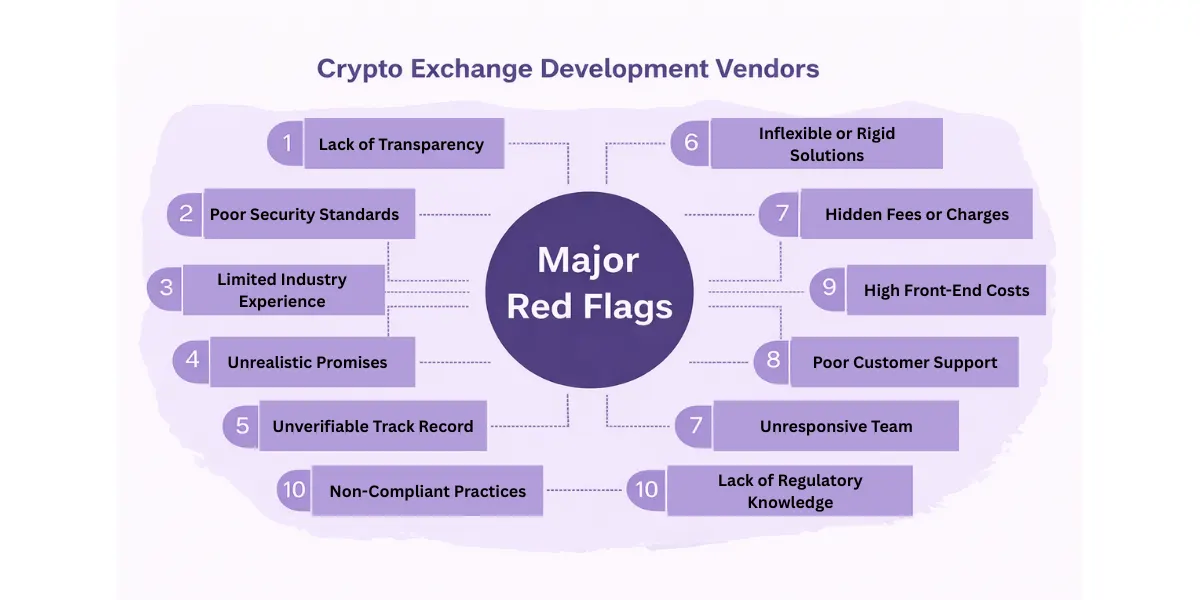
Major Red Flags in Crypto Exchange Development Vendors
When selecting a crypto exchange development vendor, small warning signs can turn into serious business risks. A crypto exchange is not a simple website — it handles live trading, user funds, compliance requirements, and constant market activity. If the development partner lacks capability or transparency, the entire platform can suffer. Below are the major red flags in crypto exchange development vendors that should never be ignored.
| Category | Red Flag | Details / Warning Signs |
|---|---|---|
| Experience | Lack of Experience | Vendor cannot show live crypto exchange projects or verified portfolio |
| Security | No Security Audit | No third-party audit or internal testing |
| Development Process | No Proper Timeline / Milestones | No schedule or deadlines for project stages |
| Pricing | Hidden Costs | Vague pricing, unclear breakdown |
| Technical | Outdated Technology Stack | Old frameworks, unsupported libraries |
Lack of Experience in Crypto Exchange Development
Experience is one of the first things you should evaluate. Crypto exchange development requires deep understanding of trading engines, wallet integration, liquidity management, and security layers. A vendor without real experience may struggle with complex technical requirements.
No Proven Portfolio in Cryptocurrency Exchange Development
If a company cannot show a verified portfolio of completed cryptocurrency exchange development projects, it is a serious warning sign. Screenshots alone are not enough. You should look for live platforms, case studies, or detailed explanations of previous work.
A vendor without a proven track record may still be experimenting. This increases the risk of errors, delays, and incomplete features. Experience shows whether the team has handled real trading environments, real users, and real security challenges.
Limited Knowledge of Centralized and Decentralized Exchange Development
Crypto exchanges can be centralized (CEX), decentralized (DEX), or hybrid. A reliable development partner should understand the technical differences between them. If the vendor cannot clearly explain how order matching works in a centralized exchange or how smart contracts power a decentralized exchange, it shows limited expertise.
Limited knowledge can lead to poor system design, weak architecture, and scalability problems in the future.
Poor Security Practices in Crypto Exchange Development
Security is the foundation of any crypto exchange. If security is treated as an optional feature instead of a priority, that vendor should not be trusted.
Weak Smart Contract Security
For decentralized exchange development, smart contracts control transactions and funds. If these contracts are poorly written or not properly tested, they can contain vulnerabilities. Hackers actively search for such weaknesses.
A vendor that does not conduct proper testing or security audits before deployment creates major financial risk for your platform.
No Advanced Security Features for Trading Platforms
A professional crypto exchange should include features such as two-factor authentication (2FA), cold wallet storage, encryption, anti-DDoS protection, and withdrawal limits. If the vendor does not include these basic protections, it shows a lack of seriousness toward user safety.
Security should be built into the system from the beginning, not added later as an afterthought.
Ignoring Security Red Flags in Crypto Exchange Software
If the development company avoids discussing security architecture or refuses third-party audits, that is a red flag. Transparency about security practices is important. A trustworthy vendor clearly explains how user data and funds are protected.
No Clear Development Process
A structured crypto exchange development process ensures that the project runs smoothly. Without a defined workflow, confusion and delays are common.
Undefined Crypto Exchange Development Process
If the vendor cannot explain step-by-step how they plan to build your exchange, it indicates poor planning. A clear process should include requirement analysis, UI/UX design, backend development, integration, testing, and deployment.
Without structure, tasks may overlap or be missed completely.
No Proper Project Timeline or Milestones
A professional vendor provides a timeline with clear milestones. If there is no defined schedule, the project may extend indefinitely. Missed deadlines affect marketing plans, partnerships, and investor confidence.
Time management reflects how organized and experienced the development team is.
Hidden Costs and Unclear Pricing Structure
Pricing transparency is critical in crypto exchange development. Many problems arise when cost details are unclear.
No Transparent Crypto Exchange Development Cost Breakdown
If the vendor gives only a total amount without explaining what is included, you may face unexpected expenses later. A proper cost breakdown should mention design, development, integrations, testing, deployment, and maintenance.
Clear pricing builds trust. Vague pricing creates risk.
Extra Charges After Project Start
Some vendors initially offer low prices to attract clients. After development begins, they add charges for necessary features or integrations. This increases the overall budget and creates frustration.
Unexpected cost increases are a strong red flag that should not be ignored.
Lack of Regulatory and Compliance Knowledge
Crypto exchanges must follow legal and regulatory standards. A vendor who ignores compliance can expose your business to legal issues.
Ignoring KYC/AML Requirements
Know Your Customer (KYC) and Anti-Money Laundering (AML) processes are essential in many regions. If the development company does not integrate proper identity verification systems or compliance tools, your exchange may face restrictions.
Compliance is not optional. It protects both your business and your users.
Legal Red Flags in Crypto Exchange Development
If the vendor avoids discussing legal frameworks, licensing requirements, or regional regulations, it shows a lack of industry awareness. Building a crypto exchange without compliance planning can lead to penalties or forced shutdowns.
Poor Communication and Support
Communication plays a major role in successful crypto exchange development. Technical expertise alone is not enough if coordination is weak.
No Dedicated Crypto Exchange Development Team
A reliable company assigns a dedicated team to your project. If there is no clear project manager or development team, communication gaps increase. You may receive inconsistent updates or unclear responses.
A dedicated team ensures accountability and smoother execution.
Slow Response and No Post-Launch Support
After launching your crypto exchange, ongoing support is essential. Bugs, updates, and performance improvements are part of long-term growth. If the vendor does not offer post-launch support, you may struggle with future issues.
Slow response during development is also a warning sign. If communication is weak before payment completion, it may become worse later.
Technical Red Flags in Crypto Exchange Development Projects
Technical strength is the backbone of any successful crypto exchange. Even if the design looks attractive and the feature list seems complete, weak technical foundations can cause serious problems after launch. Many crypto exchange projects fail not because of marketing, but because of technical red flags that were ignored during development. Identifying these issues early helps protect your investment and ensures long-term stability.
Below are some of the most critical technical red flags in crypto exchange development projects.
Low Scalability and Performance Issues
Scalability is one of the most important technical factors in crypto exchange development. In the beginning, your platform may have limited users. But as trading volume increases, the system must be able to handle higher traffic without slowing down.
A major red flag is when the development team does not clearly explain how the system will manage high transaction loads. If the exchange struggles during peak trading hours, users may face delayed order execution or failed transactions. In crypto trading, even a few seconds of delay can cause financial loss for users.
Performance problems usually come from poor backend architecture or an inefficient trading engine. If the system is not designed to process multiple orders simultaneously, it can freeze or crash during high activity. Frequent downtime damages user trust and reduces platform credibility.
Another sign of low scalability is the absence of load testing. A reliable crypto exchange development process should include stress testing under simulated high traffic conditions. If the vendor skips this step, it shows a lack of preparation for real market conditions.
Scalability is not just about handling more users. It also includes the ability to add new trading pairs, integrate new features, and expand to different regions without rebuilding the entire system. If the technical structure is rigid, future growth becomes complicated and expensive.
Outdated Technology Stack
Technology evolves quickly, especially in the blockchain and crypto industry. Using an outdated technology stack is a serious red flag in crypto exchange development projects.
If the development company relies on old frameworks, unsupported libraries, or outdated programming practices, it creates long-term risks. Old systems may not receive security updates, which increases vulnerability to attacks. They may also struggle to integrate with modern APIs, wallets, or compliance tools.
An outdated technology stack can also affect performance. Modern trading platforms require efficient databases, real-time data processing, and fast order matching systems. If the backend technology is not optimized for speed and reliability, users will experience delays. Another issue with outdated technology is maintenance difficulty. Future upgrades become more complex because newer tools may not be compatible with older systems. This increases development costs and slows innovation.
A professional crypto exchange development company should clearly explain the technology stack being used. Transparency about programming languages, frameworks, and system architecture shows technical confidence. If the vendor avoids these discussions or provides vague answers, it is a warning sign.
No Liquidity Integration Strategy
Liquidity is essential for any crypto exchange. Without proper liquidity, users cannot execute trades smoothly. Orders remain unmatched, spreads become large, and the trading experience suffers.
One of the biggest technical red flags is when a vendor does not have a clear liquidity integration strategy. Building the exchange interface alone is not enough. The system must connect with liquidity providers or external exchanges to ensure smooth order matching. If the development team cannot explain how liquidity will be managed, it shows incomplete planning. Poor liquidity leads to low trading activity, which discourages users from continuing on the platform.
A proper strategy may include integration with third-party liquidity providers, market-making solutions, or internal liquidity pools. Without these systems, even a technically stable exchange can fail to attract traders. Liquidity planning should be part of the early development stage, not an afterthought. If the vendor discusses it only after launch, it indicates weak technical and business understanding.
Weak Admin Panel and Trading Engine
The admin panel and trading engine are the core components of a crypto exchange. A weak trading engine is one of the most serious technical red flags.
The trading engine is responsible for matching buy and sell orders. If it is slow or inaccurate, users may face incorrect trade executions. In high-volatility markets, this can result in financial disputes and loss of trust. A strong trading engine must support high-speed order processing and accurate calculations. If the vendor cannot demonstrate the speed or efficiency of the engine, it raises concerns about reliability.
Similarly, the admin panel plays a key role in managing the platform. It should allow administrators to monitor transactions, manage users, control fees, handle disputes, and view reports. If the admin dashboard is limited or poorly designed, operational management becomes difficult.
A weak admin system can also affect security. Without proper control features, detecting suspicious activities or unusual trading patterns becomes harder. Another red flag is a lack of customization. If the admin panel and trading engine cannot be adjusted according to business needs, it limits flexibility. Every crypto exchange has unique requirements, and the technical system should support them.
Security and Compliance Red Flags in Crypto Exchange Vendors
Security and compliance are the backbone of any successful crypto exchange. Without proper measures, even a technically well-built platform can fail, exposing users and your business to significant risks. Many crypto exchange failures happen not because of poor trading features, but because critical security and compliance aspects were ignored during development. Identifying these red flags early is essential for building a safe and trustworthy platform.
No Security Audit Before Launch
A professional crypto exchange development vendor should conduct thorough security audits before the platform goes live. Security audits involve checking the entire system, including smart contracts, wallet integrations, backend architecture, and front-end components, for vulnerabilities.
If a vendor does not provide or refuses a detailed audit, it is a major red flag. Without this step, unnoticed issues can allow hackers to exploit the system. Crypto exchanges are prime targets for cyberattacks due to the large volume of assets stored. A single breach can result in financial loss, reputational damage, and even legal penalties.
Security audits are not just a formality. They validate that all components of the exchange function correctly, transactions are secure, and user data is protected. Reputable vendors also provide third-party audit reports from recognized blockchain security firms. Vendors avoiding audits may be cutting corners, which can be costly in the long run.
Lack of Data Encryption and User Protection
User data protection is another critical aspect of crypto exchange security. Sensitive information, including personal identification, wallet keys, and transaction history, must be encrypted to prevent unauthorized access. If a vendor does not use proper encryption protocols, such as AES-256 for stored data or TLS for data in transit, it indicates weak security practices. Lack of encryption makes the platform vulnerable to breaches and compromises user trust.
In addition to encryption, proper user protection mechanisms like two-factor authentication (2FA), anti-phishing alerts, withdrawal limits, and device management are necessary. A vendor who ignores these features demonstrates a disregard for user safety. Without strong user protection, even small mistakes can lead to account takeovers, unauthorized transactions, and potential financial loss for your users. Trust is critical in the crypto market, and compromised security can permanently damage your exchange’s reputation.
No Risk Management System
A robust risk management system is essential for monitoring and mitigating potential threats in a crypto exchange. This includes mechanisms to detect suspicious activity, prevent fraud, and handle transaction errors. Vendors who do not implement proper risk management tools are a major red flag. Without these systems, it becomes difficult to monitor unusual trading patterns, prevent market manipulation, or respond to security incidents quickly.
Risk management also includes backup systems and disaster recovery protocols. In case of system failure or cyberattacks, these measures allow the exchange to continue operating and protect user funds. A vendor without a structured risk management strategy puts your entire platform and users at risk.
Checklist to Avoid Crypto Exchange Development Vendor Red Flags
Understanding red flags is only half the battle. Knowing how to verify and select the right vendor ensures your crypto exchange project remains secure, compliant, and successful.
Questions to Ask Before Hiring a Crypto Exchange Development Company
Before signing any agreement, ask clear questions about crypto exchange development and their experience and practices:
- Have you developed live cryptocurrency exchanges before? Can you provide references?
- Do you conduct regular security audits and penetration testing?
- What measures do you take to ensure KYC/AML compliance?
- How do you protect user data and wallet keys?
- Can you demonstrate the scalability and reliability of your trading engine?
A vendor’s answers reveal not only technical expertise but also professionalism and transparency. If responses are vague or dismissive, it is a warning sign.
How to Verify a Crypto Exchange Development Vendor?
Verification involves checking both technical capability and business credibility:
- Portfolio Verification- Review past projects and confirm their functionality and security. Live platforms are better indicators than screenshots.
- Third-Party Audit Reports- Ask for independent security audits of their previous exchanges.
- Client References- Speak with previous clients to understand the vendor’s communication, delivery timelines, and support quality.
- Regulatory Knowledge- Verify that the vendor understands regional compliance requirements, including KYC, AML, and data protection laws.
This verification process ensures that you are working with a reliable and experienced partner, reducing the risk of project failure.
Build Your Secure Crypto Exchange Today
Partner with us to create a reliable, compliant, and high-performance crypto exchange. Get expert development, robust security, and seamless user experience from start to launch.
Key Factors to Choose the Right Crypto Exchange Development Company
Selecting the right vendor involves evaluating multiple aspects beyond cost:
- Technical Expertise- Ensure the team has strong experience in building scalable trading engines, secure wallets, and fast transaction processing.
- Security Practices- The company should prioritize security, including encryption, audits, and continuous monitoring.
- Compliance Awareness- Legal and regulatory compliance should be integrated into the development process, not added later.
- Transparency and Communication- Clear processes, milestone tracking, and open communication are vital for smooth project execution.
- Post-Launch Support- A vendor should provide maintenance, updates, and rapid issue resolution even after deployment.
- Reputation and References- Check reviews, references, and past work to ensure credibility and reliability.
By carefully considering these factors, you reduce risks and increase the chances of launching a secure, compliant, and efficient crypto exchange.
Frequently Asked Questions
Q1.What are the most common red flags in crypto exchange development vendors?
The most common red flags include lack of experience, poor security practices, unclear development process, hidden costs, weak technical capabilities, and poor compliance knowledge. Vendors without a proven portfolio or prior live exchange projects are high-risk. Other warning signs include no security audits, outdated technology, lack of scalability planning, weak admin panels, unclear pricing, slow communication, and limited post-launch support. Ignoring these red flags can result in security breaches, system failures, delayed launches, financial losses, and damage to your platform’s reputation.
Q2.How can I identify a vendor with poor security practices?
Vendors with weak security practices often avoid discussing audits, encryption, or risk management strategies. Key indicators include:
-
No third-party security audit or internal testing for vulnerabilities.
-
Weak or untested smart contracts for decentralized exchanges.
-
Lack of encryption for sensitive user data.
-
No two-factor authentication (2FA), cold wallet storage, or anti-DDoS measures.
-
Absence of a risk management system to monitor unusual activity or handle emergencies.
Choosing a vendor with these red flags can leave your exchange vulnerable to hacks, financial loss, and user data breaches. Always ask for audit reports and security protocols before hiring.
Q3.Why is vendor experience critical in crypto exchange development?
Experience directly affects the reliability, performance, and compliance of your exchange. Experienced vendors understand how trading engines, liquidity integration, wallets, and backend architecture work together. A vendor with a proven portfolio can handle high-volume trading, implement proper security measures, and deliver a scalable system. In contrast, inexperienced vendors may produce incomplete features, poorly coded systems, or unstable platforms, which can cause financial loss, technical failures, and delays. Always verify prior projects and live platforms to ensure competence.
Q4.What technical red flags should I check for in a crypto exchange project?
Technical red flags often involve scalability, technology stack, liquidity, and core system strength. Specifically:
-
Low scalability: The platform cannot handle high trading volumes or user growth.
-
Outdated technology stack: Old frameworks or unsupported libraries that complicate maintenance and updates.
-
No liquidity integration strategy: Lack of connection to liquidity providers or market-making solutions.
-
Weak admin panel or trading engine: Slow order matching, limited monitoring, or poor operational control.
Identifying these red flags early ensures that your platform can scale effectively and provide a smooth trading experience.
Q5.How can I avoid hidden costs and unclear pricing from vendors?
Hidden costs appear when vendors provide vague estimates or do not clarify what is included in development packages. To avoid this:
-
Request a detailed cost breakdown for development, design, integration, testing, and maintenance.
-
Ask about potential additional fees for custom features, security upgrades, or regulatory compliance.
-
Ensure that the contract clearly mentions all costs and payment milestones.
Transparent pricing protects your budget and avoids financial surprises during development.
Explore Services
Related Services
Reviewed by

Aman Vaths
Founder of Nadcab Labs
Aman Vaths is the Founder & CTO of Nadcab Labs, a global digital engineering company delivering enterprise-grade solutions across AI, Web3, Blockchain, Big Data, Cloud, Cybersecurity, and Modern Application Development. With deep technical leadership and product innovation experience, Aman has positioned Nadcab Labs as one of the most advanced engineering companies driving the next era of intelligent, secure, and scalable software systems. Under his leadership, Nadcab Labs has built 2,000+ global projects across sectors including fintech, banking, healthcare, real estate, logistics, gaming, manufacturing, and next-generation DePIN networks. Aman’s strength lies in architecting high-performance systems, end-to-end platform engineering, and designing enterprise solutions that operate at global scale.