Ai Overview
Before diving into IPFS implementation, you need to understand why blockchain storage is fundamentally different from traditional database storage. A typical Ethereum transaction that stores just 32 bytes of data costs around $0. The smart contract stores only the root CID of the directory, keeping gas costs under $10 per mint while supporting files up to 500MB. One of the most common questions we receive at Nadcab Labs is about the cost implications of IPFS versus traditional cloud storage.
Key Takeaways
- IPFS uses content addressing through cryptographic hashes, making blockchain data tamper-proof and verifiable without relying on centralized servers.
- Running your own IPFS node gives you full control over data availability, retrieval speed, and network participation for blockchain applications.
- IPFS reduces storage costs by 40-60% compared to traditional cloud solutions while improving redundancy across distributed nodes.
- Integration with smart contracts allows developers to store large datasets off-chain while maintaining on-chain references through content identifiers.
- Pinning services and dedicated gateways solve the data persistence challenge that early IPFS implementations faced in production environments.
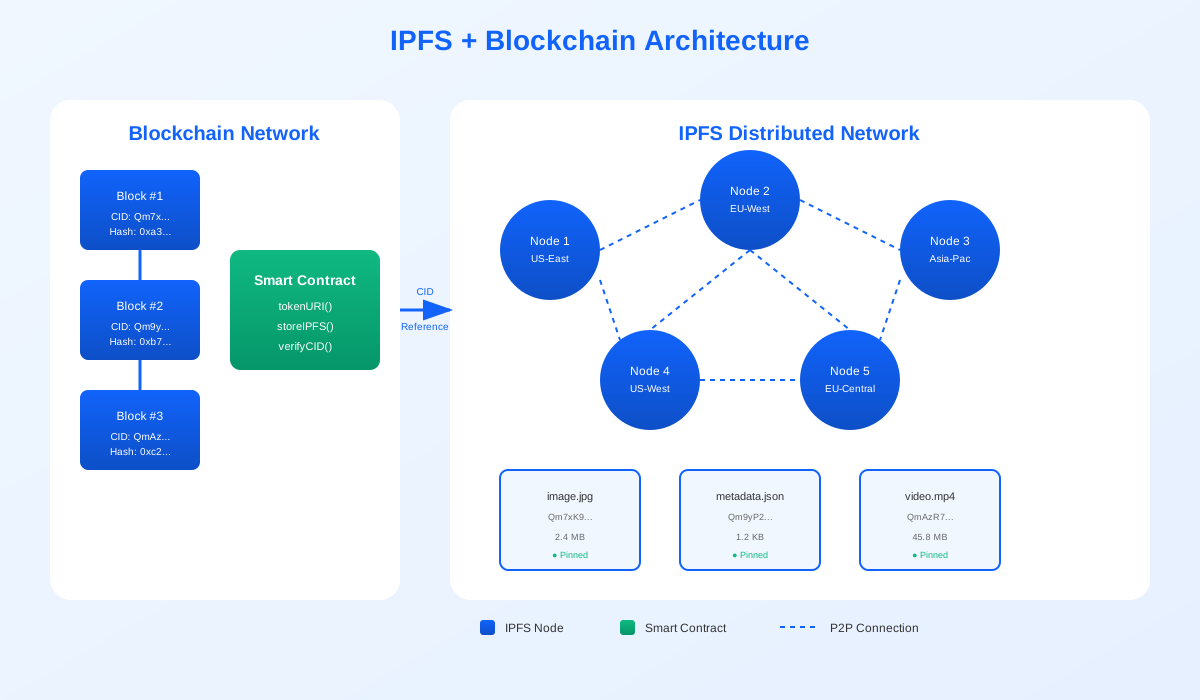
Figure 1: IPFS distributed architecture integrating with blockchain networks
When you build blockchain applications, you quickly run into a problem that most tutorials gloss over: where do you actually store your data? The blockchain itself is not designed for large files. Storing a single image directly on Ethereum would cost thousands of dollars in gas fees. This is where IPFS comes in, and understanding how to implement it properly can save your project from expensive mistakes down the road.
At Nadcab Labs, we have spent over 8 years building blockchain solutions for clients across different industries. We have seen projects fail because they chose the wrong storage approach, and we have helped others succeed by implementing IPFS correctly from day one. This guide shares what we have learned about making IPFS work in real production environments.
Understanding the Storage Problem in Blockchain Development
Before diving into IPFS implementation, you need to understand why blockchain storage is fundamentally different from traditional database storage. Blockchain networks like Ethereum, Solana, or Polygon are designed for consensus and transaction verification. They are not file storage systems.
Every piece of data stored on a blockchain gets replicated across thousands of nodes. This replication is what makes blockchains secure and decentralized, but it also makes them extremely expensive for storing anything beyond small pieces of information. A typical Ethereum transaction that stores just 32 bytes of data costs around $0.50 to $5 depending on network congestion. Now imagine storing a 5MB image. The math simply does not work.
This limitation creates a practical challenge for developers building NFT marketplaces, decentralized applications, or any blockchain project that involves media files, documents, or large datasets. You need an external storage solution that maintains the decentralized principles of your blockchain application. Centralized solutions like AWS S3 work technically, but they defeat the purpose of building on a decentralized network.
What Makes IPFS Different from Traditional Storage
The InterPlanetary File System operates on a fundamentally different model than the location-based addressing we use for traditional web storage. According to Wikipedia’s documentation on IPFS, the protocol was created by Juan Benet in 2015 as a peer-to-peer hypermedia protocol designed to make the web faster, safer, and more open.
When you store a file on a traditional server, you access it through a URL like “https://server.com/files/image.jpg”. This URL points to a specific location. If that server goes down, your file becomes inaccessible even if copies exist elsewhere. IPFS flips this model by using content addressing instead of location addressing.
Figure 2: Content addressing creates a unique fingerprint for each file
In IPFS, every file gets a unique identifier called a Content Identifier or CID. This CID is a cryptographic hash of the file’s contents. When you request a file using its CID, IPFS finds the closest node that has that exact content and delivers it to you. The file’s address is derived from what it contains, not where it is stored.
| Feature | Traditional Storage (AWS, GCP) | IPFS Storage |
|---|---|---|
| Addressing Method | Location-based URLs | Content-based CIDs |
| Single Point of Failure | Yes, server dependent | No, distributed nodes |
| Data Integrity Verification | Requires additional tools | Built into the protocol |
| Censorship Resistance | Low, centralized control | High, no central authority |
| Cost Model | Bandwidth + storage fees | Network participation based |
This content-addressing approach has a powerful side effect for blockchain applications. When you store an IPFS CID on the blockchain, you are storing a tamper-proof reference to your data. If anyone tries to modify the file, its CID would change, making the tampering immediately detectable. This creates a natural integrity verification system without any additional infrastructure.
The Technical Architecture of IPFS for Blockchain Projects
Understanding how IPFS works under the hood helps you make better implementation decisions. The system consists of several interconnected components that work together to store, distribute, and retrieve content across a global network.
The first component is the Merkle DAG (Directed Acyclic Graph). When you add a file to IPFS, the system breaks it into smaller chunks, typically 256KB each. Each chunk gets its own CID, and these chunks are linked together in a tree structure. The root of this tree becomes the CID you use to reference the entire file. This chunking approach enables efficient deduplication and allows large files to be downloaded from multiple nodes simultaneously.
The second component is the Distributed Hash Table or DHT. This is the discovery mechanism that helps nodes find content across the network. When you request a CID, your node queries the DHT to find peers that have the content. The DHT is distributed across all participating nodes, so there is no central directory that could become a bottleneck or single point of failure.
The third component is the Bitswap protocol. Once your node discovers peers with the content you need, Bitswap handles the actual data exchange. It is designed to be efficient and fair, preventing nodes from freeloading on the network without contributing back.
For blockchain developers, understanding this architecture matters because it affects how you design your application’s data layer. The structure of blockchain full nodes shares some similarities with IPFS nodes in terms of network participation and data verification, which makes integration more natural.
Setting Up Your IPFS Node: Step-by-Step Execution
Running your own IPFS node gives you the most control over your blockchain application’s data layer. Here is how to set it up properly for production use.
Installation and Initialization
Start by downloading the official IPFS implementation called Kubo (formerly go-ipfs) from the Protocol Labs distribution page. Choose the version appropriate for your server’s operating system. For most production deployments, a Linux server running Ubuntu 20.04 or later works well.
# Download and install IPFS

wget https://dist.ipfs.tech/kubo/v0.24.0/kubo_v0.24.0_linux-amd64.tar.gz

tar -xvzf kubo_v0.24.0_linux-amd64.tar.gz

cd kubo

sudo bash install.shipfs init
ipfs –version
The init command creates a .ipfs directory in your home folder containing your node’s configuration and local datastore. It also generates a unique peer ID for your node, which other nodes will use to identify you on the network.
Configuration for Production Use
The default IPFS configuration works for testing, but production deployments need adjustments. Open the config file at ~/.ipfs/config and modify these settings.
First, increase the storage quota. The default is 10GB, which fills up quickly in production. Set StorageMax to at least 100GB or more depending on your needs. Second, configure the API and Gateway ports to be accessible from your application servers while remaining secure from public access. Third, enable the filestore for large file handling, which improves performance by storing file references instead of copying entire files into the IPFS datastore.
Figure 3: Production IPFS node configuration architecture
Running the Daemon as a Service
For production reliability, run IPFS as a systemd service rather than a foreground process. This ensures the daemon restarts automatically after system reboots or crashes.
# Create systemd service file

sudo nano /etc/systemd/system/ipfs.service[Unit]
Description=IPFS Daemon
After=network.target
Type=simple
User=your-username
ExecStart=/usr/local/bin/ipfs daemon
Restart=on-failure
RestartSec=10
WantedBy=multi-user.target
sudo systemctl enable ipfs
sudo systemctl start ipfs
Monitor the daemon’s health using journalctl -u ipfs -f to watch logs in real-time. This helps catch connection issues or storage problems before they affect your application.
Integrating IPFS with Smart Contracts
The real power of IPFS for blockchain development comes from its integration with smart contracts. This combination allows you to store large amounts of data off-chain while maintaining on-chain references that preserve data integrity and ownership.
Consider an NFT marketplace as a practical example. Each NFT contains metadata describing the asset: its name, description, attributes, and most importantly, a link to the media file. Storing this directly on-chain would cost a fortune. Instead, you store the metadata JSON and media files on IPFS, then store only the IPFS CID in your smart contract.
// Solidity example: NFT with IPFS metadata

contract NFTWithIPFS is ERC721 {

mapping(uint256 => string) private _tokenURIs;public returns (uint256)
{
uint256 newTokenId = _tokenIds.current();
_mint(recipient, newTokenId);
_tokenURIs[newTokenId] = string(
abi.encodePacked(“ipfs://”, ipfsCID)
);
return newTokenId;
}
public view override returns (string memory)
{
return _tokenURIs[tokenId];
}
}
This pattern works because the CID acts as a cryptographic commitment to the content. If someone tries to swap out the image or metadata after minting, the CID stored on-chain would no longer match. Anyone can verify that the off-chain content matches the on-chain reference by checking the hash.
Understanding governance in blockchain becomes relevant here because IPFS integration decisions affect how your protocol can evolve. If you hard-code IPFS gateway addresses or CID formats, upgrading becomes difficult. Building flexibility into your smart contract design pays off in the long run.
Ready to Implement IPFS in Your Blockchain Project?
Our team has deployed IPFS solutions for over 150 blockchain projects. Get expert guidance on architecture, implementation, and optimization from developers who have solved these problems before.
Data Persistence: Solving the Pinning Problem
One of the most misunderstood aspects of IPFS is data persistence. Many developers assume that once you add a file to IPFS, it stays there forever. This is not true. IPFS uses a garbage collection system that removes unpopular content over time. If no nodes are pinning your content, it will eventually disappear from the network.
Pinning is the solution. When you pin a file, you tell your IPFS node to keep that content permanently in its local storage and continue serving it to the network. For production blockchain applications, you need a pinning strategy.
There are three main approaches to pinning:
Self-hosting pinning infrastructure. You run your own IPFS nodes on dedicated servers or VPS instances and pin all your content locally. This gives you full control but requires ongoing maintenance and monitoring. For high-availability applications, you need multiple nodes in different geographic locations.
Using pinning services. Companies like Pinata, Web3.Storage, and Infura offer pinning as a service. You upload content through their APIs, and they handle the infrastructure. This is easier to manage but introduces a dependency on third-party services.
Hybrid approach. Run your own primary nodes for critical content while using pinning services as backup. This balances control with reliability and is what we recommend for most production deployments at Nadcab Labs.
| Pinning Approach | Pros | Cons | Best For |
|---|---|---|---|
| Self-hosted Nodes | Full control, no external dependencies | Maintenance overhead, infrastructure costs | Enterprise applications |
| Pinning Services | Easy setup, managed infrastructure | Third-party dependency, ongoing costs | Startups and MVPs |
| Hybrid Setup | Balanced control and reliability | More complex architecture | Production dApps |
The choice of pinning strategy also affects how your application handles network forks and protocol upgrades. When considering hard forks in blockchain technology, your IPFS content remains accessible across all forks since it exists outside the blockchain itself. This provides a stability layer during turbulent network events.
IPFS Gateway Architecture for Web Applications
Most end users do not run IPFS nodes. They access content through web browsers using regular HTTP requests. IPFS gateways bridge this gap by translating IPFS content requests into HTTP responses.
A gateway is simply an IPFS node that also runs an HTTP server. When someone requests “https://gateway.example.com/ipfs/QmXyz…”, the gateway fetches that content from the IPFS network and returns it as a normal HTTP response.
Public gateways like ipfs.io and dweb.link are available for testing, but production applications should not rely on them. These free services have rate limits, inconsistent performance, and occasionally go offline. Running your own gateway gives you predictable performance and removes dependencies on external services.
Gateway configuration matters for user experience. Enable caching to reduce repeated fetches of popular content. Set appropriate CORS headers so your frontend can make requests directly. Configure SSL certificates for secure connections. Monitor response times and set up alerts for degraded performance.
For applications requiring high availability, deploy gateways behind a load balancer with nodes in multiple regions. This architecture mirrors how blockchain validators are often distributed for reliability, applying similar principles to your data layer.
Performance Optimization Techniques
IPFS performance in production environments depends heavily on proper optimization. Without tuning, applications can experience slow content retrieval, high bandwidth usage, and inconsistent response times.
Content Addressing Strategies
How you structure content for IPFS affects retrieval performance. For collections of related files, use IPFS directories (MFS) to group them under a single root CID. This allows efficient browsing and reduces the number of lookups needed.
For large files, IPFS automatically chunks content, but you can tune the chunk size. Smaller chunks improve deduplication and parallel downloads but increase metadata overhead. Larger chunks reduce overhead but may slow down initial display for streaming content. A chunk size of 256KB works well for most use cases, but media-heavy applications might benefit from 1MB chunks.
Network Topology Optimization
IPFS nodes discover content through the DHT, which can be slow for rare content. Preloading content to well-connected nodes improves discovery time. If you control multiple nodes, configure them as a private swarm to share content directly without DHT lookups.
Geographic distribution of nodes reduces latency for global applications. A node in Singapore serves Asian users faster than one in Virginia. Map your user base and position nodes accordingly.
| Optimization Area | Technique | Expected Improvement |
|---|---|---|
| Content Structure | Use directories for related files | 30-50% fewer lookups |
| Chunk Size | Tune based on content type | 20-40% faster transfers |
| Node Distribution | Deploy in user regions | 50-70% latency reduction |
| Caching Layer | Add CDN in front of gateway | 80-95% cache hit rate |
| Preloading | Seed content to multiple nodes | 60% faster initial retrieval |
Real-World Application Examples
Seeing how IPFS works in actual blockchain projects helps illustrate its practical benefits. Here are three implementation patterns we have used successfully at Nadcab Labs across different project types.
NFT Marketplace with Full Metadata Storage
One of our clients built a photography NFT platform where image quality was critical. Each NFT needed to store the original high-resolution image, multiple preview sizes, and detailed metadata including camera settings, location, and licensing terms.
We implemented a tiered storage approach. Original images go to IPFS with redundant pinning across three geographic regions. Preview images are generated on upload and stored in the same IPFS directory. Metadata is stored as a JSON file linked to both. The smart contract stores only the root CID of the directory, keeping gas costs under $10 per mint while supporting files up to 500MB.
The system handles around 500 mints daily with consistent sub-second metadata retrieval. This reliability comes from proper gateway configuration and strategic node placement, not from throwing more resources at the problem.
Decentralized Document Verification System
A government agency needed to issue verifiable digital credentials that citizens could store and share without depending on government servers. We built a system where credentials are stored on IPFS and verified through smart contracts.
Each credential is a signed JSON document containing the holder’s information and a government signature. The document gets uploaded to IPFS, and its CID is registered on-chain along with the issuer’s address. Anyone can verify a credential by checking that the CID matches the blockchain record and validating the signature.
This approach gives citizens control over their documents while maintaining verifiability. The government runs IPFS nodes but does not need to maintain them indefinitely. Once a credential is pinned by the holder or a third-party service, it remains accessible even if government infrastructure changes.
Working with such systems requires understanding how Byzantine Fault Tolerance in blockchain provides the consensus guarantees that make these verifiable credentials trustworthy without centralized authority.
Decentralized Application with User-Generated Content
A social platform project needed to handle user-uploaded images and videos without centralized moderation or storage costs. IPFS provided the foundation, but the implementation required careful thought about content addressing and retrieval.
Users upload content through the application, which adds it to IPFS and returns the CID. This CID gets posted to the blockchain as part of the user’s content record. Other users retrieve content through the application’s gateway, which caches popular items and connects to a network of community-run nodes.
The interesting challenge was handling content that users later wanted to delete. In IPFS, you cannot delete content from the network, only stop pinning it yourself. We implemented a system where the smart contract marks content as “unpublished,” and compliant nodes stop serving it. This provides practical deletion while acknowledging the distributed nature of the network.
Security Considerations for IPFS in Blockchain
IPFS provides integrity guarantees through content addressing, but security extends beyond data integrity. Production deployments need to address several additional concerns.
Content confidentiality. IPFS content is public by default. Anyone with the CID can retrieve it. For private data, encrypt content before uploading. The encryption key can be shared off-chain or stored in a separate secure system. Remember that CIDs are deterministic, so identical encrypted content produces the same CID. Add random padding if CID patterns could leak information.
Node security. Your IPFS nodes need the same security attention as any production server. Keep software updated, restrict network access to necessary ports, and monitor for unusual activity. The IPFS daemon runs an HTTP API that should never be exposed to the public internet.
Gateway abuse prevention. Public-facing gateways can be abused for DDoS attacks or serving illegal content. Implement rate limiting, monitor traffic patterns, and have a process for responding to abuse reports. Consider requiring authentication for upload capabilities while keeping downloads open.
Understanding the broader blockchain security context helps inform IPFS security decisions. Concepts like uncle blocks in blockchain illustrate how distributed systems handle edge cases, and similar thinking applies to IPFS network behavior.
IPFS Integration Development Lifecycle
Successful IPFS implementation follows a structured development process. Based on our experience at Nadcab Labs, here is the lifecycle we recommend for blockchain projects.
Phase 1: Architecture Design (2-3 weeks)
Define data types, access patterns, and performance requirements. Decide on pinning strategy and gateway architecture. Design the smart contract interface for CID storage.
Phase 2: Infrastructure Setup (1-2 weeks)
Deploy IPFS nodes in target regions. Configure gateways and set up monitoring. Establish connections with pinning services if using a hybrid approach.
Phase 3: Integration Development (3-4 weeks)
Build backend services for content upload and management. Implement smart contract functions for CID storage and retrieval. Create frontend components for content display.
Phase 4: Testing and Optimization (2-3 weeks)
Load test the infrastructure with realistic traffic patterns. Optimize caching, tune chunk sizes, and verify failover mechanisms. Security audit the entire system.
Phase 5: Deployment and Monitoring (Ongoing)
Deploy to production with gradual rollout. Establish operational procedures for scaling, updates, and incident response. Continuously monitor performance and costs.
This lifecycle integrates with broader blockchain development practices. When building systems that require cross-chain functionality, understanding blockchain interoperability helps design IPFS integration that works across multiple networks.
Cost Analysis: IPFS vs Traditional Cloud Storage
One of the most common questions we receive at Nadcab Labs is about the cost implications of IPFS versus traditional cloud storage. The answer depends on your specific use case, but we can provide general guidance based on typical blockchain application patterns.
| Cost Category | AWS S3 | Self-hosted IPFS | Pinning Service |
|---|---|---|---|
| Storage (1TB/month) | $23 | $10-20 (VPS cost) | $150-300 |
| Bandwidth (10TB/month) | $900 | Included in VPS | $100-500 |
| API Requests (10M/month) | $40 | $0 | $50-100 |
| Operations Overhead | Low | High | Low |
| Decentralization | None | Full | Partial |
The numbers show that self-hosted IPFS has the lowest direct costs but highest operational overhead. For teams with infrastructure expertise, this often makes sense. Pinning services cost more but eliminate operational burden. Traditional cloud storage falls in between but sacrifices decentralization entirely.
For most blockchain projects, the decision comes down to values as much as costs. If decentralization is core to your project’s purpose, IPFS is worth the additional complexity. If you are building a centralized service that happens to use blockchain for payments or ownership, traditional cloud storage might be simpler.
Why Partner with Nadcab Labs for IPFS Implementation
Implementing IPFS for blockchain applications requires expertise that spans distributed systems, blockchain development, and operational management. At Nadcab Labs, we bring over 8 years of hands-on experience to every project.
Our team has deployed IPFS solutions for NFT platforms processing millions of dollars in transactions, document verification systems serving government agencies, and decentralized applications with hundreds of thousands of users. We have encountered and solved the problems that new implementations inevitably face.
We do not just set up nodes and walk away. Our approach includes comprehensive architecture design, implementation, testing, and ongoing support. We help you choose the right pinning strategy, optimize performance for your specific use case, and build monitoring systems that catch problems before they affect users.
What sets us apart is our deep understanding of how IPFS fits into the broader blockchain ecosystem. We know how to design smart contract interfaces that remain flexible as IPFS evolves. We understand the security implications of different storage patterns. We can help you navigate the tradeoffs between decentralization, performance, and cost.
Start Your IPFS Integration Today
Whether you are building a new blockchain application or adding decentralized storage to an existing project, our team can help you implement IPFS the right way. Schedule a consultation to discuss your requirements.
Final Thoughts
IPFS solves a fundamental problem in blockchain development: how to store large amounts of data while maintaining decentralization, security, and reasonable costs. Its content-addressing model creates natural integrity verification, its distributed architecture eliminates single points of failure, and its integration with smart contracts enables new application patterns that were not possible before.
Successfully implementing IPFS requires understanding its architecture, making informed decisions about node deployment and pinning strategies, and properly integrating it with your smart contracts. The technical complexity is real, but the benefits for blockchain applications are substantial.
For development teams considering IPFS, the key is to start with a clear understanding of your requirements. Map out your data types, access patterns, and performance needs before choosing an implementation approach. Consider whether self-hosted nodes, pinning services, or a hybrid model fits your operational capabilities and budget.
The future of blockchain data storage is increasingly decentralized. IPFS provides a mature, well-supported foundation for building applications that truly deliver on the promise of decentralization. With proper implementation, it can make your blockchain applications more resilient, more secure, and more aligned with the principles that make blockchain technology valuable in the first place.
Frequently Asked Questions
Q1.What is the difference between storing data on blockchain versus IPFS?
Blockchain storage is expensive and designed for small transaction data that needs consensus verification across thousands of nodes. Storing 1MB on Ethereum could cost hundreds of dollars in gas fees. IPFS is a distributed file storage system optimized for larger files like images, videos, and documents. You store files on IPFS and record only the content identifier hash on the blockchain, combining cheap storage with verifiable references.
Q2.How does IPFS ensure my blockchain data stays available permanently?
IPFS does not guarantee permanent storage by default. Files remain available only while at least one node pins them. For production blockchain applications, you need a pinning strategy using self-hosted nodes, third-party pinning services like Pinata or Web3.Storage, or a combination of both. Multiple nodes in different geographic regions provide redundancy that keeps your content accessible even if individual nodes go offline.
Q3.Can IPFS be used for private or encrypted blockchain data storage?
IPFS content is public by default since anyone with the content identifier can retrieve files. For private data, encrypt files before uploading to IPFS using symmetric or asymmetric encryption. Store encryption keys separately through secure channels or key management systems. The encrypted content gets a unique CID that reveals nothing about the underlying data, maintaining privacy while benefiting from IPFS distribution.
Q4.How much does it cost to run IPFS infrastructure for a blockchain project?
Self-hosted IPFS nodes on VPS instances cost approximately $20 to $100 monthly per node depending on storage and bandwidth requirements. Pinning services charge around $0.15 to $0.30 per GB monthly. A typical NFT marketplace storing 1TB of content might spend $300 to $500 monthly on IPFS infrastructure. This is significantly cheaper than storing equivalent data directly on blockchain or paying cloud bandwidth fees for high-traffic applications.
Q5.What programming languages and tools are needed for IPFS blockchain integration?
IPFS integration works with most programming languages through HTTP APIs or dedicated libraries. JavaScript developers use js-ipfs or ipfs-http-client for Node.js and browser applications. Python projects use py-ipfs-http-client. For smart contracts, Solidity on Ethereum simply stores CID strings as bytes or strings. The IPFS daemon itself is written in Go and runs on Linux, macOS, or Windows servers.
Q6.How does IPFS handle large files and streaming content for blockchain applications?
IPFS automatically splits large files into chunks, typically 256KB each, creating a Merkle DAG structure that enables parallel downloads from multiple nodes. For video streaming, this chunking allows playback to begin before the entire file downloads. Configure chunk sizes based on your content type with larger chunks reducing overhead for big files. IPFS gateways serve content through standard HTTP with range request support for streaming media.
Explore Services
Related Services
Reviewed by

Aman Vaths
Founder of Nadcab Labs
Aman Vaths is the Founder & CTO of Nadcab Labs, a global digital engineering company delivering enterprise-grade solutions across AI, Web3, Blockchain, Big Data, Cloud, Cybersecurity, and Modern Application Development. With deep technical leadership and product innovation experience, Aman has positioned Nadcab Labs as one of the most advanced engineering companies driving the next era of intelligent, secure, and scalable software systems. Under his leadership, Nadcab Labs has built 2,000+ global projects across sectors including fintech, banking, healthcare, real estate, logistics, gaming, manufacturing, and next-generation DePIN networks. Aman’s strength lies in architecting high-performance systems, end-to-end platform engineering, and designing enterprise solutions that operate at global scale.