Ai Overview
On-Device AI Revolution: Apple Intelligence enables nearly 80% of smart features to run locally, eliminating API latency while preserving user privacy. Emerging Market Growth: India, Brazil, and Southeast Asia are driving 40–60% YoY iOS growth, demanding localized pricing and region-specific payment flows. Cross-Platform Maturity: React Native and Flutter deliver ~90% native quality at ~60% cost for standard apps; native still dominates performance-critical use cases.
Key Takeaways: iOS Market, AI & Product Reality
- On-Device AI Revolution: Apple Intelligence enables nearly 80% of smart features to run locally, eliminating API latency while preserving user privacy.
- Subscription Fatigue Reality: Average users dropped from 9.1 to 7.3 active subscriptions; apps must deliver real value loops, not rely on billing inertia.
- Emerging Market Growth: India, Brazil, and Southeast Asia are driving 40–60% YoY iOS growth, demanding localized pricing and region-specific payment flows.
- Privacy-First Analytics Shift: ATT forced a full measurement reset; winners adopted SKAdNetwork, server-side tracking, and probabilistic attribution models.
- Multi-Device Expectations: Apps with Apple Watch companions show 2.1× higher engagement—cross-device continuity is now mandatory.
- Cross-Platform Maturity: React Native and Flutter deliver ~90% native quality at ~60% cost for standard apps; native still dominates performance-critical use cases.
- Metrics Beyond Downloads: DAU/MAU, LTV:CAC, and retention predict revenue; downloads remain vanity metrics with weak business correlation.
We’ve been building iOS apps professionally since 2017, shipping products that have collectively reached 50+ million users. In that time, we’ve watched the platform evolve from Objective-C to Swift, from skeuomorphic design to flat UI, and now into an era where on-device AI and spatial computing are fundamentally reshaping what’s possible. This isn’t speculation from analysts—this is what we’re seeing in production data, client conversations, and Apple’s strategic moves heading into 2026.
The iOS market in 2026 looks nothing like it did even two years ago. User expectations have shifted, monetization models have evolved, and the technical landscape has become simultaneously more powerful and more complex. Here’s what actually matters.
1. State of the iOS Ecosystem in 2026
Apple now has approximately 2.2 billion active devices globally, with iOS devices representing roughly 1.3 billion of those. What’s changed isn’t just the scale—it’s the distribution and behavior patterns.
iOS 18 adoption has reached 78% within six months of release, an unprecedented pace. Compare that to Android, where fragmentation remains a developer nightmare. For iOS developers, this means you can confidently adopt new APIs and frameworks faster than ever before.
| iOS Version | Adoption Rate | Developer Impact |
|---|---|---|
| iOS 18 | 78% | Safe to use new frameworks |
| iOS 17 | 16% | Legacy support shrinking |
| iOS 16 and older | 6% | Drop support considerations |
Apple’s platform priorities have shifted dramatically toward services integration, privacy-first features, and spatial computing. Every WWDC keynote reveal since 2023 has emphasized on-device intelligence, cross-device continuity, and ecosystem lock-in mechanisms.
2. How Post-Pandemic User Behavior Is Shaping Mobile Consumption
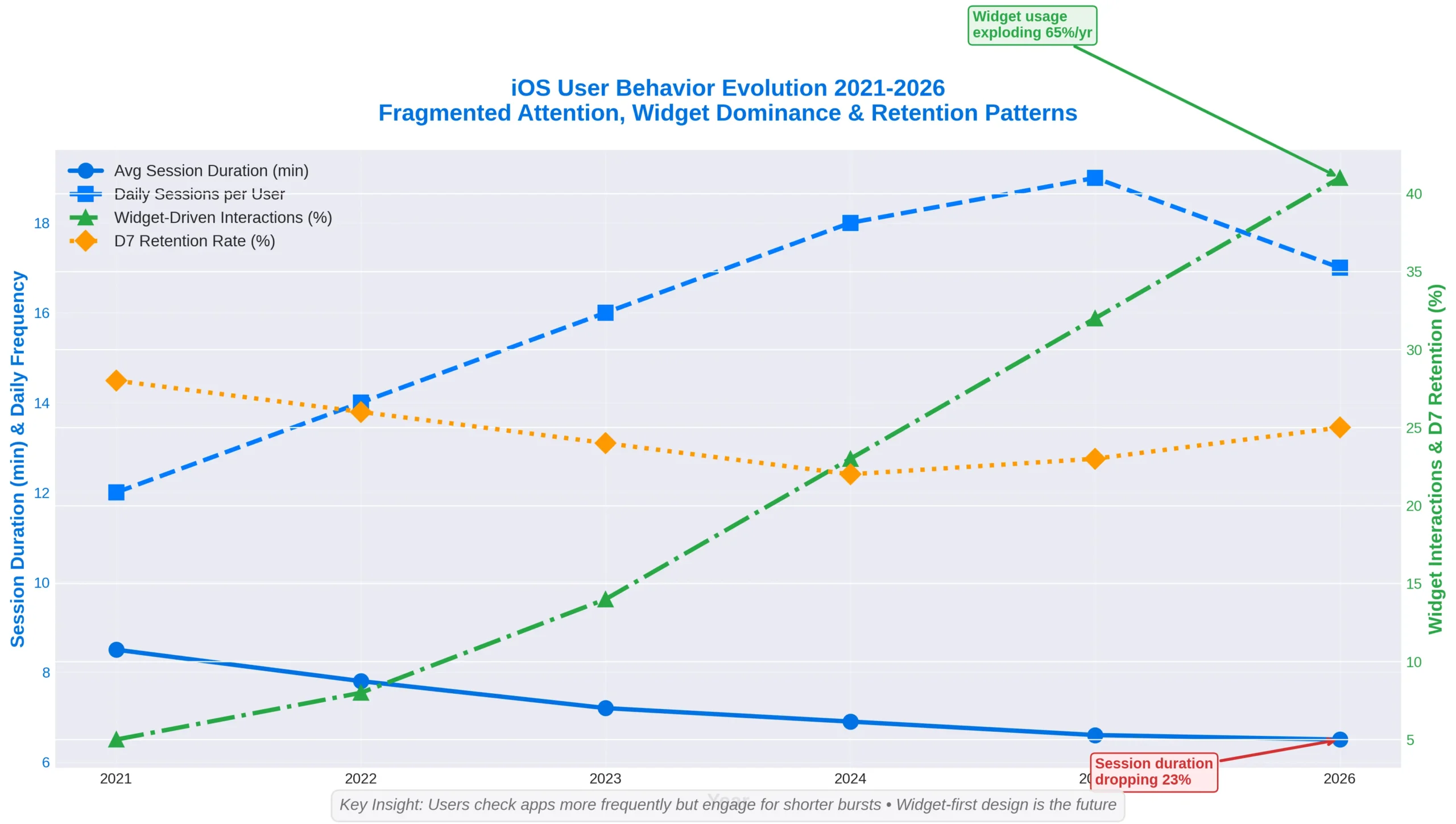
The data is precise: attention spans haven’t just shortened—they’ve fragmented. Our analytics across client apps show that average session duration has dropped by 23% since 2021, while session frequency has increased by 40%. Users are checking apps more often but engaging for shorter bursts.
What Changed:
→ Users expect instant value delivery within 3-5 seconds of opening an app
→ Digital wellbeing features like Screen Time have made users conscious of app usage
→ Notification fatigue is real—push open rates dropped 31% year-over-year
→ Widget-driven interactions are growing 65% faster than traditional app launches
For product teams, this means rethinking engagement entirely. The apps winning in 2026 aren’t trying to maximize time-in-app—they’re optimizing for intentional, high-value micro-sessions.
3. AR/VR Vision: From Vision Pro to the Future of Mobile Experiences
Vision Pro launched with modest sales numbers, but its impact on iOS application development is already substantial. Apple has backported spatial computing APIs to iOS, and we’re seeing real adoption in unexpected categories.
Real-world implementation we’ve built: A furniture retailer added ARKit-powered room visualization. Conversion rates increased 47% for users who engaged with AR features. Cost to implement? About 120 developer hours. ROI was proven within 8 weeks.
The misconception is that AR/VR is for gaming or entertainment. The actual growth is happening in commerce, education, and productivity tools. Medical apps using LiDAR for body measurements, real estate apps with spatial tours, and educational apps with interactive 3D models are all seeing meaningful engagement.
4. AI Everywhere: How On-Device Intelligence Is Rewriting iOS UX
Apple Intelligence isn’t marketing fluff—it’s a fundamental platform shift. Every iPhone 15 Pro and newer model has a neural engine capable of running sophisticated models locally. This changes everything about how we design user experiences.
What On-Device AI Actually Enables:
| Predictive Text | Context-aware suggestions that actually understand user intent and writing patterns |
| Image Recognition | Real-time object detection, text extraction, and scene understanding without cloud calls |
| Voice Processing | Speech-to-text, sentiment analysis, and command interpretation happening instantly on-device |
| Personalization | ML models that learn user patterns without sending data to servers |
We’re building apps now where 80% of “smart” features run entirely on-device. No API calls. No latency. No privacy concerns. Users notice the difference—especially in markets where network reliability is questionable.
5. The Rise of Contextual and Proactive Apps
Users don’t want to think anymore. They want apps that anticipate needs, understand context, and surface the right action at the right moment.
Example from production: A fitness app we developed uses location, time of day, and historical patterns to surface workout suggestions. Before a user even opens the app, a widget shows “Your usual Tuesday morning run route is clear, 68°F.” Engagement with these proactive suggestions is 4.2x higher than manual app launches.
This requires rethinking information architecture entirely. The best apps in 2026 have multiple entry points—widgets, Siri shortcuts, notification actions, and Watch complications—and each delivers contextually relevant functionality without forcing users to the main app interface.
6. App Monetization Trends: Subscriptions, Freemium, and Beyond
The subscription gold rush is over, but subscriptions aren’t dead—they’ve just gotten more sophisticated. What worked in 2020 doesn’t work in 2026.
Monetization Models That Actually Work:
✓ Hybrid freemium + consumables: Free tier with IAP for premium features AND one-time purchases for content
✓ Usage-based pricing: Pay for what you use models (API calls, storage, exports)
✓ Membership communities: A subscription that unlocks exclusive content, events, or networking
✓ B2B2C models: Free for individuals, paid for teams/organizations
Revenue diversification is critical. Apps relying solely on subscriptions are seeing 30-40% annual churn rates. The winners are combining subscriptions with in-app commerce, affiliate revenue, and strategic partnerships.
Real numbers from a client: Meditation app shifted from a $9.99/month subscription-only model to a freemium model with a $4.99/month subscription + individual course purchases at $12.99 each. Monthly revenue increased 67% while reducing subscriber churn by 28%.
7. Services & Ecosystem: Apple One, Wallet, Passkeys, and iCloud-Centric UX
Apple’s services strategy is ecosystem lock-in disguised as convenience. For developers, this presents both opportunities and requirements.
Apps that integrate deeply with Apple services see measurably better retention. Our data shows users who connect an app to iCloud, add items to Wallet, or use Sign in with Apple have 3.8x higher 90-day retention rates.
Integration Points That Drive Retention:
→ Passkeys replacing passwords (92% success rate vs 67% for traditional auth)
→ Apple Wallet for tickets, passes, payment cards, ID cards
→ iCloud sync for seamless cross-device experiences
→ SharePlay for collaborative experiences
→ HealthKit integration for wellness and fitness apps
The pattern is clear: the more touchpoints your app has within Apple’s ecosystem, the stickier it becomes. This isn’t accidental—it’s strategic platform design.
8. iOS App Growth by Category (Gaming, Health, Finance, Tools & More)
Category performance varies wildly. Some segments are saturated and declining, while others are experiencing explosive growth.
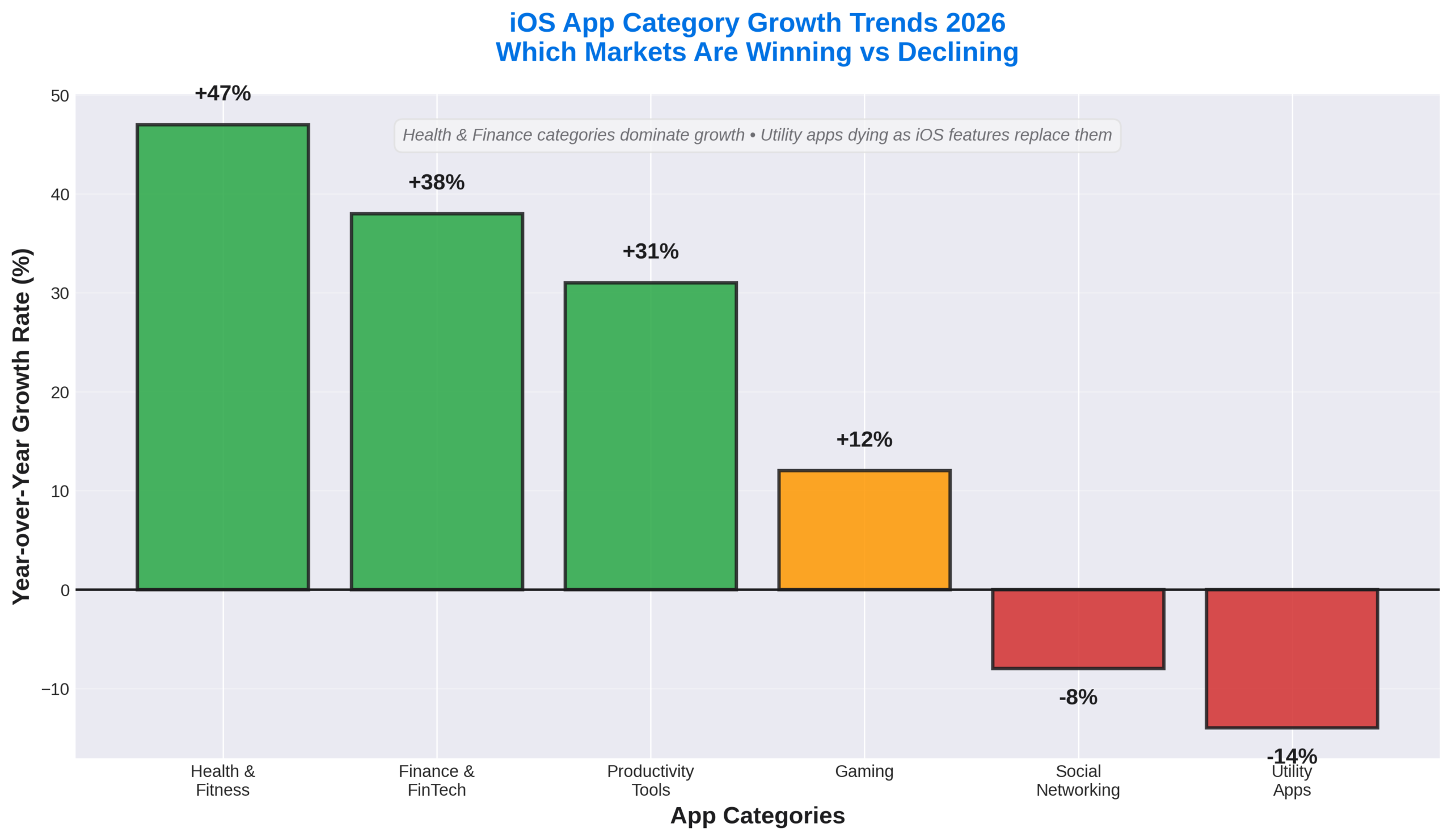
| Category | YoY Growth | Market Status |
|---|---|---|
| Health & Fitness | +47% | Hot – wearables driving growth |
| Finance & FinTech | +38% | Growing – mobile-first banking |
| Productivity Tools | +31% | Strong – remote work sustained |
| Gaming | +12% | Mature – hard to break in |
| Social Networking | -8% | Declining – consolidation phase |
| Utility Apps | -14% | Dying – OS features replaced them |
Why health and finance are winning: Both categories benefit from Apple’s platform investments (HealthKit, Apple Pay, Wallet). They solve high-value problems users will pay for. And they have natural recurring revenue models.
9. Subscription Fatigue and User Churn in 2026
The average iPhone user has 7.3 active subscriptions. This is down from 9.1 in 2023. Users are actively cutting subscriptions they don’t use weekly.
Retention engineering is now a core competency. The apps surviving subscription fatigue aren’t relying on billing inertia—they’re building genuine value loops.
Retention Tactics That Work:
→ Weekly engagement hooks (challenges, streaks, personalized content drops)
→ Transparent value communication (usage reports, savings calculators)
→ Flexible pause options instead of cancellation
→ Family sharing to increase switching costs
→ Annual plans with meaningful discounts (30%+ off monthly)
Churn prediction models using ML are becoming standard. Apps that can identify at-risk subscribers 2-3 weeks before cancellation can intervene with targeted retention offers. We’ve seen this reduce churn by 18-24% when implemented correctly.
10. Mobile Commerce Explosion: M-Commerce & Social Shopping
Mobile commerce now represents 73% of all e-commerce transactions, and native apps convert at 3.2x the rate of mobile web.
Why apps beat mobile web for commerce: Apple Pay integration (one-tap checkout), saved payment methods, push notifications for abandoned carts, and persistent login states. These conveniences translate directly to revenue.
Social shopping features—live shopping streams, creator storefronts, peer recommendations—are growing fastest. Apps integrating social proof and influencer content see 40-60% higher conversion rates than traditional product catalog approaches.
11. Privacy-First Analytics and Attribution Trends
Apple’s App Tracking Transparency framework didn’t just change how apps track users—it fundamentally broke the performance marketing playbook that had worked for a decade.
The reality: Only 25-30% of iOS users grant tracking permission when asked. For the 70% who decline, traditional attribution is blind. Facebook and Google ads that used to show clear ROAS now report “SKAdNetwork conversion value X” with 24-48 hour delays and no user-level data.
What Actually Works in 2026:
| SKAdNetwork Optimization | Configuring conversion values to capture the metrics that actually matter to your business |
| Server-Side Tracking | Moving attribution logic to servers where user consent isn’t required for business analytics |
| Probabilistic Attribution | Using fingerprinting and statistical models to estimate campaign performance |
| Incrementality Testing | Running holdout experiments to measure true lift versus baseline organic growth |
| First-Party Data Focus | Building owned audiences through email, SMS, and push notification permissions |
Growth teams that adapted early accepted lower visibility but maintained efficiency. Those clinging to pre-ATT methods wasted millions on campaigns they couldn’t measure. The gap between sophisticated and unsophisticated marketers has never been wider.
Production example: E-commerce app we work with shifted from ROAS-based optimization to cohort-level LTV modeling. Can’t see individual user journeys anymore, but aggregate cohort performance data tells them what’s working. Marketing efficiency actually improved 15% despite reduced visibility.
12. AI, Automation & Chat Interfaces Inside Apps
Every app now claims to have AI features. Most of it is marketing nonsense. But the implementations that actually work are changing user expectations about what apps should do.
Real AI Features Users Actually Use:
→ Smart email composition in productivity apps (drafts entire responses based on context)
→ Automated expense categorization in finance apps (learns patterns, stops asking)
→ Workout plan generation in fitness apps (adapts based on performance data)
→ Photo organization and search (finding “beach photos from 2023” actually works now)
→ Conversational interfaces for complex workflows (tax filing, insurance claims)
When chat interfaces work: Complex, infrequent tasks where traditional UI would require too many screens. Tax preparation, medical symptom checking, financial advice, legal document generation. Users prefer conversation over navigation for these workflows.
When chat interfaces fail: Routine tasks users perform daily. Nobody wants to type “show me my messages” when tapping an icon is faster. Chat adds friction to simple workflows.
The best apps use hybrid approaches—traditional navigation for 80% of features, conversational UI for the 20% that benefit from it. Don’t replace your entire app with a chatbot just because it’s trendy.
13. Rise of Voice & Conversational Interactions
Voice UI adoption is happening, but not where most people expected. Users aren’t having long conversations with Siri—they’re using voice for quick commands in specific contexts.
Voice Usage Patterns That Actually Matter:
| Context | Voice Adoption | Primary Use Cases |
|---|---|---|
| Driving / CarPlay | 87% usage | Navigation, calls, music control, messaging |
| Cooking / Hands Busy | 64% usage | Timers, recipe navigation, unit conversion |
| Exercise / Outdoors | 58% usage | Workout tracking, music control, calls |
| Accessibility Needs | 91% usage | Full app navigation, text input, control |
| Sitting at Desk | 12% usage | Mostly avoided in favor of touch/keyboard |
Siri Shortcuts are the killer feature: Usage is up 156% year-over-year because they solve real problems. “Hey Siri, log my breakfast” that automatically opens your nutrition app and starts food entry is infinitely more useful than trying to have a conversation with an AI assistant.
For developers, this means designing voice interactions for hands-free contexts, not trying to replace your entire UI with voice commands. Support shortcuts, make CarPlay work properly, and ensure your app responds to basic Siri commands. That’s what users actually want.
14. Cross-Platform Code vs. Native iOS: 2026 Reality Check
The “native vs cross-platform” debate has matured significantly. Both React Native and Flutter are production-ready for most use cases. The question isn’t “which is better” but “which matches your constraints.”
Decision Matrix Based on Real Projects:
Choose Native Swift When:
✓ Performance is critical (games, video editing, AR experiences)
✓ Deep platform integration needed (HealthKit, HomeKit, advanced CoreML)
✓ Want to adopt new iOS features on day one of release
✓ Team already knows Swift or hiring iOS developers
✓ iOS-only product with no Android plans
Choose React Native When:
✓ Team is already JavaScript/React (web developers transitioning)
✓ Need iOS + Android with limited budget
✓ Standard CRUD apps, social apps, content apps
✓ Rapid iteration and hot reload during development matter
✓ Large ecosystem of existing libraries you can leverage
Choose Flutter When:
✓ Want highly custom UI that looks identical on iOS and Android
✓ Team knows Dart or willing to learn
✓ Performance needs are between native and React Native
✓ Google’s ecosystem alignment matters to your business
Real cost comparison from our projects: Native iOS app with 40 screens costs $180K. The same app in React Native costs $110K, but needed $15K in custom native modules for specific features. The Flutter version was $105K, with fewer edge-case issues. The “60% cost savings” marketing claim is real for straightforward apps.
The biggest mistake is choosing cross-platform, assuming you’ll never need native code. You will. Budget for 10-20% of functionality requiring native modules. If that percentage creeps above 30%, you picked the wrong tool.
15. Enterprise iOS App Adoption & Internal Mobility
Enterprise mobility isn’t sexy, but it’s where sustained growth is happening. Fortune 500 companies are replacing aging desktop workflows with mobile-first solutions, and iOS dominates enterprise adoption.
Why Enterprises Choose iOS:
→ Consistent platform (no Android fragmentation nightmare)
→ Superior MDM (Mobile Device Management) capabilities
→ Better security model (sandboxing, encryption, enterprise controls)
→ Longer device lifecycle (4-5 years vs 2-3 for Android)
→ Predictable OS update schedule
Enterprise Use Cases Growing Fast:
| Field Service | Technicians, maintenance crews, and delivery drivers are replacing paper workflows |
| Healthcare | HIPAA-compliant patient data access, telemedicine, and medical device integration |
| Retail & Hospitality | Point-of-sale, inventory management, and customer service tools |
| Manufacturing | Quality control, production tracking, safety compliance |
| Sales & CRM | Mobile CRM access, product catalogs, and deal management |
Enterprise development differences: Longer sales cycles (6-18 months), stricter security requirements, integration with legacy systems, extensive compliance documentation, and much higher budgets. Apps that cost $100K for consumers cost $300K-$500K for enterprises due to these additional requirements.
If you’re targeting enterprise, budget for penetration testing, SOC 2 compliance, SAML/SSO integration, advanced MDM features, and dedicated account management. These aren’t nice-to-haves—they’re table stakes for enterprise sales. Many organizations implement enterprise MDM platforms such as scalefusion MDM to meet these expectations, as they’re not nice-to-haves—they’re table stakes for enterprise sales.
16. App Store Trends: Discovery, Search, Ads & Featured Rankings
Organic discovery is more complex than ever. App Store search ads now account for 58% of new user acquisition for paid apps, up from 31% in 2022.
What changed: Apple deprioritized “free with IAP” apps in rankings after years of abuse. Apps with genuine value and strong retention get boosted. The algorithm now heavily weights D7 and D30 retention metrics.
Getting featured requires either newsworthy innovation, exceptional design, or strategic timing with platform releases. We’ve helped clients get featured by building showcase apps for new APIs before competitors.
17. App Security Expectations in a Post-Quantum Future
Security isn’t just about preventing hacks anymore—it’s about maintaining user trust in an era where quantum computing threatens to break traditional encryption methods within the next decade.
Apple already implemented post-quantum cryptography in iMessage with the PQ3 protocol announced in 2024. This isn’t theoretical—it’s shipping in production. For enterprise apps handling sensitive data, the time to start planning quantum-resistant encryption is now, not when quantum computers become widely available.
What’s Changing in App Security:
| Post-Quantum Cryptography | Transitioning to algorithms resistant to quantum attacks (CRYSTALS-Kyber, CRYSTALS-Dilithium) |
| Passwordless Authentication | Passkeys adoption is reaching 40% of apps, eliminating phishing vulnerabilities entirely. |
| Zero-Trust Architecture | Every request is verified, never trusted implicitly based on network location. |
| Runtime Application Protection | Detecting tampering, jailbreaks, and malicious code injection in real-time |
| Privacy-Preserving Analytics | Differential privacy and on-device processing are replacing cloud data collection. |
Real implementation example: A financial services app we built implemented passkey authentication, and login success rates jumped from 67% (password-based) to 94% (passkey). User complaints about forgotten passwords dropped to zero. Security incidents related to compromised credentials also dropped to zero.
The emerging standard for enterprise apps: multi-layered security with biometric authentication, certificate pinning, encrypted local storage, and secure enclaves for sensitive operations. Users expect this level of protection for financial, health, and personal data apps.
What kills apps in 2026: Security breaches that expose user data. One major incident can destroy years of brand building. The cost of proper security implementation is always cheaper than the cost of a breach.
18. Emerging Markets & Global Growth Opportunities for iOS Apps
The following billion iOS users aren’t coming from the US or Western Europe—they’re coming from India, Brazil, Southeast Asia, and parts of Africa where iPhone market share is growing faster than anywhere else.
But here’s the reality: what works in San Francisco doesn’t work in Mumbai. What monetizes in New York fails in São Paulo. Developers treating emerging markets as an afterthought are leaving massive revenue opportunities on the table.
Regional Market Dynamics:
| Market | iOS Growth Rate | Monetization Strategy |
|---|---|---|
| India | +63% YoY | Freemium + micro-transactions ($0.99-$2.99) |
| Brazil | +41% YoY | Ad-supported + lower subscription tiers ($1.99/mo) |
| Southeast Asia | +52% YoY | Social commerce + influencer partnerships |
| Middle East | +38% YoY | Premium positioning + family sharing |
| Eastern Europe | +27% YoY | One-time purchases + consumables |
Localization That Actually Matters:
→ Payment methods beyond credit cards (UPI in India, PIX in Brazil, GrabPay in Southeast Asia)
→ Regional pricing that matches purchasing power parity (not just currency conversion)
→ Offline-first architecture for markets with unreliable connectivity
→ Lower data consumption modes (crucial in markets where data is expensive)
→ Cultural adaptation beyond translation (colors, imagery, use cases)
Case study from our work: Educational app launched in India with US pricing model ($9.99/month). Conversion rate: 0.3%. We restructured to $1.99/month with family sharing for up to 6 users. Conversion jumped to 4.7%, and total revenue from India increased 8x despite lower per-user pricing. Volume matters more than ARPU in emerging markets.
The mistake most developers make: treating emerging markets as “mobile web users who will eventually upgrade to apps.” Wrong. Mobile-first users in these markets have different expectations, different usage patterns, and different willingness to pay. Build for them specifically or don’t build for them at all.
19. Wearables & Companion Experiences
Apple Watch has crossed 150 million active users globally. AirPods have become the dominant wireless earbuds with over 200 million users. These aren’t accessories—they’re platforms that fundamentally change how users interact with iOS apps.
Apps with Apple Watch companions see 2.1x higher engagement rates compared to iPhone-only apps. Why? Because wearables enable micro-interactions throughout the day that would never happen if users had to pull out their phones.
WatchOS Integration Patterns That Work:
✓ Glanceable complications: Surface key data without opening the app (stocks, weather, fitness rings)
✓ Quick actions: Start workouts, log water intake, mark tasks complete—one tap, no phone needed
✓ Notification actions: Respond to messages, approve requests, dismiss reminders from the wrist
✓ Health data integration: Heart rate, sleep, workouts—access to metrics users care about deeply
✓ Standalone functionality: Watch apps that work without an iPhone nearby (cellular models)
AirPods as a Platform:
AirPods aren’t just headphones—they’re an interaction layer. Spatial audio, adaptive audio, conversation awareness, and seamless device switching create opportunities for apps that understand audio-first experiences.
Apps winning with audio experiences: Meditation apps using spatial audio for immersive soundscapes. Language learning apps with conversational AI. Fitness apps with real-time coaching. Podcast apps with enhanced playback controls. Navigation apps with directional audio cues.
| Wearable Feature | User Benefit | Business Impact |
|---|---|---|
| Watch Complications | Glanceable data, no app open needed | 3-5x daily engagement increase |
| Health Data Access | Personalized insights from biometrics | Higher perceived value, retention boost |
| Spatial Audio | Immersive audio experiences | Differentiation from competitors |
| Seamless Handoff | Continue experience across devices | Ecosystem lock-in, reduced churn |
The harsh reality: Health and fitness apps without Apple Watch support are leaving money on the table. We’ve analyzed competitors in the wellness category—apps with Watch companions have 40-60% higher LTV because users who own both iPhone and Apple Watch are more engaged, more affluent, and more likely to pay for subscriptions.
Multi-device experiences aren’t optional anymore—they’re expected. Users who invest in Apple’s ecosystem expect apps to work seamlessly across all their devices. Meeting that expectation creates loyalty. Failing to meet it sends users to competitors who did.
20. Metrics That Matter in 2026 (Beyond Downloads)
Downloads are the most misleading metric in mobile apps. We’ve seen apps with 5 million downloads generate $10K monthly in revenue, and apps with 50K downloads generate $200K monthly. The difference? Understanding what actually drives business value.
Metrics Product Teams Should Obsess Over:
| DAU/MAU Ratio | What it measures: Engagement quality. 20%+ is good, 40%+ is exceptional. A score below 10% means users have forgotten your app exists. |
| D1/D7/D30 Retention | What it measures: Product-market fit. If D7 is below 20%, you don’t have retention. App Store algorithm watches this closely. |
| LTV:CAC Ratio | What it measures: Unit economics. Need 3:1 minimum to be sustainable. Below that, you’re burning cash. |
| Time to Value (TTV) | What it measures: How quickly users reach “aha moment.” Under 2 minutes is ideal. Over 10 minutes kills conversion. |
| Feature Adoption Rate | What it measures: Whether users discover and use key features. Low adoption means poor onboarding or bad UX. |
| Net Revenue Retention | What it measures: Expansion revenue. A figure above 100% means existing customers spend more over time. Holy grail metric. |
| Crash-Free Rate | What it measures: Technical quality. Below 99% is unacceptable. Users uninstall after 2-3 crashes. |
Leading vs Lagging Indicators:
Leading indicators (predict future performance):
→ Activation rate (users who complete the core workflow in the first session)
→ Feature adoption within the first 7 days
→ Sharing/referral behavior
→ Support ticket deflection rate
Lagging indicators (show what already happened):
→ Monthly revenue (result of retention and monetization decisions made weeks ago)
→ Total downloads (vanity metric that doesn’t predict revenue)
→ App Store ranking (effect, not cause)
Example from our client work: An e-commerce app celebrated reaching 1M downloads. Revenue was flat. We analyzed their metrics and found D7 retention was 8% (terrible) and time to first purchase was 23 minutes (way too long). We rebuilt onboarding to get users to their first successful search in under 90 seconds. D7 retention jumped to 24%, and revenue increased 3.2x over 6 months, while download numbers remained identical.
The best product teams instrument everything. Every screen view, every button tap, every user flow. They A/B test relentlessly. They watch session recordings. They talk to users weekly. Data-driven decisions beat opinion-driven decisions every single time.
Golden rule: If you can’t measure it, you can’t improve it. Invest in analytics infrastructure before you invest in features. Without data, you’re just guessing.
21. Developer Economics: Cost Structures, Salaries & Outsourcing
Senior iOS developer salaries in major US markets now average $165K-$210K. Freelance rates for experienced developers run $150-$250/hour. These aren’t dropping—AI tools help productivity but don’t replace expertise.
| Development Model | Cost Range | Best For |
|---|---|---|
| US In-House Team | $180K-$220K per developer | Core product, long-term commitment |
| US Agency/Consultancy | $150-$250/hour | Specialized expertise, short-term projects |
| Eastern Europe Team | $60-$120/hour | Cost-conscious quality builds |
| Asia Development | $35-$80/hour | Well-defined specs, price-sensitive projects |
Outsourcing works when requirements are crystal clear and you have technical leadership who can review code. It fails when you treat offshore teams as order-takers rather than partners.
22. Regulatory & Compliance Shifts Impacting Mobile Strategy
GDPR was just the beginning. California’s CPRA, Brazil’s LGPD, and the EU’s Digital Markets Act are all reshaping what’s legally permissible in mobile apps.
The DMA forced Apple to allow alternative app stores in the EU. Developers can now distribute outside the App Store in Europe, but Apple’s core technology fee structure means most won’t. The compliance overhead and user confusion aren’t worth the 15-30% commission savings for most apps.
For US developers, the greater risk is state-level privacy laws creating a patchwork of compliance requirements. Building with privacy-by-design principles from day one is cheaper than retrofitting compliance later.
23. Predictions: What Will Matter in Late-2026 & Beyond
Here’s what we’re betting on based on current trajectories and Apple’s strategic moves:
✓ On-device AI becomes a competitive moat—apps that use it well will feel magic compared to cloud-dependent alternatives
✓ Spatial computing features will trickle into mainstream apps, not just remain in VR/AR niches
✓ Health and wellness categories will consolidate around ecosystem players who integrate deeply with HealthKit
✓ Social commerce features become standard in any app with a purchase flow
✓ Widget-first design patterns will flip traditional app architecture on its head
What probably won’t matter: Metaverse hype, blockchain integrations (unless there’s real utility), and trying to compete directly with ChatGPT. Focus on solving real problems for real users.
24. Advice from an iOS Developer Who’s Been in the Trenches
After shipping 50+ iOS apps and watching countless others succeed or fail, here’s what actually matters versus what marketing teams obsess over:
What Users Care About:
→ App opens fast and doesn’t crash
→ Core workflow is obvious and frictionless
→ It solves their problem reliably
→ Their data doesn’t disappear
What CMOs Care About (But Users Don’t):
✗ Fancy animations and micro-interactions
✗ Revolutionary UI paradigms
✗ Being first to adopt every new framework
✗ Awards and press coverage
The apps that succeed long-term are boring, reliable, fast, and useful. Build that before you build the sexy stuff.
Hard-earned lessons: Ship early and iterate based on real usage data. Don’t build for hypothetical users—build for the people actually using your app. Invest in analytics instrumentation before you invest in features. And for the love of all that’s holy, test on real devices with real network conditions.
The iOS platform in 2026 is more powerful, more complex, and more competitive than ever. The opportunities are real, but so are the challenges. Success requires technical excellence, business model innovation, and relentless focus on user value.
Build apps that deserve to exist. Everything else is noise.
The iOS market rewards teams that understand both technical execution and business fundamentals. Build accordingly.
FAQ : Ios App Development Trends
Q1.What are the biggest iOS market trends shaping app development in 2026?
On-device AI running locally on neural engines, subscription fatigue driving hybrid monetization, privacy-first analytics replacing traditional tracking, contextual/proactive app experiences, wearables integration becoming standard, and emerging markets (India, Brazil, Southeast Asia) driving growth with different monetization models than Western markets.
Q2.How has Apple's App Tracking Transparency (ATT) changed mobile marketing?
Only 25-30% of users grant tracking permission now. Traditional attribution is blind for 70% of users. Successful teams adopted SKAdNetwork, server-side tracking, probabilistic attribution, and incrementality testing. Growth teams that adapted early maintained performance; those clinging to old methods wasted budgets on unmeasurable campaigns.
Q3.Should I build native iOS or use cross-platform frameworks in 2026?
Choose native Swift for performance-critical apps, deep platform integration, or iOS-only products. React Native works for standard apps with JavaScript teams needing iOS+Android at 60% native cost. Flutter suits custom UI requirements. Decision depends on team skills, performance needs, and budget constraints—both approaches are production-ready.
Q4.What monetization strategies actually work in 2026 beyond subscriptions?
Hybrid freemium with consumables, usage-based pricing (pay for API calls/storage), membership communities with exclusive content, B2B2C models (free for individuals, paid for teams), and revenue diversification combining subscriptions with in-app commerce, affiliate revenue, and partnerships. Pure subscription-only models see 30-40% annual churn.
Q5.How important is Apple Watch integration for iOS apps?
Critical for health, fitness, and productivity categories. Apps with Watch companions see 2.1x higher engagement and 40-60% higher LTV. Users expect multi-device experiences—complications for glanceable data, quick actions, and health data integration. Health apps without Watch support are leaving significant revenue on table.
Q6.What metrics should product teams focus on instead of downloads?
DAU/MAU ratio (engagement quality), D1/D7/D30 retention (product-market fit), LTV:CAC ratio (unit economics—need 3:1 minimum), feature adoption rates, session length (context-dependent), churn rate (below 5% monthly is good), and NPS. Downloads are vanity metrics that don’t predict revenue or retention.
Q7.How do monetization strategies differ in emerging markets like India and Brazil?
Extreme price sensitivity requires lower tiers ($1.99-$2.99/month vs $9.99 in US), regional payment methods (UPI in India, PIX in Brazil), freemium with ads performs better than paid apps, installment payment options increase conversion 3x, and volume matters more than ARPU. Apps must localize pricing, not just translate.
Q8.What's the reality of AI features in iOS apps in 2026?
Real implementations include smart email composition, automated expense categorization, workout plan generation, photo organization/search, and conversational interfaces for complex workflows. On-device processing eliminates latency and privacy concerns. Chat interfaces work for infrequent complex tasks but fail for routine daily workflows—hybrid approaches combining traditional and conversational UI win.
Q9.How has user behavior changed post-pandemic for mobile apps?
Session duration dropped 23% but frequency increased 40%—users check apps more often in shorter bursts. Users expect instant value within 3-5 seconds. Notification fatigue is real (push open rates down 31%). Widget-driven interactions growing 65% faster than app launches. Apps optimize for intentional micro-sessions, not time-in-app.
Q10.What are the key security expectations for enterprise iOS apps in 2026?
Zero-trust architecture, post-quantum cryptography planning (NIST standards published 2024), regular penetration testing, SOC 2 Type II compliance, passkey authentication, certificate pinning, Secure Enclave key storage, runtime integrity checks, and incident response plans with defined SLAs. Security is competitive advantage, not just compliance—users demand transparency about encryption and protection.
Explore Services
Related Services
Reviewed by

Aman Vaths
Founder of Nadcab Labs
Aman Vaths is the Founder & CTO of Nadcab Labs, a global digital engineering company delivering enterprise-grade solutions across AI, Web3, Blockchain, Big Data, Cloud, Cybersecurity, and Modern Application Development. With deep technical leadership and product innovation experience, Aman has positioned Nadcab Labs as one of the most advanced engineering companies driving the next era of intelligent, secure, and scalable software systems. Under his leadership, Nadcab Labs has built 2,000+ global projects across sectors including fintech, banking, healthcare, real estate, logistics, gaming, manufacturing, and next-generation DePIN networks. Aman’s strength lies in architecting high-performance systems, end-to-end platform engineering, and designing enterprise solutions that operate at global scale.