Ai Overview
The decision to begin investing in Web3 in 2026 is supported by a maturing ecosystem that has moved far beyond the speculative excesses of earlier cycles. The tokenized real-world asset market has grown from negligible to significant in a short period, with on-chain representations of US Treasury bonds alone exceeding $1 billion in market value, demonstrating genuine institutional demand for blockchain-based financial products.
Key Takeaways
- Investing in Web3 in 2026 requires understanding the distinct asset classes available: cryptocurrencies, DeFi positions, NFTs, and early-stage startup equity each carry different risk and return profiles.
- Web3 investment for beginners should start with blue-chip Layer 1 tokens like ETH and BTC, which provide foundational exposure before venturing into higher-risk altcoins and DeFi protocols.
- A hardware wallet is non-negotiable for any Web3 investor holding assets above their risk threshold; exchange hacks have cost investors billions in losses that proper self-custody would have prevented.
- Web3 coins investment requires thorough due diligence covering tokenomics, team credentials, protocol audits, on-chain metrics, and market capitalization relative to comparable protocols.
- DeFi platforms offer yield-generating Web3 investment opportunities through liquidity provision and staking, but smart contract risk and impermanent loss must be quantitatively understood before deploying capital.
- The Web3 investment roadmap for 2026 is shaped by three macro themes: institutional adoption of tokenized real-world assets, AI-blockchain convergence, and regulatory clarity in the USA, UK, and UAE markets.
- Portfolio diversification across multiple Web3 asset categories, blockchains, and investment time horizons is the single most important risk management practice for sustainable Web3 wealth building.
- Web3 startup investment through token sales, SAFTs, and equity rounds offers the highest potential returns but also the highest failure rates, requiring a venture-style portfolio approach with many small positions.
- Tax treatment of Web3 crypto investment income is highly jurisdiction-specific and increasingly enforced; investors in the USA, UK, UAE, and Canada must understand their local reporting requirements before investing.
- On-chain analytics tools including Nansen, Dune Analytics, and Glassnode provide data-driven insights into protocol health and whale wallet behavior that should inform every significant Web3 investment decision.
Understanding Web3 and Its Investment Potential
The decision to begin investing in Web3 in 2026 is supported by a maturing ecosystem that has moved far beyond the speculative excesses of earlier cycles. Today’s Web3 landscape includes institutional-grade infrastructure, regulated financial products, and an expanding range of Web3 development services that provide the technical foundation investors evaluate when assessing protocol quality. Unlike traditional internet investments where value accrues primarily to platform operators, Web3 investment positions investors as direct economic participants in the protocols they support, capturing value through token appreciation, yield generation, and governance rights that traditional equity does not offer. After eight years of advising clients across the USA, UK, UAE, and Canada on blockchain investment strategy, we have witnessed the evolution of Web3 from an experimental technology to a legitimate alternative asset class that sophisticated institutional portfolios now allocate to deliberately and systematically.
What Makes Web3 Different from Traditional Internet Models?
Web3 represents a fundamental restructuring of how value is created, captured, and distributed on the internet, and this structural difference is what makes investing in Web3 economically distinct from investing in traditional technology companies. In the Web2 model, companies like Google, Meta, and Amazon build platforms that aggregate user data and attention, then monetize that aggregation through advertising and services, with all value accruing to shareholders who own equity in the operating company. In the Web3 model, protocols replace companies as the value-generating layer: decentralized finance protocols process billions in daily trading volume, NFT marketplaces facilitate creator economies, and blockchain networks secure trillions in digital assets, with value distributed to token holders rather than concentrated in corporate equity. This architectural inversion creates investment opportunities that do not exist in traditional technology markets: retail investors can acquire meaningful economic stakes in protocols at early stages, earn yield from their holdings through staking and liquidity provision, and participate in governance decisions that would otherwise require board-level corporate positions. The Web3 investment landscape in 2026 reflects this maturity, with established protocols generating real revenue, token economies with proven sustainability metrics, and an expanding universe of institutional products providing exposure through regulated frameworks.
Key Components of the Web3 Ecosystem
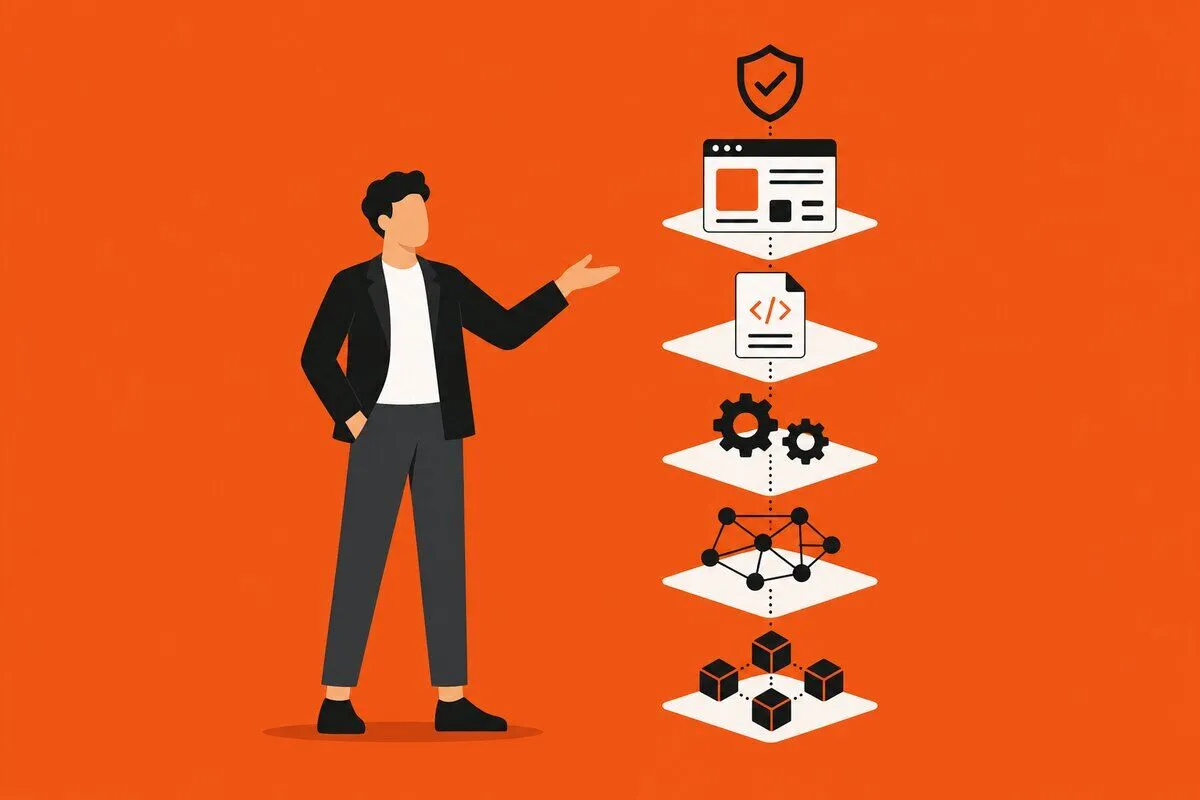
The Web3 ecosystem comprises several interconnected layers, each representing distinct investment opportunities with different risk and return characteristics. The infrastructure layer includes Layer 1 blockchains (Ethereum, Solana, Avalanche) that serve as foundational settlement networks, and Layer 2 scaling solutions (Arbitrum, Optimism, Base) that provide high-throughput transaction processing at lower cost. The protocol layer includes DeFi applications (Uniswap, Aave, Compound), NFT marketplaces (OpenSea, Blur), and Web3 communication platforms built on these infrastructure chains. The application layer includes consumer-facing products built on protocols, including gaming dApps, social media platforms, and enterprise tools. The tooling and infrastructure services layer includes node providers, oracle networks like Chainlink, data indexers like The Graph, and identity systems. Understanding which layer a project occupies is essential for web3 investment analysis, as different layers have different competitive dynamics, token value capture mechanisms, and exposure to the broader ecosystem’s growth. Infrastructure layer tokens tend to be more stable and broadly correlated with total crypto market growth, while protocol and application layer tokens offer higher potential returns and higher volatility tied to specific protocol adoption metrics.
Why Web3 is Attracting Investors in 2026?
Several converging developments in 2026 are driving renewed and deepening institutional and retail interest in web3 investment. The approval and success of spot Bitcoin and Ethereum ETFs in the USA has opened regulated investment channels for institutional allocators who were previously restricted from direct crypto exposure, bringing hundreds of billions in new capital from pension funds, endowments, and wealth management platforms. Regulatory clarity has advanced significantly in both the UK under the Financial Services and Markets Act framework and in the UAE where ADGM and DIFC financial free zones have established comprehensive digital asset regulatory frameworks. The tokenization of real-world assets including US Treasury bonds, private equity funds, and real estate on public blockchains has created entirely new investment categories that bridge traditional finance and Web3, with BlackRock, Fidelity, and Franklin Templeton all operating significant on-chain product offerings. These institutional developments have profoundly changed the risk profile of investing in Web3 compared to earlier cycles, as the presence of regulated products, established custody solutions, and institutional market makers provides liquidity and price discovery mechanisms that did not exist during previous market cycles.
Why Consider Investing in Web3 in 2026?
The 2026 Web3 investment landscape offers a set of opportunities that are qualitatively different from those available in previous cycles. The combination of technological maturation, regulatory progress, and institutional adoption has created entry points across multiple asset categories with improved risk-adjusted return profiles compared to the speculative environment of 2021 and 2022.
Growth Trends and Market Opportunities
The Web3 market in 2026 is characterized by several measurable growth trends that provide an evidential basis for investment thesis construction rather than pure speculation. Total value locked in DeFi protocols has recovered and surpassed previous cycle peaks as institutional participants have entered yield-generating positions, with protocols offering competitive yields relative to traditional fixed income at current interest rate levels. NFT market volume has shifted from speculative profile picture collections toward utility-bearing digital assets including gaming items, event tickets, and identity credentials, creating a more sustainable market structure. The tokenized real-world asset market has grown from negligible to significant in a short period, with on-chain representations of US Treasury bonds alone exceeding $1 billion in market value, demonstrating genuine institutional demand for blockchain-based financial products. Layer 2 transaction volumes have grown substantially, reducing Ethereum mainnet gas costs and making Web3 applications economically viable for a much broader user base than was previously accessible. These data points provide concrete evidence of ecosystem growth that disciplined web3 investment analysis can use to identify protocols positioned to capture value from these trends.
Role of Decentralization in Wealth Creation
Decentralization creates wealth creation mechanisms that are structurally unavailable in traditional investment markets, and understanding these mechanisms is fundamental to constructing a compelling web3 investment thesis. Protocol ownership through tokens provides economic exposure to protocol fee revenue, with many established DeFi protocols generating millions in daily fees that flow to token stakers and liquidity providers. Governance rights from token ownership enable investors to vote on protocol parameter changes including fee rates, supported collateral types, and treasury allocations, giving token holders meaningful influence over the protocol’s economic direction. The composability of Web3 protocols enables yield stacking strategies where a single capital position generates returns from multiple sources simultaneously: a staked ETH position generates ETH staking rewards while also serving as collateral for a stablecoin loan that is deployed to a DeFi yield protocol, generating compounding returns from a single underlying asset. These mechanisms represent genuinely novel forms of capital deployment that have no direct equivalent in traditional finance, creating opportunities for investors who understand the Web3 ecosystem to generate returns that are uncorrelated with traditional asset class performance. For high-net-worth investors in the USA and UK seeking portfolio diversification, this uncorrelated return profile is often the primary investment thesis for Web3 allocation alongside the technology growth opportunity.
Emerging Sectors Driving Web3 Adoption
Three emerging sectors are driving the next wave of Web3 adoption and creating the most compelling web3 investment opportunities in 2026. Real-world asset tokenization is the sector attracting the largest institutional capital flows, as traditional financial instruments including bonds, equities, real estate, and private credit are represented as blockchain tokens that settle instantly, trade 24/7, and can be used as collateral in DeFi protocols. The efficiency advantages of on-chain settlement over traditional T+2 settlement cycles are compelling institutional participants across the USA, UK, and UAE financial centers to actively build tokenization infrastructure. The decentralized AI sector is creating entirely new token categories where protocols that provide distributed GPU compute, AI model inference services, and decentralized training data marketplaces are attracting both venture capital and retail investment interest as the intersection of the two most transformative technology trends of the decade. Web3 gaming has recovered from its first-generation speculation and is now producing genuine play-and-earn games built on Layer 2 networks with sub-cent gas costs, creating sustainable player economies where in-game asset ownership delivers genuine value to players and investment opportunities to early ecosystem participants.
Types of Web3 Investment Opportunities
The Web3 investment universe in 2026 encompasses four major asset categories, each with distinct risk profiles, return mechanisms, and due diligence requirements. Understanding these categories enables investors to construct a diversified Web3 portfolio that balances exposure to different risk factors rather than concentrating all capital in a single asset type.
Web3 Investment Asset Categories
Layer 1 Tokens
- Bitcoin (BTC)
- Ethereum (ETH)
- Solana (SOL)
- Avalanche (AVAX)
- Lower risk, broad exposure
DeFi Protocols
- Uniswap (UNI)
- Aave (AAVE)
- Compound (COMP)
- Curve Finance (CRV)
- Yield + governance rights
NFTs & Gaming
- Blue-chip NFT collections
- Gaming assets + tokens
- RWA tokenized assets
- Event tickets + credentials
- Highest risk/return range
Cryptocurrencies and Web3 Tokens
Web3 coins investment covers the broadest and most liquid category of the Web3 investment universe, ranging from the established blue-chip assets Bitcoin and Ethereum that represent the lowest-risk entry points for new investors to highly speculative micro-cap tokens with enormous upside potential and equally enormous failure risk. Bitcoin remains the foundational Web3 investment asset for most portfolio allocations: its fixed supply schedule, decade-long track record, and now extensive institutional product coverage make it the least speculative entry point into the crypto investment space, functioning more like digital gold than a technology protocol investment. Ethereum investment provides exposure to the world’s most used smart contract platform, with ETH’s transition to proof-of-stake creating deflationary supply dynamics and staking yield that make it a fundamentally different investment proposition from its earlier proof-of-work incarnation.
Web3 tokens beyond these two foundations range from established protocol tokens with proven revenue and user metrics to speculative pre-revenue tokens representing early-stage protocols attempting to capture emerging market opportunities. The risk management discipline of starting with blue-chip allocations before adding speculative positions is the approach we recommend to all web3 investment for beginners regardless of their overall investment experience, as the unique volatility characteristics of crypto markets can be psychologically challenging for investors accustomed to traditional market behavior.
Decentralized Finance (DeFi) Platforms
DeFi platforms represent the most distinctively Web3 investment opportunity category, offering yield-generating positions that combine token price appreciation with ongoing income from protocol fees, staking rewards, and liquidity provision returns. The DeFi investment landscape in 2026 has matured significantly from its earlier Wild West phase: established protocols like Aave, Uniswap, Compound, and Curve have multi-year security track records, have processed trillions in total volume, and have survived multiple severe market conditions including the 2022 bear market without critical protocol failures. Lending protocol investments through tokens like AAVE provide governance rights over protocols that manage billions in lending markets, with fee revenue sharing mechanisms that reward long-term token holders.
Liquidity provision in decentralized exchanges generates trading fee income proportional to the trading volume of supported pools, but requires careful management of impermanent loss risk when the relative prices of paired assets diverge significantly. Yield aggregator protocols like Yearn Finance automatically optimize capital allocation across DeFi yield sources, providing institutional-grade yield optimization in a user-facing product that is accessible to retail investors. The key due diligence requirement for DeFi protocol investment is security audit verification: only protocols with multiple audits from recognized firms like Trail of Bits, OpenZeppelin, or ChainSecurity, and ideally with an active bug bounty program, should be considered for significant capital allocation.
NFTs and Digital Assets
NFT and digital asset investment in 2026 encompasses a much broader range of asset types than the profile picture collections that dominated earlier cycles. Utility-bearing NFTs including gaming item collections with active player economies, event ticket NFTs from major entertainment venues, and professional credential NFTs representing verifiable qualifications are creating new digital asset categories with genuine demand drivers beyond speculation. Real-world asset NFTs representing fractional ownership in real estate properties, fine art collections, and private equity funds are creating investment opportunities for retail investors to access asset classes that previously required institutional capital minimums. Blue-chip NFT collections from established artists and brands have demonstrated holding value for committed collectors even through severe market downturns, functioning more like collectibles than liquid securities.
The due diligence process for NFT investment requires evaluating the creator’s reputation and track record, the community’s size and engagement quality, the underlying utility or cultural significance of the work, the secondary market liquidity and trading volume history, and the royalty structure that determines creator economics and holder incentives. Investors in the UK and Canadian markets should be particularly attentive to the evolving regulatory classification of NFTs, as some jurisdictions are moving toward treating certain NFTs as financial instruments subject to investor protection regulations.
Web3 Startups and Early-Stage Projects
Web3 startup investment through token sales, Simple Agreement for Future Tokens (SAFTs), and equity rounds in blockchain companies represents the highest-risk and highest-potential-return segment of the web3 investment ecosystem. Token launch participation has evolved from the Wild West Initial Coin Offering era into a more structured market with multiple distinct sale mechanisms: private rounds for institutional investors and strategic partners, public token sale rounds through launchpad platforms like CoinList or Binance Launchpad, and fair launch mechanisms where tokens are distributed directly to users through airdrops or liquidity mining programs. Venture-stage Web3 startup investment is available to accredited investors in the USA and equivalent qualified investors in the UK and UAE through traditional VC fund structures, direct startup equity investments, and SAFT agreements that convert to tokens upon network launch.
The failure rate of early-stage Web3 projects is extremely high, with the majority of token launches from any given cycle failing to maintain value over a multi-year period. A disciplined web3 startup investment strategy requires treating this category as a venture capital portfolio rather than a concentrated bet: making many small investments across different project categories, teams, and blockchain ecosystems to ensure that the winners in the portfolio more than offset the inevitable failures.
Step-by-Step Guide to Start Investing in Web3
Setting Investment Goals and Budget
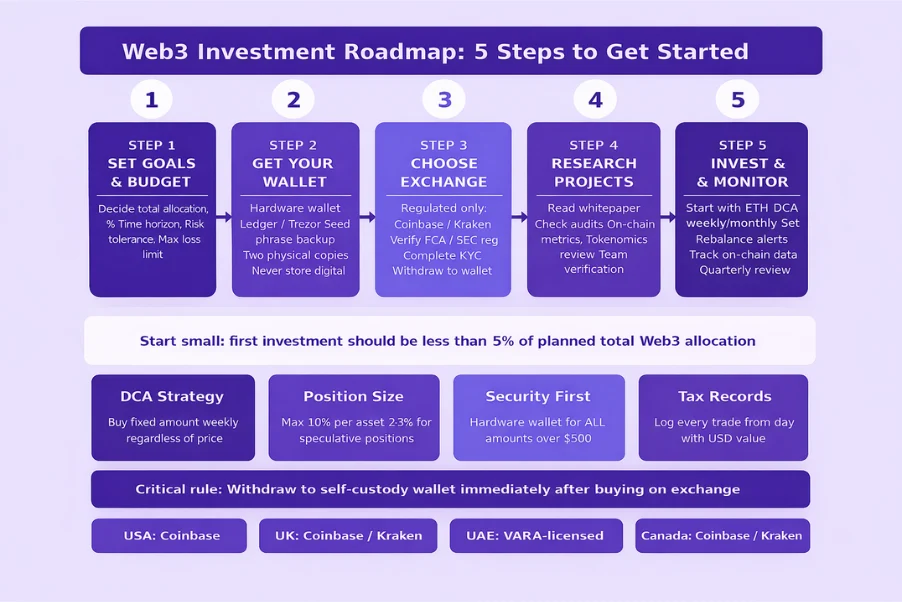
Start by deciding how much money you want to invest in Web3. Experts usually suggest investing only 5–10% of your total savings because crypto is risky. Divide this amount into parts—for example, keep more money in safer coins like Bitcoin and Ethereum, and a smaller amount in risky new projects. Plan how long you want to invest (short-term or long-term). Instead of investing all money at once, invest slowly over time (called dollar-cost averaging) to reduce risk. Also, write down your plan and stick to it.
Choosing the Right Crypto Wallet
A crypto wallet keeps your assets safe. Hardware wallets like Ledger hardware wallet and Trezor hardware wallet are the safest because they store your keys offline. Software wallets like MetaMask and Rabby Wallet are useful for daily use but should not store large amounts. For extra security, big investors use multi-signature wallets. Always back up your recovery phrase and test it before storing large funds.
Selecting Reliable Exchanges and Platforms
Choose trusted crypto exchanges to buy assets. Popular and reliable platforms include Coinbase and Kraken. Avoid keeping your money on exchanges for too long—transfer it to your wallet after buying. This helps protect your funds from risks like hacks or exchange failures, such as the FTX collapse.
Researching Web3 Projects Before Investing
Before investing, always research the project. Read its whitepaper, check how the token works, and see if the idea solves a real problem. Look at data from tools like Dune Analytics and Nansen to understand user activity and growth. Also, check if the project is secure and who is behind it. Good research helps you avoid scams and make better decisions.
Making Your First Web3 Investment
Start small to learn the process. Buy a little Ethereum, send it to your wallet, and try using a platform like Uniswap to swap tokens. This helps you understand how transactions work. Don’t rush—focus on learning first, then slowly increase your investment as you gain confidence.
Popular Platforms and Tools for Web3 Investment
The Web3 investment ecosystem is supported by a growing suite of platforms and tools that provide market access, security infrastructure, and research capabilities. Identifying and mastering the right toolset for your investment strategy significantly improves both decision quality and operational security.
Crypto Exchanges and Trading Platforms
The exchange ecosystem for Web3 investment spans centralized exchanges for fiat-to-crypto conversion and decentralized exchanges for on-chain token trading. Coinbase Pro (now Advanced Trade) provides institutional-grade trading interfaces for serious investors in the USA and UK, with deep liquidity on major pairs and direct integration with Coinbase Wallet for seamless on-chain deployment. Kraken offers competitive fees, strong security reputation, and comprehensive regulated status across multiple jurisdictions, making it a reliable choice for investors in Canada and the UAE seeking a globally recognized platform. Binance, despite its 2023 regulatory challenges in the USA market, remains the highest-liquidity platform globally for altcoin trading and provides regulated services through jurisdiction-specific entities in many markets outside the USA.
On the decentralized exchange side, Uniswap v4 on Ethereum and Arbitrum provides the deepest on-chain liquidity for ERC-20 token trading without requiring any identity verification or account creation. dYdX provides decentralized perpetual futures trading for investors seeking leveraged Web3 exposure without centralized counterparty risk. Jupiter Aggregator on Solana provides best-execution routing across Solana-based DEX liquidity sources, enabling efficient token trading within the Solana ecosystem.
Web3 Wallets and Security Tools
The security tool ecosystem for Web3 investors has expanded significantly, providing multiple layers of protection beyond the basic hardware and software wallet infrastructure. Rabby Wallet by DeBank has become a preferred browser extension wallet for DeFi power users because of its pre-transaction simulation feature that shows exactly which tokens will be transferred and which approvals will be granted before the user confirms any transaction, dramatically reducing the risk of approving malicious contracts. Revoke.cash provides a critical security maintenance tool: it displays all token approvals granted by a wallet to DeFi contracts, enabling investors to revoke unnecessary approvals from protocols they no longer use and limiting the exposure surface to smart contract vulnerabilities. Fire.xyz and Pocket Universe provide transaction simulation services that decode complex DeFi transaction data into human-readable descriptions, helping users understand what they are signing before MetaMask submits the transaction.
For institutional-scale holdings, Fireblocks and Copper provide MPC (Multi-Party Computation) wallet infrastructure that eliminates single points of failure in private key management while enabling operational efficiency through programmable transaction policies. Regular wallet security audits, including reviewing all active token approvals, confirming hardware wallet firmware is current, and verifying that seed phrase backups remain intact and accessible, should be conducted quarterly by all serious Web3 investors.
Analytics and Research Platforms
Data-driven research is what separates disciplined web3 investment from speculative gambling, and the analytics toolset available to Web3 investors in 2026 is more powerful than ever before. Dune Analytics provides a community-curated library of on-chain data dashboards covering protocol metrics, token flows, wallet behavior analysis, and market structure data for virtually every significant Web3 protocol. Token Terminal aggregates financial metrics for DeFi protocols in traditional finance-style presentation, enabling ratio analysis (Price-to-Revenue, Price-to-TVL) that allows comparison between protocols using familiar valuation frameworks. Nansen adds wallet labeling intelligence to on-chain transaction data, enabling investors to monitor the on-chain behavior of smart money wallets (institutional funds, early insiders, and successful traders) and identify positioning changes that may precede significant price moves.
Glassnode provides comprehensive Bitcoin and Ethereum on-chain analytics including network health metrics, holder behavior analysis, and derivatives market data that provide macro-level insight into market structure. DefiLlama tracks total value locked across protocols and chains in real time, enabling quick comparison of protocol scale and capital flow trends that indicate where the market is allocating capital. Coingecko and CoinMarketCap provide foundational market data including price history, volume, and market capitalization that form the starting point of any quantitative web3 investment analysis.
Risk Factors in Web3 Investing
Market Volatility and Price Fluctuations
Web3 investments are very volatile, meaning prices can go up and down quickly. It is normal for assets like Bitcoin to drop 70–80% during bad markets and then recover later. Smaller coins can fall even more and may not recover. Many investors panic and sell at a loss. To avoid this, invest only what you can afford to lose and stay patient. Investing small amounts regularly instead of all at once helps reduce risk and improves long-term results.
Smart Contract and Security Risks
Web3 projects run on smart contracts, which can have bugs or security issues. Hacks like the Wormhole hack and Ronin Network exploit caused huge losses. You cannot remove this risk completely, but you can reduce it by choosing audited projects and trusted platforms. Also, be careful of scams and phishing links. Always use secure wallets, double-check transactions, and avoid clicking unknown links. Good security habits are very important to protect your crypto funds.
Regulatory and Legal Uncertainty
Crypto rules are different in every country and keep changing. Governments like those in the USA, UK, and UAE are creating new laws to control crypto markets. For example, regulations like MiCA regulation in Europe aim to bring clarity. However, sudden rule changes can affect prices and investments. To stay safe, always follow local laws, use regulated platforms, and invest in projects that follow compliance rules. This reduces the risk of legal issues affecting your investments.
Diversification Across Web3 Assets
Do not invest all your money in one crypto asset. Instead, spread your investment across different areas like Layer 1 coins, DeFi, NFTs, and new projects. You can also invest across different blockchains like Ethereum, Solana, and Polygon. This helps reduce risk because if one asset performs badly, others may perform well. Diversification is a smart way to protect your portfolio and improve overall returns in the long run.
Long-Term vs Short-Term Investment Approaches
There are two main strategies: long-term holding and short-term trading. Long-term investing (HODLing) in assets like Ethereum usually gives better results for beginners because it avoids frequent trading risks and taxes. Short-term trading needs more knowledge, time, and discipline. Many beginners lose money trying to trade actively. A good strategy is to keep most of your money for long-term investment and use a small portion for trading and learning.
Risk Management and Portfolio Balancing
Managing risk is very important in Web3 investing. Do not invest all your money in one place. Keep some funds in stablecoins like USDC or USDT for safety and future opportunities. Regularly check your wallets and security settings. Also, keep track of taxes to avoid surprises. Writing down your investment decisions can help you learn and improve. A balanced and planned approach helps you stay safe and succeed in the long term.
Smart Strategies for Web3 Investment
Dollar-Cost Averaging: Commit to fixed-schedule purchases regardless of price, removing the impossible task of market timing from your investment process and reducing the average entry price during volatile market cycles.
Cross-Chain Diversification: Allocate across multiple blockchain ecosystems (Ethereum, Solana, Avalanche) to reduce concentration risk in any single infrastructure layer and gain exposure to different user communities.
Position Size Discipline: No single position should represent more than 10% of your total crypto portfolio, and speculative positions should be capped at 2-3% maximum, ensuring no single failure causes catastrophic portfolio damage.
Rebalancing Schedule: Quarterly portfolio rebalancing back to target allocations forces systematic profit-taking from outperformers and reinvestment into underweighted positions, maintaining your intended risk profile as markets move.
On-Chain Monitoring: Use Nansen alerts and Dune Analytics dashboards to monitor whale wallet movements and protocol health metrics that may signal important changes in your investment thesis before they appear in price.
Written Investment Policy: Document your allocation rules, position size limits, exit criteria, and rebalancing schedule before investing. Following pre-committed rules prevents emotionally-driven decisions during market extremes.
Legal and Regulatory Considerations for Web3 Investors
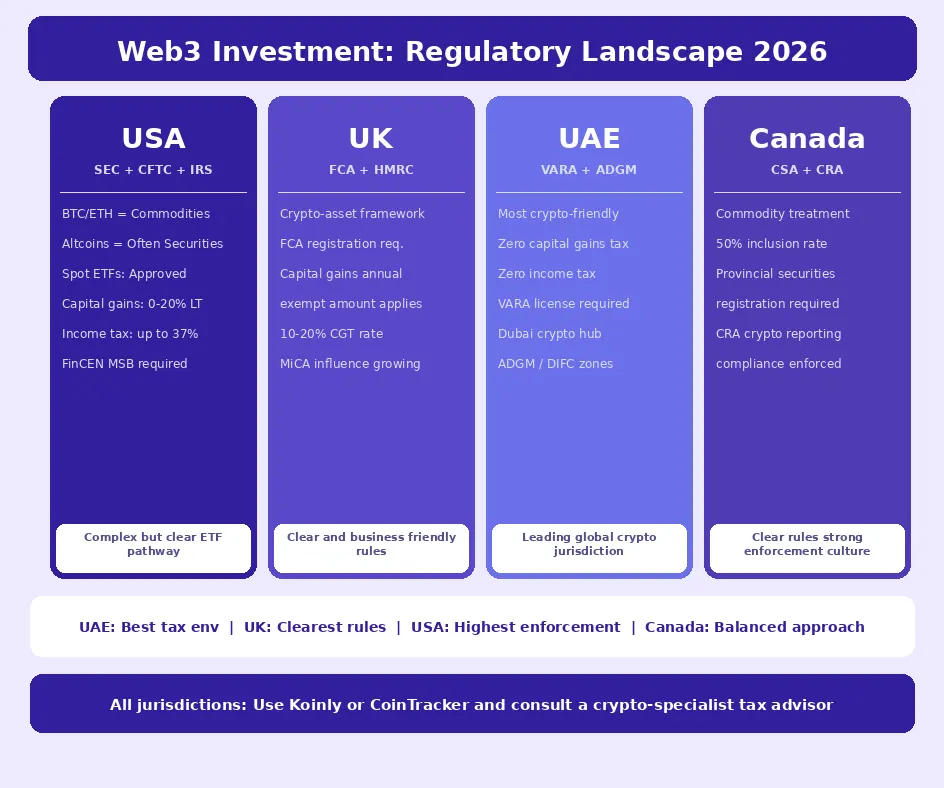
Current Crypto Regulations Across Key Markets
The regulatory environment for Web3 investment varies significantly across the major markets where investors are most active, and understanding the applicable rules in your jurisdiction is a legal obligation rather than an optional consideration. In the USA, the Securities and Exchange Commission (SEC) has taken an expansive view of which tokens qualify as securities under the Howey Test, with enforcement actions against major exchanges creating significant legal uncertainty for many DeFi and altcoin positions. The Commodity Futures Trading Commission (CFTC) asserts jurisdiction over Bitcoin and Ethereum as commodities, creating a dual regulatory framework that is still being resolved through ongoing legislation. In the UK, the Financial Conduct Authority requires registration for crypto asset service providers and has established clear AML/KYC requirements that apply to any UK-based exchange or custody service, providing a clearer operating environment than many other jurisdictions.
In the UAE, the Dubai Virtual Assets Regulatory Authority (VARA) has established a comprehensive licensing framework for virtual asset service providers operating in Dubai, positioning the emirate as a crypto-friendly jurisdiction with regulatory clarity attractive to both businesses and investors. In Canada, the Canadian Securities Administrators have brought most crypto exchanges under provincial securities law oversight, requiring registration and compliance with prospectus requirements for token offerings targeted at Canadian investors.
| Jurisdiction | Regulator | BTC/ETH Treatment | Capital Gains Rate | Exchange Requirement |
|---|---|---|---|---|
| USA | SEC + CFTC + IRS | Commodities | 0-20% (LT) / up to 37% (ST) | FinCEN MSB registration |
| UK | FCA + HMRC | Crypto-assets | 10-20% above annual exempt amount | FCA registration required |
| UAE (Dubai) | VARA + SEC UAE | Virtual assets | 0% (no capital gains tax) | VARA license required |
| Canada | CSA + CRA | Commodity (CRA) | 50% inclusion rate (capital gains) | Provincial securities registration |
Taxation on Web3 Investments
Tax treatment of Web3 crypto investment activity is complex, jurisdiction-specific, and increasingly subject to active enforcement by tax authorities who have significantly upgraded their blockchain analytics capabilities to identify unreported crypto income. In the USA, the IRS treats cryptocurrency as property, meaning every disposal event (sale, trade, or use to purchase goods and services) is a taxable event requiring calculation and reporting of capital gain or loss. Token airdrops, DeFi staking rewards, and liquidity mining income are treated as ordinary income at the time of receipt in the USA, with the fair market value at receipt establishing the cost basis for subsequent disposal. In the UK, HMRC applies similar principles: disposal of crypto assets for fiat, other crypto, or NFTs all constitute taxable disposals, and DeFi activity including lending, staking, and liquidity provision is subject to specific guidance that may treat some activities as income rather than capital events. The UAE remains one of the most favorable tax environments for Web3 investors globally, with no personal income tax or capital gains tax on crypto investments, making it an attractive domicile for high-net-worth crypto investors. The most important tax management practice is maintaining meticulous transaction records from the moment you begin investing: every trade, every DeFi interaction, every airdrop receipt, and every NFT sale must be recorded with the precise timestamp, transaction hash, and fiat value at the time of the transaction to enable accurate tax reporting.
Compliance and Safety Tips
Compliance for Web3 investors in 2026 requires proactive engagement with the regulatory framework applicable to your jurisdiction rather than assuming that blockchain transactions are invisible to tax authorities. Specialized crypto tax software including Koinly, CoinTracker, and TaxBit automatically imports transaction history from connected exchanges and wallets, calculates capital gains and losses using your jurisdiction’s specific calculation methodology (FIFO, LIFO, or specific identification), and generates the tax forms required in your jurisdiction. Maintaining records of the fiat equivalent value of every transaction at the time it occurred is both a legal requirement and a practical necessity, as the IRS, HMRC, and CRA all require this information for accurate tax reporting. Engaging a tax professional with specific Web3 experience is strongly recommended for investors with complex DeFi activity, overseas exchange accounts, or significant unrealized gains: the rapidly evolving guidance in this area creates interpretation risks that qualified professional advice can mitigate. KYC (Know Your Customer) compliance on all centralized exchange accounts is a non-negotiable legal requirement in all regulated markets, and attempting to avoid identification requirements by using unregulated exchanges or peer-to-peer trading platforms creates significant legal risk while also exposing investors to the higher counterparty risk of unregulated trading environments.
Authoritative Principles for Web3 Investment Decision-Making
Principle 1: Never invest more than you can afford to lose entirely. Web3 assets can and do go to zero, and position sizing must reflect this reality regardless of conviction level in any specific protocol.
Principle 2: Not your keys, not your coins. Assets left on centralized exchanges are IOUs from that exchange, not actual crypto holdings. Self-custody through hardware wallets is the only real form of Web3 asset ownership.
Principle 3: Audit verification is non-negotiable. Investing in unaudited smart contracts is equivalent to lending money to a stranger with an unsigned contract. Multiple recognized audits are the minimum acceptable security standard.
Principle 4: Tokenomics determines long-term value. A protocol with excellent technology but poorly designed tokenomics (excessive team allocation, no lock-up, inflationary supply without demand sinks) will systematically destroy investor value regardless of user adoption.
Principle 5: On-chain data does not lie. When price action contradicts on-chain metrics (growing TVL, user counts, and revenue), the on-chain data is typically the more reliable signal of fundamental protocol health.
Principle 6: Tax compliance is not optional. All major tax authorities now have blockchain analytics capabilities and information sharing agreements with exchanges. Unreported crypto gains are a legal liability that grows with your portfolio size.
Principle 7: Verify before you sign. Every transaction approval, token permission grant, and smart contract interaction should be verified through a transaction simulator before confirmation. One malicious approval can drain an entire wallet.
Principle 8: Protocol revenue is the most reliable valuation anchor. Protocols generating sustainable fee revenue relative to their market capitalization provide the strongest investment cases, while protocols with zero revenue and high valuations require extraordinary justification.
Future Outlook of Web3 Investments
The Web3 investment landscape of 2026 is positioned at an inflection point where converging technological, regulatory, and institutional developments are creating conditions for the next major adoption wave. Understanding the macro investment thesis helps individual investors position portfolios to capture the value from these trends without being distracted by short-term market noise.
Innovations Shaping Web3 in 2026
The innovations driving Web3 investment thesis construction in 2026 center on three primary technological developments that are creating new protocol categories and expanding the addressable market for blockchain infrastructure. Real-world asset tokenization is the innovation with the largest near-term institutional capital implications: the on-chain representation of traditional financial assets including bonds, equities, real estate, and private credit is attracting deployment from established financial institutions who see operational efficiency, settlement speed, and programmability benefits that justify the infrastructure investment required to build tokenized product offerings. The protocols providing the infrastructure for RWA tokenization, including custody solutions, compliance verification services, and on-chain market-making infrastructure, represent the category of Web3 investment opportunity with the most direct institutional tailwind.
Zero-knowledge proof technology is enabling privacy-preserving blockchain applications in regulated industries including healthcare, financial services, and government that were previously impossible due to the public nature of blockchain data, creating entirely new application markets. Layer 2 network maturation has made Web3 applications economically viable for mass market consumer applications by reducing transaction costs to levels comparable with traditional web application costs, unlocking the consumer application market that has historically been served exclusively by centralized platforms.
Integration of AI and Blockchain
The convergence of artificial intelligence and blockchain technology is creating one of the most compelling investment themes in the Web3 space for 2026 and beyond. Decentralized AI compute networks including Bittensor, Akash Network, and Render Network provide the infrastructure layer for AI applications that do not depend on centralized cloud providers, attracting both utility demand from AI applications seeking censorship-resistant compute and investment demand from investors who see the combination of two transformative technology trends as a compelling value creation thesis. AI-powered autonomous agents operating on blockchain networks are creating new categories of on-chain economic activity, executing DeFi strategies, managing DAO treasuries, and providing automated services to protocol users, driving demand for the infrastructure tokens that support their operation.
Protocol governance enhanced by AI tools that analyze proposal outcomes and model the implications of parameter changes is improving the quality of DAO decision-making, creating investment opportunities in the governance infrastructure layer. The intersection of AI and blockchain identity systems, particularly AI-powered Sybil resistance mechanisms that verify human identity without compromising privacy, is addressing one of the fundamental challenges in blockchain governance and creating investable infrastructure categories that have clear utility demand independent of speculative interest.
Long-Term Potential for Investors
The long-term investment case for Web3 assets rests on the thesis that blockchain networks will become the settlement layer for a significant portion of global economic activity, with the tokens that power these networks capturing value proportional to the economic activity they enable. The analogy to early internet infrastructure investment is instructive: investors who identified the correct internet infrastructure layer (networking equipment, cloud computing, search engines) in the 1990s and held positions through the dot-com bust achieved extraordinary long-term returns despite dramatic short-term volatility. The parallel for Web3 investment is identifying the infrastructure, protocol, and application layer investments that will be structurally necessary regardless of which specific applications achieve mass adoption, and maintaining conviction through the market cycles that characterize technology adoption S-curves.
The tokenized economy thesis, which projects that significant portions of global financial assets will eventually be represented on blockchain networks, provides a large addressable market calculation that supports substantial long-term value creation for the protocols and infrastructure that enable this transition. For investors in the USA, UK, UAE, and Canada who are willing to accept the volatility and risk profile of early-stage technology adoption in exchange for the asymmetric return potential it offers, a disciplined, research-driven, properly risk-managed Web3 investment portfolio represents a compelling addition to a well-diversified overall investment strategy.
Final Thoughts on Getting Started with Web3 Investing
Investing in Web3 in 2026 offers a genuine opportunity to participate in the early stages of what may prove to be the most significant transformation in financial infrastructure since the digitization of capital markets. The technology has matured sufficiently, the regulatory environment has clarified meaningfully, and the institutional infrastructure has developed to the point where a thoughtful, research-driven investment approach can be constructed with a reasonable expectation of long-term value creation.
The path to successful Web3 investing is not through speculation and market timing but through deep protocol understanding, disciplined risk management, operational security excellence, and the conviction to maintain long-term positions through the market volatility that characterizes this asset class. Begin with small positions in blue-chip assets, build your knowledge and operational competence, and scale your exposure proportionally with both your understanding and your demonstrated ability to manage the psychological demands of the asset class.
Ready to Build Your Web3 Investment Strategy?
Our team provides research-backed Web3 investment guidance for clients across USA, UK, UAE, and Canada. Start with a free consultation today.
Frequently Asked Questions
Q1.What is Web3 investing and how is it different from traditional investing?
Web3 investing involves acquiring tokens, protocol equity, NFTs, and DeFi positions in decentralized blockchain networks, as opposed to traditional investing in company stocks, bonds, or real estate. The key difference is that Web3 investors become direct economic participants in protocols rather than passive shareholders in operating companies. Token holders can earn yield through staking, provide liquidity for trading fees, and vote on protocol governance decisions that directly affect the value of their holdings, mechanisms with no direct equivalent in traditional financial markets.
Q2.How much money do I need to start investing in Web3?
There is no minimum amount required to begin investing in Web3. Regulated exchanges like Coinbase allow purchases as small as $2 in Bitcoin or Ethereum. However, a practical starting point for meaningful learning is $100 to $500, which is enough to experience the complete cycle of exchange purchase, wallet withdrawal, and DeFi interaction without risking significant capital during the learning phase. The more important principle than initial amount is proportionality: Web3 investment should represent only the portion of your overall portfolio you can afford to lose entirely without affecting your financial security.
Q3.Is it safe to invest in Web3 in 2026?
Web3 investment carries significant risks including market volatility, smart contract exploits, regulatory uncertainty, and operational security threats, making it an inherently high-risk asset class compared to regulated traditional investments. However, the risk profile has improved substantially compared to earlier cycles: spot Bitcoin and Ethereum ETFs are now available for regulated exposure, custody solutions have matured, and the regulatory framework in major markets including the USA, UK, and UAE has clarified considerably. The key to safe Web3 investing is proper position sizing, self-custody of assets, due diligence on protocols, and strict operational security practices.
Q4.What are the best Web3 tokens to invest in for 2026?
For web3 investment beginners in 2026, the most defensible starting position remains Ethereum (ETH) as the foundational smart contract platform with the largest developer ecosystem, proven security track record, and now institutional ETF coverage. Bitcoin (BTC) provides the lowest-risk crypto exposure. Beyond these, established DeFi protocol tokens with verifiable revenue metrics like Uniswap (UNI) and Aave (AAVE) offer exposure to specific protocol adoption with more tangible valuation anchors than pure speculative tokens. Any investment in specific tokens should be preceded by thorough due diligence covering security audits, tokenomics, and on-chain metrics.
Q5.How do Web3 investment taxes work in the USA and UK?
The primary challenges are eventual data consistency (data may be briefly stale across peers), private key management (lost keys mean permanently lost data access), OrbitDB scalability limitations for large unbounded datasets, longer initial load times while peers discover and sync data, and a steeper learning curve for engineers accustomed to centralized databases. Each challenge has established mitigation strategies, but teams must design for these trade-offs upfront rather than retrofitting solutions after encountering them in production.
Q6.What is the difference between Web3 crypto investment and DeFi investing?
Web3 crypto investment broadly refers to buying and holding blockchain tokens with expectation of price appreciation, analogous to stock investment. DeFi investing specifically refers to deploying capital into decentralized finance protocols to generate yield through liquidity provision, lending, and staking, analogous to fixed income or alternative credit investment. The key distinction is active yield generation: a crypto holder simply owns tokens and profits only from price appreciation, while a DeFi investor puts capital to work within protocols to generate ongoing returns above price movements. DeFi investing requires understanding smart contract risk, impermanent loss, and protocol-specific mechanics that pure token holding does not.
Q7.How do I keep my Web3 investments safe from hacks?
Security for Web3 investments requires a layered approach. Use a hardware wallet (Ledger or Trezor) for any holdings above your risk threshold, never keeping significant assets on exchanges longer than necessary. Store seed phrases on paper in two separate physical locations and never digitally. Use a transaction simulator like Rabby Wallet or Pocket Universe before signing any transaction. Regularly audit and revoke unnecessary token approvals via Revoke.cash. Never click links in unsolicited Discord, Telegram, or Twitter messages. Enable two-factor authentication on all exchange accounts using an authenticator app rather than SMS. The FTX collapse demonstrated that exchange-held assets are not truly owned; self-custody is the only genuine ownership model in Web3.
Explore Services
Related Services
Reviewed by

Aman Vaths
Founder of Nadcab Labs
Aman Vaths is the Founder & CTO of Nadcab Labs, a global digital engineering company delivering enterprise-grade solutions across AI, Web3, Blockchain, Big Data, Cloud, Cybersecurity, and Modern Application Development. With deep technical leadership and product innovation experience, Aman has positioned Nadcab Labs as one of the most advanced engineering companies driving the next era of intelligent, secure, and scalable software systems. Under his leadership, Nadcab Labs has built 2,000+ global projects across sectors including fintech, banking, healthcare, real estate, logistics, gaming, manufacturing, and next-generation DePIN networks. Aman’s strength lies in architecting high-performance systems, end-to-end platform engineering, and designing enterprise solutions that operate at global scale.