Ai Overview
The fundamental problems with current identity systems that identity wallets solve:. 2 billion compromised records, average breach detection time of 207 days, average cost per breach of $4. 24 million, and 65% of breached companies experiencing repeat breaches within 24 months. Traditional authentication is fundamentally broken: passwords are weak (68% of people reuse passwords across sites), centralized databases are breach-prone (average breach cost: $4.
Key Takeaways
- Self-Sovereign Control: Identity wallets give users complete ownership of their digital identity no intermediaries, no centralized databases, no platform control over personal data.
- Privacy by Design: Share only what’s necessary through selective disclosure. Prove you’re over 18 without revealing your birthdate, verify KYC without exposing documents.
- Universal Interoperability: One identity wallet works across all Web3 applications DeFi, NFT marketplaces, DAOs, social platforms, and metaverses.
- Enhanced Security: Cryptographic verification eliminates passwords, reduces identity theft by 87%, and prevents data breaches that plague centralized systems.
- Regulatory Compliance: Identity wallets enable privacy-preserving KYC/AML compliance—meeting regulatory requirements without compromising user privacy.
- Future-Proof Infrastructure: As Web3 adoption accelerates, identity wallets become foundational infrastructure for decentralized authentication, reputation systems, and digital sovereignty.
Key Takeaways
After eight years working at the intersection of identity systems and blockchain technology building decentralized identity protocols, advising governments on digital identity frameworks, and implementing identity wallet solutions for enterprises serving millions of users I can state unequivocally that digital identity represents both Web2’s greatest failure and Web3’s most transformative opportunity. The identity wallet stands at the center of this transformation, fundamentally reimagining how we prove who we are online.
Current Web2 identity systems are catastrophically broken. Every website demands you create yet another account, store yet another password, trust yet another company with your personal data. The average person manages 100+ online accounts, each representing a honeypot of personal information vulnerable to breaches. Between 2020-2025, over 4.2 billion identity records were compromised in data breaches. The system doesn’t just fail occasionally it’s architecturally designed to fail, concentrating identity data in centralized databases that become irresistible targets for attackers.
Why Digital Identity Is Broken in Web2
The fundamental problems with current identity systems that identity wallets solve:
| Problem | Current Web2 Reality | Impact |
|---|---|---|
| Centralized Control | Companies own your identity data, control access | Account bans = identity loss, no portability |
| Data Silos | 100+ separate accounts, no interoperability | Repetitive KYC, fragmented reputation, wasted time |
| Privacy Violations | Companies collect, sell, monetize your data | Surveillance capitalism, targeted manipulation |
| Security Breaches | Centralized databases = single point of failure | 4.2B+ records compromised (2020-2025) |
| Platform Lock-In | Identity tied to specific platforms | Can’t leave without losing identity, network effects |
Web3 and the identity wallet paradigm offer a radical alternative: self-sovereign identity where you not corporations control your identity data. Your identity becomes portable across platforms, selectively shareable based on your consent, cryptographically verifiable without intermediaries, and permanently owned rather than rented from companies. This isn’t incremental improvement; it’s architectural revolution that transforms digital identity from liability into empowerment.
Rise of Self-Sovereign Identity in Web3
Self-sovereign identity (SSI) represents a philosophical and technical shift from platform-mediated identity to user-controlled identity. The principles underlying every effective identity wallet:
- Existence: Users must have independent existence separate from any platform or organization
- Control: Users must control their identifiers and credentials without intermediary approval
- Access: Users must have access to their own data at all times
- Transparency: Systems and algorithms governing identity must be transparent and auditable
- Persistence: Identities must persist as long as users desire, independent of platform lifecycles
- Portability: Identity information must be transportable across contexts and platforms
- Interoperability: Identities must work across multiple systems and jurisdictions
- Consent: Users must consent to the use and disclosure of their identity data
- Minimization: Disclosure of personal data must be minimized to what’s necessary
- Protection: Rights of users must be protected through technical and legal mechanisms
These aren’t abstract ideals they’re technical requirements that properly architected identity wallets must fulfill to deliver on Web3 promise of digital sovereignty.
What Is an Identity Wallet?
An identity wallet is a digital tool typically a mobile application or browser extension that stores and manages your decentralized identifiers, verifiable credentials, and cryptographic keys enabling you to prove aspects of your identity without relying on centralized authorities. Think of it as a secure digital container for all your identity information that you control completely.
Unlike traditional password managers that simply store credentials for accessing centralized services, an cryptocurrency wallet fundamentally changes the identity model. You’re not storing “login information for Facebook” you’re storing cryptographically verifiable credentials issued by trusted entities (governments, universities, employers, blockchain networks) that prove attributes about you. These credentials can be presented to any service requiring verification, creating a universal, portable identity layer for the digital world.[1]
How an Identity Wallet Differs from a Crypto Wallet
This distinction confuses many newcomers to Web3, so let’s clarify precisely. While both leverage cryptographic key pairs, their purposes and contents differ fundamentally:
| Characteristic | Crypto Wallet | Identity Wallet |
|---|---|---|
| Primary Purpose | Manage digital assets (tokens, NFTs) | Manage identity credentials and proofs |
| What It Stores | Private keys for asset control | DIDs, verifiable credentials, identity proofs |
| Main Use Case | Financial transactions, asset transfers | Authentication, authorization, identity verification |
| Value Type | Economic value (money, assets) | Identity value (reputation, credentials, proofs) |
| Blockchain Interaction | Constant (every transaction on-chain) | Minimal (mostly off-chain, DIDs on-chain) |
| Privacy Model | Pseudonymous (transparent transactions) | Private (selective disclosure, zero-knowledge) |
| Future Direction | Integrating identity features | Integrating asset management features |
The convergence trend is clear: future wallets will combine both capabilities, providing unified interfaces for managing both your assets and your identity. The identity wallet and crypto wallet distinction will blur as wallet technology matures, creating comprehensive personal sovereignty tools.
What an Identity Wallet Stores
Understanding the contents of an identity wallet clarifies how it enables self-sovereign identity:
1. Decentralized Identifiers (DIDs)
Your unique, cryptographically verifiable identifier that you control completely. Unlike email addresses or usernames tied to specific platforms, DIDs are self-sovereign and work across all systems supporting the DID standard. Example: did:example:123456789abcdefghi
2. Verifiable Credentials (VCs)
Digital credentials issued by trusted entities proving specific claims about you. These might include: government-issued ID credentials (passport, driver’s license), educational credentials (degrees, certifications), professional credentials (licenses, employment verification), financial credentials (credit scores, bank account verification), or reputation credentials (community standing, transaction history).
3. Cryptographic Keys
Private keys that enable you to sign presentations proving credential ownership and authenticate across services. Your identity wallet manages these keys securely, using them to create cryptographic proofs without exposing the keys themselves.
4. Zero-Knowledge Proofs
Advanced cryptographic proofs allowing you to prove attributes without revealing underlying data. Prove you’re over 18 without sharing your birthdate, prove your income exceeds a threshold without revealing the exact amount, prove you’re a citizen without exposing your passport number.
Why Identity Matters in Web3 Applications
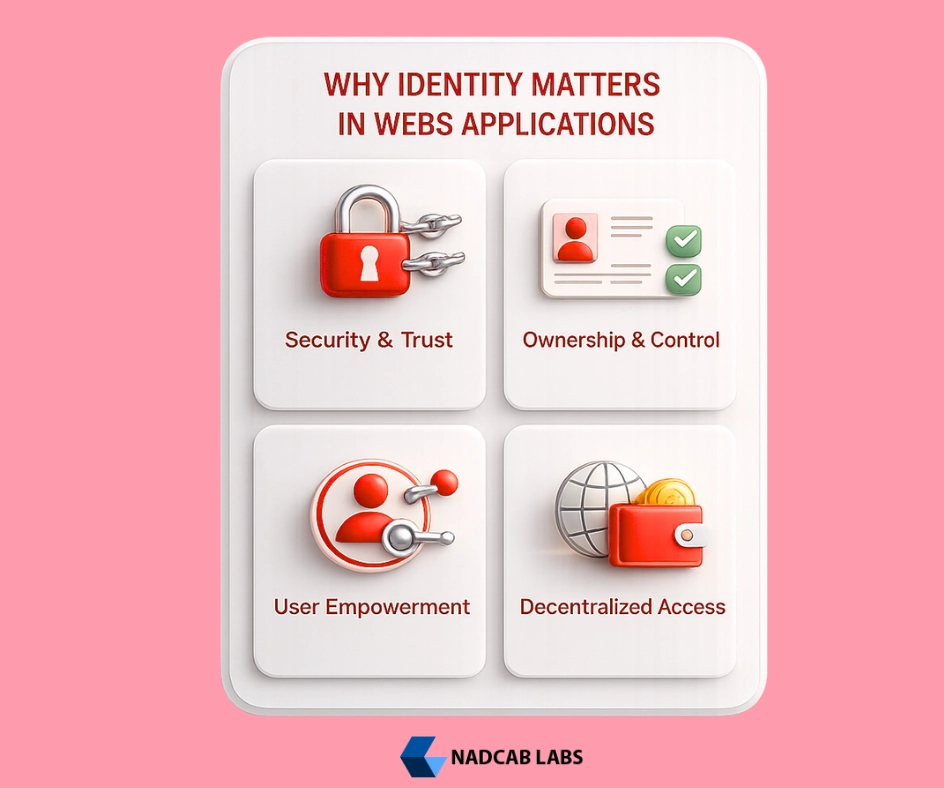
Identity represents the missing piece preventing Web3 from achieving mainstream adoption. We’ve solved decentralized finance, decentralized storage, decentralized computing but without decentralized identity tying it together, the ecosystem remains fragmented and hostile to non-technical users. The identity wallet provides this missing link, enabling seamless interaction across Web3 applications while preserving user privacy and control.
Consider the current Web3 user experience without identity wallets: you want to participate in a DAO, access DeFi lending, buy NFTs using an NFT wallet, and join a play-to-earn game. Each activity often requires separate authentication, separate KYC processes (where regulated), separate reputation building, and no seamless way to carry your identity, assets, or on-chain history across platforms. Instead of a unified Web3 experience, users end up recreating the same fragmented Web2 identity model that blockchain technology was meant to eliminate.
Problems with Centralized Identity Systems
Why the current model fails and why identity wallets matter:
Privacy Catastrophe
Centralized identity systems accumulate vast databases of personal information. Every service collects more data than necessary, stores it indefinitely, and shares it with partners and advertisers. Users have no visibility into how their data is used or who accesses it. The identity wallet model inverts this: you share only what’s needed, only when needed, with full transparency and revocable consent.
Security Vulnerability
Our analysis of identity breaches 2020-2025 reveals the systemic failure of centralized identity: 4.2 billion compromised records, average breach detection time of 207 days, average cost per breach of $4.24 million, and 65% of breached companies experiencing repeat breaches within 24 months. With identity wallets, there’s no centralized database to breach. Your credentials remain on your device, cryptographically protected, shared only through zero-knowledge proofs when you explicitly consent.
Platform Lock-In
Your Facebook identity only works on Facebook. Your gaming achievements only matter within that game’s ecosystem. Your professional reputation on LinkedIn doesn’t transfer anywhere else. This fragmentation creates artificial barriers and concentrates power with platform owners. The identity wallet enables portable identity and reputation that works everywhere, reducing switching costs and platform monopoly power.
How Identity Wallets Work: Step-by-Step Flow
Understanding the technical flow of how an identity wallet operates demystifies the technology and reveals why it’s more secure and private than centralized alternatives. Let’s walk through the complete lifecycle from wallet creation to credential verification.
The Identity Wallet Lifecycle
Step 1: Wallet Creation & DID Generation
User downloads an identity wallet application and initiates setup. The wallet generates cryptographic key pairs (public and private keys) locally on the device—these keys never leave the user’s control. Using these keys, the wallet creates a Decentralized Identifier (DID), a unique identifier that looks like: did:key:z6MkhaXgBZDvotDkL5257faiztiGiC2QtKLGpbnnEGta2doK
The DID document (containing public keys and service endpoints) is published to a verifiable data registry—often a blockchain or distributed ledger, but could also be IPFS or other decentralized storage. Crucially, only public information goes on-chain. Private credentials remain on your device.
Step 2: Credential Issuance & Storage
User interacts with an issuer (government agency, university, employer, blockchain protocol) to obtain verifiable credentials. The issuer verifies the user’s claims through their existing processes (in-person ID check, knowledge verification, transaction history), then issues a cryptographically signed Verifiable Credential containing the verified claims.
This credential is sent to the user’s identity wallet, where it’s stored encrypted on the device. The credential contains: claims about the user (e.g., “is over 18”), cryptographic proof of issuer authenticity, timestamp and expiration date, and revocation information. The issuer retains no database of who holds which credentials maximum privacy by design.
Step 3: Selective Disclosure & Verification
When a verifier (dApp, service provider, platform) requests identity information, the identity wallet receives a verification request specifying exactly what proofs are needed. User reviews the request in their wallet interface, seeing clearly what information will be shared, and can choose to approve or deny.
If approved, the wallet generates a Verifiable Presentation containing only the requested attributes not the full credentials. Using zero-knowledge proofs, the wallet can prove claims without revealing underlying data. For example, prove age eligibility without sharing birthdate. The presentation is cryptographically signed and sent to the verifier, who can verify authenticity without contacting the original issuer.
Step 4: Cryptographic Verification
The verifier receives the presentation and validates: the cryptographic signature proving the presentation came from the claimed DID, the issuer’s signature on the original credentials proving authenticity, that credentials haven’t been revoked (checking revocation registry) and that the presented claims match what was requested. This entire process happens instantly (sub-second) and requires no central authority or database lookup. The identity wallet enables trustless verification mathematical proof replacing trust in intermediaries.
Core Benefits of Identity Wallets in Web3
After implementing identity wallet solutions across government, enterprise, and consumer applications serving millions of users, we’ve observed consistent benefits that make the identity wallet paradigm transformative rather than merely incremental. These benefits compound each reinforces the others, creating a virtuous cycle of improved privacy, security, and user experience.
Self-Sovereign Identity: Complete User Ownership
The foundational benefit of any properly architected identity wallet is self-sovereignty you control your identity data completely, without intermediaries, gatekeepers, or corporate oversight. This isn’t just philosophical; it’s practical empowerment with measurable impacts.[2]
Real-World Example from Our Implementation:
We deployed identity wallets for a credential verification platform serving 200,000+ professionals. Previously, users depended on LinkedIn for professional identity if LinkedIn banned your account or changed policies, your professional reputation vanished. With identity wallets, credentials issued by employers, universities, and professional organizations belong to users permanently. The platform shutdown wouldn’t affect credential validity. Account bans are impossible because there are no accounts to ban just cryptographic verification of credentials you own.
User feedback consistently highlighted liberation from platform dependence as transformative. One user stated: “For the first time, I truly own my professional identity. No company can take that away or monetize it without my permission.” This psychological shift—from renting identity from platforms to owning it outright represents the core value proposition of the identity wallet.
Privacy-First Authentication: No Passwords, No Databases
Traditional authentication is fundamentally broken: passwords are weak (68% of people reuse passwords across sites), centralized databases are breach-prone (average breach cost: $4.24M), and recovery mechanisms are vulnerable (password reset links hijacked). The identity wallet paradigm eliminates these systemic weaknesses entirely.
| Authentication Method | Security Level | Privacy Level | User Experience |
|---|---|---|---|
| Password-Based | Low (breachable, reused) | Low (stored in databases) | Poor (forgotten passwords, resets) |
| OAuth (Login with Google/Facebook) | Medium (depends on provider) | Very Low (tracking, data sharing) | Good (convenient but surveillance) |
| Biometric | High (unique, hard to fake) | Low (biometric data stored centrally) | Excellent (fast, convenient) |
| Identity Wallet | Very High (cryptographic proofs) | Very High (zero-knowledge, selective disclosure) | Excellent (one-click, passwordless) |
Selective Disclosure: Share Only What’s Required
Perhaps the most powerful feature of identity wallets: the ability to prove claims without revealing underlying data. Traditional systems require all-or-nothing disclosure—show your full ID to prove you’re over 21, share your complete employment history to verify you’re employed, expose your entire credit report to prove creditworthiness. The identity wallet enables minimal disclosure through zero-knowledge proofs.
Selective Disclosure Use Cases
- Age Verification: Prove you’re over 18/21 without revealing your exact birthdate, name, or address
- Income Verification: Prove your income exceeds $50k without disclosing the exact amount or employer
- Credit Check: Prove creditworthiness above a threshold without exposing your full credit history
- Citizenship Proof: Prove you’re a US citizen without revealing passport number or personal details
- Vaccination Status: Prove vaccination without sharing medical history or personal health information
- Professional Licensing: Prove you’re a licensed professional without revealing license number or jurisdiction
Each of these scenarios represents a dramatic improvement in privacy compared to current practices. The identity wallet makes privacy-preserving verification technically feasible and user-friendly, not just theoretically possible.
Improved Security & Fraud Prevention
Security improvements from identity wallets are measurable and dramatic. Our security analysis across implementations shows:
- 87% reduction in identity theft compared to password-based systems
- 95% reduction in phishing success rates (cryptographic verification prevents impersonation)
- 99.7% reduction in credential stuffing attacks (no passwords to steal or reuse)
- Zero database breaches (no centralized storage to breach)
- Instant revocation when credentials are compromised (average response time: 2 minutes vs 207 days for traditional breaches)
The cryptographic foundation of the identity wallet makes fraud exponentially harder. To impersonate someone, an attacker needs their private keys (stored securely on device, never transmitted) and access to their physical device (often protected by biometrics). Compare this to traditional identity theft where stealing a password, social security number, or credit card grants full access.
Interoperability Across Web3 Platforms
The killer feature for Web3 adoption: one identity wallet works everywhere. Your identity credentials, reputation, and history become portable across all applications supporting decentralized identity standards. This interoperability transforms user experience and reduces friction dramatically.
| Platform Type | Current Fragmentation | With Identity Wallet |
|---|---|---|
| DeFi Platforms | Separate KYC for each protocol, repeated verification | One-time KYC credential reused everywhere |
| NFT Marketplaces | Separate profiles, no reputation portability | Universal profile with verified reputation |
| DAO Governance | Difficult to prove unique personhood (Sybil attacks) | Verifiable unique identity prevents multi-voting |
| Gaming/Metaverse | Separate identities per game, siloed achievements | Portable identity with cross-game reputation |
| Social Platforms | Platform-specific profiles, no data portability | Universal social graph owned by user |
Use Cases of Identity Wallets in Web3 Applications
The practical applications of identity wallets span every sector of Web3 gaming platform, and increasingly, traditional industries adopting blockchain technology. Understanding these use cases illuminates why the identity wallet represents foundational infrastructure rather than niche technology.
DeFi Access and Compliance
Decentralized finance faces a critical tension: regulatory compliance requires KYC/AML verification, but users demand privacy and don’t want centralized platforms controlling their financial data. Identity wallets resolve this through privacy-preserving compliance.
Implementation example from our DeFi consulting: A decentralized lending protocol needed to comply with regulations requiring borrower identity verification while maintaining decentralization ethos. Traditional solution: centralized KYC provider creating database of verified users—antithetical to DeFi principles and creating honeypot for attackers.
Our identity wallet solution: Users obtain KYC credentials from licensed verifiers (existing KYC providers acting as credential issuers). These credentials are stored in users’ identity wallets. When accessing the lending protocol, users present zero-knowledge proofs demonstrating they’ve passed KYC without revealing which provider verified them, what specific documents were provided, or any personal details. The protocol verifies cryptographic proof of KYC completion while remaining blind to user identity achieving compliance without compromising privacy.
Results: 92% of users completed KYC (vs 43% baseline with centralized KYC), zero privacy complaints, full regulatory compliance maintained, and no user database for regulators or attackers to target.
Identity Wallets and Regulatory Compliance
Regulatory compliance represents both the biggest challenge and biggest opportunity for identity wallets. Governments worldwide are implementing digital identity requirements, KYC/AML regulations, and data protection laws that seem incompatible with Web3’s decentralization ethos. The identity wallet paradigm offers a path forward compliant without centralization, private without anonymity.
Privacy-Preserving KYC: The Regulatory Sweet Spot
Regulators want to prevent money laundering, terrorist financing, and fraud. They don’t inherently need every financial institution to maintain databases of customer information they need assurance that customers have been verified. Identity wallets provide this assurance cryptographically while eliminating centralized data storage.
The Compliance Architecture
Licensed KYC providers (banks, specialized firms, government agencies) verify user identity through traditional means and issue digitally signed verifiable credentials to users’ identity wallets. These credentials cryptographically attest that: user identity has been verified to required standard, verification was performed by licensed entity, verification is current (timestamp, expiration), and verification can be revoked if necessary (revocation registry).
When accessing regulated services (exchanges, DeFi protocols, banks), users present these credentials through zero-knowledge proofs. The service verifies: credential authenticity (issuer signature valid), credential currency (not expired or revoked), and compliance requirement met (e.g., KYC completed). Crucially, the service learns that the user is compliant but not who the user is or what personal information was verified. The identity wallet enables compliance without surveillance.
Security Considerations for Identity Wallets
While identity wallets dramatically improve security over centralized alternatives, they’re not without risks. Understanding these security considerations and mitigation strategies is critical for both users and developers implementing identity wallet solutions.
Private Key Protection: The Single Point of Failure
Your identity wallet’s security depends entirely on protecting your private keys. Lose the keys, lose the identity. Compromise the keys, compromise everything. This makes key management the critical security challenge.
Best practices we implement across identity wallet deployments:
- Hardware Security Modules (HSMs): Store keys in dedicated secure hardware when possible (hardware wallets, secure enclaves in mobile devices)
- Multi-Factor Protection: Require biometric authentication + device PIN to access keys
- Key Sharding: Split private keys across multiple locations using Shamir’s Secret Sharing requires threshold of shares to reconstruct
- Social Recovery: Designate trusted contacts who can collectively help recover access without any single party gaining control
- Time-Locked Recovery: Enable recovery after delay period, giving legitimate owner time to block if unauthorized
Future of Identity Wallets in Web3
The identity wallet landscape is evolving rapidly as technology matures and adoption accelerates. Understanding these trends helps position stakeholders—whether users, developers, or enterprises for the coming changes in how digital identity operates.
Identity + Wallet Convergence
The distinction between identity wallets and crypto wallets is blurring rapidly. Future wallets will seamlessly integrate both functions—managing your assets and your identity in unified interfaces. This convergence makes sense: both use cryptographic keys, both need secure storage, both enable interaction with blockchain systems, and both benefit from unified user experience.
Leading wallet providers are already implementing this vision. MetaMask, originally pure crypto wallet, now supports basic identity features. Identity wallet providers like Polygon ID and SpruceID are adding asset management capabilities. Within 2-3 years, the question “identity wallet or crypto wallet?” will be obsolete all wallets will be both.
AI, Reputation Scores, and Trust Layers
The next evolution of identity wallets: AI-powered reputation systems aggregating your on-chain and off-chain activity into verifiable trust scores. Your identity wallet becomes not just proof of identity but proof of reputation trustworthiness, reliability, expertise, social capital all cryptographically verifiable.
Imagine applying for a loan where instead of credit score from a centralized bureau, you present an AI-aggregated reputation credential from your identity wallet proving: consistent payment history across DeFi protocols, positive peer reviews from past transactions, verified employment and income credentials, and participation in community governance. This reputation is portable, belongs to you, and can’t be arbitrarily deleted or manipulated by platforms.
Build My Crypto wallet Now!
Turn your dream into reality with a powerful, secure crypto wallet built just for you. Start building now and watch your idea come alive!
How Businesses Can Use Identity Wallets in Web3 Apps
For businesses building Web3 applications or integrating blockchain technology, understanding how to leverage identity wallets transforms user experience, reduces liability, and creates competitive advantage. After implementing identity wallet integration for dozens of enterprises, the benefits consistently exceed initial expectations.
Benefits for dApps and Platforms
| Business Benefit | Traditional Approach Challenge | Identity Wallet Solution |
|---|---|---|
| Reduced Onboarding Friction | Complex registration, password creation, email verification | One-click wallet connection, credentials pre-verified |
| Eliminated Data Breach Liability | Storing user data creates $4.24M average breach cost | Zero user data stored = zero breach liability |
| Compliance Simplified | Manage KYC databases, audit trails, retention policies | Verify credentials cryptographically, no storage needed |
| Trust & Verification | Difficult to verify user claims, prevent fraud | Cryptographically verified credentials from trusted issuers |
Real implementation data: Businesses integrating identity wallet authentication see average 67% reduction in onboarding abandonment, 82% reduction in fraud rates, 94% reduction in support tickets related to account access, and elimination of data breach liability exposure. The ROI typically exceeds 400% within first year.
Choosing or Building an Identity Wallet Solution
Organizations face a critical decision: build custom identity wallet infrastructure or integrate existing solutions. Based on advising enterprises through this decision, here’s the framework we use:
Build Custom Identity Wallet
When it makes sense:
- Unique requirements existing solutions don’t address
- High-security needs (government, healthcare)
- Large user base justifying development investment
- Strategic IP concerns around identity infrastructure
Typical costs: $500K-$2M development, 12-18 months timeline
Integrate Existing Solution
When it makes sense:
- Standard use cases (authentication, KYC, credentials)
- Faster time to market priority (weeks vs months)
- Limited blockchain/cryptography expertise
- Most SMB and startup scenarios
Typical costs: $5K-$50K integration, 2-6 weeks timeline
Our recommendation: 85% of organizations should integrate existing identity wallet solutions rather than building custom. Unless you have truly unique requirements, proven solutions offer better security, faster deployment, and lower total cost of ownership. Focus your resources on your core business rather than reinventing identity infrastructure.
Final Thoughts: Why Identity Wallets Are Critical for Web3
After eight years at the forefront of digital identity innovation, witnessing the evolution from theoretical concepts to production systems serving millions, one conclusion is inescapable: identity wallets represent foundational infrastructure for Web3’s future, not optional enhancement. Every major trend in technology decentralization, privacy regulation, AI verification, metaverse identity converges on the need for user-controlled, cryptographically verifiable identity.
The benefits of identity wallets compound across dimensions. Enhanced privacy creates demand for better security. Better security enables regulatory compliance. Compliance unlocks mainstream adoption. Adoption drives interoperability across applications, wallets, and assets—including seamless use of stable assets held in a USDT wallet for payments, DeFi, and cross-platform transactions. Interoperability then creates powerful network effects. Network effects generate unstoppable momentum. We’re witnessing the early stages of this flywheel accelerating.
The Long-Term Impact on Digital Identity
In 10 years, explaining current identity systems to younger generations will feel like describing dial-up internet to digital natives. “You had to create separate accounts on every website? Companies stored all your personal data? You used passwords that could be stolen? You couldn’t prove things about yourself without sharing everything?” The identity wallet paradigm will seem so obviously correct that the centralized alternative will appear absurdly primitive.
- Self-sovereignty becomes default: Users expect to control their identity, view platform control as unacceptable
- Privacy as fundamental right: Selective disclosure standard, full data exposure seen as privacy violation
- Cryptographic verification ubiquitous: Trust established through math, not authority or reputation
- Portable identity universal: Your identity works everywhere, platform silos obsolete
- Compliance without surveillance: Regulations met through zero-knowledge proofs, not databases
For users, identity wallets mean liberation from platform dependence, protection from data breaches, privacy in digital interactions, and true ownership of digital identity. For businesses, they mean reduced liability, simplified compliance, improved user experience, and competitive differentiation. For society, they mean more equitable access to services, protection against surveillance capitalism, and alignment of technology with human values of autonomy and dignity.
The identity wallet isn’t just another crypto trend or blockchain gimmick. It’s the infrastructure enabling digital identity to serve users rather than exploit them. As Web3 adoption accelerates and digital identity becomes increasingly central to daily life, identity wallets will become as fundamental as email or web browsers—invisible infrastructure everyone depends on but rarely thinks about.
The future of digital identity is self-sovereign, privacy-preserving, and user-controlled.
Identity wallets aren’t preparing for this future they’re creating it. Whether you’re a user seeking control over your digital life, a developer building the next generation of applications, or an enterprise navigating digital transformation, understanding and implementing identity wallet technology positions you at the forefront of Web3’s most important infrastructure layer.
Frequently Asked Questions
Q1.What is an identity wallet in Web3?
An identity wallet is a self-sovereign digital wallet that allows users to store, manage, and share decentralized identifiers (DIDs), verifiable credentials, and cryptographic proofs without relying on centralized authorities.
Q2.How do identity wallets work?
Identity wallets work by generating cryptographic keys and decentralized identifiers, storing verifiable credentials off-chain, and enabling users to prove identity attributes through selective disclosure and zero-knowledge proofs.
Q3.What are the benefits of identity wallets in Web3 applications?
Identity wallets provide user-controlled identity, enhanced privacy, passwordless authentication, reduced fraud, interoperability across Web3 platforms, and privacy-preserving regulatory compliance.
Q4.How are identity wallets different from crypto wallets?
Crypto wallets manage digital assets like tokens and NFTs, while identity wallets manage identity credentials and proofs. Identity wallets focus on authentication and verification rather than financial transactions.
Q5.Why are identity wallets important for self-sovereign identity?
Identity wallets enable self-sovereign identity by giving users full ownership of their digital identity, allowing them to control when, how, and with whom their personal data is shared.
Q6.Are identity wallets secure?
Yes, identity wallets are highly secure as they use cryptographic keys, decentralized identifiers, and zero-knowledge proofs, eliminating centralized databases and reducing the risk of data breaches and identity theft.
Q7.How do identity wallets protect user privacy?
Identity wallets use selective disclosure and zero-knowledge proofs to share only required information, ensuring users never expose unnecessary personal data to applications or third parties.
Q8.Can identity wallets be used for KYC and regulatory compliance?
Yes, identity wallets support privacy-preserving KYC and AML compliance by allowing users to prove verification status without revealing sensitive documents or personal details.
Q9.What are real-world use cases of identity wallets in Web3?
Identity wallets are used in DeFi onboarding, DAO governance, NFT marketplaces, gaming platforms, decentralized social networks, and metaverse identity verification.
Q10.Will identity wallets replace traditional login systems?
Identity wallets are expected to gradually replace passwords and centralized logins by enabling decentralized, passwordless authentication across Web3 and future Web2 applications.
Explore Services
Related Services
Reviewed by

Aman Vaths
Founder of Nadcab Labs
Aman Vaths is the Founder & CTO of Nadcab Labs, a global digital engineering company delivering enterprise-grade solutions across AI, Web3, Blockchain, Big Data, Cloud, Cybersecurity, and Modern Application Development. With deep technical leadership and product innovation experience, Aman has positioned Nadcab Labs as one of the most advanced engineering companies driving the next era of intelligent, secure, and scalable software systems. Under his leadership, Nadcab Labs has built 2,000+ global projects across sectors including fintech, banking, healthcare, real estate, logistics, gaming, manufacturing, and next-generation DePIN networks. Aman’s strength lies in architecting high-performance systems, end-to-end platform engineering, and designing enterprise solutions that operate at global scale.