Ai Overview
In the real estate sector, an ICO Initial Coin Offering is a modern fundraising approach in which a property owner or developer sells digital tokens representing a share in a specific property or real estate project. By using ICO Tokens, real estate investment becomes more flexible, offering advantages such as fractional ownership, improved liquidity, and global access for investors. Real estate-backed tokens represent the largest share of security offerings, accounting for 34% of that segment [2].
Key Takeaways
- ICO Tokens Modernize Fundraising – Raise real estate capital via blockchain tokens instead of traditional banks or investors.
- Fractional Ownership – High-value properties can be divided into small, affordable tokens, opening investment to more people.
- Enhanced Liquidity – Tokens can be traded on secondary markets anytime, unlike traditional illiquid real estate.
- Global Accessibility – Investors worldwide can participate without complex cross-border restrictions.
- Transparency & Security – Blockchain ensures tamper-proof ownership, and digital contracts automate income and compliance.
- Faster Fundraising – ICOs reduce time, paperwork, and reliance on intermediaries.
- Regulatory Compliance Is Critical – Most tokens are considered securities; KYC, AML, and disclosure rules must be followed.
- Integration with DeFi & Tech – Tokens can be used as collateral, staked, or enhanced with AI/IoT solutions.
- Market Growth Potential – Real estate-backed tokens account for 34% of security offerings, and the market could exceed $4T by 2035.
- Risk Management – Transparency, audits, and legal guidance are essential to mitigate volatility, fraud, and regulatory issues.
Raising capital in the real estate industry has traditionally depended on banks, private lenders, venture capital firms, or institutional investors. While these methods are effective, they often involve long approval cycles, high entry barriers, and limited access for global investors. With the rise of blockchain technology, a new and innovative fundraising model has emerged ICO Token based real estate funding.
An Initial Coin Offering (ICO) in real estate allows property developers or asset owners to raise funds by issuing blockchain-based digital tokens to investors. These tokens represent a stake in a specific real estate asset or project and operate on decentralized blockchain networks. This modern funding approach introduces a new investment structure that offers fractional ownership, increased liquidity, global accessibility, and enhanced transparency.
Understanding ICO Tokens in Real Estate
In the real estate sector, an ICO Initial Coin Offering is a modern fundraising approach in which a property owner or developer sells digital tokens representing a share in a specific property or real estate project. These tokens are issued on a blockchain, creating a transparent, secure, and decentralized way for investors to participate. By using ICO Tokens, real estate investment becomes more flexible, offering advantages such as fractional ownership, improved liquidity, and global access for investors.
How Real Estate ICO Tokens Work
The use of ICO tokens in real estate follows a structured process designed to ensure transparency, regulatory compliance, and investor confidence. The main steps include:
-
Legal Structuring:
A legal entity, often a Special Purpose Vehicle (SPV) or an LLC, is established to own the physical property. The tokens issued represent shares in this legal entity, rather than direct ownership of the property itself. This arrangement is standard in most jurisdictions and ensures that legal and regulatory frameworks are met.
-
Token Creation:
Digital tokens are created on a blockchain platform, such as Ethereum, through digital contracts. These digital contracts automatically manage ownership rules, token transfers, and distribution of income, such as rental yields or profit shares. Blockchain technology ensures that these transactions are secure, verifiable, and immutable.
-
Fundraising (ICO):
The tokens are then offered to investors in an Initial Coin Offering (or, in most regulated cases, a Security Token Offering, STO). Investors exchange fiat currency or cryptocurrency for the tokens, providing capital to the property developer or owner.
-
Secondary Market Trading:
After the initial token sale, investors can trade their ICO Tokens on secondary digital exchanges. This introduces liquidity to real estate investments, allowing participants to buy or sell their tokenized shares, something rarely available in traditional property markets.
Key Benefits of Using ICO Tokens for Real Estate Funding
Using ICO Tokens to raise real estate funds offers numerous advantages, modernizing a traditionally illiquid and exclusive asset class.
- Increased Liquidity: Real estate is historically illiquid, often taking months to sell. ICO Tokens can be traded 24/7 on secondary marketplaces, allowing investors faster access to their capital.
- Fractional Ownership: Tokenization divides high-value properties into smaller, affordable shares, making investment accessible to a broader audience.
- Lower Barriers to Entry: Minimum investments can be as low as a few hundred or thousand dollars, compared to traditional deals that often require tens or hundreds of thousands.
- Global Accessibility: Developers can attract international investors without complex cross-border laws or currency exchange issues.
- Enhanced Transparency and Security: Blockchain stores all transactions and ownership records on an immutable ledger, reducing fraud and building trust.
- Faster and More Efficient Transactions: digital contracts automate fund transfers, dividend distributions, and compliance checks, cutting administrative costs and time.
- Diversification Opportunities: Lower minimums allow investors to diversify across multiple properties, asset types, and geographies, mitigating risk.
- Community Building: Token holders often engage with the project, providing feedback, marketing support, and stronger brand loyalty.
- Potential for Integration with DeFi: Tokenized real estate can be used in decentralized finance (DeFi) platforms, such as staking as collateral for loans.
- Market Scale: Real estate accounts for around 38.8% of the global tokenized assets market[1], making it one of the largest and most attractive segments.
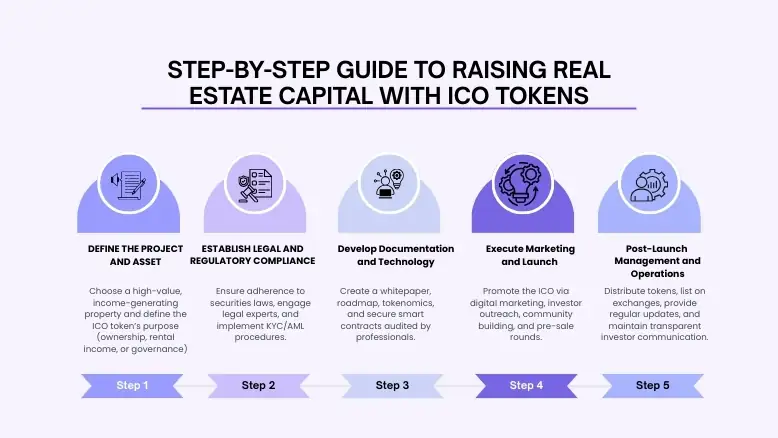
Step-by-Step Guide to Raising Real Estate Capital with ICO Tokens
Step 1: Define the Project and Asset
Select a specific, high-value, and preferably income-generating property. Conduct feasibility studies, assess market demand, and clearly define the purpose of the ICO coin, whether it represents ownership rights, rental income distribution, or governance participation.
Step 2: Establish Legal and Regulatory Compliance
Engage legal professionals experienced in blockchain, securities law, and real estate regulation. Most ICO coin offerings are classified as securities and must comply with regulatory authorities such as the SEC, FCA, or equivalent bodies. Robust KYC and AML procedures are mandatory.
Step 3: Develop Documentation and Technology
Prepare comprehensive project documentation, including a whitepaper, business plan, roadmap, and tokenomics model. Digital contracts must be securely developed and audited by professional firms to eliminate vulnerabilities.
Step 4: Execute Marketing and Launch
Implement a strategic marketing campaign to promote the upcoming ICO. You can also work with a premium digital marketing agency to enhance reach and campaign effectiveness. Projects can also leverage premium marketing services to maximize visibility, attract high-quality investors, and ensure a successful launch.
Step 5: Post-Launch Management and Operations
Distribute tokens according to digital contract terms, list ICO on regulated exchanges to ensure liquidity, and maintain transparency through regular performance updates, financial reporting, and investor communication.
Legal & Risk Considerations for Real Estate ICOs
Legal compliance is a critical foundation for any ICO cryptocurrency project. Legal and regulatory compliance is one of the most important aspects of conducting a real estate Initial Coin Offering (ICO Token) project. The process is complex and primarily revolves around determining whether the digital tokens are classified as securities, which subjects them to strict financial regulations alongside standard real estate laws. In addition, clearly defined token Vesting structures play a key role in regulatory transparency, investor protection, and long-term project credibility.
Token Classification: The Primary Factor
Determining the legal classification of the digital token is the first and most crucial step, as it dictates the regulatory framework the project must follow:
- Securities: In many jurisdictions, including the United States (regulated by the SEC) and the UK (regulated by the FCA), tokens backed by real-world assets like real estate are typically classified as securities, similar to real estate investment trusts (REITs). This classification triggers extensive regulations designed to protect investors. It requires registration (or obtaining a valid exemption), comprehensive disclosure documents (such as prospectuses), and ongoing reporting obligations.
- Utility Tokens: Tokens that are solely designed to provide access to a service or product may avoid certain securities regulations. However, this classification is uncommon in real estate investment schemes, where tokens usually represent ownership or financial rights.
- Regulatory Variance: The legal status of real estate ICO Tokens varies significantly by jurisdiction. A project compliant in one country may not be legal in another, and regulations are continuously evolving.
Key Legal and Regulatory Requirements
A real estate ICO must comply with both digital asset regulations and traditional real estate laws to ensure legality and investor protection:
- Anti-Money Laundering (AML) and Know Your Customer (KYC): Regulators worldwide require strict adherence to AML/KYC standards. This involves verifying investor identities and monitoring transactions for suspicious activity.
- Real Estate-Specific Laws: Issuers must comply with all applicable local, state, and federal real estate regulations, which may include:
- Zoning and Land Use: Ensuring the property’s intended use aligns with local regulations.
- Environmental Compliance: Securing necessary environmental clearances and conducting impact assessments.
- Building Codes and Safety: Meeting standards for construction, safety, and accessibility, including compliance with laws like the Americans with Disabilities Act.
- Permitting and Licensing: Obtaining all required permits before construction or operation.
- Title and Ownership Verification: Conducting thorough due diligence to confirm a clear title and the absence of disputes or liens.
- Data Protection and Privacy: Laws such as GDPR and the Data Use and Access Act 2025 require robust protection of investor data, transparent consent management, and secure handling of sensitive information.
- Marketing and Advertising Rules: All promotional content must be truthful, clear, and comprehensive, detailing risks, objectives, and relevant legal requirements.
- Transparent Documentation: Maintaining comprehensive and clear documentation—including white papers, token sale agreements, and disclosures is essential to uphold transparency and legal enforceability.
Mitigating Risks
To ensure compliance and foster investor confidence, issuers of real estate ICO Tokens should:
- Engage Expert Legal Counsel: Partner with legal professionals experienced in both blockchain and real estate law, given the complexity and evolving nature of regulations.
- Conduct Regular Audits: Implement periodic audits of financial practices, operational processes, and data handling to proactively address potential issues.
- Embrace Transparency: Provide full disclosure of project plans, risks, timelines, and financial accountability. Transparency is critical for building trust and meeting regulatory expectations.
Failure to comply with these regulations can result in significant fines, legal action, project delays, and severe reputational damage, emphasizing the importance of meticulous legal and operational diligence.
Case Studies & Practical Insight- Real-World Examples
Several successful projects demonstrate the effectiveness of coin offering ICO models in real estate:
- St. Regis Aspen Resort tokenized 18% of its equity and raised $18 million through a compliant token offering
- RealT enables fractional ownership of rental properties while distributing rental income in stablecoins
- Reental (Europe) tokenized more than 82 properties across multiple countries, attracting thousands of investors
- DAMAC Group partnered with blockchain platforms to tokenize large-scale real estate assets in the Middle East
These examples highlight how coin market cap ICO growth is reshaping real estate investment structures globally.
The Future of Real Estate Funding Through ICO Tokens
The future of real estate funding via Initial Coin Offering (ICO) Tokens is highly promising. Fractional ownership, improved liquidity, and global accessibility through blockchain technology are transforming a traditionally illiquid and exclusive market, although projects must navigate a complex regulatory landscape.
The future of real estate funding via ICO Tokens is highly promising, driven by fractional ownership, enhanced liquidity, and global accessibility. Real estate-backed tokens represent the largest share of security offerings, accounting for 34% of that segment[2]. This demonstrates the growing impact of tokenization on the real estate market.
Key Benefits
- Fractional Ownership: High-value properties can be divided into affordable digital tokens, enabling a broader range of investors, including retail and international participants, to join with lower capital, sometimes as low as a few hundred dollars.
- Enhanced Liquidity: Unlike traditional real estate, ICO Tokens can be traded instantly on secondary marketplaces, offering stock-like liquidity.
- Global Accessibility: Tokenized real estate removes geographic barriers, allowing developers to attract worldwide investors and enabling portfolio diversification across properties and locations.
- Transparency and Security: Blockchain provides a tamper-proof record of all transactions. digital contracts automate processes like rent distribution or ownership transfer, reducing fraud and intermediaries.
- Faster and Cheaper Fundraising: Developers can raise capital in weeks instead of months, cutting costs by reducing reliance on banks, brokers, and paperwork.
Challenges and Future Trends
- Regulatory Uncertainty: Token classification varies by jurisdiction, securities, utility, or hybrid, requiring careful compliance. Clearer frameworks like the EU’s MiCA are expected to encourage institutional adoption.
- Market Volatility and Investor Skepticism: Crypto market volatility and past ICO scams create caution, emphasizing transparency and credible projects.
- Technological Integration: Blockchain adoption requires technical expertise and smooth integration with traditional real estate systems.
Looking Ahead
The market for real estate funding through ICO Tokens is projected to grow significantly, with Deloitte estimating it could exceed $4 trillion by 2035. Key trends include:
- Greater participation from institutional investors as regulatory clarity improves.
- Integration with DeFi platforms, allowing tokens to be used as collateral for loans.
- Adoption of AI-driven valuations, IoT property monitoring, and on-chain insurance to improve efficiency and investor confidence.
Why Are ICO-Based Real Estate Funds More Accessible?
ICO-based real estate mutual funds have made property investment more inclusive and efficient by leveraging ICO Tokens. These tokens allow investors to purchase fractional shares of high-value properties with relatively small amounts of capital, making participation possible for retail and international investors who might not afford traditional real estate. Unlike conventional property investments, ICO Tokens provide liquidity through secondary marketplaces, letting investors buy and sell tokens quickly, while blockchain technology ensures transparency, security, and automated processes such as rental income distribution.
Additionally, ICOs eliminate geographic and regulatory barriers, enabling global diversification without complex legal or currency issues. Developers also benefit by raising funds faster and more efficiently, bypassing traditional intermediaries like banks and brokers. Real estate-backed tokens represent the largest share of security offerings, accounting for 34% of that segment, demonstrating how this approach is transforming real estate investment into a more accessible, flexible, and globally inclusive market.
If you are seeking an innovative, transparent, and scalable approach to real estate investment or fundraising, ICO Tokens offer a future-ready solution aligned with the evolution of global finance.
Frequently Asked Questions
Q1.What is real estate tokenization or an ICO in real estate?
Real estate tokenization is the process of converting ownership interests in a property into digital tokens on a blockchain. When used for fundraising, it often takes the form of an Initial Coin Offering (ICO) or Security Token Offering (STO), where investors purchase tokens that represent fractional ownership, rental income rights, or governance participation in a property or real estate project. This approach leverages blockchain’s transparency and automation to make real estate investment more accessible and efficient.
Q2.How do ICO tokens raise capital for real estate?
ICO tokens allow developers or property owners to raise funds by issuing digital tokens that represent a share in a legal entity holding the property. Investors exchange fiat currency or cryptocurrency for these tokens, providing the developer with capital to acquire, develop, or manage the property. Compared to traditional financing, ICO-based fundraising is faster, offers global investor access, and reduces dependence on banks or institutional lenders.
Q3.Are these tokens considered securities?
In most jurisdictions, tokens that represent fractional ownership or financial returns from real estate are classified as securities. This classification requires compliance with securities laws, such as registration, disclosure of financial and operational information, and ongoing reporting obligations. Failing to comply with securities regulations can lead to legal penalties, making proper classification and legal consultation critical before launching a real estate ICO.
Q4.Can anyone invest, or are there restrictions?
Investment eligibility depends on local regulations and the structure of the ICO/STO. Some offerings are open to retail investors worldwide, while others are restricted to accredited or professional investors. Regardless of investor type, projects must implement robust Know Your Customer (KYC) and Anti-Money Laundering (AML) procedures to verify identities and prevent illicit activities, ensuring compliance with financial regulations.
Q5.How do investors make money from real estate tokens?
Investors can earn returns in two primary ways: through rental income or profit distributions generated by the property and through appreciation in the value of the tokens themselves. Rental income or dividends is usually distributed automatically via digital contracts, providing transparency and efficiency. Token price appreciation can occur when market demand for the tokenized property increases, offering capital gains similar to traditional equity investments.
Q6.Can these tokens be traded like stocks?
Yes, real estate tokens can often be traded on secondary digital exchanges, giving them liquidity that traditional property investments usually lack. However, the liquidity depends on the number of investors and the availability of compliant trading platforms. While tokenized real estate is more liquid than physical property, trading may still be less active than in public stock markets.
Q7.Do token holders have legal ownership of the property?
Typically, token holders do not hold direct title to the real estate. Instead, they own a stake in a Special Purpose Vehicle (SPV) or legal entity that owns the property. The tokens grant financial rights, such as profit sharing or voting on certain decisions, but the SPV maintains legal ownership. Proper legal structuring ensures that token holders’ rights are enforceable and protected under law.
Q8.What are the main risks of investing in tokenized real estate?
Investing in real estate ICO tokens carries risks, including regulatory uncertainty, limited secondary market liquidity, potential digital contract vulnerabilities, cybersecurity threats, and valuation challenges. Additionally, the crypto market’s volatility can affect token prices. Investors must conduct due diligence, verify legal compliance, and assess the project’s management and technical security to mitigate these risks.
Q9.Are ICO tokens the same as NFTs?
No. While both ICO tokens and NFTs exist on a blockchain, NFTs are non-fungible, unique digital assets representing art, collectibles, or one-of-a-kind items. Real estate tokens, in contrast, are usually fungible and represent ownership, income rights, or stakes in a property. Investors can trade real estate tokens in portions, similar to shares in a company, whereas NFTs are typically sold as single, indivisible items.
Q10.How do I launch a compliant real estate ICO/STO?
Launching a compliant real estate ICO involves several key steps: establishing a legal SPV to own the property, determining whether the tokens are securities, preparing detailed disclosures and a whitepaper, implementing KYC/AML procedures, auditing digital contracts, and consulting experienced legal counsel. Ensuring regulatory compliance, transparency, and security is essential to protect investors, avoid legal issues, and successfully raise capital.
Explore Services
Related Services
Reviewed by

Aman Vaths
Founder of Nadcab Labs
Aman Vaths is the Founder & CTO of Nadcab Labs, a global digital engineering company delivering enterprise-grade solutions across AI, Web3, Blockchain, Big Data, Cloud, Cybersecurity, and Modern Application Development. With deep technical leadership and product innovation experience, Aman has positioned Nadcab Labs as one of the most advanced engineering companies driving the next era of intelligent, secure, and scalable software systems. Under his leadership, Nadcab Labs has built 2,000+ global projects across sectors including fintech, banking, healthcare, real estate, logistics, gaming, manufacturing, and next-generation DePIN networks. Aman’s strength lies in architecting high-performance systems, end-to-end platform engineering, and designing enterprise solutions that operate at global scale.