Ai Overview
At its core, a dynamic NFT is still a non-fungible token. Gaming NFTs account for 38% of global NFT transactions, and the intersection of dNFTs with play-to-earn models is driving significant development activity in the space. It supports batch transfers, which means multiple tokens can be sent in a single transaction, reducing gas costs by up to 90% compared to sending them individually under ERC-721. 1 million in 2025, with projections showing it could reach USD 12,094.
Key Takeaways
- The dynamic NFT (dNFT) market was valued at USD 693.1 million in 2025 and is projected to grow to USD 12,094.2 million by 2035, at a compound annual growth rate of 33.1%, with gaming and metaverse applications leading at a 30% market share.
[1] - A dynamic NFT is a non-fungible token that can change based on external conditions, with modifications in the NFT’s metadata triggered by smart contracts that encode automatic changes and provide instructions for when and how metadata should update.
[2] - While static NFTs use the ERC-721 token standard with permanently fixed metadata, dynamic NFTs often leverage the ERC-1155 standard, sometimes called semi-fungible, because it can be changed after minting if necessary and supports batch transfers.
[3] - LaMelo Ball released eight different dynamic NFTs, where each one tracks a different set of his basketball stats, including rebounds, assists, and points scored, and changes based on his game performance, with his Gold Change NFT transforming entirely after he won Rookie of the Year.
[4] - Chainlink serves as the most widely used decentralized oracle network for dNFTs, providing off-chain data feeds, automation services, and verifiable randomness functions (VRF) that trigger metadata changes when predefined conditions are met.
[5] - Gaming NFTs account for 38% of global NFT transactions, and the broader NFT market is expected to grow from USD 43.08 billion in 2025 to approximately USD 247 billion by 2029, with dynamic NFTs playing a growing role in interactive in-game assets.
[6] - ERC-1155 allows batch transfers of multiple tokens at once at faster speeds than ERC-721, and a single deployed smart contract under ERC-1155 can include varied combinations of non-fungible, fungible, and semi-fungible tokens, reducing gas costs significantly.
[7] - Regenerative Resources (RRC) launched five dynamic Short Film NFTs, where each starts with a single frame and releases more frames every time the NFT is bought or resold, continuing until the holder can view the entire short film, with proceeds funding 100 million mangroves.
[8] - Dynamic NFTs enable real estate tokenization, where the NFT can be programmed to update property records, including maintenance history, ownership changes, and market valuation data in real time by pulling off-chain data through oracle services.
[9] - Around 30% of new NFT projects incorporate AI technology, and intelligent NFTs (iNFTs) combine blockchain provenance with AI adaptability, creating assets that are programmable, upgradeable, and responsive to user interaction, making static collectibles increasingly outdated.
[10]
Non-fungible tokens changed the way people think about digital ownership. For the first time, artists, gamers, collectors, and businesses could prove that they own something unique on the blockchain. But there was always a limitation baked into the original NFT model. Once an NFT was minted, its metadata was locked forever. The image, the description, the traits, none of them could ever change. That permanence made NFTs powerful for representing static items like digital art, but it also made them rigid and unable to reflect the changing nature of real-world assets, player achievements, or shifting market conditions.
This is where dynamic NFTs enter the conversation. A dynamic NFT, often shortened to dNFT, is a non-fungible token whose metadata can be updated after minting based on external conditions. These updates are triggered through smart contracts that respond to real-world data, on-chain events, or user interactions. The unique token ID stays the same, but the properties attached to it can evolve. Think of a sports trading card that updates a player’s stats after every game, or a virtual sword in a blockchain game that becomes more powerful as the player levels up. That is the promise of dynamic NFT technology, and it is already being put into practice across multiple industries.
This blog breaks down everything you need to know about dynamic NFTs, explained in simple terms, from how they work under the hood to where they are being used right now. Whether you are a developer exploring dNFT meaning for a new project or someone curious about how this technology could shape digital ownership, this is the right place to start.
What Exactly Is a Dynamic NFT?
At its core, a dynamic NFT is still a non-fungible token. It lives on the blockchain, has a unique token ID, and represents ownership of a specific digital asset. What makes it different from a traditional static NFT is the ability to change over time. When a dNFT is created, the developer writes logic into its smart contract that defines what conditions should trigger a change and what those changes look like. This could be a visual update, a stats modification, or even unlocking hidden features that only become accessible when certain criteria are met.
The dNFT’s meaning becomes clearer when you compare it to its static counterpart. A static NFT, once minted, has its metadata permanently fixed on the blockchain. If you create a digital artwork as a static NFT, the image, description, and any traits attached to it remain exactly the same forever. For purely artistic purposes, that permanence is a feature. But for use cases that involve changing data, like tokenized real estate, game characters, sports collectibles, or identity credentials, that rigidity becomes a problem.
Dynamic NFTs solve this by keeping the token ID immutable while allowing certain metadata fields to update. The token still belongs to the same owner, still exists at the same contract address, and still maintains its provenance on the blockchain. But the data describing what that token looks like or represents can evolve based on conditions the creator has defined in advance.
Coinbase describes a dynamic NFT as an NFT that has code in its smart contract, and this code allows the NFT’s information to change based on things that happen outside of it. Chainlink, which powers many dNFT implementations, explains that the change in a dynamic NFT often refers to changes in the NFT’s metadata triggered by a smart contract, where automatic changes are encoded within the NFT smart contract itself.
How Dynamic NFT Technology Works Behind the Scenes
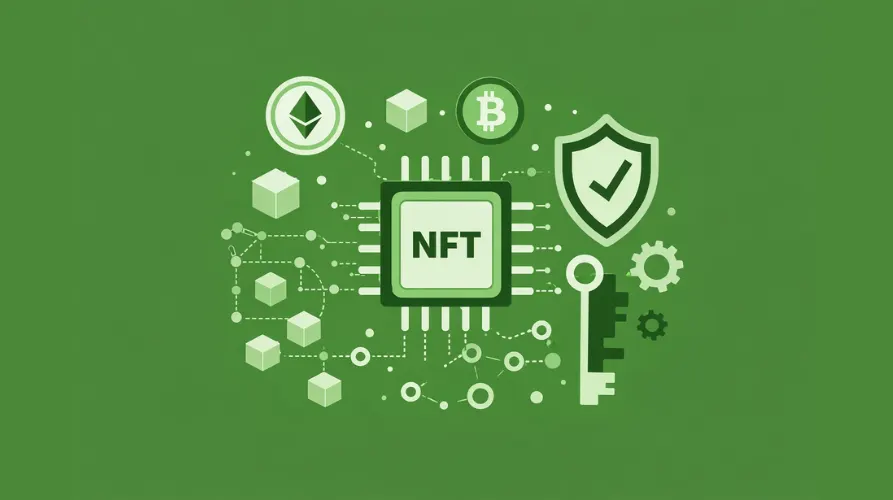
Understanding dynamic NFT technology requires looking at three core components that work together: smart contracts, oracles, and metadata storage. Each plays a distinct role in making the “dynamic” part possible.
1. Smart Contracts as the Decision Engine
The smart contract is the brain of a dynamic NFT. It contains the rules that determine when and how metadata should change. When a user or an external system queries the NFT, the smart contract evaluates both on-chain and off-chain data to decide what version of the metadata to return. For instance, if a dNFT is tied to a basketball player’s stats, the smart contract checks whether a specific performance threshold has been crossed before triggering a visual upgrade.
These contracts are typically built on the ERC-721 or ERC-1155 token standard on Ethereum, or similar standards on other blockchains. ERC-1155 is particularly useful for dNFTs because it supports both fungible and non-fungible tokens within a single contract and allows batch transfers, which reduces gas costs and improves efficiency for projects that involve multiple changing assets.
2. Oracles as the Bridge to Real World Data
Blockchains are isolated systems. They cannot natively access data from the outside world, whether that is weather information, sports scores, stock prices, or IoT sensor readings. This is where oracles come in. Oracles are services that connect blockchains to external systems, fetching real-world data and delivering it to smart contracts in a format they can process.
Chainlink is the most widely used oracle network for dynamic NFTs. It provides three key services that power dNFT functionality: Data Feeds for bringing off-chain information on-chain, Automation (formerly Keepers) for triggering smart contract functions when predefined conditions are met, and VRF (Verifiable Random Function) for generating provably fair random numbers used in things like randomized trait generation or item drops.
Without oracles, dynamic NFTs would be limited to responding only to on-chain events. Oracles are what allow a dNFT to change based on real-world sports data, environmental conditions, market prices, or any other external variable.
3. Metadata Storage and Updates
The metadata of an NFT describes its characteristics. For a game character, this might include strength, agility, visual appearance, and equipment. For a real estate NFT, it could include property value, ownership records, and maintenance history. In a dynamic NFT, this metadata is stored in a way that allows selective updates without altering the token’s core identity.
Some projects store metadata on-chain for full transparency and immutability of the update history. Others use decentralized storage solutions like IPFS or Arweave, where the smart contract points to a metadata URI that can be updated when conditions change. The choice between on-chain and off-chain metadata storage involves tradeoffs between cost, speed, and transparency that each development team must evaluate based on its specific needs.
Recommended Reading:
Static NFTs vs Dynamic NFTs: What Sets Them Apart
The easiest way to understand dynamic NFTs is to compare them directly with static NFTs. Both are built on blockchain technology, and both establish verifiable ownership of unique digital assets. But the similarities largely end there.
Static NFTs represent a single, unchanging version of a digital asset. Once the creator mints the token and attaches metadata to it, everything is locked. The image stays the same, the description remains fixed, and the traits are permanent. This model works perfectly for things like one-of-a-kind digital artworks, where the whole point is that the piece exists exactly as the artist intended, forever. CryptoPunks, for example, are static NFTs that derive their value from historical significance and rarity, and they would not benefit from being dynamic.
Dynamic NFTs, on the other hand, are built for scenarios where change is not just acceptable but necessary. A game character that never improves is boring. A sports collectible that cannot reflect updated stats feels incomplete. A property deed that cannot record new ownership or renovation data is less useful than a paper document. Dynamic NFTs address all of these limitations by allowing metadata to evolve while the token itself remains unchanged on the blockchain.
Static NFTs vs Dynamic NFTs: Feature Comparison
| Feature | Static NFTs | Dynamic NFTs (dNFTs) |
|---|---|---|
| Metadata | Permanently fixed after minting | Can update based on external conditions |
| Token Standard | Primarily ERC-721 | ERC-721 or ERC-1155 (preferred) |
| Smart Contract Logic | Basic minting and transfer functions | Advanced logic with conditional triggers |
| Oracle Dependency | Not required | Often required for off-chain data |
| Best Use Cases | Digital art, PFPs, collectibles | Gaming, sports, real estate, identity |
| Interactivity | View only, no user interaction | Responds to user actions and events |
| Gas Costs | One-time minting fee | Ongoing costs for metadata updates |
Real World Use Cases of Dynamic NFTs
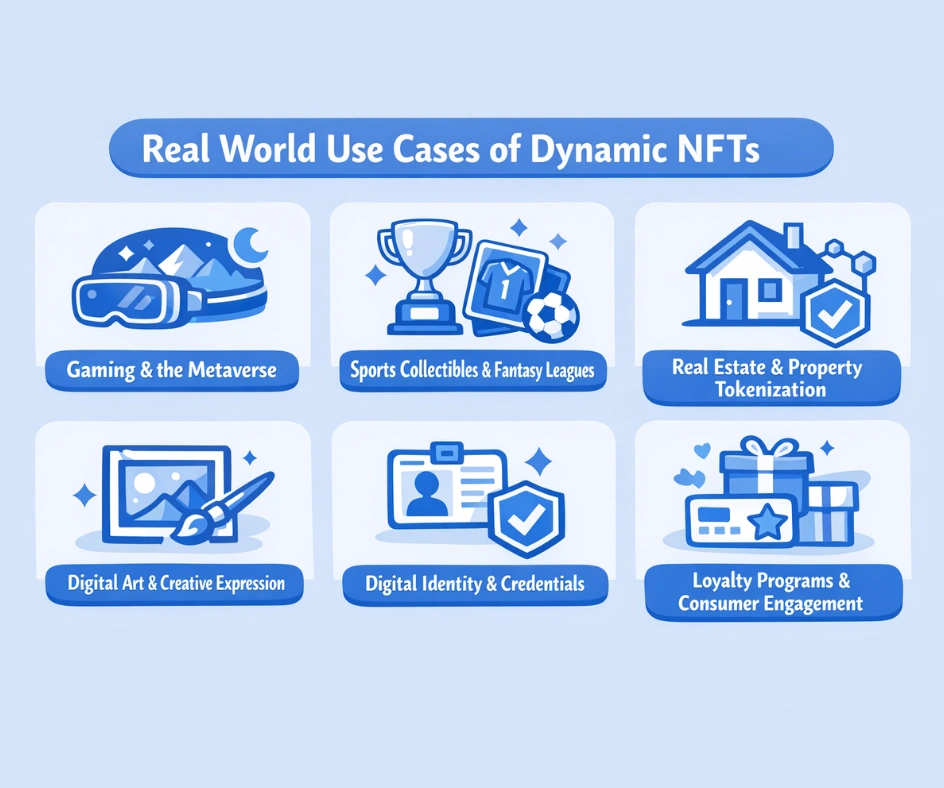
The true power of dynamic NFT technology becomes clear when you look at where it is already being applied. Far from being a theoretical concept, dNFTs are solving real problems across several major industries.
1. Gaming and the Metaverse
Gaming is the largest and most natural use case for dynamic NFTs. In traditional games, characters gain experience, unlock abilities, and acquire new equipment as the player progresses. With dNFTs, all of these changes can be recorded directly in the token’s metadata. A sword that starts as a basic weapon can become a legendary item as the player completes quests, with each upgrade permanently reflected on the blockchain. Gaming NFTs account for 38% of global NFT transactions, and the intersection of dNFTs with play-to-earn models is driving significant development activity in the space.
In metaverse environments like Decentraland and The Sandbox, dynamic NFTs can represent virtual land parcels whose properties change based on what the owner builds, how many visitors they attract, or what events take place there. This creates a living, breathing digital world where assets are not just owned but actively evolving.
2. Sports Collectibles and Fantasy Leagues
Sports is where some of the most well-known dNFT implementations have already launched. NBA player LaMelo Ball released eight different dynamic NFTs, each tracking a different set of his in-game stats like rebounds, assists, and points scored. When he reaches certain milestones, the NFTs change visually. For example, the Gold Change NFT carried a condition: if LaMelo won Rookie of the Year, the image would transform entirely. He won, and the NFT changed.
Sorare, a fantasy football platform, uses dynamic NFTs to represent player cards whose value and appearance fluctuate based on real-world performance. This creates a fantasy league experience where the cards themselves are living assets tied to actual game outcomes, powered by oracle-fed data from real matches.
3. Real Estate and Property Tokenization
Real estate is an industry built on records that change constantly. Properties are bought, sold, renovated, insured, and revalued. A dynamic NFT can represent a property and be programmed to update all associated records by pulling off-chain data through oracle services. Ownership transfers, renovation histories, insurance status, and current market valuations can all be reflected in the token’s metadata in real time. This makes property records more transparent and accessible than paper-based systems or centralized databases.
4. Digital Art and Creative Expression
Artists are using dynamic NFTs to create works that respond to the world around them. Async Art is a platform where artists create programmable art that can change appearance based on external inputs or decisions made by the token holders. Beeple’s “Crossroads” NFT famously changed its visual representation depending on the outcome of a U.S. election, demonstrating how art can become a living commentary on current events. The Living Tree project created a single NFT that evolves based on actual environmental data, including temperature and humidity, turning climate data into a visual narrative.
5. Digital Identity and Credentials
Dynamic NFTs can represent a person’s digital identity, storing data such as educational qualifications, professional certifications, employment history, and even social reputation scores. Unlike traditional static credentials, a dNFT-based identity document can update automatically when the holder earns a new degree, completes a certification, or changes their contact information. This eliminates the need to reissue identity documents and provides a verifiable, tamper-proof record of a person’s evolving credentials.
6. Loyalty Programs and Consumer Engagement
Brands are exploring dNFTs as the backbone of next-generation loyalty programs. Instead of static rewards cards, a dynamic NFT can evolve based on a customer’s spending patterns, interactions, and engagement level. The NFT could unlock progressively better rewards, change appearance to reflect loyalty tier status, or grant access to exclusive experiences as the holder’s relationship with the brand deepens. This creates a more engaging and personalized rewards experience compared to traditional point-based systems.
Recommended Reading:
Notable Dynamic NFT Projects and Examples
Several pioneering projects have already demonstrated the potential of dynamic NFTs in the real world. These examples show how the technology moves from concept to execution across different domains.
1. LaMelo Ball Dynamic NFTs
As mentioned earlier, LaMelo Ball’s collection is one of the most cited examples of dNFTs in action. Each of his eight NFTs tracks different basketball statistics that are constantly updated on-chain. The smart contracts powering these tokens are connected to sports data oracles that feed real game performance data into the blockchain, triggering visual and functional changes based on predefined thresholds.
2. Regenerative Resources (RRC) Short Film NFTs
RRC launched five dynamic Short Film NFTs designed by prominent artists, with proceeds used to seed and grow 100 million mangroves. Each Short Film NFT starts with only a single frame displayed. Every time the NFT is bought or resold, more frames are released in a continuous process until the holder can view the entire short film. This creative use of dynamic metadata turns the NFT trading process itself into an art experience.
3. Art Blocks and Generative Dynamic Art
Art Blocks is a Web3 platform for generative art that uses dNFT technology to create pieces existing at the intersection of computer programming and visual expression. Many of these NFTs change over time or respond to user interaction. The Chromie Squiggle collection, for instance, uses dNFT technology to animate when clicked, creating an interactive art experience that goes beyond what a static image could offer.
4. CryptoKitties
One of the earliest NFT projects on Ethereum, CryptoKitties featured virtual cats that could breed and produce offspring with inherited traits. While not purely a dNFT in the modern definition, CryptoKitties demonstrated the concept of NFTs whose properties can change through user interaction, laying the groundwork for the dynamic NFT movement that followed.
5. Aavegotchi
Aavegotchi combines DeFi mechanics with dynamic NFT gaming. Each Aavegotchi is a dNFT that represents a ghost-like avatar whose traits are influenced by the amount and type of staked DeFi tokens. As players interact with their Aavegotchis, care for them, and participate in the ecosystem, the NFTs change and grow, blending financial utility with gaming engagement in a way that static NFTs simply cannot achieve.
The Role of Token Standards in Dynamic NFT Development
Token standards define the rules that govern how NFTs are created, transferred, and managed on a blockchain. For dynamic NFTs, choosing the right standard is a fundamental development decision that affects everything from gas costs to the types of metadata changes that are possible.
1. ERC-721: The Original NFT Standard
ERC-721 was the first standard designed specifically for non-fungible tokens on Ethereum. It was introduced through an Ethereum Improvement Proposal in 2017 and popularized by CryptoKitties. Under ERC-721, each token has a unique token ID, and each collection is managed by a single smart contract. The standard provides functions for transferring ownership, checking balances, and approving third-party transfers. While ERC-721 can be used for dynamic NFTs by pointing the metadata URI to an updateable source, the standard itself was designed primarily for static tokens.
2. ERC-1155: The Multi-Token Standard
ERC-1155 was developed by the Enjin team and introduced to address several limitations of ERC-721, particularly for gaming use cases. Unlike ERC-721, where each token type requires a separate smart contract, ERC-1155 allows a single contract to manage an infinite number of token types, both fungible and non-fungible. It supports batch transfers, which means multiple tokens can be sent in a single transaction, reducing gas costs by up to 90% compared to sending them individually under ERC-721. ERC-1155 also supports semi-fungible tokens, which start as fungible items (like concert tickets) and convert to non-fungible collectibles after an event.
3. Emerging Standards: ERC-6551 and ERC-7857
Newer standards are pushing dynamic NFT technology even further. ERC-6551, which went mainstream in 2025, allows NFTs to own other assets and identities, essentially giving each NFT its own smart contract wallet. This enables complex compositions where a game character NFT could “own” its weapon NFTs, armor NFTs, and even token balances. ERC-7857 targets intelligent NFTs (iNFTs) that can link with AI models, upgrade over time, and exhibit evolving attributes. These emerging standards are expanding what is possible with dynamic digital assets.
Token Standards Comparison for Dynamic NFTs
| Token Standard | Key Characteristics | Best Suited For |
|---|---|---|
| ERC-721 | One unique token per contract, individual transfers, widely adopted | Static art, single collectibles, simple dNFTs |
| ERC-1155 | Multi-token support, batch transfers, fungible and non-fungible in one contract | Gaming items, complex dNFT ecosystems, metaverse assets |
| ERC-6551 | NFTs can own other assets, token-bound accounts, and composable ownership | Character inventories, nested assets, complex identity systems |
| ERC-7857 | AI-linked NFTs, evolving attributes, intelligent metadata updates | iNFTs, AI-powered art, adaptive digital assets |
| ERC-998 | Composable tokens, NFTs that can hold other NFTs or fungible tokens | DeFi bundles, virtual land with buildings, multi-layer collectibles |
The Market Landscape for Dynamic NFTs
The broader NFT market has matured significantly from the speculative frenzy of earlier cycles. According to market research data, the global NFT market was valued at approximately USD 43.08 billion in 2025, with projections suggesting growth toward USD 247 billion by 2029. Within this broader ecosystem, dynamic NFTs are carving out a rapidly growing niche.
The dynamic NFT market specifically was valued at USD 693.1 million in 2025, with projections showing it could reach USD 12,094.2 million by 2035 at a compound annual growth rate of 33.1%. Gaming and metaverse applications dominate the dNFT space with approximately 30% of the market share, followed by digital art and collectibles.
Ethereum continues to power roughly 62% of all NFT transactions, but alternative blockchains like Solana (handling about 18% of transactions), Polygon (approximately 11% of minting activities), and BNB Chain (around 6% market share) are gaining traction, particularly for projects that need lower fees and faster processing times.
The shift toward utility-driven NFTs is one of the most significant trends shaping the market. More than half of top-selling NFTs now include functional features beyond simple ownership, and around 30% of new NFT projects incorporate AI technology, creating intelligent NFTs that combine blockchain provenance with AI adaptability. Dynamic NFTs with updatable metadata are increasingly being adopted in education and health tech sectors, signaling expansion well beyond the traditional art and collectibles space.
Recommended Reading:
Benefits of Dynamic NFTs for Creators and Businesses
Dynamic NFTs offer a range of advantages that make them attractive for creators, developers, and businesses looking to build on blockchain technology. Here are the most impactful benefits.
1. Deeper User Engagement
When an NFT can change based on how a user interacts with it, it creates an ongoing relationship between the holder and the asset. Game characters that grow stronger, loyalty tokens that unlock better rewards, and art pieces that respond to their environment all give holders reasons to stay engaged over time rather than simply holding a static asset.
2. New Revenue Streams
Dynamic metadata opens up monetization opportunities that static NFTs cannot offer. Creators can design dNFTs with premium upgrade paths, seasonal content updates, or conditional features that unlock new value over time. Each evolution of the token can drive secondary market activity, generating royalty income for the original creator.
3. Real World Asset Representation
Physical assets like property, vehicles, and luxury goods have values and conditions that change constantly. Dynamic NFTs can serve as digital twins for these assets, maintaining up-to-date records that are transparent and verifiable on the blockchain. This is particularly valuable for industries like real estate, insurance, and supply chain management, where accurate, current data is essential.
4. Programmable and Automated Processes
Because dNFTs are governed by smart contracts, many of the processes that would normally require manual intervention can be fully automated. Royalty distributions, reward unlocks, stat updates, and visual transformations all happen automatically when the predefined conditions are met, without any middleman or administrative overhead.
5. Future-Proof Digital Assets
A static NFT is frozen in the moment it was created. A dynamic NFT can adapt to new developments, making it a more useful and enduring asset. As standards evolve, as new data sources become available, and as the needs of holders change, dNFTs have the flexibility to remain useful rather than becoming obsolete.
Challenges and Considerations in Dynamic NFT Development
While the potential of dNFTs is enormous, the development of dynamic NFT technology is not without its challenges. Understanding these hurdles is important for anyone planning to build or invest in dNFT projects.
1. Higher Gas Costs from Frequent Updates
Every time a dynamic NFT’s metadata is updated on-chain, it requires a blockchain transaction that costs gas fees. For dNFTs that update frequently, such as those tied to live sports data or real-time market prices, these costs can accumulate quickly. Developers must carefully balance the frequency of updates against the cost of executing them, especially on networks like Ethereum, where gas fees can spike during periods of high congestion.
2. Oracle Reliability and Trust
Since dynamic NFTs depend on external data delivered through oracles, the accuracy and reliability of that data are critical. A faulty oracle feed could trigger incorrect metadata changes, potentially affecting the value or functionality of a dNFT. This is why most serious dNFT projects rely on established oracle networks like Chainlink that provide decentralized data verification rather than single-source data feeds.
3. Smart Contract Complexity
Dynamic NFTs require more sophisticated smart contract logic than static NFTs. The contracts must handle conditional logic, interact with Oracle feeds, manage state changes, and potentially interface with multiple external systems. This increased complexity raises the risk of bugs or vulnerabilities, making thorough auditing and testing essential before any dNFT project goes live.
4. User Understanding and Adoption
The concept of an NFT that changes after minting can be confusing for mainstream users who are still getting comfortable with the basic idea of digital ownership. Clear communication about what changes are possible, how they are triggered, and what the holder can expect is essential for building trust and driving adoption of dNFT products.
5. Regulatory Uncertainty
The regulatory landscape for NFTs is still evolving globally. Dynamic NFTs that change properties based on external conditions could potentially be classified differently from static NFTs under certain regulatory frameworks. Projects should stay informed about developments in regions like the EU (where MiCA regulations apply) and the United States, where classification rules for digital assets continue to be refined.
How to Build a Dynamic NFT: The Development Process
For developers and businesses interested in creating dNFTs, the development process involves several key steps. While specific implementation details vary based on the blockchain and use case, the general approach follows a consistent pattern.
1. Define the Asset and Its Variables
Start by clearly identifying what the NFT represents and which of its properties should be dynamic. A game character might have changeable stats and appearance, while a real estate NFT might update ownership records and valuation data. Documenting which metadata fields will be fixed and which will be dynamic is a critical first step that shapes all subsequent development decisions.
2. Choose Your Blockchain and Token Standard
Select the blockchain network that best fits your project’s needs for transaction speed, cost, ecosystem support, and developer tooling. Ethereum remains the dominant choice for NFT development, but Solana, Polygon, and BNB Chain offer compelling alternatives for specific use cases. Choose between ERC-721 and ERC-1155 (or equivalent standards on non-Ethereum chains) based on whether you need single-token or multi-token functionality.
3. Write and Audit the Smart Contract
Develop the smart contract logic that defines how and when metadata changes should occur. This includes coding the conditional triggers, integrating with Oracle services for off-chain data, and establishing the rules for metadata updates. Given the increased complexity of dNFT contracts compared to static NFTs, professional security auditing is strongly recommended before deployment.
4. Integrate Oracle Services
If your dNFT needs to respond to real world data, set up the oracle connections that will deliver that data to your smart contract. This typically involves configuring data feeds, setting up automation triggers, and testing the end-to-end flow from an external data source through Oracle to the smart contract to the metadata update.
5. Test, Deploy, and Monitor
Test the dNFT thoroughly on a testnet to verify that metadata updates are triggered correctly under all expected conditions. Once satisfied, deploy to mainnet and set up monitoring to track gas costs, oracle performance, and user interactions. Dynamic NFTs require ongoing attention to ensure they continue functioning as intended as external conditions change.
Dynamic NFT Implementations in the Real World
The following projects reflect how dynamic NFT architecture and blockchain development principles are already being applied across gaming, NFT marketplaces, and digital asset ecosystems. Each implementation showcases the same development concepts discussed throughout this article, from smart contract logic and token standards to community-driven engagement and interactive digital assets.
🖼️
LooksRare: Community-Driven NFT Marketplace
Developed a community-centered NFT marketplace that redistributes 100% of protocol fees back to the NFT community. The platform supports dynamic listing options including floor-based pricing and flexible USD-based listings that respond to market conditions, alongside bulk buying and listing tools that enable efficient trading of evolving digital asset collections.
Build Your Dynamic NFT Project Today:
We bring 8+ years of blockchain expertise to NFT development. Our specialized team handles everything from smart contract creation and oracle integration to multi-chain deployment, ensuring your dynamic NFTs are built for performance, security, and long-term engagement. Whether you need gaming dNFTs, tokenized real-world assets, or interactive digital collectibles, we deliver solutions that work.
Final Thoughts
Dynamic NFTs represent a fundamental shift in how we think about digital ownership. While static NFTs proved that unique digital assets could exist and hold value on the blockchain, they were limited by their inability to change. Dynamic NFTs remove that limitation, creating tokens that can evolve, respond, and adapt while maintaining the same immutable identity and provenance guarantees that make NFTs valuable in the first place.
The technology behind dNFTs, built on smart contracts, oracle networks, and flexible token standards like ERC-1155, is already mature enough to power real-world applications. From LaMelo Ball’s performance-linked basketball cards to regenerative environmental projects, from blockchain gaming economies to tokenized real estate records, dNFTs are solving actual problems across multiple industries.
With the dynamic NFT market projected to grow at a CAGR of 33.1% over the next decade and the broader NFT ecosystem moving firmly toward utility-driven applications, the trajectory is clear. Businesses, creators, and developers who understand and embrace dynamic NFT technology now will be best positioned to build the next generation of digital experiences that are interactive, personalized, and genuinely useful.
Whether your interest is in gaming, art, sports, identity, real estate, or any other domain where assets change over time, dynamic NFTs offer a powerful and flexible foundation. The era of static digital ownership is giving way to something far more interesting, and the projects being built on dNFT technology today are just the beginning of what is possible.
Frequently Asked Questions
Q1.What is a dynamic NFT?
A dynamic NFT (dNFT) is a non-fungible token whose metadata can change after it has been minted on the blockchain. These changes are triggered through smart contracts that respond to external conditions such as real-world data, user interactions, or on-chain events. The token itself retains its unique ID and ownership history, but the visual appearance, stats, or other properties attached to it can evolve over time based on rules defined by the creator.
Q2.How do dynamic NFTs differ from regular NFTs?
Regular (static) NFTs have metadata that is permanently fixed once the token is minted. The image, description, and traits never change. Dynamic NFTs, on the other hand, include smart contract logic that allows specific metadata fields to be updated when predefined conditions are met. This makes dNFTs more interactive and better suited for use cases where data changes over time, such as gaming, sports collectibles, and tokenized real-world assets.
Q3.What are the main use cases for dynamic NFTs?
The most prominent use cases include blockchain gaming (where characters and items evolve based on player progress), sports collectibles (where stats update based on real game performance), real estate tokenization (where property records update in real time), digital art (where pieces respond to environmental data or viewer interaction), digital identity (where credentials update as qualifications change), and loyalty programs (where rewards evolve based on customer engagement).
Q4.What role do oracles play in dynamic NFTs?
Oracles serve as the bridge between blockchains and the outside world. Since blockchains cannot natively access external data, oracles fetch information from real-world sources (like sports scores, weather data, or market prices) and deliver it to smart contracts in a format they can process. For dynamic NFTs, oracle networks like Chainlink provide the data feeds and automation services that trigger metadata changes when specific conditions are met in the real world.
Q5.Which token standard is best for dynamic NFTs?
ERC-1155 is generally considered the better choice for dynamic NFT development because it supports both fungible and non-fungible tokens within a single contract, allows batch transfers that reduce gas costs, and offers greater flexibility for managing multiple token types. However, ERC-721 can also be used for simpler dNFT implementations. Newer standards like ERC-6551 and ERC-7857 are extending functionality even further for advanced use cases involving composable and AI-linked NFTs.
Q6.Are dynamic NFTs more expensive to create than static NFTs?
Yes, dynamic NFTs typically involve higher development and operational costs compared to static NFTs. The smart contract logic is more complex, requiring additional development time and professional security auditing. Ongoing gas costs are incurred each time metadata is updated on-chain. Integration with Oracle services may involve subscription or usage fees. However, these increased costs are offset by the greater utility, engagement potential, and long-term value that dynamic NFTs can deliver for both creators and holders.
Explore Services
Related Services
Reviewed by

Aman Vaths
Founder of Nadcab Labs
Aman Vaths is the Founder & CTO of Nadcab Labs, a global digital engineering company delivering enterprise-grade solutions across AI, Web3, Blockchain, Big Data, Cloud, Cybersecurity, and Modern Application Development. With deep technical leadership and product innovation experience, Aman has positioned Nadcab Labs as one of the most advanced engineering companies driving the next era of intelligent, secure, and scalable software systems. Under his leadership, Nadcab Labs has built 2,000+ global projects across sectors including fintech, banking, healthcare, real estate, logistics, gaming, manufacturing, and next-generation DePIN networks. Aman’s strength lies in architecting high-performance systems, end-to-end platform engineering, and designing enterprise solutions that operate at global scale.