Ai Overview
Smart contract design is the structured process of taking a real-world rule or use-case and planning exactly how that rule becomes code that runs reliably on a blockchain. In the first half of 2025 alone, over $3 billion in Web3 assets were lost due to hacks and bugs related to smart contracts and other vulnerabilities. As of 2025, major audited smart contract projects represent over $100 billion in market cap, showing the economic impact of well-designed blockchain systems.
Key Takeaways
- Smart contract design is essential because contracts handle real funds and cannot be changed once deployed
- Defining roles, mapping data flows, and planning error handling helps prevent costly mistakes and vulnerabilities
- Choosing the right execution model and breaking contracts into clear responsibilities enhances performance and gas efficiency
- Secure contract calls, proper data modeling, and thorough testing ensure predictable behavior in all scenarios
- Planning for upgrades and emergency controls allows contracts to evolve without risking user funds
- Best practices, trusted libraries, and audits strengthen credibility within the blockchain ecosystem
- Good smart contract design balances security, usability, cost, and long-term project success
Smart contracts are programs on blockchains that automatically carry out rules, like paying someone when goods are delivered or releasing tokens after a vote. They may sound simple, but creating them correctly needs careful planning and testing. A poorly made contract can lose money, have security problems, or behave unexpectedly. That is why understanding smart contract design is very important.
Good design makes contracts safe, efficient, and easy to manage. Developers follow proven patterns and best practices to ensure contracts work exactly as they should. This article explains what smart contract design is, why it matters, how contracts are built, and how to choose the right design for your project
What is Smart Contract Design?
Smart contract design is the structured process of taking a real-world rule or use-case and planning exactly how that rule becomes code that runs reliably on a blockchain.
Unlike ordinary software, once a smart contract is deployed, it’s very hard and sometimes impossible to change. That means design is not just a technical step: it’s a risk-management decision.
Smart contract design includes:
- Breaking down what the system must do
- Defining who can do what
- Planning how data and money move
- Anticipating errors and attacks
- Structuring contracts for future changes
In other words, it’s turning business logic into deterministic, predictable computer logic.
Smart contracts are being used more and more today. According to Fortune Business Insights, Many industries not just finance, are now using them. Areas like supply chain, healthcare, and legal systems are adopting smart contracts to automate work and reduce errors. The smart contracts market size is expected to reach around $12.07 billion by 2032. As this market grows so fast, the need for well-designed and secure smart contracts becomes even more important.
Why Should You Use Smart Contract Design?
Building a smart contract without thoughtful design is like building a bridge without architectural plans; it might stand for a while, but a tiny flaw can break everything. This principle applies equally to digital experiences, where businesses based in Grantham invest in Grantham web design services and must prioritize structure and planning from the start.
Here’s why smart contract design matters:
1. Prevent Costly Mistakes Before Deployment
Smart contracts control real money. Bugs can drain all funds instantly, and because they are immutable, you can’t simply “patch” them like normal software.
According to recent security statistics, smart contract vulnerabilities contributed to hundreds of millions to billions of dollars in losses across blockchain ecosystems. In the first half of 2025 alone, over $3 billion in Web3 assets were lost due to hacks and bugs related to smart contracts and other vulnerabilities.[2]
When designers plan carefully:
- They think through how functions interact
- They model attacks and misuse
- They prevent logic that could be exploited
A thorough design drastically cuts the chance of losing assets.
2. Make Audits More Effective
Audits are critical in blockchain security. Independent auditors read your design before reading your code to understand intended behavior. A clear design document helps auditors know what they are checking against.
Without design specs, even experienced auditors can miss flaws, or demand costly rewrites.
3. Improve Performance and Cost Efficiency
Smart contracts run on blockchains like Ethereum, where every network action costs gas (money). Good design optimizes how frequently and how data is stored and moved, reducing unnecessary gas costs and making user interactions cheaper.
Too many on-chain state changes or complex workflows increase user costs and make the system less attractive.
4. Prepare for Future Upgrades
Many smart contracts must evolve after deployment. Thoughtful design includes planning for upgrades using techniques like proxy patterns or modular architectures. Contracts built with upgrade-friendly designs are easier and safer to enhance later. By leveraging platforms like DesignLoop Studio, teams can also access unlimited design, development, and AI-powered services to support scalable architecture planning, streamline updates, and ensure consistent performance across evolving blockchain projects.
As of 2025, major audited smart contract projects represent over $100 billion in market cap, showing the economic impact of well-designed blockchain systems.
5. Build Trust With Users and Partners
Good design documents, paired with auditing and testing, build confidence in users, developers, and investors. When people can see how the system works, and how risks were mitigated, adoption grows faster.
How Smart Contracts Are Designed and Built End to End
Smart contracts are built step by step, starting from planning and ending with deployment. Each step focuses on clarity, safety, and long term use because smart contracts handle real value.
Translating Real World Logic Into Deterministic Code
Real life rules are converted into clear blockchain rules. Smart contracts remove confusion so that the same action always gives the same result on the network.
Identifying trust boundaries before writing any contract code
- Decide who can use the contract
- Choose which actions are open or restricted
- Define admin and user roles clearly
- Identify trusted external data sources
- Plan protection against misuse
Converting off chain rules into on chain constraints
- Select rules that must run on chain
- Keep manual or heavy checks off chain
- Use proofs for off chain results
- Secure important actions on chain
Choosing the Right Contract Execution Model
Every contract works differently. Choosing the right execution style helps reduce fees, improve speed, and keep the contract safe and easy to manage.
Stateless calls versus state heavy workflows
- Stateless calls only read data
- They cost less and are simple
- State heavy actions change storage
- They increase fees and risk
- Good design limits state changes
When single contract systems fail at scale
- Large contracts are hard to manage
- Small changes cause new issues
- Fees increase with complexity
- Upgrades become difficult
Contract Decomposition and Responsibility Isolation
Breaking the system into smaller contracts makes it easier to manage. Each contract has one clear role, which improves security and simplifies future changes.
Separating financial logic from permission logic
- One contract handles funds
- Another controls access
- Bugs cause less damage
- Reviews become easier
Avoiding tightly coupled contract responsibilities
- Use clear communication rules
- Avoid shared internal data
- Updates do not break others
- Systems stay flexible
Data Modeling for Long Lived Smart Contracts
Smart contracts store data for many years. Proper data planning helps protect user information and ensures the contract can grow without breaking existing data.
Designing storage layouts for future upgrades
- Plan data structure early
- Document storage clearly
- Keep space for new data
- Avoid changing order
Preventing state corruption during feature expansion
- Protect old data
- Support previous versions
- Add checks for changes
- Test updates carefully
Secure Interaction With External Contracts
Smart contracts often interact with other contracts or services. Secure design ensures these interactions do not put funds or data at risk.
Managing external calls without reentrancy exposure
- Update data before calls
- Limit external interactions
- Use safe coding patterns
- Protect sensitive actions
Handling failures and partial execution safely
- Expect external failures
- Revert safely on errors
- Avoid half completed actions
- Keep contract stable
Testing and Simulation Before Production Deployment
Testing confirms the contract works correctly. It checks normal use and failure cases to make sure the contract behaves safely in all situations.
Modeling failure paths during test execution
- Test wrong inputs
- Test missing data
- Test empty values
- Test limit cases
Simulating adversarial transaction ordering
- Test front running cases
- Check transaction order changes
- Reduce unfair advantages
- Improve user safety
Production Deployment and Risk Acceptance
Once deployed, smart contracts carry real risk. Teams must understand limits and plan safety measures to handle problems after launch.
Understanding what cannot be changed post deployment
- Identify fixed logic
- Review permanent code
- Keep core rules simple
Establishing emergency control assumptions
- Decide who can pause
- Limit emergency power
- Plan safe recovery
- Avoid misuse
From Idea to Deployment Build Smart Contracts End to End
Nadcab Labs designs and builds smart contracts step by step, covering requirements, architecture, coding, testing, and deployment so your blockchain applications remain secure, scalable, and reliable.
How To Choose The Right Smart Contract Design?
Choosing the right smart contract design is a trade off between safety, cost, speed, and flexibility. Here’s how to choose wisely.
Start from the user story
Who uses the contract, and how? A simple token that only transfers between users needs a far simpler design than a leveraged DeFi product with swaps and liquidations.
Design should follow the complexity of real usage:
- High-value financial flows → conservative, audited, modular design with multisig controls.
- Low-risk utility features → simpler design focused on gas efficiency.
Decide acceptable risk and map controls
For each risk, decide how much you are willing to accept. For example, a protocol handling millions in TVL (Total Value Locked) should accept near-zero risk for funds theft. TVL is a common metric for risk exposure in DeFi; many protocols with high TVL face disproportionately higher attack incentives. (DeFi dashboards such as DeFiLlama track TVL across protocols and chains.)[3]
Choose execution model by cost vs function
If you must store a lot of history (positions, trades), a state-heavy model is necessary. If not, prefer stateless computations and aggregate state periodically to reduce gas.
Prefer modularity early
Even for small projects, I prefer separating core parts. It’s easier to compose than to split later. Monolithic contracts may seem faster to ship but fail badly during audits and upgrades.
Select upgradeability only when necessary — and plan it
Upgrades let you fix bugs, but they add complexity and trust assumptions (who can upgrade?). If you need upgrades:
- Use transparent or UUPS proxy patterns with clear governance.
- Publish upgrade plans and use timelocks/multisigs.
- Keep storage layout documented and minimal.
If immutability is a key selling point, avoid proxies; ensure initial code is final and well-audited.
Match tooling and language to your chain
Different chains and languages have different guarantees and tooling:
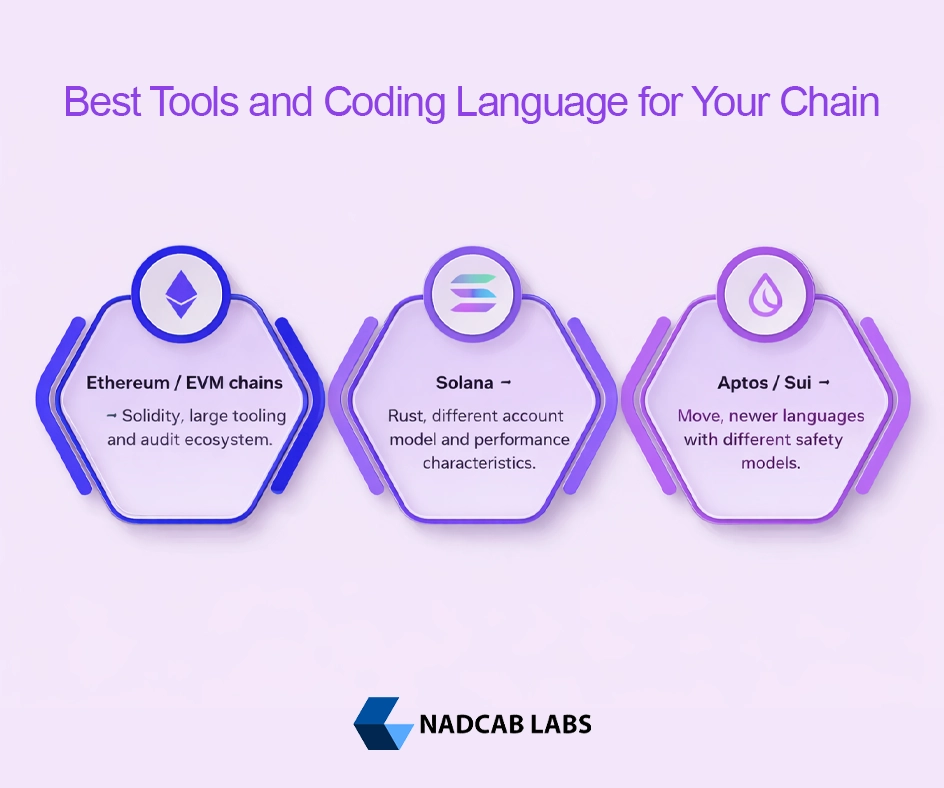
- Ethereum / EVM chains → Solidity, large tooling and audit ecosystem.
- Solana → Rust, different account model and performance characteristics.
- Aptos / Sui → Move, newer languages with different safety models.
Your team should pick languages and tools they’re comfortable with and that suit your performance and security needs.
Use proven libraries and patterns
Don’t reinvent standards. Use audited libraries like OpenZeppelin for tokens, access control, and math utilities. These libraries remove common pitfalls for standard functions and save audit time. For critical, unique logic, approach carefully and document decisions.[5]
Practical Smart Contract Design Examples
Below are common patterns and small design examples in simple language.
Example: Simple staking contract (high-level design)
Goal: Users stake tokens and earn rewards.
Design decisions:
- Separate token (ERC-20) and staking logic into two contracts.
- Vault contract holds staked tokens.
- Rewards calculated off-chain each epoch and claimed on-chain to reduce gas.
- Pause function in staking contract for emergencies (only multisig).
- Storage layout: userBalance, totalStaked, rewardIndex, userIndex (reserve slots for future fields).
Why this design:
- Separation reduces blast radius. If the reward logic has a bug, core funds are in the vault.
- Off-chain reward calc reduces expensive on-chain loops.
Example: DEX order settlement (high-level)
Goal: Match and settle token swaps.
Design decisions:
- Use stateless matching engine off-chain, on-chain settlement contract for final transfer.
- Smart contract verifies signatures and balances, and then atomically transfers tokens.
- Settlement is stateless: it only validates and executes final token movements.
Why this design:
- Matching off-chain reduces gas and complexity.
- Settlement contract only needs to trust signatures, simplifying audit.
Common Design Pitfalls and How to Avoid Them
1) Overloading a single contract with too many roles
Problem: One big contract does everything: logic, storage, admin functions. Fix: Break responsibilities into smaller contracts and use clear interfaces.
2) Poor storage planning
Problem: Reordering or adding variables later corrupts storage when upgrading. Fix: Reserve storage slots and document variable ordering. Use standardized upgrade patterns.
3) Trusting off-chain data without safeguards
Problem: Oracle manipulation or stale data causes wrong decisions. Fix: Use multiple sources, TWAPs (time-weighted average price), and sanity checks.
4) Ignoring gas costs during design
Problem: Users face high fees; some operations fail. Fix: Model expected usage and optimize hot paths.
5) No recovery or emergency path
Problem: When something breaks, there’s no safe way to limit damage. Fix: Include pause, timelocked governance, and clear emergency processes, but use them sparingly.
Security and Audits
Security is a combination of code quality, a correct design, and external review.
Audits
Audits combine automatic tools and human review. Studies of thousands of audit reports show audits reduce the chance of post-launch vulnerabilities but are not a guarantee. Include spec documents, tests, and threat models with any audit, these make an audit more effective.
Known vulnerability classes
Top problems causing loss include access control mistakes, logic errors, reentrancy, and oracle manipulation. OWASP and industry reports list these as the most damaging. Design for defensive coding and minimal trusted dependencies.[4]
Real-world losses and why design matters
In recent years, the blockchain space saw large thefts and losses from design and implementation mistakes. Industry reports show billions lost across many incidents in a single year, this demonstrates both the value at stake and why good design + auditing is non-negotiable. For instance, 2024 saw a large set of on-chain security incidents with total losses in the low billions.[6]
Testing and Simulation – How to Prove the Design Works
Testing should mirror the threat model. Steps include:
Unit tests and integration tests
- Unit tests check small pieces (function logic).
- Integration tests validate the whole contract system with mocks for external calls.
Property-based tests
Instead of only fixed inputs, property tests check invariants across many random cases (e.g., total supply is always conserved).
Failure scenario tests
Test what happens on failures, oracle downtime, failed transfers, gas limits reached.
Adversarial simulations and MEV testing
Attackers can reorder transactions to profit (MEV – Miner/Maximal Extractable Value). Simulate transaction ordering and front-running in tests to ensure the contract tolerates these cases.
Testnets and staged rollout
Deploy to testnets for real network interactions, and then to mainnet with a small “canary” phase if possible. Monitor closely, and be ready to pause or intervene if things go wrong.
Deployment and Post-deploy Responsibilities
Deployment is the point where theory meets reality. Key steps:
- Confirm constructor parameters and owner addresses.
- Verify and publish source code so users can read it.
- Ensure monitoring, alerts, and dashboards are running.
- Set up on-call rotations and quick response plans.
- Communicate emergency plans publicly so users know what to expect.
Note that some design decisions cannot be changed post-deployment, immutability is both a feature and a constraint. Understand and accept this before you press deploy.
Industry Context – How Big and How Risky is this Area?
Smart contracts run a lot of value and activity:
- The smart contracts market saw valuations in the low billions in 2024 and is projected to grow substantially, reflecting broad adoption across sectors.
- Millions of contracts have been deployed on major chains; Ethereum alone had tens of millions of deployed contracts by early 2025, reflecting the ecosystem’s scale.
- DeFi – the space that most often uses complex smart contracts, tracks Total Value Locked (TVL) across many protocols and chains; this metric is widely used to measure exposure and risk. Dashboards like DeFiLlama provide up-to-date TVL metrics for analysis and design planning.
- Security incidents continue at scale: industry security reports show billions lost across hundreds of incidents in a single year, illustrating that design and security practices remain central to safe deployment.
These facts show smart contract design is not niche, it matters to projects holding real value and to users trusting those systems.
Checklist – Design Deliverables Before You Code
Before writing code, produce these documents and artifacts:
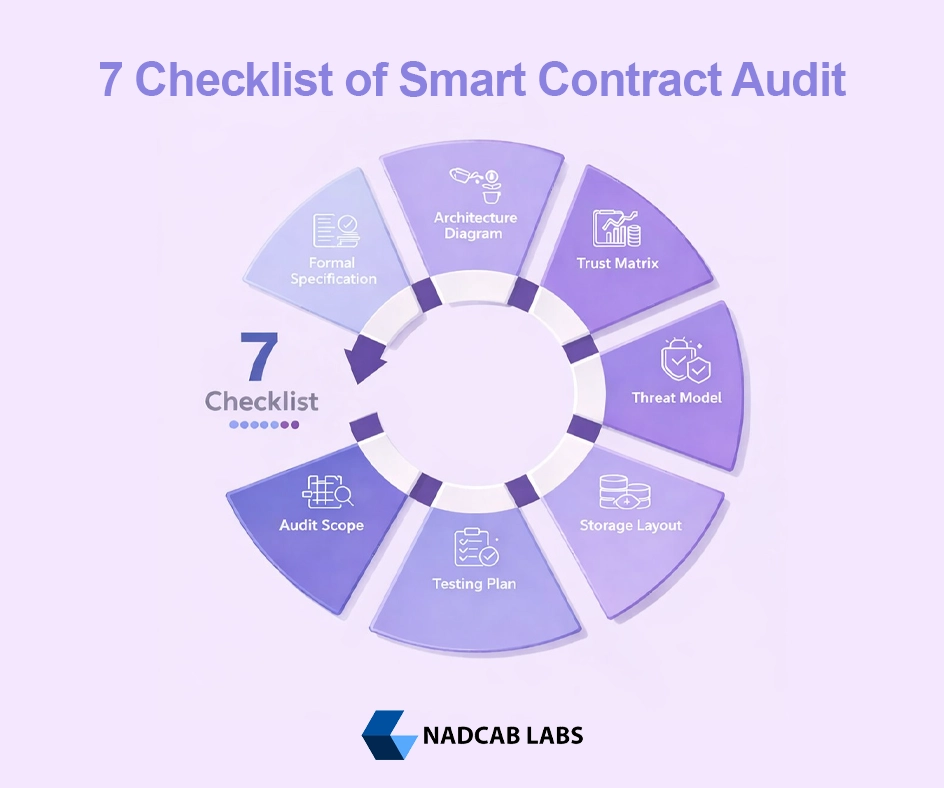
- Formal specification (functions, events, storage)
- Architecture diagram (contracts, interactions)
- Trust matrix (roles and actors)
- Threat model and risk register
- Storage layout document (for upgradeable contracts)
- Testing plan (unit, integration, adversarial)
- Audit scope and contact plan
Providing these increases audit effectiveness and reduces unknowns.
Plan, Test, and Secure Your Smart Contracts with Experts
Smart contract design is the base of any safe and successful blockchain project. It is not just about writing code, but about planning how everything should work before launch. Good design helps avoid mistakes, bugs, and loss of funds.
When smart contracts are designed properly, they are easier to test, cheaper to use, and safer for users. They also become easier to upgrade and manage in the future. This is important because smart contracts often handle real money and run for many years. In simple words, strong design builds trust. Projects that take time to plan, test, and document their smart contracts have fewer problems and better chances of long term success.
If you want to use blockchain now or later, Nadcab Labs can help you design smart contracts that are safe, easy to use, and reliable. We guide you in planning, testing, and organizing your contracts so they work properly, save costs, and stay secure. With our help, your project will be ready for the future, trusted by users, and easier to manage as it grows.
Frequently Asked Questions (FAQs)
Q1.What is the basic structure of a smart contract?
The basic structure of a smart contract is like a simple program. It starts with a version line that tells the blockchain which compiler to use. Then comes the contract name. Inside the contract, there are variables to store data, functions to perform actions, and rules that control how the contract works. Some contracts also include events and modifiers. This clear structure helps make smart contracts easy to read, secure, and reliable.
Q2.How does a smart contract look?
A smart contract looks like normal computer code written in a blockchain language such as Solidity. It contains functions, conditions, and data storage rules. For example, it can say that when payment is received, tokens are sent automatically. Once written and deployed, the contract lives at a blockchain address. Users and applications interact with it through transactions, making it automatic, transparent, and trustworthy without needing a middleman.
Q3.What are the 7 basic elements of a contract?
The seven basic elements of a contract are offer, acceptance, value exchange, involved parties, terms and conditions, intention, and enforcement. In smart contracts, these elements are written as code. Wallet addresses act as parties, rules are written as functions, and enforcement happens automatically. Once conditions are met, the contract executes on its own. This makes smart contracts fast, secure, and free from manual interference.
Q4.What is the architecture of smart contracts?
Smart contract architecture shows how different parts work together. At the base is the blockchain, where the contract is stored and executed. On top of that is the smart contract logic that handles rules and decisions. Sometimes oracles are used to bring real-world data into the contract. The top layer is the front-end application, which users interact with. This structure makes smart contracts reliable and decentralized.
Q5.How to design a smart contract?
Designing a smart contract starts with planning. First, you decide what the contract should do and who can use it. Then you define rules, permissions, and possible risks. Simple logic is always better than complex logic. Security and cost should be considered early. A well-designed smart contract avoids errors, saves gas fees, and works smoothly even after deployment. Good design is the foundation of a safe smart contract.
Q6.How are smart contracts made?
Smart contracts are made through a step-by-step process. First, requirements are clearly defined. Then the contract is written using a blockchain language like Solidity. After coding, the contract is tested on test networks to find errors. Security checks are done to avoid risks. Finally, the contract is deployed on the main blockchain network. This careful process helps ensure the contract works correctly and safely.
Q7.Where are smart contracts stored?
Smart contracts are stored on a blockchain network such as Ethereum or Polygon. Once deployed, the contract gets a unique address. The code is stored across many computers called nodes. This makes the contract secure and transparent. No one can secretly change the contract after deployment. Because it lives on the blockchain, anyone can view the code and trust that it will run exactly as written.
Q8.How do I create my own contract?
To create your own smart contract, you first learn the basics of a blockchain language like Solidity. Then you use tools such as Remix or Hardhat to write and test the contract. A digital wallet is used to deploy the contract on a test network. After testing, it can be deployed on the main network. Beginners should start with simple contracts and improve step by step.
Q9.How to integrate smart contract with front end?
Smart contracts are connected to the front end using tools like Web3.js or Ethers.js. The front end uses the contract address and its rules to communicate with the blockchain. Users connect their wallets and approve transactions. When a button is clicked, a contract function is called. This integration creates a full application where users can interact with blockchain features easily and securely.
Q10.Do smart contracts expire?
Smart contracts do not expire automatically because they stay on the blockchain forever. However, developers can add time limits inside the contract. For example, a function may only work for a certain number of days or blocks. After that time, the contract stops performing certain actions. This allows smart contracts to be temporary or long-term, depending on how they are designed.
Explore Services
Related Services
Reviewed by

Aman Vaths
Founder of Nadcab Labs
Aman Vaths is the Founder & CTO of Nadcab Labs, a global digital engineering company delivering enterprise-grade solutions across AI, Web3, Blockchain, Big Data, Cloud, Cybersecurity, and Modern Application Development. With deep technical leadership and product innovation experience, Aman has positioned Nadcab Labs as one of the most advanced engineering companies driving the next era of intelligent, secure, and scalable software systems. Under his leadership, Nadcab Labs has built 2,000+ global projects across sectors including fintech, banking, healthcare, real estate, logistics, gaming, manufacturing, and next-generation DePIN networks. Aman’s strength lies in architecting high-performance systems, end-to-end platform engineering, and designing enterprise solutions that operate at global scale.