Ai Overview
Yield farming is the practice of depositing cryptocurrency into decentralized finance protocols to earn rewards. Compound distributes approximately 2,880 COMP tokens daily to users who lend and borrow on its platform. The total value locked across DeFi protocols reached $129 billion in January, reflecting a 137% increase compared to the previous year. Aave generated $178 million in fees in a single quarter, with revenue coming from interest spreads and liquidation penalties.
Key Takeaways
- DeFi’s Total Value Locked reached $129 billion in January, reflecting a 137% increase compared to the previous year, with projections suggesting the figure could exceed $200 billion by year’s end through growth in liquid staking, decentralized lending, and stablecoins.
[1] - Compound Finance launched its COMP governance token on June 16, which introduced the concept of liquidity mining and kicked off what became known as DeFi Summer, where protocols began distributing tokens to incentivize user participation.
[2] - The DeFi sector witnessed a shift toward real yield models, with 77% of DeFi yields in a recent period coming from actual fee revenue rather than token emissions, amounting to over $6 billion generated from genuine platform activity.
[3] - The DeFi sector surged to a three-year high of $153 billion in TVL during July, driven by ETH’s 60% price rally, with Ethereum maintaining dominance at nearly 60% of total value locked across all protocols.
[4] - Aave, one of the largest lending protocols, reached $3 trillion in cumulative deposits in August and surpassed $29 billion in active loans, accounting for 30 to 40 percent of the DeFi lending market, depending on the timeframe and aggregator used.
[5] - Stablecoin yield farming pairs like USDC/USDT eliminate impermanent loss almost entirely since both assets are pegged to $1, offering APY returns between 1% and 5%, which, while lower than volatile pairs, represent real and sustainable earnings.
[6] - Uniswap allocates 0.3% of trading volume as fees distributed proportionally to liquidity providers, making it one of the most widely used decentralized exchanges for yield farmin,g with over 6.3 million wallets interacting with the protocol.
[7] - Crypto hacking losses reached approximately $2.2 billion in a single year, with incident counts rising from 282 to 303, where the majority of value was tied to compromised private keys at centralized services and smart contract exploits.
[8] - Liquid staking protocols saw unprecedented growth with TVL reaching an all-time high of $63 billion in Q1, a massive surge from $919 million recorded in August of the prior year, creating new compounding opportunities for yield farmers.
[9] - The global DeFi Yield Farming Platform Development market was valued at USD 79.4 million and is projected to grow to USD 154 million by the end of the forecast period, exhibiting a compound annual growth rate of 8.3%, driven by increasing adoption of decentralized finance solutions.
[10]
Yield farming has grown from an experimental DeFi concept into one of the most powerful ways cryptocurrency holders put their digital assets to work. Rather than letting tokens sit idle in a wallet, users can deposit them into decentralized protocols and earn returns through trading fees, interest payments, and bonus token rewards. But the process of how yield farming works is more layered than it appears on the surface. There are liquidity pools to understand, smart contracts managing every transaction, and risks that can quietly eat into your profits if you are not paying attention.
This blog breaks down every aspect of yield farming in DeFi, from the foundational mechanics of liquidity pools and automated market makers to advanced strategies used by experienced participants. Whether you are new to decentralized finance or looking to sharpen your approach, you will find real data, practical insights, and honest discussion about both the opportunities and the pitfalls that come with this fast-moving space.
What Is Yield Farming and How Did It Begin
Yield farming is the practice of depositing cryptocurrency into decentralized finance protocols to earn rewards. In its simplest form, you are providing the digital assets that DeFi platforms need to operate, and in return, you receive a share of the fees or additional tokens as compensation. The concept draws from the agricultural metaphor of planting seeds and harvesting crops, but the mechanics are entirely financial and powered by blockchain technology.
The practice went mainstream during what the crypto community calls “DeFi Summer.” Compound Finance launched its COMP governance token on June 16 of that year, introducing a new concept of liquidity mining that caught the community by surprise. Users who supplied assets to the protocol received COMP tokens on top of the interest they were already earning, which created a powerful incentive loop. This token distribution model attracted billions in deposits within weeks and inspired dozens of other protocols to follow the same approach.
After Compound’s success, Uniswap took the concept further by introducing the UNI token through what it called a “fair launch,” airdropping tokens to all current and past users of the protocol. Yearn Finance’s creator, Andre Cronje, pushed the model even further by creating the YFI governance token with no premine, urging liquidity providers to earn it rather than buy it. These events collectively shaped the yield farming landscape that continues to evolve today.
The Core Mechanics Behind How Yield Farming Works
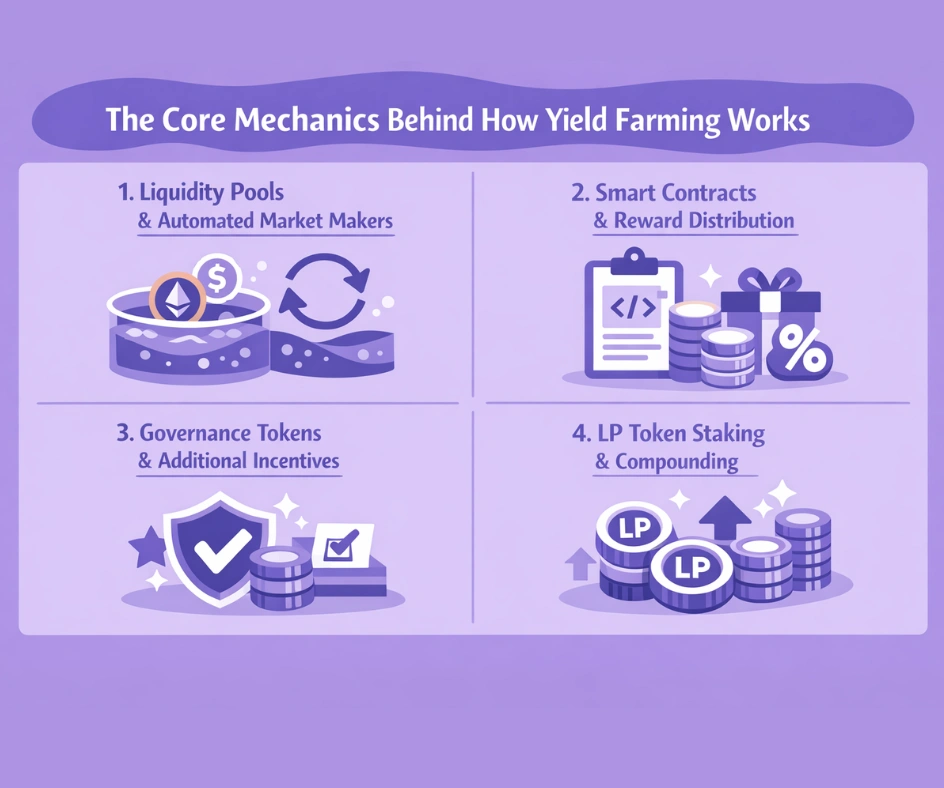
Understanding how yield farming works requires breaking down several interconnected components that operate together within the DeFi ecosystem. Each piece plays a specific role in making the entire system function.
1. Liquidity Pools and Automated Market Makers
A liquidity pool is a smart contract holding reserves of two or more tokens. These pools power decentralized exchanges by allowing anyone to trade without a traditional order book. When you deposit tokens into a liquidity pool, you become a liquidity provider (LP) and receive LP tokens as a receipt representing your share of the pool. Automated market makers (AMMs) like Uniswap use mathematical formulas (such as x * y = k) to determine token prices based on the ratio of assets in the pool. Every time a trader swaps tokens through the pool, a small fee is charged, and that fee gets distributed proportionally among all liquidity providers. This trading fee distribution forms the base layer of yield farming returns.
2. Smart Contracts and Reward Distribution
Smart contracts are the backbone of every yield farming operation. These self-executing programs, deployed on blockchains like Ethereum, manage everything from accepting your deposits to calculating rewards and distributing them to participants. When you interact with a DeFi protocol, you are not trusting a company or a person. You are trusting the code. The development of these smart contracts determines how deposits are handled, how rewards accrue, and how withdrawals are processed. Platforms like Aave and Compound use algorithmically set interest rates that adjust automatically based on supply and demand within each lending pool.
3. Governance Tokens and Additional Incentives
Beyond trading fees and interest, many protocols distribute their native governance tokens to yield farmers. These tokens often grant voting rights on protocol decisions, such as fee structures, new feature proposals, and treasury management. Compound distributes approximately 2,880 COMP tokens daily to users who lend and borrow on its platform. Curve Finance rewards liquidity providers with CRV tokens. These governance token rewards can significantly boost overall returns, though their value fluctuates with market conditions.
4. LP Token Staking and Compounding
After depositing assets into a liquidity pool and receiving LP tokens, many platforms allow you to stake those LP tokens in separate reward pools for additional earnings. This layered approach is central to how yield farming strategies multiply returns. Yield aggregators like Yearn Finance and Convex Finance automate this compounding process, continually reinvesting earned rewards back into the pool to increase future returns. The development of these auto-compounding tools has made yield farming more accessible to participants who do not want to manually manage their positions.
Recommended Reading:
DeFi Yield Farming Explained Through Real World Data
The numbers tell a compelling story about the scale and growth of yield farming in DeFi. The total value locked across DeFi protocols reached $129 billion in January, reflecting a 137% increase compared to the previous year. Projections suggest this figure could exceed $200 billion, driven by advancements in liquid staking, decentralized lending, and stablecoins. By July, the DeFi market surged even further to a three-year high of $153 billion, fueled by ETH’s 60% price rally and growing institutional interest.
Ethereum continues to dominate, maintaining nearly 60% of total value locked across the entire DeFi ecosystem. Aave, one of the largest lending protocols, reached $3 trillion in cumulative deposits and surpassed $29 billion in active loans, accounting for 30 to 40 percent of the DeFi lending market. These figures demonstrate that yield farming is not a passing trend but a foundational component of decentralized finance.
The yield farming landscape has also shifted significantly toward what the industry calls “real yield.” DeFi is moving away from inflationary token emissions and toward rewards generated from actual platform revenue like trading fees and lending interest. In a recent period, 77% of DeFi yields came from real fee revenue, amounting to over $6 billion. This transition indicates a maturing ecosystem where returns are backed by genuine economic activity rather than short-lived token incentives.
Types of Yield Farming Strategies in DeFi
Yield farming strategies range from conservative approaches with steady returns to aggressive methods that chase the highest APY. Choosing the right strategy depends on your risk tolerance, the amount of capital you have, and how actively you want to manage your positions. Below are the primary approaches used by DeFi participants.
1. Liquidity Provision on Decentralized Exchanges
This is the most common form of yield farming. You deposit equal values of two tokens into a DEX liquidity pool, such as an ETH/USDC pair on Uniswap, and earn a share of the trading fees generated by swaps in that pool. Uniswap allocates 0.3% of trading volume as fees distributed proportionally to liquidity providers. The development of concentrated liquidity in Uniswap V3 allows providers to focus their capital within specific price ranges, improving capital efficiency and fee capture.
2. Lending and Borrowing on Money Markets
Platforms like Aave and Compound allow you to deposit tokens to earn interest from borrowers. On Aave, depositing $10,000 in USDC means you earn interest from borrowers plus potentially AAVE token rewards. Your aUSDC tokens represent your deposit and automatically increase in value as interest accrues. Current APY ranges for stablecoins on these platforms typically fall between 2% and 6%, while volatile assets offer 0.2% to 2%.
3. Stablecoin Farming for Lower Risk
Farming stablecoin pairs like USDC/USDT or USDC/DAI eliminates impermanent loss almost entirely since both assets are pegged to $1, and their ratio stays constant. The trade-off is lower yields, with returns typically between 1% and 5% APY. However, these returns are real and are not being eaten by impermanent loss or sudden token price drops. For beginners, stablecoin farming serves as an effective way to learn the mechanics without exposure to wild price swings. Curve Finance has built its entire protocol around this approach, specializing in stablecoin and similar asset swaps with minimal slippage.
4. Liquid Staking and Restaking
Liquid staking protocols like Lido allow you to stake ETH and receive stETH (a liquid staking derivative) that you can then use across other DeFi protocols. This means you earn staking rewards while simultaneously using your stETH in liquidity pools or lending platforms for additional yield. EigenLayer introduced “restaking,” allowing users to reuse their staked Ethereum to support additional protocols and earn extra rewards. Liquid staking protocols saw unprecedented growth, with TVL reaching an all-time high of $63 billion, a massive surge from $919 million recorded in August of the prior period.
5. Yield Aggregation and Auto Compounding
Yield aggregators like Yearn Finance and Beefy Finance automatically move your assets across multiple protocols to chase the best available returns. These platforms use sophisticated vault strategies that handle compounding, reward claiming, and rebalancing without manual intervention. The development of these aggregation tools has lowered the barrier to entry for yield farming, allowing users to deposit into a single vault and let the smart contracts handle the complex strategy execution behind the scenes.
Yield Farming Strategies Comparison by Risk and Return
| Strategy Type | Typical APY Range | Risk Level and Key Considerations |
|---|---|---|
| Stablecoin Lending (Aave, Compound) | 2% to 6% | Low risk; no impermanent loss; rates fluctuate with borrowing demand |
| Stablecoin LP (Curve Finance) | 1% to 5% | Low risk; minimal impermanent loss; additional CRV token rewards possible |
| Liquid Staking (Lido, Rocket Pool) | 3% to 7% | Low to moderate risk; stETH/ETH depegging possibility; smart contract exposure |
| Blue Chip LP (ETH/USDC on Uniswap) | 5% to 20% | Moderate risk; impermanent loss from ETH price changes; higher fee income |
| Yield Aggregation (Yearn, Beefy) | 5% to 15% | Moderate risk; automated compounding; multiple smart contract dependencies |
| Restaking (EigenLayer) | Variable (evolving) | Moderate to high risk; newer protocol; additional slashing risk; high potential upside |
| Volatile Token LP (New Token Pairs) | 50% to 200%+ | High risk; severe impermanent loss possible; reward token dumping; rug pull danger |
Understanding Impermanent Loss in Yield Farming
Impermanent loss is the most misunderstood and underestimated risk in yield farming. It occurs when the price of tokens in a liquidity pool changes relative to each other after you have deposited them. Automated market makers require pools to maintain a balanced ratio, and when prices shift on external exchanges, arbitrage traders rebalance the pool. This process benefits traders but leaves liquidity providers holding more of the underperforming token and less of the appreciating one.
To understand this practically, imagine you deposit equal values of ETH and DAI into a 50/50 liquidity pool. If the price of ETH increases significantly on an external exchange like Coinbase, arbitrageurs will buy the cheaper ETH from your pool, taking ETH out and putting DAI in. When you withdraw, you end up with more DAI and less ETH. Even though your total value may have gone up in dollar terms, it is less than what you would have earned by simply holding both tokens in your wallet. That difference is impermanent loss.
The severity depends on how far token prices diverge. A 500% price increase in one asset can result in approximately 25% impermanent loss for the liquidity provider. The loss is called “impermanent” because it reverses if prices return to their original ratio before you withdraw. However, if you withdraw while prices remain different, the loss becomes permanent. For stablecoin pools on platforms like Curve, where assets hold similar values, the risk of impermanent loss is greatly minimized since there is no volatile asset in the pool whose value could diverge sharply.
Recommended Reading:
Top Yield Farming Aggregators of 2024 and Their Impact on DeFi
Top DeFi Platforms Where Yield Farming Work Is Most Active
The DeFi ecosystem hosts a wide range of platforms, but a handful of protocols have proven themselves through years of operation, multiple security audits, and billions in locked value. Here is a closer look at the major players.
1. Aave: The Lending and Borrowing Powerhouse
Aave is a non custodial money market where users supply assets to earn interest and borrow against collateral through on chain liquidity pools. Its TVL stands at over $44 billion across supported networks, with Ethereum making up approximately 80% of the total. The protocol offers variable lending rates across multiple crypto assets and supports flash loans, which allow traders to borrow millions without collateral if they repay within the same transaction. Aave generated $178 million in fees in a single quarter, with revenue coming from interest spreads and liquidation penalties. The development of Aave across Ethereum, Polygon, Arbitrum, Base, Optimism, and Avalanche provides yield farming opportunities across multiple networks.
2. Uniswap: The DEX That Powers Liquidity
Uniswap is the largest decentralized exchange and a foundational protocol for yield farming in DeFi. Its total TVL fluctuates around $4.5 billion, with the protocol processing between 50% and 65% of weekly DEX volume. Uniswap V3 introduced concentrated liquidity, allowing providers to focus capital within custom price ranges for greater efficiency. The launch of Uniswap V4 brought Hooks and singleton architecture that reduce gas costs by over 99% and enable even more sophisticated farming strategies. Over 6.3 million wallets have interacted with the protocol, and more than 50% of users now transact through Layer 2 networks.
3. Curve Finance: Stablecoin Farming Specialist
Curve Finance is the go-to platform for stablecoin yield farming, with $2.39 billion in TVL and $38.99 million in annual fees from stablecoin swaps. Its specialized AMM algorithm, called StableSwap, is designed specifically for assets that should hold similar values. Curve pools only contain assets like USDC/DAI or different versions of the same token, such as sBTC/renBTC/wBTC, which greatly minimizes impermanent loss. The CRV governance token and the “Curve Wars” ecosystem, where protocols compete for CRV emissions to boost their pool yields, add another layer of opportunity for farming participants.
4. Compound Finance: The Protocol That Started It All
Compound remains a pillar of DeFi lending. Its TVL has fluctuated between $2 billion and $8 billion depending on market conditions. The protocol issues cTokens when users deposit assets, and these tokens are yield-bearing assets that automatically increase in value as interest accrues. Compound currently supports several Ethereum Virtual Machine networks, including Ethereum, Optimism, Base, and Arbitrum. Its governance system requires holders to have 100,000 COMP tokens to submit a proposal, ensuring that major decisions carry significant stakeholder commitment.
5. Yearn Finance and Convex: Yield Optimization
Yearn Finance automates yield farming by moving user deposits across protocols to capture the best available returns. Its vault strategies handle the complex work of compounding, rebalancing, and harvesting rewards. Convex Finance dominates Curve-related yield optimization by allowing users to earn boosted CRV rewards without locking their own CRV tokens. Experienced yield farmers often combine multiple platforms, staking ETH through Lido, depositing stETH into Curve pools, and boosting those returns through Convex, creating layered strategies that multiply yield opportunities.
Top DeFi Yield Farming Platforms by Key Metrics
| Platform | Primary Function | Notable Characteristics |
|---|---|---|
| Aave | Lending and Borrowing | Multi chain deployment; flash loans; $44B+ TVL; strongest audits in DeFi |
| Uniswap | Decentralized Exchange | Concentrated liquidity (V3/V4); 6.3M+ wallets; 0.3% fee distribution to LPs |
| Curve Finance | Stablecoin DEX | StableSwap AMM; minimal impermanent loss; CRV governance and Curve Wars |
| Compound | Lending Protocol | Pioneer of DeFi Summer; cToken system; algorithmic interest rates; daily COMP distribution |
| Lido | Liquid Staking | $34B+ TVL; stETH for DeFi composability; non custodial with DAO governance |
| Yearn Finance | Yield Aggregator | Auto compounding vaults; cross protocol optimization; beginner friendly interface |
| PancakeSwap | BSC DEX | Lower gas fees; CAKE token rewards; $2.2B weekly trading volume; BNB Chain focused |
Step by Step Process of How Yield Farming Work in Practice
Getting started with yield farming involves a series of practical steps. Here is the process broken down for anyone looking to participate.
1. Set Up a Compatible Crypto Wallet
Before you can farm anything, you need a crypto wallet that connects to DeFi apps. MetaMask, Rainbow, or Rabby are popular choices. Make sure you have the native coin of your chosen blockchain (ETH for Ethereum, BNB for Binance Smart Chain) to cover gas fees. Creating a separate wallet specifically for farming, rather than using your main holdings wallet, is a recommended practice.
2. Choose a Trusted DeFi Platform
Select a protocol with a strong track record. Check for completed security audits, total value locked, community reputation, and how long the platform has been operating. Aave, Compound, MakerDAO, and Lido remain among the most trusted platforms because they have multi year histories and high TVL. The development of audit standards across the industry means you should look for protocols that have been reviewed by firms like Trail of Bits, OpenZeppelin, or CertiK.
3. Provide Liquidity or Deposit Assets
Follow the platform’s instructions to contribute liquidity. For a DEX like Uniswap, this means depositing equal values of two tokens into a pool. For a lending protocol like Aave, you simply deposit a single asset. Once confirmed, you will receive LP tokens or deposit receipts. Approve the spending limit in your wallet, then confirm the deposit transaction.
4. Stake LP Tokens for Additional Rewards
If the platform offers farming rewards, navigate to the “Farm” or “Staking” page and stake your LP tokens. This is where you begin earning governance tokens on top of the base trading fees or interest. The development of user friendly interfaces on modern DeFi platforms has made this step much more straightforward than it was during the early days of yield farming.
5. Monitor, Claim, and Manage Positions
Yield farming requires active monitoring. Keep an eye on reward rates, pool performance, and market volatility. APYs fluctuate constantly with TVL and trading volume. Use tools like DeFiLlama, Zapper, or Yieldwatch to track your portfolio across multiple protocols. Claim rewards based on gas costs. For large positions, weekly claiming makes sense. For smaller positions, monthly claiming reduces the fee impact.
Risks Every Yield Farmer Must Understand
Yield farming in DeFi offers the potential for high returns, but those gains come with risks that can erode profits or even wipe out your entire investment. Here are the major risks you need to account for.
1. Smart Contract Vulnerabilities
Even audited protocols can contain bugs that hackers exploit. Crypto hacking losses reached approximately $2.2 billion in a single year, with incident counts rising from 282 to 303. The majority of value lost was tied to compromised private keys at centralized services and smart contract exploits. Flash loan attacks surged, making up 83.3% of eligible exploits in a recent period according to Halborn’s DeFi Hacks Report. The development of better auditing practices helps, but no protocol is entirely immune to attack.
2. Impermanent Loss
As discussed earlier, impermanent loss can quietly eat into your returns when token prices diverge. For volatile pairs, impermanent loss can cancel out incentive rewards entirely, leaving you worse off despite a high APY displayed on the dashboard. The only way to fully avoid impermanent loss in a dual asset pool is to withdraw your tokens at exactly the same price ratio at which they were deposited.
3. Yield Compression
As more capital flows into popular farms, APYs drop. The 100% yield that initially attracted you can become 20% within a month as total deposits grow. DeFi is more competitive now than ever, and the easy gains of earlier periods are largely gone. Most established platforms offer 5% to 20% APY on stable pools, while riskier farms can go higher but with proportionally greater risk.
4. Rug Pulls and Fraudulent Protocols
Not every DeFi protocol is legitimate. Since anyone can create a token pool on a permissionless DEX, scam operators can set up attractive looking farms, attract deposits, and drain the liquidity. In one notable case, the HyperVault yield farming protocol within the Hyperliquid ecosystem executed what analysts described as a rug pull, removing approximately $3.6 million in user deposits. The project developers drained liquidity pools and deleted their social channels.
5. Regulatory Uncertainty
Governments are paying increasing attention to DeFi. Sudden legal restrictions or compliance requirements could impact liquidity, token values, and the operational viability of certain protocols. The EU’s Markets in Crypto Assets (MiCA) regulation and updated FATF guidance both signal growing regulatory pressure on the DeFi ecosystem. Tax regulations regarding DeFi are also still evolving, and yield earnings are generally considered taxable income in most jurisdictions.
Recommended Reading:
APR vs APY: What Yield Farmers Need to Know
When comparing yield farming opportunities, you will frequently see both APR and APY mentioned. Understanding the difference between them is essential for making accurate return calculations.
APR (Annual Percentage Rate) represents your simple yearly return without compounding. If a protocol offers 10% APR on a $10,000 deposit, you would earn $1,000 over a full year, paid out in regular intervals. APY (Annual Percentage Yield) includes compounding, meaning your earned rewards are automatically reinvested to generate additional returns. A 10% APR with daily compounding translates to approximately 10.52% APY because each day’s earnings are added to your principal before the next day’s calculation.
Platforms that offer auto-compounding DeFi strategies through yield aggregators like Yearn Finance or Beefy Finance tend to deliver higher effective returns because compounding happens continuously. When evaluating pools, always compare APY to APY or APR to APR, not mixed figures, to avoid misleading conclusions about which opportunity offers better returns. The development of transparent yield tracking tools on platforms like DeFiLlama helps farmers compare apples to apples across different protocols.
The Role of Cross-Chain Yield Farming in Modern DeFi
Traditional yield farming strategies typically focus on a single blockchain network. However, cross-chain approaches allow for greater flexibility and diversification by leveraging multiple blockchain platforms. This means farmers can access a broader range of liquidity pools and yield opportunities across Ethereum, Solana, BNB Chain, Arbitrum, Avalanche, and other networks.
Solana’s TVL has grown by 23% in the recent month to $12 billion, with protocols like Sanctum, Jupiter, and Marinade outperforming the wider ecosystem. Avalanche and Sui have also seen significant growth, with TVL increasing 33% and 39%, respectively. Each chain offers different fee structures, transaction speeds, and yield opportunities. You can start farming with as little as $50 to $100 on low-fee blockchains like BNB Chain or Arbitrum, whereas Ethereum’s higher gas costs make it more suitable for larger positions.
Cross-chain bridges and interoperability solutions have made it possible to move assets between networks and capitalize on the best opportunities across the entire DeFi landscape. However, bridge protocols themselves have been among the most exploited DeFi components, so careful evaluation of bridge security is critical before moving assets between chains.
DeFi Yield Farming Implementations in the Real World
The following projects reflect how decentralized finance infrastructure is already being applied across lending, staking, and cross-chain interoperability. Each implementation showcases the same yield farming and smart contract principles discussed throughout this article, from liquidity pool design and token governance to automated reward distribution and multi-chain deployment.
🔗
Kaon: Cross-Chain Bitcoin DeFi Infrastructure
Built a hybrid blockchain infrastructure that bridges Bitcoin and Ethereum, enabling Bitcoin interoperability with Ethereum smart contracts without relying on bridges or wrapped tokens. The platform uses mirrorBTC, a 1:1 BTC-backed asset, to enable DeFi applications like staking, lending, and yield farming to leverage Bitcoin liquidity natively through Delegated Proof of Stake consensus.
🤖
Athene Network: Decentralized Mining and Staking Platform
Created a decentralized mining platform where participants stake tokens and earn rewards through Proof of Stake consensus and token holder governance. The platform enables community-driven participation in DeFi staking infrastructure, allowing users to earn yield through automated smart contract mechanisms without centralized control.
Build Your DeFi Yield Farming Platform Today:
We bring 8+ years of blockchain expertise to DeFi yield farming platform development. Our specialized team handles everything from smart contract creation and liquidity pool architecture to cross-chain integration and security audits, ensuring your platform is built for growth, user trust, and long term sustainability. Whether you need a lending protocol, staking platform, or full yield farming ecosystem, we deliver solutions that work.
Final Thoughts
Yield farming has matured from the chaotic gold rush of DeFi Summer into a structured, data-driven component of decentralized finance. The mechanics of how yield farming works are built on liquidity pools, smart contracts, and token incentive models that continue to evolve as the industry grows. With DeFi’s total value locked reaching new highs and established protocols like Aave, Uniswap, and Curve handling billions in daily activity, the infrastructure supporting yield farming is stronger than it has ever been.
However, the opportunities come with genuine risks. Smart contract vulnerabilities, impermanent loss, yield compression, and outright fraud remain real concerns that every participant must weigh against potential returns. The shift toward real yield, where rewards come from actual protocol revenue rather than inflationary token emissions, signals a healthier and more sustainable ecosystem. Stablecoin farming, liquid staking, and yield aggregation have emerged as strategies that balance risk with realistic returns, giving both newcomers and experienced farmers practical paths to earning.
Whether you are looking to start small with stablecoin lending on Aave or dive deeper into cross-chain strategies across multiple networks, the development of better tools, more transparent protocols, and stronger security practices means the yield farming landscape today offers more informed choices than ever before. Start with research, choose audited platforms, diversify your positions, and always invest only what you can afford to lose. The DeFi ecosystem rewards those who approach it with both curiosity and caution.
Frequently Asked Questions
Q1.What is yield farming in DeFi?
Yield farming is the practice of depositing cryptocurrency into decentralized finance protocols to earn rewards. Users provide liquidity or lend their assets to DeFi platforms and, in return, receive trading fees, interest payments, and governance token rewards managed automatically through smart contracts.
Q2.How much can you earn from yield farming?
Returns vary widely based on the strategy and platform. Stablecoin pools on Aave or Curve typically offer 1% to 6% APY, blue chip pairs on Uniswap can yield 5% to 20%, while riskier volatile token pairs may advertise 50% to 200% or more, though those come with significantly higher risks.
Q3.What is impermanent loss in yield farming?
Impermanent loss occurs when the price of tokens in a liquidity pool changes relative to each other after deposit. Arbitrage traders rebalance the pool, leaving liquidity providers with more of the underperforming token. The loss is temporary if prices revert, but it becomes permanent upon withdrawal.
Q4.Is yield farming safe for beginners?
Yield farming carries inherent risks, including smart contract bugs, market volatility, and scams. Beginners should start with small amounts on audited and established platforms like Aave or Compound, use stablecoin pools to minimize impermanent loss, and learn the mechanics before scaling up their investment.
Q5.What is the minimum amount needed to start?
You can start yield farming with as little as $50 to $100, but small amounts may be eroded by transaction fees, especially on Ethereum. Using low-fee blockchains like BNB Chain, Arbitrum, or Polygon makes it more practical to start with smaller capital since gas costs are significantly lower.
Q6.How do yield farming strategies differ across platforms?
Each platform specializes in different types of farming. Aave focuses on lending and borrowing with variable interest rates. Uniswap provides liquidity provision with concentrated capital ranges. Curve optimizes stablecoin swaps with minimal impermanent loss. Yearn Finance automates cross-protocol strategies through vault systems that compound rewards.
Explore Services
Related Services
Reviewed by

Aman Vaths
Founder of Nadcab Labs
Aman Vaths is the Founder & CTO of Nadcab Labs, a global digital engineering company delivering enterprise-grade solutions across AI, Web3, Blockchain, Big Data, Cloud, Cybersecurity, and Modern Application Development. With deep technical leadership and product innovation experience, Aman has positioned Nadcab Labs as one of the most advanced engineering companies driving the next era of intelligent, secure, and scalable software systems. Under his leadership, Nadcab Labs has built 2,000+ global projects across sectors including fintech, banking, healthcare, real estate, logistics, gaming, manufacturing, and next-generation DePIN networks. Aman’s strength lies in architecting high-performance systems, end-to-end platform engineering, and designing enterprise solutions that operate at global scale.