Ai Overview
Yield farming is a DeFi strategy where cryptocurrency holders lend, stake, or lock their assets in decentralized protocols to earn rewards. Aave currently offers variable rates around 4 to 7% APY for stablecoins and 2 to 3% for ETH. Users can also borrow against their deposits (up to 80% of collateral value for most assets), which opens up leverage strategies for more advanced participants. This compounding effect can add 10 to 20% more returns over a year compared to manual claiming.
Key Takeaways
- The Total Value Locked across all DeFi protocols reached $153 billion in July, marking a three-year high driven by growing institutional interest and a strong ETH rally that pushed Ethereum’s dominance to nearly 60% of total DeFi TVL.[1]
- Staking and yield farming captured over $63.2 billion in assets across DeFi protocols, with Lido managing over $34.8 billion in staked ETH and derivatives, making liquid staking the largest DeFi category by locked value at 27% of total TVL.[2]
- Aave became the largest DeFi lending platform with over $14.6 billion in active liquidity pools, generating $178 million in fees last quarter while offering 4 to 7% APY on stablecoins and 2 to 3% on ETH through genuine lending demand.[3]
- Pendle Finance’s TVL surged from $3 billion to over $10 billion between May and August, with the protocol holding over 50% of the DeFi yield sector TVL and enabling fixed income strategies through yield tokenization.[4]
- Curve Finance maintains $2.5 billion in TVL and generates $38.99 million in annual fees from stablecoin swaps, offering between 5% and 15% APY with minimal impermanent loss due to its specialized bonding curve algorithm for similarly priced assets.[5]
- EigenLayer’s restaking ecosystem reached over $18 billion in TVL with peaks above $20 billion, allowing staked ETH holders to earn layered rewards by securing additional protocols known as Actively Validated Services without deploying new capital.[6]
- Cryptocurrency thefts totaled $2.2 billion in hacks and exploits, with a 17% increase from the previous period, while infrastructure attacks involving private key and seed phrase compromises accounted for nearly 70% of all stolen funds.[7]
- Curve’s stablecoin pools have recorded impermanent loss rates under 1% during stable market periods, making them a preferred option for conservative yield farmers who prioritize capital preservation over aggressive returns.[8]
- DeFi lending protocols saw over $51 billion in outstanding loans, with the average interest rate on stablecoin loans sitting at 4.8%, while flash loan activity topped $2.1 billion across 30 protocols in Q1 alone.
- The global DeFi yield farming platform development market was valued at USD 79.4 million and is projected to reach USD 154 million by 2031, exhibiting a CAGR of 8.3% as both retail and institutional participants seek higher yields through decentralized protocols.[10]
Yield farming has changed the way people think about earning returns on their cryptocurrency holdings. Instead of letting digital assets sit idle in a wallet, yield farming strategies allow holders to put those assets to work inside decentralized finance protocols and earn rewards through trading fees, interest payments, governance tokens, or a combination of all three. What started during the famous DeFi Summer of 2020 has now matured into a multi-billion-dollar sector with protocols that have survived bear markets, regulatory pressure, and major exploits.
But the landscape looks very different today compared to those early days. The 10,000% APY pools are largely gone, replaced by more sustainable returns from battle-tested protocols. The development of sophisticated yield farming strategies now requires an understanding of protocol mechanics, risk management, impermanent loss calculations, and the ability to evaluate smart contract security. Whether someone is a first-time participant or an experienced DeFi user, choosing the best DeFi yield farming strategy depends on understanding how each approach works and what trade-offs it carries.
This blog breaks down the most effective yield farming in DeFi approaches used today, covering everything from stablecoin lending to advanced restaking and yield tokenization, with real protocol data and practical considerations for every strategy.
What Is Yield Farming and How Does It Work?
Yield farming is a DeFi strategy where cryptocurrency holders lend, stake, or lock their assets in decentralized protocols to earn rewards. These rewards typically come as transaction fees, interest payments from borrowers, or additional governance tokens distributed by the protocol itself. The entire process runs on smart contracts, which are self-executing programs on the blockchain that handle deposits, withdrawals, reward calculations, and distributions without any human intermediary.
At its core, yield farming relies on liquidity pools. These pools are collections of crypto assets deposited by users (known as liquidity providers or LPs) that enable trading, lending, or borrowing on DeFi platforms. When someone trades on a decentralized exchange like Uniswap or Curve, they are swapping tokens against a liquidity pool rather than matching with another trader directly. The LPs who funded that pool earn a portion of the trading fees as their reward.
Three components make yield farming function. First, automated market makers (AMMs) use mathematical formulas to price assets within pools and enable swaps without traditional order books. Second, governance tokens give participants voting rights over protocol decisions, and many protocols distribute these tokens as extra incentives to attract more liquidity. Third, smart contracts automate every step of the development process, from calculating each provider’s share to distributing rewards at defined intervals.
The returns from yield farming are expressed as APY (Annual Percentage Yield), which accounts for compounding, or APR (Annual Percentage Rate), which shows the flat rate without compounding. Understanding the difference matters because a protocol showing 20% APR could deliver significantly more with daily compounding compared to one that pays out monthly.
Top Yield Farming Strategies Used in DeFi Today
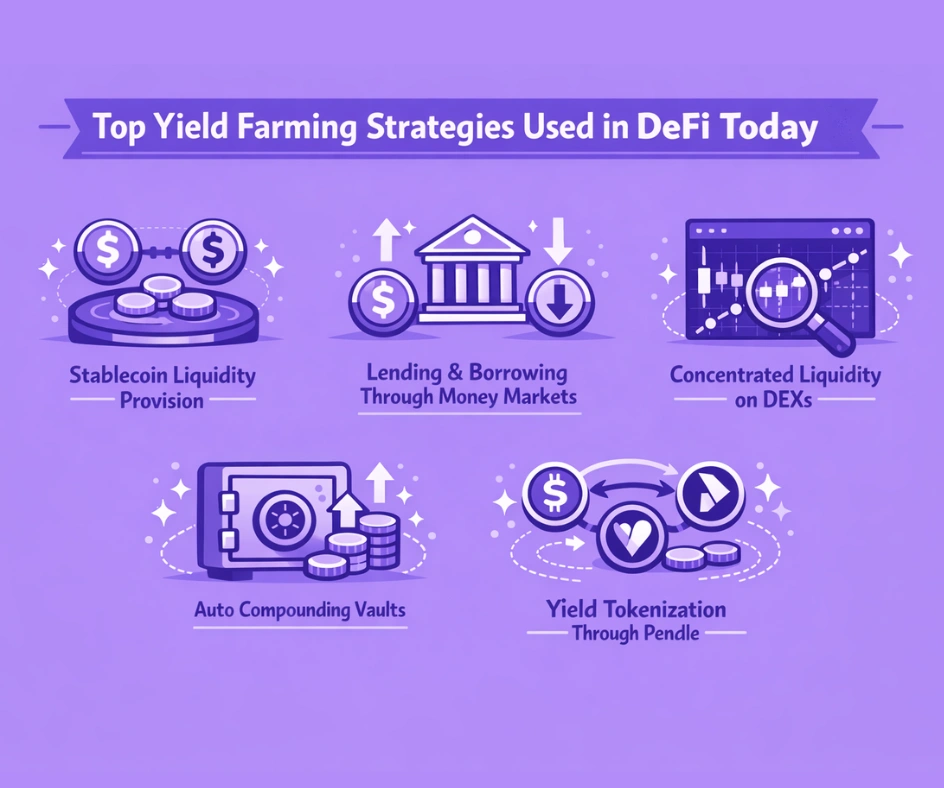
The best DeFi yield farming strategy varies based on risk tolerance, capital size, and the amount of time someone can dedicate to managing positions. Below are the most widely used approaches, each with its own advantages and trade-offs.
1. Stablecoin Liquidity Provision
This is the lowest risk entry point into yield farming. Users deposit stablecoins like USDC, USDT, or DAI into liquidity pools that only trade between similarly priced assets. Because these tokens are designed to maintain a consistent dollar peg, the price difference between them stays minimal, which keeps impermanent loss close to zero. Curve Finance specializes in this approach, with its bonding curve algorithm optimized for efficient swaps between stable assets. The development of Curve’s unique AMM design means that even large trades experience minimal slippage, attracting billions in trading volume and generating consistent fees for liquidity providers.
2. Lending and Borrowing Through Money Markets
Platforms like Aave and Compound allow users to supply crypto assets and earn interest from borrowers. The rates are variable and fluctuate based on how much of the pool is being borrowed (utilization rate). When demand for borrowing increases, interest rates go up, benefiting lenders. This strategy is straightforward because it involves depositing a single asset rather than a token pair, eliminating impermanent loss entirely. Aave currently offers variable rates around 4 to 7% APY for stablecoins and 2 to 3% for ETH. Users can also borrow against their deposits (up to 80% of collateral value for most assets), which opens up leverage strategies for more advanced participants.
3. Concentrated Liquidity on DEXs
Uniswap V3 introduced concentrated liquidity, which allows liquidity providers to choose a specific price range where their capital is active. Instead of spreading liquidity across the entire price spectrum, providers can focus their funds in a narrow band where most trading actually occurs. This makes the capital work harder and can produce significantly higher fees on a per-dollar basis. However, it also demands active management. If the price moves outside the selected range, the position stops earning fees entirely and becomes exposed to impermanent loss. This strategy works well for active participants who monitor their positions regularly.
4. Auto Compounding Vaults
Yield aggregators like Yearn Finance and Beefy Finance automate the process of harvesting rewards and reinvesting them back into the farming position. This compounding effect can add 10 to 20% more returns over a year compared to manual claiming. These platforms batch transactions across many users, which reduces gas costs for each individual participant. Yearn’s “yVaults” continuously shift funds between different protocols to capture the highest available yields, while Beefy operates across more than 50 blockchain networks, giving users access to a wide range of farming opportunities through a single interface.
5. Yield Tokenization Through Pendle
Pendle Finance introduced a different approach to yield farming by splitting yield-bearing assets into two separate tokens: a Principal Token (PT) and a Yield Token (YT). The PT represents the underlying value of the asset, while the YT captures the future yield. Buying PTs at a discount to face value effectively locks in a fixed return upon maturity, similar to a zero-coupon bond. Meanwhile, buying YTs gives leveraged exposure to future yield fluctuations. This development in DeFi protocol design has attracted massive capital, with Pendle’s TVL surging past $10 billion as users find new ways to manage and trade yield.
Recommended Reading:
6. Liquid Staking and Restaking
Liquid staking protocols like Lido allow ETH holders to stake their tokens and receive a liquid derivative (stETH) that can be used across DeFi while still earning staking rewards. EigenLayer takes this further with restaking, where already staked ETH is pledged again to provide security for additional protocols. This creates layered yields without requiring new capital. Lido manages over $34.8 billion in staked assets, and EigenLayer’s restaking ecosystem has reached over $18 billion in TVL. The development of liquid staking tokens as composable DeFi building blocks has made this one of the most capital-efficient yield farming strategies available today.
7. Leveraged Yield Farming
Advanced users sometimes borrow against their deposited assets to increase their farming position size. For example, someone might deposit ETH on Aave, borrow stablecoins against it, and deploy those stablecoins into a stablecoin yield farm. This looping strategy amplifies returns but also increases liquidation risk. If the collateral value drops below the required threshold, the position gets automatically liquidated, resulting in potential losses. This approach works best with correlated assets or stablecoins where price volatility is minimal.
Understanding the Risks of Yield Farming in DeFi
Every yield farming strategy carries risk, and understanding these risks is just as important as understanding the potential returns. The development of more sophisticated DeFi protocols has reduced some dangers, but others remain inherent to how decentralized finance operates.
Impermanent Loss: This occurs when the price of tokens in a liquidity pool changes relative to when they were deposited. If one token rises significantly while the other stays flat, the pool rebalances, and the provider ends up with more of the cheaper token and less of the expensive one. The “loss” is called impermanent because it disappears if prices return to their original ratio, but in practice, prices rarely do. Stablecoin pools minimize this risk since the assets trade within a very tight price range.
Smart Contract Vulnerabilities: All yield farming happens through smart contracts, and any bug or flaw in the code can be exploited by attackers. Despite thorough audits, no contract is entirely immune. Even audited protocols have been compromised. The crypto industry has seen billions lost to exploits, with infrastructure attacks involving private key and seed phrase compromises accounting for the majority of stolen funds.
Market Volatility: Cryptocurrency prices can swing dramatically in short periods. If the tokens you’re farming with drop in value, the dollar amount of your rewards and your principal both decline. This risk is especially pronounced when farming with volatile altcoin pairs.
Rug Pulls and Exit Scams: In unaudited or newly launched protocols, the developers themselves may drain the liquidity and disappear with user funds. This risk is highest with unknown protocols that offer unusually high APYs to attract deposits quickly.
Liquidation Risk: When using leverage (borrowing against collateral), a sudden price drop can trigger automatic liquidation, causing the loss of deposited collateral along with any unrealized farming rewards.
Top DeFi Yield Farming Protocols by Strategy Type
| Protocol | Strategy Type | Key Details |
|---|---|---|
| Aave | Lending and Borrowing | $44.8B TVL, 4 to 7% APY on stablecoins, operates on Ethereum, Polygon, Arbitrum, Base, Optimism, Avalanche |
| Curve Finance | Stablecoin Liquidity | $2.5B TVL, 5 to 15% APY, specialized AMM for minimal slippage on stablecoin swaps, $38.99M annual fees |
| Pendle Finance | Yield Tokenization | $10B+ TVL at peak, splits assets into Principal and Yield Tokens, fixed income strategies, over 50% of DeFi yield sector TVL |
| Uniswap V3 | Concentrated Liquidity | Largest DEX, 8 to 50% APY for active LPs, custom price ranges, 0.05% to 1% fee tiers |
| Yearn Finance | Auto Compounding Vaults | Automated yield aggregator, shifts funds across Aave, Curve, and Pendle to chase best yields, 2% management fee on profits |
| EigenLayer | Restaking | $18B+ TVL, layered rewards from securing additional protocols (AVSs), approximately 4.24% annual yield in EIGEN token |
| Lido | Liquid Staking | $34.8B in staked ETH, issues stETH that earns staking rewards while remaining usable across DeFi protocols |
How to Evaluate a Yield Farming Protocol Before Depositing
Choosing the right protocol is one of the most important steps in any yield farming strategy. Depositing funds into the wrong platform can result in anything from poor returns to total loss of capital. Here are the key factors to consider during the evaluation process.
1. Check Total Value Locked (TVL)
TVL measures how much capital is currently deposited in a protocol. Higher TVL generally indicates greater community trust, deeper liquidity, and a lower probability of the protocol failing or being abandoned. Protocols with $1 billion or more in TVL have typically survived multiple market cycles and undergone extensive testing in real market conditions. DeFiLlama is the most widely used tool for tracking TVL across hundreds of protocols and blockchain networks.
2. Review Audit History
Smart contract audits by reputable firms like CertiK, Quantstamp, Halborn, or Trail of Bits provide an external review of the protocol’s code. Multiple audits from different firms offer more confidence than a single audit. However, even audited protocols can be compromised, so audits should be viewed as one layer of security, not a guarantee. Check whether the protocol has an active bug bounty program, which incentivizes security researchers to find and report vulnerabilities before they can be exploited.
3. Understand the Source of Yield
Sustainable yield comes from real economic activity like trading fees, borrowing interest, or protocol revenue. If a protocol’s high APY is primarily funded by token emissions (printing new tokens as rewards), those returns are likely to decrease over time as more participants dilute the rewards and the token’s value drops from selling pressure. The question to ask is: where does the money come from? If the answer is “from new investors depositing,” that’s a warning sign.
4. Assess Protocol Governance and Team
Transparent development teams and active governance participation signal a healthy protocol. DAOs (Decentralized Autonomous Organizations), where token holders vote on fee structures, reward distributions, and protocol upgrades, tend to make decisions that align with long term sustainability. Check the governance forums and voting history to understand how decisions are made and whether the community actively participates.
Recommended Reading:
Building a Yield Farming Portfolio Based on Risk Tolerance
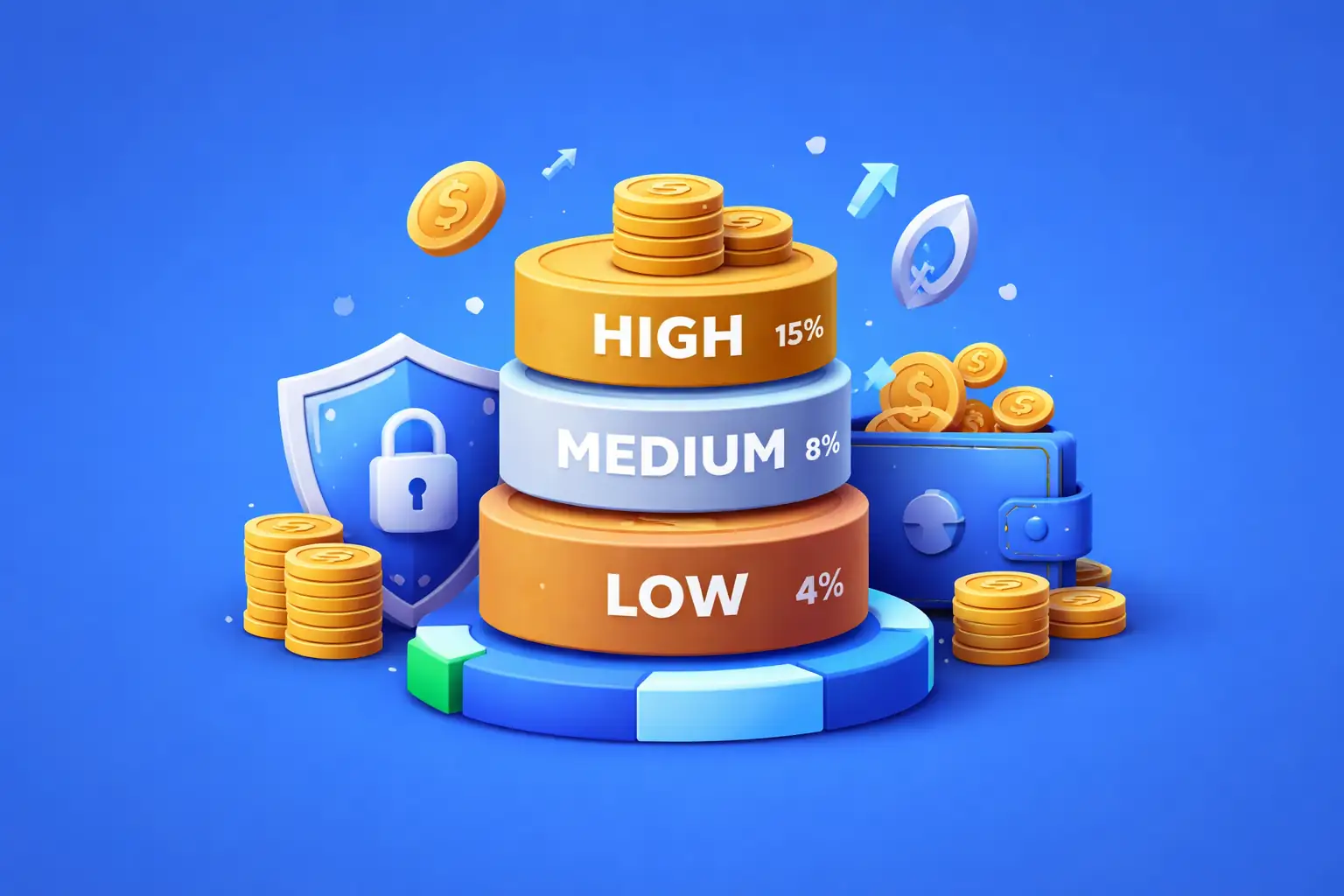
Not all yield farming strategies carry the same risk, and building a portfolio means matching strategies to individual comfort levels. Here’s how to think about portfolio construction across three risk profiles.
Conservative Approach (Low Risk)
Focus on established protocols with deep liquidity and a long track record. Allocate the majority of capital to stablecoin lending on Aave or Compound, where returns of 2 to 6% come from genuine borrowing demand rather than token incentives. Adding Curve’s stablecoin pools provides additional yield with negligible impermanent loss. This approach prioritizes capital preservation and provides predictable, though modest, returns. It suits participants who treat DeFi as an alternative to traditional savings with slightly higher returns.
Moderate Approach (Medium Risk)
Combine stablecoin strategies with blue-chip token farming. Using ETH/USDC pairs on Uniswap V3 with concentrated liquidity can produce 15 to 30% APY, but requires regular position management. Adding Convex Finance on top of Curve positions boosts rewards through CRV token multipliers without additional complexity. This level also opens up Pendle’s yield tokenization for fixed income strategies, where buying Principal Tokens at a discount locks in predictable returns. The development of these layered strategies gives moderate risk participants access to meaningfully higher yields while maintaining exposure to well-audited protocols.
Aggressive Approach (High Risk)
This involves leveraged yield farming, new protocol launches, and high volatility token pairs. Looping strategies on Aave (depositing, borrowing, redepositing) can amplify returns to 15%+ on stablecoins but introduce liquidation risk. Farming new protocol incentives during their launch phase often produces the highest short-term returns, but the protocol’s unproven smart contracts and uncertain tokenomics carry substantial risk. This approach should only be considered with capital that the participant can afford to lose entirely.
Yield Farming Strategies Compared by Risk and Return
| Strategy | Typical APY Range | Risk Level | Best For |
|---|---|---|---|
| Stablecoin Lending (Aave/Compound) | 2% to 6% | Low | Beginners, capital preservation |
| Stablecoin Pools (Curve) | 5% to 15% | Low to Medium | Conservative farmers seeking stable returns |
| Liquid Staking (Lido) | 3% to 5% base + DeFi yield | Low to Medium | ETH holders wanting staking rewards with liquidity |
| Auto Compounding Vaults (Yearn/Beefy) | 5% to 20% | Medium | Passive farmers who want automation |
| Concentrated Liquidity (Uniswap V3) | 15% to 50% | Medium to High | Active managers are comfortable with position monitoring |
| Yield Tokenization (Pendle) | 7% to 14.5% fixed | Medium | Users wanting fixed income returns in DeFi |
| Restaking (EigenLayer) | 4% to 8%+ layered | Medium to High | ETH stakers seeking additional yield layers |
| Leveraged Farming (Looping) | 15% to 30%+ | High | Experienced users with strong risk management |
Practical Steps to Start Yield Farming
Getting started with yield farming in DeFi doesn’t require an enormous amount of capital, but it does require preparation. Here’s a step-by-step walkthrough of the process.
1. Set Up a Non-Custodial Wallet
MetaMask is the most widely compatible wallet across DeFi protocols. Rabby offers better transaction previews for users who want more visibility into what they’re signing. The important rule: create a separate wallet specifically for farming. Never use a wallet that holds your primary savings for DeFi interactions, because every protocol interaction involves granting smart contract permissions to access your tokens.
2. Fund Your Wallet with the Right Network Tokens
Each blockchain requires its native token for transaction fees (called gas). ETH is needed for Ethereum and Layer 2s like Arbitrum and Optimism. BNB for Binance Smart Chain. SOL for Solana. Layer 2 networks like Arbitrum and Base offer significantly lower gas costs compared to the Ethereum mainnet, making them better options for smaller capital amounts where gas fees would otherwise eat into returns.
3. Choose Your Protocol and Pool
Start with protocols that have at least $1 billion in TVL, multiple completed audits, and at least two years of operational history. For beginners, stablecoin lending on Aave or Compound provides the simplest entry point with no impermanent loss. DeFiLlama’s yield rankings show real-time APYs across hundreds of protocols, filtered by chain, asset type, and risk level.
4. Approve Token Spending and Deposit
Connect your wallet to the protocol, approve the smart contract to access your specific tokens (some users set limited approvals instead of unlimited for extra security), and then deposit into the chosen pool. Security-conscious users should also regularly revoke old token approvals for protocols they no longer use.
5. Monitor and Manage Your Position
Yield farming is not passive in the traditional sense. APYs change constantly based on TVL and trading volume. Reward token prices fluctuate. Protocol governance votes can modify fee structures. Check positions at least weekly. Use DeFiLlama or the protocol’s native dashboard to track performance. Claim and compound rewards based on a schedule that balances gas costs against compounding benefits.
Recommended Reading:
The Role of Smart Contracts in Yield Farming
Smart contracts are the foundation of every yield farming strategy. They handle everything from calculating each liquidity provider’s share of a pool to distributing rewards, managing collateral ratios in lending protocols, and executing automated rebalancing in yield aggregator vaults. Without smart contracts, none of the decentralized financial infrastructure that yield farming depends on would be possible.
In lending protocols like Aave, smart contracts manage the entire lifecycle of a loan: they accept deposits, track utilization rates, calculate variable interest, process collateral liquidations when borrowers fall below health thresholds, and distribute interest to lenders. All of this happens on a chain, transparent and verifiable by anyone. The development of these automated systems is what enables DeFi to operate around the clock without human intervention.
For liquidity provision, AMM smart contracts use mathematical formulas (like the constant product formula x * y = k in Uniswap) to determine prices and execute trades. When a user swaps tokens, the smart contract adjusts the pool balance, calculates the appropriate fee, and allocates that fee to liquidity providers proportionally. More advanced implementations, like Curve’s StableSwap invariant, modify these formulas to optimize for specific use cases like low slippage stablecoin trades.
Yield aggregators like Yearn take smart contract automation even further. Their vault contracts contain complex strategies that interact with multiple protocols simultaneously. A single Yearn vault might deposit stablecoins into Aave, borrow against them, deploy the borrowed funds into a Curve pool, stake the resulting LP tokens in Convex for boosted rewards, harvest those rewards periodically, sell them for the original stablecoin, and compound everything back into the position. This chain of interactions happens automatically and transparently on the blockchain.
However, this composability also introduces compounded risk. Each additional smart contract in a strategy adds another potential point of failure. If any single contract in the chain has a vulnerability, the entire strategy and all funds within it could be at risk. This is why audits, bug bounties, and proven track records matter so much when selecting yield farming strategies that involve multiple protocol interactions.
Cross-Chain Yield Farming and Layer 2 Opportunities
Yield farming in DeFi is no longer limited to the Ethereum mainnet. Layer 2 networks and alternative blockchains have become important venues for farming, often offering higher yields due to lower competition and protocol incentive programs designed to attract liquidity.
Arbitrum has emerged with over $10.4 billion in TVL, hosting major protocols like Aave, Uniswap, and GMX. The significantly lower gas costs (often under $0.10 per transaction compared to $20 to $100+ on Ethereum mainnet) make farming viable for smaller capital amounts. Optimism holds $5.6 billion in TVL and offers similar advantages. Base, Coinbase’s Layer 2, has reached $2.2 billion in TVL and continues to attract new protocols and users.
Solana represents a different approach entirely, with its own native DeFi ecosystem. Solana’s TVL has grown to $10 billion, with protocols like Jupiter, Marinade, and Sanctum offering competitive yields. Transaction costs on Solana are fractions of a cent, making it possible to compound rewards frequently without gas costs eating into returns. The development of Solana’s DeFi infrastructure has matured significantly, though the chain’s history of outages introduces a different type of risk compared to Ethereum.
Cross-chain bridges allow users to move assets between networks to capture the best yields available at any given time. However, bridges have been frequent targets for exploits, so using well-established bridges with strong security records is essential. Many experienced farmers keep positions on multiple chains simultaneously, diversifying across ecosystems to reduce exposure to any single chain’s risks while capturing the best available opportunities.
DeFi Yield Farming Implementations in the Real World
The following project reflects how yield farming and DeFi protocol design principles are already being applied across lending, yield management, and liquidity provision. Each implementation showcases the same smart contract automation, liquidity pooling, and yield optimization strategies discussed throughout this article, from token staking and governance to automated reward distribution and multi-chain deployment.
📊
Pendle Finance: DeFi Yield Tokenization Platform
Created a DeFi platform that tokenizes yield-bearing assets by splitting them into Principal and Yield Tokens, enabling fixed income strategies and yield trading. The platform features an optimized AMM for yield token swaps, multi-chain support across Ethereum, Arbitrum, BNB Chain, and Optimism, and has surpassed $23 billion in total trading volume.
Build Your DeFi Yield Farming Platform Today:
We bring 8+ years of blockchain expertise to DeFi yield farming platform development. Our specialized team handles everything from smart contract creation to multi-chain integration and liquidity pool architecture, ensuring your platform is built for growth, security, and user experience. Whether you need a lending protocol, yield aggregator, or staking platform, we deliver solutions that work.
Final Thoughts
Yield farming in DeFi has moved well beyond its experimental roots. The protocols that survived multiple market cycles have proven that sustainable returns are possible through genuine economic activity like trading fee generation, borrowing demand, and staking security. With the Total Value Locked across DeFi reaching new highs and institutional participation growing, yield farming strategies have become an important part of how both retail and professional investors manage their crypto portfolios.
The key to success lies in matching strategy to risk tolerance. Stablecoin lending on protocols like Aave and Curve provides the lowest risk entry point with 2 to 15% returns backed by real demand. Yield tokenization through Pendle offers fixed income returns for those who want predictability. Liquid staking and restaking through Lido and EigenLayer create layered yield opportunities on staked ETH. And for active managers, concentrated liquidity on Uniswap V3 and leveraged strategies can produce significantly higher returns with proportionally higher risk.
What matters most is doing thorough research before committing capital. Understanding where yield comes from, evaluating smart contract security through audit histories and TVL, and maintaining proper position sizing and diversification across protocols and chains are the foundations of responsible yield farming. The development of DeFi infrastructure continues to advance, with better tools for risk assessment, more efficient yield strategies, and improved security practices making participation more accessible than ever before. But the fundamental principle hasn’t changed: never deploy more capital into yield farming than you can afford to lose, and always question returns that seem too good to sustain.
Frequently Asked Questions
Q1.What is yield farming in DeFi?
Yield farming is a DeFi strategy where users deposit cryptocurrency into decentralized protocols to earn returns through trading fees, borrowing interest, or governance token rewards. These operations run on smart contracts that automatically manage deposits, calculate shares, and distribute earnings without any central intermediary.
Q2.Which protocol is best for beginners?
Aave and Compound are the most beginner-friendly options because they involve depositing a single asset to earn interest from borrowers. There is no impermanent loss, the interfaces are straightforward, and both protocols have years of security track records with billions in TVL.
Q3.How much can I earn from farming?
Returns vary widely based on the strategy and risk level. Stablecoin lending typically produces 2 to 6% APY. Stablecoin liquidity pools on Curve offer 5 to 15%. Active concentrated liquidity provision on Uniswap V3 can produce 15 to 50% for skilled managers. Leveraged strategies can push above 30% but carry significant liquidation risk.
Q4.What is impermanent loss and how do I avoid it?
Impermanent loss happens when the prices of tokens in a liquidity pool change relative to each other after you deposit them. To minimize it, choose stablecoin-only pools where assets maintain similar values, or use protocols like Curve that specialize in trading between similarly priced assets. Curve’s stablecoin pools have recorded impermanent loss rates under 1% during stable market conditions.
Q5.Is yield farming safe in DeFi?
Yield farming carries real risks, including smart contract exploits, market volatility, impermanent loss, and rug pulls on unaudited platforms. Using established protocols with high TVL, multiple audits, and proven track records reduces these risks significantly. However, no DeFi strategy is completely risk-free, and participants should only use capital they can afford to lose.
Q6.Do I need a lot of capital to start?
You can start with as little as $50 to $100, but transaction fees (gas) on the Ethereum mainnet can make small positions unprofitable. Layer 2 networks like Arbitrum, Optimism, and Base offer much lower gas costs, making yield farming practical for smaller amounts. BNB Chain and Solana also provide low-fee environments for getting started.
Explore Services
Related Services
Reviewed by

Aman Vaths
Founder of Nadcab Labs
Aman Vaths is the Founder & CTO of Nadcab Labs, a global digital engineering company delivering enterprise-grade solutions across AI, Web3, Blockchain, Big Data, Cloud, Cybersecurity, and Modern Application Development. With deep technical leadership and product innovation experience, Aman has positioned Nadcab Labs as one of the most advanced engineering companies driving the next era of intelligent, secure, and scalable software systems. Under his leadership, Nadcab Labs has built 2,000+ global projects across sectors including fintech, banking, healthcare, real estate, logistics, gaming, manufacturing, and next-generation DePIN networks. Aman’s strength lies in architecting high-performance systems, end-to-end platform engineering, and designing enterprise solutions that operate at global scale.