Ai Overview
Blockchain introduces fundamental changes to application architecture by decentralizing data storage, computation, and decision-making processes. Organizations adopting blockchain architectures report 60% reductions in reconciliation overhead and 40% improvements in audit efficiency according to recent enterprise surveys. Organizations adopting smart contract architectures report 70% reductions in operational overhead for processes requiring multiple party coordination and approval workflows.
Key Takeaways
- Blockchain fundamentally transforms application architecture by replacing centralized trust assumptions with cryptographic verification and distributed consensus mechanisms across network nodes.
- Immutable data layers provide tamper-proof state management, ensuring application integrity through cryptographic hashing and merkle tree verification structures that prevent unauthorized modifications.
- Smart contracts enable autonomous business logic execution without intermediaries, reducing operational costs while enforcing deterministic rules across distributed application environments.
- Decentralized identity management embeds cryptographic authentication directly into application architecture, eliminating vulnerabilities associated with centralized credential databases and authentication servers.
- Event-driven dApp architectures leverage on-chain state changes to trigger application workflows, creating reactive systems synchronized automatically across all network participants.
- Blockchain-based auditability becomes a native architectural feature, providing transparent and verifiable transaction histories without requiring separate logging infrastructure or trusted audit authorities.
- Fault tolerance increases substantially through distributed ledger systems that eliminate single points of failure, maintaining application availability even when individual nodes experience outages.
- Composable smart contract architectures enable modular application design where different protocols integrate seamlessly, accelerating innovation through standardized interfaces and interoperable components.
- Economic incentives integrate directly into application logic through token mechanisms, aligning user behavior with system goals and creating self-sustaining ecosystems.
Modern application architecture faces unprecedented challenges as enterprises demand higher security standards, greater transparency, and resilience against centralized failures. Traditional systems rely on trusted intermediaries and centralized databases vulnerable to single-point compromises. Blockchain technology introduces a paradigm shift by distributing trust across network participants through cryptographic consensus. This architectural transformation eliminates central authorities while maintaining data integrity through mathematical guarantees rather than institutional trust. Organizations implementing blockchain-enhanced architectures report significant improvements in security posture, operational transparency, and system resilience. The technology enables applications to operate autonomously without requiring constant human oversight, reducing costs while improving reliability. As blockchain infrastructure matures, architectural patterns emerge that fundamentally reshape how we design, deploy, and maintain distributed applications across industries.
Blockchain-Driven Architectural Shifts in Modern Application Design
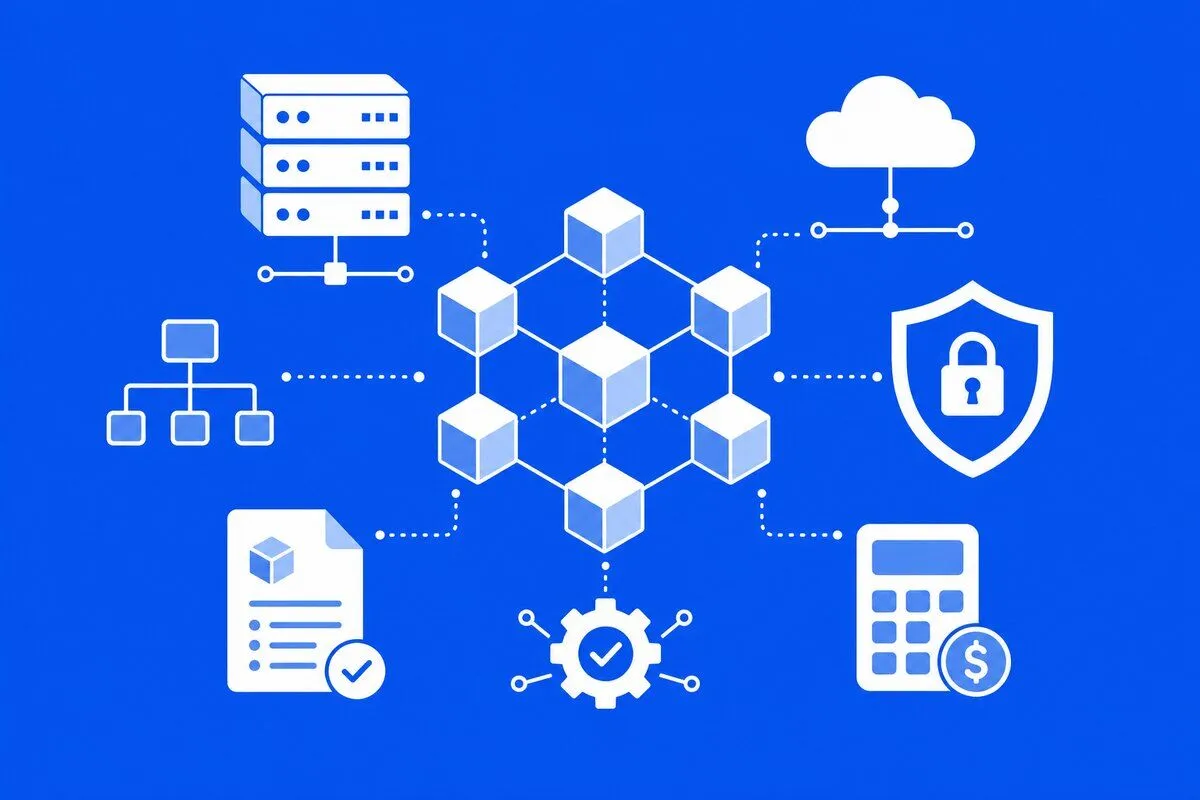
Blockchain introduces fundamental changes to application architecture by decentralizing data storage, computation, and decision-making processes. Traditional three-tier architectures with presentation, business logic, and data layers transform into distributed systems where state replication occurs across hundreds or thousands of nodes. Each participant maintains a complete copy of the application state, verified through consensus algorithms that ensure consistency without central coordination. This shift requires rethinking database design, as blockchain prioritizes integrity and availability over immediate consistency. Applications transition from request-response models to event-driven architectures where on-chain transactions trigger state changes propagated throughout the network. Smart contracts replace server-side application logic, executing deterministically across all nodes with identical results. This architectural evolution eliminates database administrators, reduces infrastructure costs, and increases transparency. Organizations adopting blockchain architectures report 60% reductions in reconciliation overhead and 40% improvements in audit efficiency according to recent enterprise surveys.[1]
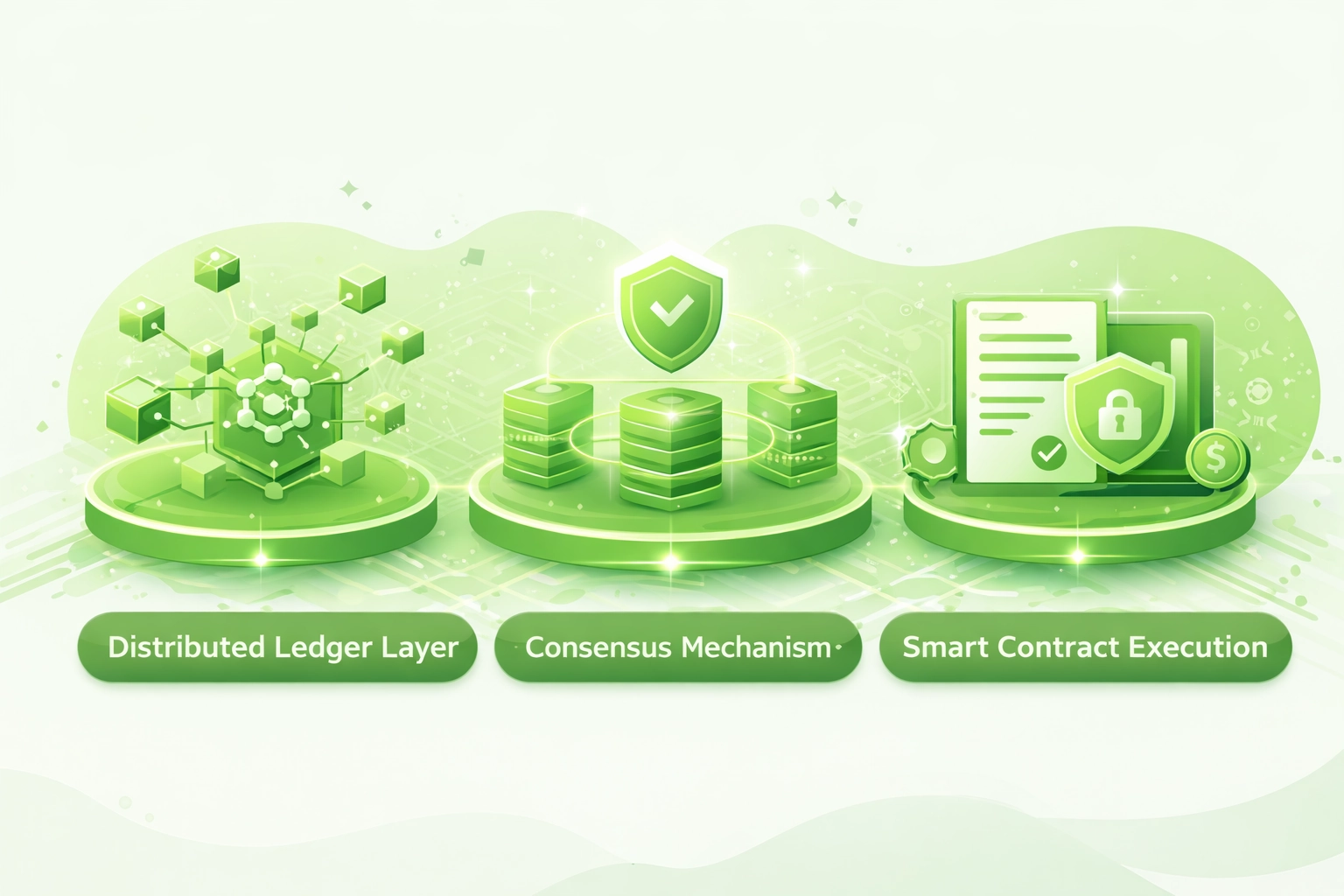 Core Architectural Components
Distributed Ledger Layer
Replaces centralized databases with synchronized state machines across network nodes, ensuring data consistency through cryptographic verification and consensus protocols that eliminate single points of failure.
Consensus Mechanism
Coordinates distributed nodes to agree on transaction validity and state updates without central authority, using proof-of-work, proof-of-stake, or byzantine fault-tolerant algorithms to maintain network integrity.
Smart Contract Execution
Implements autonomous business logic directly on blockchain through self-executing code that runs identically across all nodes, eliminating intermediaries and ensuring deterministic outcomes.
Decentralized Trust Models Replacing Centralized System Assumptions
Traditional applications operate on implicit trust assumptions where users must believe database administrators, system operators, and service providers act honestly. This trust model creates vulnerabilities as centralized entities become high-value targets for attacks and corruption. Blockchain architectures replace institutional trust with mathematical certainty through cryptographic proofs and economic incentives. No single participant can unilaterally alter system state; changes require network consensus following predefined rules. This trustless design enables applications to operate across organizational boundaries without requiring participants to trust each other or intermediaries. Users verify transactions independently through cryptographic signatures and merkle proofs rather than relying on assurances from third parties. The shift from trusted to trustless systems reduces counterparty risk, eliminates custody concerns, and enables peer-to-peer interactions previously impossible without intermediaries. Financial applications particularly benefit as settlement occurs directly between parties with mathematical finality rather than through clearing houses requiring multiple days for verification.
Immutable Data Layers as a Foundation for Secure Application State
Immutability represents blockchain’s most transformative property for application architecture. Once data commits to the blockchain, cryptographic linking through hash chains makes retroactive modification computationally infeasible without detection. Each block contains the previous block’s hash, creating a tamper-evident chain where altering historical data would require recalculating hashes for all subsequent blocks while maintaining consensus among network participants. This immutable foundation enables applications to build upon guaranteed historical states without complex versioning systems or audit trails. Database rollbacks and unauthorized deletions become impossible, providing absolute certainty about data provenance. Applications benefit from simplified state management as developers need not implement complex change-tracking mechanisms. The immutable ledger automatically maintains complete transaction history, enabling time-travel queries to reconstruct application state at any historical point. Financial systems particularly value this property for regulatory compliance and dispute resolution, while supply chain applications leverage immutability for product authenticity verification across multiple stakeholder organizations.
Immutability vs Traditional Database Comparison
| Feature | Blockchain Immutable Layer | Traditional Database |
|---|---|---|
| Data Modification | Append-only structure prevents alterations through cryptographic hash chains | Full CRUD operations allow unrestricted updates and deletions |
| Audit Trail | Complete transaction history maintained automatically by design | Requires separate logging infrastructure and manual implementation |
| Tampering Detection | Immediate detection through consensus validation and hash verification | Requires external monitoring tools and periodic integrity checks |
| Rollback Capability | Only through network fork requiring majority consensus agreement | Administrators can rollback transactions with appropriate privileges |
| Trust Model | Trustless verification through mathematical cryptographic proofs | Requires trust in database administrators and system operators |
Consensus-Backed State Validation Across Distributed Application Nodes
Consensus mechanisms coordinate distributed nodes to agree on application state changes without central arbitration. Traditional systems rely on master databases to resolve conflicts and maintain consistency, creating bottlenecks and single points of failure. Blockchain consensus algorithms enable thousands of independent nodes to reach agreement on transaction validity and ordering through cryptographic voting protocols. Proof-of-work systems require computational puzzles ensuring attackers need majority computing power to compromise the network. Proof-of-stake variants align economic incentives where validators risk financial stakes on honest behavior. Byzantine fault-tolerant algorithms tolerate arbitrary node failures while guaranteeing consistency. This distributed validation means application state changes require network-wide verification rather than unilateral database administrator actions. Applications gain resilience as no single node failure disrupts operations. Consensus also prevents double-spending, ensuring digital assets transfer only once despite distributed processing. The result is highly available systems maintaining consistency guarantees previously possible only through centralized control, enabling applications to scale horizontally while preserving integrity.
Leading Consensus Mechanisms
Proof of Work
Requires computational puzzle solving to propose blocks, creating economic costs for attacks while ensuring distributed validation through network-wide mining competition.
Proof of Stake
Validators stake cryptocurrency holdings as collateral, aligning economic incentives with honest behavior while reducing energy consumption compared to mining-based systems.
Byzantine Fault Tolerance
Enables consensus among distributed nodes even when some participants behave maliciously, guaranteeing safety and liveness properties through multi-round voting protocols.
Cryptographic Identity Management Embedded Into Application Architecture
Blockchain fundamentally reimagines identity management by embedding cryptographic authentication directly into application architecture. Traditional systems store credentials in centralized databases vulnerable to breaches affecting millions simultaneously. Blockchain replaces username-password authentication with public-private key cryptography where users control their identities without intermediaries. Each participant generates key pairs locally, with public keys serving as identifiers and private keys proving ownership through digital signatures. Applications verify signatures mathematically without storing sensitive credentials, eliminating password theft risks entirely. This self-sovereign identity model gives users complete control over personal data and authentication credentials. Smart contracts enforce access permissions based on cryptographic proofs rather than database lookups, reducing latency and improving security. Decentralized identity systems enable portability where users maintain consistent identities across applications without creating separate accounts for each service. Organizations benefit from reduced liability as they never store sensitive credentials, while users gain privacy through selective disclosure where they share only necessary information rather than comprehensive profiles.
Cryptographic Identity Implementation Checklist
Generate public-private key pairs using industry-standard elliptic curve cryptography algorithms ensuring computational security
Implement secure key storage mechanisms using hardware wallets or encrypted software solutions with recovery procedures
Verify digital signatures for transaction authentication without storing sensitive credentials in application databases
Enable self-sovereign identity where users control personal data disclosure through selective sharing mechanisms
Integrate identity verification with smart contracts for automated access control without centralized authentication servers
Support cross-application identity portability enabling users to maintain consistent identities across multiple services
Smart Contract Orchestration as an Autonomous Business Logic Layer
Smart contracts transform application business logic from centralized server code into autonomous programs executing across distributed networks. Unlike traditional APIs requiring trusted operators, smart contracts run deterministically with guaranteed outcomes independent of deployment location. Developers encode business rules directly into blockchain-native code that executes automatically when predefined conditions trigger. This orchestration layer eliminates intermediaries in complex multi-party workflows, reducing costs while increasing speed and reliability. Smart contracts handle everything from simple token transfers to sophisticated financial instruments and governance mechanisms. Their composability enables applications to integrate multiple protocols seamlessly, stacking functionality like building blocks. Upgradability patterns allow controlled evolution without compromising security through proxy contracts and governance systems. Gas optimization becomes critical architectural consideration as computation costs scale with complexity. Advanced patterns like factory contracts enable dynamic contract deployment while maintaining security guarantees. Organizations adopting smart contract architectures report 70% reductions in operational overhead for processes requiring multiple party coordination and approval workflows.
Event-Driven dApp Architectures Powered by On-Chain State Changes
Blockchain enables reactive application architectures where on-chain events automatically trigger workflows across distributed systems. Smart contracts emit events whenever state changes occur, creating observable data streams that applications can monitor and respond to instantly. This event-driven model replaces polling-based architectures with push notifications, reducing latency and infrastructure costs. Applications subscribe to relevant blockchain events through WebSocket connections or indexing services, maintaining synchronized state without constant database queries. Event sourcing patterns naturally align with blockchain’s append-only structure where complete transaction history enables reconstructing application state at any point. Off-chain components react to on-chain events by updating user interfaces, triggering external system integrations, or initiating additional blockchain transactions. This architecture separates concerns effectively with blockchain handling authoritative state while off-chain systems manage presentation and auxiliary functions. Event-driven patterns enable complex orchestrations where multiple smart contracts coordinate through event emission and consumption. Real-time applications benefit from instant state synchronization across all participants when blockchain events propagate. The result is highly responsive systems maintaining eventual consistency while preserving blockchain’s security guarantees for critical state transitions.
Event-Driven Architecture Evolution
Event Emission
Smart contracts emit structured events during transaction execution, creating immutable logs stored permanently on blockchain accessible to all network participants.
Event Indexing
Specialized indexing services monitor blockchain events in real-time, organizing them into queryable databases enabling efficient historical event retrieval and filtering.
Subscription Management
Applications establish WebSocket connections to blockchain nodes, subscribing to specific event filters receiving instant notifications when matching events occur.
State Synchronization
Off-chain components process incoming events updating local state mirrors, maintaining synchronization with authoritative on-chain data without continuous polling overhead.
Workflow Orchestration
Event handlers trigger business logic workflows including user interface updates, external system integrations, and additional blockchain transactions coordinating complex processes.
Event Sourcing
Applications reconstruct complete state history from event streams, enabling time-travel debugging, audit trails, and alternative state projections from same event sequence.
Decentralized Data Integrity Through Merkle Proof Verification
Merkle trees provide cryptographic data structures enabling efficient integrity verification for large datasets stored across distributed systems. Each leaf node contains a data hash while parent nodes combine child hashes recursively until reaching a single root hash representing the entire dataset. Applications can verify data authenticity by providing merkle proofs containing only logarithmic number of hashes rather than transmitting complete datasets. This efficiency enables light clients to validate blockchain state without downloading full transaction history, reducing resource requirements dramatically. Smart contracts leverage merkle proofs for off-chain data verification, validating external information without storing complete datasets on-chain. Supply chain applications use merkle trees to prove product authenticity by verifying certificates against published root hashes. The structure detects any data modification as changes propagate upward producing different root hashes. Merkle proofs enable scalable verification where participants can independently confirm data integrity without trusting verification providers. Applications benefit from reduced storage costs by maintaining only root hashes on-chain while storing bulk data off-chain with verifiable integrity guarantees.
Merkle Proof Verification Process
| Step | Process | Benefit |
|---|---|---|
| Data Hashing | Hash individual data elements creating leaf nodes in merkle tree structure | Creates fixed-size fingerprints enabling efficient comparisons |
| Tree Construction | Combine adjacent hashes recursively forming parent nodes until single root | Organizes data hierarchically enabling selective verification |
| Proof Generation | Collect sibling hashes along path from leaf to root for verification | Minimizes data transmission requiring only logarithmic hashes |
| Root Publication | Publish merkle root on-chain creating immutable commitment to dataset | Anchors off-chain data with blockchain security guarantees |
| Verification | Recompute hashes from data and proof confirming match with published root | Enables independent validation without trusting data providers |
Cross-Component Security Enforcement Using Blockchain Transaction Logic
Blockchain transaction logic provides unified security enforcement across distributed application components, replacing fragmented security implementations with consistent cryptographic guarantees. Traditional microservices architectures struggle with security consistency as each service implements authentication and authorization independently. Blockchain enables security policies encoded in smart contracts that govern all component interactions through transaction validation. Components cannot bypass security checks as blockchain consensus rejects unauthorized transactions automatically. This architecture ensures atomicity where complex multi-step operations either complete entirely or fail without partial state changes. Cross-service communication occurs through blockchain transactions creating immutable audit trails of all interactions. Security policies update consistently across all components through smart contract upgrades rather than requiring synchronized deployments. Access control becomes declarative with permissions defined on-chain and enforced automatically during transaction execution. The result is dramatically reduced security vulnerabilities as centralized enforcement eliminates inconsistent implementations. Organizations report 80% reductions in security incidents after migrating authorization logic to blockchain smart contracts from distributed service implementations.
Security Enforcement Mechanisms
Cryptographic Authorization: Smart contracts verify transaction signatures ensuring only authorized parties execute privileged operations without centralized authentication servers.
Atomic Transactions: Multi-component operations execute atomically through blockchain guarantees preventing partial failures that create security vulnerabilities in distributed systems.
Immutable Audit Logs: All component interactions record permanently on blockchain creating tamper-proof audit trails for security monitoring and compliance reporting requirements.
Consistent Policy Enforcement: Security rules encoded in smart contracts apply uniformly across all components eliminating inconsistent implementations that create exploitable gaps.
Fault-Tolerant Application Design Enabled by Distributed Ledger Systems
Distributed ledger technology inherently provides fault tolerance through data replication and consensus mechanisms that maintain availability despite node failures. Traditional systems require complex clustering and failover configurations to achieve high availability. Blockchain applications gain fault tolerance automatically as the network continues operating when individual nodes fail, restart, or experience network partitions. State replication across hundreds or thousands of nodes ensures no single failure impacts application availability. Byzantine fault tolerance handles not just crashes but malicious behavior where compromised nodes attempt network disruption. Applications designed for blockchain naturally embrace eventual consistency models where transient inconsistencies resolve through consensus protocols. Geographic distribution of nodes provides disaster recovery capabilities as network continues operating despite regional outages. The architecture eliminates single points of failure completely with no master database or central coordinator whose failure stops the entire system. Blockchain’s peer-to-peer nature means applications remain accessible as long as participants can reach any network node. Organizations achieve five-nines availability without expensive infrastructure redundancy previously required for mission-critical systems.
Build Resilient Blockchain Applications
Transform your architecture with decentralized systems ensuring 24/7 availability and cryptographic security across distributed infrastructure.
Decentralized Access Control Models Without Central Authentication Servers
Decentralized access control eliminates authentication server dependencies through blockchain-based permission management. Traditional role-based access control requires centralized directories vulnerable to breaches affecting entire organizations simultaneously. Blockchain enables permission systems where access rights exist as on-chain tokens or smart contract state changes verified cryptographically. Users prove identity through signature verification rather than password authentication, eliminating credential theft risks entirely. Smart contracts enforce access policies automatically during transaction execution without requiring runtime authentication checks against external servers. This architecture enables fine-grained permissions where different users have distinct capabilities verified transparently on-chain. Revocation occurs immediately through on-chain transactions propagating to all network participants instantly. Time-based permissions expire automatically through smart contract logic without manual administration. Delegation becomes straightforward as users transfer access tokens representing specific permissions to other addresses. Multi-signature requirements enforce separation of duties where critical operations require multiple parties’ cryptographic approval. The result is highly secure access control resilient to server compromises, credential leaks, and insider threats plaguing centralized systems.
Permission Management Patterns
Token-Based Permissions
Access rights represented as blockchain tokens enabling transferable permissions verified cryptographically during transaction execution without central authority validation.
Role-Based Contracts
Smart contracts maintain role assignments on-chain with functions checking caller permissions automatically enforcing organizational hierarchies through code logic.
Multi-Signature Authorization
Critical operations require cryptographic signatures from multiple parties implementing separation of duties and preventing unilateral actions by single administrators.
Time-Locked Permissions
Temporary access grants expire automatically through smart contract timestamp validation eliminating manual revocation and reducing administrative overhead significantly.
Blockchain-Based Auditability as a Native Architectural Feature
Blockchain transforms auditability from expensive add-on functionality into fundamental architectural property available automatically. Traditional systems require separate logging infrastructure, tamper-resistant storage, and complex access controls to maintain trustworthy audit trails. Blockchain provides complete transaction history by design with immutable records accessible to authorized parties without additional infrastructure. Every state change records permanently with timestamps, participants, and precise details of modifications. Auditors verify transaction authenticity through cryptographic proofs rather than trusting system administrators or logs. The transparency enables real-time compliance monitoring where automated systems detect policy violations instantly rather than during periodic reviews. Smart contracts enforce business rules deterministically with all execution details recorded on-chain enabling precise reconstruction of decision-making processes. Regulatory reporting simplifies dramatically as blockchain provides authoritative transaction records accepted by compliance frameworks. Supply chain applications leverage auditability for complete product provenance from manufacture through distribution. Financial systems meet stringent regulatory requirements without expensive compliance infrastructure. Organizations report 90% reductions in audit preparation costs after migrating to blockchain architectures with native auditability.
Audit Capability Comparison Matrix
| Audit Capability | Blockchain Implementation | Traditional Systems |
|---|---|---|
| Transaction History | Complete immutable records from genesis block automatically maintained | Requires separate logging systems with periodic archival processes |
| Tamper Evidence | Cryptographic hash chains make modifications computationally infeasible | Administrators can modify logs requiring external verification mechanisms |
| Verification Method | Independent cryptographic proof validation without trusting parties | Rely on trusted log servers and access control mechanisms |
| Real-Time Monitoring | Instant visibility into all transactions through blockchain explorers | Delayed reporting through periodic batch processes and extracts |
| Compliance Cost | Minimal additional cost as auditability built into core architecture | Substantial investments in compliance infrastructure and manual audits |
Secure Inter-Service Communication Using On-Chain Verification
Blockchain enables secure service-to-service communication without traditional authentication infrastructure like mutual TLS or service meshes. Microservices architectures typically require complex certificate management and secure networking configurations to protect inter-service calls. Blockchain simplifies this by routing all service interactions through on-chain transactions with cryptographic verification. Services prove identity through transaction signatures automatically validated by network consensus rather than exchanging certificates. State changes propagate through blockchain events ensuring all services maintain consistent views without complex synchronization protocols. This architecture eliminates man-in-the-middle attack vectors as tampering attempts fail consensus validation. Services communicate asynchronously through transaction submission and event monitoring, decoupling temporal dependencies that create availability issues. Message ordering guarantees arise naturally from blockchain’s transaction sequencing without requiring distributed coordination protocols. Cross-organizational service integration becomes straightforward as blockchain provides neutral ground where parties interact without trusting each other’s infrastructure. The approach dramatically reduces operational complexity while improving security posture for distributed service architectures spanning multiple trust boundaries and organizations.
Resilience Against Single-Point Failures Through Network Decentralization
Network decentralization eliminates catastrophic single-point failures plaguing centralized architectures through geographic and organizational distribution. Traditional systems depend on specific servers, data centers, or cloud regions whose failures cause complete outages. Blockchain distributes application logic and state across thousands of independent nodes operated by different entities worldwide. This radical decentralization ensures applications continue functioning as long as sufficient nodes remain online, typically requiring less than one-third node availability. Network partitions isolate failing components automatically without impacting healthy nodes through peer-to-peer connectivity. Byzantine fault tolerance handles not just crashes but malicious behavior where compromised nodes cannot corrupt network state. Geographic distribution provides natural disaster recovery as regional events affect only local nodes while global network continues operating. No single organization controls infrastructure preventing political or regulatory actions from disrupting service. Participants can join or leave network dynamically without coordination, enabling organic scaling and resilience. The architecture proves remarkably robust with major blockchain networks maintaining 99.99% uptime despite operating in completely hostile adversarial environments without central governance or technical support teams coordinating responses to incidents.
Composable Application Architecture Using Modular Smart Contracts
Composability transforms application construction through modular smart contracts that integrate seamlessly like digital building blocks. Traditional systems require complex API integrations with authentication, versioning, and compatibility management. Blockchain smart contracts expose standardized interfaces enabling applications to combine multiple protocols without permission or coordination. This composability accelerates innovation as developers build upon existing infrastructure rather than recreating functionality. DeFi exemplifies this power with lending protocols, automated market makers, and derivative systems integrating atomically within single transactions. Applications leverage composability to offer sophisticated features quickly by orchestrating existing smart contracts. Security improves through battle-tested components reused across applications rather than reimplementing critical logic. Economic incentives align as protocols benefit when others build upon their infrastructure. Standards like ERC-20 for tokens and ERC-721 for NFTs enable universal compatibility where any application integrates new assets immediately. Composability extends beyond technical integration as smart contracts combine economically through yield aggregation and cross-protocol strategies. The result is exponential innovation potential as each new protocol expands possibilities for all applications simultaneously through permissionless composition.
Smart Contract Interface Standards
| Standard | Purpose | Composability Benefit |
|---|---|---|
| ERC-20 | Fungible token interface for currencies and assets | Universal token integration across wallets exchanges and DeFi protocols |
| ERC-721 | Non-fungible token standard for unique items | Marketplace compatibility enabling trading and display across platforms |
| ERC-1155 | Multi-token standard combining fungible and NFTs | Efficient batch operations reducing gas costs for complex systems |
| ERC-4626 | Tokenized vault standard for yield-bearing positions | Automatic integration with yield aggregators and portfolio managers |
| ERC-2535 | Diamond standard for upgradeable modular contracts | Unlimited contract size through facet architecture enabling complex systems |
Decentralized Upgrade Patterns Without Service Downtime Risks
Blockchain enables sophisticated upgrade mechanisms maintaining service continuity while evolving application functionality over time. Traditional systems face downtime during upgrades as new versions deploy and databases migrate. Smart contract architectures separate data storage from logic through proxy patterns where storage contracts remain constant while logic contracts upgrade seamlessly. Users interact with stable proxy addresses that delegate to current implementation contracts behind the scenes. This pattern enables zero-downtime upgrades as new logic deploys without affecting user interactions or requiring migration. Governance mechanisms coordinate upgrade decisions through on-chain voting where stakeholders propose and approve changes democratically. Time-locks provide safety buffers allowing community review before upgrades activate automatically. Upgradeable contracts maintain careful storage layouts preventing conflicts between versions that could corrupt state. Emergency pause functionality enables rapid response to discovered vulnerabilities without permanent data loss. Transparent upgrade processes build trust as all changes occur publicly on-chain with full audit trails. Organizations successfully operate mission-critical applications through upgrade cycles without user disruption or downtime windows previously required for traditional system maintenance.
Modernize Your Application Architecture
Leverage blockchain expertise to build scalable, secure applications with decentralized infrastructure and smart contract automation.
Economic Incentives Integrated Directly Into Application Architecture
Blockchain uniquely enables economic incentives as first-class architectural components rather than external reward systems. Traditional applications implement incentives through separate payment processing and reward tracking systems disconnected from core functionality. Smart contracts embed token economics directly into application logic where economic actions trigger automatically based on user behavior and system state. This native integration creates self-sustaining ecosystems where participation generates value distributed fairly through transparent rules. Network effects strengthen as users benefit economically from contributing to application growth. Staking mechanisms align long-term interests where participants lock tokens to receive governance rights and revenue shares. Mining rewards compensate infrastructure providers proportional to their contributions without central coordination. Liquidity mining bootstraps new protocols by rewarding early adopters with token distributions. Fee mechanisms create sustainable funding where protocol usage generates revenue distributed to stakeholders automatically. Token models enable novel business architectures like protocol-owned liquidity and ve-tokenomics that were impossible previously. Applications evolve from extractive platforms capturing value to generative protocols where all participants benefit from growth through carefully designed economic incentives.
Common Token Economic Structures
Utility Tokens
Required for accessing application features and services creating natural demand aligned with platform usage and adoption rates.
Governance Tokens
Grant voting rights on protocol parameters and upgrades decentralizing control to community stakeholders invested in long-term success.
Staking Rewards
Compensate participants for locking tokens securing network or providing liquidity aligning incentives with protocol security and stability.
Revenue Sharing
Distributes protocol fees to token holders creating cash flow similar to dividends incentivizing long-term holding and reducing selling pressure.
Future-Ready Application Architectures Built on Trustless Infrastructure
Blockchain architectures prepare applications for emerging technological paradigms through foundation built on trustless infrastructure. As artificial intelligence systems become more autonomous, blockchain provides verifiable audit trails and deterministic environments ensuring AI agents operate within defined parameters. Internet of Things devices leverage blockchain for secure identity management and tamper-proof data logging creating trustworthy sensor networks. Web3 applications enable user data ownership reversing surveillance capitalism through self-sovereign identity and decentralized storage. Cross-chain interoperability protocols connect disparate blockchain networks creating unified ecosystems where applications leverage multiple specialized chains. Layer-2 scaling solutions achieve throughput rivaling centralized systems while maintaining security guarantees through cryptographic proofs. Zero-knowledge cryptography enables privacy-preserving applications where sensitive computations verify without revealing underlying data. Quantum-resistant cryptography ensures long-term security as computing capabilities advance. The modular blockchain architecture allows incorporating new technologies through protocol upgrades without disrupting existing applications. Organizations investing in blockchain architectures today position themselves advantageously for future technological shifts requiring transparent, verifiable, and decentralized infrastructure supporting next-generation applications across industries and use cases.
Emerging Technology Integration Points
AI Agent Coordination: Autonomous AI systems utilize blockchain for verifiable decision logging and multi-agent coordination through smart contract orchestration ensuring transparency and accountability.
IoT Device Networks: Internet of Things infrastructure leverages blockchain identity management and immutable data logging creating trustworthy sensor ecosystems for industrial monitoring.
Zero-Knowledge Privacy: Cryptographic protocols enable privacy-preserving computation where applications verify sensitive data correctness without exposing underlying information to validators.
Cross-Chain Interoperability: Bridge protocols connect independent blockchain networks enabling applications to leverage specialized chains while maintaining unified user experience across ecosystems.
Transform Your Enterprise Architecture
Partner with blockchain specialists to design and implement secure, scalable architectures leveraging decentralized infrastructure and smart contract automation for competitive advantage.
Blockchain fundamentally enhances application architecture by replacing centralized trust assumptions with cryptographic verification and distributed consensus mechanisms. The technology enables immutable data layers, autonomous business logic through smart contracts, and native auditability without separate infrastructure. Organizations implementing blockchain architectures achieve superior security postures, operational transparency, and system resilience compared to traditional centralized systems. Decentralized identity management eliminates credential storage vulnerabilities while fault-tolerant designs survive individual node failures maintaining high availability. Event-driven architectures powered by on-chain state changes create reactive systems synchronized automatically across all participants. Composable smart contracts accelerate innovation through permissionless integration of existing protocols without complex API coordination. Economic incentives integrate directly into application logic aligning participant interests with system goals creating self-sustaining ecosystems. As enterprises face increasing demands for transparency, security, and resilience, blockchain architectures provide future-ready infrastructure supporting next-generation applications across industries. The paradigm shift from trust-based to verification-based computing positions organizations advantageously for emerging technological trends requiring decentralized coordination, autonomous operations, and transparent governance mechanisms that blockchain uniquely enables.
Frequently Asked Questions
Q1.Q1: How does blockchain enhance application security compared to traditional architectures?
Blockchain enhances application security through cryptographic verification, immutable data storage, and distributed consensus mechanisms. Unlike centralized systems with single points of failure, blockchain distributes trust across network nodes, making unauthorized modifications computationally infeasible. Each transaction undergoes cryptographic validation, creating tamper-evident audit trails. Smart contracts enforce security policies autonomously without human intervention, reducing attack surfaces. This architecture eliminates central authentication servers vulnerable to breaches, replacing them with decentralized identity systems. The result is enhanced resilience against data manipulation, unauthorized access, and system-wide compromises.
Q2.Q2: What are the key architectural components of blockchain-based applications?
Blockchain-based applications consist of several critical components: distributed ledger layer for immutable state storage, consensus mechanism for transaction validation, smart contract layer for autonomous business logic, cryptographic identity management system, peer-to-peer networking protocol, and decentralized storage infrastructure. These components work together to eliminate centralized control points. The ledger maintains application state across distributed nodes, while smart contracts orchestrate complex workflows. Consensus algorithms ensure all nodes agree on state changes, and cryptographic protocols secure communications. This modular architecture enables composability, where applications can integrate multiple blockchain services seamlessly.
Q3.Q3: How do smart contracts improve application business logic execution?
Smart contracts revolutionize business logic execution by providing autonomous, deterministic, and transparent rule enforcement. Unlike traditional server-side code requiring trusted intermediaries, smart contracts execute on decentralized networks with mathematically guaranteed outcomes. They eliminate manual intervention, reducing operational costs and human error. Code deployed on-chain becomes immutable, ensuring consistent behavior across all transactions. Smart contracts enable complex conditional logic, multi-party agreements, and automated settlements without centralized oversight. Their composability allows applications to integrate multiple protocols, creating sophisticated architectures. This paradigm shifts business logic from trusted servers to trustless networks.
Q4.Q4: What challenges exist when implementing blockchain in application architecture?
Implementing blockchain architectures presents several challenges: transaction throughput limitations compared to centralized databases, higher latency due to consensus requirements, increased storage costs from data replication across nodes, and complexity in managing state across distributed systems. Applications must handle eventual consistency rather than immediate finality. Smart contract upgrades require careful governance mechanisms to maintain security. Integration with existing systems demands specialized middleware. Network congestion can increase transaction fees unpredictably. Privacy considerations arise from public ledger transparency. However, layer-2 solutions, sharding, and hybrid architectures address many limitations while preserving decentralization benefits.
Q5.Q5: How can existing applications transition to blockchain-enhanced architectures?
Transitioning existing applications involves incremental integration rather than complete rewrites. Start by identifying components benefiting most from decentralization: authentication systems, audit logs, or payment processing. Implement blockchain for these specific functions while maintaining existing infrastructure. Use hybrid architectures where critical data resides on-chain while high-throughput operations remain off-chain. Deploy middleware layers to bridge legacy systems with blockchain networks. Adopt modular smart contracts that interface with existing APIs. Consider layer-2 solutions for scalability without sacrificing security. Gradually migrate additional components as team expertise grows, ensuring business continuity throughout the transition process.
Explore Services
Related Services
Reviewed by

Aman Vaths
Founder of Nadcab Labs
Aman Vaths is the Founder & CTO of Nadcab Labs, a global digital engineering company delivering enterprise-grade solutions across AI, Web3, Blockchain, Big Data, Cloud, Cybersecurity, and Modern Application Development. With deep technical leadership and product innovation experience, Aman has positioned Nadcab Labs as one of the most advanced engineering companies driving the next era of intelligent, secure, and scalable software systems. Under his leadership, Nadcab Labs has built 2,000+ global projects across sectors including fintech, banking, healthcare, real estate, logistics, gaming, manufacturing, and next-generation DePIN networks. Aman’s strength lies in architecting high-performance systems, end-to-end platform engineering, and designing enterprise solutions that operate at global scale.