Ai Overview
DEX aggregators are the infrastructure layer that resolves this fragmentation. A DEX aggregator is a protocol that sources liquidity from multiple decentralized exchanges simultaneously and routes user trades to achieve the best possible output in terms of tokens received after fees, gas, and price impact. It functions as an intelligent routing middleware layer positioned between the user and the fragmented DEX ecosystem below.
Key Takeaways
- 01. DEX aggregators query hundreds of on-chain liquidity pools via Web3 APIs, returning optimal pricing that a single decentralized exchange can never replicate.
- 02. Smart order-routing algorithms evaluate thousands of swap paths in under 200 milliseconds before assembling a single atomic on-chain transaction for users.
- 03. Order splitting across multiple DEX pools dramatically reduces price impact on large trades, making aggregators the standard choice for any DeFi trading platform.
- 04. Cross chain swaps now combine DEX routing and bridge liquidity in a single user interaction, powered by multi-chain Web3 API orchestration layers.
- 05. MEV sandwich attacks remain the primary risk; private mempool routing through services like Flashbots Protect reduces exposure to over 95 percent on protected routes.
- 06. 1inch Pathfinder, Paraswap Delta, and Jupiter v6 are the three most battle-tested routing engines across EVM and Solana ecosystems respectively as of 2026.
- 07. Gas cost optimization inside aggregator contracts can cut transaction costs by 20 to 40 percent versus interacting with each DEX protocol separately.
- 08. Intent-based execution systems are replacing traditional AMM routing, letting users declare desired outcomes while competing solver networks fulfill them optimally.
- 09. Token swap aggregator APIs provide developers ready-to-sign calldata, allowing any DeFi trading platform to embed best-execution swaps without building a routing engine.
- 10. Businesses in the UAE and Canada building DeFi trading platforms should integrate aggregator Web3 APIs at the architecture stage, not as an afterthought post-launch.
Introduction
Decentralized finance has created an extraordinary paradox: more liquidity exists on-chain than ever before, yet fragmentation across hundreds of protocols makes accessing that liquidity efficiently a technical challenge most retail traders cannot solve alone. A trader on Ethereum looking to swap a mid-cap token might find Uniswap v3 offering one price, Curve offering another, and Balancer a third — with no obvious way to determine which is best, or whether splitting the trade across all three would yield a superior outcome altogether.
DEX aggregators are the infrastructure layer that resolves this fragmentation. They are protocol-level routing systems, typically powered by sophisticated Web3 applications and off-chain computation engines, that automatically scan, compare, and execute trades across the entire DEX ecosystem in a single user-facing interaction. Since the first aggregators appeared in 2020, they have matured from basic price comparison tools into multi-chain execution engines processing tens of billions in monthly volume across the USA, UK, UAE, Canada, and every other major crypto market.
This guide provides a precise, step-by-step technical explanation of how DEX aggregators work, what architectural patterns distinguish the best platforms from mediocre ones, and why understanding this technology is essential for anyone building or using DeFi trading platforms in 2026. Every concept is grounded in real systems, real protocols, and real engineering decisions that our team has encountered over eight years of DeFi infrastructure work.
What is a DEX Aggregator?
A DEX aggregator is a protocol that sources liquidity from multiple decentralized exchanges simultaneously and routes user trades to achieve the best possible output in terms of tokens received after fees, gas, and price impact. It functions as an intelligent routing middleware layer positioned between the user and the fragmented DEX ecosystem below. Unlike a single decentralized exchange aggregator or AMM that only accesses its own pool contracts, an aggregator treats every connected protocol as one potential segment of a larger optimal route.
The aggregator model emerged from a straightforward observation: as DeFi protocols multiplied, liquidity atomized into thousands of independent pools. No single pool could offer best execution for every token pair at every volume level. Early aggregators like 1inch solved this in 2020 by building off-chain routing engines connected to on-chain data via Web3 APIs, delivering better prices than any single DEX could on most trades above a few hundred dollars in size.
By 2026, the definition has expanded considerably. Modern crypto DEX aggregators now encompass cross chain routing across 20+ blockchains, intent-based execution where users specify outcomes rather than routes, and solver competition models where multiple entities compete to fill user orders optimally. The common thread across all of these architectures is the same: aggregate fragmented liquidity through Web3 API connectivity, apply intelligent optimization, and deliver superior execution to users who would otherwise navigate that complexity manually.
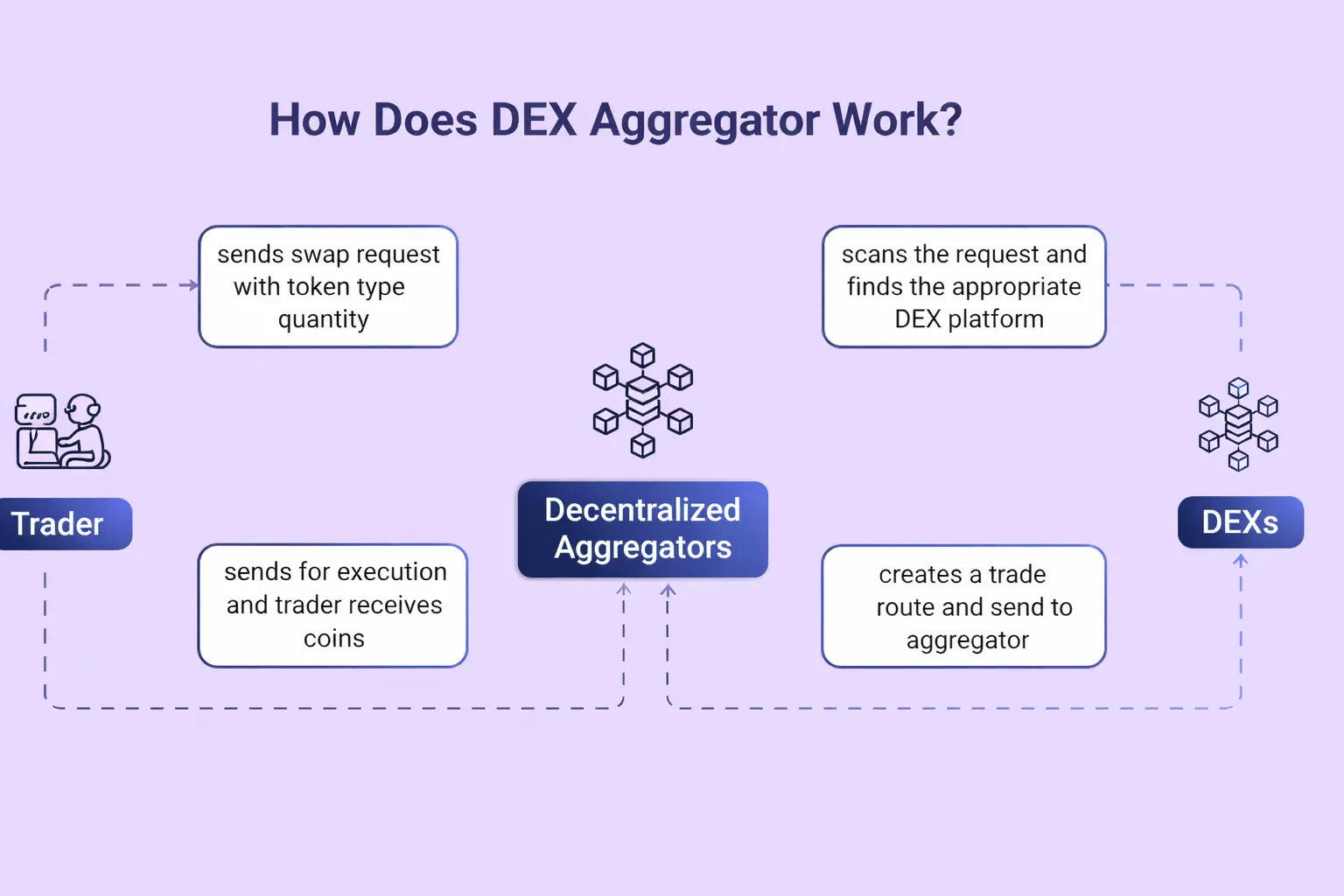
How DEX Aggregators Work: Step-by-Step
The inner workings of a DEX aggregator guide-worthy platform involve at least six distinct technical phases that must execute in tight coordination — most within a few hundred milliseconds of the user initiating a swap. Understanding each phase reveals why professional-grade aggregators consistently outperform both single DEXs and naive routing implementations, and why the quality of the underlying Web3 APIs driving each phase is the single largest determinant of execution quality.
The entire lifecycle from user intent to confirmed on-chain trade is a choreography of off-chain computation and on-chain atomic execution. Neither component can be simplified without degrading the result. Teams building DeFi trading platforms that embed aggregator functionality must understand both halves: the off-chain routing intelligence and the on-chain execution guarantees that together constitute the aggregator value proposition.
DEX Aggregator Full Transaction Lifecycle
Phase 1 — User Intent Capture
The user selects input token, output token, and amount in the aggregator UI or SDK. No on-chain action occurs. The parameters are passed to the off-chain routing engine via an internal Web3 API call, triggering the computation pipeline.
Phase 2 — Parallel Pool Querying
The routing engine issues parallel Web3 API requests to hundreds of liquidity pool contracts across all supported DEX protocols. Reserve balances, fee tiers, concentrated liquidity tick data, and current spot prices are fetched simultaneously in real time.
Phase 3 — Graph-Based Pathfinding
The routing engine models the entire liquidity landscape as a weighted directed graph. Token pairs are nodes; pools are edges weighted by output. Dijkstra-variant and beam-search algorithms evaluate direct, multi-hop, and split-route combinations to maximize output tokens.
Phase 4 — Gas-Adjusted Route Selection
A marginally better route through five protocol hops may net fewer tokens after gas than a simpler two-hop path. The engine calculates gas cost for each candidate route, subtracts it from expected output, and selects the route with the highest true net value to the user.
Phase 5 — Transaction Calldata Assembly
The routing engine encodes the full execution plan — every protocol interaction, approval, swap parameter, and slippage tolerance — into a single transaction payload. This calldata is returned to the user’s wallet via the Web3 API without any on-chain action yet.
Phase 6 — Atomic On-Chain Execution
The user signs and broadcasts the transaction. The aggregator’s router smart contract executes every swap segment atomically in sequence. If any segment fails or slippage exceeds the user’s tolerance, the entire transaction reverts with zero partial fills and zero token loss.
Key Features of DEX Aggregators
The most powerful DEX trading aggregator platforms share a set of architectural features that elevate them above basic routing wrappers. These features are not cosmetic; they represent genuine engineering investments that translate directly into better execution outcomes and lower risk for users. Platforms building on top of aggregator Web3 APIs should evaluate each feature category before committing to an integration partner.
Core Feature Architecture of Leading DEX Aggregators
Routing Intelligence
- Multi-hop cross-protocol pathing
- Percentage split across pools
- Real-time pool graph from Web3 APIs
- Gas-adjusted net output scoring
- Negative liquidity pool exclusion
Execution Security
- MEV and sandwich attack protection
- Private mempool submission options
- Slippage tolerance enforcement
- Atomic revert guarantee on failure
- Deadline parameter enforcement
Cross-Chain Capability
- Bridge + DEX combined routing
- Cross chain swaps in one transaction
- 20+ blockchain network support
- Unified Web3 API across all chains
- Chain-specific gas optimization
The developer API layer sits across all three categories and is the interface through which token swap aggregator functionality reaches end-user applications. A well-designed aggregator API exposes quote, build, and status endpoints that abstract the entire routing complexity into three clean calls, enabling any DeFi trading platform to embed best-execution swaps without maintaining routing infrastructure in-house.
Benefits of Using a Crypto DEX Aggregator
For traders, the immediate benefit is simple: better prices, lower slippage, and lower risk on every swap. But the benefits of integrating a crypto DEX aggregator extend far beyond the headline price improvement figure. For platform operators in the USA, UK, UAE, and Canada building DeFi products, the aggregator model also delivers competitive advantages in operational simplicity, security posture, and user acquisition that compound over time.
For platform builders, the compliance benefit of aggregators is equally important. Because DEX aggregators execute trades non-custodially — the user’s tokens never leave their wallet until the swap is confirmed — the regulatory classification of an aggregator-powered platform is typically more favorable than a custodial exchange product. This matters significantly for licensing discussions in regulated markets including the UK under FCA oversight and the UAE under VARA frameworks.
DEX Aggregators vs Traditional DEXs
The clearest way to understand why how DEX aggregators work matters is to compare them directly against the standard single-DEX interaction. The differences manifest across pricing, slippage, gas efficiency, route flexibility, MEV exposure, and API integration complexity — each with tangible financial and operational consequences for traders and builders alike.
Side-by-Side Execution Comparison
| Execution Factor | Single DEX | DEX Aggregator |
|---|---|---|
| Liquidity Sources | One protocol only | 100 to 200+ protocols |
| Price on $100K Trade | Heavy slippage | Split routing minimizes impact |
| Cross Chain Swaps | Not supported natively | Bridge + DEX in one tx |
| MEV Protection | None by default | Private mempool routing |
| Gas Optimization | Standard call cost | Batch-encoded contracts |
| Developer Web3 API | Protocol-specific SDK | Unified aggregation API |
The table makes clear that for any trade above a few hundred dollars, routing through an aggregator rather than directly to a single DEX is a straightforward optimization. The only scenario where a direct DEX interaction consistently outperforms an aggregator is on very small trades in highly liquid pairs where the aggregator’s gas overhead exceeds the price improvement it delivers — a threshold that varies by chain and network congestion level.
Popular and Best DEX Aggregators
The best DEX aggregators available in 2026 reflect years of protocol iteration, security hardening, and liquidity network expansion. Each platform has carved out distinct strengths that make it the optimal choice for specific use cases, chains, or user profiles. For teams building DeFi trading platforms in the USA, UK, UAE, or Canada, selecting the right aggregator integration is a foundational technology decision that shapes execution quality for every user interaction going forward.
Real-world performance data from DeFi analytics platforms confirms that no single aggregator is universally best across all token pairs, chains, and trade sizes. The practical solution for serious exchange builders is to integrate two or three aggregator Web3 APIs with a routing fallback layer that selects the best quote at query time from among the integrated options. This meta-aggregation approach adds modest engineering complexity but delivers materially superior execution consistency, particularly during periods of market volatility when individual aggregator routing quality varies most.
Leading DEX Aggregator Platforms: 2026 Profiles
1inch (Pathfinder v3): Covers 10+ EVM chains with 200+ liquidity sources. Industry reference for algorithmic routing quality. Widely integrated via Web3 API in USA and EU DeFi platforms.
Paraswap (Delta): Gas-abstracted execution with MEV protection baked in. Preferred by UK and European fintech platforms building regulated DeFi trading features.
Jupiter v6 (Solana): The definitive token swap aggregator on Solana. Routes through all Solana DEXs with sub-second finality. Essential for Solana-native DeFi trading platforms.
LI.FI Protocol: Combines DEX aggregation and bridge aggregation for true cross chain swaps in one API call. Increasingly adopted for UAE multi-chain exchange products.
CoW Protocol (CoW Swap): Batch auction model with peer-to-peer coincidence of wants matching before routing to on-chain liquidity. Superior MEV protection and pricing on ETH mainnet.
OpenOcean: Full-chain aggregator covering CEX and DEX liquidity simultaneously. Popular with Canadian retail DeFi users seeking unified access to both market types.
Model Selection Criteria for Aggregator Integration
Platform teams integrating a DEX aggregator guide-worthy routing solution must evaluate candidates across three structured dimensions. Skipping this evaluation in favor of integrating the most popular option without analysis frequently leads to chain coverage gaps, API reliability issues, or security exposure that is expensive to remediate after launch. Apply this three-step framework before committing to any aggregator integration.
3-Step Aggregator Selection Framework
Step 1: Coverage Audit
- Map every blockchain your platform needs
- Confirm each chain’s top 10 DEXs covered
- Verify Web3 API endpoint per chain
- Test cross chain swaps on target pairs
Step 2: API Reliability Test
- Measure P50 and P99 quote latency
- Stress test under simulated peak load
- Review published uptime SLA history
- Confirm rate limit tiers match your volume
Step 3: Security Verification
- Read all published audit reports fully
- Check historical exploit database
- Confirm active bug bounty program
- Verify MEV protection mechanism type
Challenges and Limitations
Despite transforming how traders access on-chain liquidity, DEX aggregators carry inherent limitations that platform architects must account for. These are not deal-breakers; they are engineering constraints that require deliberate mitigation strategies during integration design. Ignoring them in the architecture phase creates user experience problems and potential financial losses that are difficult to fix after a platform goes live.
Operational Risk Principles for Aggregator-Powered Platforms
Principle 1: Always implement a direct DEX fallback for critical token pairs; aggregator API downtime should never make core trading pairs inaccessible to end users.
Principle 2: Refresh price quotes every 10 to 15 seconds for displayed rates; stale quotes on volatile assets lead to failed transactions and negative user experience.
Principle 3: Cap maximum route hop count at four or five; longer routes inherit smart contract risk from every additional protocol in the path, increasing exposure without proportional benefit.
Principle 4: Display gas estimates prominently before confirmation; multi-hop routes can consume 400,000+ gas units on Ethereum, which may surprise cost-sensitive retail users.
Principle 5: For cross chain swaps, always show estimated bridge time prominently; users accustomed to instant on-chain swaps may abandon the flow without clear timing expectations.
Principle 6: Monitor aggregator contract upgrade announcements; protocol upgrades can change calldata encoding formats, breaking existing integrations without advance notice.
Principle 7: Implement circuit breakers that pause swaps automatically if the aggregator API returns error rates above 5 percent; user-facing errors erode trust faster than brief outages.
Principle 8: Conduct monthly best-execution audits comparing your aggregator’s quoted rates against competing aggregators; routing quality shifts over time as liquidity landscapes change.
Compliance and Governance Checklist
Regulatory expectations for DeFi trading platforms using DEX aggregators are evolving in all four of our target markets. While fully non-custodial aggregators occupy a different regulatory category than custodial exchanges, platforms that present aggregator functionality to end users carry interface-layer obligations that must be addressed proactively — especially for businesses seeking licensing in the UK, UAE, USA, or Canada.
Compliance Checklist for Aggregator-Integrated Platforms
| Item | Jurisdiction | Implementation |
|---|---|---|
| Wallet Address Sanctions Screening | USA, UK, UAE, Canada | Pre-swap OFAC/SDN check |
| Geo-Restriction on Restricted Tokens | All regulated markets | IP-based token blocklist |
| On-Chain Transaction Monitoring | Platforms with KYC users | AML engine integration |
| Smart Contract Audit Publication | All platforms | Public audit report links |
| User Data Privacy Policy | UK GDPR, UAE PDPL | On-chain data disclosure notice |
Future of DEX Aggregators in DeFi
The next generation of DEX aggregators is already taking shape in 2026 through three architectural shifts that will redefine what a DeFi trading platform can deliver. Understanding these shifts is essential for any team making long-term technology decisions today, because the aggregator layer a platform builds on in 2026 will determine whether it is competitive or obsolete by 2028.
The first shift is the broad adoption of intent-based execution. Rather than computing an optimal route themselves, aggregators in this model publish user intents — structured swap requests stating desired outcomes — to a network of competing solvers. Solvers bid to fulfill the intent using any available liquidity source, including off-chain market maker inventory, centralized exchange order books accessed via Web3 APIs, and on-chain AMM pools. The winning solver submits the best execution proof on-chain, ensuring verifiable best execution without the routing engine needing to model every possible path itself. UniswapX and CoW Protocol are the leading implementations of this pattern today.
The second shift is AI-augmented routing, where machine learning models trained on historical routing outcomes, gas price series, and pool behavior patterns predict optimal routes faster and more accurately than deterministic algorithms — particularly on novel token pairs with thin liquidity where historical heuristics outperform real-time graph search. The third shift is regulatory-grade execution attestation, where zero-knowledge proofs certify that a trade received best execution across all available liquidity. For institutional clients in the USA and UK, this cryptographic execution quality guarantee is becoming a baseline requirement for large-volume DeFi participation.
Final Thoughts
DEX aggregators have become the definitive execution layer of decentralized finance — transforming fragmented on-chain liquidity into competitive, optimized trading outcomes through intelligent Web3 API connectivity, graph-based pathfinding, and atomic smart contract execution. For anyone building or using DeFi trading platforms in 2026, understanding how DEX aggregators work is not optional knowledge; it is foundational to making informed decisions about technology stack, execution architecture, and user experience design.
Whether you are a retail trader in Canada seeking better swap rates, an institution in the UAE demanding verifiable best execution, or a platform builder in the UK integrating a token swap aggregator API for the first time, the architecture described in this guide is the engine behind every optimal trade you execute on-chain.
Build a DEX Aggregator-Powered Platform
Launch with best-execution routing built in. Expert Web3 API integration and proven DeFi infrastructure by Nadcab Labs.
Frequently Asked Questions
Q1.What is a DEX aggregator in crypto?
A DEX aggregator is a protocol that consolidates liquidity from multiple decentralized exchanges into a single interface, allowing traders to access the best available prices across all connected pools simultaneously. Instead of manually checking Uniswap, Curve, Balancer, and other platforms, users submit one transaction and the aggregator’s smart routing algorithm splits or routes the trade to achieve optimal execution. This is foundational infrastructure for any serious cross asset trading platform.
Q2.How do DEX aggregators find the best price?
DEX aggregators use real-time pathfinding algorithms powered by Web3 APIs that query multiple liquidity pools across different protocols simultaneously. The algorithm evaluates each possible route, calculates expected output after slippage and fees, then selects the single route or combination of routes that returns the most tokens to the user. Advanced aggregators like 1inch use Pathfinder technology to evaluate thousands of route combinations in milliseconds before a transaction is confirmed on-chain.
Q3.Are DEX aggregators safe to use?
DEX aggregators are generally considered safe when built with audited smart contracts and reputable Web3 APIs. However, users should verify that the aggregator has undergone independent security audits, check for any historical exploits, and confirm that the platform does not hold user funds between transactions. The smart contracts process swaps atomically, meaning either the entire trade succeeds or it fully reverts, protecting users from partial execution losses. Always verify contract addresses from official sources.
Q4.What is the difference between a DEX and a DEX aggregator?
A DEX like Uniswap is a single protocol with its own liquidity pools and automated market maker (AMM) model. A DEX aggregator sits on top of multiple DEXs and routes trades across them to find optimal pricing. Think of it as the difference between one shop versus a price comparison engine. For multi asset crypto exchange scenarios, aggregators provide significantly better execution than any single DEX can achieve because they access fragmented liquidity simultaneously across the entire ecosystem.
Q5.Do DEX aggregators charge extra fees?
Most DEX aggregators do not charge additional fees beyond the underlying DEX fees and gas costs. Platforms like 1inch and Paraswap have no protocol fee on standard swaps. Some aggregators implement positive slippage capture, where if a trade executes better than quoted, the surplus is retained by the protocol rather than returned to the user. Premium features on institutional-grade aggregators used in multi asset trading platform contexts may carry small service fees for advanced routing or guaranteed execution options.
Explore Services
Related Services
Reviewed by

Aman Vaths
Founder of Nadcab Labs
Aman Vaths is the Founder & CTO of Nadcab Labs, a global digital engineering company delivering enterprise-grade solutions across AI, Web3, Blockchain, Big Data, Cloud, Cybersecurity, and Modern Application Development. With deep technical leadership and product innovation experience, Aman has positioned Nadcab Labs as one of the most advanced engineering companies driving the next era of intelligent, secure, and scalable software systems. Under his leadership, Nadcab Labs has built 2,000+ global projects across sectors including fintech, banking, healthcare, real estate, logistics, gaming, manufacturing, and next-generation DePIN networks. Aman’s strength lies in architecting high-performance systems, end-to-end platform engineering, and designing enterprise solutions that operate at global scale.