Ai Overview
A decentralized oracle network (DON) is a system that provides smart contracts with access to real-world data without depending on a single centralized entity. As of mid 2025, Chainlink secures over $93 billion in on-chain value and commands approximately 67% of the total oracle market by value secured. It operates more than 2,000 price feeds and has integrated with over 2,400 projects spanning DeFi, tokenization, derivatives, and prediction markets.
Key Takeaways
- Chainlink holds approximately 67% of the total oracle market share and secures over $93 billion in on-chain value across multiple blockchain ecosystems, powering price feeds for protocols like Aave, Compound, Synthetix, GMX, and Lido.
[1] - In 2022, DeFi protocols lost $403.2 million in 41 separate oracle manipulation attacks, with the Mango Markets exploit alone draining $117 million from the Solana-based DEX through artificial price inflation of its MNGO governance token.
[2] - Pyth Network has emerged as the second-ranked oracle by DeFi usage, securing 48% of all oracle-powered DEX trading volume globally, with data feeds refreshing every few hundred milliseconds through its Solana-based infrastructure.
[3] - Chainlink’s Cross Chain Interoperability Protocol (CCIP) now supports over 60 blockchains and has processed more than $24 billion in token value, enabling DEX platforms to access off-chain data across multiple ecosystems.
[4] - The decentralized finance market stands at $51.22 billion in 2025, with decentralized exchanges holding the largest share at 32.45%, and oracle networks forming the backbone of pricing infrastructure for these platforms.
[5] - Uniswap V2 and V3 introduced on-chain TWAP (Time Weighted Average Price) oracles that average asset prices over a set period to reduce manipulation risk, with V3 supporting up to 65,535 stored observations per pool.
[6] - Protocols that rely on a single DEX liquidity pool as their price oracle face near certain exploitation risk, while decentralized oracle networks like Chainlink require an attacker to compromise more than 50% of nodes on a price feed to succeed.
[7] - Chainlink’s Data Streams throughput surged by 777% in Q1 2025, with the Multistream upgrade allowing a single Decentralized Oracle Network (DON) to deliver thousands of data points per request.
[8] - Flawed oracles accounted for over 49% of all losses in price manipulation attacks during 2023, making oracle architecture the single most critical dependency in DeFi and DEX operations.
[9] - The Gravix DEX platform integrated Chainlink Oracles alongside a proprietary oracle system to provide real-time, accurate market data for trading cryptocurrencies, stocks, and forex with up to 200x leverage, demonstrating how modern DEX platforms combine multiple oracle sources for stronger data integrity.
Every time you swap one token for another on a decentralized exchange, something invisible but absolutely essential happens behind the scenes. The platform needs to know the current price of what you are buying and what you are selling. It cannot simply make up a number. It cannot rely on a single server sitting in a data center somewhere. And it certainly cannot pause and ask a human to verify the rate. This is where decentralized oracle networks step in.
Decentralized oracle networks in DEX platforms serve as the data bridge between the blockchain (which is, by design, isolated from the outside world) and the real-world financial information that smart contracts need to execute trades accurately. Without them, a decentralized exchange would be trading blind. And in a market that moves by the second, blind trading means catastrophic losses.
What makes these oracle networks particularly interesting is that they do not rely on any single source of truth. Instead, they pull data from multiple independent nodes, aggregate it, verify it, and deliver a final price feed that smart contracts can trust. This distributed approach is what separates a functioning DEX from one that is vulnerable to manipulation, flash loan attacks, and outright theft.
This blog will walk through the architecture, working mechanisms, leading implementations, security challenges, and the practical impact of blockchain oracle networks on how DEX platforms operate today. Every claim here is backed by data from verifiable sources, and the goal is to give you a clear, honest picture of what these systems actually do and why they matter so much.
What Are Decentralized Oracle Networks and Why Do DEX Platforms Need Them?
A decentralized oracle network (DON) is a system that provides smart contracts with access to real-world data without depending on a single centralized entity. Traditional oracles act as single points of failure. If the one data source they rely on goes down or gets compromised, every smart contract depending on it becomes vulnerable. A DON, by contrast, distributes the responsibility of fetching, verifying, and delivering data across a network of independent nodes.
For decentralized exchanges specifically, this matters enormously. A DEX uses automated market makers (AMMs) or order books that are governed entirely by smart contracts. These contracts need to know the price of ETH relative to USDC, or the value of a newly listed token against a stablecoin. If that price data is wrong, even by a fraction of a percent on a large trade, it creates arbitrage opportunities that sophisticated traders will exploit immediately.
The term “oracle problem” describes this fundamental challenge. Blockchains are closed systems that cannot natively access data from external APIs, exchanges, or databases. Oracles bridge that gap. But a centralized oracle introduces the very trust dependency that blockchain technology was built to eliminate. That contradiction drove the development of decentralized oracle networks, where consensus among multiple independent data providers replaces reliance on any single source.
How Decentralized Oracle Networks Actually Work Inside a DEX
The mechanics of Oracle integration in DEX platforms follow a structured process, though the specifics vary between Oracle providers. The general flow involves data sourcing, aggregation, consensus, and on-chain delivery.
1. Data Sourcing from Multiple Providers
Oracle nodes collect price data from a variety of sources. These can include centralized exchanges like Binance and Coinbase, other DEX platforms, financial data APIs, and institutional market makers. The key is that no single source controls the output. Chainlink, for instance, uses a network of independent node operators who each fetch data separately and submit their observations to the network.
2. Aggregation and Consensus
Once individual nodes submit their data, the oracle network aggregates these inputs. Chainlink uses Off-Chain Reporting (OCR), a protocol where nodes form consensus and provide cryptographic attestations about the data before submitting a single, aggregated report on chain. This reduces gas costs significantly compared to having every node submit individual transactions. Pyth Network takes a different approach, using a pull-based model where data is broadcast off-chain and applications can request it on-chain when needed, saving gas fees and reducing latency.
3. On Chain Delivery
The final aggregated price is delivered to the blockchain, where DEX smart contracts can read it. In the push model (used by early Chainlink implementations), the oracle continuously updates on-chain feeds. In the pull model (used by Pyth and newer Chainlink Data Streams), the data is available off-chain and gets pulled on-chain only when a transaction requires it. The pull model is particularly useful for high-frequency trading environments because it reduces the cost of keeping prices updated every block.
Recommended Reading:
The Dominant Players in DEX Oracle Networks
The Oracle market is not evenly distributed. A handful of projects command the vast majority of value secured and integrations, and their architectural differences shape how DEX platforms across different blockchains handle price data.
1. Chainlink: The Market Leader
Chainlink has established itself as the most widely adopted oracle network in DeFi. As of mid 2025, Chainlink secures over $93 billion in on-chain value and commands approximately 67% of the total oracle market by value secured. It operates more than 2,000 price feeds and has integrated with over 2,400 projects spanning DeFi, tokenization, derivatives, and prediction markets. Its price feeds are the default for major DeFi protocols, including Aave, Compound, Synthetix, GMX, and Lido. On Ethereum specifically, Chainlink secures over 83% of all oracle-supported value.
What sets Chainlink apart is the breadth of its service offering beyond simple price feeds. Its Verifiable Random Function (VRF) provides provably fair randomness for on-chain gaming and NFTs. Its Proof of Reserve mechanism verifies the backing of tokenized assets. And its Cross Chain Interoperability Protocol (CCIP) now supports over 60 blockchains and has processed more than $24 billion in token value, enabling DEX platforms to work across chains.
2. Pyth Network: Speed Focused Oracle for DEX Trading
Pyth Network has grown rapidly by focusing on speed. Unlike traditional oracles that refresh every few minutes, Pyth refreshes its data feeds every few hundred milliseconds using Solana’s infrastructure. According to DeFiLlama, Pyth secures 48% of all oracle-powered DEX trading volume globally, making it the second-largest oracle by that metric. It now supplies data to dApps across more than 50 blockchains and supports over 400 price feeds covering cryptocurrency, equities, forex, and commodities.
Pyth’s differentiation lies in its first-party data model. Instead of relying on intermediaries to scrape prices from exchanges, Pyth receives data directly from institutional providers like trading firms, exchanges, and market makers. Companies like Revolut and Flow Traders contribute data directly to the network. This eliminates the middleman in the data supply chain and reduces the surface area for manipulation.
3. UMA (Universal Market Access): The Optimistic Oracle
UMA introduced the concept of “optimistic oracles,” where data is considered valid unless someone disputes it within a challenge period. When a dispute occurs, UMA token holders vote to resolve it. This model works well for event-based data and prediction markets. It does not suit high-frequency price feeds for DEX trading, but it fills an important niche in the oracle ecosystem for applications like decentralized insurance and governance.
4. Uniswap’s Built-In TWAP Oracle
Uniswap V2 introduced an on-chain Time Weighted Average Price (TWAP) oracle that tracks price changes within its own liquidity pools. V3 improved this by using a geometric mean calculation and supporting up to 65,535 stored observations per pool. The TWAP approach smooths out short-term volatility and makes single block price manipulation impractical for large, liquid pools. However, TWAP oracles are inherently lagging and work only for assets that already have deep on-chain liquidity. They are best understood as a complement to external oracle networks rather than a replacement.
Comparison of Leading Decentralized Oracle Networks in DEX
| Oracle Network | Market Share / Adoption | Key Technical Approach |
|---|---|---|
| Chainlink | ~67% oracle market share, $93B+ value secured, 2,400+ integrations | Off-chain reporting (OCR), multi-node aggregation, push and pull models, CCIP for cross-chain |
| Pyth Network | 48% of oracle-powered DEX trading volume, 50+ blockchains, 400+ price feeds | First-party data from institutional providers, pull-based model, sub-second updates via Solana |
| UMA | Focused on event data, prediction markets, and governance oracles | Optimistic oracle model with dispute resolution via token holder voting |
| Uniswap TWAP | Built into all Uniswap V3 pools, widely used as a secondary oracle | On-chain geometric mean price over a configurable time window, up to 65,535 observations |
| Band Protocol | $143M TVS, ranked #14 in oracle market, focused on the Cosmos ecosystem | Community curated data sources, cross-chain via IBC, validator-based consensus |
| RedStone | 110+ chains supported, focused on high frequency and modular oracle delivery | RedStone Bolt delivers sub-20ms latency, pull-based modular architecture |
Oracle Manipulation: The Biggest Security Threat to DEX Platforms
If decentralized price oracles are the backbone of DEX operations, then oracle manipulation is the fracture that can bring the entire structure crashing down. The history of DeFi is littered with examples of oracle exploits that drained hundreds of millions of dollars from protocols that thought they were protected.
1. The Mango Markets Exploit ($117 Million)
In October 2022, Avraham Eisenberg exploited Mango Markets, a DEX on the Solana blockchain, by manipulating the price of its MNGO governance token. He started with $10 million USDC split across two accounts. One account shorted 488 million MNGO while the other took the opposite long position. He then purchased $4 million worth of MNGO on three separate exchanges, pumping the oracle-reported price by 2,300% within ten minutes. With his portfolio artificially inflated to over $400 million, he borrowed against it and drained virtually all of Mango Markets’ assets. The protocol lost $117 million. Eisenberg later argued that his actions were a “profitable trading strategy,” but the SEC, CFTC, and DOJ all filed charges against him.
2. The bZx Flash Loan Attacks
In February 2020, the bZx protocol experienced two flash loan attacks that exploited its pricing oracles. Attackers used flash loans to manipulate prices on decentralized exchanges that bZx relied on for price data. The combined losses were approximately $954,000. While the amount was small compared to later exploits, these attacks were significant because they demonstrated the fundamental vulnerability of using a single DEX as a price oracle.
3. The Scale of Oracle Manipulation
According to Chainalysis, DeFi protocols lost $403.2 million in 41 separate oracle manipulation attacks during 2022 alone. Halborn’s research found that flawed oracles accounted for over 49% of all losses in price manipulation attacks during 2023. More recently, the KiloEx attack in early 2025 leveraged a price manipulation vulnerability that resulted in $7.5 million in losses. These numbers show that Oracle security is not a theoretical concern but an ongoing, active threat.
Recommended Reading:
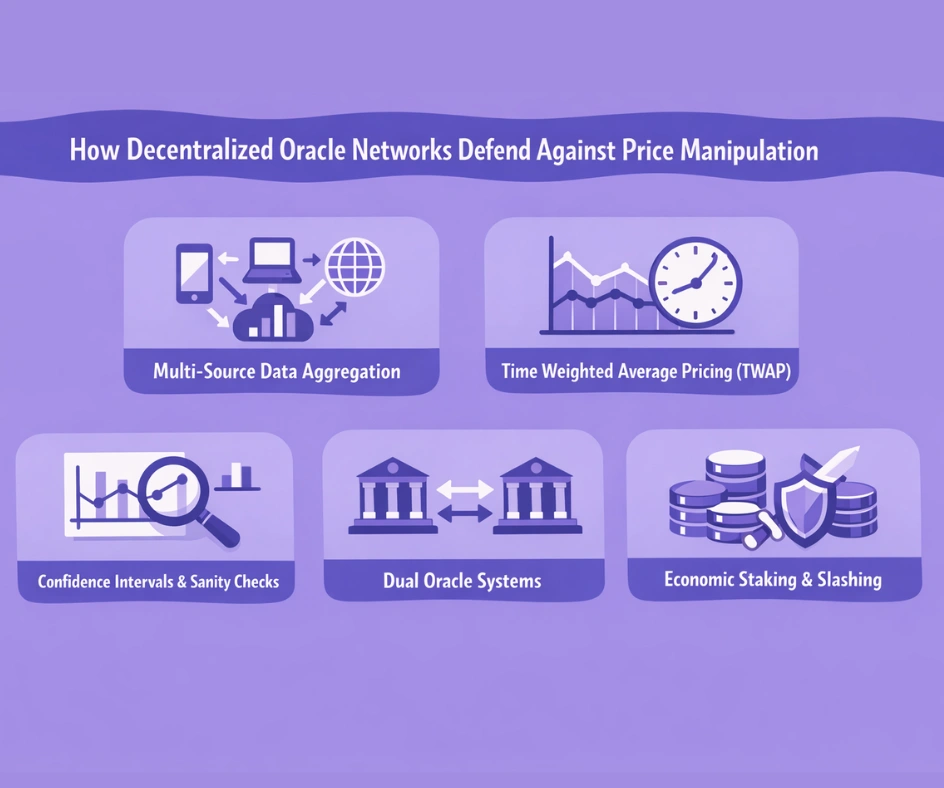
How Decentralized Oracle Networks Defend Against Price Manipulation
The attacks described above have driven significant innovation in how decentralized oracle networks protect DEX platforms. The defense strategies fall into several categories.
1. Multi-Source Data Aggregation
The most fundamental defense is sourcing data from multiple independent providers. Chainlink’s model, for example, requires multiple node operators to independently fetch and submit data. The aggregated result resists manipulation because an attacker would need to simultaneously corrupt a majority of nodes. As noted in Cyfrin’s analysis, attacking a decentralized oracle like Chainlink requires compromising more than 50% plus one of all nodes on a price feed, which is orders of magnitude more expensive than manipulating a single liquidity pool.
2. Time Weighted Average Pricing (TWAP)
TWAP mechanisms, as implemented by Uniswap V2 and V3, average prices over a set period. This means an attacker cannot simply spike the price in one block and exploit it immediately. They would need to sustain the artificial price over the entire averaging window, paying arbitrage costs every block. For large liquidity pools, the cost of maintaining a 5% price deviation on a 1-hour TWAP roughly equals the amount lost to arbitrage and fees for holding that deviation for every block during that hour.
3. Confidence Intervals and Sanity Checks
Pyth Network publishes confidence intervals alongside its price feeds. Instead of reporting that ETH is worth exactly $3,500, it might report $3,500 plus or minus $5. DEX smart contracts can use these confidence intervals to detect unusual market conditions. If the confidence interval suddenly widens, it signals volatility or potential manipulation, and the protocol can pause certain operations or increase collateral requirements.
4. Dual Oracle Systems
Many modern DeFi projects use a dual oracle system that combines an external decentralized oracle (like Chainlink Price Feeds) with an on-chain oracle (like Uniswap V3 TWAP). If the two sources diverge beyond a set threshold, the system can switch to the more conservative price or pause operations entirely. This layered approach provides redundancy without relying entirely on any single oracle architecture.
5. Economic Staking and Slashing
Oracle networks increasingly use staking mechanisms where node operators lock up tokens as collateral. If a node provides inaccurate data, its stake can be slashed. Chainlink’s staking v0.2 introduced dynamic rewards and slashing capabilities, creating direct economic consequences for dishonest behavior. Pyth’s PYTH token holders stake to secure data integrity, tying network usage directly to economic accountability.
The Role of Cross-Chain Oracle Data in Modern DEX Architecture
As DeFi moves beyond single-chain environments, the ability of decentralized oracle networks to deliver data across multiple blockchains has become increasingly important for DEX platforms. A trader using a DEX on Arbitrum still needs accurate ETH/USDC pricing, even though the liquidity for that pair may primarily exist on the Ethereum mainnet.
Chainlink’s CCIP has expanded to support over 60 blockchains, enabling protocols on one chain to securely access data from another. This is not just about price feeds; CCIP supports cross-chain messaging and token transfers, which are essential for cross-chain DEX functionality. When a user bridges tokens from Ethereum to Polygon and then trades them on a Polygon-based DEX, multiple oracle interactions happen behind the scenes to verify asset values, confirm bridge transactions, and execute the swap at the correct price.
Pyth Network addresses cross-chain needs through its integration with Wormhole, a cross-chain messaging protocol. Pyth’s data originates on its Pythnet appchain (a Solana-based network) and is distributed to more than 50 blockchains through Wormhole’s infrastructure. This allows DEX platforms on Ethereum, Arbitrum, Base, Avalanche, and dozens of other networks to access the same institutional-grade price feeds.
The practical impact of cross-chain oracle data on DEX platforms is significant. Without it, each blockchain would need its own isolated set of price feeds, creating inconsistencies across chains and making cross-chain arbitrage more difficult to manage. With standardized oracle data available across chains, prices tend to converge more quickly, which benefits traders and reduces the profitability of MEV (Maximal Extractable Value) attacks.
Oracle Extractable Value: A Growing Concern for DEX Traders
As Oracle infrastructure matures, a new category of value extraction has emerged: Oracle Extractable Value (OEV). OEV refers to the profit that can be captured by entities that have advanced knowledge of upcoming oracle price updates. For example, if a liquidation bot knows that an oracle update is about to push a token’s price below a liquidation threshold, it can position itself to capture the liquidation reward.
This is not necessarily malicious, but it represents a hidden cost to DEX users and liquidity providers. The DeFi industry is actively working on OEV solutions. Chainlink introduced Smart Value Recapture (SVR), which allows protocols to reclaim MEV and liquidation value that would otherwise go to third parties. Chainlink committed 50% of fees from staking secured SVR services to its newly created Chainlink Reserve. Since its launch, the Reserve has accumulated over $9 million worth of LINK tokens.
For DEX platforms, managing OEV is becoming a design priority. Protocols that ignore it effectively subsidize MEV searchers at the expense of their own users. Protocols that address it, either through oracle design choices or through mechanisms like batch auctions and protected order flow, create a fairer trading environment.
Recommended Reading:
Real World Applications: How Specific DEX Platforms Use Decentralized Oracles
Understanding decentralized oracle networks in DEX platforms becomes more concrete when you look at how specific projects implement them.
1. GMX: Chainlink Data Streams for Perpetual Trading
GMX, one of the largest perpetual trading DEX platforms, relies on Chainlink’s Data Streams for low-latency, high-frequency price data. The pull-based model allows GMX to access sub-second price updates without the gas costs of continuous on-chain updates. This is critical for a perpetual trading platform where liquidation timing depends on precise, up-to-date pricing.
2. Synthetix on Optimism: Pyth as Primary Oracle
Synthetix Perps on Optimism adopted Pyth Network as its primary off-chain data source. Synthetix Perps has grown to support more than 80 different digital assets and reached more than $40 billion in trading volume. Pyth’s low-latency feeds are essential for maintaining accurate pricing across Synthetix’s synthetic asset ecosystem.
3. Aave: Dual Oracle Architecture
Aave, the largest DeFi lending protocol, uses Chainlink price feeds as its primary oracle. The protocol cross references oracle data against internal circuit breakers and fallback mechanisms to prevent stale or manipulated prices from triggering incorrect liquidations. This multi-layered approach has helped Aave maintain its position as the protocol with the highest total value locked in DeFi lending.
4. Gravix: Multi-Oracle Integration for High Leverage Trading
The Gravix DEX platform integrated both Chainlink Oracles and a proprietary oracle system to support trading of cryptocurrencies, stocks, and forex with leverage up to 200x. This dual oracle approach ensures that the platform has continuous access to accurate pricing data even during periods of network congestion or when individual oracle sources experience downtime. The Gravix DEX Case Study shows that combining multiple oracle sources strengthens data integrity for complex financial instruments on a DEX.
Types of Data Delivered by Oracle Networks to DEX Platforms
| Data Type | Purpose in DEX Operations | Oracle Provider Example |
|---|---|---|
| Spot Price Feeds | Real-time pricing for executing swaps, setting AMM curves, and calculating trade outputs | Chainlink Price Feeds, Pyth Network |
| TWAP (Time Weighted Average) | Smoothing price volatility, defending against single block manipulation | Uniswap V3 Built in Oracle |
| Cross-Chain Asset Prices | Enabling multi-chain DEX trading and cross-chain swaps with accurate valuations | Chainlink CCIP, Pyth via Wormhole |
| Proof of Reserve Data | Verifying that tokenized assets traded on DEX are properly backed | Chainlink Proof of Reserve |
| Verifiable Randomness | Fair distribution mechanics for token launches, airdrops, and lottery-based DEX features | Chainlink VRF |
| Candlestick / OHLC Data | Supporting charting, volatility modeling, and automated trading strategies on DEX platforms | Chainlink Candlestick API (launched mid 2025) |
| Macroeconomic Data | Enabling tokenized real-world asset pricing, interest rate feeds for DeFi lending on DEX | Chainlink (U.S. Department of Commerce GDP, PCE Index feeds) |
Key Features That Define a Strong DEX Oracle Integration
Not all Oracle integrations are created equal. The difference between a DEX that withstands market shocks and one that loses millions to an exploit often comes down to how thoughtfully the oracle layer was designed. Here are the features that matter most.
1. Data Freshness and Update Frequency
For spot trading and perpetual contracts, stale data can lead to incorrect liquidations, unfair trade executions, and arbitrage losses. Pyth’s sub-second updates and Chainlink’s Data Streams (which saw a 777% growth in throughput in Q1 2025) are designed specifically for latency-sensitive DEX applications. The Multistream upgrade enabled a single DON to deliver thousands of data points per request, dramatically increasing the volume of data available to high-frequency trading protocols.
2. Decentralization of Node Operators
An oracle network is only as decentralized as its node operator set. If five nodes are all run by the same company or are all hosted on the same cloud provider, a single point of failure still exists despite the appearance of distribution. Chainlink addresses this by requiring independent node operators who use diverse data sources and infrastructure. The network’s dominance is estimated to be nine times greater than its closest competitor, in part because of the depth and diversity of its node operator ecosystem.
3. Fallback and Circuit Breaker Mechanisms
Robust DEX oracle integrations include fallback logic that activates when primary feeds fail or report anomalous data. This might involve switching from Chainlink to a TWAP oracle, or pausing trading entirely if all feeds diverge beyond acceptable thresholds. Protocols that lack these safeguards have historically suffered the largest losses during oracle failures.
4. Data Source Transparency
Users and auditors should be able to verify where an oracle’s data comes from, how many sources contribute to the feed, and what aggregation method is used. Pyth publishes its list of data providers, and Chainlink’s feeds are auditable on-chain. This transparency allows the community to identify potential weaknesses before they are exploited.
5. Economic Security Through Staking
Staking creates financial accountability for oracle node operators. Chainlink’s staking capacity has risen to 45 million LINK, with slashing and alerting features that penalize nodes for delivering inaccurate data. This economic layer aligns the financial incentives of node operators with the accuracy requirements of DEX platforms.
The DeFi Market Context: Why Oracle Networks Are More Critical Than Ever
The decentralized finance market is valued at $51.22 billion in 2025 and is projected to reach $78.49 billion by 2030, growing at an 8.96% compound annual growth rate. Decentralized exchanges hold the largest share of DeFi activity at 32.45%, ahead of lending, stablecoins, and yield farming. This means that oracle networks powering DEX platforms are responsible for the data integrity of the single largest category of DeFi activity.
Layer 2 fee compression has cut average settlement costs by 30%, enabling over half of Ethereum’s DEX volume to migrate off the mainchain. This migration to L2s like Arbitrum, Optimism, and Base creates new demands on oracle networks. Feeds need to be available on every chain where a DEX operates, update frequencies need to match the faster block times of L2s, and cross-chain consistency becomes a design requirement rather than a nice-to-have.
Institutional adoption is accelerating this trend. Chainlink now works with financial institutions including SWIFT, Euroclear, J.P. Morgan, Fidelity International, UBS, and ANZ Bank. The tokenized real-world asset market is growing rapidly, with consulting firm Deloitte estimating it could reach $4 trillion by 2026. As tokenized equities, bonds, and real estate start trading on DEX platforms, the need for oracle networks that can deliver institutional-grade data on-chain becomes even more pressing.
Build Your Oracle Integrated DEX Platform Today:
We bring 8+ years of blockchain expertise to decentralized exchange development. Our specialized team handles everything from oracle integration and smart contract architecture to multi-chain deployment and real-time price feed configuration, ensuring your DEX platform is built for accuracy, security, and performance. Whether you need an AMM-based exchange or a perpetual trading platform, we deliver solutions that work.
Final Thoughts
Decentralized oracle networks are not a luxury feature for DEX platforms. They are the foundation on which every trade, every liquidation, every price calculation, and every cross-chain swap depends. Without accurate, tamper-resistant price data flowing from the real world into smart contracts, a DEX is simply a set of code executing trades based on numbers that may or may not reflect reality.
The data is unambiguous about their importance. Chainlink alone secures over $93 billion in value and powers price feeds for the majority of DeFi lending and derivatives protocols on Ethereum. Pyth Network has captured 48% of oracle-powered DEX trading volume through its speed-focused architecture. And the $403.2 million lost to oracle manipulation attacks in 2022 proves what happens when this infrastructure fails or is poorly implemented.
Looking ahead, the demands on Oracle networks will only increase. The growth of real-world asset tokenization, the expansion of DeFi onto Layer 2 networks, the emergence of institutional participation, and the need for sub-second data for perpetual trading all push oracle networks toward greater speed, broader chain support, and stronger economic security. DEX platforms that choose the right oracle architecture, implement proper fallback mechanisms, and stay ahead of emerging threats like Oracle Extractable Value will be the ones that survive and grow.
For developers building DEX platforms, the choice of oracle network is not a technical checkbox. It is a strategic decision that affects every aspect of platform performance, security, and user trust. The protocols that understand this and invest accordingly in their oracle infrastructure are the ones writing the next chapter of decentralized finance.
Frequently Asked Questions
Q1.What is a decentralized oracle network in a DEX?
A decentralized oracle network (DON) is a system of independent nodes that fetch, verify, and deliver real-world data (like asset prices) to smart contracts on a blockchain. In a DEX, oracles provide the price feeds that smart contracts use to execute trades, calculate swap rates, manage collateral, and trigger liquidations. The decentralized aspect means no single node controls the data, reducing the risk of manipulation or downtime.
Q2.Why can't a DEX just use prices from its own liquidity pools instead of external oracles?
Using internal liquidity pool prices as the sole source of truth is extremely risky. Flash loan attacks can temporarily distort pool prices within a single transaction. Protocols that rely on a single DEX liquidity pool as their oracle face near-certain exploitation risk, as demonstrated by numerous attacks, including the bZx exploits. External decentralized oracles aggregate data from multiple sources, making them far more resistant to this type of manipulation.
Q3.How does Chainlink differ from Pyth Network for DEX oracle integration?
Chainlink uses a broad network of independent node operators who fetch data from multiple sources and achieve consensus through its off-chain reporting protocol. It is the dominant oracle by market share and supports the widest range of data types. Pyth Network focuses on speed, receiving data directly from institutional providers like trading firms and market makers, and delivers sub-second updates. Chainlink excels in breadth and institutional adoption; Pyth excels in latency and is particularly popular for perpetual trading DEX platforms.
Q4.What is Oracle Extractable Value (OEV) and how does it affect DEX traders?
OEV refers to the profit that entities can capture by exploiting advanced knowledge of upcoming oracle price updates. For example, a bot might front-run a liquidation by detecting that an oracle update is about to push a price below a liquidation threshold. This represents a hidden cost to DEX users. Protocols are addressing this through mechanisms like Chainlink’s Smart Value Recapture and batch auction designs that minimize the value extracted by MEV searchers.
Q5.Can oracle manipulation still happen with decentralized oracle networks?
While decentralized oracle networks are far more resistant to manipulation than centralized ones, they are not invulnerable. Attacks can target the data sources rather than the oracle network itself (as in the Mango Markets case, where the attacker manipulated prices on centralized exchanges that fed into the oracle). The strongest defense combines decentralized oracles with TWAP mechanisms, confidence intervals, circuit breakers, and economic staking to create multiple layers of protection.
Q6.How do decentralized oracle networks handle cross-chain data for multi-chain DEX platforms?
Cross-chain oracle delivery is handled through protocols like Chainlink’s CCIP (which supports over 60 blockchains) and Pyth’s integration with Wormhole (distributing data to 50+ chains). These systems ensure that a DEX operating on Arbitrum, for example, can access the same price feeds available on the Ethereum mainnet. This consistency is essential for cross-chain swaps, bridge transactions, and maintaining price parity across different blockchain environments.
Explore Services
Related Services
Reviewed by

Aman Vaths
Founder of Nadcab Labs
Aman Vaths is the Founder & CTO of Nadcab Labs, a global digital engineering company delivering enterprise-grade solutions across AI, Web3, Blockchain, Big Data, Cloud, Cybersecurity, and Modern Application Development. With deep technical leadership and product innovation experience, Aman has positioned Nadcab Labs as one of the most advanced engineering companies driving the next era of intelligent, secure, and scalable software systems. Under his leadership, Nadcab Labs has built 2,000+ global projects across sectors including fintech, banking, healthcare, real estate, logistics, gaming, manufacturing, and next-generation DePIN networks. Aman’s strength lies in architecting high-performance systems, end-to-end platform engineering, and designing enterprise solutions that operate at global scale.