Ai Overview
Enterprise Resource Planning, or ERP, is software that brings all the main functions of a business into one place. Research shows that plants which attempt to use ERP alone for shop floor management often find cost-of-goods discrepancies of 15 to 30%. Customisations can add 50 to 200% to the base software cost. You pay a one-time licence fee and then an annual maintenance charge, typically 15 to 20% of the original licence cost.
Key Takeaways
- The global ERP software market was valued at USD 97.77 billion in 2024 and is projected to reach USD 199.59 billion by 2030, growing at a CAGR of 11.6%, showing strong worldwide demand for enterprise resource planning tools in manufacturing and other sectors.[1]
- The global MES market reached 5.5 billion dollars in 2024 and accounts for roughly 6.5% of the broader 85 billion dollar industrial software market, with more than 300 vendors now operating in this space to replace manual and spreadsheet-based methods.[2]
- As of 2024, 54% of manufacturing plants worldwide still relied on paper and spreadsheets to manage production operations, highlighting the enormous gap that custom MES software can fill for factories that have not yet gone digital.[3]
- ERP systems save manufacturers an average of 22% in operational costs and can reduce business decision-making time by up to 36%, making them one of the most impactful investments a manufacturing business can make.[4]
- Manufacturers report an average efficiency increase of 10 to 20% after implementing a manufacturing execution system, with faster response to production issues and a measurable rise in throughput and revenue.[5]
- Plants that try to use ERP in place of a dedicated MES system often discover cost-of-goods discrepancies of 15 to 30% that only come to light once a proper manufacturing execution system is put in place, showing why the two systems must work together rather than replace each other.[6]
- A food processing company saved 1 million dollars annually by automating data transfers between its MES and ERP systems, reducing manual work and data entry errors through a properly designed ERP and MES integration approach.[7]
If you run a manufacturing business, you have probably heard the terms ERP and MES more than once. But what do they actually mean, and why does it matter whether you use a standard off-the-shelf version or one that is built specifically for your operations? This guide breaks it all down in simple language so you can understand what these tools do, how they work together, and how supply chain software development solutions play an important role in connecting your processes. It also helps you see what choosing the right system could mean for your factory floor and your business as a whole.
Manufacturing today is not just about making a product. It involves managing raw materials, tracking every stage of production, keeping accounts in order, managing staff, staying compliant with quality standards, and making decisions based on live data. That is a lot to handle, and doing it with outdated systems or manual processes often leads to mistakes, delays, and lost money. Custom ERP and MES software exists to solve exactly these problems.
The global ERP software market was valued at USD 97.77 billion in 2024 and is expected to more than double, reaching USD 199.59 billion by 2030. At the same time, the global MES market reached USD 5.5 billion in 2024, with more than 300 vendors actively competing to bring factories out of the pen-and-paper era. These are not small numbers. They reflect how seriously the manufacturing world is taking digital transformation and how quickly businesses are moving toward smarter, more connected systems.
Recommended Reading:
Smart Manufacturing & Industry 4.0: Technology Adoption Guide
Understanding Enterprise Resource Planning
Enterprise Resource Planning, or ERP, is software that brings all the main functions of a business into one place. Think of it as the brain of your company. It connects your finance team, your HR department, your purchasing team, your warehouse, and your production floor so that everyone is working from the same data at the same time.
When a sales order comes in, your ERP knows how much stock you have. When stock runs low, it can trigger a purchase order. When workers complete a production run, the system updates inventory, adjusts accounts, and logs the labour used, all without someone having to type that information into three different spreadsheets.
Standard ERP platforms like SAP, Oracle, and Microsoft Dynamics are used by thousands of businesses around the world. However, these are general-purpose tools. A metal fabrication company has very different needs from a pharmaceutical manufacturer. A food processing plant tracks allergens and batch codes. A defence contractor tracks serial numbers and compliance certifications. Off-the-shelf ERP software is often not built for this level of specificity. That is where custom ERP software comes in.
1. What Custom ERP Software Actually Means
Custom ERP software is an enterprise resource planning system that is built or heavily modified to match the exact way your business works. Instead of changing how your team works to fit the software, the software is designed to fit your team. This matters because no two manufacturing businesses are exactly the same.
Custom ERP development typically costs between USD 40,000 and USD 400,000, depending on the size and complexity of the project. Manufacturing businesses tend to fall on the higher end of this range because they need deep production modules, automation logic, and connections to machines and sensors that a retail business would never require.
2. Key Modules Found in a Manufacturing ERP System
A well-built ERP for manufacturing will typically include modules that cover the following areas:
- Production Planning: Scheduling jobs based on machine capacity, material availability, and delivery deadlines.
- Inventory Management: Tracking raw materials, work-in-progress, and finished goods in real time. More than 50% of businesses confirm that ERP contributes to better inventory control.
- Procurement: Raising purchase orders, tracking supplier deliveries, and managing vendor relationships.
- Finance and Costing: Recording production costs, labour, overheads, and generating financial reports.
- Quality Management: Logging inspection results, non-conformances, and corrective actions.
- Human Resources: Managing shifts, payroll, skills, and certifications for shop floor workers.
- Sales and Customer Management: Handling customer orders, pricing, and delivery tracking.
What Is a Manufacturing Execution System and How Does It Differ from ERP?
While ERP is the brain that handles business-level decisions, a Manufacturing Execution System, or MES, is the hands that control what actually happens on your factory floor in real time. The MES sits between the ERP and the machines, translating business plans into shop floor actions and feeding actual production data back up to the ERP.
According to the ISA-95 standard, which is the international standard for industrial automation, MES operates at Level 3 of the automation pyramid. Your ERP system sits above it at Level 4, managing the business. Your machine controllers, sensors, and SCADA systems sit below at Level 2. MES is the layer that connects these two worlds.
Here is a simple way to understand the difference. Your ERP might say: produce 500 units of Product A this week, using 200 kilograms of Material X. Your MES takes that instruction and turns it into a specific work order for a specific machine, assigns an operator, tracks the start and stop time, measures how many good parts were made and how many were rejected, and then sends that actual data back to the ERP so it can update stock levels and production costs accurately.
Without an MES, this information would have to be entered manually, which is slow, error-prone, and often delayed. Research from IoT Analytics shows that 54% of manufacturing plants worldwide still rely on paper and spreadsheets to manage production operations. That is more than half the world’s factories running on methods that introduce delays and mistakes every single day.
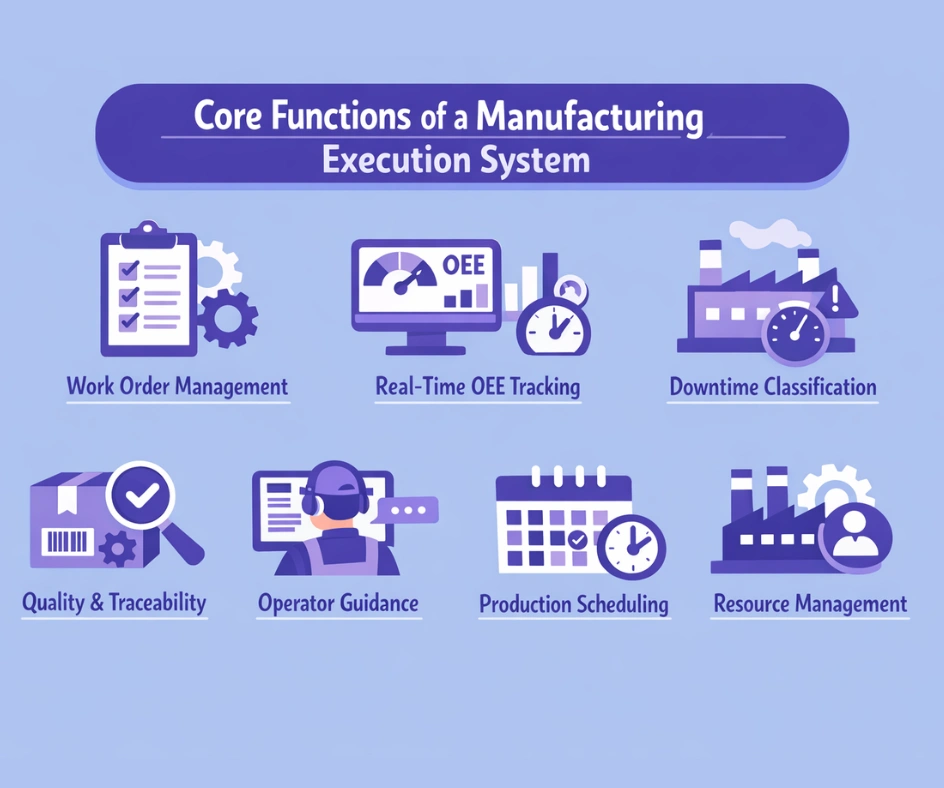
1. Core Functions of a Manufacturing Execution System
According to MESA International, a proper MES should cover eleven core functions. In practice, most deployments focus on these key areas:
- Work Order Management: Assigning and tracking production orders from start to finish.
- Real-Time OEE Tracking: Measuring Overall Equipment Effectiveness by capturing uptime, performance, and quality data automatically from machines.
- Downtime Classification: Logging every machine stop and categorising it so your team can find and fix the root cause.
- Quality and Traceability: Recording every inspection result and linking it to the batch, operator, machine, and time it happened.
- Operator Guidance: Displaying work instructions on the shop floor so workers know exactly what to do at every step.
- Production Scheduling: Assigning work orders to workstations based on machine capacity and material availability.
- Resource Management: Tracking machines, tools, materials, and people in real time.
2. Why ERP Cannot Replace MES
This is a common misconception. Some manufacturers try to use their ERP system as their MES, especially when their ERP provider offers shop floor modules. However, ERP modules from providers like SAP ME or Microsoft Dynamics 365 Manufacturing cannot replace a dedicated MES. They do not have the real-time granularity, machine connectivity, or OEE calculation depth that a proper manufacturing execution system provides.
Research shows that plants which attempt to use ERP alone for shop floor management often find cost-of-goods discrepancies of 15 to 30%. These discrepancies only come to light when a dedicated MES is finally installed and begins feeding accurate, real-time production data back to the ERP. The two systems are designed to do different things and work best when used together.
Recommended Reading:
ERP and MES Integration
The real power of a digital manufacturing operation comes not from ERP or MES alone but from the integration of both. ERP and MES integration creates a two-way flow of data between business planning and shop floor execution. Production orders flow down from ERP to MES. Actual results, machine data, labour hours, material consumption, and quality outcomes flow back up from MES to ERP.
This bidirectional connection means your financial reporting is based on real production data rather than estimates. Your inventory levels are updated the moment materials are used. Your cost-of-goods calculations are accurate because the MES has captured every hour of machine time and every kilogram of material consumed.
A food processing company that implemented proper ERP and MES integration saved USD 1 million annually by automating data transfers between the two systems and eliminating the manual data entry that had previously introduced errors and delays. That is a real-world example of what a well-designed integration can deliver.
1. What Proper Integration Looks Like
When ERP and MES are integrated correctly, here is what the data flow looks like in practice:
- Step 1: A customer order is entered into the ERP system.
- Step 2: The ERP checks inventory, raises a production order, and sends it to the MES.
- Step 3: The MES schedules the production order on the right machine, assigns an operator, and displays work instructions.
- Step 4: The operator completes the job. The MES records actual output, downtime, quality checks, and material usage in real time.
- Step 5: This actual data is sent back to the ERP, which updates stock levels, job costing, and financial records automatically.
2. Common Challenges During Integration
Getting ERP and MES to talk to each other is not always straightforward. Here are the most common challenges that manufacturing businesses face during this process:
- Data Format Differences: ERP and MES systems often store data in different formats. A common data standard must be agreed upon before integration can work properly.
- Data Duplication: Both systems sometimes handle similar data sets, which can lead to duplication unless the integration is carefully designed to avoid it.
- Legacy Equipment: Older machines may not have built-in connectivity. IoT sensors or middleware may be needed to capture machine data.
- Change Management: People on the shop floor need training. Integration is not just a technology project; it is a people project too.
Native ERP connectors built specifically for platforms like SAP S/4HANA, Oracle Manufacturing Cloud, and Microsoft Dynamics 365 can reduce ERP-MES integration project costs by 40 to 60% compared to building a custom connector from scratch.
Custom ERP Software: Cost Breakdown for Manufacturing Businesses
| Development Component | Cost Range (USD) | What This Covers |
|---|---|---|
| Basic Custom ERP | $10,000 to $40,000 | Small teams, simple workflows, minimal integration needs |
| Mid-Range Custom ERP | $40,000 to $120,000 | Multiple modules, third-party integrations, growing businesses |
| Advanced Manufacturing ERP | $120,000 to $400,000+ | Heavy automation, multi-site operations, production modules, machine integration |
| ERP Implementation and Training | 1x to 2x the software cost | Business process mapping, data migration, staff training, and go-live support |
| Third-Party Integration | $5,000 to $50,000 per connection | Connecting ERP to MES, CRM, warehouse systems, and e-commerce platforms |
| Annual Maintenance | 15% to 20% of the licence cost | Updates, security patches, support, system upgrades |
| Cloud ERP Subscription | $40 to $200 per user per month | Access, hosting, automatic updates, and basic support included |
Why Manufacturers Are Moving to Custom Solutions Over Generic Software
The manufacturing sector is not a single, uniform industry. An automotive parts supplier has different pressures than a pharmaceutical company. A food manufacturer faces traceability requirements that a textiles business does not. A defence contractor must manage certification records that a furniture maker would never think about. Generic software tries to serve everyone, and in doing so, it often serves no one particularly well.
This is why more manufacturers are choosing custom ERP software and purpose-built manufacturing execution systems. The goal is not just to have software that works. It is to have software that fits the exact way your business operates, the specific standards you must comply with, and the particular machines and processes you run every day.
ERP systems save manufacturers an average of 22% in operational costs. Decision-making speed improves by up to 36%. More than 50% of businesses report better inventory management after adopting ERP. These are outcomes that matter directly to a manufacturing business’s bottom line.
1. Industry-Specific Requirements That Generic Software Cannot Handle
Each manufacturing sector has its own rules. Here are some examples of where generic software falls short:
- Automotive: OEM customers like Volkswagen and Stellantis require documented OEE performance and full component-level traceability throughout the supply chain. Generic ERP cannot capture this level of shop floor detail.
- Food and Beverage: Allergen traceability, HACCP compliance, lot tracking, and strict changeover management require features that most standard platforms do not include by default.
- Pharmaceuticals: GMP compliance, batch record management, and audit trails must be built into the system from the ground up, not bolted on later.
- Electronics and Semiconductors: First-pass yield tracking, component-level traceability, and AEC-Q100 compliance standards demand real-time monitoring that only a properly configured MES can provide.
2. The Customisation Question: How Much Is Enough?
Not everyone needs a fully custom-built system from scratch. According to a Panorama Consulting report, 44.8% of businesses implement ERP software without any customisation, while 20.8% go for heavy customisation. The right answer depends on how different your operations are from the standard processes the software was built for. Manufacturing businesses, particularly those with complex or hybrid production methods, typically require more customisation than businesses in retail or service sectors.
Customisation adds cost. Third-party integrations alone can run from USD 5,000 to USD 50,000 per connection. Customisations can add 50 to 200% to the base software cost. But the payoff is a system that actually reflects how your business works rather than forcing your team to adapt to a tool that was never designed for them.
Recommended Reading:
Benefits of Custom ERP and MES Software
Adopting custom ERP and MES software is not simply a technology upgrade. It is a change in how a manufacturing business collects, uses, and acts on information. The benefits show up in production, in quality, in costs, and in the speed at which decisions can be made.
1. Better Visibility Across the Entire Operation
When ERP and MES are working together, every manager from the production supervisor to the finance director can see the same live picture of operations. Production progress is visible in real time. Inventory levels are updated automatically. Machine performance data feeds directly into dashboards. There is no waiting for end-of-day reports or chasing people for updates. Decisions can be made faster because the information needed to make them is already there.
2. Lower Operational Costs and Less Waste
ERP and MES integration eliminates redundant processes and reduces the need for manual data entry. When you stop entering the same data into three different systems, you stop making the mistakes that come with it. Production scheduling becomes more accurate because it is based on real machine capacity and real material levels. MES helps identify bottlenecks and inefficiencies on the shop floor that would otherwise be invisible. The result is a leaner, more efficient operation that spends less time and money fixing problems that should never have happened.
3. Improved Product Quality and Traceability
Quality problems are expensive. Defects that reach customers cost far more to fix than defects caught on the production line. A properly implemented MES monitors quality at every stage of the process. It flags issues as they happen, links defects to the machine, operator, batch, and time they occurred, and generates the records needed to prove compliance to customers and regulators. Manufacturers report measurable reductions in scrap rates and rework costs after MES implementation.
4. Faster Response to Market Changes
Manufacturing businesses that run on live data can respond to changes much faster than those working from yesterday’s reports. When demand changes unexpectedly, an integrated ERP and MES can adjust production schedules in real time. When a supplier cannot deliver, the system can identify the impact on production plans immediately. When a quality issue appears on the line, production can be stopped and the batch quarantined before more defective products are made. This kind of agility is only possible when the data is live, accurate, and accessible.
5. AI-Powered Decision Making
Modern ERP software are no longer just databases that record what has happened. They are now analytical tools that help predict what will happen. AI-powered analytics in ERP systems can improve manufacturer productivity by up to 43%, according to 2025 data from Nucleus Research. Features like predictive maintenance alerts, demand forecasting, intelligent inventory optimisation, and conversational interfaces that let users ask plain-language questions of their data are now part of leading ERP platforms.
Cloud-Based vs On-Premise
When you choose a custom ERP or MES system, one of the first big decisions is where the software will live. Will it run on servers in your own building, or will it run in the cloud? Both options have genuine advantages, and the right choice depends on the size of your business, your budget, your IT capability, and how your team works.
1. Cloud-Based ERP and MES
Cloud-based ERP systems are accessed through a web browser and are hosted by the software provider on external servers. You pay a subscription fee, typically between USD 40 and USD 200 per user per month, and the provider handles all the technical maintenance, security updates, and infrastructure.
Over 45% of new ERP and MES installations in 2024 were cloud-based. Organisations that move to cloud ERP architecture see up to 30% faster time-to-value and 20% higher process efficiency compared to those still running on older on-premise systems, according to Gartner’s 2024 ERP Value Study. Cloud also gives remote teams the ability to access the system from anywhere, which matters for multi-site manufacturing businesses and for management teams that need to stay connected when travelling.
2. On-Premise ERP and MES
On-premise systems run on servers that you own and manage inside your own facility. You pay a one-time licence fee and then an annual maintenance charge, typically 15 to 20% of the original licence cost. On-premise deployment gives you full control over your data and can offer better performance for systems that need to process large volumes of real-time machine data without relying on internet connectivity. Some manufacturers in regulated industries prefer on-premises because of data sovereignty requirements.
3. Hybrid Approaches
Many modern manufacturing businesses use a hybrid model. They might run their core ERP in the cloud for flexibility while keeping their MES on-premise for the real-time performance needed on the shop floor. This combination is increasingly common among mid-size and large manufacturers who want the best of both worlds.
Recommended Reading:
ERP and MES Software Comparison
| Manufacturing Type | Key ERP Needs | Key MES Needs | Why Custom Matters |
|---|---|---|---|
| Automotive | Supply chain integration, tier supplier management, and demand planning | Component traceability, OEE tracking, and IATF 16949 compliance | OEM customer requirements are very specific and non-negotiable |
| Food and Beverage | Lot tracking, expiry management, recipe costing | Allergen tracking, HACCP compliance, changeover management | Food safety regulations demand traceability that standard tools miss |
| Pharmaceuticals | Regulatory compliance, batch cost accounting, and audit trails | Batch records, GMP documentation, electronic signatures | FDA and EMA requirements need built-in compliance features |
| Electronics | Component procurement, BOM management, multi-level costing | PCB traceability, first-pass yield, cycle time monitoring | AEC-Q100 and customer quality standards require deep component data |
| Discrete / Job Shop | Project costing, engineer-to-order management, and quoting | Work order flexibility, capacity scheduling, operator tracking | High-mix low-volume production does not fit standard templates |
How to Choose the Right Custom ERP and MES Software Partner
Choosing software is only half the decision. The team that builds and implements it matters just as much. A well-designed system, poorly implemented, will not deliver the results you need. A less polished system built by a team that understands your industry deeply will often outperform a technically superior product that was set up without that knowledge.
Here are the most important factors to consider when selecting a development partner for your custom ERP and MES project:
1. Industry Knowledge and Past Work
A development partner who has built ERP systems for manufacturers before will understand things that a general software house will not. They will know about production scheduling logic, machine data collection, quality traceability, and the kind of compliance documentation your industry demands. Ask for case studies. Ask to speak to previous clients. Look at the specific industries they have served before and how closely those match your own.
2. The Implementation Approach
A phased approach to ERP implementation is generally lower risk than trying to go live with everything at once. According to Panorama Consulting data, 27.9% of organisations used a phased implementation approach by module. Starting with finance or inventory, then adding production and MES modules over time, allows the team to learn the system gradually and reduces the chance of disruption to live production.
3. Support and Long-Term Partnership
ERP and MES systems are not one-time projects. They need to grow and change as your business grows and changes. The partner you choose needs to be someone you can work with over the long term, not just someone who will hand over the software and disappear. Look for a team that offers proper documentation, training programmes for your staff, ongoing support contracts, and a clear process for handling change requests.
4. Data Migration Planning
Moving from your current system to a new one requires careful handling of all your existing data. Product records, customer histories, supplier lists, stock levels, open orders, and financial records all need to be transferred accurately. Underestimating the complexity of data migration is one of the most common reasons ERP projects go over budget. Make sure your chosen partner has a clear, detailed data migration plan before work starts.
ERP Solutions for Manufacturing: Market Trends Shaping the Future
The manufacturing software market is not standing still. New technologies are changing what ERP and MES systems can do, and manufacturers that stay ahead of these trends will have a genuine advantage over those that do not.
1. Artificial Intelligence and Machine Learning in ERP
AI is moving from a feature that sounds impressive on a brochure to one that delivers measurable results every day. Predictive maintenance alerts that flag equipment problems before they cause downtime. Demand forecasting tools that analyse market signals and adjust production plans automatically. Inventory optimisation engines that reduce carrying costs while keeping the right materials in stock. These capabilities are already built into leading ERP platforms and are showing up in the results manufacturers are achieving with them.
Oracle’s NetSuite platform launched a conversational AI feature in 2025 called Ask Oracle, which allows manufacturing managers to query their ERP data using plain language questions and get immediate reports and supply chain recommendations without navigating complex menus. This kind of natural language interface makes ERP accessible to people at every level of the business, not just IT specialists.
2. Agentic AI in Manufacturing Execution Systems
The next step beyond AI-assisted MES is agentic AI. At the MES and Industry 4.0 Summit in June 2025, Francisco Almada Lobo, CEO of Critical Manufacturing, outlined a vision for MES systems that use AI agents to not just execute tasks but also learn from production outcomes, suggest process improvements, and optimise the shop floor in real time without waiting for a human to issue an instruction. This represents a shift from MES as a tool that records what happens to one that actively helps improve what happens.
3. IoT and Real-Time Machine Connectivity
More than 500,000 industrial robots were connected to MES platforms worldwide in 2024, generating billions of data points daily. The ability to connect machines, from 1985 presses to 2024 CNC centres, without specialist programming or production stoppages is now a standard expectation for modern MES software. Wireless IoT sensors that communicate over WiFi, LoRaWAN, or 4G can be installed in under 30 minutes per machine and can deliver live OEE data within 48 hours of deployment. This level of rapid connectivity is changing what is possible for manufacturers who have previously felt locked out of digitalisation by the age of their equipment.
4. Sustainability and Carbon Tracking
Over 40% of manufacturers are now adding carbon footprint tracking to their ERP systems, capturing energy usage and raw material sourcing data to meet increasingly strict environmental regulations. This is not just about compliance. Many large manufacturers are being asked by their customers to demonstrate their environmental impact, and ERP systems are becoming the tool through which that data is gathered and reported.
5. MES Penetration Still Low: A Big Opportunity
Despite all the talk of digital transformation, commercial MES systems are currently present in only 8% of the world’s roughly 5 million factories. The rest rely on homegrown tools, ERP add-ons, or a mix of spreadsheets and paper. This means the potential addressable market for proper MES software is estimated at more than USD 50 billion. Manufacturers who adopt proper MES solutions now will have a significant operational advantage over competitors still running on manual methods.
Recommended Reading:
Build Your Custom ERP and MES Software Today:
We help manufacturing businesses design, build, and deploy custom ERP and MES systems that are built around the way your factory actually works. Our team handles everything from requirement analysis and system design to integration, deployment, and staff training. Whether you need a manufacturing execution system for your shop floor, a fully integrated ERP for your entire business, or both connected together, we build solutions that deliver real results.
Final Thoughts
Manufacturing is one of the most data-intensive industries in the world. Every machine produces data. Every production run generates records. Every shift produces results that need to be measured, analysed, and acted on. The businesses that do this well, using connected, purpose-built custom ERP and MES software, will consistently outperform those that rely on manual processes, disconnected spreadsheets, and outdated tools.
The numbers make the case clearly. The global ERP software market is heading toward USD 200 billion by 2030. The MES software market for discrete manufacturing alone is on course to reach USD 4.7 billion by 2035. ERP systems save manufacturers 22% in operational costs on average. Manufacturers who implement MES see efficiency gains of 10 to 20%. Organisations that move to cloud ERP achieve up to 30% faster time-to-value. These are not projections from an optimistic sales brochure. They are outcomes from real businesses that made the decision to invest in the right tools.
What makes custom ERP software and manufacturing execution systems worth the investment is not just the technology itself. It is the alignment between the software and the actual operations of the business. A system built to match your workflows, your production processes, your quality standards, and your compliance requirements will deliver far more value than a generic tool that requires you to change how you work to fit the software.
The manufacturing industry is at a turning point. With 54% of factories still using paper and spreadsheets, and commercial MES present in only 8% of the world’s manufacturing plants, the gap between businesses that have embraced digital operations and those that have not is growing. The decision to invest in custom ERP and MES software is not just about staying current. It is about building the operational foundation that will allow your business to grow, compete, and thrive in the years ahead.
Frequently Asked Questions
Q1.What is the difference between ERP and MES in manufacturing?
ERP handles the business side of manufacturing. It manages finance, purchasing, HR, inventory planning, and customer orders at a high level. MES handles the shop floor side. It controls and tracks what actually happens during production in real time, including machine performance, work order progress, quality checks, and material usage. ERP tells the factory what to produce. MES makes it happen and records the actual results. The two systems are most effective when integrated together, so data flows automatically between them.
Q2.Why should a manufacturer invest in custom ERP software instead of buying a standard product?
Standard ERP software is built to serve a wide range of businesses. It covers common processes well, but often does not match the specific production methods, compliance requirements, or reporting needs of individual manufacturers. Custom ERP software is built around how your business actually operates, which means it supports your exact workflows, connects to your specific machines, and generates the data your team needs without requiring your people to adapt to a system that was not designed for them. The upfront investment is higher, but the long-term fit is much better.
Q3.How much does it cost to develop a custom ERP system for a manufacturing company?
Custom ERP development for manufacturing typically costs between USD 40,000 for a basic system and USD 400,000 or more for an advanced, fully integrated platform with deep production modules and automation. Implementation costs on top of software development are often equal to one to two times the software cost. The final figure depends on the number of modules required, the complexity of integrations needed, the size of the business, and the level of customisation involved.
Q4.What is the ROI of implementing ERP and MES software together?
The return on investment from a well-implemented ERP and MES combination comes from multiple sources. ERP alone saves manufacturers an average of 22% in operational costs and cuts decision-making time by up to 36%. MES delivers average efficiency improvements of 10 to 20% and reduces quality defects and rework. When the two are properly integrated, manufacturers also eliminate the data entry errors and cost-of-goods discrepancies, which can be as large as 15 to 30%, that occur when ERP is used without a proper MES. One food processing company saved USD 1 million annually from automation alone after connecting its ERP and MES systems.
Q5.Is cloud-based ERP suitable for manufacturing businesses?
Yes. Cloud-based ERP is increasingly common in manufacturing. Over 45% of new ERP installations in 2024 were cloud-based. Gartner’s 2024 ERP Value Study found that businesses that migrate to cloud ERP achieve up to 30% faster time-to-value and 20% higher process efficiency compared to those running on older on-premise systems. Cloud ERP is particularly well-suited to multi-site manufacturers and businesses where management teams need access to operational data from different locations. For real-time shop floor data capture, some manufacturers use a hybrid approach with MES running on-premise alongside a cloud-based ERP.
Q6.How long does it take to implement a custom ERP system for a manufacturing business?
The timeline for custom ERP implementation in manufacturing varies depending on the size of the project. Smaller, simpler systems can be deployed in three to six months. Mid-range projects with multiple modules and integrations typically take six to twelve months. Large, enterprise-level implementations with complex integrations, data migrations, and multi-site rollouts can take twelve to twenty-four months or more. A phased approach, starting with one module or one site and expanding over time, is a common way to reduce risk and get value from the system sooner while the full rollout continues in the background.
Explore Services
Related Services
Reviewed by

Aman Vaths
Founder of Nadcab Labs
Aman Vaths is the Founder & CTO of Nadcab Labs, a global digital engineering company delivering enterprise-grade solutions across AI, Web3, Blockchain, Big Data, Cloud, Cybersecurity, and Modern Application Development. With deep technical leadership and product innovation experience, Aman has positioned Nadcab Labs as one of the most advanced engineering companies driving the next era of intelligent, secure, and scalable software systems. Under his leadership, Nadcab Labs has built 2,000+ global projects across sectors including fintech, banking, healthcare, real estate, logistics, gaming, manufacturing, and next-generation DePIN networks. Aman’s strength lies in architecting high-performance systems, end-to-end platform engineering, and designing enterprise solutions that operate at global scale.