Ai Overview
Real estate has always been one of the most reliable wealth-building tools in the world. Instead of one buyer needing the full amount, the ownership is divided into, say, 5,000,000 tokens worth $1 each. Think of a commercial building worth $5 million. In eight years of building these systems, we have seen platforms grow from zero to 50,000 users in under six months using this model.
Key Takeaways
- Real estate tokenization breaks property ownership into digital tokens, making it accessible to small investors worldwide with minimal capital.
- Crypto MLM uses smart contracts and multi-level referral systems to automate commission payouts and accelerate platform user growth.
- Combining both models creates a self-sustaining investment ecosystem where participants earn from property appreciation and referral commissions simultaneously.
- Regulatory compliance remains the biggest challenge, as crypto MLM structures face legal scrutiny in countries like the United States, China, and several EU nations.
- Token standards like ERC-20 and ERC-721 on Ethereum power both fungible fractional shares and unique property NFTs in these networks.
- Real estate DAOs, cross-border investments, and AI-integrated MLM networks represent the near-term future of this converging space.
Introduction: Why Real Estate Needed a New Model
Real estate has always been one of the most reliable wealth-building tools in the world. But let’s be honest about its problems. Buying property requires large upfront capital, involves lengthy legal processes, and once you invest, your money is largely locked in. Selling a property can take months. For most people globally, especially those outside wealthy economies, owning real estate remains out of reach.
Then came blockchain technology, and with it, the concept of tokenizing real-world assets. Property tokenization converts ownership rights into digital tokens on a blockchain, enabling fractional ownership, faster transfers, and global accessibility. But technology alone does not grow a user base. That’s where Crypto MLM enters the picture.
Multi-level marketing in the blockchain context is not your traditional door-to-door sales scheme. It is a smart-contract-driven referral architecture that rewards participants for bringing in new investors. When you plug an MLM incentive structure into a tokenized real estate platform, you get a model that markets itself, grows organically, and distributes wealth across multiple tiers of participants.
This article explores exactly how that combination works, what benefits it creates, what risks it carries, and where it is all heading. If you are a developer, investor, or someone simply trying to understand this space, you are in the right place. Our team has spent 8+ years building crypto MLM development solutions for real estate and DeFi platforms across four continents, and we have seen firsthand what works and what does not.
Understanding Real Estate Tokenization
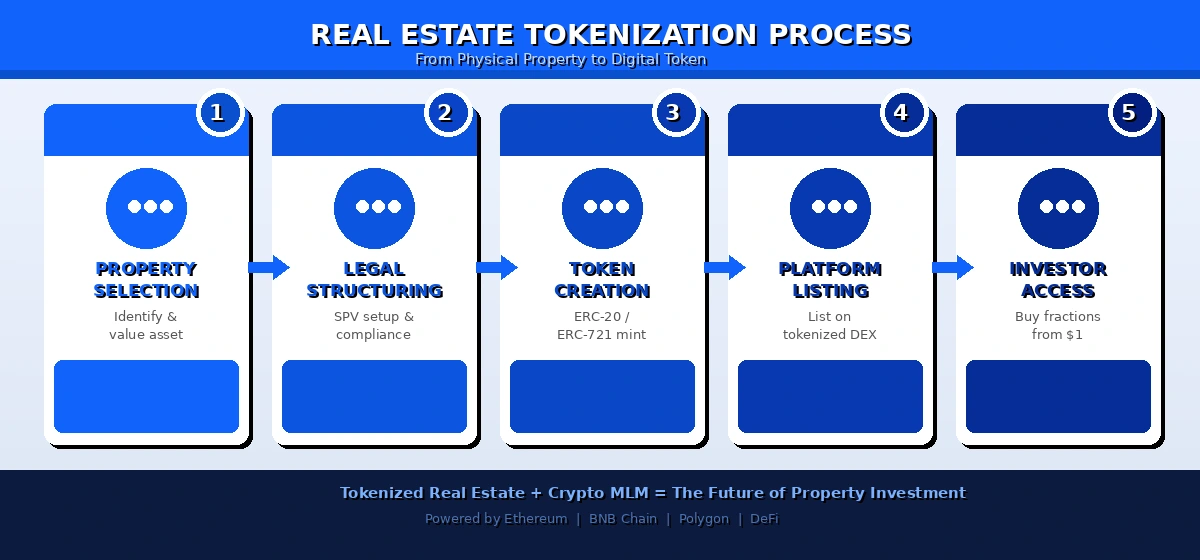
Real estate tokenization is the process of converting ownership or economic rights in a property into digital tokens recorded on a blockchain. Think of a commercial building worth $5 million. Instead of one buyer needing the full amount, the ownership is divided into, say, 5,000,000 tokens worth $1 each. Anyone can buy one token, or ten, or a thousand, and they hold a proportional stake in that asset.
This is made possible by smart contracts on platforms like Ethereum, which automate the enforcement of ownership rules, rental income distribution, and voting rights without needing a lawyer or a bank in the middle.
Platforms operating in this space, like RealT and Lofty AI, already allow users to buy fractional shares in U.S. rental properties for as little as $50. That is genuinely transformative for global investors who previously had no pathway into American real estate markets.
Key Benefits of Real Estate Tokenization
The benefits of tokenizing real estate are not theoretical. They solve specific, longstanding problems in traditional property markets. Liquidity is the biggest win. A tokenized property share can be sold on a secondary market in minutes, compared to the months it takes to sell a physical property. Global accessibility means that a farmer in Southeast Asia can own a fraction of a Manhattan apartment. Transparency and security come from blockchain’s immutable record of ownership, reducing fraud and disputes. Automated income distribution through smart contracts eliminates the middleman from rental income payouts.
Traditional Real Estate vs. Tokenized Real Estate
| Feature | Traditional Real Estate | Tokenized Real Estate |
|---|---|---|
| Minimum Investment | $50,000 – $500,000+ | $1 – $500 (fractional) |
| Liquidity | Low (months to sell) | High (minutes on DEX) |
| Geographic Access | Local or limited cross-border | Global, 24/7 |
| Transaction Speed | 30 – 90 days | Seconds to minutes |
| Transparency | Paper records, opaque | On-chain, publicly verifiable |
| Income Distribution | Manual via agents/banks | Automated via smart contracts |
| Intermediaries | Lawyers, banks, brokers | Mostly eliminated |
What Is Crypto MLM? A Plain-Language Explanation
Crypto MLM stands for Multi-Level Marketing built on blockchain infrastructure. The concept borrows the referral-based growth model from traditional MLM businesses, but replaces paper contracts and manual commission tracking with programmable smart contracts that execute automatically. If you want a full breakdown of MLM types and global regulation, our team wrote a detailed guide you can read here: MLM Meaning, Types, Benefits and Global Regulation.
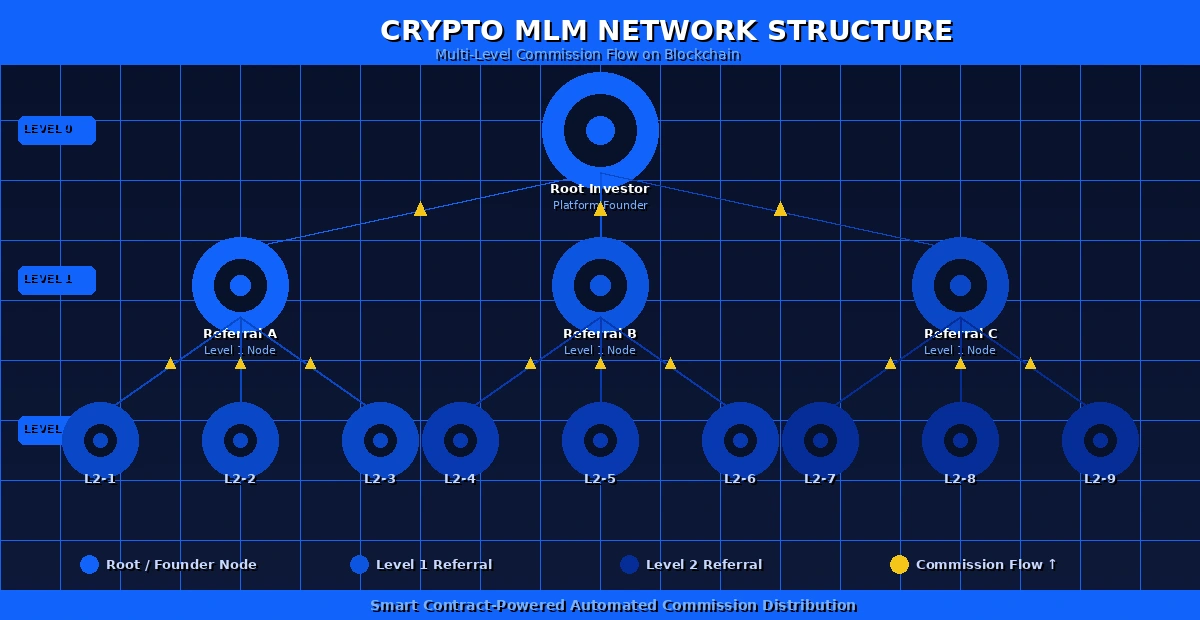
In a Crypto MLM network, a participant signs up, completes some on-chain action (like purchasing tokens or staking assets), and receives a referral link or wallet-linked ID. When someone joins through their link and invests, the original participant earns a commission. When that new participant also refers someone, the commissions flow upward through the levels, all governed by smart contract rules that no single party can manipulate.
Core Components of a Crypto MLM System
Smart Contracts: These are the backbone of the entire operation. A smart contract on Ethereum or BNB Chain defines the commission percentages per level, the conditions for payout, and the rules for network expansion. Once deployed, the code runs exactly as written. No one can change the payout rules after the fact, which builds user trust.
Referral Systems: Each participant gets a unique referral address tied to their wallet. All activity originating from that link is tracked on-chain. This creates a permanent, auditable trail of who referred whom and what commissions are owed.
Automated Payouts: When a condition is met (such as a new user completing a token purchase), the smart contract instantly calculates and distributes commissions to all eligible upline participants. There is no waiting period, no admin approval, and no bank transfer delay.
For a deeper dive into how decentralized blockchain MLM networks are structured, read our guide on Blockchain MLM Networks.
How Crypto MLM Integrates with Real Estate Tokenization Networks
On their own, real estate tokenization platforms face a classic cold-start problem. You have a great product, but how do you build a user base of investors fast enough to fund properties, generate returns, and prove the model? Traditional marketing is slow and expensive. This is exactly where a Crypto MLM layer provides disproportionate value.
The MLM layer sits on top of the tokenization infrastructure. When a new investor joins the platform and buys property tokens, they automatically enter the referral network. If they bring in other investors, they earn commissions in crypto, often in the platform’s native token or in stablecoins like USDC. The more active investors they recruit, the more they earn from referrals, on top of whatever rental income or capital appreciation their property tokens generate.
A Step-by-Step Workflow: From Joining to Earning
Investor Lifecycle in a Crypto MLM Real Estate Network
The network effect here is powerful. Every investor who joins has a financial incentive to recruit more investors, who in turn recruit more. The property platform grows its user base and asset pool without running traditional advertising campaigns. Growth is decentralized and self-sustaining.
“The power of combining tokenized assets with referral networks is that you turn every investor into a distribution channel. In eight years of building these systems, we have seen platforms grow from zero to 50,000 users in under six months using this model.” — BlockMLM Solutions Development Team
Key Benefits of Crypto MLM in Real Estate Tokenization
The combination of these two models creates advantages that neither approach achieves on its own. Let’s look at what really matters.
Faster User Acquisition and Network Growth: Traditional real estate crowdfunding platforms can spend years building a user base. An MLM incentive structure compresses that timeline dramatically. Users become marketers. Each referral commission paid is essentially a performance-based marketing cost, far more efficient than broad advertising spend.
Passive Income from Multiple Streams: An investor in a Crypto MLM real estate network can earn from three sources at once: rental income from their property tokens, appreciation in token value as the underlying property grows in worth, and ongoing commissions from their MLM downline activity. That multi-stream passive income profile is genuinely attractive and distinguishes this model from standard property crowdfunding.
Democratization of Real Estate Investment: The combination lowers the barrier to entry to almost zero. A young professional in Lagos, a student in Manila, or a retiree in rural Brazil can buy $50 worth of property tokens and immediately join a global investment network. That is the kind of financial inclusion that traditional real estate has never offered. According to the World Bank’s financial inclusion research, over 1.4 billion adults globally remain unbanked, and blockchain-based investment platforms represent one of the most viable paths to changing that.
Borderless Investment Ecosystem: A smart contract does not check your passport. Investors from any country can participate, subject to local laws, without needing a bank account in the country where the property is located. Cross-border property investment, which previously required expensive legal structures and currency exchange, becomes a routine transaction.
Benefits Breakdown by Stakeholder
| Stakeholder | Primary Benefit | Secondary Benefit |
|---|---|---|
| Small Investors | Fractional ownership access | Referral commission income |
| Platform Operators | Lower user acquisition cost | Faster capital pooling |
| Property Developers | Access to global retail capital | Faster project funding timelines |
| Top MLM Earners | Scalable passive commission income | Token appreciation gains |
| Local Communities | Increased property investment flow | Economic development activity |
Launch Your Crypto MLM Real Estate Platform
Ready to build a tokenized real estate network powered by smart contract MLM? Our team has delivered 80+ blockchain MLM projects. Let us architect a platform that’s compliant, scalable, and built to grow.
Challenges and Risks You Cannot Ignore
We would be doing you a disservice if we only talked about the upside. The Crypto MLM real estate model has real challenges, and understanding them is essential before building or investing in such a platform.
Regulatory Uncertainty: This is the biggest challenge. In the United States, the SEC has taken an increasingly aggressive stance toward tokenized securities and MLM structures that may constitute unregistered investment schemes. In China, crypto activities including token sales face an outright ban. European regulators are still drafting frameworks under MiCA (Markets in Crypto-Assets). Platforms operating in this space must conduct jurisdiction-by-jurisdiction legal reviews. The regulatory landscape for blockchain MLM is evolving rapidly, and staying compliant requires ongoing legal counsel, not just a one-time review.
Pyramid Structure Risk: Not every multi-level referral network is a pyramid scheme, but the line can be thin. The critical legal distinction is whether the platform generates real-world value from actual property investments, or whether it primarily rewards recruitment. Platforms where earnings depend mostly on recruiting new investors rather than genuine property returns face serious legal exposure. Any legitimate Crypto MLM real estate platform must anchor value creation in real asset performance, not just referral activity.
Crypto Market Volatility: When commissions are paid in native platform tokens or in cryptocurrencies like ETH or BNB, the actual dollar value of those earnings can swing wildly. A user who earned $500 worth of tokens in January might find their holdings worth $150 by March. Platforms that pay commissions in stablecoins like USDC or USDT reduce this risk considerably, but they introduce dependency on stablecoin issuers.
Trust and Transparency Issues: Despite blockchain’s transparency, many retail investors still find it difficult to verify the real-world value of tokenized properties. Who did the property valuation? Is the rental income data accurate? Are the legal wrappers around the tokens enforceable? Building genuine trust requires third-party property audits, legal opinion letters, and clear disclosures, none of which are automatically provided by smart contracts alone.
Real-World Use Cases and Applications
Theory is one thing, but the real measure of this model is whether it produces working platforms. Here are four use cases that are either live or in active development across multiple markets.
Tokenized Rental Income Distribution: Platforms like RealT allow holders of property tokens to receive daily rental income distributions directly to their crypto wallets. Plugging an MLM referral layer into this creates a scenario where landlords and investors can simultaneously earn from rent and from building a network of fellow investors. Several crypto MLM development services firms, including our own, have built custom versions of this for markets in Southeast Asia and the Middle East.
Crowdfunded Property Investments: Rather than a single wealthy buyer, a tokenized property can be funded by thousands of small investors pooling capital through an MLM platform. The referral network drives capital formation while investors collectively own the underlying asset. Early MLM participants who joined and invested before full funding receive higher commission rates as a reward for early network building.
Real Estate DAOs: A Decentralized Autonomous Organization (DAO) can govern a portfolio of tokenized properties. Token holders vote on property acquisitions, sales, and management decisions. An MLM incentive layer can reward members for contributing to governance participation as well as for bringing in new DAO members, creating an organization that grows and governs itself simultaneously.
Cross-Border Property Ownership: A developer in Dubai can tokenize a residential project and sell shares through an MLM referral network to investors in Europe, North America, and Africa. The legal structure is handled through a Special Purpose Vehicle (SPV) in a crypto-friendly jurisdiction, tokens are issued on Ethereum, and commissions are paid automatically via smart contract. This is not futuristic speculation. It is happening today, and our team has been part of structuring multiple such projects.
The Technology Stack Behind the Model
Building a Crypto MLM real estate platform is not a simple task. It requires carefully selected blockchain infrastructure, well-tested smart contract code, and a frontend that makes complex DeFi interactions feel easy for non-technical investors. Here is what the technology picture looks like.
Blockchain Platforms: Ethereum remains the most widely used for tokenized real estate due to its established ecosystem, developer tooling, and ERC standards. BNB Chain is popular for projects prioritizing lower transaction fees. Polygon is increasingly favored as a layer-2 solution that offers Ethereum’s security with much faster and cheaper transactions. For enterprise-grade projects, Hyperledger Fabric or private blockchains may be used for the property registry layer while public chains handle token trading.
Smart Contracts for Automation: The smart contract layer handles everything from token issuance and ownership transfers to MLM commission calculations and rental income splits. A single property onboarding might involve 4 to 6 interconnected smart contracts: a property token contract, a referral tracking contract, a commission distribution contract, a governance contract, and an income distribution contract. Auditing these contracts before launch is not optional. A single vulnerability in commission logic can be drained by bad actors within minutes.
Token Standards and What They Mean: Understanding the difference between ERC-20 and ERC-721 tokens matters here. ERC-20 tokens are fungible, meaning each token is identical to every other token in the same contract. These are used for fractional property shares where one token equals one millionth of the property value. ERC-721 tokens are non-fungible (NFTs), meaning each one is unique. These are used to represent whole properties or specific units within a development. ERC-1155 combines both types and is increasingly used in real estate platforms that deal with multiple property types.
Token Standards Used in Real Estate Tokenization
| Token Standard | Type | Best Used For | Example |
|---|---|---|---|
| ERC-20 | Fungible | Fractional property shares | 1 token = 0.0001% of building |
| ERC-721 | Non-Fungible (NFT) | Unique property deeds | Token ID 001 = Unit 4B, Floor 12 |
| ERC-1155 | Hybrid | Mixed property portfolio | Fractional shares + unique units |
| ST-20 (Polymath) | Security Token | Regulated securities offerings | SEC-compliant property tokens |
| ERC-3643 (T-REX) | Compliant Token | KYC/AML-enforced ownership | Institutional real estate platforms |
DeFi Integration: The most advanced platforms are now integrating DeFi protocols into their real estate MLM networks. Property token holders can stake their tokens in liquidity pools to earn additional yield, borrow against their holdings as collateral, or participate in automated market makers that provide secondary market liquidity. According to Investopedia’s overview of DeFi, the total value locked in DeFi protocols has crossed hundreds of billions of dollars, and real estate tokenization is increasingly capturing a share of that capital.
Future Trends Shaping This Space
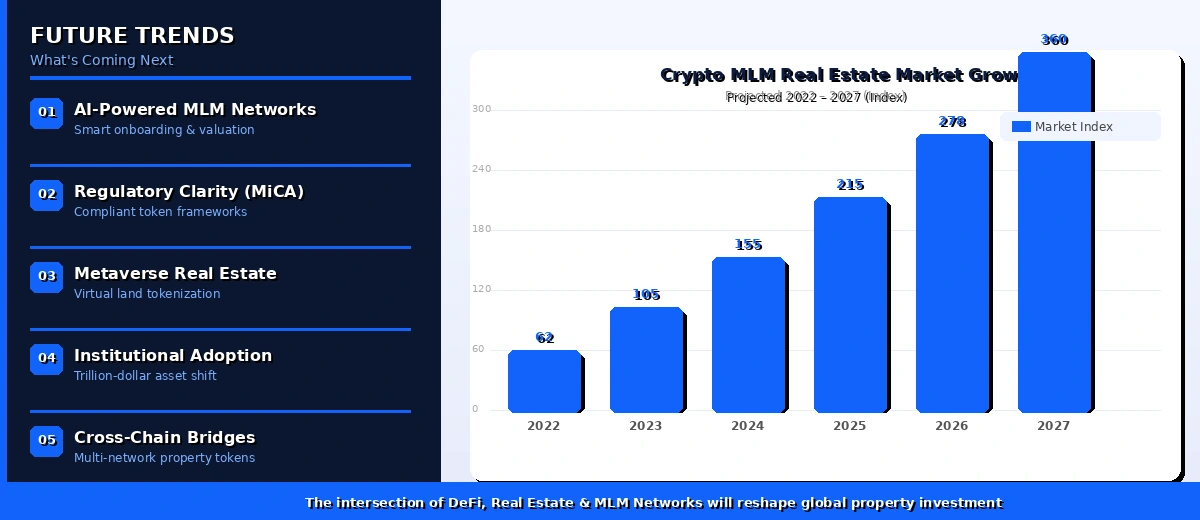
Having built crypto MLM development solutions since before the DeFi boom, our team tracks these trends closely. The next three to five years will look very different from today.
AI Integration in MLM Networks: Artificial intelligence is beginning to enter the picture in two meaningful ways. First, AI-driven onboarding tools can identify the most promising referral candidates within a user’s social graph, effectively helping participants build their downlines faster. Second, AI-based property valuation models can provide real-time token price discovery for unlisted properties, making the secondary market more efficient and trustworthy.
Increased Regulatory Frameworks: The EU’s MiCA regulation, set for full implementation, provides clearer rules for crypto asset issuers and MLM networks operating in Europe. The U.S. SEC is working through multiple enforcement actions that are gradually creating case law precedents for tokenized securities. As regulation solidifies, institutional money, currently on the sidelines due to compliance uncertainty, will enter the tokenized real estate space. That will dramatically increase liquidity and asset quality on these platforms.
Metaverse Real Estate Tokenization: While still early, metaverse property platforms like Decentraland and The Sandbox are already tokenizing virtual land and distributing it through referral networks. The mechanics are identical to physical real estate tokenization. As enterprise use of the metaverse grows, the financial models developed for physical property tokenization will carry over directly. MLM networks will become primary distribution channels for virtual property portfolios.
Institutional Adoption: Major asset managers including BlackRock have already begun experimenting with tokenized funds. As institutional participation in tokenized assets grows, the underlying infrastructure built by crypto MLM development companies becomes the backbone of trillion-dollar asset markets. The MLM distribution model will likely evolve into more regulated “affiliate marketing” structures to accommodate institutional compliance requirements, but the core smart contract architecture remains the same.
Conclusion: A Model Worth Understanding Seriously
Crypto MLM in real estate tokenization is not a get-rich-quick concept. When done right, with solid smart contract architecture, genuine underlying assets, clear legal structures, and transparent commission rules, it represents a genuinely innovative approach to how property investment and network growth can work together.
The model democratizes access to real estate in ways that traditional finance has consistently failed to achieve. It rewards participants for growing the network, aligns incentives across all levels of the investor community, and uses blockchain’s programmability to remove intermediaries that have historically extracted value without adding much.
That said, the risks are real. Regulatory ambiguity, pyramid scheme optics, and crypto volatility are not minor footnotes. They are active challenges that require deliberate legal and technical design choices to navigate. The difference between a legitimate platform and a fraudulent one in this space often comes down to whether real property value drives earnings or whether recruitment does.
If you are considering building in this space, the architecture, compliance frameworks, and MLM smart contract design choices you make at the start will define your platform’s long-term viability. Our crypto MLM development team has helped more than 80 platforms navigate exactly these decisions, and we bring that depth of experience to every engagement. You can also explore broader blockchain and MLM topics in our resource on MLM types, benefits, and global regulation.
The future of real estate investment is decentralized, fractional, and community-driven. The Crypto MLM model, for all its complexity, is one of the most credible paths to getting there.
Frequently Asked Questions
Q1.What is real estate tokenization and how does it work?
Q2.Is Crypto MLM in real estate legal?
Q3.How are MLM commissions paid in a crypto real estate platform?
Q4.What blockchain platforms are best for building a crypto MLM real estate project?
Q5.What is the difference between a legitimate crypto MLM real estate platform and a pyramid scheme?
Q6.How much does it cost to develop a crypto MLM real estate tokenization platform?
Development costs vary widely based on feature complexity, blockchain choice, compliance requirements, and the number of smart contracts needed. A basic MVP with core tokenization and referral features can range from $40,000 to $80,000. A full-featured platform with KYC/AML integration, secondary market trading, DAO governance, and multi-chain support typically ranges from $150,000 to $400,000 or more. Ongoing smart contract auditing, legal fees, and platform maintenance add to the total cost of ownership.
Explore Services
Related Services
Reviewed by

Aman Vaths
Founder of Nadcab Labs
Aman Vaths is the Founder & CTO of Nadcab Labs, a global digital engineering company delivering enterprise-grade solutions across AI, Web3, Blockchain, Big Data, Cloud, Cybersecurity, and Modern Application Development. With deep technical leadership and product innovation experience, Aman has positioned Nadcab Labs as one of the most advanced engineering companies driving the next era of intelligent, secure, and scalable software systems. Under his leadership, Nadcab Labs has built 2,000+ global projects across sectors including fintech, banking, healthcare, real estate, logistics, gaming, manufacturing, and next-generation DePIN networks. Aman’s strength lies in architecting high-performance systems, end-to-end platform engineering, and designing enterprise solutions that operate at global scale.