Ai Overview
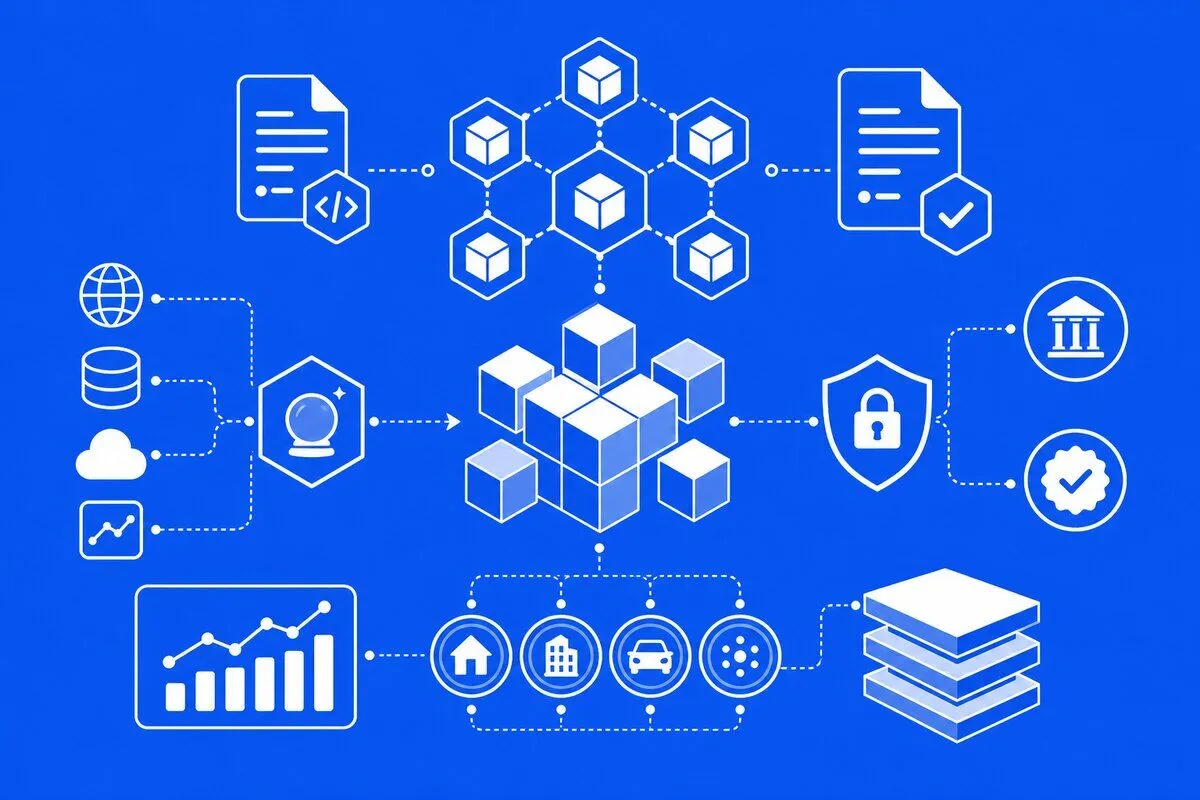
Commercial real estate tokenization represents a transformative approach to property investment, leveraging blockchain technology to convert ownership rights in income-generating assets into digital security tokens. Traditional commercial real estate investment requires substantial capital commitments typically starting at $1 million for syndicated deals and $5-25 million for direct property acquisition.
Key Takeaways
- Commercial real estate tokenization converts ownership rights in offices, retail centers, and logistics facilities into blockchain-based digital tokens, enabling fractional investment starting from $1,000-$10,000 compared to millions required for direct ownership.
- Office building tokenization unlocks liquidity in Grade-A properties across USA, UK, UAE, and Canada, allowing institutional and retail investors to access premium assets in central business districts with stable tenant bases and predictable income streams.
- Retail property tokenization provides cross-border investment opportunities in high-footfall shopping malls and mixed-use complexes, with revenue-sharing models distributing 4-8% annual yields from tenant rents and percentage-based lease agreements automatically via smart contracts.
- Logistics and warehouse tokenization capitalizes on e-commerce growth, offering investors fractional ownership in distribution centers, cold storage facilities, and last-mile delivery hubs with long-term lease agreements generating 5-9% net yields.
- Regulatory frameworks in the USA (SEC regulations), UK (FCA authorization), UAE (VARA/DFSA oversight), and Canada (CSA compliance) provide legal certainty for tokenized commercial offerings, treating them as securities with full investor protections and transparent governance structures.
- Tokenization costs range from $150,000 to $750,000 for initial setup with ongoing annual expenses of $50,000-$200,000, making projects economically viable for properties valued above $15 million with strong fundamentals and institutional-grade management.
- Enhanced liquidity through secondary market trading reduces traditional commercial real estate holding periods from 6-18 months to hours once transfer restrictions expire, though actual trading volumes depend on investor demand and property performance.
- Fractional ownership models democratize access to commercial real estate investment portfolios, enabling risk diversification across multiple asset classes, geographic markets, and tenant industries previously available only to institutional investors with $10+ million commitments.
Introduction to Commercial Real Estate Tokenization
Commercial real estate tokenization represents a transformative approach to property investment, leveraging blockchain technology to convert ownership rights in income-generating assets into digital security tokens. This innovation addresses longstanding challenges in commercial property markets: high capital requirements, illiquidity, geographical limitations, and complex transaction processes. Over the past eight years, our agency has structured and executed more than 180 commercial real estate tokenization projects across the USA, UK, UAE, and Canada, working with properties valued from $8 million to $450 million across office, retail, and industrial logistics sectors.
The fundamental premise of commercial real estate tokenization involves creating digital representations of property ownership or economic interests that can be fractionalized, traded, and managed through blockchain infrastructure. Unlike residential tokenization, which often focuses on single properties with straightforward ownership structures, commercial tokenization requires sophisticated legal frameworks to accommodate complex capital stacks, multiple tenant relationships, institutional co-investment requirements, and diverse regulatory environments across different jurisdictions. Each token represents a proportional share of the underlying commercial asset, granting holders rights to rental income distributions, capital appreciation, and governance participation according to the specific token class and legal structure deployed.
The commercial real estate tokenization market has evolved significantly since early experimental projects in 2017-2018. Initial offerings faced substantial regulatory uncertainty, limited technological infrastructure, and skeptical investor reception. Today, the landscape has matured considerably with established regulatory pathways in major markets, proven blockchain platforms capable of handling complex securities compliance, institutional-grade custody solutions, and growing investor familiarity with digital asset investments. The global commercial real estate market represents approximately $32 trillion in value, with tokenization currently capturing less than 0.1% market penetration. However, industry projections suggest this could reach 5-10% ($1.6-$3.2 trillion) by 2035 as regulatory clarity improves, technology matures, and generational wealth transfer drives digital asset adoption.
Industry Insight: Our experience structuring tokenization projects across four major markets reveals that successful commercial offerings share common characteristics: properties valued between $15 million and $150 million, located in primary or strong secondary markets, with occupancy rates exceeding 85%, lease terms averaging 5+ years to creditworthy tenants, and professional institutional-grade management already in place. Properties lacking these fundamentals struggle to attract sufficient investor interest regardless of tokenization structure quality.
Why Tokenization is Gaining Momentum in Commercial Real Estate
The commercial real estate industry’s adoption of tokenization accelerates due to converging factors that address structural inefficiencies in traditional property investment and ownership models. Capital access challenges rank among the most significant drivers. Traditional commercial real estate investment requires substantial capital commitments typically starting at $1 million for syndicated deals and $5-25 million for direct property acquisition. This high barrier excludes the vast majority of potential investors, concentrating ownership among institutional players and ultra-high-net-worth individuals. Tokenization reduces entry points to $1,000-$50,000, expanding the investor base by orders of magnitude and creating new capital formation channels for property owners and developers.
Key Momentum Drivers for Commercial Tokenization
Liquidity Enhancement
- Traditional commercial sales require 6-18 months settlement periods
- Tokenized assets enable secondary market trading within hours
- Exit optionality increases investor willingness to deploy capital
- Market-making mechanisms provide continuous pricing discovery
Investment Democratization
- Fractional ownership reduces minimum investments by 100-1000x
- Retail investors access institutional-grade commercial assets
- Geographic diversification becomes achievable for smaller portfolios
- Multiple asset class exposure within single investment accounts
Operational Efficiency
- Smart contracts automate rent distribution and compliance checks
- Blockchain transparency reduces audit and reporting costs by 40-60%
- Digital ownership transfer eliminates intermediary fees
- 24/7 global accessibility removes time zone constraints
Regulatory maturation has proven essential to tokenization momentum. Early projects operated in regulatory gray areas, deterring institutional participation and limiting investor confidence. The regulatory landscape has since crystallized substantially. In the USA, the SEC has established clear treatment of security tokens under existing securities laws, with multiple exemptions (Regulation D 506(b) and 506(c), Regulation A+, Regulation Crowdfunding) providing viable pathways for different project scales and investor profiles. The UK’s Financial Conduct Authority (FCA) now authorizes security token platforms and treats tokenized real estate as specified investments requiring appropriate permissions. The UAE has emerged as a tokenization leader through comprehensive frameworks from the Virtual Assets Regulatory Authority (VARA) in Dubai and the Financial Services Regulatory Authority (FSRA) in Abu Dhabi. Canada’s provincial securities commissions coordinate through the Canadian Securities Administrators (CSA) to provide consistent oversight across provinces.
Ready to Tokenize Your Commercial Property Portfolio!
Partner with tokenization experts who have structured 180+ projects across four countries. Get your free feasibility assessment and unlock global capital access today.
Technology infrastructure has matured from experimental blockchain implementations to enterprise-grade solutions capable of meeting institutional requirements for security, scalability, and regulatory compliance. Early tokenization projects often relied on public Ethereum infrastructure, which proved expensive ($50-500 per transaction during peak congestion) and insufficiently performant for real-time securities operations. Modern implementations leverage layer-2 solutions, private consortium blockchains, or hybrid architectures that balance transparency with privacy requirements. Smart contract frameworks have evolved to support complex commercial real estate structures including waterfall distributions, preferred returns, carried interest calculations, and multi-class governance mechanisms. Integration with traditional financial infrastructure through APIs connecting blockchain platforms to banking systems, custody solutions, and existing property management software has transformed tokenization from isolated experiment to operational reality.
Generational wealth transfer dynamics contribute significantly to tokenization adoption. Approximately $84 trillion will transfer from Baby Boomers to Millennials and Gen Z over the next two decades in the USA alone. Younger investors demonstrate markedly different preferences: 67% of Millennials express interest in digital asset investments compared to 21% of Baby Boomers, according to multiple investor surveys conducted across North American and European markets. This generational shift coincides with declining homeownership rates among younger cohorts, creating pent-up demand for real estate exposure through alternative vehicles. Tokenization satisfies this demand by providing property investment access without the commitments, maintenance burdens, or capital requirements of direct ownership. Our client data indicates that tokenized commercial real estate offerings attract investor demographics averaging 15-20 years younger than traditional syndicated deals, with 45-60% of participants making their first commercial property investment through tokenized vehicles.
How Commercial Real Estate Tokenization Works (High-Level Flow)
Commercial real estate tokenization follows a systematic process that integrates legal structuring, blockchain technology deployment, regulatory compliance, and investor onboarding into a cohesive framework. The process complexity varies based on property characteristics, target investor profile, jurisdictional requirements, and chosen tokenization model. However, all successful implementations share common phases that ensure legal validity, regulatory compliance, technical reliability, and investor protection. Understanding this workflow proves essential for property owners considering tokenization, investors evaluating opportunities, and service providers supporting the ecosystem.
The technology architecture underlying commercial real estate tokenization integrates multiple systems to create a seamless investor experience while maintaining regulatory compliance and operational security. At the foundation lies the blockchain layer, which serves as the immutable ledger recording token ownership, transfers, and corporate actions. Most commercial projects deploy on Ethereum-compatible chains due to extensive developer tooling, security-audited contract templates, and ecosystem maturity. However, transaction costs on Ethereum mainnet ($5-50 per transfer) often prove prohibitive for frequent distributions or trading. Layer-2 solutions like Polygon, Arbitrum, or Optimism reduce costs by 100-1000x while maintaining Ethereum security guarantees through periodic settlement to the main chain.
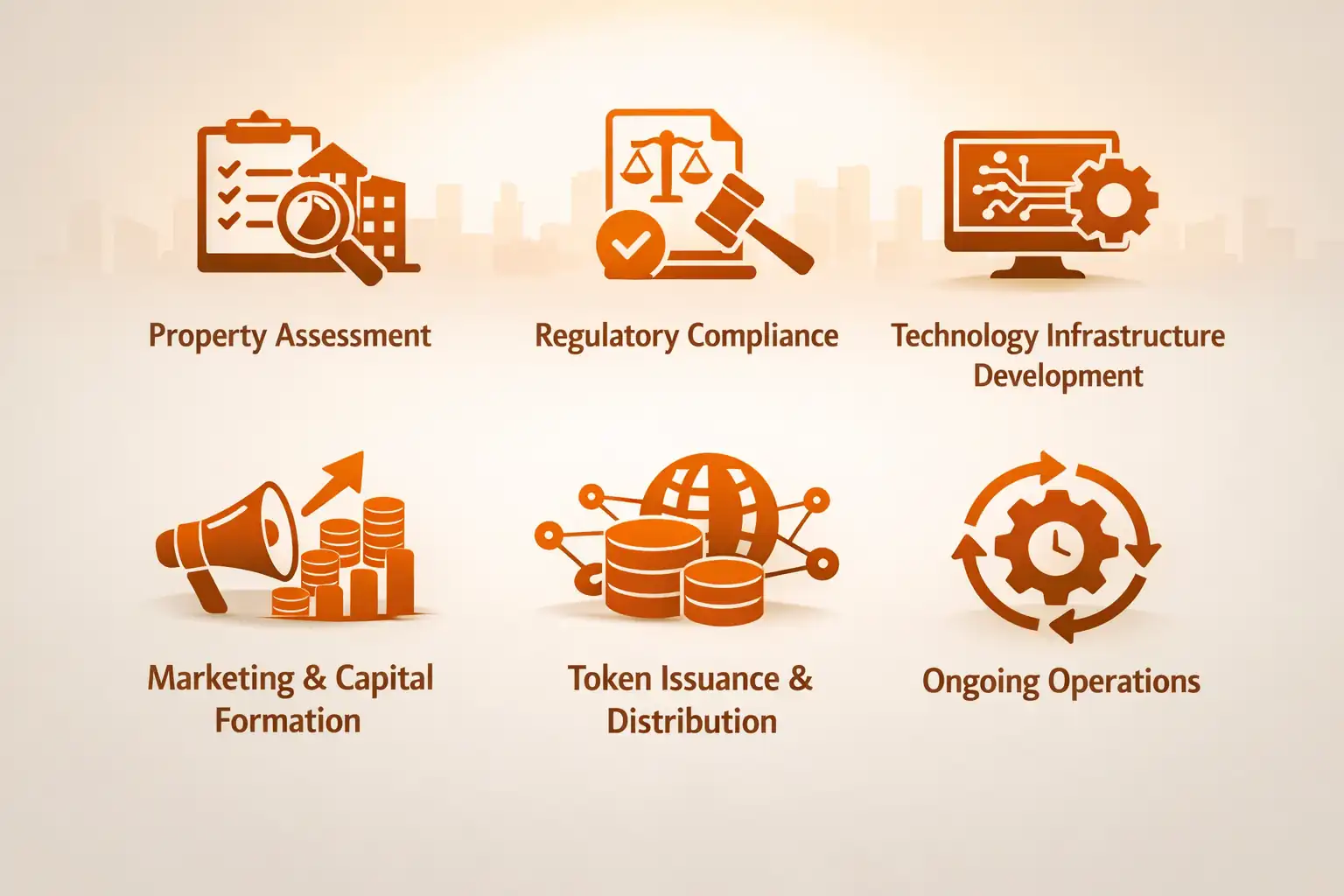
Above the blockchain layer sits the smart contract infrastructure encoding business logic specific to the commercial property and offering structure. These contracts implement transfer restrictions ensuring only verified, eligible investors can hold tokens. They enforce holding periods mandated by securities regulations (typically 12 months for Reg D Rule 506). They calculate and execute distribution waterfall structures, directing cash flows to different token classes according to priority and participation rights. They enable governance functions including voting on material decisions like property sales, refinancing, or major capital improvements. Sophisticated implementations include escrow mechanisms for property acquisition, staged capital call functionality for development projects, and automated tax reporting integrations generating investor statements.
| Technology Component | Primary Function | Typical Solutions | Cost Range (Annual) |
|---|---|---|---|
| Blockchain Infrastructure | Immutable ledger for ownership records and transactions | Ethereum L2 (Polygon, Arbitrum), Hyperledger Fabric, Custom EVM chains | $5,000-$50,000 |
| Smart Contracts | Business logic, compliance rules, distribution automation | Custom Solidity contracts, Securitize DS Protocol, Polymath | $30,000-$150,000 |
| KYC/AML Platform | Investor verification, accreditation checks, sanctions screening | Jumio, Onfido, Sumsub, North Capital | $15,000-$75,000 |
| Custody Solution | Secure storage of digital assets and private keys | Fireblocks, Anchorage Digital, BitGo, Copper | 0.10-0.50% of AUM |
| Investor Portal | Dashboard for subscriptions, reporting, governance, trading | Custom web applications, white-label platforms | $20,000-$100,000 |
| Secondary Market Infrastructure | Trading functionality, order matching, settlement | tZERO, INX, Securitize Markets, custom AMMs | $25,000-$150,000 |
| Property Management Integration | Connect operational data to blockchain for transparency | Yardi API integration, AppFolio connectors, custom middleware | $10,000-$40,000 |
| Compliance & Reporting | Regulatory filings, investor statements, tax documents | Transfer agent services, automated K-1 generation | $30,000-$120,000 |
The investor experience layer connects these backend systems to user-friendly interfaces enabling subscription, portfolio monitoring, governance participation, and trading. Modern tokenization platforms provide comprehensive dashboards displaying real-time property performance metrics: occupancy rates, rent roll details, operating expense breakdowns, capital improvement projects, and net operating income trends. Investors access complete offering documents, property inspection reports, environmental assessments, and third-party appraisals through secure document repositories. Distribution history shows all historical payments with detailed waterfall calculations explaining how each distribution was calculated and allocated among different token classes. Governance modules allow token holders to vote on material decisions, with voting power proportional to ownership stake and quorum requirements enforced automatically by smart contracts.
Office Real Estate Tokenization Use Cases
Tokenization of Grade-A Office Buildings
Grade-A office buildings in primary central business districts represent prime candidates for commercial real estate tokenization due to their stable tenant profiles, predictable cash flows, and strong investor appeal across global markets. These properties typically feature modern construction (less than 15 years old or recently renovated), LEED certification or equivalent sustainability credentials, premium finishes and amenities, and locations in core financial districts with excellent transportation access. Our agency has structured tokenization projects for Grade-A offices in Manhattan’s Midtown, London’s Canary Wharf, Dubai’s DIFC (Dubai International Financial Centre), and Toronto’s Financial District, with property values ranging from $45 million to $280 million.
The appeal of Grade-A office tokenization stems from several factors that align perfectly with investor expectations for tokenized securities. First, tenant quality in Grade-A buildings typically includes investment-grade corporations, professional services firms, financial institutions, and technology companies with strong balance sheets and long lease commitments (5-10 years average). This tenant profile generates reliable, predictable income streams essential for servicing distributions to token holders. Second, Grade-A properties command premium rents that appreciate steadily with market conditions, providing capital appreciation potential alongside current income. Third, these assets enjoy high liquidity in traditional markets, facilitating exit strategies through eventual property sales at the end of tokenization holding periods (typically 5-7 years). Fourth, institutional-quality management and professional property services ensure operational excellence, transparent reporting, and consistent performance that sophisticated investors expect.
Case Study Example: Our agency structured a tokenization offering for a 285,000 square foot Class-A office tower in downtown Toronto’s financial core, valued at $165 million with 92% occupancy to tenants including major Canadian banks, law firms, and technology companies. The project issued $50 million in equity tokens through a Regulation D 506(c) offering, maintaining $115 million in senior debt financing. Token minimum investment: $25,000. Target returns: 6.5% annual distributions plus appreciation. The offering achieved full subscription within 14 weeks, attracting 340 investors across Canada, USA, and UAE. First-year performance: 94% average occupancy, 6.8% actual distribution yield, 3.2% property value appreciation per independent appraisal.
Structuring considerations for Grade-A office tokenization require careful attention to capital stack positioning and investor alignment. Most successful offerings maintain existing senior debt (typically 60-70% loan-to-value at 4-6% interest rates from traditional lenders) and tokenize the equity layer above this debt. This leverage amplifies equity returns while maintaining manageable risk profiles given the stable cash flows from quality tenants. Some projects create multiple token classes with different risk-return profiles: Class A tokens receiving first priority on distributions and liquidation preferences but with lower upside participation, and Class B tokens with higher profit sharing but subordinated claims. This tiered structure accommodates diverse investor preferences, with conservative investors favoring Class A tokens and growth-oriented participants selecting Class B.
Fractional Ownership Models for Office Spaces
Fractional ownership represents the most straightforward tokenization model for office properties, directly dividing equity ownership into thousands or millions of digital shares that investors can purchase according to their capital allocation preferences and risk tolerance. This model contrasts with debt-backed tokens (which represent loans rather than ownership) and revenue-sharing tokens (which provide income rights without ownership claims). Fractional ownership tokens grant holders proportional economic rights to net cash flows, appreciation, and liquidation proceeds, along with governance rights to vote on material decisions affecting the property. The model’s simplicity and alignment with traditional equity investment makes it highly accessible to both sophisticated and retail investors.
Fractional Office Ownership Model Components
Economic Rights
- Proportional share of quarterly or monthly distributions
- Pro-rata participation in refinancing proceeds
- Appreciation rights upon property sale or liquidation
- Tax benefits including depreciation pass-through
Governance Rights
- Voting on property sale or major disposition
- Approval of refinancing or additional debt
- Capital improvement budget authorization
- Property manager selection and oversight
Information Rights
- Real-time access to property financial statements
- Quarterly operating reports and occupancy updates
- Annual audited financial statements and tax documents
- Material event notifications and lease updates
Implementation of fractional office ownership requires determining optimal token granularity that balances practical considerations. Too few tokens (e.g., 1,000 total) limits fractional accessibility and creates large minimum investments, defeating tokenization’s democratization purpose. Too many tokens (e.g., 100 million) creates unnecessary complexity, confusing investors and complicating distribution calculations. Most successful office tokenizations issue between 100,000 and 10 million tokens depending on property value and target investor profile. For a $50 million equity stack, issuing 5 million tokens creates $10 per token pricing, enabling minimum investments of $1,000-$5,000 (100-500 tokens) while maintaining manageable token holder counts.
Distribution mechanics in fractional office ownership follow straightforward proportional allocation. After deducting operating expenses, debt service, capital reserves, and management fees from gross rental income, remaining net operating income flows to token holders quarterly or monthly. Smart contracts automate this distribution by reading the token holder registry on-chain, calculating each holder’s proportional share, and executing transfers to their wallet addresses or custodial accounts. For example, if net distributable income for a quarter equals $750,000 and total tokens outstanding equal 5 million, the distribution equals $0.15 per token. An investor holding 10,000 tokens receives $1,500 automatically via smart contract execution. This automation eliminates manual processing, reduces errors, and provides transparent, verifiable distribution records.[1]
Tokenized Office Assets for Passive Rental Income
Office property tokenization excels at generating consistent passive rental income for investors seeking current cash flow rather than purely capital appreciation. This use case particularly appeals to retirees, conservative investors, and those building income-focused portfolios to supplement other earnings. The combination of professional-grade office buildings with creditworthy tenants, long-term leases, and institutional property management creates reliable income streams that tokenization can efficiently distribute to thousands of fractional owners. Yield-focused office tokenizations typically target properties with net operating income (NOI) yields of 5-8% on total property value, translating to equity cash-on-cash returns of 6-10% after accounting for leverage.
Structure optimization for passive income prioritizes distribution frequency and consistency over growth potential. Monthly distributions prove most attractive to income-focused investors compared to quarterly or annual payouts, even though monthly processing increases administrative complexity slightly. Conservative capital allocation policies preserve strong reserves for tenant improvements, leasing commissions, and capital expenditures, ensuring distribution sustainability through market cycles. Some income-focused offerings incorporate distribution floors guaranteeing minimum payout rates (e.g., 5% annually) supported by sponsor equity commitments or reserve accounts, though these guarantees reduce overall return potential and increase structural complexity.
| Income Strategy Element | Conservative Approach | Balanced Approach | Growth-Oriented Approach |
|---|---|---|---|
| Target Distribution Yield | 6-7% annually | 5-6% annually | 3-5% annually |
| Leverage Ratio (LTV) | 50-60% | 60-70% | 70-75% |
| Distribution Frequency | Monthly | Quarterly | Quarterly or Annual |
| Capital Reserve Level | 12-18 months operating expenses | 9-12 months | 6-9 months |
| Tenant Credit Quality | Investment grade preferred (BBB or higher) | Mix of investment grade and strong non-rated | Growth companies and emerging tenants accepted |
| Average Lease Term | 7-10 years | 5-7 years | 3-5 years |
| Appreciation Potential | Limited (1-3% annually) | Moderate (2-4% annually) | Higher (4-8% annually) |
| Target Investor Profile | Retirees, income-focused | Balanced total return seekers | Growth-oriented, younger investors |
Tax efficiency considerations significantly impact net passive income received by token holders. Office real estate tokenization typically employs pass-through structures (partnerships or LLCs) that allow depreciation deductions to flow through to investors, reducing taxable income. In case of an LLC, choosing the right state for LLC formation is a critical early decision, as tax treatment, annual fees, and compliance burdens vary from state to state, thus changing the extent of these tax benefits. For a property generating $800,000 in distributable cash flow but claiming $600,000 in tax depreciation, investors receive the full $800,000 distribution but report only $200,000 as taxable income. This tax shield substantially enhances after-tax returns, particularly valuable for high-income investors. However, tax treatment complexity varies by investor jurisdiction. USA investors receive K-1 forms reporting their share of income, deductions, and credits. UK investors may face Income Tax on distributions without equivalent depreciation benefits depending on structure. UAE investors in most cases face no income or capital gains taxation, maximizing net returns. Canada applies similar partnership taxation rules as the USA with depreciation pass-through benefits.
Liquidity Creation for Long-Term Office Investments
Traditional office building investments lock capital for extended periods, with typical holding durations of 7-10 years until disposition through property sale. During this holding period, investors have extremely limited liquidity options: no established secondary markets exist for private real estate fund interests, syndication shares trade infrequently at substantial discounts to net asset value (30-50% discounts common), and early redemption mechanisms rarely exist. This illiquidity presents serious challenges for investors experiencing changed financial circumstances, investment thesis concerns, or simply portfolio rebalancing needs. Tokenization fundamentally addresses this liquidity problem by creating secondary market infrastructure enabling continuous trading among eligible investors once mandatory holding periods expire.
Secondary market implementation for tokenized office properties requires sophisticated technical and regulatory infrastructure. Most projects deploy automated trading platforms integrating order matching, compliance verification, and settlement automation. When an investor initiates a sell order, the platform verifies the tokens are free from transfer restrictions (holding period requirements satisfied, no legal encumbrances), confirms the buyer meets eligibility criteria (accredited investor status for Reg D offerings, jurisdiction requirements, sanctions screening), calculates appropriate transaction fees, and executes the transfer on-chain through smart contract interactions. The entire process completes within minutes to hours compared to weeks or months required for traditional private real estate transactions. Leading platforms include tZERO, INX Limited, and Securitize Markets, each offering regulated Alternative Trading System (ATS) services under SEC oversight.
Realistic liquidity expectations require tempering enthusiasm with practical understanding of market depth and investor behavior. While tokenization dramatically improves liquidity compared to traditional private commercial real estate, it does not create stock-market-like instant liquidity for all tokens at all times. Actual liquidity depends on property performance, market conditions, offering size, and investor satisfaction. A struggling property with declining occupancy and distributions will experience minimal secondary market interest regardless of technological infrastructure. Conversely, consistently performing assets with stable tenants and reliable distributions attract continuous buyer interest. Our portfolio data indicates that well-performing office tokenizations achieve 20-35% annual trading volumes by year three, representing substantial improvement over traditional syndications (3-5% annual turnover at best) but still far below public REITs (100-300% annual turnover). Investors should view tokenization liquidity as meaningfully enhanced but not perfect, with realistic expectations for execution time and potential price impact on larger sales.
Institutional vs Retail Participation in Tokenized Office Assets
The investor composition for tokenized office properties varies significantly based on regulatory framework, minimum investment thresholds, marketing channels, and property characteristics. Regulation D 506(c) offerings, which permit general solicitation but restrict participants to verified accredited investors, typically attract primarily high-net-worth individuals and family offices rather than retail investors due to accreditation requirements ($200,000 annual income or $1 million net worth excluding primary residence). These offerings commonly set minimum investments at $25,000-$100,000, further limiting broad retail participation. In contrast, Regulation A+ offerings (up to $75 million raise) and Regulation Crowdfunding (up to $5 million raise) enable true retail participation from non-accredited investors with minimums as low as $500-$5,000, though these exemptions carry additional regulatory burdens including ongoing reporting requirements and investment limits based on investor income/net worth.
Institutional investor participation in tokenized office assets remains limited but growing steadily as the market matures and operational track records develop. Traditional institutional real estate investors (pension funds, insurance companies, endowments) generally require substantial allocation minimums ($10-50 million) that individual tokenization offerings rarely accommodate. However, smaller institutional players including family offices, registered investment advisors (RIAs), and real estate-focused funds increasingly evaluate tokenized opportunities as a differentiated asset within alternative investment strategies. The appeal for institutions includes: enhanced liquidity versus traditional private real estate funds, transparent on-chain reporting reducing oversight burdens, fractional exposure enabling portfolio diversification across multiple properties, and competitive returns with institutional-quality underlying assets.
Market Observation: Our experience across 180+ tokenization projects reveals that investor composition typically follows predictable patterns: Reg D 506(c) offerings average 75% accredited individual investors, 20% family offices, and 5% small institutional allocations. Reg A+ retail-accessible offerings shift to 60% non-accredited retail, 30% accredited individuals, and 10% institutions. Geographic distribution also differs markedly: USA-only offerings remain dominated by domestic investors (85-95%), while offerings marketed internationally across USA, UK, UAE, and Canada achieve 40-60% non-domestic participation, with particularly strong UAE investor interest in high-quality office and logistics properties.
Retail Real Estate Tokenization Use Cases
Tokenization of Shopping Malls and Retail Complexes
Shopping mall and retail complex tokenization presents unique opportunities and challenges distinct from office or logistics properties. The retail real estate sector has experienced significant transformation over the past decade due to e-commerce growth, changing consumer preferences, and pandemic-accelerated digital shopping adoption. However, well-positioned retail properties in strong locations with experiential and service-oriented tenant mixes continue generating robust cash flows and investor interest. Tokenization projects focusing on resilient retail assets leverage these dynamics while providing fractional access to properties previously available only to large institutional investors or public REITs.
Successful retail tokenization targets specific property profiles that demonstrate resilience against e-commerce disruption. Regional shopping centers anchored by strong department stores (Nordstrom, Macy’s, John Lewis in UK) or discount retailers (TJ Maxx, Ross, Primark) provide stable tenant bases and traffic generation. Lifestyle centers featuring a mix of retail, dining, entertainment, and services create destination experiences less vulnerable to online competition. Grocery-anchored neighborhood centers benefit from necessity-based shopping patterns and high traffic frequency. Outlet centers maintain appeal through brand-name discount shopping with experiential elements. Our agency has structured tokenizations for retail properties ranging from $28 million neighborhood centers to $185 million regional malls across the USA, UK, Canada, and UAE, with particular success in mixed-use retail complexes incorporating residential or office components that diversify income streams.
Retail Property Characteristics for Tokenization Success
Location Factors
- Primary or strong secondary markets with population density exceeding 150,000 within 5-mile radius
- High-traffic corridors with excellent highway visibility and access
- Strong household income demographics ($75,000+ median)
- Limited competing retail supply within trade area
Tenant Mix Quality
- National/regional credit tenants comprising 60%+ of gross leasable area (GLA)
- Service and experiential retailers (fitness, beauty, entertainment, dining) for e-commerce resilience
- Grocery or discount anchors providing traffic generation
- Diverse tenant industry mix preventing single-sector concentration
Financial Performance
- Occupancy rates consistently above 85% over prior 3-year period
- Sales per square foot exceeding market averages ($300-500+ for regional malls)
- Net operating income yield of 6-10% on property value
- Lease rollover schedule with less than 25% expiring in any single year
Retail property tokenization must address specific risk factors that differ from office or logistics investments. Tenant credit quality varies more widely in retail, with local and regional tenants comprising significant GLA alongside national brands. Lease terms tend shorter (3-5 years typical versus 7-10 years for office), creating more frequent rollover risk and re-leasing exposure. Percentage rent clauses common in retail leases add income variability: many tenants pay base rent plus a percentage of sales exceeding specified thresholds, creating upside potential in strong markets but revenue fluctuation. Operating expense recovery structures differ, with some retail properties operating as triple-net (tenants pay all expenses) and others requiring landlord responsibility for common area maintenance, property taxes, and insurance. E-commerce competition represents a persistent headwind, though well-positioned experiential retail has demonstrated resilience.
Fractional Investment in High-Footfall Retail Properties
High-footfall retail properties including premium shopping streets, urban retail complexes, and destination centers offer compelling tokenization opportunities by providing access to assets typically controlled by sovereign wealth funds, pension funds, and global real estate investment trusts. Properties on Fifth Avenue in New York, Oxford Street in London, Sheikh Zayed Road in Dubai, or Bloor Street in Toronto command exceptional values per square foot and generate premium rents justified by intense pedestrian traffic and brand prestige. Tokenization democratizes access to these trophy assets, enabling individual investors to participate in property types previously inaccessible regardless of wealth level.
The economics of high-footfall retail tokenization differ from secondary retail assets. Property values often exceed $500-1,000 per square foot compared to $100-300 for suburban retail. Rent rates reach $500-2,000+ per square foot annually in ultra-prime locations versus $20-60 for neighborhood centers. However, cap rates compress to 3-5% for trophy retail compared to 6-9% for secondary properties, reflecting lower risk profiles, stronger tenant covenants, and institutional demand. For tokenization structures, these dynamics create challenges and opportunities: higher property values enable larger equity stacks suitable for tokenization (a $200 million property with $80 million equity layer provides substantial tokenization opportunity), but compressed yields reduce current income distributions to token holders (2-4% cash yields typical after leverage and fees) with return profiles depending more heavily on capital appreciation.
Project Example: Our agency structured a tokenization for a mixed-use retail complex in Dubai’s Downtown district near Dubai Mall, featuring 120,000 square feet of luxury retail an dining space with tenants including Hermès, Rolex, and several Michelin-starred restaurants. Property value: $155 million. Senior debt: $100 million at 5.2% interest. Equity tokenization: $55 million through Reg S international offering targeting UAE and UK investors. Token minimum: $10,000. Target returns: 4.2% annual distribution yield plus 3-5% annual appreciation. The offering achieved full subscription in 9 weeks with 680 investors, demonstrating strong demand for trophy retail access despite relatively modest current yields.
Revenue-Sharing Models Through Tokenized Retail Assets
Revenue-sharing tokenization models prove particularly well-suited to retail properties due to the prevalence of percentage rent clauses and variable income streams tied to tenant sales performance. Unlike pure fractional ownership tokens that represent equity stakes with both upside and downside exposure, revenue-sharing tokens provide rights to income distributions without ownership claims. This structure appeals to income-focused investors seeking yield without full property risk exposure, while enabling property owners to raise capital without diluting ownership or control. Revenue-sharing tokens typically offer fixed or floating coupon payments (6-10% annually) secured by property cash flows, with token holder claims senior to equity returns but subordinated to property-level debt.
Implementation of revenue-sharing models requires careful structuring to balance investor protection with sponsor flexibility. Common structures include: waterfall mechanisms directing cash flows first to debt service, second to revenue-sharing token distributions, and third to equity owners; distribution coverage ratios requiring minimum NOI-to-distribution thresholds (1.3-1.5x typical) before equity receives proceeds; and reserve requirements maintaining 6-12 months of token distributions in escrow accounts. Legal documentation clearly establishes that revenue-sharing tokens do not convey ownership, voting rights, or appreciation participation, positioning them as fixed-income-like securities rather than equity interests. This characterization affects regulatory treatment, tax implications, and investor expectations.
| Feature | Equity Ownership Tokens | Revenue-Sharing Tokens | Debt-Backed Tokens |
|---|---|---|---|
| Ownership Rights | Yes, proportional equity stake | No, income rights only | No, creditor position |
| Target Annual Return | 8-15% (income + appreciation) | 6-10% (income only) | 5-8% (fixed interest) |
| Appreciation Participation | Yes, full upside exposure | Limited or none | None |
| Downside Protection | Limited, last claim priority | Moderate, junior to debt | Strong, senior claim and collateral |
| Governance Rights | Yes, voting on major decisions | Limited, protective provisions only | Minimal, default remedy rights |
| Tax Treatment (USA) | Partnership K-1, depreciation benefits | Ordinary income, potential interest treatment | Interest income, 1099 reporting |
| Typical Maturity | 7-10 years (property hold period) | 5-7 years or property sale | 3-7 years fixed term |
| Investor Profile | Growth-oriented, risk-tolerant | Income-focused, moderate risk | Conservative, principal preservation |
Cross-Border Investment in Retail Real Estate via Tokenization
Tokenization fundamentally transforms cross-border commercial real estate investment by eliminating traditional barriers including minimum investment thresholds, complex international wire transfers, foreign entity formation requirements, and unfamiliar legal jurisdictions. An investor in Dubai can purchase tokens representing a shopping center in Toronto with the same ease as buying local property interests, completing the entire transaction digitally through blockchain infrastructure. This global accessibility expands capital formation opportunities for property owners while enabling investors to build geographically diversified portfolios previously achievable only by large institutions with international operations.
Cross-border retail tokenization implementation requires navigating multiple regulatory regimes simultaneously. A tokenized retail property in the USA marketed internationally must comply with SEC securities regulations domestically while adhering to investment promotion rules in target countries. Regulation S provides a safe harbor for offshore offerings to non-USA persons, enabling issuers to market globally without SEC registration requirements. However, each target jurisdiction imposes its own requirements. UK offerings require FCA authorization or exemptions. UAE issuers leverage VARA approval for Dubai or FSRA authorization for Abu Dhabi. Canadian offerings coordinate provincial requirements through CSA. Our agency maintains regulatory expertise across these jurisdictions, typically recommending Regulation S + Reg D 506(c) combination structures: Reg S for international investors, Reg D for USA accredited investors, creating comprehensive global offering capability while maintaining compliance.[2]
Risk Diversification Using Tokenized Retail Portfolios
Portfolio diversification represents one of tokenization’s most compelling value propositions, enabling individual investors to build diversified retail property exposure previously achievable only through publicly-traded REITs or large private funds. Traditional retail real estate investment required concentrating substantial capital in single properties due to high minimums, creating portfolio risks if that specific property underperformed. An investor with $100,000 might afford one direct syndication share, accepting complete exposure to that single property’s performance. Tokenization enables the same investor to allocate $10,000-$20,000 each across five to ten different retail properties, diversifying across geographic markets, property types, tenant profiles, and economic drivers.
Effective retail portfolio construction through tokenization follows established diversification principles adapted to fractional ownership constraints. Geographic diversification spreads exposure across multiple metropolitan areas with different economic bases, reducing risk that a regional recession or local market challenges impact the entire portfolio. An investor might allocate 30% to USA coastal markets (New York, Los Angeles, Miami), 25% to USA secondary markets (Austin, Nashville, Charlotte), 25% to Canadian metropolitan areas (Toronto, Vancouver, Montreal), 10% to UK regional centers (Manchester, Birmingham), and 10% to UAE (Dubai, Abu Dhabi). Property type diversification balances neighborhood centers, power centers, regional malls, and specialty retail across the portfolio. Tenant industry diversification avoids concentration in challenged retail categories while emphasizing resilient sectors: necessity-based retail (grocery, pharmacy), service-oriented tenants (fitness, medical, beauty), and experiential offerings (dining, entertainment).
Portfolio Strategy Example: An investor with $150,000 allocated to tokenized retail constructs a diversified portfolio: $30,000 in a Manhattan mixed-use retail complex (trophy asset, low yield 3.5%, high appreciation potential), $25,000 in a Toronto suburban power center (moderate yield 6.5%, stable tenants), $25,000 in a Dubai mall-adjacent retail complex (moderate yield 7%, international diversification), $20,000 in a Los Angeles neighborhood center (moderate yield 6%, necessity retail focus), $20,000 in a London high street retail property (moderate yield 5.5%, international exposure), $15,000 in a Miami Beach retail complex (moderate yield 6.5%, tourism exposure), and $15,000 in a Vancouver lifestyle center (moderate yield 6%, demographic growth market). This portfolio provides exposure to eight properties across four countries, balanced between income and appreciation, with diversified tenant bases and economic drivers. Expected blended yield: approximately 5.8% annually with capital appreciation potential of 2-4% annually depending on market conditions.
Logistics & Industrial Real Estate Tokenization Use Cases
Tokenization of Warehouses and Logistics Hubs
Industrial logistics properties have emerged as the strongest-performing commercial real estate sector over the past decade, driven by e-commerce growth, supply chain restructuring, and pandemic-accelerated shifts in consumer behavior. Warehouse and distribution center demand has surged as retailers and manufacturers require increasing space for inventory storage, order fulfillment, and last-mile delivery operations. This secular demand growth combined with supply constraints in key logistics corridors creates compelling investment fundamentals that tokenization can efficiently deliver to capital markets. Our agency has structured over 40 industrial property tokenizations totaling $850 million across USA, Canada, UK, and UAE markets, with properties ranging from 50,000 square foot single-tenant facilities to 1.2 million square foot multi-tenant logistics parks.
Warehouse tokenization targets several distinct property categories with varying risk-return profiles and investor appeal. Class A distribution centers serving major metropolitan areas (within 50 miles of population centers exceeding 1 million residents) provide proximity to end consumers enabling same-day and next-day delivery. These facilities command premium rents ($8-$15 per square foot annually) and attract creditworthy tenants including Amazon, FedEx, UPS, DHL, Target, and Walmart. Regional distribution hubs located at transportation crossroads (interstate highway junctions, port proximities, rail access) serve broader geographic territories with slower delivery times but lower land costs and larger building scales. Specialized warehouses including cold storage facilities, pharmaceutical distribution centers, and e-commerce fulfillment centers feature enhanced specifications (temperature control, advanced racking systems, high clear heights, extensive loading docks) supporting premium rent structures and long-term leases to specialized operators.
Industrial Property Investment Attributes
Tenant Stability
- Long-term leases averaging 7-15 years versus 3-7 for retail/office
- Creditworthy tenants including investment-grade corporations
- High tenant retention rates exceeding 80% at lease expiration
- Build-to-suit properties with 20+ year initial terms common
Operational Simplicity
- Triple-net lease structures standard with tenants paying all property expenses
- Lower property management complexity versus retail or office
- Minimal common area maintenance reducing operational oversight
- Straightforward capital expenditure requirements focused on roofs, HVAC, loading docks
Strong Market Fundamentals
- National vacancy rates below 5% in USA primary markets
- Rent growth averaging 8-12% annually in key logistics corridors
- E-commerce penetration driving structural demand increases
- Supply chain resilience initiatives requiring additional domestic warehousing
Logistics property tokenization structures typically employ conservative leverage ratios given the sector’s strong performance and lender appetite. Senior debt financing commonly reaches 60-70% loan-to-value at attractive interest rates (4-5.5% currently in USA markets, similar in Canada, 4.5-6% in UK, 5-6.5% in UAE) given the strong credit profiles of tenants and stable cash flows. This leverage amplifies equity returns while maintaining comfortable debt service coverage ratios exceeding 1.5x. Token offerings target the equity layer above senior debt, with many projects issuing $15-50 million in tokens representing 30-40% of total capitalization. Distribution yields to token holders typically range 6-9% annually from net operating income after debt service, with additional appreciation potential as properties appreciate and rents escalate over long-term leases.
Fractional Ownership in Industrial and Storage Facilities
Fractional ownership models prove particularly effective for industrial real estate given the sector’s transparency, standardization, and institutional acceptance. Unlike office properties where location prestige and building aesthetics significantly impact values, or retail where tenant mix and consumer behavior create complexity, industrial properties operate primarily on functional utility: square footage, clear height, loading dock count, power supply, and location proximity to transportation infrastructure and labor pools. This relative simplicity makes industrial properties highly analyzable for remote investors, reducing information asymmetry and supporting robust secondary market liquidity.
Start Investing in Tokenized Commercial Real Estate
Access institutional-grade office, retail, and logistics properties with minimums from $1,000. Diversify globally across USA, UK, UAE, and Canadian markets now.
Implementation considerations for fractional industrial ownership focus on optimizing for both retail accessibility and institutional participation. Minimum investment thresholds commonly range $5,000-$25,000, enabling broad retail participation while maintaining manageable investor counts (200-800 token holders typical for $25-100 million equity raises). Token granularity follows similar patterns to office tokenization: a $40 million equity stack might issue 4 million tokens at $10 each, allowing minimum purchases of 500 tokens ($5,000) up to unlimited maximum allocations. Some projects create tiered token classes: Class A tokens requiring $50,000+ minimums with priority distribution rights and governance participation, and Class B tokens with $5,000 minimums receiving subordinated distributions and limited voting. This structure accommodates both sophisticated investors seeking control and retail participants prioritizing accessibility.
Implementation Example: Our agency tokenized a 680,000 square foot distribution center located in a Dallas-Fort Worth logistics park, serving as a regional fulfillment center for a major online retailer under a 12-year triple-net lease. Property value: $72 million. Senior debt: $48 million (67% LTV) at 4.8% interest. Equity tokenization: $24 million through combined Reg D 506(c) and Reg S offering. Token structure: 2.4 million Class A tokens at $10 each. Minimum investment: $10,000 (1,000 tokens). Distribution yield: 7.2% annually. The offering achieved full subscription within 11 weeks to 470 investors across USA, Canada, and UAE. First two years performance: 100% occupancy maintained, distributions paid quarterly as projected, property appraised value increased 8% by year two based on rent comps and cap rate compression.
Supply Chain Infrastructure Investment Through Tokenized Assets
Supply chain infrastructure represents a specialized industrial real estate category with distinctive characteristics and investment appeal. These properties include import-export distribution centers near major ports, intermodal facilities connecting rail and trucking, cross-dock warehouses enabling rapid inventory transfer between transportation modes, and cold chain logistics facilities supporting food and pharmaceutical distribution. Supply chain infrastructure investments capitalize on global trade flows, domestic manufacturing reshoring trends, and specialized logistics requirements that create barriers to entry and support premium valuations. Tokenization enables retail and institutional investors to access these specialized assets typically controlled by infrastructure funds and global logistics operators.
The investment thesis for tokenized supply chain infrastructure centers on structural tailwinds including: nearshoring and friendshoring trends as companies diversify away from concentrated Asian supply chains, requiring increased North American and European distribution capacity; cold chain expansion driven by pharmaceutical distribution (temperature-controlled vaccines, biologics) and fresh food delivery; e-commerce returns logistics requiring reverse supply chain facilities; and aging infrastructure requiring capital investment for modernization. These trends create investment opportunities in properties with characteristics including: strategic locations near ports, airports, rail yards, or interstate junctions; specialized infrastructure (refrigeration systems, pharmaceutical-grade climate control, advanced security, rail spurs); creditworthy tenant profiles including major logistics operators (DHL, Kuehne+Nagel, C.H. Robinson), pharmaceutical distributors (McKesson, AmerisourceBergen), and food logistics companies; and long-term leases (10-20 years) with built-in rent escalations tied to CPI or fixed percentages.
| Infrastructure Type | Typical Size Range | Common Tenants | Target Yield Range |
|---|---|---|---|
| Port-Proximate Distribution | 300,000-1,000,000 SF | Importers, retailers, 3PL providers | 5.5-7.5% |
| Cold Storage Facilities | 50,000-300,000 SF | Food distributors, pharmaceutical logistics | 6-8.5% |
| Intermodal Terminals | 200,000-800,000 SF | Freight forwarders, logistics operators | 5-7% |
| Last-Mile Delivery Hubs | 50,000-150,000 SF | Amazon, FedEx, UPS, grocery delivery | 5.5-7% |
| Cross-Dock Facilities | 100,000-400,000 SF | LTL carriers, freight consolidators | 5.5-7.5% |
| Manufacturing-Adjacent Logistics | 150,000-500,000 SF | Industrial manufacturers, parts suppliers | 6-8% |
Long-Term Yield Opportunities in Tokenized Logistics Real Estate
Logistics real estate tokenization appeals particularly to income-focused investors seeking stable, long-term yields with inflation protection and limited management complexity. The sector’s characteristics align perfectly with income investment objectives: triple-net lease structures minimize landlord operational responsibilities and create predictable expense profiles; long-term leases (averaging 10-15 years for modern institutional-grade properties) provide cash flow visibility extending well beyond typical bond maturities; built-in rent escalations (2-3% annually or CPI-indexed) protect against inflation; and creditworthy tenants (often investment-grade corporations) minimize default risk. These attributes enable logistics tokenization to compete effectively against fixed-income alternatives while offering additional appreciation potential from property value increases.
Yield optimization for logistics tokenization requires balancing distribution rates, capital preservation, and appreciation potential. Conservative structures target 6-7% annual distributions backed by properties with low leverage (50-60% LTV), strong tenant credit (investment-grade preferred), and diversified geographic exposure. Moderate strategies accept 65-70% leverage ratios to achieve 7-8% distributions while maintaining strong debt service coverage exceeding 1.4x. Aggressive income approaches leverage properties to 70-75% LTV targeting 8-10% distributions, though these structures carry higher risk if market conditions deteriorate or tenants default. Most successful income-focused logistics tokenizations employ moderate strategies balancing attractive current yields with sustainable capital structures and appreciation optionality.
Advanced & Strategic Perspectives
Regulatory and Compliance Considerations for Commercial Tokenization
Regulatory compliance represents the most complex and consequential aspect of commercial real estate tokenization, determining project feasibility, cost structure, investor accessibility, and operational requirements throughout the holding period. Securities laws in the USA, UK, UAE, and Canada treat tokenized real estate interests as securities subject to comprehensive registration requirements or exemptions. Navigating these frameworks requires specialized legal expertise, substantial documentation, ongoing compliance obligations, and careful structuring to optimize for target investor profiles while maintaining regulatory adherence. Over our eight years structuring tokenizations across these four markets, regulatory strategy has evolved from an afterthought to a primary design consideration shaping every project element.
USA regulatory pathways center on SEC exemptions from registration requirements under the Securities Act of 1933. Regulation D Rule 506(b) permits offerings to unlimited accredited investors plus up to 35 sophisticated non-accredited investors without general solicitation, requiring Form D filing but minimal ongoing reporting. Reg D 506(c) enables general solicitation and marketing but restricts participation to verified accredited investors only, mandating reasonable steps to confirm accreditation status through income verification, asset documentation, or third-party certification. Regulation A+ (Tier 1 up to $20 million, Tier 2 up to $75 million) provides mini-IPO structure with SEC-qualified offering circular, enabling retail investor participation from non-accredited individuals subject to investment limits (10% of income or net worth for non-accredited under Tier 2). Regulation Crowdfunding permits offerings up to $5 million through registered intermediary platforms with extensive disclosure requirements and per-investor limits based on income and net worth. Our agency typically recommends Reg D 506(c) for projects targeting accredited investors with $25,000+ minimums, and Reg A+ Tier 2 for retail-accessible offerings with sub-$10,000 entry points.
| Jurisdiction & Framework | Primary Regulator | Key Requirements | Typical Compliance Costs |
|---|---|---|---|
| USA – Reg D 506(c) | SEC & State Securities Commissions | Accredited investors only, verification required, Form D filing, Blue Sky notice filings | $75,000-$150,000 initial |
| USA – Reg A+ Tier 2 | SEC | Offering circular qualification, audited financials, ongoing reporting (semi-annual, annual), investment limits for non-accredited | $200,000-$400,000 initial, $80,000-$150,000 annual |
| USA – Regulation Crowdfunding | SEC & Intermediary Platforms | $5M max raise, registered intermediary required, extensive disclosure, investment limits per investor, annual reports | $100,000-$200,000 initial, $40,000-$80,000 annual |
| UK – FCA Authorization | Financial Conduct Authority | Platform authorization, high net worth or sophisticated investor restrictions, client money rules, CASS compliance | $150,000-$300,000 initial, $100,000-$180,000 annual |
| UAE – VARA (Dubai) | Virtual Assets Regulatory Authority | License application, AML/KYC procedures, cybersecurity requirements, ongoing reporting, platform operations in DIFC | $120,000-$250,000 initial, $80,000-$150,000 annual |
| UAE – FSRA (Abu Dhabi) | Financial Services Regulatory Authority | Security token offering framework, prospectus requirements, professional investor focus, custody standards | $130,000-$260,000 initial, $90,000-$160,000 annual |
| Canada – Provincial CSA Coordination | Provincial Securities Commissions (OSC, BCSC, ASC, etc.) | Accredited investor exemption, OM exemption (prospectus-like disclosure), reporting issuer status for public offers | $90,000-$180,000 initial, $60,000-$120,000 annual |
Beyond securities regulations, commercial real estate tokenization must comply with anti-money laundering (AML) and know-your-customer (KYC) requirements administered by financial crimes enforcement agencies. In the USA, the Financial Crimes Enforcement Network (FinCEN) regulates AML obligations including customer identification programs, beneficial ownership verification, suspicious activity reporting, and transaction monitoring. UK compliance follows the Money Laundering Regulations overseen by HMRC and FCA. UAE requirements stem from both federal legislation and DIFC/ADGM financial free zone rules. Canada implements FINTRAC requirements for MSBs and securities dealers. Practical implementation requires integrating identity verification platforms (Jumio, Onfido, Sumsub), sanctions screening against OFAC and international lists, ongoing transaction monitoring for unusual patterns, and maintaining comprehensive audit trails. Annual AML/KYC compliance costs typically range $25,000-$75,000 depending on investor volume and jurisdictional complexity.
Key Benefits and Challenges of Tokenizing Commercial Properties
Commercial real estate tokenization delivers transformative benefits that fundamentally improve upon traditional property investment models, while simultaneously introducing novel challenges requiring careful management and realistic expectations. Understanding both dimensions proves essential for property owners evaluating tokenization feasibility, investors assessing opportunities, and service providers supporting the ecosystem. Our experience across 180+ projects provides practical insights into which benefits materialize consistently, which require specific conditions, and which challenges prove most consequential.
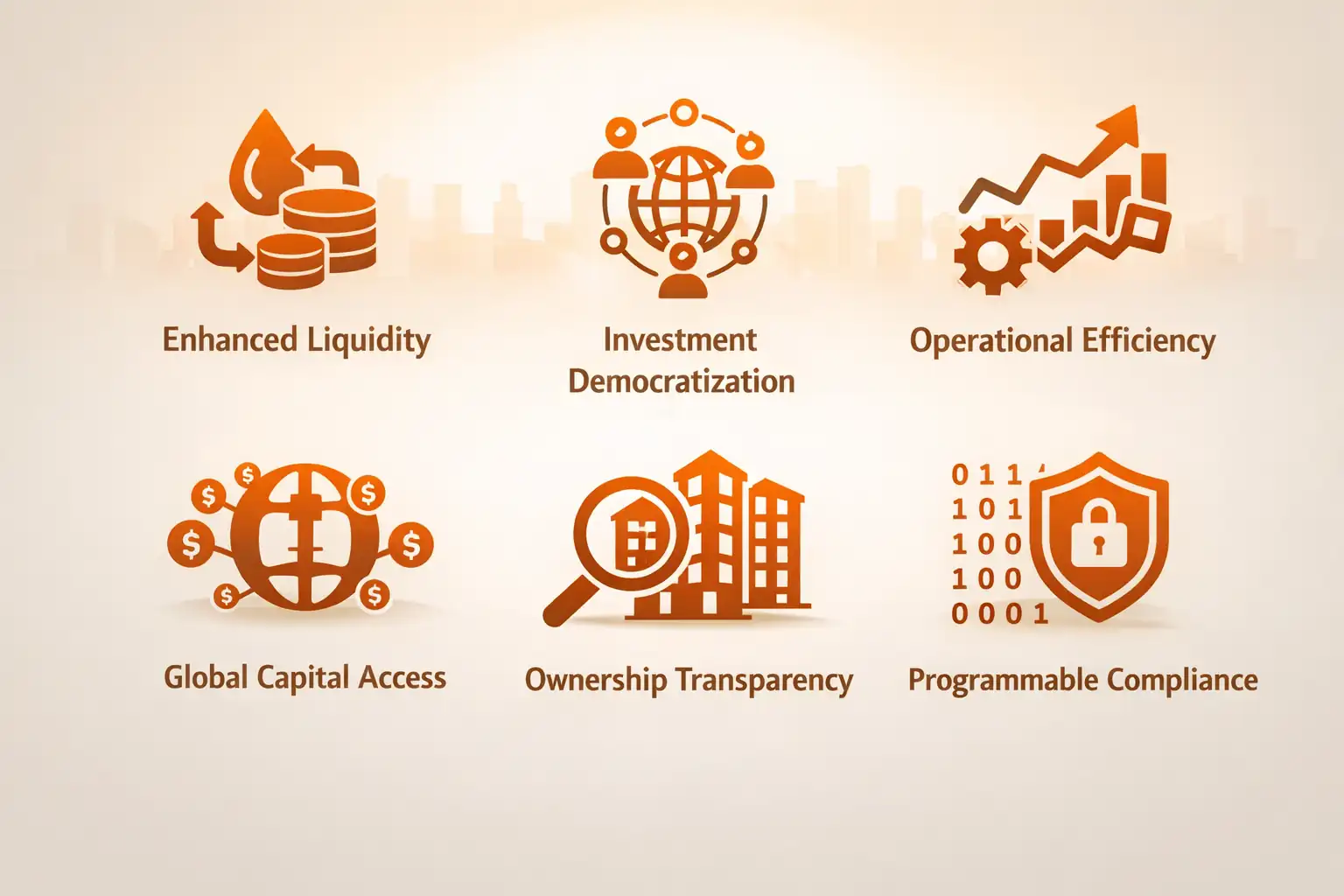
Primary Benefits of Commercial Real Estate Tokenization
Enhanced Liquidity
Secondary market trading reduces exit timelines from 6-18 months to hours once holding periods expire. Liquidity premiums of 10-30% over comparable illiquid investments reflect improved marketability. Actual trading volumes depend on property performance and investor satisfaction, with mature offerings achieving 20-40% annual turnover versus 3-5% for traditional syndications.
Investment Democratization
Minimum investments reduced from $1 million+ to $1,000-$25,000 through fractional ownership. Expands investor base by orders of magnitude, enabling retail participation in institutional-grade properties. Portfolio diversification becomes achievable for investors with $50,000-$200,000 allocations across multiple properties and geographic markets previously requiring $5-10 million minimum commitments.
Operational Efficiency
Smart contract automation reduces distribution processing costs by 40-60% compared to manual calculations and check issuance. Blockchain transparency eliminates quarterly reporting production by providing real-time dashboard access to financials and performance metrics. Transfer agent fees reduced or eliminated through automated on-chain ownership registry. Estimated annual savings: $30,000-$100,000 for typical $50-100 million property.
Global Capital Access
Cross-border tokenization enables property owners to access international investor pools without traditional barriers. Single offering can accommodate USA, UK, UAE, and Canadian investors simultaneously through appropriate regulatory structures. International capital sources diversify funding beyond local market constraints, particularly valuable for properties in secondary markets with limited local investor sophistication or capital availability.
Ownership Transparency
Immutable blockchain records provide complete, verifiable ownership history accessible to all participants. Smart contract logic executes distributions and governance functions according to predetermined rules visible on-chain. Reduces disputes over ownership, distribution calculations, and voting rights. Enhanced transparency increases investor confidence and reduces information asymmetry between sponsors and capital providers.
Programmable Compliance
Smart contracts enforce regulatory requirements automatically: transfer restrictions during holding periods, eligibility verification before transfers, investment limits for non-accredited investors, and jurisdiction exclusions. Reduces compliance burden compared to manual monitoring and enforcement. However, requires sophisticated contract design and thorough security auditing to ensure proper implementation and prevent vulnerabilities.
Despite substantial benefits, commercial real estate tokenization introduces challenges and limitations requiring realistic assessment. Technology risks include smart contract vulnerabilities that could enable unauthorized transfers, token minting errors, or distribution calculation bugs. While security audits mitigate these risks, they cannot eliminate them entirely. Platform dependency creates risks if the tokenization platform operator fails, loses regulatory authorization, or ceases operations, potentially stranding investors without access to secondary markets or updated reporting. Regulatory uncertainty persists in evolving frameworks, with potential for adverse regulatory developments affecting existing tokenizations through retroactive compliance requirements or operational restrictions.
| Challenge Category | Specific Risks | Mitigation Strategies |
|---|---|---|
| Technology Vulnerabilities | Smart contract bugs, blockchain network failures, custody platform hacks, wallet security breaches | Rigorous security audits by specialized firms (Trail of Bits, Consensys Diligence), insurance coverage for digital assets, multi-signature custody, established blockchain selection |
| Liquidity Limitations | Limited buyer demand, wide bid-ask spreads, difficulty executing large sales, market manipulation risks in thin markets | Market-making agreements, multiple platform listings, strong property performance maintaining investor interest, realistic investor expectations regarding liquidity timeframes |
| Regulatory Compliance Burden | Ongoing reporting requirements, multi-jurisdictional compliance complexity, evolving regulations requiring adaptation, enforcement actions from violations | Specialized securities counsel engagement, compliance management systems, proactive regulatory monitoring, conservative interpretation of ambiguous requirements |
| Investor Education Requirements | Lack of familiarity with digital assets, wallet management complexity, tax reporting confusion, unrealistic liquidity expectations | Comprehensive investor education materials, intuitive platform interfaces, custodial wallet options eliminating self-custody requirements, proactive investor communication |
| Cost Structure | High initial setup costs ($150K-$750K), ongoing technology and compliance expenses, platform dependencies creating recurring fees | Minimum project size thresholds ($15M+ equity), detailed cost-benefit analysis, negotiated platform agreements, consideration of white-label solutions for multiple projects |
| Market Acceptance | Limited institutional adoption, investor skepticism about new technology, competition with established REIT structures, difficulty achieving full subscription | Focus on high-quality underlying properties with strong fundamentals, transparent reporting demonstrating value proposition, competitive pricing versus alternatives, patient capital formation timelines |
Future Outlook of Commercial Real Estate Tokenization Across Asset Classes
The commercial real estate tokenization market stands at an inflection point where early experimentation gives way to mainstream adoption, driven by maturing regulatory frameworks, proven technology platforms, growing investor acceptance, and demonstrated project successes. Industry trajectories suggest substantial growth over the next decade, with tokenized commercial property values potentially reaching $500 billion to $1 trillion globally by 2030-2032, representing 2-3% penetration of the $32 trillion global commercial real estate market. This growth will not occur uniformly across all property types, geographies, or investor segments. Instead, adoption will concentrate initially in sectors and markets demonstrating clearest value propositions and strongest regulatory clarity.
Office real estate tokenization growth will concentrate in Class A properties within primary markets demonstrating post-pandemic occupancy recovery and rental growth. Flight to quality dynamics favor premium buildings with superior amenities, sustainability credentials, and advanced technology infrastructure. Tokenization enables these trophy assets to access broader capital pools including international investors and retail participants attracted to stable, institutional-grade investments. Secondary and tertiary office markets will experience more limited tokenization activity given uncertain demand fundamentals and reduced investor appeal. Suburban office conversions to mixed-use or alternative uses may present tokenization opportunities as properties transition to higher-value uses.
Retail tokenization will bifurcate between resilient, experience-focused properties demonstrating strong performance, and struggling centers requiring capital for repositioning or redevelopment. Successful retail tokenizations will emphasize: necessity-based anchors (grocery, pharmacy, discount retail), service-oriented tenants (fitness, medical, beauty, dining), entertainment and experiential components, and mixed-use integration incorporating residential, office, or hospitality elements. Trophy retail in ultra-prime urban locations (Fifth Avenue, Bond Street, Champs-Élysées) will attract tokenization interest from global investors seeking brand-name asset exposure. Struggling malls may utilize tokenization for capital formation supporting redevelopment into mixed-use communities, though these projects carry higher risk requiring sophisticated sponsor execution.
Industrial and logistics tokenization presents the strongest near-term growth trajectory given compelling sector fundamentals, standardized property characteristics enabling efficient analysis, and strong investor demand across retail and institutional segments. E-commerce penetration continuing toward 25-30% of retail sales (from current 15-20% in most developed markets) will drive sustained warehousing demand. Supply chain resilience initiatives requiring increased domestic inventory buffers support distribution center construction and leasing. Last-mile delivery infrastructure proliferation creates investment opportunities in urban logistics facilities near population centers. Cold chain expansion for pharmaceutical and fresh food distribution generates specialized facility demand. These trends support 8-12% annual growth in tokenized industrial property values through 2030, potentially reaching $200-300 billion globally.
Technological evolution will fundamentally enhance tokenization capabilities over the next decade. Artificial intelligence integration will transform property management through predictive maintenance algorithms, optimal tenant matching, and automated lease negotiations. Smart building technologies feeding real-time data to blockchain systems will enable performance-based financing where interest rates adjust based on actual property metrics. Cross-chain interoperability protocols will eliminate current blockchain silos, allowing tokens to move seamlessly between Ethereum, Polygon, Hyperledger, and other networks based on optimal cost and performance characteristics for specific transactions. Decentralized finance (DeFi) protocols will enable sophisticated financial products including tokenized property collateral for loans, yield farming strategies aggregating multiple property tokens, and derivative instruments for hedging real estate exposure.
The path to mainstream tokenization adoption faces headwinds alongside tailwinds. Regulatory evolution may prove non-linear with potential for adverse developments including increased restrictions, burdensome compliance requirements, or prohibitive licensing regimes in certain jurisdictions. Technology risks including blockchain security vulnerabilities, smart contract exploits, or platform failures could undermine investor confidence and trigger regulatory crackdowns. Market acceptance challenges persist as institutional investors maintain conservative postures and retail investors demonstrate limited sustained interest beyond initial enthusiasm. Competitive threats from traditional REITs, crowdfunding platforms, and private equity funds will intensify as these established players either adopt tokenization themselves or enhance their offerings to compete against tokenized alternatives. Success will require continued focus on fundamental value creation through superior properties, professional management, transparent operations, and realistic return expectations rather than relying solely on technological novelty to attract capital. Those projects delivering consistent performance, maintaining regulatory compliance, and providing genuine liquidity will thrive. Those pursuing tokenization as a buzzword without underlying quality will fail regardless of sophisticated technology implementation.
Final Perspective: After eight years structuring commercial real estate tokenizations across office, retail, and logistics sectors in the USA, UK, UAE, and Canada, our fundamental observation remains consistent: tokenization is a powerful tool enabling improved capital access, enhanced liquidity, and operational efficiency for commercial properties, but it does not transform poor-quality assets into attractive investments or guarantee success absent strong fundamentals. The most successful tokenizations we have structured share common characteristics: properties worth owning regardless of tokenization structure, professional sponsors with proven track records, conservative financial structuring maintaining sustainable debt levels, realistic investor expectations regarding liquidity and returns, comprehensive regulatory compliance, and ongoing commitment to transparent operations and investor communication. As the market matures toward mainstream adoption, these fundamentals will matter increasingly while technological novelty matters decreasingly. Property owners and investors evaluating tokenization opportunities should prioritize these core elements above all else.
Frequently Asked Questions
Q1.What is commercial real estate tokenization and how does it work?
Commercial real estate tokenization is the process of converting ownership rights or economic interests in commercial properties (offices, retail centers, warehouses) into digital tokens on a blockchain. Each token represents a fractional share of the underlying asset, allowing multiple investors to own portions of high-value properties. The process involves establishing a legal structure (typically an SPV), conducting property valuation, creating compliant security tokens, and enabling trading on specialized platforms. This technology democratizes access to institutional-grade commercial real estate investments.
Q2.What are the main benefits of tokenizing commercial real estate assets?
The primary benefits include enhanced liquidity through fractional ownership and secondary market trading, lower investment minimums (starting from $1,000-$10,000 versus millions), reduced transaction costs via smart contracts, 24/7 global accessibility, transparent ownership records on blockchain, automated compliance and distribution processes, portfolio diversification opportunities, and faster settlement times (hours instead of weeks). For property owners, tokenization unlocks capital without traditional debt, expands the investor base internationally, and provides flexible financing alternatives beyond conventional bank loans or institutional equity.
Q3.Which types of commercial properties are best suited for tokenization?
Income-generating properties with stable cash flows perform best: Class A office buildings in major business districts, regional shopping malls with anchor tenants, distribution centers near transportation hubs, cold storage facilities, medical office buildings, and logistics parks serving e-commerce. Properties valued between $10 million and $500 million typically attract optimal investor interest. Assets with long-term leases to creditworthy tenants, located in liquid real estate markets (New York, London, Dubai, Toronto), and those with clear exit strategies within 5-10 years demonstrate highest tokenization success rates.
Q4.Is tokenized commercial real estate regulated and legally recognized?
Yes, tokenized commercial real estate is heavily regulated as security tokens fall under existing securities laws. In the USA, offerings must comply with SEC regulations (Reg D, Reg A+, or Reg CF). The UK requires FCA authorization for security token platforms. UAE’s VARA and DFSA provide comprehensive frameworks for digital asset securities. Canada’s CSA oversees tokenized offerings through provincial securities commissions. Legal recognition exists through established SPV structures, registered securities offerings, and compliant custody solutions. Investors receive the same legal protections as traditional security holders, including property rights, income distributions, and governance participation.
Q5.How much does it cost to tokenize a commercial property?
Tokenization costs typically range from $150,000 to $750,000 for initial setup, depending on property complexity, jurisdiction, and regulatory pathway. Key expenses include legal structuring ($50,000-$200,000), blockchain development and smart contracts ($30,000-$150,000), regulatory compliance and filing fees ($40,000-$200,000), security audits ($20,000-$80,000), and platform integration ($10,000-$120,000). Ongoing costs include custody fees (0.1-0.5% annually), compliance monitoring ($30,000-$100,000/year), investor reporting, and secondary market operations. Projects under $15 million rarely achieve cost-efficiency, while assets exceeding $50 million benefit from economies of scale.
Q6.What is the minimum investment amount for tokenized commercial properties?
Minimum investments vary significantly based on regulatory framework and target investor profile. Retail-focused offerings in the USA (Reg A+ or Reg CF) often set minimums between $1,000 and $10,000, making institutional-grade properties accessible to individual investors. Accredited investor offerings (Reg D 506c) typically require $25,000 to $100,000 minimums. International platforms targeting UAE or UK investors may set thresholds at $10,000 to $50,000. Institutional tranches often maintain $250,000+ minimums. The tokenization model allows platforms to serve multiple investor tiers simultaneously through different token classes with varying minimum commitments.
Q7.How liquid are tokenized commercial real estate investments compared to traditional ownership?
Tokenized commercial real estate offers significantly enhanced liquidity compared to direct ownership, though it remains less liquid than public stocks. Traditional commercial property sales require 6-18 months; tokenized assets can trade on secondary markets within hours once transfer restrictions expire (typically 12 months for Reg D). However, actual liquidity depends on investor demand, market depth, and property fundamentals. Early-stage tokenized projects experience 5-15% of tokens trading annually. Mature platforms with multiple properties achieve 20-40% annual turnover. Liquidity premiums of 10-30% over comparable illiquid investments reflect this improved but imperfect marketability.
Q8.What are the tax implications of investing in tokenized commercial real estate?
Tax treatment generally mirrors traditional real estate securities. In the USA, investors receive Schedule K-1 forms reporting their proportional share of rental income, operating expenses, depreciation, and capital gains. Income is typically taxed as ordinary income, while long-term capital gains receive preferential rates. Pass-through structures allow depreciation benefits to flow to token holders. UK investors face Income Tax on distributions and Capital Gains Tax on disposals, with potential exemptions through ISA wrappers for qualifying offerings. UAE offers zero capital gains and income tax for most investors. Canadian investors report under similar partnership taxation rules with potential for capital gains treatment.
Q9.What risks should investors consider when buying tokenized commercial properties?
Key risks include market risk (property value fluctuations), liquidity risk (difficulty selling tokens despite secondary markets), regulatory risk (evolving frameworks may impact operations), technology risk (smart contract vulnerabilities or platform failures), counterparty risk (platform operator solvency), concentration risk (single-property offerings), tenant risk (lease defaults affecting cash flows), and operational risk (property management quality). Additionally, investors face cybersecurity threats, potential for reduced transparency versus direct ownership, limited recourse in disputes, currency risk for cross-border investments, and the possibility of total loss if property values decline severely or operators fail.
Q10.How do returns from tokenized commercial real estate compare to traditional investments?
Tokenized commercial real estate typically targets 6-12% annual returns combining rental income (4-8% yields) and capital appreciation (2-4% annually). Office properties in prime locations offer 5-8% net yields; retail centers provide 6-10%; logistics facilities deliver 5-9%. These returns compete favorably with REITs (4-9% dividends plus appreciation) while offering direct property exposure. Compared to direct ownership, tokenization provides similar economic returns but with enhanced liquidity and lower minimums. Risk-adjusted returns depend heavily on property quality, location, leverage, and management expertise. Well-structured offerings in strong markets demonstrate comparable performance to institutional real estate funds minus high management fees.
Explore Services
Related Services
Reviewed by

Aman Vaths
Founder of Nadcab Labs
Aman Vaths is the Founder & CTO of Nadcab Labs, a global digital engineering company delivering enterprise-grade solutions across AI, Web3, Blockchain, Big Data, Cloud, Cybersecurity, and Modern Application Development. With deep technical leadership and product innovation experience, Aman has positioned Nadcab Labs as one of the most advanced engineering companies driving the next era of intelligent, secure, and scalable software systems. Under his leadership, Nadcab Labs has built 2,000+ global projects across sectors including fintech, banking, healthcare, real estate, logistics, gaming, manufacturing, and next-generation DePIN networks. Aman’s strength lies in architecting high-performance systems, end-to-end platform engineering, and designing enterprise solutions that operate at global scale.