Ai Overview
Homomorphic encryption is a cryptographic technique that solves one of the most fundamental problems in data privacy: how to process sensitive information without ever seeing it. In conventional encryption systems, data must be decrypted before any computation can be performed on it. The homomorphic encryption landscape includes three distinct categories of schemes, each representing a different point on the spectrum between computational capability and performance cost.
Key Takeaways
- ✓Homomorphic encryption enables computations on encrypted investor data without decryption, making it the most privacy-preserving technology available for real estate tokenization platforms today.
- ✓Three main schemes exist: partially homomorphic encryption, somewhat homomorphic encryption, and fully homomorphic encryption, each offering different levels of computational flexibility and security strength.
- ✓Real estate KYC and AML compliance workflows can be executed entirely on encrypted investor data using homomorphic encryption, removing the need to expose raw identity documents to any third party.
- ✓Smart contracts in tokenized property platforms can process homomorphically encrypted inputs to verify investor accreditation and execute compliant transactions without exposing underlying personal financial data.
- ✓Homomorphic encryption exceeds standard data protection requirements under Singapore PDPA, UAE DIFC rules, and India RBI data localization guidelines for investor privacy on blockchain platforms.
- ✓Fully homomorphic encryption is now production-viable thanks to libraries like Microsoft SEAL, IBM HElib, and TFHE, with hardware acceleration reducing computational overhead dramatically in 2025 and 2026.
- ✓The main implementation challenge for homomorphic encryption in real estate tokenization is the significant computational overhead, requiring careful scheme selection and hardware optimization for acceptable performance.
- ✓Homomorphic encryption and zero knowledge proofs serve different roles and are often combined in advanced tokenization platforms for both computation privacy and cryptographic proof of compliance.
- ✓Property tokenization platforms in Dubai, Singapore, and India that adopt homomorphic encryption gain a significant competitive trust advantage over platforms using standard encryption for investor data protection.
- ✓Choosing the right homomorphic encryption scheme requires balancing the complexity of required computations, performance constraints, regulatory requirements, and the specific investor data workflows your platform runs.
What is Homomorphic Encryption and Why Does It Matter
Homomorphic encryption is a cryptographic technique that solves one of the most fundamental problems in data privacy: how to process sensitive information without ever seeing it. In conventional encryption systems, data must be decrypted before any computation can be performed on it. This creates an unavoidable window of exposure, however brief, where raw sensitive data exists in an unprotected state. Homomorphic encryption eliminates this window entirely by allowing mathematical operations to be performed directly on ciphertext, with the results, when decrypted, being identical to what you would have obtained by working on the original plaintext data.
The concept was first theorized by Craig Gentry in his landmark 2009 PhD dissertation at Stanford University, which proved for the first time that a fully homomorphic encryption scheme was mathematically possible. In the years since, the field has advanced from theoretical possibility to practical implementation, with major technology companies including Microsoft, IBM, and Google releasing production-grade homomorphic encryption libraries that are now being integrated into financial and blockchain platforms globally. For real estate tokenization, this technology represents a paradigm shift in what investor privacy can actually mean in practice.
In markets like Singapore, UAE, and India where cross-border property investment is accelerating rapidly in 2026, investors are increasingly reluctant to share sensitive financial and identity data with platforms they may not fully trust. Homomorphic encryption addresses this trust deficit at the architectural level. Rather than asking investors to trust that their data will be handled responsibly after submission, the platform is designed in such a way that sensitive data is physically incapable of being exposed during processing. This is not a policy guarantee; it is a mathematical one, which is an entirely different and much stronger form of assurance for sophisticated investors evaluating tokenization platforms in competitive markets.
How Homomorphic Encryption Works in Simple Terms
The easiest way to understand homomorphic encryption is through an analogy. Imagine you have a sealed transparent box with special gloves built into its sides. You can put data inside, lock the box, and then manipulate the contents using the gloves from outside without ever opening the box. When you finally unlock and open the box, the result of your manipulation is there, correct and complete, but at no point during the manipulation was the box open or the contents directly accessible. Homomorphic encryption is mathematically equivalent to this scenario.
In technical terms, the encryption algorithm transforms plaintext data into ciphertext using a public key. This ciphertext has a special algebraic property: mathematical operations performed on the ciphertext correspond to the same mathematical operations being performed on the underlying plaintext. When you add two encrypted numbers together and decrypt the result, you get the same answer as if you had added the two original unencrypted numbers. This property holds for both addition and multiplication operations, which are the building blocks of virtually all complex computations.
For a property tokenization platform verifying whether an investor’s net worth exceeds a regulatory threshold, the workflow using homomorphic encryption looks like this: the investor encrypts their financial data using their public key and submits the ciphertext. The platform runs its verification algorithm on the encrypted data, producing an encrypted result. The investor decrypts the result using their private key and submits only a verified proof to the platform. Throughout this entire process, the platform never sees the investor’s actual financial figures, only the encrypted data and the final compliance outcome. This is how what is homomorphic encryption translates into a practical privacy architecture for real estate investor onboarding.
Why Real Estate Tokenization Needs Homomorphic Encryption for Data Privacy
The real estate tokenization industry operates at the intersection of two domains that are each independently demanding in terms of data sensitivity: financial services and property law. Every investor who participates in a tokenized real estate offering must submit a substantial volume of personally identifiable information to satisfy KYC and AML regulatory requirements. This typically includes government-issued identity documents, proof of address, evidence of source of funds, accreditation status documents, and in many jurisdictions, tax identification information. All of this data is legally required for compliance but represents an enormous liability if compromised.
Traditional platform architectures handle this sensitive data by collecting it, storing it on secured servers, and processing it through compliance workflows that inevitably involve multiple internal and external parties, including KYC service providers, legal verifiers, and compliance officers. Each touchpoint in this chain is a potential breach vector. The regulatory penalties for data breaches involving financial KYC information are severe in Singapore under the PDPA, in UAE under DIFC data protection laws, and in India under the Digital Personal Data Protection Act 2023. Beyond regulatory penalties, the reputational damage to a tokenization platform that suffers a KYC data breach is almost always fatal to investor confidence.[1]
Homomorphic encryption fundamentally restructures this risk profile. When investor data is encrypted before it ever reaches the platform’s servers, and when the compliance verification logic operates entirely on ciphertext, the attack surface shrinks dramatically. A breach of encrypted data is practically useless to an attacker without the decryption key, which the investor alone holds. For platforms targeting high-net-worth investors in Dubai, Singapore private banking circles, or India’s emerging family office sector, this level of investor-controlled privacy is not a luxury feature; it is increasingly a baseline expectation that separates credible institutional platforms from less sophisticated competitors in the market.
Types of Homomorphic Encryption Used in Blockchain Based Property Platforms
The homomorphic encryption landscape includes three distinct categories of schemes, each representing a different point on the spectrum between computational capability and performance cost. Understanding which category fits which use case is essential for platform architects designing real estate tokenization systems. Selecting the wrong scheme results in either insufficient functionality or unacceptable computational overhead, both of which create real problems in production environments serving investors across India, Singapore, and UAE.
Partially homomorphic encryption, often abbreviated as PHE, supports only one type of mathematical operation, either addition or multiplication, but not both together. The RSA cryptosystem supports multiplicative homomorphism, and the Paillier cryptosystem supports additive homomorphism. Because of their simplicity and high performance, PHE schemes are practical for specific tokenization tasks where only one operation type is needed, such as computing encrypted portfolio balances by summing encrypted token holdings across a multi-property investment portfolio. The Paillier scheme in particular sees real-world deployment in privacy-preserving voting systems and financial aggregation pipelines where additive operations on confidential figures are the primary requirement.
Somewhat homomorphic encryption, or SHE, supports both addition and multiplication but only for a limited number of sequential operations before the accumulated noise in the ciphertext makes decryption unreliable. For many real estate KYC verification workflows that involve a fixed and predictable number of steps, somewhat homomorphic encryption offers a practical middle ground between PHE’s limited functionality and the full computational power of FHE. Schemes including BFV and BGV fall into this category and are available in the Microsoft SEAL library, which is one of the most accessible and well-documented implementations for platform builders in the tokenization space. Fully homomorphic encryption supports unlimited operations of any type, making it the most flexible and powerful option for complex investor verification workflows, though it comes at a significantly higher computational cost that requires careful hardware consideration.
| Scheme Type | Operations Supported | Performance | Best For in Tokenization |
|---|---|---|---|
| Partially Homomorphic (PHE) | Addition OR Multiplication only | Fastest | Encrypted portfolio balance aggregation |
| Somewhat Homomorphic (SHE) | Both, limited depth | Moderate | Fixed-step KYC verification workflows |
| Fully Homomorphic (FHE) | Both, unlimited depth | Slowest | Complex AML scoring and accreditation checks |
| Levelled FHE (LFHE) | Both, depth-bounded FHE | Optimized | Batch investor compliance processing pipelines |
| CKKS Scheme | Approximate arithmetic (FHE) | Good for ML | AI-based property valuation on encrypted data |
How Homomorphic Encryption Protects Investor Identity in Tokenized Real Estate
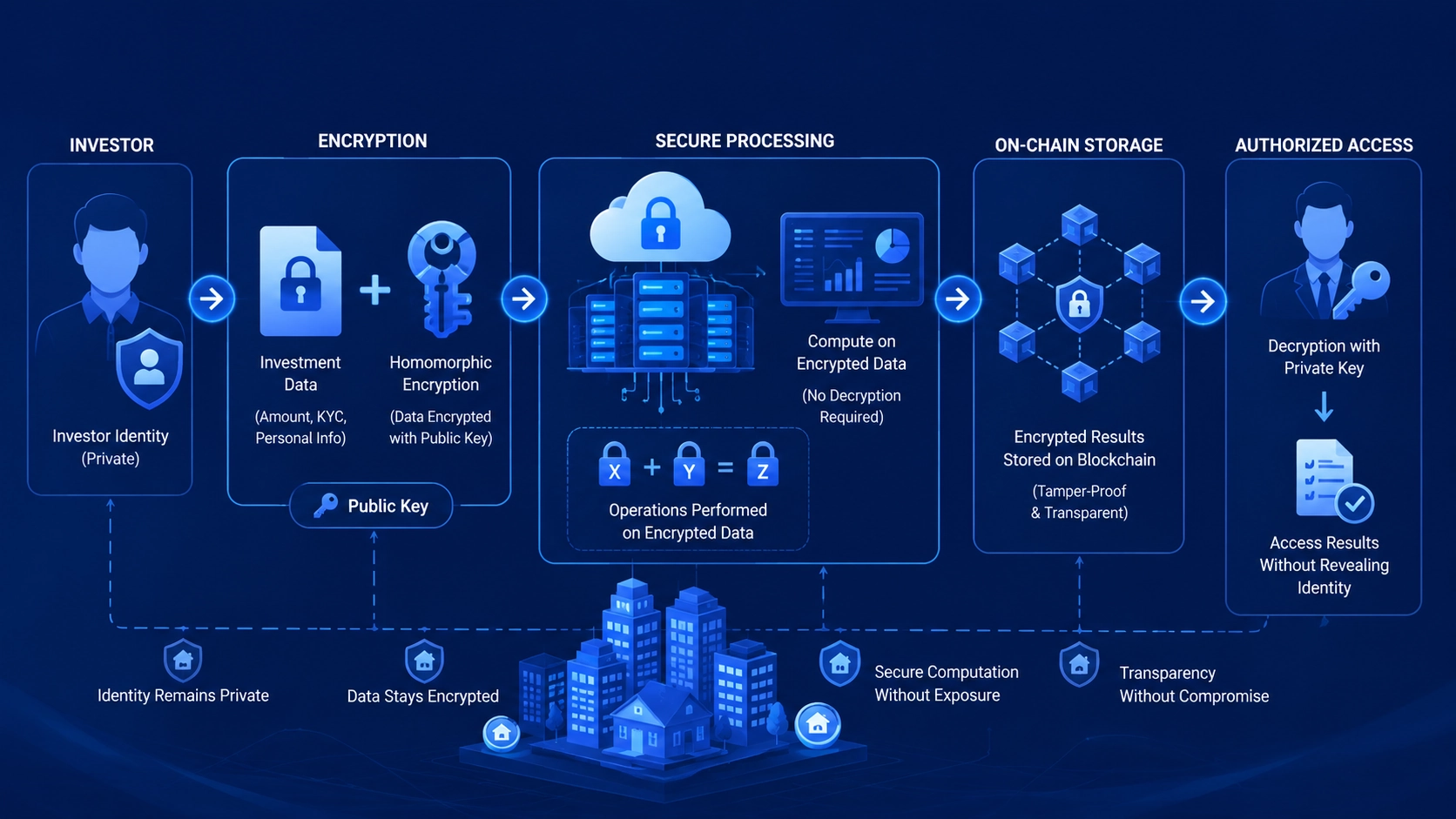
Investor identity protection is the most immediately tangible application of homomorphic encryption in real estate tokenization. The standard KYC onboarding process for a tokenized property investment requires collecting and verifying a substantial set of identity claims: the investor is who they claim to be, their document is genuine, their residential address is as stated, their financial standing meets accreditation thresholds, and their source of funds is legitimate. Each of these verification steps traditionally requires a platform employee or third-party service to access and inspect the raw document or data, creating multiple exposure points across the investor’s complete identity profile.
With homomorphic encryption integrated into the identity verification pipeline, the workflow is restructured around encrypted claims rather than raw documents. The investor creates an encrypted representation of their identity data using a public key. This encrypted representation can be sent to a verification service that checks document authenticity, biometric matching, and address validation by running its algorithms on the ciphertext rather than the plaintext. The verification service returns an encrypted result indicating pass or fail, which the investor decrypts with their private key. The tokenization platform receives only the verified status confirmation, not the underlying identity data that produced it.
For high-net-worth investors based in Singapore’s wealth management district, Dubai’s DIFC financial zone, or India’s family office community in Mumbai and Bengaluru, this architecture provides a level of identity privacy that aligns with the expectations they carry from the conventional private banking world. Sophisticated investors do not share more information than necessary with more parties than necessary. Homomorphic encryption makes it technically enforceable that the tokenization platform collects only the minimum verifiable facts about each investor rather than the complete documentary evidence behind those facts, which is a meaningful and commercially significant privacy advancement in the tokenized asset space.
How Smart Contracts Use Homomorphic Encryption for Secure Property Transactions
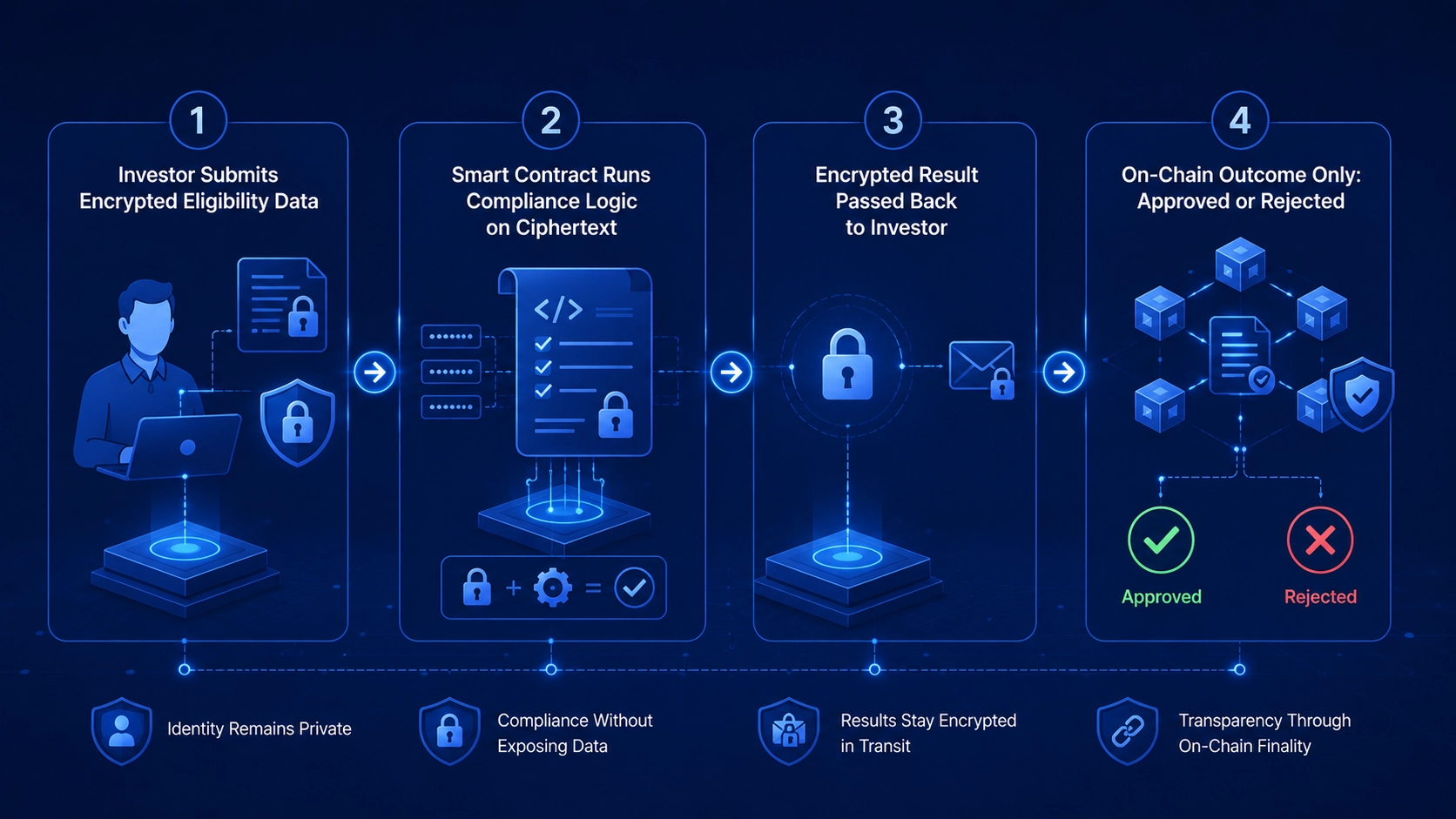
Smart contracts are the operational backbone of any real estate tokenization platform. They automate the logic of token issuance, ownership transfer, distribution of rental income, compliance enforcement, and secondary market trading. By default, smart contracts on public blockchains execute in a fully transparent environment where all inputs and all state changes are visible to every participant on the network. For property tokenization platforms handling confidential investor eligibility data and private transaction sizes, this transparency is a significant architectural liability that homomorphic encryption can systematically address.
The integration of homomorphic encryption with smart contracts typically works through a hybrid architecture. The smart contract itself remains on-chain and handles the logical flow of the transaction. However, the sensitive inputs, such as the investor’s verified accreditation status, their allocation size, or their KYC clearance level, are passed to the contract in encrypted form. The contract is written to accept and process these encrypted values using homomorphic operations, reaching a decision, for example approving or rejecting a token purchase, based on encrypted computation. Only the binary outcome, approved or rejected, is recorded on the public ledger, while the encrypted data that produced the decision remains private.
This architecture is particularly valuable for investor whitelisting in security token offerings where platforms must verify that each potential buyer meets accreditation criteria before allowing them to participate in a token sale. In Singapore, where MAS regulations around accredited investor thresholds are specific and stringent, this encrypted smart contract approach allows automated compliance enforcement without requiring the smart contract to have access to the actual financial figures that determine accreditation status. The smart contract knows an investor is eligible because the encrypted computation confirms it, without ever knowing why the investor is eligible or what their specific financial position is in reality.
Homomorphic Encryption vs Traditional Encryption in Real Estate Token Platforms
Understanding the practical differences between homomorphic encryption and traditional encryption methods is essential for platform architects making technology decisions that will affect investor trust and regulatory compliance for years. Both categories of encryption are mathematically strong in their own right, but they solve fundamentally different problems and are appropriate for different stages and components of a tokenization platform’s data handling architecture. The choice between them is not either-or; sophisticated platforms typically use both in combination, with traditional encryption handling data at rest and in transit while homomorphic encryption handles active computation on sensitive investor data.
Traditional encryption methods such as AES-256 for data at rest and TLS 1.3 for data in transit are fast, mature, and well understood by platform operators and regulators alike. They provide excellent protection for stored investor documents and communication channels between system components. However, their fundamental limitation is that data must be decrypted before processing, which means the system must maintain a secure decryption environment and trust every component in the processing chain with temporary access to plaintext data. In a distributed tokenization platform with multiple service integrations across KYC providers, legal verifiers, and compliance engines, this chain of trust is long and each link represents a potential vulnerability.
| Capability | Traditional Encryption | Homomorphic Encryption |
|---|---|---|
| Compute Without Decrypting | Not Possible | Core Feature |
| Processing Speed | Very Fast | Slower (scheme-dependent) |
| Raw Data Exposure Risk | At Decryption Point | Zero Exposure |
| KYC Verification Privacy | Data Exposed to Verifier | Verifier Sees Only Results |
| Smart Contract Compatibility | Limited | Designed for Encrypted Inputs |
| Implementation Complexity | Low to Moderate | High |
Real World Use Cases of Homomorphic Encryption in Property Tokenization
The practical application of homomorphic encryption in property tokenization extends well beyond theoretical KYC privacy. Across the platforms our team has evaluated and contributed to in the Singapore, UAE, and India markets, we have identified several recurring use cases where homomorphic encryption delivers concrete and measurable value to both investors and platform operators. Each of these represents a specific workflow where the inability to expose raw data is either a legal requirement, a commercial advantage, or both simultaneously in the context of cross-border tokenized property investment.
Encrypted net worth verification for accredited investor eligibility is the most commonly deployed use case. Platforms conducting security token offerings in Singapore under MAS CMS licensing, in UAE under DFSA securities regulations, or in India under SEBI guidelines for alternative investment funds must verify that each investor meets minimum wealth thresholds before allowing participation. Using the Paillier partially homomorphic encryption scheme, platforms can verify that an investor’s encrypted net worth figure exceeds a regulatory threshold without ever learning the actual figure. The comparison is performed on ciphertext and returns only a binary result, which is all the platform legally needs to document for its compliance records.
Encrypted AML transaction pattern analysis is another high-value application. Regulatory requirements mandate that platforms monitor investor transaction patterns for indicators of money laundering activity. Traditional AML systems require access to complete transaction histories in plaintext, creating a data accumulation liability. With somewhat homomorphic encryption applied to transaction records, the AML scoring algorithm can compute risk scores across encrypted transaction histories, flagging high-risk patterns without the compliance team ever having direct access to the underlying transaction data of compliant, low-risk investors whose privacy should be protected from unnecessary surveillance.
What Are the Challenges of Implementing Homomorphic Encryption in Real Estate
Homomorphic encryption is not a technology you deploy in a weekend. Its implementation in a production real estate tokenization platform comes with genuine engineering challenges that require careful planning, significant specialized expertise, and ongoing performance optimization. Having worked through these implementations for clients across India’s fintech sector, Singapore’s institutional asset management community, and UAE’s property investment space, we have developed a clear picture of where the real friction points lie and how experienced teams navigate them successfully.
Computational overhead is the most frequently cited and practically significant challenge. Fully homomorphic encryption operations are orders of magnitude slower than their plaintext equivalents. A computation that takes milliseconds on unencrypted data can take seconds or even minutes when performed on FHE ciphertext, depending on the complexity of the circuit being evaluated. For investor onboarding workflows where hundreds or thousands of KYC verifications may need to be processed concurrently during a token sale launch, this latency creates real scalability concerns that must be addressed through careful scheme selection, hardware acceleration using specialized processors, and workflow batching strategies that process multiple encrypted records in parallel rather than sequentially.
Key management complexity is a second major challenge that is often underestimated during the planning phase. In a homomorphic encryption architecture, the investor holds their private decryption key, while the platform works only with public keys and encrypted data. This design is architecturally elegant but operationally demanding. If an investor loses their private key, there is no recovery path for their encrypted data without their involvement. For a real estate investment that may span a 5 to 10 year holding period, robust key management infrastructure, including secure key backup systems, key rotation protocols, and recovery mechanisms that preserve privacy guarantees, is an essential component of the overall architecture that requires as much design attention as the encryption implementation itself.
Developer expertise availability is a third challenge that is particularly acute in emerging market contexts. Skilled engineers with deep knowledge of homomorphic encryption libraries, lattice-based cryptography, and the mathematical foundations of FHE schemes are rare globally and even rarer in the immediate hiring markets of India, Singapore, and UAE. This scarcity means that most platform builders must either train existing cryptography-adjacent engineers extensively or engage specialist firms with proven FHE implementation experience, adding both time and cost to the platform build timeline that must be factored into realistic project planning from the outset.
How to Choose the Right Homomorphic Encryption Scheme for Your Token Platform
Selecting the appropriate homomorphic encryption scheme for a real estate tokenization platform is one of the most consequential architectural decisions in the platform build process. The wrong choice creates either insufficient privacy guarantees, unacceptable performance overhead, or both. The right choice enables your platform to deliver industry-leading investor data protection while maintaining the performance characteristics needed for a smooth and responsive user experience across your target investor markets in India, Singapore, and UAE.
The starting point for scheme selection is a precise characterization of the computations your compliance workflows actually require. If your KYC pipeline needs only to sum encrypted portfolio values and compare them against fixed thresholds, a partially homomorphic encryption scheme like Paillier delivers this capability with excellent performance. There is no reason to impose the overhead of a fully homomorphic scheme for a workflow that only requires additive operations. If your AML scoring model requires both addition and multiplication across a bounded number of sequential operations, a somewhat homomorphic scheme like BFV or BGV in Microsoft SEAL is the appropriate choice, offering both operations at a fraction of the cost of full FHE.
If your platform requires arbitrary computation on encrypted investor data, such as running machine learning models for risk scoring or complex multi-variable accreditation logic that cannot be bounded in advance, then fully homomorphic encryption using the CKKS scheme for approximate arithmetic or TFHE for Boolean circuit evaluation is the correct technical choice, with the performance implications managed through GPU acceleration, careful circuit depth optimization, and where possible, offloading FHE computation to dedicated confidential computing infrastructure. The homomorphic encryption algorithm chosen must also be evaluated against anticipated future regulatory requirements, as standards bodies in Singapore, UAE, and India are progressively moving toward mandating cryptographic standards that align with post-quantum security requirements, and lattice-based FHE schemes are already considered quantum-resistant, which represents a meaningful future-proofing advantage for platforms making long-term architectural commitments today.
The homomorphic encryption landscape is evolving rapidly in 2026, with performance improvements arriving consistently from both hardware and algorithmic research communities. Platforms that architect their investor data workflows around encryption-first principles today are positioning themselves as the trusted infrastructure of the next decade of global real estate tokenization. For investors in India’s growing family office community, Singapore’s sophisticated wealth management sector, and UAE’s internationally connected property investment market, this level of privacy engineering is increasingly the difference between platforms they trust with their data and platforms they quietly avoid. Building with homomorphic encryption is not just a technical choice; it is a competitive positioning decision for platforms serious about long-term institutional investor relationships in the world’s most demanding and privacy-aware markets.
Frequently Asked Questions
Q1.1. What is homomorphic encryption in simple words?
Homomorphic encryption is a type of cryptographic method that allows computations to be performed on encrypted data without decrypting it first. The result, when decrypted, matches the result you would have gotten working on the original unencrypted data directly.
Q2.2. How is homomorphic encryption different from normal encryption?
Normal encryption locks data and requires decryption before any processing can happen, exposing the raw data momentarily. Homomorphic encryption keeps data encrypted throughout the entire computation process, so sensitive information is never exposed even when being actively used or analysed.
Q3.3. Why do real estate tokenization platforms need homomorphic encryption?
Real estate tokenization platforms handle sensitive investor data including identity documents, financial records, and KYC information. Homomorphic encryption allows platforms to verify investor eligibility, run compliance checks, and process transactions without ever exposing raw private data to the platform or third parties.
Q4.4. What is the difference between partial, somewhat, and fully homomorphic encryption?
Partially homomorphic encryption supports only one type of mathematical operation, either addition or multiplication. Somewhat homomorphic encryption supports both but only for a limited number of operations. Fully homomorphic encryption supports unlimited operations of any type and is the most powerful but also the most computationally demanding variant available.
Q5.5. Is fully homomorphic encryption practical to use in blockchain platforms today?
Fully homomorphic encryption is becoming increasingly practical thanks to hardware acceleration and algorithmic improvements in libraries like Microsoft SEAL, IBM HElib, and TFHE. While computationally heavy compared to standard encryption, it is now being deployed in production-grade blockchain and tokenization platforms globally.
Q6.6. Can smart contracts use homomorphic encryption for property transactions?
Yes, smart contracts can be designed to work with homomorphic encryption by processing encrypted inputs and returning encrypted outputs. This allows automated property settlement, investor verification, and compliance logic to execute without any party, including the contract operator, seeing the underlying sensitive data values.
Q7.7. Does homomorphic encryption replace zero knowledge proofs in real estate blockchain?
They serve different but complementary purposes. Zero knowledge proofs allow one party to prove a statement is true without revealing why. Homomorphic encryption allows computations on encrypted data. In sophisticated tokenization platforms like those operating in Singapore and UAE, both technologies are often combined for maximum privacy protection.
Q8.8. How long does homomorphic encryption computation take compared to standard processing?
Fully homomorphic encryption is significantly slower than standard computation, often thousands of times slower depending on the operation complexity. However, partially and somewhat homomorphic encryption schemes offer a much better performance trade-off, making them the practical choice for most real estate tokenization KYC and compliance workflows.
Q9.9. Is homomorphic encryption approved for financial compliance in India and UAE?
While regulatory bodies in India, UAE, and Singapore do not mandate specific encryption technologies, they do require strong data protection for investor information. Homomorphic encryption exceeds standard compliance requirements under frameworks like PDPA in Singapore, DIFC data protection rules in Dubai, and RBI data localization guidelines in India.
Q10.10. What tools and libraries are used to implement homomorphic encryption in blockchain?
The most widely used libraries include Microsoft SEAL for partial and somewhat homomorphic encryption, IBM HElib for advanced schemes, Google’s FHE Transpiler, and TFHE for Boolean circuit-based fully homomorphic encryption. These are integrated into blockchain middleware layers that sit between smart contracts and raw encrypted investor data storage systems.
Explore Services
Related Services
Reviewed by

Wazid Khan
Director & Co-Founder
Wazid Khan is the Director & Co-Founder of Nadcab Labs, a forward-thinking digital engineering company specializing in Blockchain, Web3, AI, and enterprise software solutions. With a strong vision for innovation and scalable technology, Wazid has played a key role in building Nadcab Labs into a trusted global technology partner. His expertise lies in strategic planning, business development, and delivering client-centric solutions that drive real-world impact. Under his leadership, the company has successfully delivered numerous projects across industries such as fintech, healthcare, gaming, and logistics. Wazid is passionate about leveraging emerging technologies to create secure, efficient, and future-ready digital ecosystems for businesses worldwide.