Ai Overview
Smart contract agencies are specialized technology firms that focus exclusively on blockchain-based solutions, with particular emphasis on designing, developing, auditing, and maintaining smart contracts across various blockchain platforms. Cost considerations strongly favor working with agencies for most businesses, particularly when accounting for total cost of ownership rather than just immediate development expenses.
Key Takeaways
- Smart contract agencies bring specialized expertise that combines blockchain, security auditing, legal compliance, and business process optimization, eliminating the need for businesses to build expensive in-house teams.
- Professional agencies reduce security risks significantly through comprehensive auditing processes, formal verification methods, and adherence to industry best practices that prevent costly vulnerabilities and exploits.
- Time to market accelerates dramatically when working with experienced agencies who have refined development frameworks, reusable components, and established testing protocols that would take years to develop internally.
- Cost efficiency improves over the long term despite initial investment, as agencies prevent expensive mistakes, optimize gas fees, and provide ongoing support that reduces total cost of ownership.
- Regulatory compliance becomes manageable with agencies that understand evolving blockchain regulations across different jurisdictions and can design smart contracts that meet legal requirements while maintaining technical functionality.
- Multi-platform expertise enables better technology choices as agencies evaluate different blockchain networks based on specific business requirements rather than limiting solutions to a single platform.
- Enterprise integration capabilities ensure smart contracts work seamlessly with existing business systems, databases, and workflows rather than operating as isolated blockchain applications.
- Post-deployment support and monitoring from agencies provide ongoing value through performance optimization, incident response, upgrades, and adaptation to changing business needs and technological advancements.
The blockchain revolution has moved far beyond cryptocurrency speculation into practical business applications that deliver measurable value. At the heart of this transformation are smart contracts, which are self-executing digital agreements that automatically enforce terms without intermediaries. As businesses across industries recognize the potential of this technology, they increasingly turn to specialized smart contract agencies rather than attempting to build solutions in-house. This decision reflects both the complexity of blockchain and the critical importance of getting implementation right the first time.
Over the past eight years working with businesses of all sizes, we have witnessed a fundamental shift in how organizations approach blockchain adoption. Early adopters who rushed to build internal blockchain teams often struggled with security vulnerabilities, regulatory uncertainties, and technical debt that outweighed initial savings. Today, mature businesses understand that smart contracts requires specialized knowledge that extends beyond traditional software engineering. This realization drives the growing demand for professional smart contract agencies that bring comprehensive expertise, proven methodologies, and accountability to blockchain projects.
Understanding Smart Contract Agencies
Smart contract agencies are specialized technology firms that focus exclusively on blockchain-based solutions, with particular emphasis on designing, developing, auditing, and maintaining smart contracts across various blockchain platforms. Unlike general software companies that may offer blockchain services as a side offering, dedicated smart contract agencies build their entire business model around this technology. They invest heavily in staying current with rapidly evolving blockchain protocols, security best practices, regulatory developments, and emerging use cases across different industries.
These agencies typically employ multidisciplinary teams that include blockchain architects who design system-level solutions, smart contract developers proficient in languages like Solidity for Ethereum or Rust for Solana, security specialists who conduct vulnerability assessments and penetration testing, quality assurance engineers who create comprehensive test suites, and business analysts who translate business requirements into technical specifications. Many agencies also maintain relationships with legal experts who understand blockchain regulations and can advise on compliance matters, particularly important given the evolving regulatory landscape in different jurisdictions.
The core value proposition of smart contract agencies lies in their accumulated experience from working on diverse projects across multiple industries and blockchain platforms. This exposure allows them to identify patterns, anticipate challenges, and apply proven solutions rather than learning through trial and error on client projects. They maintain libraries of tested code components, security checklists refined through hundreds of audits, and documented best practices that dramatically reduce development risks and timelines. Their business model depends on delivering successful projects, creating strong incentives for quality and accountability that internal teams may lack.
Professional smart contract agencies distinguish themselves through their commitment to security and quality assurance. They understand that smart contract vulnerabilities cannot simply be patched like traditional software because blockchain transactions are immutable and often involve significant financial value. This reality drives their rigorous development methodologies that include multiple review stages, automated vulnerability scanning, extensive testing on test networks before mainnet deployment, and often third-party security audits from independent firms. These practices reflect industry standards that have emerged from expensive lessons learned through high-profile smart contract failures that cost millions of dollars.
Why Businesses Hire Smart Contract Agencies
The decision to hire a smart contract agency rather than build internal capabilities stems from several compelling business reasons that become clear when organizations seriously evaluate their blockchain initiatives. First and foremost, the specialized knowledge required for smart contracts exceeds what most businesses can reasonably develop internally. Blockchain technology combines cryptography, distributed systems, consensus mechanisms, and programming paradigms that differ fundamentally from traditional application development. Building a competent internal team requires recruiting scarce talent in a highly competitive market, providing extensive training, and accepting significant learning curves that delay project delivery, similar to challenges seen in the in house marketing vs agency decisions.
Cost Considerations
Cost considerations strongly favor working with agencies for most businesses, particularly when accounting for total cost of ownership rather than just immediate development expenses. Building an internal blockchain team requires competitive salaries for specialized developers, ongoing training investments to keep pace with rapid technological changes, infrastructure costs for development and testing environments, and overhead for management and coordination. These costs continue regardless of project volume, creating inefficiency when blockchain work is sporadic rather than continuous. In contrast, smart contract agencies allow businesses to access top-tier expertise on a project basis, paying only for the specific services needed and scaling engagement up or down based on business requirements.
Risk Mitigation
Risk mitigation represents another critical driver for agency engagement. Smart contract vulnerabilities have led to losses exceeding billions of dollars across the blockchain industry, with high-profile hacks regularly making headlines. These incidents demonstrate that blockchain security requires specialized expertise that goes beyond general cybersecurity knowledge. Professional smart contract agencies bring battle-tested security practices developed through extensive experience identifying and preventing vulnerabilities. They carry professional liability insurance, provide security guarantees, and stake their reputation on delivering secure solutions. This transfers significant risk from the business to the agency, providing important protection for organizations entering unfamiliar technological territory.
Time to Market
Time to market advantages also drive many businesses toward agency partnerships. Developing internal blockchain capabilities from scratch requires months or years before teams become productive, during which market opportunities may disappear or competitors may establish dominant positions. Agencies begin delivering value immediately, drawing on established development frameworks, reusable components, and refined processes that accelerate project timelines dramatically. They can mobilize teams quickly, scale resources up during intensive development phases, and deliver production-ready solutions in weeks or months rather than years. For businesses where speed creates competitive advantage, this acceleration often justifies agency costs many times over.
| Factor | Internal Development | Agency Partnership |
|---|---|---|
| Initial Investment | Lower immediate costs but higher long-term expenses | Higher project costs but predictable budgeting |
| Expertise Level | Limited by available talent and learning curve | Immediate access to specialized experts |
| Time to Launch | 6 to 18 months including team building | 2 to 6 months with immediate start |
| Security Assurance | Depends on team experience and processes | Professional audits and proven practices |
| Scalability | Difficult to scale team quickly | Flexible resource allocation |
| Knowledge Retention | Vulnerable to employee turnover | Institutional knowledge maintained by agency |
| Regulatory Compliance | Requires separate legal consultation | Integrated compliance expertise |
Access to Multi-Platform
Access to multi-platform expertise provides another significant advantage of working with smart contract agencies. The blockchain ecosystem includes dozens of platforms, each with distinct characteristics, tradeoffs, and optimal use cases. Ethereum offers the most mature ecosystem and developer tools but faces higher transaction costs. Solana provides extremely high transaction throughput but has experienced network stability issues. Polygon delivers Ethereum compatibility with lower costs through layer-two scaling. Businesses typically lack the expertise to evaluate these options objectively, often defaulting to familiar names rather than optimal technical choices. Agencies bring deep knowledge of multiple platforms, enabling them to recommend and implement solutions on whichever blockchain best serves specific business requirements.
Common Services Offered by Smart Contract Agencies
Smart contract agencies provide comprehensive services that span the entire project lifecycle from initial concept through ongoing maintenance and optimization. Consultation and strategy development typically form the first engagement phase, where agencies work with businesses to understand their objectives, evaluate whether blockchain technology appropriately addresses their needs, and design high-level architectures for proposed solutions. This phase includes feasibility analysis that honestly assesses whether smart contracts provide genuine value over traditional approaches, technology selection that identifies optimal blockchain platforms based on specific requirements, and roadmap development that phases implementation to manage risk and demonstrate value progressively.
Custom Smart Contracts
Custom smart contracts represents the core technical service most smart contract agencies provide. This involves translating business requirements into functioning code that executes reliably on chosen blockchain platforms. According to Plain Concepts, Development work includes writing smart contract code using appropriate languages and frameworks, implementing business logic that accurately reflects agreed-upon rules and processes, integrating with external systems through oracles and APIs, creating user interfaces that allow humans to interact with smart contracts intuitively, and building administrative functions that enable authorized parties to manage contract parameters within defined constraints. Professional agencies follow structured development methodologies that include requirements documentation, technical specifications, code reviews, and version control to ensure quality and maintainability.
Security Auditing
Security auditing forms a critical service that distinguishes professional smart contract agencies from amateur developers. Comprehensive security audits involve systematic examination of smart contract code to identify vulnerabilities before deployment to production environments where they could be exploited. Audit processes include manual code review by experienced security specialists who understand common attack vectors and subtle vulnerabilities, automated analysis using specialized tools that scan for known vulnerability patterns, threat modeling that considers potential attack scenarios specific to the application, penetration testing where security experts attempt to exploit identified weaknesses, and formal verification using mathematical methods to prove that contract behavior matches specifications. Agencies provide detailed audit reports documenting findings, severity assessments, and recommended remediation steps.
Token Economics Design
Token economics design has emerged as a specialized service for projects involving cryptocurrencies, utility tokens, governance tokens, or other digital assets. Token economics, or tokenomics, encompasses the design of token supply schedules, distribution mechanisms, incentive structures, and governance frameworks that determine how tokens function within an ecosystem. Agencies help businesses design token models that align incentives among different stakeholders, create sustainable economic systems, comply with securities regulations where applicable, and avoid common pitfalls that have doomed numerous token projects. This service combines economic modeling, game theory, legal analysis, and technical implementation to create viable token ecosystems.
Integration Services
Integration services ensure that smart contracts work seamlessly within existing business technology ecosystems rather than operating as isolated blockchain applications. Modern businesses run on complex software stacks including databases, enterprise resource planning systems, customer relationship management platforms, and various specialized applications. Agencies build integration layers that connect smart contracts with these systems, enabling automatic data synchronization, triggering smart contract functions based on business events, and reflecting blockchain state changes in traditional databases. Integration work often requires expertise in traditional software development, API design, middleware technologies, and enterprise architecture in addition to blockchain knowledge.
Testing and Quality Assurance
Testing and quality assurance receive substantial attention from professional agencies who understand that smart contract bugs cannot simply be patched after deployment. Comprehensive testing includes unit tests that verify individual functions work correctly in isolation, integration tests that confirm different components interact properly, scenario-based tests that simulate realistic usage patterns and edge cases, gas optimization testing to minimize transaction costs, testnet deployment where contracts run in realistic blockchain environments without financial risk, and user acceptance testing where clients validate that delivered functionality meets requirements. Agencies often develop automated test suites that can be run repeatedly as code evolves, catching regressions quickly before they reach production.
| Service Category | Key Deliverables | Typical Timeline |
|---|---|---|
| Strategy Consultation | Feasibility assessment, technology recommendations, project roadmap | 1 to 3 weeks |
| Smart Contracts | Functional contracts, documentation, deployment scripts | 4 to 16 weeks |
| Security Audit | Audit report, vulnerability assessment, remediation guidance | 2 to 4 weeks |
| Tokenomics Design | Economic model, distribution plan, governance framework | 3 to 6 weeks |
| Enterprise Integration | APIs, middleware, data synchronization systems | 4 to 8 weeks |
| Maintenance & Support | Monitoring, upgrades, incident response | Ongoing |
Deployment and Launch Support
Deployment and launch support ensures smooth transitions from development environments to production blockchain networks. smart contract agencies manage the technical complexities of mainnet deployment including verifying contract addresses, configuring initial parameters, coordinating multi-signature wallet setup for administrative functions, monitoring initial transactions for unexpected behavior, and providing immediate support to address any issues that arise. They often recommend phased rollouts that begin with limited functionality or controlled user groups before expanding to full production use, reducing risk during critical early stages when unexpected issues most commonly surface.
Ongoing Maintenance and Support
Ongoing maintenance and support services provide long-term value after initial deployment. Blockchain technology evolves rapidly, with platform upgrades, security best practice updates, and changing regulatory requirements demanding continuous attention. Agencies offer monitoring services that track contract performance and alert teams to unusual activity, upgrade planning and implementation for contracts designed with upgradeability mechanisms, gas optimization as network conditions change and new efficiency techniques emerge, incident response when security issues or operational problems occur, and regulatory compliance updates as legal frameworks evolve. These services ensure that blockchain investments continue delivering value over time rather than becoming obsolete or vulnerable shortly after launch.
Key Benefits of Partnering with a Smart Contract Agency
The advantages of working with specialized smart contract agencies extend far beyond simple cost and time savings, touching fundamental aspects of project success, business risk, and long-term strategic positioning. One of the most significant benefits lies in accessing proven expertise that would take years to develop internally. Professional agencies bring accumulated knowledge from dozens or hundreds of projects across diverse industries and use cases. This experience allows them to anticipate challenges before they arise, apply battle-tested solutions rather than experimenting with untried approaches, and avoid common pitfalls that trap inexperienced developers. They understand subtle technical issues like gas optimization techniques that reduce transaction costs significantly, security patterns that prevent exploitation, and architecture decisions that enable future scalability.
Security Assurance
Security assurance represents perhaps the most compelling benefit of agency partnerships, given the immutable nature of blockchain transactions and the significant financial value often at stake in smart contract applications. Professional agencies employ comprehensive security methodologies developed through extensive experience with vulnerability assessment and remediation. They maintain security checklists covering hundreds of potential issues, use automated scanning tools that identify known vulnerability patterns, conduct manual code reviews by specialists trained to spot subtle security flaws, and often arrange third-party security audits from independent firms that provide additional validation. This multi-layered approach dramatically reduces the likelihood of security breaches that have cost other projects millions of dollars and destroyed business reputations.
Regulatory Compliance
Regulatory compliance benefits emerge from agencies’ cross-industry experience with blockchain regulations in multiple jurisdictions. The legal landscape surrounding smart contracts remains complex and rapidly evolving, with different countries taking varied approaches to issues like token classification, anti-money laundering requirements, data privacy, and consumer protection. Agencies that work with clients globally develop deep understanding of these regulatory frameworks and how they apply to specific business scenarios. They can design smart contracts that incorporate required compliance features, structure token offerings to avoid securities law violations, implement know-your-customer procedures where necessary, and document projects in ways that satisfy regulatory scrutiny. This expertise prevents costly legal problems that could jeopardize entire projects or expose businesses to significant liability.
Cost Predictability
Cost predictability and control improve when working with agencies despite higher initial project costs compared to hiring junior developers. Agency engagements typically begin with detailed scoping and estimation processes that establish clear budgets and deliverables. Fixed-price contracts eliminate uncertainty around total costs, while time-and-materials arrangements provide transparency through regular reporting. smart contract agencies absorb the costs of mistakes and rework, unlike internal teams whose errors simply extend timelines and consume budgets. They also optimize development efficiency through reusable components, established workflows, and parallel workstreams that reduce overall project duration. When comparing total cost of ownership including potential losses from security breaches, regulatory violations, or failed deployments, agency partnerships often prove substantially more economical than internal development attempts.
Technology Independence
Technology independence represents another valuable benefit of agency relationships. Many businesses approaching blockchain technology feel overwhelmed by the proliferation of platforms, each with vocal advocates claiming superiority. Agencies provide objective guidance based on technical analysis of specific requirements rather than platform loyalty or limited experience. They can recommend Ethereum for applications requiring maximum decentralization and security despite higher costs, suggest Polygon when Ethereum compatibility matters but lower fees are essential, propose Solana for applications demanding extremely high transaction throughput, or advocate for private blockchain solutions when confidentiality requirements exceed public network capabilities. This objective assessment ensures technology choices align with business needs rather than arbitrary preferences.
Process Principle: Professional smart contracts should never compromise security for speed. Agencies that promise unrealistic timelines or skip security auditing to reduce costs create substantially more risk than value. The immutable nature of blockchain deployments means that security must be absolutely correct before launch, as post-deployment fixes often prove impossible without costly and complex migration procedures.
Knowledge Transfer and Documentation
Knowledge transfer and documentation practices maintained by professional smart contract agencies ensure that businesses retain understanding of their blockchain implementations even after agency engagement ends. Quality agencies produce comprehensive documentation including system architecture diagrams, code comments explaining complex logic, deployment procedures, operational runbooks for common administrative tasks, and troubleshooting guides for typical issues. They conduct training sessions for client technical teams, explain design decisions and tradeoffs, and provide ongoing consultation during transition periods. This approach prevents businesses from becoming perpetually dependent on external support while still allowing them to access specialized expertise when needed for major changes or complex issues.
Network Effects and Ecosystem
Network effects and ecosystem connections that agencies provide can significantly accelerate project success. Established agencies maintain relationships with security auditors, legal advisors, blockchain infrastructure providers, and other specialists that projects may need. They can facilitate introductions, negotiate favorable terms based on volume relationships, and coordinate between different service providers to ensure seamless collaboration. They also stay connected with blockchain platforms teams, gaining early access to new features, participating in beta programs, and receiving direct support when encountering platform-specific issues. These connections provide tangible advantages that isolated internal teams struggle to replicate.
Industry Use Cases for Smart Contract Agencies
Smart contract agencies serve businesses across virtually every industry sector, each with unique requirements, regulatory constraints, and value propositions that shape how blockchain technology gets applied. The financial services industry has embraced smart contracts extensively for applications ranging from decentralized finance protocols that eliminate traditional intermediaries to automated trade settlement systems that reduce counterparty risk. Banks and investment firms work with agencies to develop smart contracts for syndicated loans where multiple lenders share risk, insurance claim processing that automatically validates and pays claims based on predefined conditions, and cross-border payment systems that bypass expensive correspondent banking networks. These applications deliver measurable cost savings through reduced manual processing while maintaining the security and compliance that financial regulators demand.
Supply Chain and Logistics
Supply chain and logistics companies leverage smart contracts to bring transparency and efficiency to complex multi-party operations. Agencies help these businesses implement track-and-trace solutions where smart contracts record every step of product journey from manufacture through delivery, automatically triggering payments when goods reach specific milestones and verifying authenticity to prevent counterfeiting. Food and pharmaceutical companies use smart contracts to maintain unalterable records of temperature, handling, and custody that satisfy regulatory requirements for safety and efficacy. Manufacturing firms employ smart contracts to coordinate just-in-time inventory management across suppliers, distributors, and assembly operations, reducing working capital requirements while maintaining production continuity. These applications transform opaque supply chains into transparent, auditable systems that build trust among participants.
Real Estate Applications
Real estate applications of smart contracts address longstanding inefficiencies in property transactions and management. Agencies work with real estate firms to tokenize properties, enabling fractional ownership that opens investment opportunities to smaller investors while providing liquidity in traditionally illiquid assets. They develop smart contracts for rental agreements that automatically collect payments, manage security deposits, and enforce lease terms without landlord intervention. Title transfer processes benefit from smart contracts that automatically verify ownership, clear liens, and transfer property rights once all conditions satisfy, reducing closing times from weeks to hours while eliminating title insurance costs. Commercial real estate operators use smart contracts to manage common area maintenance fees, coordinate tenant improvements, and automate lease renewals based on predefined terms.
Healthcare Organizations
Healthcare organizations face unique challenges around data privacy, interoperability, and regulatory compliance that smart contract agencies help address through carefully designed blockchain solutions. Hospitals and research institutions implement smart contracts for secure patient data sharing where patients control access permissions and receive cryptographic proof of how their data gets used. Clinical trial management benefits from smart contracts that track participant consent, ensure protocol compliance, and protect data integrity throughout research processes. Insurance claim automation through smart contracts reduces administrative overhead while preventing fraud through transparent, auditable claim validation. Pharmaceutical supply chains use smart contracts to combat counterfeit drugs by creating unbreakable records of authenticity and custody from manufacture through patient administration.
Gaming and Entertainment
Gaming and entertainment industries have become major adopters of smart contract technology, particularly for non-fungible tokens that represent digital ownership of in-game items, collectibles, and creative works. Agencies help gaming companies implement smart contracts that enable true player ownership of game assets, allow items to transfer between different games, and create play-to-earn mechanics where player achievements generate real value. Music and video creators work with agencies to develop smart contracts for royalty distribution that automatically splits revenue among multiple rights holders based on predefined percentages, eliminating disputes and payment delays. Event ticketing applications use smart contracts to prevent scalping through resale restrictions, authenticate tickets to prevent counterfeiting, and enable organizers to capture value from secondary market transactions.
| Industry | Common Applications | Primary Benefits |
|---|---|---|
| Financial Services | DeFi protocols, trade settlement, cross-border payments, loan syndication | Cost reduction, faster settlement, reduced counterparty risk |
| Supply Chain | Track and trace, authenticity verification, automated payments, inventory management | Transparency, fraud prevention, efficiency gains |
| Real Estate | Property tokenization, rental agreements, title transfers, lease management | Fractional ownership, reduced friction, lower costs |
| Healthcare | Data sharing, clinical trials, insurance claims, pharmaceutical tracking | Patient control, compliance, fraud prevention |
| Gaming & Entertainment | NFTs, royalty distribution, ticketing, player-owned assets | True ownership, automated payments, new revenue models |
| Legal Services | Escrow agreements, IP licensing, contract automation, record keeping | Trust minimization, cost efficiency, transparency |
Legal Services
Legal services and professional practices increasingly adopt smart contracts to automate routine agreements and establish trust in multi-party arrangements. Law firms work with agencies to implement smart contracts for escrow services where funds release automatically when predefined conditions are met, eliminating the need for trusted intermediaries while providing stronger guarantees than traditional escrow accounts. Intellectual property licensing benefits from smart contracts that automatically track usage, calculate royalties, and distribute payments based on actual consumption rather than estimates. Legal document management systems use blockchain to create immutable audit trails showing when contracts were executed, modified, or accessed, providing evidence that satisfies legal discovery requirements and prevents document tampering.
Energy and Utilities
Energy and utilities sectors explore smart contracts for peer-to-peer energy trading where households with solar panels sell excess power directly to neighbors, carbon credit tracking that creates transparent markets for emissions offsets, and grid management that automatically balances supply and demand through dynamic pricing. smart contract agencies help energy companies navigate regulatory requirements while implementing technically sound solutions that integrate with existing grid infrastructure. These applications support sustainability goals while creating new business models that reward distributed energy production and efficient consumption.
Challenges Businesses Face Without Smart Contract Agencies
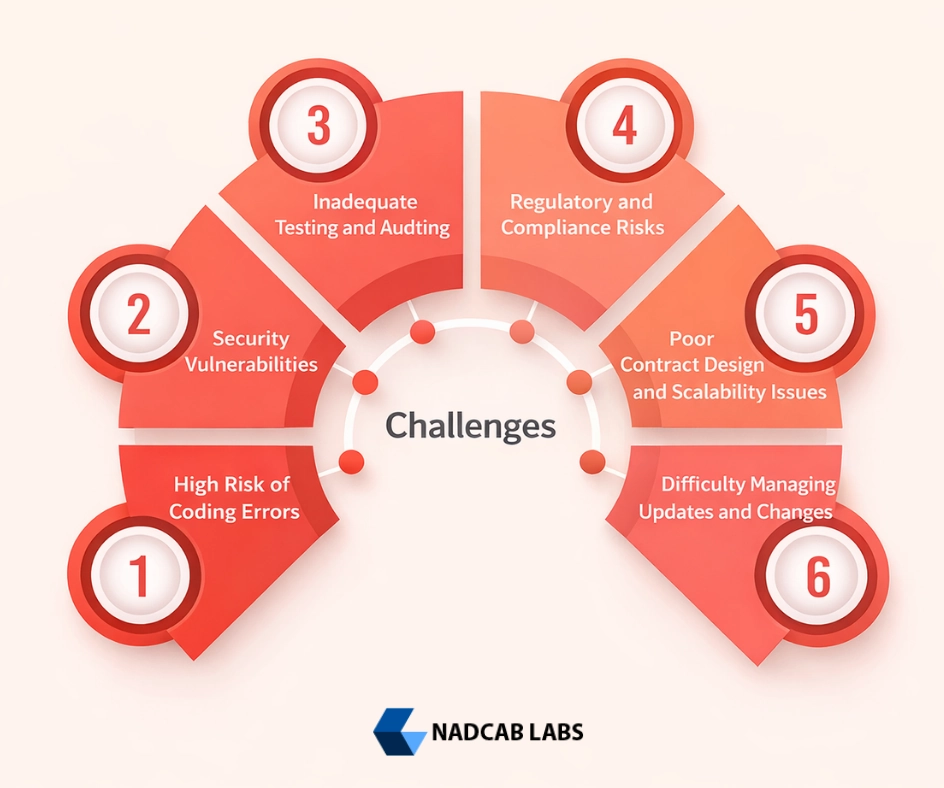
Businesses that attempt smart contracts without professional agency support encounter numerous challenges that often derail projects entirely or result in severely compromised outcomes. Security vulnerabilities represent the most dangerous risk, as evidenced by billions of dollars lost to smart contract exploits over the past several years. Internal teams without specialized blockchain security expertise routinely overlook subtle vulnerabilities that experienced agencies identify immediately. Common mistakes include reentrancy vulnerabilities where malicious contracts can repeatedly call functions before state updates complete, integer overflow errors that allow attackers to manipulate calculations, access control flaws that give unauthorized users privileged functions, and logic errors in complex interactions between multiple contracts. These vulnerabilities often remain undetected until exploited in production, causing catastrophic losses that could have been prevented through proper security auditing.
Technical Debt
Technical debt accumulates rapidly when inexperienced teams build smart contracts using suboptimal architectures or outdated patterns. Blockchain best practices evolve quickly as the community learns from failures and discovers better approaches. Internal teams working in isolation miss these developments, implementing contracts using deprecated patterns or inefficient code that will require expensive refactoring. They may choose inappropriate blockchain platforms based on familiarity rather than technical merit, creating performance bottlenecks or unnecessary costs that proper evaluation would have avoided. Gas optimization, which can reduce transaction costs by orders of magnitude, requires specialized knowledge that general developers typically lack. Without this expertise, businesses deploy contracts that work functionally but impose prohibitive costs on users, undermining adoption and competitive positioning.
Regulatory Compliance
Regulatory compliance failures pose severe risks for businesses developing smart contracts without proper legal guidance. Blockchain regulation varies dramatically across jurisdictions, with different countries taking contradictory approaches to token classification, data privacy, consumer protection, and financial regulation. Internal teams focused primarily on technical implementation often overlook or misunderstand these requirements, creating solutions that violate securities laws, fail to implement required know-your-customer procedures, or inadequately protect user data under regulations like GDPR. These violations can result in substantial fines, forced project shutdowns, or criminal liability for executives. The complexity of applying traditional legal frameworks to novel blockchain applications requires specialized expertise that typical development teams cannot provide.
Integration Challenges
Integration challenges between smart contracts and existing business systems frequently overwhelm internal teams that underestimate the complexity involved. Modern enterprises run on intricate technology stacks that have evolved over decades, incorporating databases, APIs, microservices, and legacy systems with varying levels of documentation and maintainability. Connecting smart contracts to these systems requires expertise in traditional software development, middleware technologies, and enterprise architecture alongside blockchain knowledge. Teams that excel at smart contract coding often struggle with enterprise integration, resulting in blockchain applications that operate in isolation from critical business systems. This isolation prevents smart contracts from realizing their full value and creates operational headaches as staff manually transfer data between blockchain and traditional systems.
Risk Warning: Smart contract vulnerabilities cannot be patched like traditional software. Once deployed to blockchain mainnet, contracts become immutable. Security flaws discovered after deployment typically require complex and expensive migration procedures where users must explicitly move to new contract versions. In worst cases, vulnerabilities result in permanent loss of funds with no recovery possible. This immutability makes thorough security auditing before deployment absolutely essential.
Testing Inadequacies
Testing inadequacies commonly plague smart contract projects developed without professional methodology. Blockchain applications require testing strategies that differ from traditional software because transaction immutability and public accessibility create unique risk profiles. Comprehensive testing includes unit tests covering individual functions, integration tests validating interactions between contracts, scenario tests simulating realistic usage patterns, gas optimization testing to minimize costs, and extended testnet deployment to identify issues in realistic blockchain environments. Internal teams often conduct minimal testing, deploying to mainnet after basic functional validation. This approach misses edge cases, fails to identify security vulnerabilities, and overlooks performance issues that emerge under load. The cost of discovering these problems in production vastly exceeds the investment in proper testing before launch.
Knowledge Concentration
Knowledge concentration creates organizational risk when blockchain expertise resides in just one or two individuals within a business. Smart contracts represent critical infrastructure that requires ongoing maintenance, monitoring, and eventual upgrades. If key personnel leave, businesses face knowledge gaps that can cripple their ability to manage deployed contracts or implement needed changes. Professional smart contract agencies maintain institutional knowledge across teams, document their work thoroughly, and transfer knowledge to client organizations, reducing this concentration risk significantly. They also maintain continuity when individual team members leave, ensuring projects continue without disruption.
Opportunity Costs
Opportunity costs mount as internal teams struggle through learning curves that agencies have already climbed. While in-house developers spend months understanding blockchain fundamentals, learning development tools, and making beginner mistakes, competitors working with agencies achieve production deployments and begin realizing business value. In rapidly evolving markets where first-mover advantages matter significantly, these delays can prove strategically fatal. The time and resources invested in building internal capabilities from scratch might deliver greater value if directed toward other strategic initiatives while leveraging agency expertise for blockchain implementation.
How Smart Contract Agencies Work With Businesses
Understanding how smart contract agencies structure their engagements helps businesses set appropriate expectations and maximize value from agency relationships. Most engagements begin with a discovery or assessment phase where agencies invest time understanding the client’s business model, objectives, technical environment, and constraints. This phase typically involves stakeholder interviews, process mapping, technical architecture review, and requirements gathering. Agencies ask probing questions about business workflows, volume projections, integration needs, regulatory considerations, and success criteria. They assess whether blockchain technology genuinely addresses the problem at hand or whether traditional solutions might prove more appropriate, demonstrating the intellectual honesty that distinguishes professional advisors from sales-oriented vendors.
Following discovery, agencies typically deliver comprehensive proposals that outline recommended approaches, technology choices, project scope, timelines, deliverables, and costs. These proposals reflect deep analysis rather than boilerplate responses, addressing specific business requirements with tailored solutions. They explain architecture decisions, identify risks and mitigation strategies, propose phased implementation approaches that manage complexity and demonstrate value progressively, and establish clear success metrics. Professional agencies take time to explain proposals thoroughly, ensuring clients understand what they are buying and why specific approaches are recommended. They welcome questions and refinement, recognizing that proposal development is collaborative rather than transactional.
| Project Phase | Key Activities | Client Involvement | Typical Duration |
|---|---|---|---|
| Discovery & Planning | Requirements gathering, feasibility analysis, architecture design | Stakeholder interviews, process documentation, requirement validation | 1 to 3 weeks |
| Design & Specification | Detailed technical design, security planning, user interface mockups | Design review, requirement refinement, approval | 2 to 4 weeks |
| Development | Smart contract coding, testing, integration development | Progress reviews, clarification, feature validation | 6 to 12 weeks |
| Security Audit | Vulnerability assessment, penetration testing, code review | Audit report review, remediation decisions | 2 to 4 weeks |
| Testing & QA | Testnet deployment, user acceptance testing, performance validation | Functional testing, acceptance sign-off | 2 to 3 weeks |
| Deployment | Mainnet deployment, monitoring setup, documentation delivery | Deployment approval, initial monitoring | 1 to 2 weeks |
| Support & Maintenance | Performance monitoring, issue resolution, optimization | Periodic reviews, change requests | Ongoing |
Development Phases
Development phases follow structured methodologies that balance agility with predictability. Agencies typically use iterative approaches where functionality gets delivered in stages rather than all at once, allowing clients to provide feedback and make refinements before significant resources get committed. Sprint planning establishes clear objectives for each development cycle, typically lasting two to three weeks. Regular progress reviews keep clients informed, demonstrate working functionality, and identify issues early when they are easier to address. Code reviews by senior developers ensure quality and consistency, while automated testing catches regressions quickly. Documentation evolves alongside code, ensuring that knowledge gets captured systematically rather than becoming a last-minute rush before delivery.
Communication Practices
Communication practices established at project outset prevent the misunderstandings that often plague client-vendor relationships. Agencies assign dedicated project managers who serve as primary contacts, coordinate between technical teams and business stakeholders, and ensure that both parties remain aligned on progress, priorities, and expectations. Regular status meetings with structured agendas provide forums for discussing progress, addressing blockers, and making decisions that affect project scope or direction. Agencies maintain transparency around challenges rather than hiding problems until they become critical, recognizing that early escalation enables collaborative problem-solving. They document decisions, change requests, and rationale, creating clear records that prevent disputes about what was agreed upon.
Security Audit
Security audit coordination represents a critical phase where agencies manage interactions with independent security auditors who provide external validation of smart contract security. Agencies prepare comprehensive documentation for auditors including code comments, architecture diagrams, threat models, and testing results. They facilitate information exchange, respond to auditor questions, and coordinate remediation of identified vulnerabilities. After addressing audit findings, agencies often arrange follow-up reviews to confirm that fixes were implemented correctly. This process demonstrates the seriousness with which professional agencies approach security, recognizing that external validation significantly reduces risk of vulnerabilities remaining undetected.
Testing and Quality Assurance
Testing and quality assurance phases involve substantial client participation to ensure delivered solutions meet actual business needs. smart contract agencies conduct user acceptance testing where client representatives validate that functionality matches requirements, identify usability issues, and confirm that workflows integrate appropriately with existing business processes. They provide test environments where clients can explore functionality safely before mainnet deployment, using test tokens that have no real value. Agencies document test scenarios, expected results, and actual outcomes, creating records that demonstrate due diligence and provide references for future troubleshooting. They encourage thorough testing, understanding that issues discovered before deployment cost far less to address than problems found in production.
Deployment Support
Deployment support ensures smooth transitions to production environments. Agencies handle technical deployment procedures including contract compilation, verification, parameter configuration, and initial transaction execution. They monitor contracts closely during initial operation, watching for unexpected behavior or performance issues. They provide runbooks documenting operational procedures, troubleshooting guides for common issues, and contact information for emergency support. Many agencies conduct soft launches with limited functionality or controlled user groups before opening systems to full production use, managing risk during the highest-vulnerability period immediately following deployment. They remain available for immediate support during initial weeks when questions and minor issues typically emerge most frequently.
Knowledge Transfer and Training
Knowledge transfer and training help client organizations take ownership of deployed solutions. Agencies conduct training sessions for technical staff covering smart contract architecture, code structure, deployment procedures, monitoring practices, and common maintenance tasks. They explain design decisions and tradeoffs, helping internal teams understand why specific approaches were chosen. They document everything comprehensively, creating resources that remain valuable long after active engagement ends. Professional smart contract agencies view knowledge transfer as essential to client success rather than protecting proprietary information, recognizing that empowered clients become long-term partners rather than perpetually dependent customers.
Why Businesses Are Choosing Smart Contract Agencies
Get expert guidance to design secure, reliable, and scalable smart contracts that align with your business goals, reduce risks, and ensure long-term efficiency.
Future of Smart Contracts in Business
The trajectory of smart contract adoption in business settings points toward increasingly mainstream integration with traditional enterprise systems and processes. Over the next several years, smart contracts will likely transition from novel experiments to standard components of business technology stacks, much as cloud computing and mobile applications became ubiquitous despite initial skepticism. This normalization will be driven by maturing development tools that make smart contract creation more accessible, expanding regulatory clarity that reduces legal uncertainty, and accumulating real-world evidence demonstrating measurable business value. Early adopters who establish blockchain capabilities now will enjoy significant advantages as the technology becomes essential rather than optional for competitive operations.
Interoperability
Interoperability between different blockchain platforms will improve dramatically, eliminating current fragmentation that forces businesses to commit exclusively to single networks. Cross-chain protocols and bridge technologies already enable limited asset transfers between blockchains, but future developments will allow smart contracts on different platforms to interact seamlessly. This interoperability means businesses can choose optimal platforms for specific functions rather than accepting compromises inherent in any single blockchain. Financial applications might run on high-security networks like Ethereum, while supply chain tracking uses more scalable platforms, with smart contracts coordinating between them automatically. smart contract agencies will increasingly focus on multi-chain architectures that leverage strengths of different platforms while providing unified user experiences.
Integration
Integration with artificial intelligence and machine learning will create smart contracts that adapt to changing conditions and learn from historical patterns. Current smart contracts follow strictly deterministic logic defined at deployment, unable to adjust behavior based on new information or evolved circumstances. Future smart contracts will incorporate AI-driven decision making that optimizes parameters based on observed outcomes, predicts likely events and adjusts operations preemptively, and identifies anomalies that might indicate fraud or system failures. This combination of blockchain’s transparency and immutability with AI’s adaptive intelligence will enable applications impossible with either technology alone. Agencies will need to develop expertise in both domains, understanding how to design systems where AI recommendations get validated and executed through smart contracts that maintain auditability.
Regulatory frameworks
Regulatory frameworks will continue evolving toward more nuanced approaches that distinguish between different types of blockchain applications rather than treating all smart contracts identically. Early regulations often took broad strokes, classifying tokens as securities or restricting blockchain applications based on theoretical risks rather than actual use cases. Mature regulatory regimes will recognize that supply chain smart contracts require different oversight than financial instruments, and that private consortium blockchains pose different risks than public networks. This regulatory sophistication will enable more blockchain adoption in heavily regulated industries like healthcare and finance, where compliance concerns currently limit implementation. Smart contract agenciesthat understand these regulatory nuances will provide crucial guidance helping businesses navigate complex compliance landscapes.
| Trend | Current State | Future Direction | Business Impact |
|---|---|---|---|
| Development Tools | Requires specialized programming knowledge | Low-code platforms with visual development | Lower barriers, faster implementation |
| Interoperability | Limited cross-chain functionality | Seamless multi-blockchain integration | Optimal platform selection, reduced lock-in |
| AI Integration | Static, deterministic contracts | Adaptive contracts with AI decision making | Dynamic optimization, predictive capabilities |
| Regulation | Uncertain, evolving frameworks | Clear, use-case specific regulations | Reduced legal risk, broader adoption |
| Scalability | Limited transaction throughput | Layer-2 solutions, sharding | Support for high-volume applications |
| Privacy | Transparent public blockchains | Zero-knowledge proofs, confidential computing | Privacy-preserving business applications |
Privacy-Preserving Technologies
Privacy-preserving technologies will address current limitations that make public blockchain unsuitable for confidential business information. Zero-knowledge proofs enable validation of information without revealing underlying data, allowing smart contracts to verify that conditions are met without exposing sensitive details to public blockchain observers. Confidential computing techniques encrypt data during processing, preventing even blockchain validators from accessing contract contents while still maintaining execution integrity. These technologies will enable smart contract applications in areas like healthcare, finance, and competitive business strategy where confidentiality requirements currently prevent blockchain adoption. Agencies will incorporate privacy technologies into standard practice, designing contracts that protect sensitive information while maintaining blockchain’s verification benefits.
Scalability
Scalability improvements through layer-two solutions and sharding will eliminate current throughput limitations that restrict smart contract applications to relatively low-transaction-volume use cases. Layer-two technologies like rollups process transactions off the main blockchain then post compressed proofs to mainnet, achieving orders of magnitude higher throughput while maintaining security guarantees. Sharding divides blockchain networks into parallel processing segments that can handle transactions simultaneously. These advancements will enable smart contracts to support applications requiring thousands or millions of transactions daily, opening possibilities in retail payments, high-frequency trading, gaming, and social media that current blockchain performance makes impractical.
Standards and Best Practices
Standards and best practices will mature as the industry learns from successes and failures, creating increasingly standardized approaches to common patterns. Just as web development coalesced around established frameworks and design patterns, smart contracts will converge on proven architectures for typical use cases. Token standards like ERC-20 and ERC-721 demonstrate this standardization, creating interoperability and reducing development effort for common functionality. Future standards will address governance, upgradeability, access control, and other recurring patterns. Agencies will increasingly leverage these standards, focusing creative effort on unique business logic rather than reinventing solutions to solved problems.
The role of smart contract agencies will evolve from primarily technical implementation toward strategic advisory that helps businesses identify optimal blockchain applications and navigate complex technology choices. As development tools mature and best practices become codified, the pure technical challenge of writing smart contracts will diminish somewhat. However, the strategic questions of when blockchain adds value, which platforms to use, how to structure governance, and how to manage legal and regulatory complexity will become increasingly important. Successful agencies will develop deep industry expertise, understanding specific business challenges well enough to identify where smart contracts deliver genuine value versus where traditional approaches remain superior. They will act as trusted advisors who can objectively assess whether blockchain makes sense for particular applications, sometimes recommending against smart contracts when simpler solutions suffice.
Education and knowledge sharing will become increasingly important as smart contracts transition from bleeding-edge technology to mainstream business tools. Smart contract agencies will invest in creating educational resources, conducting workshops, and participating in industry conferences that raise general understanding of blockchain capabilities and limitations. They will publish case studies demonstrating successful implementations, share lessons learned from challenges, and contribute to open source tools that benefit the entire ecosystem. This knowledge sharing strengthens the industry overall while establishing agencies as thought leaders, creating business development opportunities as organizations seek partners with demonstrated expertise and commitment to advancing the field.
FAQs - Smart Contract Agencies
Q1.What is a smart contract agency?
A smart contract agency is a tech company that builds, tests, and deploys smart contracts on blockchain. They help businesses automate agreements without middlemen. Their team usually includes blockchain developers, security experts, and consultants. These agencies help reduce costs, improve transparency, and make processes faster using blockchain technology.
Q2.How much does it cost to hire a smart contract agency?
The cost depends on project size and complexity. Simple smart contracts may cost $5,000–$15,000. Advanced or enterprise-level projects can range from $50,000 to $500,000+. Pricing can be fixed, hourly, or monthly. Extra services like audits, compliance, and support can increase the total cost.
Q3.What blockchain platforms do smart contract agencies work with?
Most smart contract agencies work with multiple blockchains. Ethereum is the most popular choice. Others include Binance Smart Chain, Polygon, Solana, Cardano, Avalanche, and Hyperledger. The platform is chosen based on speed, fees, security, and whether the project needs a public or private blockchain setup.
Q4.How long does it take to develop a smart contract?
Development time depends on complexity. A basic smart contract can take 2–4 weeks. Medium-level projects may need 8–16 weeks. Large enterprise solutions can take 3–6 months. The process includes planning, coding, testing, auditing, testnet launch, fixes, and final blockchain deployment.
Q5.Are smart contracts legally binding?
In many countries, smart contracts are legally valid if they follow normal contract rules like agreement and consent. Some regions officially recognize them by law. Still, legal clarity varies. That’s why agencies often combine smart contracts with traditional legal documents to avoid confusion and handle disputes safely.
Q6.How do smart contract agencies ensure code quality?
Agencies ensure quality by planning clearly, following coding standards, and using trusted tools. They run unit tests, security scans, and peer reviews. Contracts are tested on testnets before launch. Third-party audits add extra safety. Good documentation and monitoring help keep contracts stable after deployment.
Q7.What industries benefit most from smart contract agencies?
Many industries benefit from smart contracts. Finance uses them for DeFi and payments. Supply chains track goods and automate payments. Real estate uses property tokenization. Gaming uses NFTs. Healthcare manages data securely. Even governments explore smart contracts for identity, records, and digital services.
Q8.What questions should I ask when hiring a smart contract agency?
Ask about their experience, past projects, and security process. Check if they do audits and testing. Ask about timelines, pricing, and post-launch support. Understand who owns the code. Also ask how they handle bugs, upgrades, compliance, and emergencies. Clear communication is a big green flag.
Explore Services
Related Services
Reviewed by

Aman Vaths
Founder of Nadcab Labs
Aman Vaths is the Founder & CTO of Nadcab Labs, a global digital engineering company delivering enterprise-grade solutions across AI, Web3, Blockchain, Big Data, Cloud, Cybersecurity, and Modern Application Development. With deep technical leadership and product innovation experience, Aman has positioned Nadcab Labs as one of the most advanced engineering companies driving the next era of intelligent, secure, and scalable software systems. Under his leadership, Nadcab Labs has built 2,000+ global projects across sectors including fintech, banking, healthcare, real estate, logistics, gaming, manufacturing, and next-generation DePIN networks. Aman’s strength lies in architecting high-performance systems, end-to-end platform engineering, and designing enterprise solutions that operate at global scale.