Ai Overview
The constructor in smart contracts serves as the foundational initialization mechanism that every blockchain developer must master. This special function executes exactly once when deploying a contract to networks like Ethereum, Polygon, or Binance Smart Chain, establishing critical initial state that persists throughout the contract’s lifetime.
Key Takeaways
- Constructor in smart contracts is a special function executing only once during deployment to initialize state variables and configure contract settings permanently.
- Solidity allows only one constructor per contract, though inheritance patterns enable calling multiple parent constructors during child contract deployment processes.
- Constructor code does not persist on-chain after deployment, reducing storage costs while initialization parameters become permanently embedded in contract state.
- Proper constructor in smart contracts implementation prevents security vulnerabilities including unauthorized ownership claims and uninitialized critical state variables.
- Gas costs for constructor execution vary significantly based on initialization complexity, with storage operations consuming the majority of deployment gas fees.
- Enterprise blockchain projects across USA, UK, UAE, and Canada require thorough constructor auditing as part of comprehensive smart contract security reviews.
- Constructor parameters enable flexible contract deployment, allowing the same bytecode to initialize differently across multiple blockchain network deployments.
- Best practices include input validation, access control initialization, and avoiding complex logic that could cause deployment failures or excessive gas consumption.
Introduction to Constructor in Smart Contracts
The constructor in smart contracts serves as the foundational initialization mechanism that every blockchain developer must master. With over eight years of experience building decentralized applications across USA, UK, UAE, and Canadian markets, our agency has observed that constructor implementation quality directly correlates with overall contract security and functionality. This special function executes exactly once when deploying a contract to networks like Ethereum, Polygon, or Binance Smart Chain, establishing critical initial state that persists throughout the contract’s lifetime. Understanding constructor mechanics, best practices, and common pitfalls enables developers to create robust, secure smart contracts that perform reliably in production environments serving millions of users worldwide.
What is a Constructor in Solidity?
A constructor in smart contracts written in Solidity is a special function declared using the constructor keyword that initializes contract state during deployment. Unlike regular functions, constructors have no name, cannot be called after deployment, and execute automatically when the contract creation transaction processes. The constructor in smart contracts accepts parameters enabling dynamic initialization based on deployment requirements. Modern Solidity versions require using the constructor keyword rather than the deprecated approach of naming a function after the contract name, which caused critical vulnerabilities in early smart contract deployment.
Syntax and Structure of Constructor in Smart Contracts
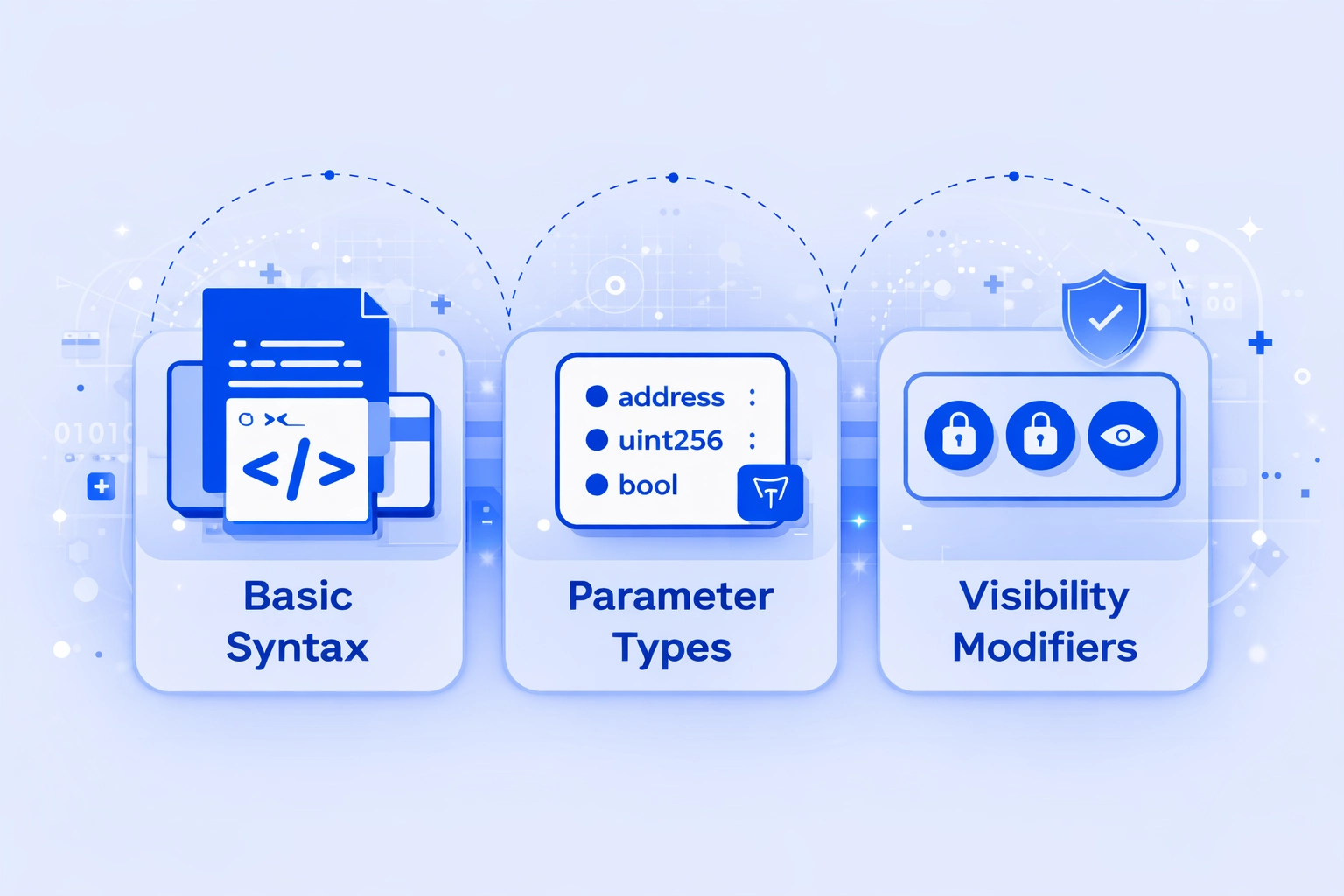
Basic Syntax
- Uses constructor keyword
- No function name required
- Optional visibility modifier
- Accepts typed parameters
Parameter Types
- Address for owner setup
- Uint256 for numeric configs
- String for metadata values
- Arrays for batch initialization
Visibility Modifiers
- Public for deployable contracts
- Internal for abstract bases
- Payable for ETH acceptance
- No external or private allowed
Constructor Parameters and Arguments
| Parameter Type | Use Case | Gas Impact |
|---|---|---|
| address | Owner, admin, treasury setup | Low (20 bytes) |
| uint256 | Supply caps, rates, limits | Low (32 bytes) |
| string | Token names, metadata URIs | Variable (length dependent) |
| bytes32 | Merkle roots, identifiers | Low (32 bytes) |
| address[] | Whitelist initialization | High (array length dependent) |
Build Reliable Constructor in Smart Contracts
Our expert blockchain developers implement secure constructor in smart contracts with proper validation and initialization. Get production-ready contract deployment.
Default vs Custom Constructors in Smart Contracts
When developers omit a constructor in smart contracts, Solidity automatically provides an empty default constructor that performs no initialization. Custom constructors become essential when contracts require owner assignment, token configuration, or any state setup before operational use. Our teams across USA, UK, UAE, and Canada consistently recommend explicit constructors even for simple contracts to ensure initialization intent remains clear and auditable.
Best Practice: Always define explicit constructors to document initialization requirements clearly for auditors and future maintainers.
Common Use Cases of Constructor in Smart Contracts
| Use Case | Description | Example |
|---|---|---|
| Owner Assignment | Set deployer as contract owner | owner = msg.sender |
| Token Configuration | Initialize name, symbol, supply | ERC20 token deployment |
| Access Control Setup | Grant initial admin roles | Role-based permissions |
| External Contract Links | Store dependent contract addresses | Oracle, router connections |
| Initial Minting | Mint tokens to specified address | Treasury allocation |
Constructor and Contract Initialization
The constructor in smart contracts establishes the initial state that all subsequent interactions build upon. Proper initialization prevents common vulnerabilities like uninitialized owner variables that attackers can claim. Dubai-based DeFi projects and Canadian tokenization platforms particularly emphasize constructor security given regulatory scrutiny in these markets. Initialization order matters significantly when multiple state variables depend on each other or when inheriting from multiple parent contracts.
One-Time Execution
Post-Deploy Calls
State Initialization
Inheritance and Constructors in Smart Contracts
When contracts inherit from parent contracts, the constructor in smart contracts must properly initialize all parent constructors. Solidity supports two methods for parent constructor invocation: directly in the inheritance list or within the child constructor body. The inheritance list approach executes parent constructors in declaration order, while the constructor body approach offers more flexibility for computed arguments. UK and USA enterprise clients frequently utilize complex inheritance hierarchies requiring careful constructor chaining to avoid initialization failures.
Security Considerations for Constructor in Smart Contracts
Constructor vulnerabilities have caused millions in losses across blockchain ecosystems. The infamous Parity wallet hack exploited unprotected initialization functions, emphasizing why constructor in smart contracts security remains critical. Common vulnerabilities include missing access controls on initialize functions in upgradeable contracts, hardcoded sensitive addresses, insufficient parameter validation, and front-running deployment transactions. Security audits conducted by our team consistently identify constructor-related issues in 25% of reviewed contracts.
Best Practices for Writing Constructor in Smart Contracts
Input Validation
- Validate non-zero addresses
- Check numeric bounds
- Verify array lengths
- Reject invalid configurations
Gas Optimization
- Minimize storage writes
- Use immutable variables
- Avoid loops in constructor
- Batch related assignments
Documentation
- NatSpec comments required
- Document all parameters
- Explain initialization logic
- Note deployment requirements
Constructor Implementation Development Lifecycle
Requirements Gathering
Define initialization parameters and state variables needed for contract operation.
Parameter Design
Select appropriate data types and determine validation rules for each parameter.
Constructor Implementation
Write constructor code with proper validation, initialization, and event emissions.
Inheritance Integration
Properly chain parent constructors and verify initialization order correctness.
Unit Testing
Test constructor with valid and invalid parameters to verify all validation paths.
Security Audit
Review constructor for vulnerabilities including access control and input validation.
Testnet Deployment
Deploy to testnet with production parameters to verify initialization succeeds.
Mainnet Launch
Execute production deployment with verified parameters and post-deploy verification.
Constructor vs Regular Functions: Key Differences
| Aspect | Constructor | Regular Function |
|---|---|---|
| Execution Count | Once during deployment | Multiple times as called |
| On-Chain Storage | Code not stored after deploy | Code permanently stored |
| Function Name | No name (constructor keyword) | Required unique name |
| Return Values | Cannot return values | Can return any type |
| Visibility Options | Public or internal only | All visibility types |
Real-World Examples of Constructor Implementation
Major DeFi protocols demonstrate effective constructor in smart contracts implementation patterns. Uniswap V2 pair contracts use constructors to set factory addresses permanently. OpenZeppelin’s ERC20 implementation accepts name, symbol, and initial supply parameters. Aave lending pools initialize complex configurations including reserve factors and interest rate models. These production-proven patterns guide our development teams across USA, UK, UAE, and Canada when building enterprise blockchain solutions.[1]
Factory Address Init
ERC20 Token Setup
Pool Configuration

Constructor Design Selection Criteria
Complexity Assessment
- Evaluate initialization needs
- Count state variables required
- Assess inheritance depth
- Calculate gas budget limits
Security Requirements
- Identify sensitive parameters
- Plan validation strategy
- Define access controls
- Document security assumptions
Upgrade Considerations
- Proxy pattern requirements
- Initialize function needs
- Storage layout planning
- Migration path design
Constructor Compliance and Governance Checklist
| Requirement | Description | Priority |
|---|---|---|
| Input Validation | Validate all constructor parameters with require statements | Critical |
| Zero Address Checks | Prevent zero address assignment for critical roles | Critical |
| Event Emission | Emit initialization events for off-chain tracking | High |
| NatSpec Documentation | Document all parameters and initialization logic | High |
| Gas Optimization Review | Optimize storage operations and use immutable where possible | High |
Authoritative Industry Standards for Constructor Design
Principle 1: Always validate constructor parameters with explicit require statements to prevent invalid initialization states.
Principle 2: Use immutable variables for values set once in constructor to optimize gas costs and prevent modification.
Principle 3: Emit events for all significant initialization actions to enable off-chain monitoring and verification.
Principle 4: Document constructor parameters comprehensively with NatSpec annotations for auditor and developer clarity.
Principle 5: Test constructor with boundary values and invalid inputs to ensure robust error handling paths.
Principle 6: Review constructor security during every audit phase to identify initialization vulnerabilities early.
Why Constructor Matters for Smart Contract Deployment
The constructor in smart contracts establishes the foundation upon which all contract functionality builds. Proper initialization prevents critical vulnerabilities, ensures correct access control configuration, and enables flexible deployment across different network environments. Enterprise blockchain projects across USA, UK, UAE, and Canada increasingly recognize constructor quality as a key indicator of overall contract security and development team competence.
With eight years of experience implementing constructor in smart contracts for tokenization platforms, DeFi protocols, and enterprise applications, our agency emphasizes that investment in proper constructor design delivers returns through reduced security incidents, lower audit costs, and smoother deployment processes. Mastering constructor patterns distinguishes professional blockchain developers from those producing vulnerable, unreliable smart contracts.
Build Secure Smart Contracts with Expert Constructor Implementation
Partner with our experienced blockchain team to implement robust constructor logic for your decentralized applications across USA, UK, UAE, and Canada.
Frequently Asked Questions
Q1.1. What is a constructor in smart contracts and what purpose does it serve?
A constructor in smart contracts is a special function that executes only once during contract deployment on the blockchain. It initializes state variables, sets contract ownership, and configures essential parameters that define how the contract operates throughout its lifetime.
Q2.2. How does constructor syntax work in Solidity smart contracts?
In Solidity, constructors use the constructor keyword followed by parentheses containing optional parameters. The function body executes during deployment, setting initial values for state variables. Constructors cannot be called again after deployment completes on the blockchain.
Q3.3. Can a constructor in smart contracts accept parameters during deployment?
Yes, constructors accept parameters passed during deployment to customize contract behavior. Developers can pass addresses, numerical values, strings, and other data types to initialize state variables dynamically, enabling flexible contract configuration for different use cases.
Q4.4. What happens if constructor in smart contracts fails during deployment?
If a constructor fails due to require statements, reverts, or insufficient gas, the entire deployment transaction fails. No contract is created on the blockchain, and gas spent is not refunded. Proper testing prevents deployment failures.
Q5.5. How is constructor different from regular functions in smart contracts?
Constructors execute only once at deployment and cannot be called afterward, while regular functions can execute multiple times. Constructors have no name, no return type, and automatically run when the contract creation transaction processes on the network.
Q6.6. Can smart contracts have multiple constructors like traditional programming?
No, Solidity smart contracts can have only one constructor. Unlike languages supporting constructor overloading, blockchain contracts require a single constructor. Developers use optional parameters with default values or factory patterns to achieve similar flexibility.
Q7.7. How do constructors work in upgradeable smart contracts?
Upgradeable smart contracts using proxy patterns cannot use traditional constructors because proxies delegate calls to implementation contracts. Instead, developers use initializer functions that mimic constructor behavior while supporting the upgrade mechanism properly.
Q8.8. What security risks exist with constructor in smart contracts?
Security risks include hardcoding sensitive values, improper access control initialization, failing to validate constructor parameters, and front-running attacks during deployment. Comprehensive audits should verify constructor logic before mainnet deployment.
Q9.9. How do you test constructor in smart contracts effectively?
Testing constructors requires deploying contracts with various parameter combinations using frameworks like Hardhat or Foundry. Tests should verify state variable initialization, access control setup, event emissions, and revert conditions for invalid inputs.
Q10.10. What are best practices for writing constructor in smart contracts?
Best practices include validating all input parameters, using events to log deployment details, avoiding complex logic that increases gas costs, properly initializing access controls, and following established patterns from audited contracts.
Explore Services
Related Services
Reviewed by

Aman Vaths
Founder of Nadcab Labs
Aman Vaths is the Founder & CTO of Nadcab Labs, a global digital engineering company delivering enterprise-grade solutions across AI, Web3, Blockchain, Big Data, Cloud, Cybersecurity, and Modern Application Development. With deep technical leadership and product innovation experience, Aman has positioned Nadcab Labs as one of the most advanced engineering companies driving the next era of intelligent, secure, and scalable software systems. Under his leadership, Nadcab Labs has built 2,000+ global projects across sectors including fintech, banking, healthcare, real estate, logistics, gaming, manufacturing, and next-generation DePIN networks. Aman’s strength lies in architecting high-performance systems, end-to-end platform engineering, and designing enterprise solutions that operate at global scale.