Ai Overview
At their core, token airdrop campaigns are a marketing and distribution method where blockchain projects send free tokens directly to users’ crypto wallets. The protocol distributed 400 UNI to every wallet that had interacted with the platform before September 1, 2020, covering over 250,000 addresses. At launch, those tokens were worth about $1,200, but at UNI’s peak in 2021, that same airdrop would have been worth around $16,000.
Key Takeaways
- The total value distributed through crypto airdrops since 2017 has crossed $20 billion, with 36 notable airdrops in 2024 alone adding over $20 billion to the overall crypto market cap, according to the CoinGecko 2024 annual report.[1]
- Hyperliquid’s HYPE airdrop in November 2024 distributed 310 million tokens to approximately 94,000 addresses, with 31% of the total supply going to community participants and the overall value reaching $4.3 billion at peak token price, making it the largest airdrop in crypto history.[2]
- Uniswap’s September 2020 airdrop gave 400 UNI tokens to over 250,000 addresses, but 75% of recipients sold their tokens within the first 7 days, and only about 7% of wallets still hold UNI today, showing the challenge of long-term retention in token airdrop campaigns.[3]
- Research shows that 66.09% of 1inch airdrop recipients transferred their tokens to exchanges within 24 hours, and ENS and Lido experienced similar patterns, pointing to widespread “claim and dump” behavior across blockchain airdrop campaigns.[4]
- More than 80 different airdrop campaigns were launched in just the first three months of 2025, with on-chain data showing over 1.2 million wallets participating in at least one airdrop during that 90-day period.[5]
- Projects distributing more than 10% of their total token supply through airdrops showed better price stability than those distributing less than 5%, while projects with a high fully diluted valuation (FDV) at the time of airdrop were more likely to see negative ROI.[6]
- The Optimism airdrop increased 30-day user retention by 4.2 percentage points and 60-day retention by 2.8 points, though user activity typically reverts to only 20 to 40% above pre-aidrop levels within weeks.[7]
- Global cryptocurrency scam losses, including those from fake airdrops, reached at least $9.9 billion in 2024 according to Chainalysis data, with that figure climbing to an estimated $12.5 billion in 2025.
- Airdrop participants globally reached approximately 199 million in 2024, representing a roughly 45% increase over the approximately 135.8 million participants recorded in 2022.[8]
- BONK distributed 50% of its total supply to Solana users, NFT holders, and developers through its airdrop, and the token’s price surged 3,000% in weeks while Solana network activity increased significantly, showing the power of a well-timed crypto airdrop campaign in building ecosystem momentum.[9]
If you have spent any time in the crypto world over the past few years, you have probably noticed that token airdrop campaigns have moved far beyond simple giveaways. What used to be a niche tactic for tiny projects trying to get noticed has turned into a multi-billion-dollar distribution mechanism that shapes entire blockchain ecosystems. From Uniswap handing out governance tokens to hundreds of thousands of wallets in 2020, to Hyperliquid rewriting the playbook with its massive community drop in late 2024, the way projects think about airdrop marketing in crypto has changed dramatically.
The numbers tell a story of their own. In 2024 alone, 36 notable airdrops added over $20 billion to the overall crypto market cap. Participation has exploded, too, with approximately 199 million global participants in 2024 compared to about 135.8 million in 2022. And yet, for every wildly successful campaign, there are dozens of disappointing ones where tokens crashed, users vanished, and communities disintegrated within days. So what separates a great token airdrop strategy from one that falls flat? That is exactly what this guide will break down, pulling from real-world data, actual project results, and the lessons that matter most.
What Are Token Airdrop Campaigns and Why Do They Matter?
At their core, token airdrop campaigns are a marketing and distribution method where blockchain projects send free tokens directly to users’ crypto wallets. The idea is straightforward: by putting tokens in the hands of real people, you create awareness, build a user base, and (ideally) establish a community of stakeholders who care about the project’s long term success.
But the real significance of crypto airdrop campaigns goes deeper than just free money. Airdrops have become one of the primary ways new protocols decentralize their governance. When Uniswap distributed UNI tokens in September 2020, it was not just rewarding early users. It was handing them voting power over the future direction of one of DeFi’s most important platforms. Since then, this pattern has been repeated across dozens of major protocols, from Arbitrum to Optimism to Hyperliquid.
For projects, the appeal is clear. Unlike traditional advertising, blockchain airdrop campaigns create immediate economic alignment between the project and its participants. When someone holds your token, they have a financial stake in your success. That is a fundamentally different relationship than what you get from a banner ad or a sponsored tweet. And for users, airdrops offer something no other marketing channel does: the chance to earn real value simply by engaging with a product or protocol early on.
Recommended Reading:
The Different Types of Token Airdrop Campaigns
Not all airdrops are built the same. Over the years, the industry has developed several distinct models, each suited to different goals and project stages. Understanding these types is the first step toward building a strong token airdrop strategy.
1. Standard Airdrops
These are the simplest forms of distribution. Users provide a wallet address, sometimes complete a quick sign-up process, and receive tokens. The barrier to entry is low, which makes standard airdrops great for maximum reach. However, the tradeoff is that they tend to attract a high volume of users with little genuine interest in the project.
2. Bounty Airdrops
Bounty campaigns require users to complete specific tasks before qualifying for tokens. These tasks typically include following the project on social media, joining Telegram or Discord groups, creating content, or sharing posts. This model works well for generating early buzz and building a social footprint, though participation quality can vary widely.
3. Holder (Snapshot) Airdrops
In this model, the project takes a snapshot of a blockchain at a specific block height and distributes tokens to wallets that hold a particular cryptocurrency at that moment. Bitcoin Cash’s distribution to BTC holders in 2017 is one of the best-known examples. Holder airdrops reward loyalty and can strengthen ties with an existing user base.
4. Retroactive Airdrops
Retroactive distributions have become the gold standard for serious DeFi protocols. Instead of announcing the airdrop in advance, projects reward users who interacted with the protocol before a certain date. Uniswap pioneered this approach in 2020, and it has since been adopted by Arbitrum, Optimism, ENS, and many others. The beauty of retroactive airdrops is that they reward genuine usage rather than speculative farming.
5. Points-Based and Task-Based Airdrops
This is the model that has dominated 2024 and 2025. Projects like EigenLayer and Blast introduced loyalty programs where users earn points for staking, bridging, or performing specific on-chain activities over extended periods. These points later convert to tokens, creating sustained engagement rather than one-time interactions. Blast went even further, splitting rewards between users earning “Points” and developers earning “Blast Gold” for building on the platform.
6. Fork-Based Airdrops
When a blockchain undergoes a hard fork, existing holders of the original chain’s token typically receive equivalent amounts of the new chain’s token. The most famous example remains Bitcoin Cash (BCH) being distributed to Bitcoin holders. While these are less common now, they still occur during major protocol upgrades.
Real World Token Airdrop Campaigns That Shaped the Industry
Looking at the biggest crypto airdrop campaigns in history offers powerful lessons about what works, what fails, and what the data actually shows.
1. Uniswap (UNI), September 2020
Uniswap’s retroactive airdrop remains one of the most studied events in DeFi. The protocol distributed 400 UNI to every wallet that had interacted with the platform before September 1, 2020, covering over 250,000 addresses. At launch, those tokens were worth about $1,200, but at UNI’s peak in 2021, that same airdrop would have been worth around $16,000. However, according to analysis from Dune, 75% of recipients sold their tokens within the first 7 days, 80% within 30 days, and only about 7% of wallets still hold UNI today. This taught the industry a hard lesson: giving people tokens is easy, but making them stay is incredibly difficult.
2. Arbitrum (ARB), March 2023
Arbitrum distributed over 1 billion ARB tokens to roughly 625,000 wallets, with the total value exceeding $1.5 billion at the time. Over 42 million ARB were claimed in the first hour alone. Arbitrum’s drop demonstrated the scale that Layer 2 airdrops could achieve, though it also faced criticism over sybil farming, where individuals used multiple wallets to claim larger allocations.
3. Hyperliquid (HYPE), November 2024
Hyperliquid’s genesis event on November 29, 2024, has been widely regarded as the most successful airdrop in crypto history. The protocol distributed 310 million HYPE tokens (31% of total supply) to approximately 94,000 users who had interacted with the platform. With no venture capital backing and no allocation to private investors, the entire distribution went to the community. The average allocation per wallet was approximately 2,915 HYPE tokens, and at peak prices, the total airdrop value reached $4.3 billion. What made Hyperliquid truly exceptional was that HYPE’s price surged from $2 at launch to over $35 within 24 days, a 1,700% increase. Daily new users spiked to nearly 11,000 in the two days following the airdrop, and unlike most projects, Hyperliquid continued to set records in active users and trading volume well after the distribution.
4. BONK on Solana, 2022
BONK took a different approach. The team distributed 50% of its total supply to Solana users, NFT holders, and developers. The results were dramatic, with the token’s price jumping 3,000% within weeks and Solana network activity surging. BONK showed that meme coin airdrops, when timed correctly and targeted at the right community, can generate enormous ecosystem energy.
Notable Token Airdrop Campaigns: Results at a Glance
| Project | Year | Key Highlights |
|---|---|---|
| Uniswap (UNI) | 2020 | 400 UNI to 250,000+ addresses; pioneered retroactive airdrop model; $6.43 billion total value at ATH |
| Arbitrum (ARB) | 2023 | Over 1 billion ARB to 625,000 wallets; $1.97 billion value at ATH; 42 million claimed in first hour |
| Hyperliquid (HYPE) | 2024 | 310 million tokens to 94,000 users; 31% of supply; $4.3 billion at peak; no VC allocation |
| Celestia (TIA) | 2024 | Approximately 60 million TIA to 190,000 addresses; rewarded early ecosystem contributors |
| BONK | 2022 | 50% of supply to Solana users and devs; 3,000% price surge; boosted Solana ecosystem activity |
| Apecoin (APE) | 2022 | $3.54 billion at ATH; up to 10,950 tokens per eligible wallet; rewarded Yuga Labs NFT holders |
| Linea (LINEA) | 2025 | 9.36 billion tokens to nearly 750,000 addresses; approximately $437 million at peak price |
Building an Effective Token Airdrop Strategy: Step by Step
Running a successful crypto airdrop campaign takes far more than just sending tokens to random wallets. Every stage needs careful planning, from tokenomics to distribution mechanics to post-airdrop engagement. Here is how to approach it.
1. Define Your Goals Before Anything Else
What exactly do you want your blockchain airdrop campaign to achieve? Are you trying to build initial awareness for a new protocol? Are you decentralizing governance by distributing voting tokens? Are you rewarding early users to build loyalty? Or are you trying to boost on-chain activity on your platform? Each of these goals calls for a different distribution model, different eligibility criteria, and different success metrics. A project focused on governance decentralization might prioritize distributing to a smaller number of genuinely active users, while a project focused on awareness might cast a wider net.
2. Design Thoughtful Tokenomics
The percentage of supply allocated to the airdrop matters enormously. Data from CoinLaw’s analysis of 30 major airdrops in 2024 shows that projects distributing more than 10% of their total token supply through airdrops demonstrated better price stability than those distributing less than 5%. Hyperliquid allocated 31% of its supply to the community airdrop and saw extraordinary results. In contrast, several Layer 2 projects that offered only 5% to community airdrops, while allocating 20% or more to venture capital investors, saw massive fund outflows and token price declines after their token generation events.
3. Choose Your Eligibility Criteria Carefully
This is where many projects stumble. Set the bar too low, and you attract sybil farmers who create dozens of wallets to game the system. Set it too high, and you exclude the very community members you want to reward. The most successful recent campaigns have used multi-layered criteria: genuine on-chain activity over a sustained period, interaction with specific smart contracts, participation in testnets, governance involvement, or a combination of these factors.
4. Implement Strong Anti-Sybil Measures
Sybil farming, the practice of creating multiple wallets to claim larger airdrop allocations, is one of the biggest challenges facing blockchain airdrop campaigns today. Projects are now using wallet clustering analysis, activity pattern detection, and on-chain identity verification to filter out farming wallets. Some have even introduced proof of personhood requirements or minimum activity thresholds that make it uneconomical to farm at scale.
5. Plan Your Post Airdrop Engagement Strategy
The airdrop itself is just the beginning. Without a plan for what happens after the tokens are distributed, most recipients will simply sell and move on. The Optimism airdrop showed promising early results, increasing 30-day retention by 4.2 percentage points and 60-day retention by 2.8 points. But even in that case, user activity typically reverted to only 20 to 40% above pre-airdrop levels within weeks. Successful post-airdrop strategies include staking incentives, governance participation rewards, and tiered benefits that unlock additional value for users who hold their tokens.
Recommended Reading:
The “Claim and Dump” Problem: Why Most Airdrop Recipients Sell Immediately
One of the most persistent challenges in airdrop marketing in crypto is the tendency for recipients to sell their tokens as quickly as possible. Academic research published on arXiv, analyzing nine major airdrops across Ethereum and Layer 2 ecosystems, found that a substantial share of tokens are rapidly sold. In the case of 1inch, 66.09% of recipients transferred their tokens to exchanges within 24 hours. ENS and Lido experienced similar patterns.
Uniswap’s data tells an even starker story. According to Dune’s analysis, over 75% of wallets dumped UNI within the first 7 days, and only about 1% of wallets actually increased their UNI position after the airdrop. One analysis estimated that airdrops, as structured today, are 4 to 7 times more expensive as a user acquisition channel than spending venture dollars on traditional sales and marketing.
So what can projects do about it? Several approaches have shown promise. Vesting schedules that release tokens over time reduce immediate selling pressure. Hyperliquid’s approach of having no VC allocation eliminated the overhang of large institutional sellers. Points-based systems that require sustained engagement before tokens are distributed tend to attract users who are more likely to stay. And ultimately, building a product that people genuinely want to use is still the most powerful retention tool there is.
The Security Side: Protecting Your Crypto Airdrop Campaigns from Scams
As token airdrop campaigns have grown in value and visibility, they have become a major target for scammers. According to Chainalysis data, global cryptocurrency scam losses, including those from fake airdrops, reached at least $9.9 billion in 2024 and climbed to an estimated $12.5 billion in 2025. The problem is widespread and affects both project teams and users.
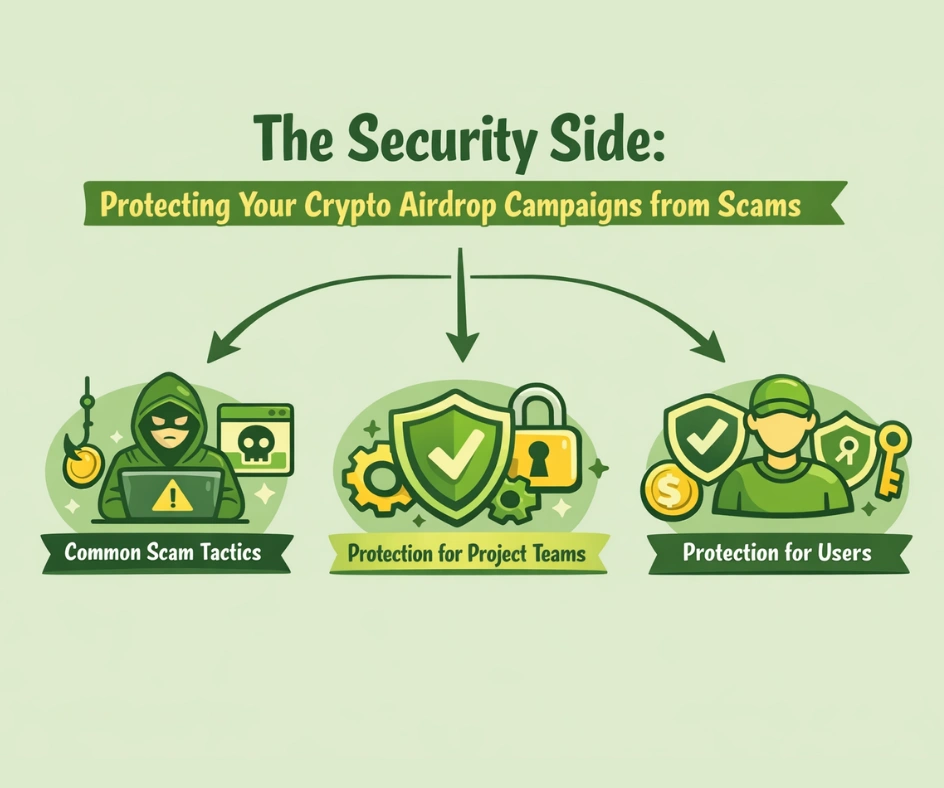
1. Common Scam Tactics
Fake airdrop websites clone the branding and interface of legitimate projects to trick users into connecting wallets or entering seed phrases. Hamster Kombat, which attracted over 250 million users, became a prime target for phishing scams impersonating its official airdrop. Cybersecurity firm Kaspersky specifically warned users about fake Hamster Kombat airdrop pages designed to steal wallet credentials. Scammers also use fake social media accounts, deepfake videos of crypto personalities, and unsolicited token deposits that contain malicious smart contract interactions.
2. Protection for Project Teams
If you are running a blockchain airdrop campaign, security needs to be baked into every layer of your process. This includes using audited smart contracts for token distribution, implementing multi-signature wallets for treasury management, publishing clear and verifiable information about the airdrop on your official channels, and working with security firms to monitor for phishing sites using your brand.
3. Protection for Users
Users should never share private keys or seed phrases to claim an airdrop. Legitimate airdrops never require upfront payments. Always verify airdrop announcements through official project channels. Use tools like Revoke. Cash to check and revoke suspicious token approvals. And if something looks too good to be true, it almost certainly is.
How Token Airdrop Campaigns Have Evolved from 2020 to 2025
The evolution of crypto airdrop campaigns over the past five years has been remarkable. In 2020, the Uniswap model of simple retroactive distribution based on past usage was revolutionary. By 2023, projects like Arbitrum and Optimism had refined the approach with multi-round distributions and activity scoring. In 2024, the rise of points-based systems through EigenLayer, Blast, and others introduced a new era of sustained engagement campaigns. And in late 2024, Hyperliquid showed what happens when a project genuinely puts community allocation first.
The shift from “click and claim” to “prove your engagement” has been one of the most significant changes. Early airdrops asked users to do almost nothing. Today, qualifying for a meaningful airdrop often requires weeks or months of active protocol usage, testnet participation, liquidity provision, or governance involvement. This evolution has been driven by the hard data showing that simple distributions lead to instant selling and minimal long-term engagement.
Another major shift has been the rise of the “airdrop farmer” as a recognized participant in the ecosystem. On-chain data from early 2025 showed over 1.2 million wallets participating in at least one airdrop within a 90-day period. Many of these wallets are operated by individuals or groups specifically targeting upcoming airdrops, using new platforms and testnets strategically to qualify for future distributions. This has created an arms race between projects trying to reward genuine users and farmers trying to game eligibility criteria.
Token Airdrop Campaign Types: Comparison of Key Features
| Airdrop Type | Best Used For | User Retention Potential |
|---|---|---|
| Standard Airdrop | Maximum reach and brand awareness for new projects; quick wallet count growth | Low; most recipients have minimal commitment to the project |
| Bounty Airdrop | Social media buzz generation; building initial follower counts across platforms | Low to Medium; engagement is task-driven and often drops after claiming |
| Holder (Snapshot) Airdrop | Rewarding existing community; building loyalty among current token holders | Medium; recipients already have some investment in the ecosystem |
| Retroactive Airdrop | Rewarding genuine early users, governance decentralization, and building trust | Medium to High; targets real users with demonstrated interest in the protocol |
| Points/Task-Based Airdrop | Sustained user engagement over weeks or months; growing TVL and on-chain activity | High; extended participation period filters for committed users |
| Fork Based Airdrop | Capturing attention during protocol upgrades; bootstrapping a new chain’s user base | Variable; depends entirely on the new chain’s value proposition |
Best Practices for Running Successful Blockchain Airdrop Campaigns
Drawing from the data and case studies above, here are the practices that consistently separate successful token airdrop campaigns from failed ones.
1. Allocate a Meaningful Percentage of Token Supply
Skimping on the community allocation is one of the fastest ways to kill momentum. The data is clear: higher supply allocations to community airdrops correlate with better price stability and stronger post launch engagement. Hyperliquid’s 31% community allocation set a new benchmark, and projects that allocated less than 5% have consistently underperformed in both price action and user retention.
2. Prioritize Genuine Users Over Wallet Count
The temptation to boast about distributing tokens to millions of wallets is strong, but quality matters far more than quantity. Hyperliquid distributed to just 94,000 addresses and achieved better results than projects that targeted hundreds of thousands. Focus on users who have demonstrated real interest and activity in your protocol or its ecosystem.
3. Use Vesting and Lock Up Mechanisms
Releasing all tokens at once creates immediate selling pressure that can crush a token’s price in the first hours of trading. Implementing vesting schedules, staking incentives, or tiered claim mechanisms (where holding unlocks additional benefits) can significantly reduce dumping while maintaining community excitement.
4. Build a Product People Actually Want to Use
No airdrop strategy can compensate for a bad product. Hyperliquid’s continued growth after its airdrop was not just about the generous allocation; it was about having built a genuinely fast, intuitive trading platform that users wanted to keep using. The token distribution amplified existing product quality rather than trying to substitute for it.
5. Communicate Transparently and Consistently
Surprises are welcome when they are pleasant (like unexpected retroactive rewards), but opacity about tokenomics, eligibility criteria, or timelines breeds distrust. The most successful campaigns have been transparent about their allocation models, vesting schedules, and the rationale behind their distribution choices.
Recommended Reading:
The Role of Smart Contracts in Token Airdrop Campaigns
Behind every major token airdrop campaign sits a smart contract (or set of smart contracts) that handles the mechanics of distribution. These contracts automate the entire process: verifying eligibility, calculating allocation amounts, distributing tokens to qualified wallets, and enforcing any vesting or lock-up conditions. This automation is what makes it possible to distribute tokens to hundreds of thousands of addresses in a single transaction or within a very short timeframe.
Smart contract security is non-negotiable. The contract handling your airdrop distribution will hold or have authority over a significant portion of your token supply. Any vulnerability could result in funds being drained, incorrect distributions, or other catastrophic outcomes. Professional auditing by reputable security firms, thorough testing on testnets, and formal verification of critical logic are all essential steps before deploying any airdrop contract to mainnet.
The growing sophistication of airdrop mechanics has also pushed smart contract development forward. Modern airdrop contracts often incorporate Merkle tree verification for gas-efficient claims, time-locked vesting schedules, anti-sybil checks through on-chain activity scoring, and integration with oracle networks for external data verification. These technical advances have made it possible to run far more nuanced and effective blockchain airdrop campaigns than were possible even two years ago.
Regulatory Considerations for Token Airdrop Campaigns
The legal landscape around crypto airdrop campaigns varies significantly by jurisdiction and continues to evolve. In many countries, airdropped tokens are considered income at their fair market value at the time they are received, creating tax obligations for recipients. For project teams, the regulatory picture is even more complex. Depending on how a token is classified (utility token, security token, governance token), different rules may apply to its distribution.
In the United States, between 920,000 and 5.2 million persons were impacted by geoblocking policies across 11 analyzed airdrops from 2020 to 2024, with many projects excluding U.S. residents entirely to avoid potential regulatory issues with the SEC. The post 2024 U.S. elections brought a somewhat more favorable regulatory environment, with some projects that had previously avoided tokenization beginning to announce token generation events. However, the regulatory uncertainty has not fully resolved, and projects need to work with legal counsel to understand the implications of distributing tokens in specific jurisdictions.
Blockchain Token Distribution Infrastructure in the Real World
The following project reflects how token creation, smart contract architecture, and community-driven distribution models are already being applied across DeFi platforms and multi-chain ecosystems. Each implementation showcases the same principles discussed throughout this article, from tokenomics design and governance mechanisms to smart contract automation and community-focused token allocation.
🪙
EverRise: Multi-Chain DeFi Token Ecosystem
Built a multi-chain token ecosystem operating across Ethereum, BNB Chain, Polygon, Avalanche, and Fantom, featuring token swaps, cross-chain transfers, NFT staking, and launchpad functions. The project demonstrates how thoughtful token architecture and community-driven distribution can power an interconnected DeFi ecosystem across multiple blockchains.
Launch Your Token Airdrop Campaign Today:
We bring 8+ years of blockchain expertise to token development and airdrop campaign execution. Our specialized team handles everything from smart contract creation and tokenomics design to multi-chain distribution and anti-sybil implementation, ensuring your airdrop campaign is built for community growth, engagement, and long-term success. Whether you need a governance token distribution or a DeFi loyalty rewards program, we deliver solutions that work.
Final Thoughts
Token airdrop campaigns have traveled an extraordinary distance from the early days of simple token giveaways. What began as a niche promotional tactic has matured into one of the most powerful tools in the blockchain marketing toolkit, capable of distributing billions of dollars in value, bootstrapping entire ecosystems, and decentralizing governance across hundreds of thousands of participants. The data from real campaigns paints a nuanced picture: while the total value distributed through airdrops since 2017 has crossed $20 billion and participation has grown to nearly 199 million globally, the challenge of converting airdrop recipients into long-term community members remains very real.
The projects that have succeeded, like Hyperliquid with its community-first approach and no VC allocation, have done so by combining generous token distributions with genuinely useful products and transparent communication. The projects that have failed typically shared common traits: low community allocations, heavy VC involvement, weak products, and no post-airdrop engagement strategy. For anyone building or planning a crypto airdrop campaign today, the lesson is clear. Allocate meaningfully, target genuine users, build something worth using, secure your distribution infrastructure, and plan for what happens after the tokens land in wallets. The airdrop is not the destination; it is the starting point of a relationship between your project and its community. Treat it that way, and you will be well-positioned to build something that lasts.
Frequently Asked Questions
Q1.What is a token airdrop campaign?
A token airdrop campaign is a marketing and distribution strategy where a blockchain project sends free tokens directly to crypto wallets. The purpose can range from building awareness and rewarding early users to decentralizing governance by distributing voting power across a wide community of holders.
Q2.How do I qualify for crypto airdrop campaigns?
Eligibility varies by project. Some airdrops only require holding a specific token at the time of a blockchain snapshot. Others require active participation, such as using a protocol, providing liquidity, joining testnets, or completing on-chain tasks. Points-based campaigns require sustained engagement over weeks or months before tokens are distributed.
Q3.Are token airdrops free?
The tokens themselves are distributed at no cost. However, recipients may need to pay network gas fees to claim their tokens, and in some jurisdictions, received airdrop tokens may be considered taxable income at their fair market value at the time of receipt.
Q4.How can I tell if a crypto airdrop is a scam?
Legitimate airdrops never ask for private keys, seed phrases, or upfront payments. Warning signs include unsolicited messages about free tokens, websites with suspicious URLs, grammar errors in official-looking communications, and promises of unusually high returns. Always verify airdrop information through the project’s official website and verified social media channels.
Q5.Why do so many airdrop recipients sell their tokens immediately?
Research shows that a majority of airdrop recipients view the distribution as “free money” and prioritize taking profit over long-term participation. The Uniswap airdrop data showed that 75% of wallets sold within 7 days. Projects combat this through vesting schedules, staking incentives, and designing their airdrops to target users who have demonstrated genuine interest in the protocol.
Q6.What percentage of the token supply should a project allocate to an airdrop?
While there is no single right answer, data from 2024 airdrops shows that projects distributing more than 10% of their total supply through airdrops achieved better price stability than those distributing less than 5%. Hyperliquid’s 31% community allocation is widely considered a benchmark for community-first token airdrop campaigns, though the right percentage depends on the project’s specific goals, tokenomics, and funding structure.
Explore Services
Related Services
Reviewed by

Aman Vaths
Founder of Nadcab Labs
Aman Vaths is the Founder & CTO of Nadcab Labs, a global digital engineering company delivering enterprise-grade solutions across AI, Web3, Blockchain, Big Data, Cloud, Cybersecurity, and Modern Application Development. With deep technical leadership and product innovation experience, Aman has positioned Nadcab Labs as one of the most advanced engineering companies driving the next era of intelligent, secure, and scalable software systems. Under his leadership, Nadcab Labs has built 2,000+ global projects across sectors including fintech, banking, healthcare, real estate, logistics, gaming, manufacturing, and next-generation DePIN networks. Aman’s strength lies in architecting high-performance systems, end-to-end platform engineering, and designing enterprise solutions that operate at global scale.