Ai Overview
Launching a crypto-based MLM (Multi-Level Marketing) project is not just a technical task — it is a financial undertaking that demands serious planning from day one. We have also seen how careful planning can take a project from a $50,000 seed investment to a fully operational token ecosystem with thousands of active distributors. Reputable audit firms like CertiK or Hacken charge between $5,000 and $15,000 for a thorough audit, and that cost is fully justified.
Key Takeaways
- Token creation for an MLM project costs between $24,000 and $73,000 on average, depending on blockchain and complexity.
- Listing on a centralized exchange (CEX) can demand anywhere from $50,000 to $500,000+, while DEX listings are far more affordable at under $5,000.
- Marketing typically consumes 30–40% of the total project budget and is the single largest ongoing spend.
- Smart contract security audits are non-negotiable and usually cost between $5,000 and $15,000, but they protect millions in investor funds.
- BNB Chain and Polygon offer lower deployment costs compared to Ethereum, making them popular for budget-conscious MLM projects.
- Legal and KYC/AML compliance can add $10,000 to $50,000 to your budget but shields your project from regulatory shutdowns.
- A phased budget approach — starting lean and scaling with revenue — is the most sustainable path for new MLM crypto ventures.
Introduction: Why Budget Planning Is the Backbone of Every MLM Crypto Project
Launching a crypto-based MLM (Multi-Level Marketing) project is not just a technical task — it is a financial undertaking that demands serious planning from day one. Many founders jump in, get their token built, and then realize they have no budget left for listing it, marketing it, or keeping it compliant. That is where projects fail.
Over the past eight years, our team has worked directly with MLM crypto startups, mid-scale networks, and enterprise-level distribution projects across Southeast Asia, the Middle East, and Eastern Europe. We have seen first-hand how a shaky budget leads to abandoned projects. We have also seen how careful planning can take a project from a $50,000 seed investment to a fully operational token ecosystem with thousands of active distributors.
This article breaks down every major cost layer you need to plan for: token creation, exchange listing, marketing, development, legal compliance, and day-to-day operations. Whether you are building from scratch or restructuring an existing plan, the numbers and strategies here are grounded in real project data, not theory.
One important note upfront: the MLM industry is highly regulated globally, and adding a cryptocurrency layer makes compliance even more critical. Budget accordingly from the start.
Understanding the MLM Token Ecosystem
Before we talk money, let us quickly establish what we are building. A crypto MLM token is a digital asset that functions as the reward, commission, and utility currency inside a multi-level distribution network. Unlike a typical cryptocurrency that exists purely as a store of value, an MLM token is purpose-built to power a specific business model.
Tokenomics — the economic design of a token — plays a huge role in MLM. The way tokens are distributed, vested, burned, and rewarded directly determines whether the system is sustainable or collapses under its own weight. A well-designed tokenomics model answers questions like: How many tokens go to early investors? How are referral commissions paid? What keeps the token from inflating into worthlessness?
Smart contracts automate all of this. They handle commission payouts, vesting schedules, staking rewards, and tier-based bonuses without any manual intervention. This is one of the biggest advantages of running an MLM on blockchain infrastructure — trust is built into the code, not into a person or company promise.
“A token without a purpose inside the MLM structure is just speculation. The projects that last are the ones where the token has genuine utility — commission payments, governance, product access, or staking.”
Cost of Token Creation: What You Are Actually Paying For
The cost of creating a token varies enormously depending on your blockchain choice, the complexity of your smart contracts, whether you need a full token audit, and who is doing the work. Let us break it down clearly.
Blockchain Selection
Your blockchain is the foundation. Ethereum is the most trusted, but it is expensive in terms of gas fees and development costs. BNB Chain (formerly Binance Smart Chain) is faster and cheaper, and it is currently the most popular choice for new MLM projects. Polygon and TRON are also widely used when cost efficiency is the priority.
| Blockchain | Token Standard | Dev Cost (Approx.) | Gas Fees | Best For |
|---|---|---|---|---|
| Ethereum | ERC-20 | $15K–$40K | High | Enterprise-level credibility |
| BNB Chain | BEP-20 | $8K–$20K | Low | Most MLM projects |
| Polygon | ERC-20/Polygon | $8K–$18K | Very Low | High-volume transactions |
| TRON | TRC-20 | $5K–$15K | Very Low | Asia-Pacific MLM networks |
| Solana | SPL | $12K–$30K | Very Low | Speed-focused applications |
Smart Contract Development Costs
Smart contracts are the engine of your token. For a basic MLM reward structure, you are looking at around $8,000 to $20,000. If you need multi-tier commission logic, staking, governance voting, and auto-compounding features, expect costs to climb to $25,000 or more. The complexity of your MLM plan directly drives this number. A binary plan with a matching bonus is more complex to code than a simple unilevel structure.
Security Audit and Token Design
Skipping a security audit is one of the most dangerous mistakes an MLM project can make. A single vulnerability in your smart contract can drain the entire liquidity pool in minutes. Reputable audit firms like CertiK or Hacken charge between $5,000 and $15,000 for a thorough audit, and that cost is fully justified.
Token design includes decisions around supply, burn mechanisms, vesting schedules, and utility definitions. Getting this right requires experienced tokenomics advisors, and budget anywhere from $3,000 to $8,000 for this phase. If you are building a utility token for internal MLM use, you also need to define clearly why the token has value beyond just commission payments — otherwise, the whole system risks regulatory scrutiny.
Token Listing Expenses: CEX vs DEX — What Projects Actually Spend
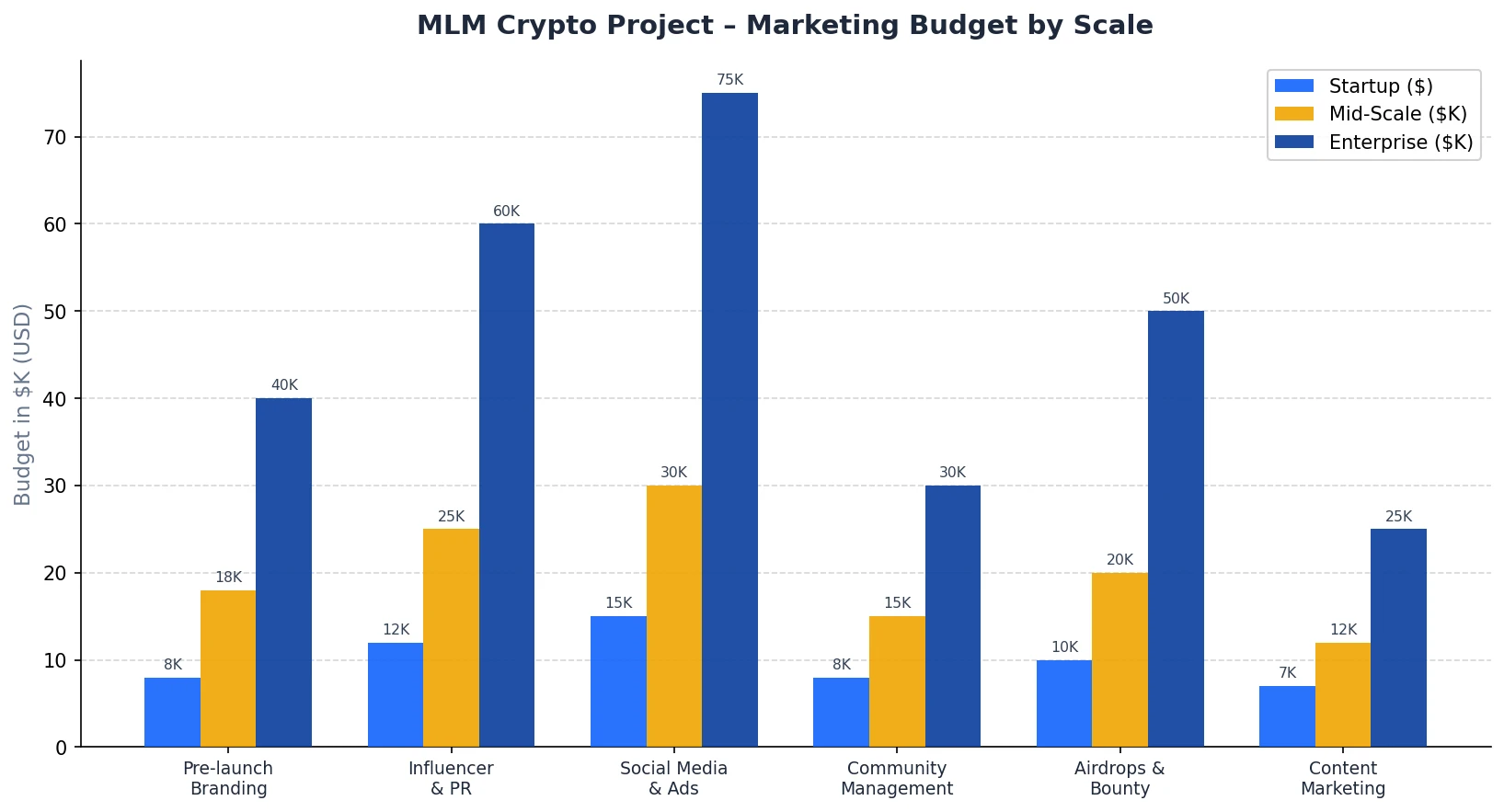
Getting your token listed is where many projects get blindsided by costs. There are two main paths: Centralized Exchanges (CEX) and Decentralized Exchanges (DEX). Each has a very different cost profile, timeline, and level of control.
CEX listings like Binance, Coinbase, or KuCoin carry enormous weight in terms of credibility and user reach, but they are expensive and selective. DEX listings on platforms like Uniswap or PancakeSwap are permissionless and affordable, and they are increasingly the go-to first move for most new projects.
| Exchange | Type | Listing Fee (Est.) | Liquidity Required | Timeline |
|---|---|---|---|---|
| Binance | CEX | $200K–$500K+ | $1M+ | 3–9 months |
| KuCoin | CEX | $50K–$150K | $200K+ | 2–5 months |
| Gate.io | CEX | $20K–$80K | $100K+ | 1–3 months |
| PancakeSwap | DEX | $500–$2K (gas) | $10K–$50K | 24–48 hours |
| Uniswap | DEX | $1K–$5K (gas) | $15K–$60K | 24–48 hours |
Most MLM token projects we advise start with a DEX listing — it builds organic trading volume, establishes a price history, and demonstrates real demand before approaching a CEX. This sequencing approach saves money and creates a stronger case for CEX negotiation later. Also keep in mind that regulatory considerations around token listings differ by jurisdiction and can add legal review costs of $5,000 to $20,000.
Marketing Budget for MLM Crypto Projects: Where the Real Money Goes
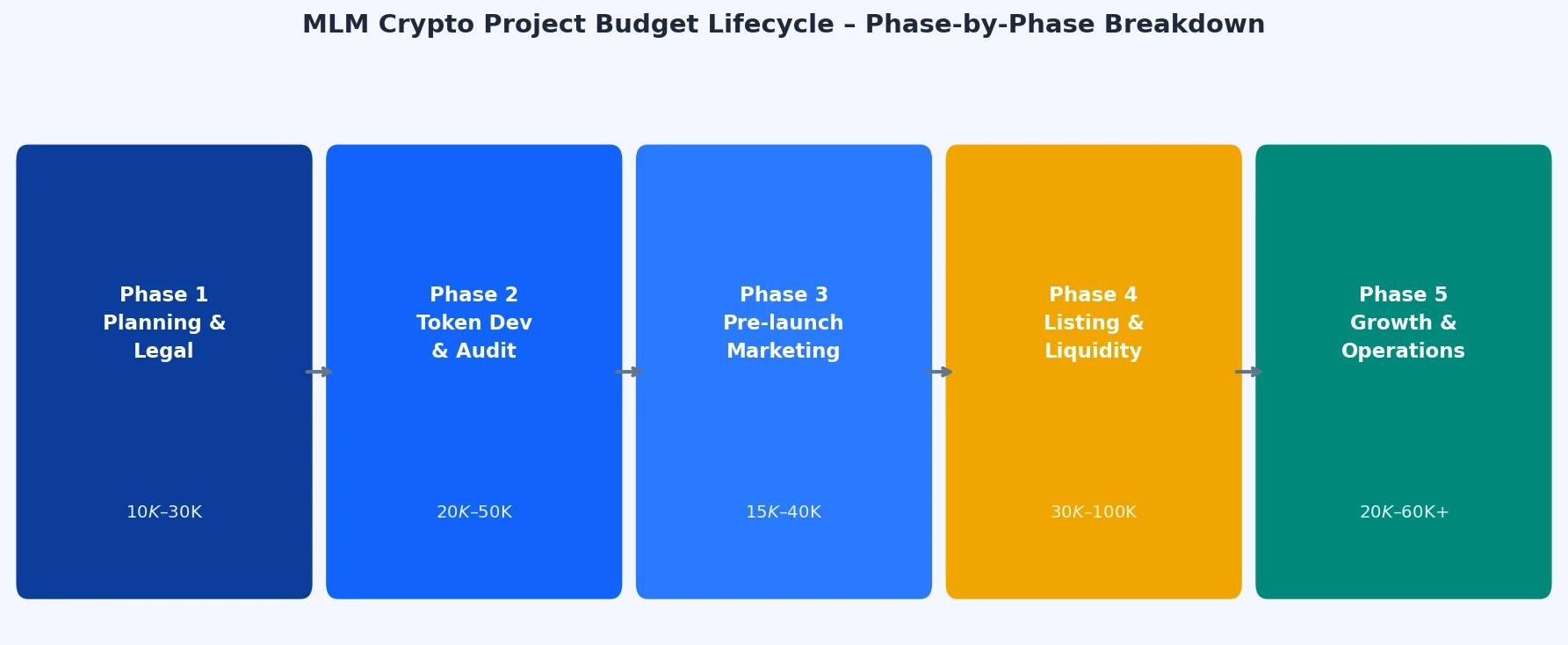
Marketing is not one line item — it is a whole category of spending that starts before your token goes live and continues long after. For most MLM crypto projects, marketing eats between 30% and 40% of the total budget. Here is how that breaks down:
Pre-launch Branding and Website
Before you list or even announce your token publicly, you need a professional brand identity and a website that builds trust. This includes a logo, brand guidelines, a whitepaper, a landing page, and a project explainer. Budget between $5,000 and $20,000 for this phase. A poorly designed website kills credibility in the crypto space instantly — investors and distributors evaluate your legitimacy within seconds of landing on your page.
Influencer and PR Campaigns
Crypto influencer marketing has become a core channel for token launches. Mid-tier crypto YouTubers and Twitter/X personalities with 50K to 500K followers typically charge between $2,000 and $15,000 per sponsored post or video. A coordinated PR campaign that places your project in publications like CoinDesk or Decrypt adds another $5,000 to $25,000 to the budget. The return on this spend depends entirely on how well the project is positioned.
Social Media and Paid Advertising
Paid advertising in crypto is tricky — many platforms including Google and Facebook have restrictions on crypto ads. That said, native crypto ad networks like Coinzilla and Bitmedia remain available. Budget $5,000 to $30,000 per month for paid campaigns depending on your scale. Twitter/X ads, Reddit promoted posts, and Telegram channel buys are also common tactics for crypto MLM projects. Build in budget for a dedicated social media manager or agency who understands the crypto audience.
Community Management (Telegram and Discord)
Community is everything in crypto MLM. An active, well-moderated Telegram group and Discord server can be the difference between a project that sustains momentum and one that collapses after launch hype fades. Dedicated community managers for both platforms cost $2,000 to $6,000 per month combined. Bots, moderation tools, and pinned content systems add another $500 to $1,500 monthly.
Airdrops, Bounty Programs, and Referral Incentives
These are powerful tools for growing your early user base, but they also carry real token supply costs. Airdrops distribute tokens to potential users for free — creating wallet holders and social buzz. Bounty programs reward community members for completing tasks like writing reviews, translating content, or creating social media posts. Budget 1% to 5% of your total token supply for airdrop and bounty allocation, which should translate to roughly $10,000 to $50,000 in value at launch pricing. Referral incentives that are built into the smart contract are cheaper to run than manual campaigns. To set up these referral incentives, you can use dedicated referral tools, like ReferralCandy.
Ready to Launch Your MLM Token the Right Way?
We have helped 200+ MLM crypto projects plan and execute their token launches — from budget structuring to smart contract deployment. Start with a free strategy session.
Technology and Development Costs: Building the Infrastructure
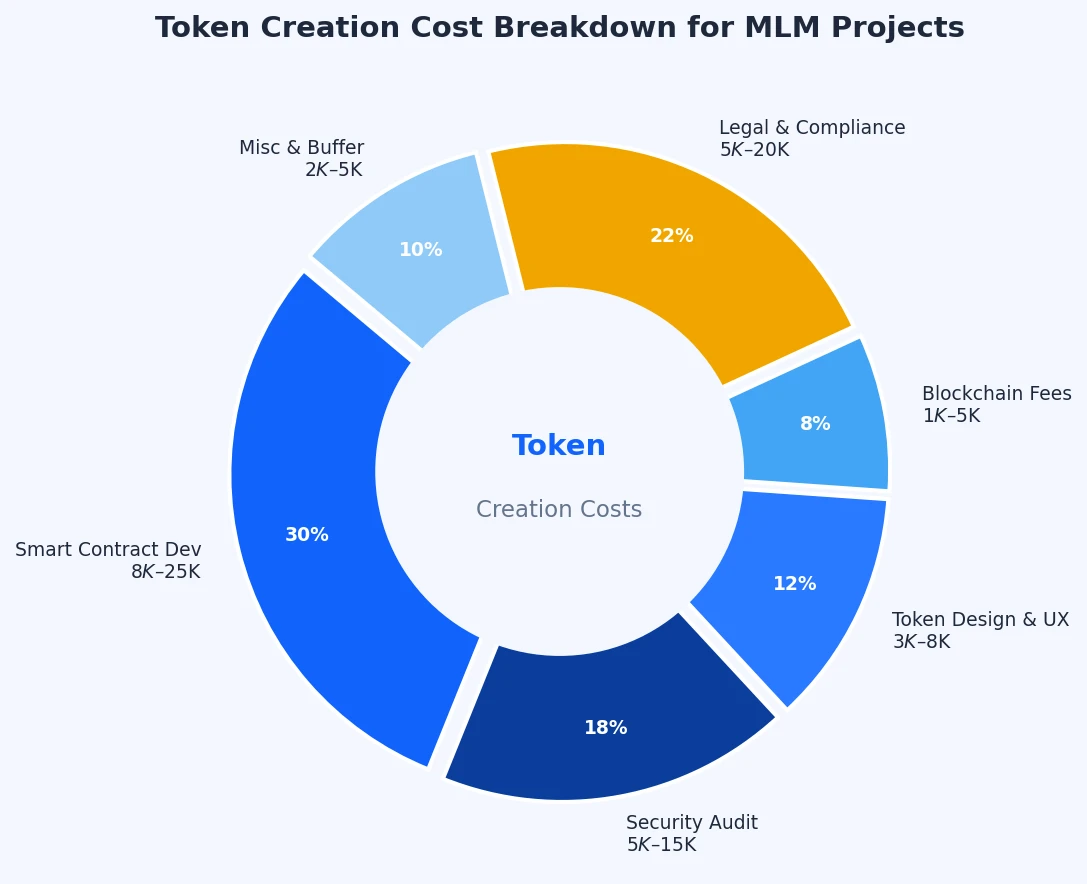
The token is just one piece of the technical puzzle. An MLM project also needs a full software platform — user dashboards, wallet integration, admin panels, reporting systems, and the backend infrastructure to handle thousands of concurrent users. Our cryptocurrency MLM software builds include all of these components.
Here is a realistic breakdown of technology costs:
- MLM Software Platform: $15,000 to $60,000 depending on compensation plan complexity
- User and Admin Dashboards: $8,000 to $20,000 for clean, responsive UI/UX design
- Wallet Integration: $3,000 to $10,000 for multi-wallet support (MetaMask, Trust Wallet, etc.)
- API Development and Third-Party Integrations: $5,000 to $15,000
- Backend Infrastructure (AWS, cloud hosting): $1,500 to $5,000 per month ongoing
- QA Testing and Bug Bounty Program: $5,000 to $12,000 at launch
If you are building custom from scratch, total technology costs can reach $60,000 to $120,000 for an enterprise-grade system. Using a white-label MLM software solution can bring that figure down dramatically — to $15,000 to $40,000 — while still delivering a professional, feature-rich platform. For most new projects, this is the more practical path.
Legal and Compliance Budget: The Cost of Staying Out of Trouble
Legal work is the most under-budgeted area in most MLM crypto projects. And it is consistently the area where founders pay the most when something goes wrong. Getting it right upfront is far cheaper than dealing with a regulatory action later.
The legal classification of your token is the first priority. Is it a security, a utility token, or a payment token? This classification determines which regulatory frameworks apply to your project in each country where you operate. Getting a legal opinion on this typically costs $5,000 to $15,000 from a qualified crypto attorney.
Here is a breakdown of key legal budget items:
- Company incorporation (offshore or local): $2,000 to $10,000
- Token legal opinion letter: $5,000 to $15,000
- KYC/AML system implementation: $3,000 to $8,000 (setup); $500 to $2,000 monthly ongoing
- Terms of service and user agreements: $2,000 to $5,000
- Ongoing legal counsel: $1,500 to $5,000 per month
- Compliance with regional regulations (EU, UAE, US, etc.): $5,000 to $25,000
For projects targeting markets with strict regulations — the US, Germany, or Singapore — budget on the higher end. You can learn more about how blockchain MLM regulations are evolving globally and what your project needs to account for in each region.
Ongoing Operational Costs: What It Takes to Keep Running
Launch costs are one-time. But operating costs are every single month. Many projects launch successfully and then run out of runway because they did not budget for the ongoing expense of running a real business. Here is what operational budgets typically look like month-to-month:
- Server infrastructure and hosting: $1,500 to $6,000/month depending on traffic
- Customer support team (3 to 5 agents): $3,000 to $10,000/month
- Community management: $2,000 to $6,000/month
- Ongoing marketing and content: $5,000 to $30,000+/month
- Legal and compliance retainer: $1,500 to $5,000/month
- Software maintenance and updates: $2,000 to $5,000/month
- Security monitoring and audits: $1,000 to $3,000/month
In total, a functioning MLM crypto project with a small team should budget between $15,000 and $65,000 per month in operational costs. That means you need a launch capital that covers at least 6 to 12 months of operations beyond your initial build costs — this is your runway, and getting to revenue before that runway ends is the core challenge of every startup in this space.
Sample Budget Breakdown by Project Scale
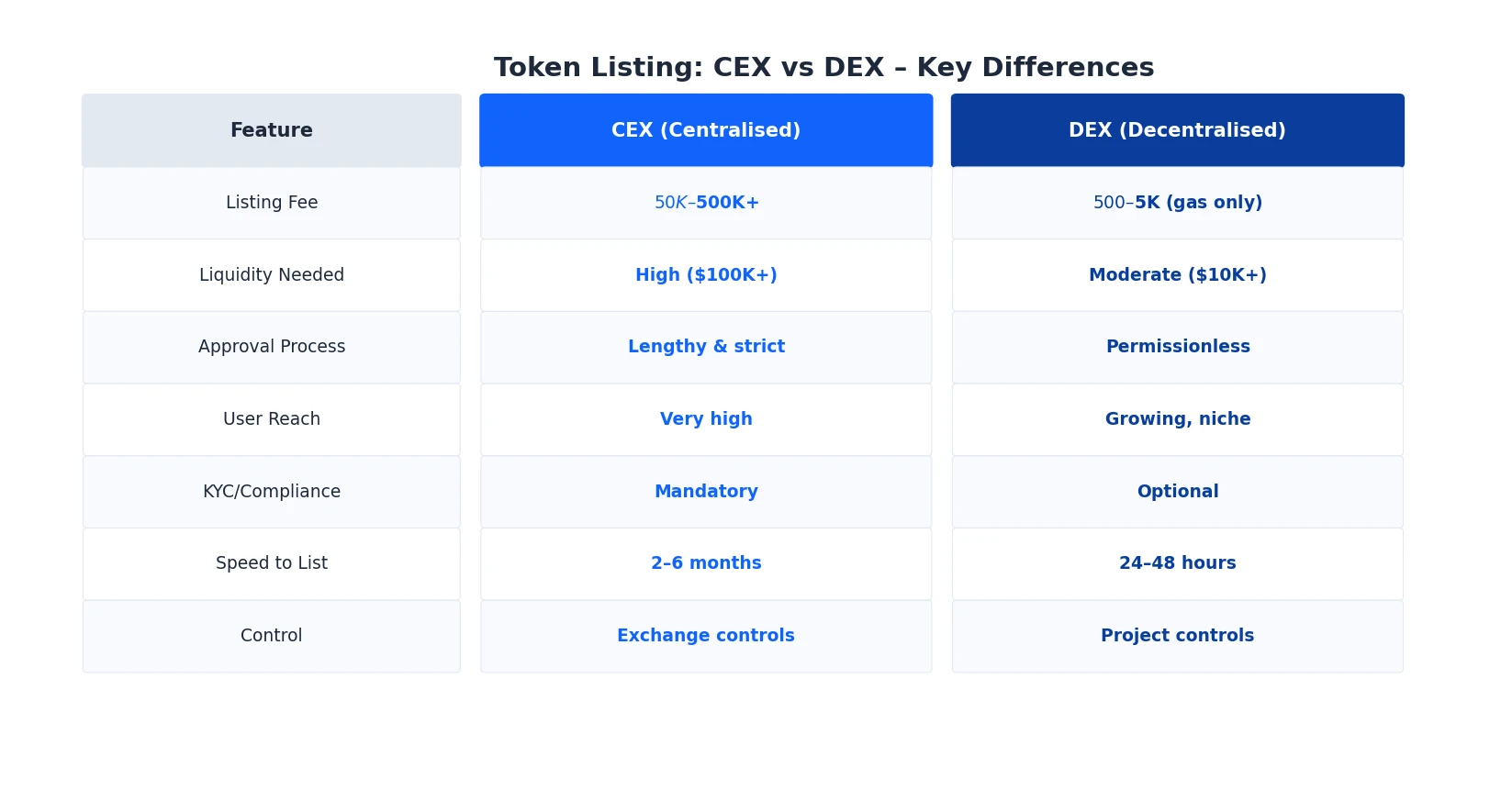
Every project has different goals, audiences, and resources. Below is a realistic snapshot of what total launch budgets look like at three different scales, based on our real-world project experience:
| Cost Category | Startup $50K–$100K Total |
Mid-Scale $150K–$350K Total |
Enterprise $500K–$2M+ Total |
|---|---|---|---|
| Token Development | $8K–$15K | $20K–$40K | $50K–$120K |
| Security Audit | $5K–$8K | $8K–$15K | $15K–$30K |
| MLM Software Platform | $12K–$20K | $25K–$60K | $80K–$200K |
| Exchange Listing + Liquidity | $5K–$15K (DEX) | $30K–$100K | $200K–$600K+ |
| Marketing (6 months) | $15K–$25K | $50K–$100K | $200K–$500K |
| Legal & Compliance | $5K–$10K | $15K–$30K | $50K–$150K |
| TOTAL ESTIMATE | $50K–$93K | $148K–$345K | $595K–$1.6M+ |
These figures are directional, not fixed. Your actual costs will depend on your team’s geography, the blockchain you choose, how complex your MLM plan is, and how aggressively you market. Projects built in Eastern Europe or Southeast Asia tend to have lower development costs than those built with US or UK-based teams.
Cost Optimization Strategies: Spending Smarter, Not Less
Budget optimization in an MLM crypto project is not about cutting corners — it is about sequencing spending intelligently, choosing scalable infrastructure, and avoiding costs that do not produce real value at your current stage.
Choose your blockchain wisely. For most projects under $500K total budget, BNB Chain or Polygon offers the best balance of cost, speed, and ecosystem support. You can always bridge to Ethereum later when you have more resources. Starting on Ethereum with a $50K budget is a quick way to exhaust your runway on gas fees alone.
White-label over custom-build. A white-label MLM crypto software platform can reduce your development costs by 60% to 70% compared to building from scratch. More importantly, it reduces time-to-market from 8 to 12 months down to 6 to 10 weeks, which means you start generating revenue sooner. This is the single most impactful cost decision you will make.
Start DEX, then CEX. Do not blow half your budget trying to list on a major CEX at launch. Build real trading volume on DEX first. Once your community is active and your token shows organic price discovery, CEX negotiations become far more favorable — and sometimes the exchange approaches you rather than the other way around.
Phase your marketing spend. Instead of spending $50,000 upfront on a marketing blitz that peaks and fades, invest in a 12-month content and community strategy that builds compounding value. According to Investopedia’s analysis of crypto market cycles, projects with consistent community engagement outperform those that rely solely on launch hype in long-term token price stability.
Outsource strategically. Community management, content writing, and social media can be outsourced cost-effectively to specialist agencies or freelancers. Your in-house team should focus on the core product, sales strategy, and key partnerships. Trying to do everything in-house early on burns budget and dilutes focus.
Challenges in Budget Planning: What Most Projects Get Wrong
Market volatility is unpredictable. If you are raising capital in crypto and spending in fiat, the exchange rate swing can significantly affect your real budget. A 30% drop in ETH between your raise and your spending phase can cut your effective budget by the same amount. Always maintain a fiat reserve equal to at least 30% to 40% of total project costs.
Regulatory uncertainty adds surprise costs. A regulation change in a key market — like a new KYC requirement, a token classification update, or a platform ban — can require emergency legal work and platform redesign that was not in the budget. Following the latest developments in blockchain MLM regulation is not optional — it is ongoing budget intelligence.
Overpromising MLM returns creates token instability. MLM projects that promise unrealistically high returns attract short-term speculators rather than genuine distributors. When those speculators sell, the token price drops, and the community loses confidence. The financial stability of the whole system depends on building real product value underneath the reward structure — not just token appreciation promises. This is a budget and design challenge, not just a marketing one.
Managing ROI expectations. Most MLM crypto projects take 12 to 18 months to reach profitability. Founders who expect a 3-month ROI will cut marketing, reduce development, and underinvest in compliance — exactly the areas that determine long-term success. Budget planning must be anchored in realistic revenue projections, not optimistic ones.
The MLM Token Project Lifecycle: From Concept to Active Network
Understanding where each budget category fits into the project timeline helps you plan cash flow and avoid running dry at a critical phase. Here is how a typical MLM token project progresses:
Conclusion: Strategic Budgeting Is What Separates Projects That Last
The MLM crypto space is full of projects that had great ideas and terrible plans. Token creation is just the starting point — listing, marketing, operations, legal compliance, and ongoing development all demand serious capital and serious planning. The projects that make it past two years are almost always the ones that budgeted for all of it, not just the exciting parts.
There is no shortcut here. A $30,000 project that skips the audit, ignores legal, and rushes to list on a no-name exchange is not a $30,000 project — it is a future liability waiting to collapse. Conversely, a well-structured $150,000 project with a clear compensation plan, a solid token utility model, and a realistic 12-month marketing roadmap can build something genuinely sustainable.
Our team has spent eight years helping founders get these decisions right from day one. The first step is always the same: be honest about what it actually costs, and then plan accordingly. If you are ready to take that step, our cryptocurrency MLM software team is here to help you scope, budget, and build the right way.
For a deeper understanding of how MLM structures work globally and what compliance means for your business model, explore our foundational guides before finalizing your project scope.
Frequently Asked Questions
Q1.How much does it cost to create a token for an MLM project?
Token creation for an MLM project typically costs between $8,000 and $40,000 for smart contract development, plus $5,000 to $15,000 for a security audit. Your total creation cost — including tokenomics design and deployment — usually falls between $24,000 and $73,000 depending on blockchain choice and feature complexity.
Q2.Which blockchain is best for MLM token development?
BNB Chain (BEP-20) is the most popular choice for MLM projects due to its low gas fees, large DeFi ecosystem, and wide wallet support. Polygon and TRON are strong alternatives for projects needing even lower transaction costs. Ethereum is preferred for enterprise-level projects where credibility matters more than cost efficiency.
Q3.What are the listing fees for a crypto token on major exchanges?
Listing fees vary enormously. Binance and similar top-tier CEX platforms charge $200,000 to $500,000 or more, plus significant liquidity requirements. Mid-tier CEXs like KuCoin range from $50,000 to $150,000. DEX platforms like PancakeSwap or Uniswap cost only $500 to $5,000 in gas fees and are the standard starting point for most new projects.
Q4.How much marketing budget does an MLM crypto project need?
Marketing typically represents 30–40% of the total project budget. A startup-level project might spend $15,000 to $30,000 over the first 6 months. A mid-scale project should budget $50,000 to $100,000 for the same period. Enterprise-level campaigns routinely exceed $200,000 for a half-year marketing push across influencers, PR, paid ads, and community building.
Q5.Is it legal to create an MLM crypto token?
It can be legal, but it depends heavily on jurisdiction and how the token is classified. Utility tokens used within an MLM ecosystem face fewer restrictions than tokens classified as securities. You need a legal opinion specific to your project and target markets before launching. KYC/AML compliance is mandatory in most regulated markets and should be built into your platform from day one.
Q6.What is the total budget needed to launch an MLM cryptocurrency project?
A startup-level MLM crypto project typically requires $50,000 to $100,000 for a lean but complete launch. Mid-scale projects run $150,000 to $350,000. Enterprise-level projects with CEX ambitions and large marketing campaigns can require $500,000 to $2 million or more. These figures include development, audit, listing, marketing, legal, and at least 6 months of operational costs.
Explore Services
Related Services
Reviewed by

Aman Vaths
Founder of Nadcab Labs
Aman Vaths is the Founder & CTO of Nadcab Labs, a global digital engineering company delivering enterprise-grade solutions across AI, Web3, Blockchain, Big Data, Cloud, Cybersecurity, and Modern Application Development. With deep technical leadership and product innovation experience, Aman has positioned Nadcab Labs as one of the most advanced engineering companies driving the next era of intelligent, secure, and scalable software systems. Under his leadership, Nadcab Labs has built 2,000+ global projects across sectors including fintech, banking, healthcare, real estate, logistics, gaming, manufacturing, and next-generation DePIN networks. Aman’s strength lies in architecting high-performance systems, end-to-end platform engineering, and designing enterprise solutions that operate at global scale.