Ai Overview
The evolution of digital identity stands at a critical crossroads as Web3 technologies reshape how users interact with online services. Self-sovereign identity represents the most significant advancement in digital identity since the internet began, offering users unprecedented control over their personal information. Organizations across the USA, UK, UAE, and Canada increasingly recognize that traditional identity systems cannot meet the privacy, security, and user sovereignty demands of decentralized ecosystems.
The evolution of digital identity stands at a critical crossroads as Web3 technologies reshape how users interact with online services. Self-sovereign identity represents the most significant advancement in digital identity since the internet began, offering users unprecedented control over their personal information. Organizations across the USA, UK, UAE, and Canada increasingly recognize that traditional identity systems cannot meet the privacy, security, and user sovereignty demands of decentralized ecosystems. Our agency brings over eight years of experience implementing Web3 solutions that prioritize user ownership while meeting compliance requirements.
This comprehensive guide explores why self-sovereign identity for Web3 has become essential, examining how self-sovereign identity works, the benefits of self-sovereign identity for users and platforms, and practical implementation strategies. Whether you are building decentralized applications or evaluating identity solutions, understanding SSI fundamentals positions your organization for the future of digital trust.
Key Takeaways
- Self-sovereign identity gives users complete ownership and control over their digital identity without depending on centralized authorities.
- SSI enables selective disclosure, allowing users to prove specific claims without revealing unnecessary personal information to verifiers.
- Decentralized identifiers (DIDs) and verifiable credentials (VCs) form the technical foundation enabling trustworthy, portable identity.
- SSI vs traditional identity shows fundamental improvements in privacy, security, and user autonomy across Web3 applications.
- Benefits of self-sovereign identity include reduced data breach risks, fraud prevention, and compliance with global privacy regulations.
- Zero-knowledge proofs enable privacy-preserving verification where users prove claims without exposing underlying credential data.
- SSI solution for Web3 applications supports use cases including private KYC, DAO membership, sybil resistance, and DeFi access control.
- Wallet-based sign-in provides authentication but lacks the trust, claims, and verification capabilities that SSI delivers.
- Implementation requires careful attention to user experience, wallet recovery, issuer trust frameworks, and interoperability standards.
- Future SSI systems will enable cross-chain identity, reputation portability, and passwordless authentication across the entire Web3 ecosystem.
What Is Self-Sovereign Identity (SSI)?
Self-sovereign identity represents a paradigm shift in how digital identity operates, moving control from centralized institutions to individual users. Rather than storing identity data in corporate databases or government systems, SSI enables individuals to hold their own credentials and present them when needed. This fundamental change addresses decades of identity challenges that have plagued digital systems, from data breaches to privacy violations to identity theft.
SSI Meaning in Simple Terms
Self-sovereign identity means you own your identity just like you own your physical wallet and the cards inside it. When someone needs to verify something about you, like your age or citizenship, you show them proof without handing over your entire identity document. In the digital world, SSI accomplishes this through cryptographic credentials that you control completely. No company or government holds your identity data hostage, and you decide exactly what information each service receives. This approach transforms users from passive subjects of identity systems into active owners of their digital selves.
How SSI Differs from Traditional Digital Identity?
Understanding SSI vs traditional identity reveals fundamental architectural differences that impact privacy, security, and user autonomy. Traditional systems place identity providers at the center, controlling user data and acting as gatekeepers for verification. Users must trust these intermediaries to protect their information and provide access when needed. SSI eliminates this dependency by distributing control to credential holders themselves. The issuer-holder-verifier model ensures that once credentials are issued, holders can present them anywhere without the issuer’s continued involvement or knowledge of each verification event.
| Aspect | Traditional Identity | Self-Sovereign Identity |
|---|---|---|
| Data Control | Centralized providers | Individual users |
| Privacy | Full data exposure | Selective disclosure |
| Breach Risk | High (central databases) | Low (distributed) |
| Portability | Platform-locked | Fully portable |
Core SSI Model (Issuer-Holder-Verifier)
The SSI trust model operates through three distinct roles that separate concerns and distribute trust appropriately. Issuers are trusted entities that verify claims and create signed credentials, such as governments issuing citizenship credentials or universities confirming degrees. Holders receive these credentials in their identity wallets, maintaining complete control over storage and presentation. Verifiers are services that request proof of specific claims, checking cryptographic validity without contacting issuers or storing personal data. This triangular model enables trust relationships that scale globally while preserving user privacy.
Why Web3 Needs a New Identity System?
Web3 promises decentralization, user ownership, and trustless interactions, yet identity remains a critical gap that undermines these principles. The tension between blockchain transparency and privacy requirements, combined with regulatory pressures across jurisdictions like the USA, UK, and UAE, creates urgent demand for identity solutions that align with Web3 values while meeting practical needs.
Problems with Centralized Identity Providers
Centralized identity providers contradict Web3’s foundational principles while creating practical risks that affect users and platforms. Single points of failure mean that provider outages lock users out of services entirely. Data breaches expose millions of users simultaneously, as demonstrated by countless high-profile incidents affecting major corporations. Centralized providers also gain inappropriate power over user access, ability to censor or exclude users, and monetization of personal data. For Web3 applications promoting decentralization, relying on centralized identity creates philosophical and technical inconsistencies.
Wallet-Based Identity Gaps in Web3
While wallet addresses provide pseudonymous authentication for Web3 applications, they cannot fulfill complete identity requirements. Wallets prove control over private keys but reveal nothing about the person behind them. This limitation prevents use cases requiring verified claims about users, such as compliance verification, age restrictions, or professional credentials. Additionally, wallet addresses linked to transaction history create privacy concerns, as sophisticated analysis can trace activities and potentially link addresses to real identities despite pseudonymity.
Data Ownership and Privacy Challenges
Web3 users expect ownership of their data, yet current identity approaches often require surrendering information to centralized services that may use it inappropriately. Privacy regulations like GDPR in the UK and similar frameworks in Canada demand data minimization, yet traditional verification requires sharing complete documents. The permanent nature of blockchain records amplifies privacy concerns, making it crucial that identity solutions avoid storing personal information on-chain while still enabling verifiable claims.
Key Benefits of SSI for Web3 Users
Full Control Over Identity
Users own their credentials completely, deciding what to share, when, and with whom. No third party can revoke access or modify identity data without consent.
Privacy Through Selective Disclosure
Share only specific attributes needed for each interaction. Prove age without revealing birthdate, or citizenship without exposing passport details.
Better Security Than Passwords
Cryptographic credentials eliminate password vulnerabilities, phishing risks, and credential stuffing attacks that plague traditional authentication systems.
Portable Identity Across Platforms
Credentials issued once work across multiple dApps and chains. Verify once, use everywhere without repeating identity processes for each new service.
SSI vs Web3 Wallet Sign-In (Sign Message Login)
Why Wallet Sign-In Is Not True Identity?
Wallet-based authentication proves key ownership but reveals nothing about the person behind the keys. When users sign messages to log into Web3 applications, they demonstrate control over private keys associated with specific addresses. However, this authentication provides no verified information about user identity, qualifications, or compliance status. Multiple people could share wallet access, bots could operate wallets, and no mechanism exists to verify claims about users beyond address ownership.
SSI Adds Trust, Claims, and Proofs
Self-sovereign identity extends beyond authentication to enable verifiable claims from trusted issuers. SSI adds layers of trust that wallet sign-in cannot provide: proof of humanity, verified credentials, compliance attestations, and reputation signals. When applications require knowing something about users beyond address control, SSI delivers cryptographic certainty about specific claims while maintaining privacy for everything else. This combination of authentication and verification creates complete identity solutions for Web3.[1]
When Wallet Authentication Alone Is Enough?
Not every Web3 application requires SSI integration. Simple token transfers, NFT collections without access restrictions, and permissionless DeFi protocols may function adequately with wallet authentication alone. Applications serving primarily crypto-native users comfortable with pseudonymity can defer SSI adoption until specific use cases demand it. The decision depends on compliance requirements, user verification needs, and application complexity rather than adopting SSI universally.
SSI Use Cases in Web3
Private KYC and Compliance Proof
Regulatory requirements in the USA, UK, UAE, and Canada demand identity verification for financial services while users expect privacy protection. SSI solution for Web3 enables compliant verification where trusted issuers perform KYC once, then issue credentials that multiple verifiers can check without accessing raw data. This approach reduces compliance costs, improves user experience through single verification, and protects personal information from unnecessary exposure across multiple platforms.
DAO Membership and Voting Rights
Decentralized autonomous organizations require mechanisms to verify member eligibility, assign voting rights, and manage role-based access without exposing member identities. SSI enables DAO participants to prove membership credentials, contribution history, and assigned roles through verifiable presentations. This supports governance processes requiring verified participation while protecting contributor privacy from surveillance or retaliation concerns that might otherwise discourage participation.
Sybil Resistance for Airdrops and Rewards
Token distributions, airdrops, and reward programs face constant manipulation from users creating multiple accounts to claim benefits repeatedly. SSI provides sybil resistance through proof-of-personhood credentials that verify unique human participation without revealing identity. Users can prove they represent distinct individuals eligible for single allocations, protecting program integrity while maintaining participant privacy throughout the distribution process.
Web3 Gaming Identity and Reputation
Top web3 applications in gaming benefit from SSI enabling portable player identities and verifiable achievements across different games. Players can prove skill levels, tournament victories, and fair-play records without revealing personal information. Understanding how to build a web3 game with SSI integration creates competitive advantages through reputation systems that reward genuine players while identifying bad actors across the gaming ecosystem.
DeFi Access Control and Risk Profiling
Decentralized finance protocols increasingly require user verification for regulatory compliance or risk management purposes. SSI enables credential-gated access where users prove compliance status, accreditation level, or risk profile without permanent identity linking. This approach allows DeFi protocols to serve regulated markets while protecting user privacy from transaction surveillance that would otherwise accompany traditional compliance approaches.
SSI Security Advantages for Web3 Platforms
Reduced Data Breach Risk: Verifiers store only verification results, not personal data. Breaches expose minimal information since raw credentials never leave user wallets.
Fraud Prevention: Cryptographically signed credentials from trusted issuers make forgery virtually impossible, reducing fake accounts and fraudulent claims.
Stronger Verification: Multi-factor identity combining wallet ownership with verified credentials provides stronger assurance than either method alone.
Trust Management: Credential revocation enables rapid response when credentials become invalid, maintaining ecosystem integrity without blocking legitimate users.
Standards and Technologies Used in SSI
W3C Verifiable Credentials Standard
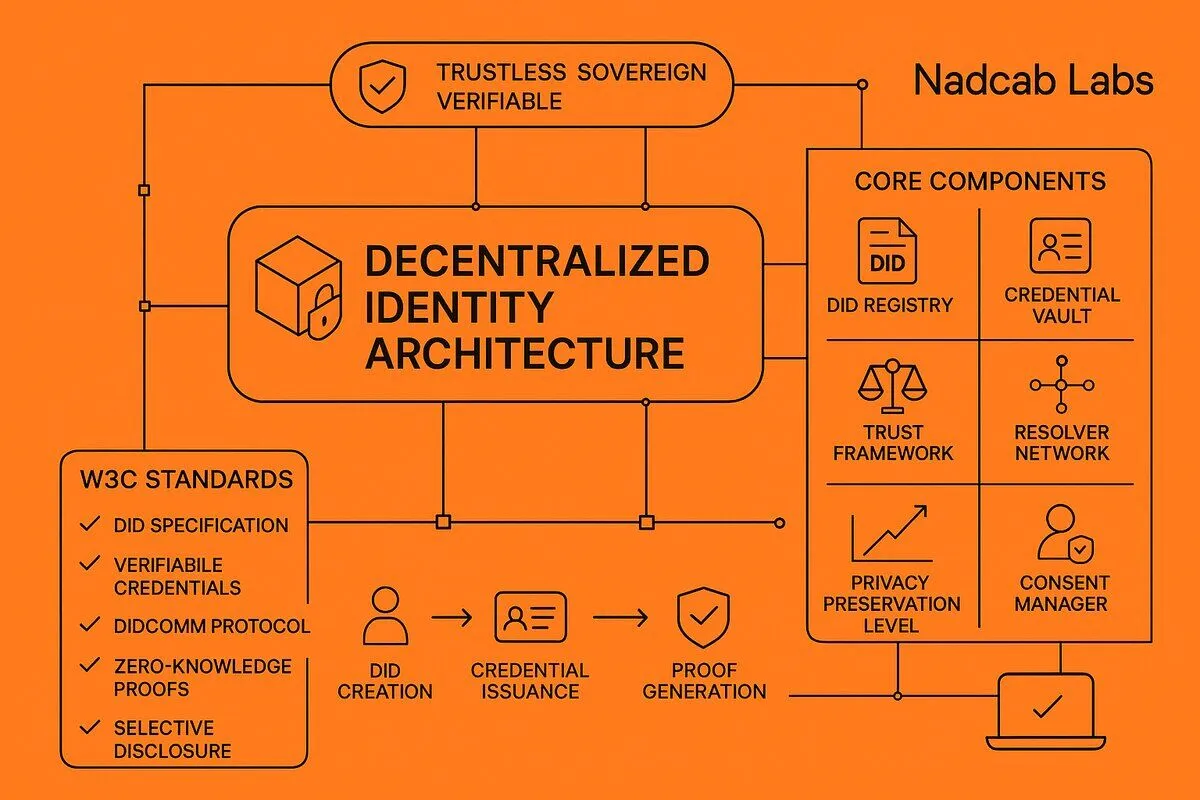
The World Wide Web Consortium defines the data model for verifiable credentials that enables interoperability across SSI implementations. This standard specifies how issuers create credentials, how holders store and present them, and how verifiers confirm their validity. Following W3C specifications ensures credentials issued by one system can be verified by others, preventing vendor lock-in and enabling ecosystem-wide trust relationships.
DID Methods and DID Documents
Decentralized identifiers use various methods for creation, resolution, and management depending on underlying infrastructure. Popular DID methods include did:ethr for Ethereum, did:ion for Bitcoin, and did:key for cryptographic key-based identifiers. Each DID resolves to a document containing public keys, authentication methods, and service endpoints that enable secure communication and verification. Choosing appropriate DID methods impacts interoperability, cost, and privacy characteristics.
Zero-Knowledge Proofs (ZK Identity)
Zero-knowledge proofs enable the most privacy-preserving credential verification possible, allowing users to prove claims without revealing underlying data. ZK identity implementations let users prove statements like being over a certain age without disclosing birthdates, or demonstrating credential validity without exposing credential contents. This cryptographic technique transforms SSI from data minimization to true zero-knowledge verification.
Credential Revocation Registries
Revocation mechanisms enable issuers to invalidate credentials when circumstances change, such as expired certifications, terminated employment, or discovered fraud. Various approaches exist including status lists, accumulators, and blockchain-anchored registries. Privacy-preserving revocation ensures verifiers can check credential status without learning which specific credential is being checked or tracking user verification patterns.
Challenges and Limitations of SSI in Web3
UX Complexity for Non-Technical Users
Self-sovereign identity introduces concepts unfamiliar to mainstream users accustomed to centralized login systems. Managing identity wallets, understanding credential presentations, and handling backup phrases creates friction that may discourage adoption. SSI integration services must prioritize user experience design that abstracts technical complexity while preserving security guarantees, making SSI accessible to users across diverse technical backgrounds.
Wallet Recovery and Credential Loss
Self-sovereignty means users bear responsibility for credential security and recovery. Lost wallet access may require complete credential reissuance, unlike centralized systems where password resets restore access. Social recovery mechanisms, secure backup strategies, and hardware security modules help mitigate these risks, but recovery remains more complex than traditional identity systems where providers maintain ultimate control.
Interoperability Between SSI Providers
Despite standardization efforts, practical interoperability between different SSI implementations remains challenging. Varying DID methods, credential formats, and verification protocols can create fragmented ecosystems where credentials from one system may not verify in another. Organizations must carefully evaluate ecosystem compatibility when selecting SSI infrastructure to ensure credentials remain portable across intended use cases.
Trust Issues with Credential Issuers
SSI systems depend entirely on issuer trustworthiness for credential validity. Malicious or compromised credential issuers could create fraudulent credentials that verifiers would accept. Establishing trust frameworks, governance models, and accountability mechanisms becomes essential for ecosystem security. Verifiers must carefully evaluate which issuers they trust and understand the implications of credential acceptance.
Compliance and Legal Considerations
GDPR and Data Minimization
SSI aligns naturally with GDPR principles by enabling data minimization and purpose limitation. Verifiers collect only necessary verification results.
KYC/AML Requirements
SSI satisfies regulatory requirements while improving privacy. Issuers perform full verification, then issue credentials that multiple verifiers can check.
Identity Proofing vs Privacy Balance
Organizations must balance thorough identity proofing with privacy preservation. SSI enables this balance through selective disclosure and ZK proofs.
Best Practices to Implement SSI in Web3
Choose the Right SSI Stack
- Evaluate ecosystem compatibility
- Consider credential format support
- Assess scalability requirements
Design Smooth Onboarding UX
- Abstract technical complexity
- Provide clear consent interfaces
- Enable progressive disclosure
Secure Wallet Integrations
- Implement secure key storage
- Enable backup mechanisms
- Support hardware wallets
Avoid Over-Collection
- Request minimal attributes
- Use ZK proofs where possible
- Implement data retention limits
Authoritative Industry Standards for SSI Implementation
Standard 1: Follow W3C Verifiable Credentials and DID specifications for maximum interoperability across SSI ecosystems.
Standard 2: Implement selective disclosure using BBS+ signatures or zero-knowledge proofs to minimize attribute exposure.
Standard 3: Establish formal issuer governance frameworks with audit requirements and accountability mechanisms.
Standard 4: Use privacy-preserving revocation mechanisms that avoid revealing credential usage patterns to observers.
Standard 5: Provide clear user consent interfaces showing exactly which attributes will be disclosed to each verifier.
Standard 6: Implement secure backup and recovery mechanisms for identity wallets to prevent permanent credential loss.
Standard 7: Store credentials in secure enclaves with hardware-backed key protection where available.
Standard 8: Conduct regular security audits of SSI implementations and credential verification flows.
Self-sovereign identity represents the identity layer that Web3 has always needed but lacked until now. As organizations across the USA, UK, UAE, and Canada build applications requiring verified user claims, SSI provides the only solution that aligns with Web3 principles of decentralization, user ownership, and privacy. Understanding how self-sovereign identity works and the benefits of self-sovereign identity positions teams to build applications that users can trust with their most sensitive information.
The technical foundations continue maturing rapidly, with standards achieving broader adoption and tooling improving accessibility. Whether implementing private KYC, enabling DAO governance, or building reputation systems, SSI solution for Web3 applications delivers the trust and privacy that next-generation digital experiences require. Organizations investing in SSI infrastructure today will lead the transformation of digital identity from corporate control to user sovereignty.
Ready to Implement Self-Sovereign Identity?
Partner with our experienced team to integrate SSI solutions that empower users while meeting your compliance and security requirements.
Explore Services
Related Services
Reviewed by

Aman Vaths
Founder of Nadcab Labs
Aman Vaths is the Founder & CTO of Nadcab Labs, a global digital engineering company delivering enterprise-grade solutions across AI, Web3, Blockchain, Big Data, Cloud, Cybersecurity, and Modern Application Development. With deep technical leadership and product innovation experience, Aman has positioned Nadcab Labs as one of the most advanced engineering companies driving the next era of intelligent, secure, and scalable software systems. Under his leadership, Nadcab Labs has built 2,000+ global projects across sectors including fintech, banking, healthcare, real estate, logistics, gaming, manufacturing, and next-generation DePIN networks. Aman’s strength lies in architecting high-performance systems, end-to-end platform engineering, and designing enterprise solutions that operate at global scale.