Ai Overview
It’s the profit miners, validators, and searchers can earn by reordering, inserting, or censoring transactions. In simple terms, MEV is hidden value extraction from blockchain transactions that users don’t expect and don’t receive. But before you pay, a store employee notices what’s in your cart and buys all the popular items before you finish paying. For example: “I want to swap 10 ETH for USDC at a minimum acceptable rate of 2,500 USDC per ETH.
Key Takeaways
- ✓MEV protection in DeFi shields users from front running and sandwich attacks that exploit public transaction visibility
- ✓Front running attacks happen when traders intercept pending transactions in public mempools to profit from price movements
- ✓Private mempools hide transactions from public view until final settlement, reducing exposure to malicious extraction
- ✓Intent based execution separates user intent from execution details, enabling fairer transaction ordering mechanisms
- ✓Solver networks compete to execute transactions fairly rather than allowing mempool snooping and sandwich attacks
- ✓Batch auctions and shared sequencing distribute MEV more fairly across participants rather than concentrating value extraction
- ✓Layer 2 rollups and execution abstraction improve transaction ordering and reduce opportunities for malicious front running
- ✓Building secure DeFi execution systems requires balancing decentralization, speed, and protection against MEV attacks
- ✓Modern DeFi infrastructure companies help protocols implement fair execution layers and MEV resistant systems
- ✓The future of DeFi depends on widespread adoption of intent centric architectures and transparent transaction execution
Understanding MEV and Transaction Security in DeFi
Every day, millions of users interact with decentralized finance protocols. They swap tokens, provide liquidity, and trade assets. But most don’t realize something troubling is happening behind the scenes.
When you submit a transaction to a decentralized exchange, it doesn’t execute instantly. Your order sits in a public memory pool, visible to everyone on the network. In those precious seconds before confirmation, bad actors can see your transaction and insert their own orders before yours. This is called front running.
The result? You receive fewer tokens than expected. The difference profits someone else. This problem affects DeFi exchanges, lending protocols, and billions in daily transaction volume.
MEV protection in DeFi represents the modern solution to this age old problem of transaction manipulation. Modern protocols now employ sophisticated execution systems, private mempools, intent based architecture, and solver networks to ensure fair transaction ordering.
In this guide, we’ll explain how front running happens, why it costs users real money, and how next generation DeFi infrastructure is solving execution quality problems once and for all.
What Is MEV in DeFi?
Quick Definition:
MEV stands for Maximal Extractable Value. It’s the profit miners, validators, and searchers can earn by reordering, inserting, or censoring transactions. In simple terms, MEV is hidden value extraction from blockchain transactions that users don’t expect and don’t receive.
Let’s imagine you’re shopping at a grocery store. You’ve selected items and walked to checkout. But before you pay, a store employee notices what’s in your cart and buys all the popular items before you finish paying. They then sell those items to you at a markup.
That’s essentially what MEV is in blockchain. Your transaction is visible to everyone before execution. The network sees your order. Others profit from knowing what you’re about to do before you do it.
Who Benefits from MEV Today?
- Block Builders: Validators who construct blocks and select transaction ordering
- Searchers: Bots that scan the mempool for profitable transactions to frontrun
- Miners and Validators: Network participants who can reorder transactions for profit
- MEV Relayers: Intermediaries who match transactions and extract ordering value
Regular DeFi users see none of this value. Instead, they experience slippage, failed transactions, and unexpectedly poor execution prices.
What Are Front Running and Sandwich Attacks?
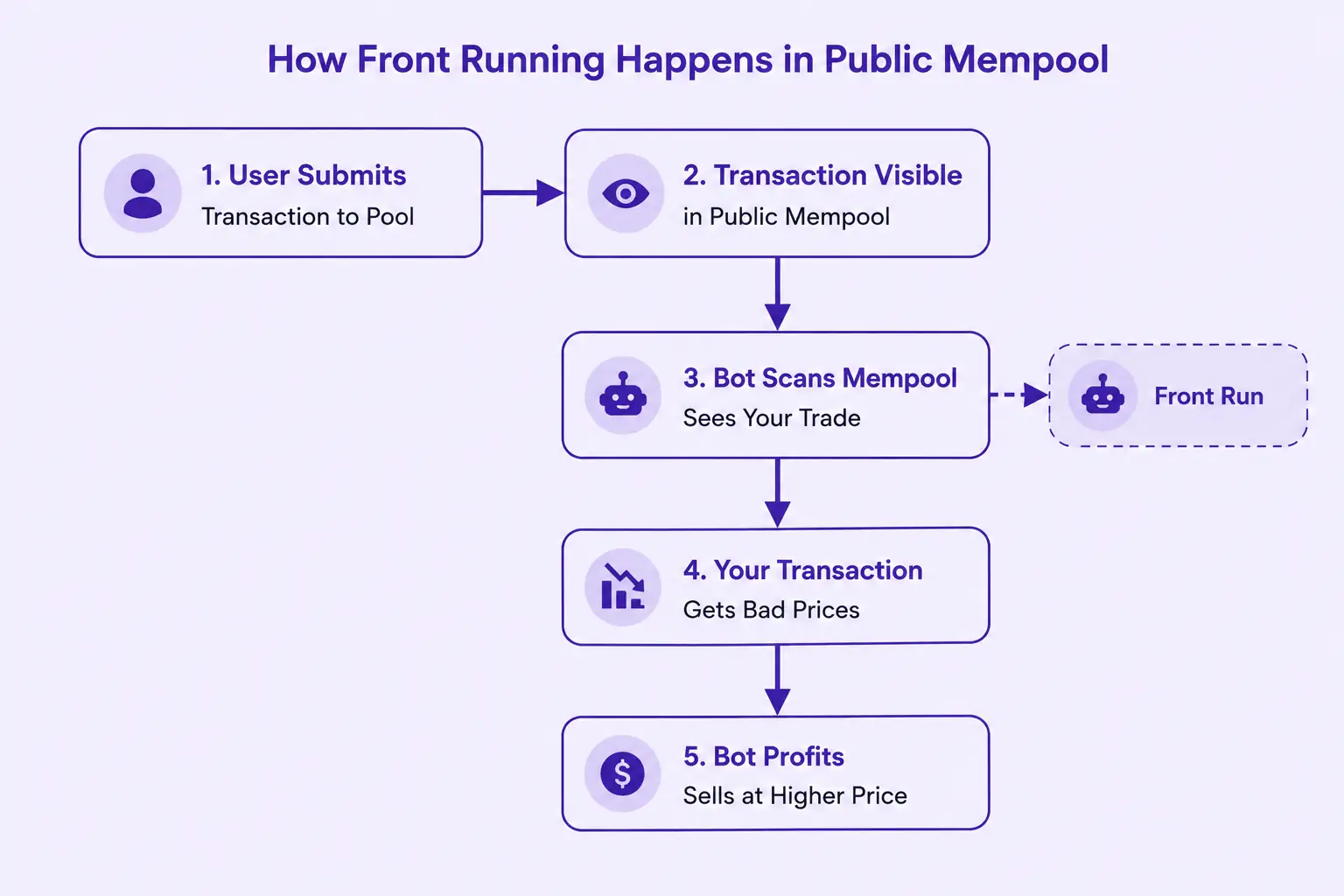
Front running is when someone intercepts your pending transaction and executes their own transaction before yours. In sandwich attacks, the attacker places transactions both before and after your transaction, profiting from the price movement your trade creates.
How a Sandwich Attack Works in DeFi: Step by Step
Step 1: You Submit Your Swap
You want to swap 10 ETH for USDC on a decentralized exchange. Your transaction sits in the public mempool waiting for confirmation.
Step 2: A Bot Sees Your Transaction
A searcher bot scans the mempool constantly. It sees your large ETH order and realizes it will move the market price upward when executed.
Step 3: The Front Running Transaction
The bot places its own swap BEFORE your transaction in the block. It buys the same token you’re about to buy at the current price.
Step 4: Your Transaction Executes
Your ETH to USDC swap executes next. But the price has moved because the bot already bought tokens. You get fewer tokens than you expected.
Step 5: The Back Running Transaction
The bot sells the tokens it bought in Step 3 at the new higher price. It profits from the difference between the old and new price your transaction created.
Real World Cost of Front Running
Think about a simple example. You swap 100 tokens worth $1,000. Due to front running, you receive tokens worth $970 instead. That $30 loss represents 3% slippage that shouldn’t happen on a fair DEX.
Now multiply this across millions of daily DeFi transactions. Billions in value disappear due to MEV extraction. Front running isn’t a minor issue. It’s a fundamental fairness problem in blockchain infrastructure.
Why Traditional DeFi Systems Are Vulnerable to MEV
Public mempools expose pending transactions to all network participants. This transparency enables anyone to see what orders are coming and profit from that information before the transactions confirm.
The Core Vulnerability: Transaction Transparency
Blockchain networks, especially Ethereum, are designed for transparency. Every full node can see every pending transaction. This is great for decentralization and verification. But it creates a massive attack surface for MEV.
When you broadcast a transaction, it doesn’t disappear. It lives in the mempool for everyone to inspect. Your token amounts, your destination address, your contract interactions—all visible. Searchers run sophisticated bots that analyze this data constantly.
The Problem of Transaction Ordering
Once your transaction reaches a block, another vulnerability emerges. The block builder or validator decides the order of transactions. They can reorder your transaction to profit from it.
Validators and block builders have economic incentives to extract MEV. In fact, it’s often more profitable than their base block reward. This creates a situation where fair ordering becomes secondary to MEV maximization.
- Search Access: Bots see all pending transactions before confirmation
- Ordering Power: Validators choose which transactions go first
- Economic Incentives: MEV rewards are often higher than honest validation
- Information Asymmetry: Users don’t know they’re being exploited
This combination creates a systemic problem where normal DeFi users bear the cost while networks don’t incentivize fair execution.
Public Mempools vs Private Mempools
| Feature | Public Mempool | Private Mempool |
|---|---|---|
| Transaction Visibility | Visible to all network nodes before execution | Hidden until final settlement |
| Front Running Risk | Very High | Significantly Reduced |
| MEV Extraction | Widespread and profitable | Minimized through encryption |
| Decentralization | Fully transparent and open | Requires trusted operators |
| User Protection | Minimal protections against attacks | Strong protection from sandwich attacks |
| Examples | Ethereum mainnet, standard DEX pools | Flashbots Relay, MEV protected pools |
Private mempools hide transactions from public view until they’re included in a block. This reduces the window for front running attacks. But private mempools introduce their own tradeoffs around centralization and trust.
How Intent Based Execution Works
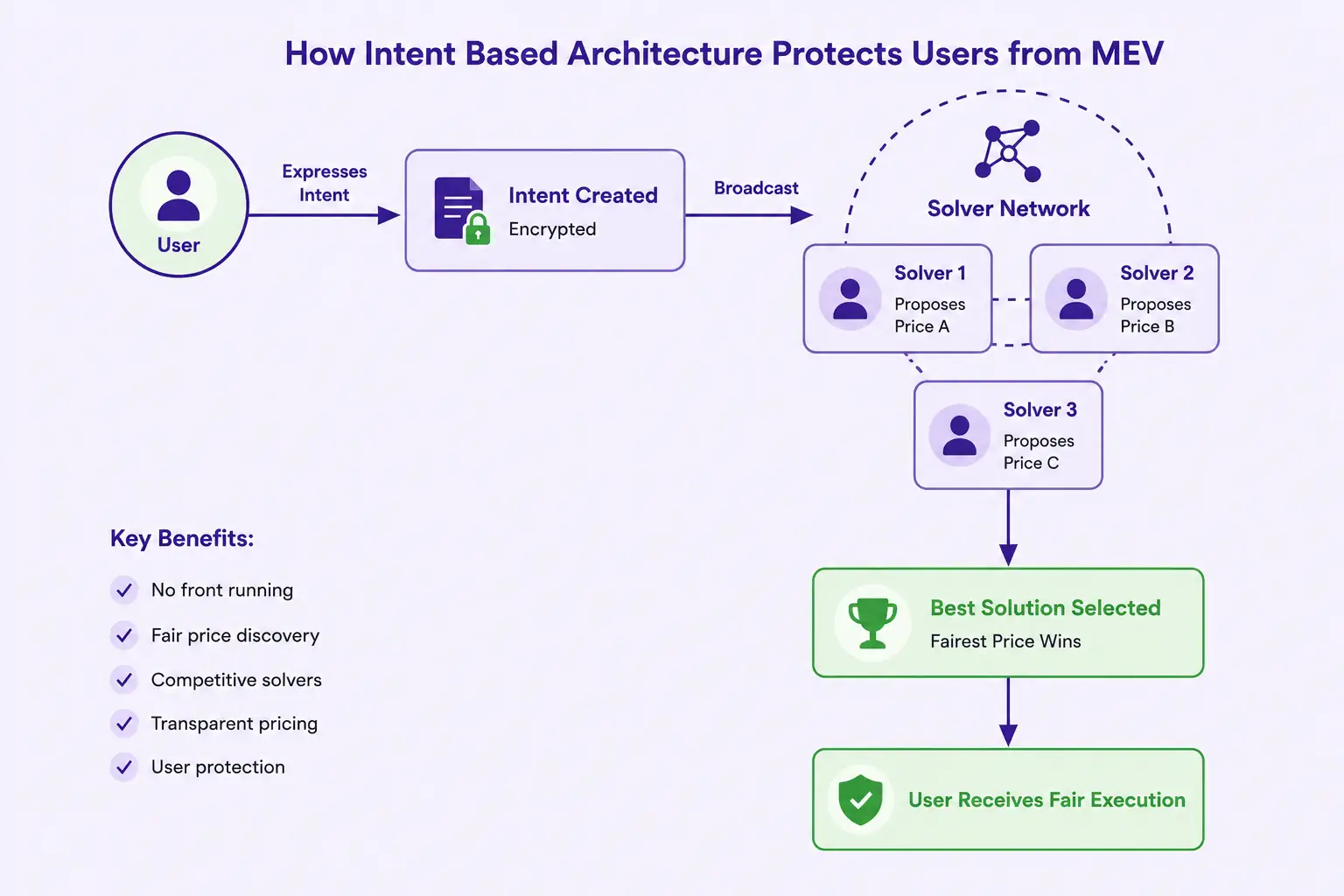
Intent based execution separates what you want from how it gets done. Users express their trading intent without revealing exact transaction details. Solvers compete to fulfill that intent fairly, reducing MEV opportunities.
Intent Based Execution: Step by Step
Step 1: User Expresses Intent
Instead of broadcasting a transaction, you express your intent. For example: “I want to swap 10 ETH for USDC at a minimum acceptable rate of 2,500 USDC per ETH.”
Step 2: Intent Is Encrypted and Submitted
Your intent is encrypted and sent to a solver network, not broadcast to the public mempool. The actual token amounts and contract interactions remain hidden.
Step 3: Solvers Compete to Fulfill Intent
Multiple solvers receive your encrypted intent. They analyze their resources, liquidity access, and pricing. They propose solutions that fulfill your intent while optimizing for fair execution.
Step 4: Best Solution Is Selected
The solver offering the best price or execution quality is selected. Your trade is executed through their proposed solution.
Step 5: Settlement Occurs On Chain
The execution details are finalized and settled on the blockchain. You receive your swapped tokens at a fair price without MEV extraction.
Why Intent Based Execution Reduces MEV
- Hidden Details: Exact transaction data isn’t visible to the public before execution
- Competition: Solvers compete on price and quality, not on MEV extraction ability
- Abstraction: Users don’t need to know execution details or technical specifics
- Fairness Mechanisms: Intent based systems can enforce fair ordering and pricing
This approach shifts incentives from MEV extraction to fair execution. Solvers make money by providing better prices and faster execution, not by front running users.
Traditional MEV Vulnerable Transaction Flow
What Are Solver Networks in DeFi?
Solver networks are decentralized systems where multiple participants compete to execute user intents fairly. Instead of miners reordering transactions, solvers propose execution solutions and are selected based on price and quality.
In a solver network, no single entity controls transaction ordering. Instead, multiple solvers receive encrypted user intents and propose solutions. The best solution wins based on competitive bidding and reputation.
How Solver Networks Replace MEV Extraction
- Decentralized Participation: Anyone can become a solver with sufficient capital and technical infrastructure
- Competitive Bidding: Solvers compete on execution quality, not MEV extraction ability
- Transparent Pricing: Users can see and compare multiple solutions before accepting execution
- Reputation Systems: Reliable solvers build reputation and earn more intent volume
This transforms the economic game. Instead of hidden value extraction, solvers make money through better execution and honest pricing. The incentives align with user interests rather than against them.
Intent Based Execution with Solver Networks
How Private Mempools Reduce Transaction Exploitation
Private mempools encrypt transactions until they’re included in a block. This eliminates the visibility window where MEV extraction attacks can occur. Users can’t be front run if their transaction isn’t publicly visible.
How Private Mempools Work
Instead of broadcasting your transaction to every node on the network, private mempool services send your transaction directly to a trusted relay. The relay includes your transaction in blocks without exposing it to the public mempool first.
Flashbots Relay, for example, operates a private mempool service for Ethereum. Builders and validators use Flashbots to receive bundles of transactions that are kept private and executed in the chosen order.
Benefits and Tradeoffs of Private Mempools
- Front Running Protection: Transactions aren’t visible until confirmed, eliminating MEV extraction attacks
- Faster Confirmation: Private relay services often confirm transactions faster than public mempool
- Privacy: Your transaction details are shared only with trusted parties
Centralization Concerns
The main tradeoff with private mempools is trust. You must trust the relay operator not to exploit your transaction. If the relay is compromised or operated maliciously, your privacy and execution quality could be at risk.
This creates a tension: private mempools solve MEV protection but introduce centralization. Modern DeFi infrastructure research focuses on achieving MEV protection without sacrificing decentralization through intent based execution and distributed solver networks.
What Are Batch Auctions in Blockchain?
Batch auctions collect pending transactions and execute them simultaneously at a uniform price. This prevents front running by ensuring no one benefits from executing transactions first.
How Batch Auctions Work in DeFi
Imagine an auction where multiple people want to buy an item. Instead of first come, first served, the auctioneer collects all bids first. Then all winning bids are executed at the same price. No one benefits from bidding early.
Batch auctions in blockchain work similarly. Transactions are grouped into batches. All trades in a batch execute at a clearing price determined after all transactions in the batch are known. This eliminates the advantage of transaction ordering.
Why Batch Auctions Reduce MEV
- Uniform Pricing: All transactions in a batch get the same execution price
- Eliminated Front Running: Earlier execution doesn’t guarantee better prices
- Fair Treatment: All participants are treated equally regardless of transaction timing
- MEV Distribution: Any MEV from price movements is distributed across batch participants
Batch auctions trade speed for fairness. Since transactions aren’t executed instantly, there can be delays. But for many DeFi users, fair execution is worth the slight latency.
Traditional vs Intent Based DeFi Execution
| Aspect | Traditional Execution | Intent Based Execution |
|---|---|---|
| Transaction Format | Complete transaction details visible | Encrypted user intent only |
| Execution Control | Protocol and miners control ordering | Solvers propose and compete on solutions |
| MEV Exposure | High exposure through public visibility | Minimized through abstraction |
| Price Discovery | Single execution path available | Multiple solutions proposed and compared |
| User Knowledge | Technical execution understanding needed | Simple intent expression required |
| Scalability | Limited by protocol throughput | Scales with number of solvers |
Intent based execution fundamentally changes how users interact with DeFi. Instead of writing transactions, users express what they want. The infrastructure handles the complex execution details.
Shared Sequencing and Cross Chain Execution
Shared sequencing services order transactions across multiple blockchains. This prevents MEV in single chain execution and enables fair cross chain transaction ordering.
As DeFi expands across multiple blockchains and Layer 2 solutions, a new problem emerges. Users need to interact with liquidity and protocols across different chains. Without coordination, MEV problems multiply.
Shared sequencing services act as coordinators. They receive transactions from multiple chains and order them in a unified way. This prevents front running that would happen if each chain ordered transactions independently.
Benefits of Shared Sequencing for MEV Protection
- Cross Chain Fairness: Transactions ordered fairly across multiple networks simultaneously
- Atomic Execution: Cross chain swaps and interactions execute atomically
- MEV Reduction: Eliminates MEV opportunities from chain hopping and ordering arbitrage
- Liquidity Aggregation: Access best prices across all chains through single intent
Shared sequencing represents the evolution of MEV protection for multi chain DeFi. It addresses a fundamental scaling challenge: how to maintain execution fairness as users interact with fragmented liquidity across many blockchains.
How Rollups Improve Transaction Fairness
Layer 2 rollups bundle multiple transactions into single on chain settlements. This reduces MEV opportunities and improves execution fairness by abstracting away transaction ordering at the base layer.
Rollups are designed to scale Ethereum by processing thousands of transactions off chain and settling them in batches on chain. But they also improve MEV protection.
Why Rollups Help With MEV
In optimistic rollups and ZK rollups, the rollup sequencer controls transaction ordering within the rollup, not the base layer validators. This allows rollup designers to implement MEV resistant sequencing mechanisms.
Many rollups are adopting fair ordering services and intent based sequencing at the rollup level. This means MEV protection in DeFi no longer depends solely on base layer design. Rollups can innovate faster on execution fairness.
- Sequencer Control: Rollups control ordering independently from base layer
- Fair Ordering Services: Rollups can implement MEV resistant sequencers
- Intent Based Sequencing: Rollups can use intent based architecture natively
- Faster Innovation: Execution fairness improvements deploy at rollup level
This architecture creates competition among Layer 2 solutions. Rollups that offer better MEV protection attract users and liquidity. This incentivizes rapid innovation in MEV resistant infrastructure.
SUAVE Architecture and Advanced MEV Protection
SUAVE (Single Unified Auction for Value Expression) is a proposed architecture where a dedicated chain handles MEV and ordering. This separates execution layer concerns from validation and consensus.
SUAVE represents a next generation approach to MEV protection. Instead of embedding MEV handling into validator incentives and protocol design, SUAVE creates a specialized layer specifically for MEV and fair ordering.
How SUAVE Works
The SUAVE design proposes a separate blockchain that handles intent expression, solver networks, and MEV ordering. This chain receives encrypted user intents and runs solvers to determine fair execution. The results are sent to application chains for settlement.
By separating MEV handling from consensus, SUAVE allows each application chain to focus on execution and settlement. The specialized MEV layer can optimize purely for fairness and efficiency without affecting the base protocol.
SUAVE Benefits for MEV Protection
- Specialized MEV Design: A dedicated chain focused entirely on fair ordering and execution
- Chain Abstraction: Application chains can ignore MEV concerns and focus on functionality
- Solver Competition: Solvers compete globally on a single MEV aware chain
- Composable Liquidity: Seamless MEV protection across all connected applications
SUAVE architecture addresses a key limitation of current approaches. Instead of each chain implementing its own MEV protection, a unified layer handles it globally. This creates network effects and improves efficiency.
Challenges in Building Fair DeFi Execution Systems
Building MEV protection in DeFi requires balancing decentralization, speed, and fairness. Every approach introduces tradeoffs that protocols must carefully navigate.
The Decentralization vs Fairness Tension
Pure decentralization creates MEV opportunities. Public mempools enable front running. But adding MEV protections often requires trust in operators or service providers. This creates a fundamental tradeoff.
Private mempools protect users but require trusting the relay operator. Intent based execution requires trusting solvers. Batch auctions create latency. Every MEV protection mechanism introduces costs elsewhere.
Speed vs Fairness
Instant transaction execution enables MEV. Users want transactions confirmed fast. But fair ordering mechanisms often require collecting and processing multiple intents before execution.
Batch auctions introduce latency. Intent based systems require waiting for solver proposals. The faster a system operates, the harder it becomes to implement fair ordering mechanisms.
Practical Implementation Challenges
- Solver Economics: Solvers must be profitable to attract participation, but can still exploit MEV
- Cryptographic Overhead: Encryption and verification adds computation cost
- Capital Requirements: Solver networks require significant capital reserves
- Coordination Problems: Getting stakeholders to adopt new execution mechanisms is difficult
These challenges are real. MEV protection in DeFi is not a solved problem. Modern protocols continue experimenting with different approaches. The ideal solution will likely combine multiple techniques depending on the specific use case and protocol design.
How Businesses Benefit From Secure Execution Layers
Startups and enterprises building DeFi protocols benefit from MEV protection in DeFi by offering better user protection and competitive advantages in execution quality.
Why Execution Quality Matters for Business
Users choose DeFi protocols based on price, speed, and trust. A protocol that offers better execution quality attracts more users. MEV protection in DeFi becomes a competitive advantage.
When users experience poor execution prices due to front running, they leave for competitors. Protocols implementing intent based execution or fair ordering can retain users and build loyalty through superior execution quality.
Building MEV Protected DeFi Infrastructure
Companies like Nadcab Labs help DeFi protocols and blockchain projects build secure execution layers. This involves designing and implementing:
- Intent Based Architecture: Systems where users express intent rather than specific transactions
- Solver Networks: Decentralized systems for executing and ordering intents fairly
- Fair Sequencing Services: Mechanisms to order transactions without MEV extraction
- Cross Chain Execution: Systems for fair ordering across multiple blockchains
- Rollup Optimization: Layer 2 solutions with built in MEV protection
DeFi projects building on these technologies gain immediate competitive advantages. Users experience better execution. The protocol gains reputation for fairness. This translates to higher adoption and TVL.
As blockchain technology matures, execution fairness becomes table stakes. Projects that ignore MEV protection in DeFi risk losing users to competitors with better execution quality.
The Future of Intent Centric DeFi Infrastructure
The future of DeFi relies on widespread adoption of intent centric execution systems that protect users from MEV attacks while maintaining decentralization and performance.
Emerging Trends in MEV Protection
The DeFi infrastructure landscape is evolving rapidly. Intent based execution is gaining adoption. Solver networks are becoming more sophisticated. Layer 2 solutions are competing on execution quality.
We’re seeing a shift from passive MEV extraction to active MEV minimization. Projects that previously accepted front running as inevitable are now implementing protection mechanisms. This represents a fundamental change in how DeFi protocols think about user protection.
What Users Should Expect
In the next few years, MEV protection in DeFi will become standard rather than optional. Users will expect fair execution by default. Protocols without MEV protection will be at a competitive disadvantage.
Intent based architecture will likely become the dominant execution model. Users will express what they want (swap tokens, provide liquidity, etc.) without worrying about transaction details. The infrastructure handles complexity invisibly.
Cross chain and multi chain DeFi will rely on shared sequencing and distributed solver networks. Transaction fairness will be maintained across fragmented liquidity.
The Role of Blockchain Development Companies
As MEV protection becomes critical, DeFi projects increasingly partner with experienced blockchain infrastructure providers. Companies specializing in execution layer design and implementation become essential partners.
Nadcab Labs and similar companies help projects implement state of the art execution systems. This includes designing intent based architecture, building solver networks, and optimizing cross chain execution.
The complexity of modern DeFi infrastructure means most projects can’t build these systems alone. Partnering with experienced blockchain development companies accelerates innovation and ensures best practices.
Build Secure and Scalable DeFi Infrastructure
Protect your users from MEV attacks and front running. Implement intent based execution, solver networks, and fair sequencing mechanisms. Nadcab Labs specializes in designing and building next generation DeFi execution systems.
Startups, protocols, and enterprises benefit from MEV protection in DeFi through better user protection, competitive execution quality, and improved protocol reputation. Partner with Nadcab Labs to implement secure execution layers that give your users the fairness they deserve.
The Future of Fair DeFi Execution
MEV protection in DeFi is no longer optional. Users are increasingly aware of front running and sandwich attacks. They’re choosing protocols that offer better execution quality.
The solutions exist. Intent based execution, solver networks, private mempools, batch auctions, shared sequencing, and rollup optimization all contribute to fairer execution. The challenge is implementing these mechanisms at scale while maintaining decentralization and performance.
Modern DeFi protocols are adopting MEV protection in DeFi as a core feature. This isn’t a niche concern anymore. It’s a fundamental aspect of protocol design and user protection.
As you evaluate DeFi protocols and infrastructure, ask about their execution quality. Do they implement fair ordering mechanisms? Do they protect against front running? Do they offer solver competition?
The best DeFi protocols won’t just offer liquidity and yield. They’ll offer fairness. They’ll protect users from invisible costs and value extraction. They’ll implement execution systems that serve user interests rather than MEV maximizers.
MEV protection in DeFi represents maturation of blockchain technology. It’s the difference between first generation systems that naively expose users to attacks and next generation systems that actively protect users.
The future of DeFi is intent centric. The future is fair. The future requires execution systems designed for user protection. That future is being built now.
Frequently Asked Questions
Q1.Can I calculate how much MEV I've lost on my DeFi trades?
Yes, several tools analyze blockchain transactions to estimate MEV impact. Flashbots provides MEV inspection tools. You can check transaction slippage against expected prices to estimate MEV costs. Most DeFi analytics platforms now highlight potential MEV exposure. Use MEV transaction analyzers to audit your past trades.
Q2.Which DeFi protocols currently offer the best MEV protection?
CoW Swap pioneered intent based execution and offers strong MEV protection. MEV Blocker provides flashbots protection. Some rollups like Arbitrum implement fair sequencing. StarkEx uses validity proofs for secure execution. Protocols continuously evolve their execution mechanisms. Research recent protocol updates for current MEV protection capabilities.
Q3.Is intent based execution the same as shielded transactions?
No. Intent based execution abstracts transaction details. Users express intent without specifying exact contract interactions. Shielded transactions hide transaction details for privacy. Intent based systems focus on fair execution. Shielded systems focus on privacy. Both can coexist but serve different purposes. Intent based execution requires trust in solvers.
Q4.Why don't all protocols use private mempools if they prevent front running?
Private mempools introduce centralization. Users must trust the relay operator. They can censor or manipulate transactions. They create single points of failure. They limit transparency. Protocols want decentralization alongside fairness. Private mempools solve fairness but sacrifice decentralization. Intent based execution offers better tradeoffs.
Q5.How do solvers in intent based systems make profit without extracting MEV?
Solvers profit from execution spreads, not MEV extraction. They execute user intents profitably by routing through optimal liquidity sources. They charge small execution fees. They compete on price, encouraging efficiency. They earn from volume, not information asymmetry. This aligns solver incentives with user interests. MEV extraction requires exploiting information asymmetry solvers can’t access.
Q6.What's the latency impact of batch auction based DeFi execution?
Batch auctions typically introduce delays from seconds to minutes. They collect all transactions in a batch window, then execute simultaneously. The batch window creates latency. For traders wanting instant execution, batch auctions feel slow. For institutional trades and large positions, latency tradeoff is acceptable. Different use cases have different latency tolerance levels.
Q7.Can MEV occur on different blockchains besides Ethereum?
Yes, MEV is universal to all blockchains. Solana experiences MEV through ordering attacks. Cosmos chains face MEV in transaction ordering. Bitcoin transactions experience MEV through fee manipulation. Any blockchain with public mempools and validator controlled ordering experiences MEV. The mechanisms vary by chain, but the fundamental problem is identical.
Q8.How do rollups handle MEV differently than Layer 1 chains?
Rollups control their own sequencing independent from Layer 1. They can implement MEV resistant sequencers. They can use intent based execution natively. They batch transactions for Layer 1 settlement, abstracting transaction ordering. This gives rollups more flexibility in MEV handling. Layer 1 chains must maintain validator participation through consensus. Rollups have more freedom to optimize for fairness.
Q9.What happens to MEV if all transactions are encrypted end to end?
Encrypted transactions eliminate information based MEV. No one can see transaction details to front run. However, ordering based MEV still exists. Encrypting transaction content doesn’t specify transaction order. Validators still choose which encrypted transactions to include and in what order. Complete MEV elimination requires both encryption and fair ordering mechanisms.
Q10.How do I choose a DeFi protocol based on MEV protection quality?
Evaluate MEV protection mechanisms implemented by the protocol. Does it use intent based execution? Does it have solver networks? Does it implement fair sequencing? Check protocol documentation and research papers. Compare slippage on trades between protocols. Read community discussions about execution quality. Check if the protocol conducts MEV research. Partner with established blockchain infrastructure providers who ensure best practices. MEV protection is now a key protocol differentiator.
Explore Services
Related Services
Reviewed by

Aman Vaths
Founder of Nadcab Labs
Aman Vaths is the Founder & CTO of Nadcab Labs, a global digital engineering company delivering enterprise-grade solutions across AI, Web3, Blockchain, Big Data, Cloud, Cybersecurity, and Modern Application Development. With deep technical leadership and product innovation experience, Aman has positioned Nadcab Labs as one of the most advanced engineering companies driving the next era of intelligent, secure, and scalable software systems. Under his leadership, Nadcab Labs has built 2,000+ global projects across sectors including fintech, banking, healthcare, real estate, logistics, gaming, manufacturing, and next-generation DePIN networks. Aman’s strength lies in architecting high-performance systems, end-to-end platform engineering, and designing enterprise solutions that operate at global scale.