Ai Overview
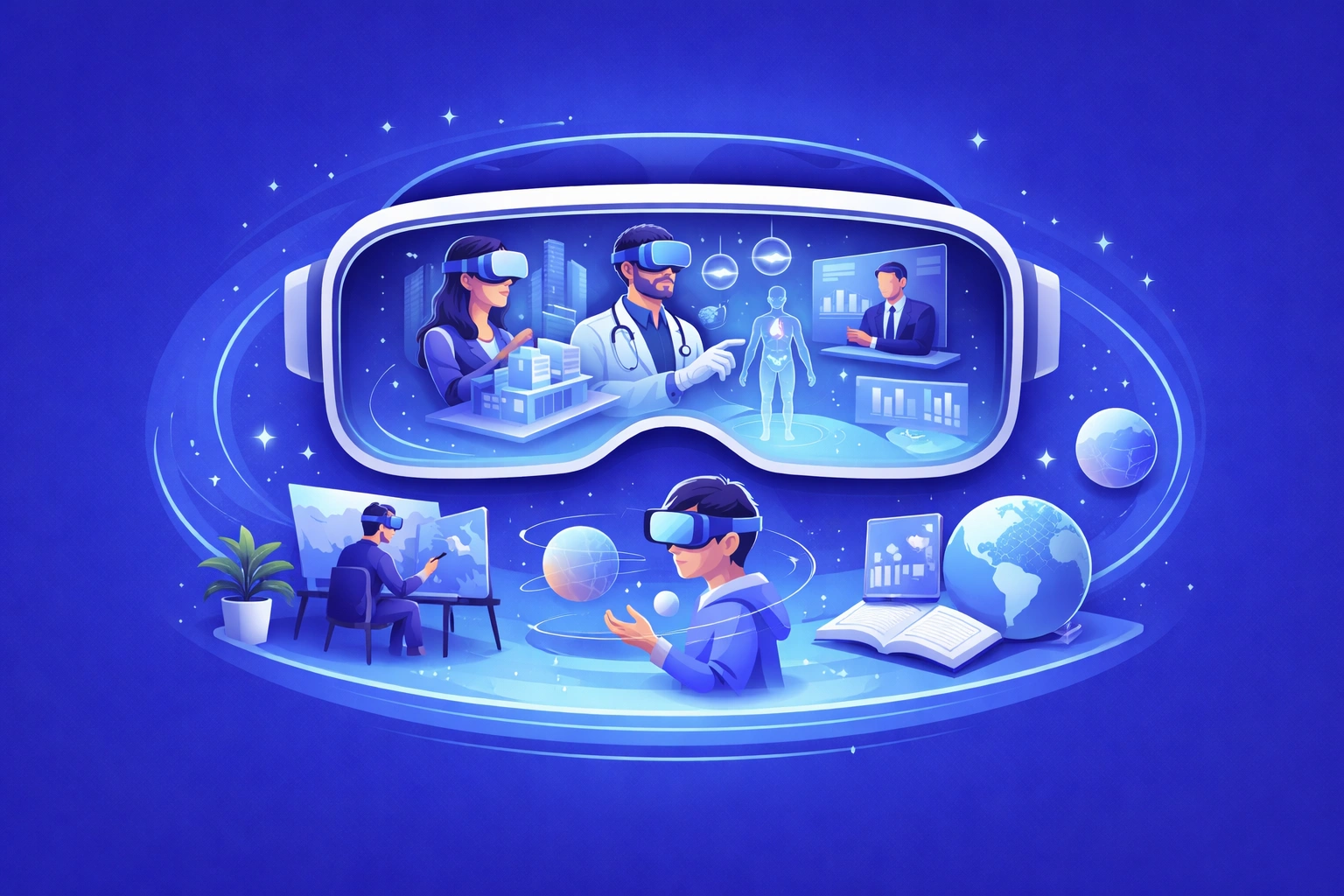
Before we move into the market outlook, let’s define the metaverse. Metaverse is a shared, persistent digital universe where users interact through virtual identities. It blends VR, AR, 3D worlds, and real-world data to enable socializing, work, gaming, commerce, and creation. It functions as an interconnected network of immersive experiences rather than a single platform or technology.
Before we move into the market outlook, let’s define the metaverse. Metaverse is a shared, persistent digital universe where users interact through virtual identities. It blends VR, AR, 3D worlds, and real-world data to enable socializing, work, gaming, commerce, and creation. It functions as an interconnected network of immersive experiences rather than a single platform or technology.
1.Why Metaverse Data Matters
The metaverse is no longer science fiction. What once was a futuristic vision of virtual worlds, a mix of immersive 3D spaces, social interaction, gaming, digital assets, and augmented/virtual reality is rapidly evolving into a serious economic and technological ecosystem. For businesses, developers, investors, and decision-makers, understanding the real data behind metaverse adoption, growth, and trends is vital to assess opportunity, risk and long-term potential.
Metaverse data also supports security and trust. It helps authenticate users, protect digital assets, and prevent fraud or misuse. For creators and developers, data provides insights to build scalable, personalized, and immersive environments. As more industries enter the metaverse gaming, education, retail, and events the value of accurate and secure data becomes even more important.[1]
2. Global Metaverse Market Size & Forecast (2023–2027).
One of the most credible indicators of metaverse expansion comes from Markets, which reported a global market valuation of USD 61.8 billion in 2022, alongside a projection of USD 426.9 billion by 2027 representing a powerful 47.2% CAGR (MarketsandMarkets).
Using that CAGR, the following year-by-year market size estimates for 2023–2027 can be generated. These calculations align closely with growth patterns referenced in GlobeNewswire and similar forecast reports.[2]
Metaverse Market Size Forecast (Using MarketsandMarkets CAGR Method):
- 2023: USD 90.97 billion
- 2024: USD 133.91 billion
- 2025: USD 197.11 billion
- 2026: USD 290.15 billion
- 2027: USD 427.10 billion
These projections show how aggressively the metaverse ecosystem is scaling, with the market more than increasing within five years. Even conservative studies confirm the same trend: strong year-over-year growth fueled by advancements in AR/VR hardware, virtual platforms, blockchain integration, and enterprise adoption.
Metaverse market growth based on consistent multi-source data (MarketsandMarkets, GlobeNewswire, and similar research outlets), the metaverse is evolving into a multi-hundred-billion-dollar economy, positioning itself as one of the fastest-rising technology sectors globally.
Also Read: Blockchain in Metaverse: The Ultimate Guide to Decentralized Virtual Worlds
3. User Adoption & Active Users Is People Actually Using It?
A market is only as strong as its user base. So how many people are actively using metaverse platforms in 2024–2025?
- A 2025 report estimated around 700 million monthly active metaverse users (MAUs) globally.>[3]
- Some older reports (2024–2025) suggested over 600 million active users globally.[4]
- Regarding demographics: one 2025 source claims that a significant portion of users are very young for example, a large share under age 13 (though these youth-heavy demographics are sometimes debated).
- Usage patterns: some reports suggest that with better accessibility (smartphones, mobile + desktop + VR), the entry barrier is shrinking, encouraging more users worldwide.
With hundreds of millions monthly users, the metaverse already rivals many major global platforms. That critical mass gives the ecosystem a foundation for further growth social, economic, gaming, virtual commerce, and more.
Build My Metaverse Now!
Turn your dream into reality with a powerful, secure metaverse built just for you. Start building now and watch your idea come alive!
4. Technology & Hardware Adoption AR / VR Headsets Market
User adoption doesn’t just require platforms it also depends on hardware (headsets, AR glasses, VR gear) and accessibility.
- According to recent market-analysis, global AR/VR headset shipments + display-less smart glasses are expected to hit 14.3 million units in 2025, growing roughly 39.2% that year.[5]
- A broader hardware- market forecast estimates the AR/VR headsets market size (revenue) at USD 10.9 billion in 2025, with long-term growth projected to 2035.[6]
- Mixed reality (MR) and AR adoption are increasingly being counted as part of the metaverse’s hardware infrastructure as more users adopt lighter headsets or glasses, and enterprises explore MR for work/training rather than only gaming.[7]
Takeaway Hardware availability and affordability are improving, which reduces barriers to entry for users and accelerates the growth of the metaverse ecosystem both consumer and enterprise side
5. Industry & Sector-wise Adoption and Who Uses the Metaverse, and How?
The metaverse isn’t just about gaming or social hangouts. Its reach is expanding across many sectors. Based on recent studies and forecasts:
- By technology segment, virtual reality/augmented reality remain dominant within the metaverse, but software, platforms, and mixed reality are rising too.[8]
- By platform or use-case: gaming, virtual platforms, social/social-gaming, digital assets, e-commerce, virtual events all are parts of metaverse growth.[9]
- Regionally, while North America has historically led the metaverse market share, the fastest metaverse market growth is expected in Asia Pacific due to rising internet penetration, mobile adoption, and growing interest in immersive digital experiences.
- On the consumer side, youth and younger demographics remain significant but as hardware becomes more accessible, older age groups (teens, young adults) are also participating, which widens the audience for virtual commerce, entertainment, education, and social spaces.[10]
Why this matters The metaverse is not just a niche playground for gamers. It’s expanding across industries entertainment, social media, e-commerce, education, remote work/training, etc. This diversification boosts resilience and long-term viability.
6. Market Forecast Through 2027 What Data Projects for Next Few Years?
Using current data and industry forecasts, here is a consolidated projection for 2024–2027 (and slightly beyond):
| Year | Estimated / Forecast Market Size* | Source / Notes |
|---|---|---|
| 2024 | ~ USD 105–130 billion | Grand View Research; Statifacts reports [11] |
| 2025 | ~ USD 139–155 billion | Grand View Research + additional forecasts [12] |
| 2026 | ~ USD 226.8 billion CAGR expected (hardware + software + platforms) | Research Nester; Mordor Intelligence [13] |
| 2027 | Some forecasts project ~USD 385.49 billion | PR Newswire (commonly referenced projection) [14] |
| 2030 | Estimated USD 700 billion–1 trillion+ | Grand View Research; Research Nester |
“Market Size” here refers broadly to the entire metaverse ecosystem: hardware, software, services, platforms, content, VR/AR, etc.
What this projected growth depends on:
- Wider hardware adoption: A 2025 market-analysis from a leading research firm underlines hardware improvements and lower-cost devices as a growth engine.[15]
- Technology maturity: Immersive-tech advances (hardware + software) are described as crucial for metaverse expansion.
- Content & use-case diversification: Academic and market-survey analyses list multiple application domains beyond gaming business process, customer experience, training, virtual commerce.[16]
- Enterprise adoption: A 2025 survey of enterprise interest notes the rise of business-focused metaverse use companies exploring VR/AR for productivity, training, and internal processes.
- Global expansion: The growth of AR/VR and metaverse demand in regions such as Asia-Pacific is highlighted as a driver due to increasing smartphone penetration, local hardware manufacturers, and adoption potential.[17]
7. What This Means for Developers, Businesses, and Investors
Given the data and trends, here’s how different stakeholders can interpret and act:
(1)For Developers & Startups
- Huge opportunity window now (2025–2027): The combination of growing market size, increasing hardware adoption, and user base expansion means this might be one of the best times to launch metaverse-based apps, services or platforms.
- Focus on cross-platform + accessibility: Because not everyone owns VR headsets, building solutions that work on mobile, desktop along with optional VR/AR can help reach more users.
- Diverse use-cases win: Don’t just build games or virtual worlds; consider e-commerce, education/training, virtual events, remote collaboration, social experiences verticals with potentially broader appeal.
(2)For Enterprises & Brands
- Emerging channel for marketing & commerce: Virtual events, virtual stores, brand activations in metaverse as long as user base grows could offer novel, global reach.
- Early investment in infrastructure and strategy pays off: Enterprises adopting AR/VR and metaverse tools early (for collaboration, marketing, training, digital twin operations) could gain a competitive edge.
- Monitor hardware & user adoption trends: Investments should be aligned with hardware market growth and user penetration to maximize ROI.
(3)For Investors & VCs
- High growth with high upside, but also high risk: The large projected growth (hundreds of billions to trillions) is attractive but depends on broad adoption, standards, and meaningful use-cases.
- Diversify across hardware, software, infrastructure, and content: Rather than betting only on one sector (e.g., headsets or games), spreading across multiple layers increases resilience.
- Watch for consolidation & winners: As platforms mature, market consolidation likely early winners may capture disproportionate value (platform + ecosystem + content + tools).
8. The Metaverse is Becoming Real With Data to Back it Up
The metaverse is no longer a speculative fantasy. Current data reveals a thriving, rapidly expanding ecosystem with hundreds of millions of active users, billions in market size, growing hardware adoption, and forecasts that run into hundreds of billions (or more) in the coming years.
For developers, businesses, investors and even policy-makers the metaverse presents a profound opportunity: a new digital frontier that blends immersive technology, social connection, commerce, content, and global reach.
If you position yourself today with the right mix of vision, execution, flexibility you could ride this wave early, when the upside is still large.
But success will require realism: understanding the limitations, building with accessibility in mind, and staying aligned with evolving hardware, user behaviour, regulation, and content demand.
Frequently Asked Questions
Q1.What is the metaverse in simple terms?
The metaverse is a shared digital universe where people interact using virtual identities. It combines virtual reality (VR), augmented reality (AR), 3D environments, and real-world data to support socializing, work, gaming, commerce, and content creation across interconnected platforms.
Q2.Why is metaverse market data important?
Metaverse data helps businesses, developers, and investors evaluate real adoption, market size, growth trends, and risks. Accurate data supports better decision-making, security, fraud prevention, and long-term strategy planning in this rapidly evolving ecosystem.
Q3.How big is the global metaverse market?
The global metaverse market was valued at around USD 61.8 billion in 2022 and is projected to exceed USD 400 billion by 2027, growing at a CAGR of over 45%. Some long-term forecasts estimate the market could reach USD 700 billion to USD 1 trillion by 2030.
Q4.How many people are using the metaverse today?
Recent estimates suggest there are over 600–700 million monthly active metaverse users globally. Adoption continues to rise as platforms expand beyond VR into mobile and desktop experiences, making the metaverse more accessible.
Q5.Is the metaverse only for gaming?
No. While gaming is a major use-case, the metaverse is expanding into education, virtual commerce, digital events, remote work, training, healthcare, and enterprise collaboration. This diversification is key to its long-term growth.
Q6.What role does AR and VR hardware play in metaverse growth?
AR and VR hardware enables immersive experiences within the metaverse. As headsets and smart glasses become more affordable and lightweight, user adoption increases, reducing entry barriers and accelerating both consumer and enterprise participation.
Q7.Which industries are adopting the metaverse fastest?
Gaming, entertainment, retail, education, virtual events, and enterprise training are among the fastest adopters. Businesses are also exploring metaverse environments for marketing, customer engagement, digital twins, and internal collaboration.
Q8.Which regions are leading metaverse adoption?
North America currently leads in market share, but Asia-Pacific is expected to see the fastest growth due to high mobile penetration, expanding internet access, and growing interest in immersive digital experiences.
Q9.Is the metaverse a good investment opportunity?
The metaverse offers high-growth potential but also carries risk. Investors benefit most by diversifying across hardware, platforms, software, infrastructure, and content rather than focusing on a single segment.
Q10.What does the future of the metaverse look like beyond 2027?
Beyond 2027, the metaverse is expected to evolve into a mature digital economy powered by better hardware, interoperable platforms, enterprise adoption, and real-world use cases, potentially becoming a trillion-dollar ecosystem by 2030.
Explore Services
Related Services
Reviewed by

Aman Vaths
Founder of Nadcab Labs
Aman Vaths is the Founder & CTO of Nadcab Labs, a global digital engineering company delivering enterprise-grade solutions across AI, Web3, Blockchain, Big Data, Cloud, Cybersecurity, and Modern Application Development. With deep technical leadership and product innovation experience, Aman has positioned Nadcab Labs as one of the most advanced engineering companies driving the next era of intelligent, secure, and scalable software systems. Under his leadership, Nadcab Labs has built 2,000+ global projects across sectors including fintech, banking, healthcare, real estate, logistics, gaming, manufacturing, and next-generation DePIN networks. Aman’s strength lies in architecting high-performance systems, end-to-end platform engineering, and designing enterprise solutions that operate at global scale.