Ai Overview
Before diving into matrix plans, it’s crucial to understand Multi-Level Marketing (MLM). MLM is a business model where individuals earn money by selling products or services and also by recruiting others to join the business. This creates a network, often called a “downline,” where you can earn commissions from both your personal sales and the sales made by people you’ve recruited.
Key Takeaways
- A Matrix MLM Plan is a structured compensation model defined by two numbers: width (direct recruits) and depth (earning levels), forming a forced team grid.
- The key mechanic of this plan is “spillover”, where new recruits automatically fill the next open spot in your downline, promoting teamwork and shared growth.
- Plan size directly determines your team’s scale—a 3×3 matrix can build a team of 40, while a 5×5 can grow into the hundreds.
- Earnings are not just from sales but come from structured bonuses like level commissions and matrix completion bonuses for filling your grid.
- Success heavily depends on collective activity; slow recruiting from your upline can stall your growth due to the plan’s interdependent nature.
- Operating this plan is impossible manually; specialized Matrix MLM software is essential to manage placement, calculate complex commissions, and run payouts.
- This model is best suited for beginners and collaborative teams, as it provides structure and support, but limits highly independent recruiters due to its fixed width.
In multi-level marketing (MLM), how your team is structured directly impacts your earnings and growth. The Matrix MLM plan is a popular, structured compensation strategy designed to balance individual effort with team collaboration[1]. Unlike plans with unlimited width, a Matrix plan operates within a fixed framework, creating a predictable and often supportive environment for distributors.
This guide will break down the Matrix MLM plan in simple terms. You will learn its core structure, see clear examples of common formats like 2×2 and 3×3, and understand the key concept of “spillover” that makes this plan unique.
What is Multi-Level Marketing (MLM)?
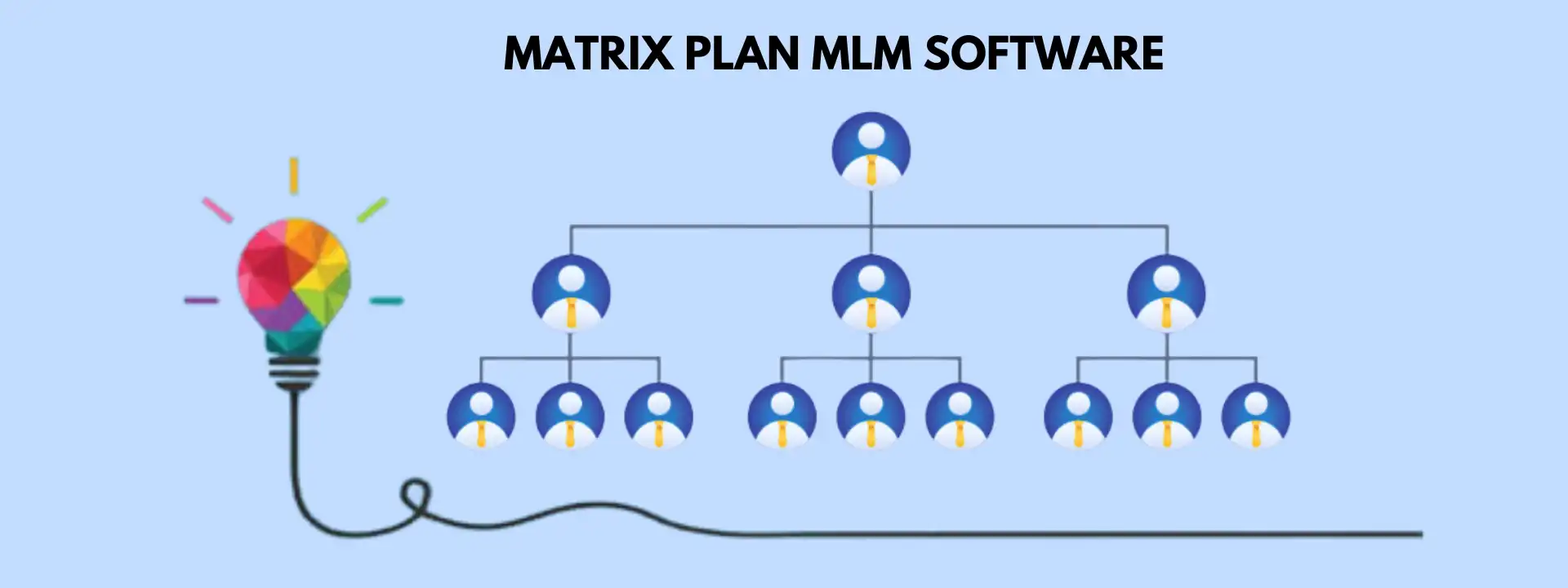
Before diving into matrix plans, it’s crucial to understand Multi-Level Marketing (MLM). MLM is a business model where individuals earn money by selling products or services and also by recruiting others to join the business. This creates a network, often called a “downline,” where you can earn commissions from both your personal sales and the sales made by people you’ve recruited.
A legitimate MLM focuses on genuine product sales, not just recruitment. The system that defines how these commissions and bonuses are calculated and paid is known as an MLM compensation plan.
The Basic Structure: Width x Depth
Every Matrix MLM plan is defined by two numbers: width and depth. These create the “forced matrix” structure that gives the plan its name.[2]
- Width: This is the maximum number of people you can personally sponsor and place directly under you on your first level. It is fixed and limited.
- Depth: This is the number of levels in your downline network for which you can potentially earn commissions.
A plan is described as “Width x Depth.” For example, a 3×5 matrix means you can have 3 people on your first level, and the network extends 5 levels deep.[3]
How does a Matrix MLM Plan Work?
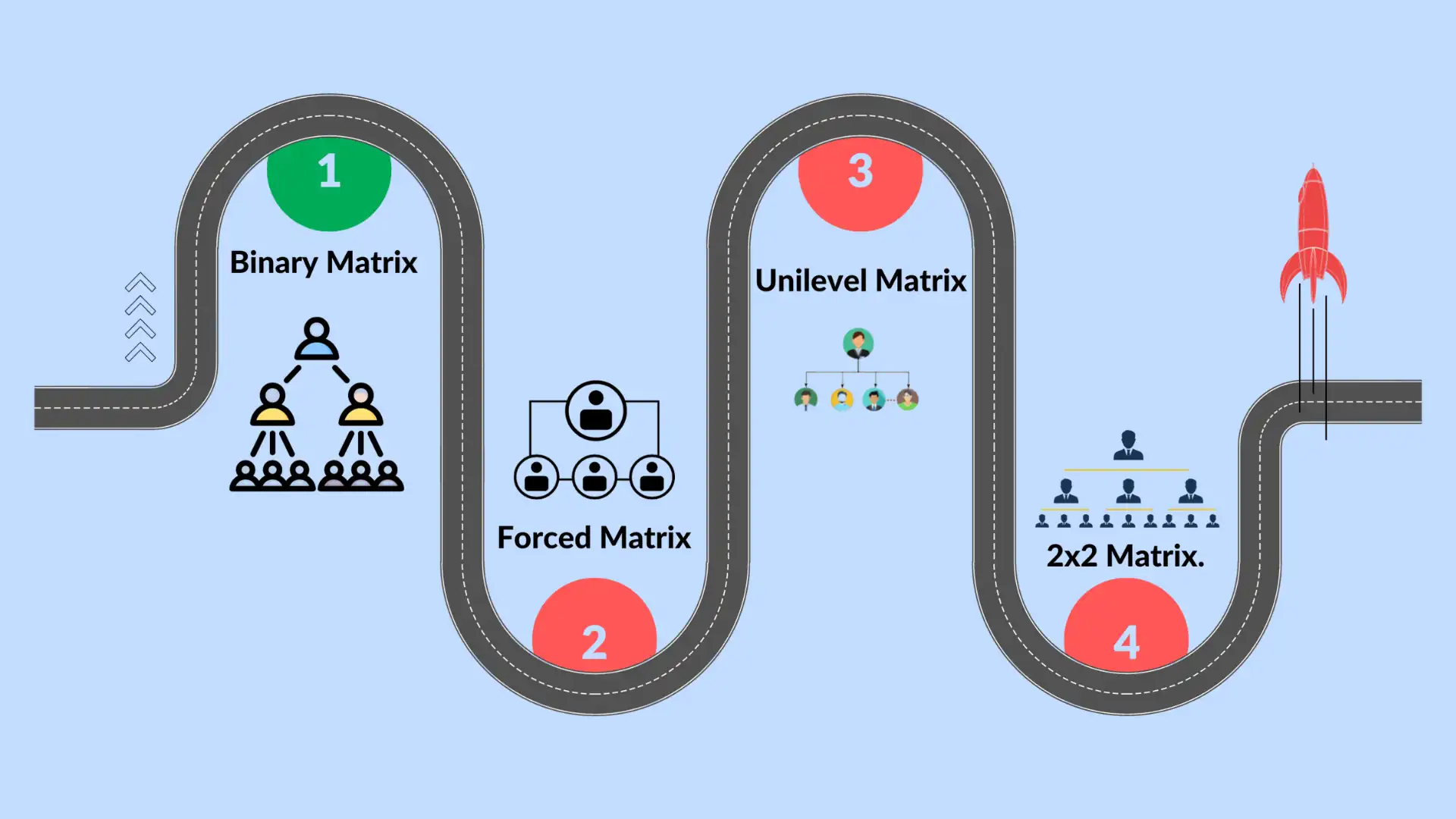
Understanding how a matrix fills is crucial. You start by recruiting people to fill your first level, up to its width limit. Here’s the key mechanism:
Once your first level is full, any new person you recruit cannot be placed there. Instead, they are automatically placed in the next available open spot somewhere in your downline. This process is called spillover.[4]
Example: In a 2×2 matrix, your first level holds 2 people. The third person you recruit will “spill over” to the second level, placed under one of your first two recruits.
This design encourages teamwork, as active recruiting by an upline member can help fill the downline of their team members.
Visualizing Common Matrix Plans
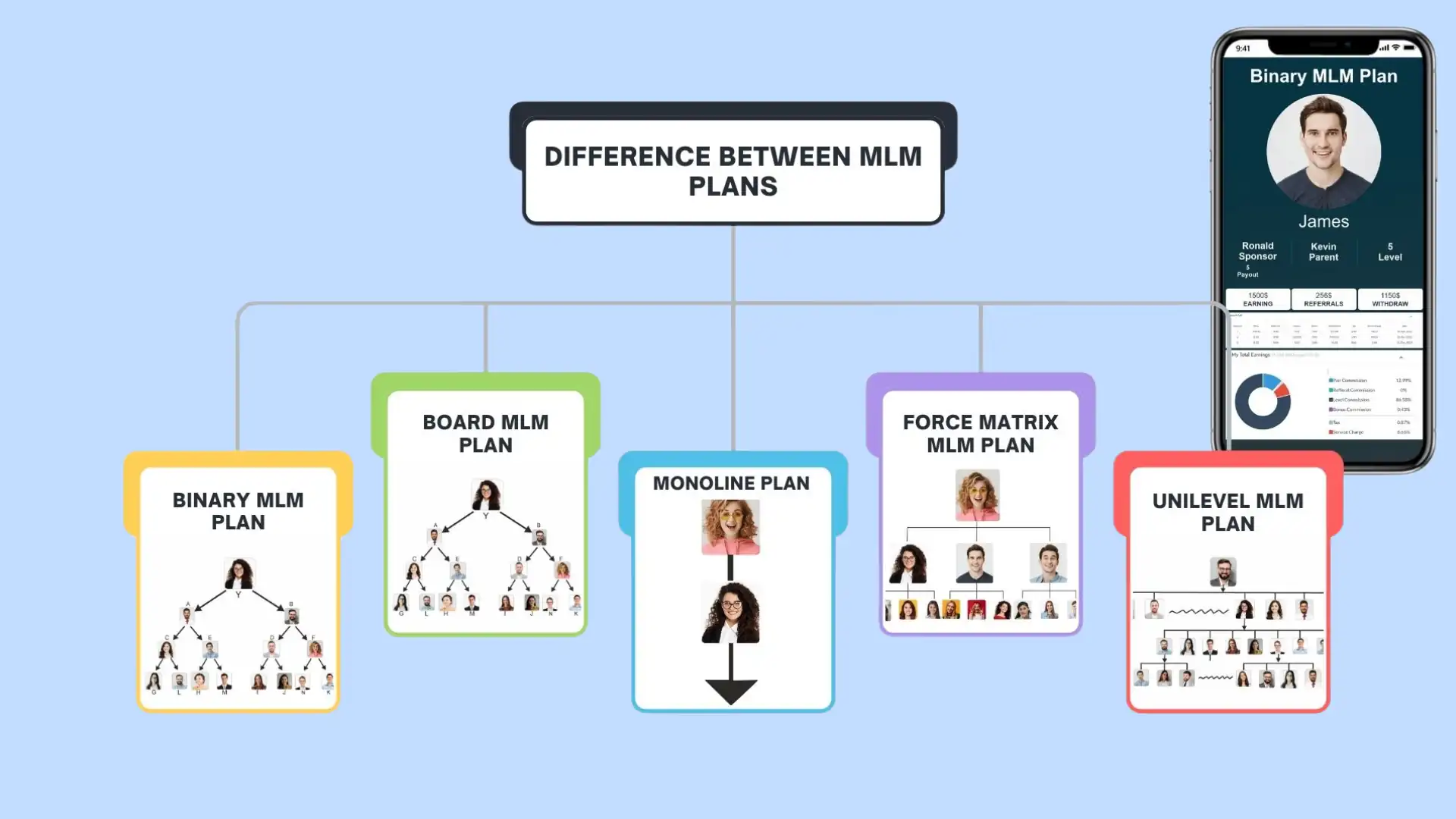
Let’s look at the total team size and structure of three common matrix configurations.
| Matrix Plan | Level 1 (Your Direct Recruits) | Level 2 | Level 3 | Total Possible Team Members (Including You) |
|---|---|---|---|---|
| 2×2 Matrix | 2 members | 4 members | – | 7 members |
| 3×3 Matrix | 3 members | 9 members | 27 members | 40 members |
| 5×5 Matrix | 5 members | 25 members | 125 members | Many hundreds (Calculated similarly) |
Note: The “Total Possible Team Members” is the theoretical maximum if every single position in the matrix is filled. It includes you at the top plus all members on all levels.[2]
Earning Money: Compensation in a Matrix Plan
Income in a Matrix plan typically comes from a combination of bonuses tied to the structure. Common types include:
- Sponsor/Referral Bonus: A reward for directly recruiting a new member into your network.
- Level Commissions: Earnings based on the sales volume or activity of members on each specific level of your downline. For instance, you might earn 10% on Level 1 sales and 5% on Level 2 sales.
- Matrix Completion Bonus: A bonus paid when every single spot in your personal matrix (according to its width and depth) is completely filled.
Key Advantages of a Matrix MLM Plan
- Structured and Manageable: The fixed size prevents the network from becoming overwhelming and makes growth easier to visualize and track.
- Promotes Teamwork: The spillover effect means active recruiters help their entire downline grow, fostering a collaborative environment.
- Faster “Cycling”: Compared to wider plans, the limited width can allow members to fill their matrix and earn completion bonuses more frequently.
- Beginner-Friendly: New distributors can benefit from spillover from their active upline, receiving members into their downline without having to recruit them all personally.
Integrating Smart Contracts and Cryptocurrency into Your MLM Matrix
While the matrix plan’s structure promotes teamwork, its execution in traditional systems can still face issues like payout delays or opaque rules. This is where blockchain technology and smart contracts create “MLM 2.0.” A smart contract is a self-executing program on a blockchain (like Ethereum) that automatically enforces the matrix rules, placement, spillover, and commission payouts, with 100% transparency. Projects like Forsage pioneered this by encoding a global matrix into a smart contract, allowing trustless, automated global operations. This evolution addresses core concerns of trust and efficiency in the industry.
Potential Challenges to Consider
- Limited Direct Width: Your personal income potential from direct recruits is capped by the first-level width limit.
- Dependency on Upline: If your upline is not actively recruiting, you may receive little to no spillover, slowing your own matrix growth.
- Placement Strategy: To maximize earnings, you may need to strategically place new recruits under specific downline members to balance the structure, which can be complex.
- Income Disparity: Earnings can vary widely based on your position in the genealogy and the activity levels of those above and below you.
The Essential Role of Matrix MLM Software
Managing a Matrix plan: tracking hundreds of members, calculating layered commissions, and managing spillover placement—is impossible to do manually. This is where Matrix MLM Plan software becomes non-negotiable.[4]
A robust multi-level marketing software automates the entire operation. Key features include:
- Automated Commission & Payouts: Accurately calculates complex bonuses and ensures timely payments.
- Genealogy Tree Management: Visually displays the entire network structure.
- Member Management & Onboarding: Handles sign-ups and automatically places new members according to spillover rules.
- E-Wallet & Payment Integration: Allows distributors to manage earnings and withdraw funds easily.
Choosing flexible MLM software that can be customized for your specific matrix plan (2×2, 3×3, etc.) is critical for accuracy, transparency, and scalability.
Beyond Traditional Software: The Blockchain Layer
Today’s most advanced MLM software solutions are integrating a blockchain layer. While traditional software manages the dashboard and user interface, a smart contract on a public blockchain handles the core logic. This means every rule of your 3×3 or 5×5 matrix, and every transaction, is recorded on an immutable public ledger. It eliminates doubts about calculation errors or manipulation, as the code is law. Payments in cryptocurrency enable instant, borderless commission distribution directly to members’ digital wallets, streamlining global operations.
MLM. Reinvented for Web3.
Transition from traditional structures to a borderless, trust-minimized future. We provide the complete blockchain infrastructure for your next-generation network.
Is a Matrix MLM Plan Right for You?
The Matrix MLM plan is an excellent fit for:
- Beginners who benefit from team support and spillover.
- Companies and teams that want to emphasize collaboration and group sales over individual superstar recruiters.
- Business models where a structured, predictable growth pattern is desirable.
It may be less ideal for:
- Highly independent recruiters who want unlimited direct team-building potential.
- Businesses that prioritize simple, less structured compensation models.
Final Thoughts
The Matrix MLM plan is a balanced, team-oriented compensation structure defined by its fixed width and depth. Its core mechanism, spillover, helps distribute growth across the network. While it offers a supportive and manageable framework, its success depends heavily on active teamwork and is virtually impossible to run without dedicated MLM software to handle its complexity.
For businesses looking to modernize this model with enhanced transparency and security, exploring specialized services like blockchain-based MLM software integration can offer innovative solutions. Before joining or starting a Matrix-based company, ensure you understand its specific rules. Also, consider whether the platform uses modern Web3.0 principles, like smart contracts for transparency and crypto payments for efficiency, as these are becoming key differentiators for trust and scalability in the modern network marketing landscape.
Frequently Asked Questions
Q1.How to make a matrix plan?
To create a matrix plan, you first define its fixed structure by choosing the width (e.g., 2, 3, or 5 frontline slots) and depth (the number of earning levels). You then set commission rules for each level, referral bonuses, and criteria for rewards like a cycle bonus. You can explore technical implementation options like Matrix MLM Plan software, which automates placement, calculations, and genealogy, or consult development experts like Nadcab Labs for custom blockchain-based solutions.
Q2.What is the difference between binary plan and matrix plan?
The core difference is in structure. A Binary Plan forces each distributor to build only two legs (left and right). The focus is on balancing the sales volume between these two legs to earn commissions. A Matrix Plan (like 3×3 or 5×5) has a fixed width and depth. You recruit a set number of people on your frontline, and excess recruits “spill over” to fill your team’s downline, encouraging more collaborative team building.
Q3.What is the 2x2 planning matrix?
A 2×2 planning matrix is a specific type of Matrix MLM plan. It means each distributor can have a maximum of 2 people on their direct frontline (width=2) and can earn commissions from sales down to 2 levels (depth=2). This creates a small, simple structure of up to 7 people (you + 2 frontline + 4 second-level). It’s often used for high-ticket items or as a fast-cycling component within larger compensation plans.
Q4.Which MLM plan is best?
There is no single “best” plan; it depends on your goals. For teamwork and simplicity, a Matrix Plan (like 3×3) is excellent. For high-earning potential with a focus on personal recruiting, a Unilevel Plan works. For those good at building two balanced teams, a Binary Plan is ideal. The best plan aligns with your company’s products and the way you want your distributors to build their networks. The right multi level marketing software is crucial to manage any plan effectively.
Q5.What is Matrix MLM plan software?
Matrix MLM Plan software is a specialized computer program that automates the entire operation of a forced matrix network. It handles the critical tasks of automatically placing new members in the correct “spillover” position, visually displaying the network tree (genealogy), and accurately calculating complex multi-level commissions, bonuses, and payouts in real-time. This software is essential for running a professional and scalable MLM business.
Q6.What is a matrix MLM plan calculator?
A matrix MLM plan calculator is a tool (often part of MLM software) that lets distributors simulate their potential earnings. You input variables like your matrix type (e.g., 3×3), commission rates per level, and projected team activity or sales volume. The calculator then estimates your potential income from level commissions, bonuses, and cycles, helping you set goals and understand the plan’s mechanics before joining or building your team.
Q7.Which is the best crypto MLM software development company?
There is no single “best” company for everyone, as the ideal partner depends on your specific project needs, budget, and desired blockchain platform. However, companies that specialize in blockchain-based MLM software, like Nadcab Labs, are excellent choices. They focus on developing secure, transparent smart contracts that automate commissions and payouts for crypto MLM models. The best approach is to evaluate several providers based on their technical expertise, security audit practices, and portfolio of live projects in the Web3 MLM space before making a decision.
Explore Services
Related Services
Reviewed by

Aman Vaths
Founder of Nadcab Labs
Aman Vaths is the Founder & CTO of Nadcab Labs, a global digital engineering company delivering enterprise-grade solutions across AI, Web3, Blockchain, Big Data, Cloud, Cybersecurity, and Modern Application Development. With deep technical leadership and product innovation experience, Aman has positioned Nadcab Labs as one of the most advanced engineering companies driving the next era of intelligent, secure, and scalable software systems. Under his leadership, Nadcab Labs has built 2,000+ global projects across sectors including fintech, banking, healthcare, real estate, logistics, gaming, manufacturing, and next-generation DePIN networks. Aman’s strength lies in architecting high-performance systems, end-to-end platform engineering, and designing enterprise solutions that operate at global scale.