Ai Overview
Lending and borrowing contracts represent one of the most transformative applications of blockchain technology, recreating traditional financial services through automated smart contract logic. Market Impact: DeFi lending protocols process over $10 billion in transactions monthly, demonstrating institutional-grade demand for lending and borrowing contracts. As utilization approaches optimal levels (typically 80%), rates increase sharply to incentivize new deposits.
Key Takeaways
- Lending and borrowing contracts automate financial services through smart contracts, eliminating traditional banking intermediaries while maintaining security and transparency.
- DeFi lending protocols like Aave and Compound manage over $15 billion in assets using lending and borrowing contracts across Ethereum and compatible chains.
- Lending and borrowing contracts require over-collateralization (typically 125-150%) to protect lenders from borrower default during market volatility.
- Algorithmic interest rate models in lending and borrowing contracts adjust rates based on supply-demand dynamics, optimizing capital efficiency automatically.
- Oracle integration is critical for lending and borrowing contracts to obtain accurate price feeds for collateral valuation and liquidation triggers.
- Enterprises across USA, UK, UAE, and Canada increasingly adopt lending and borrowing contracts for treasury management and yield optimization strategies.
- Security audits and formal verification are essential for lending and borrowing contracts managing significant value to prevent exploit vulnerabilities.
- Future lending and borrowing contracts will incorporate cross-chain functionality, real-world asset collateral, and enhanced privacy features for broader adoption.
Introduction to Lending and Borrowing in Smart Contract Platforms
Lending and borrowing contracts represent one of the most transformative applications of blockchain technology, recreating traditional financial services through automated smart contract logic. With over eight years of experience building DeFi solutions for enterprises across USA, UK, UAE, and Canadian markets, our agency has witnessed these protocols evolve from experimental concepts to infrastructure managing billions in assets. These contracts enable permissionless access to credit markets, algorithmic interest rates, and transparent collateral management without requiring trust in centralized institutions. Understanding the foundations of lending and borrowing contracts is essential for any organization seeking to participate in or build decentralized financial infrastructure.
What Are Lending and Borrowing Smart Contracts?
Lending and borrowing contracts are self-executing programs deployed on blockchain networks that facilitate financial transactions between lenders and borrowers. Lenders deposit assets into liquidity pools managed by these contracts and earn interest from borrowers who access funds by providing collateral. The contracts automatically handle interest accrual, collateral management, and liquidation processes without human intervention. This automation eliminates the need for credit checks, lengthy approval processes, and intermediary fees characteristic of traditional banking systems.
How Smart Contracts Replace Traditional Lending Intermediaries
Lending and borrowing contracts fundamentally transform financial services by replacing banks, credit bureaus, and loan officers with immutable code. Traditional lending requires extensive paperwork, credit history evaluation, and manual approval processes taking days or weeks. Smart contracts execute these functions instantly, 24/7, without geographic restrictions. The code enforces loan terms automatically, eliminating disputes and reducing operational costs. This efficiency benefits both lenders earning higher yields and borrowers accessing credit without traditional barriers faced in markets across USA, UK, UAE, and Canada.
Market Impact: DeFi lending protocols process over $10 billion in transactions monthly, demonstrating institutional-grade demand for lending and borrowing contracts.
Architecture of Lending and Borrowing Contracts on Blockchain
| Component | Function | Implementation |
|---|---|---|
| Liquidity Pool | Holds deposited assets | ERC-20 vault contracts |
| Interest Controller | Calculates rates | Algorithmic models |
| Collateral Manager | Locks and tracks collateral | Escrow mechanisms |
| Oracle Integration | Price feeds | Chainlink, Pyth |
| Liquidation Engine | Executes liquidations | Keeper networks |
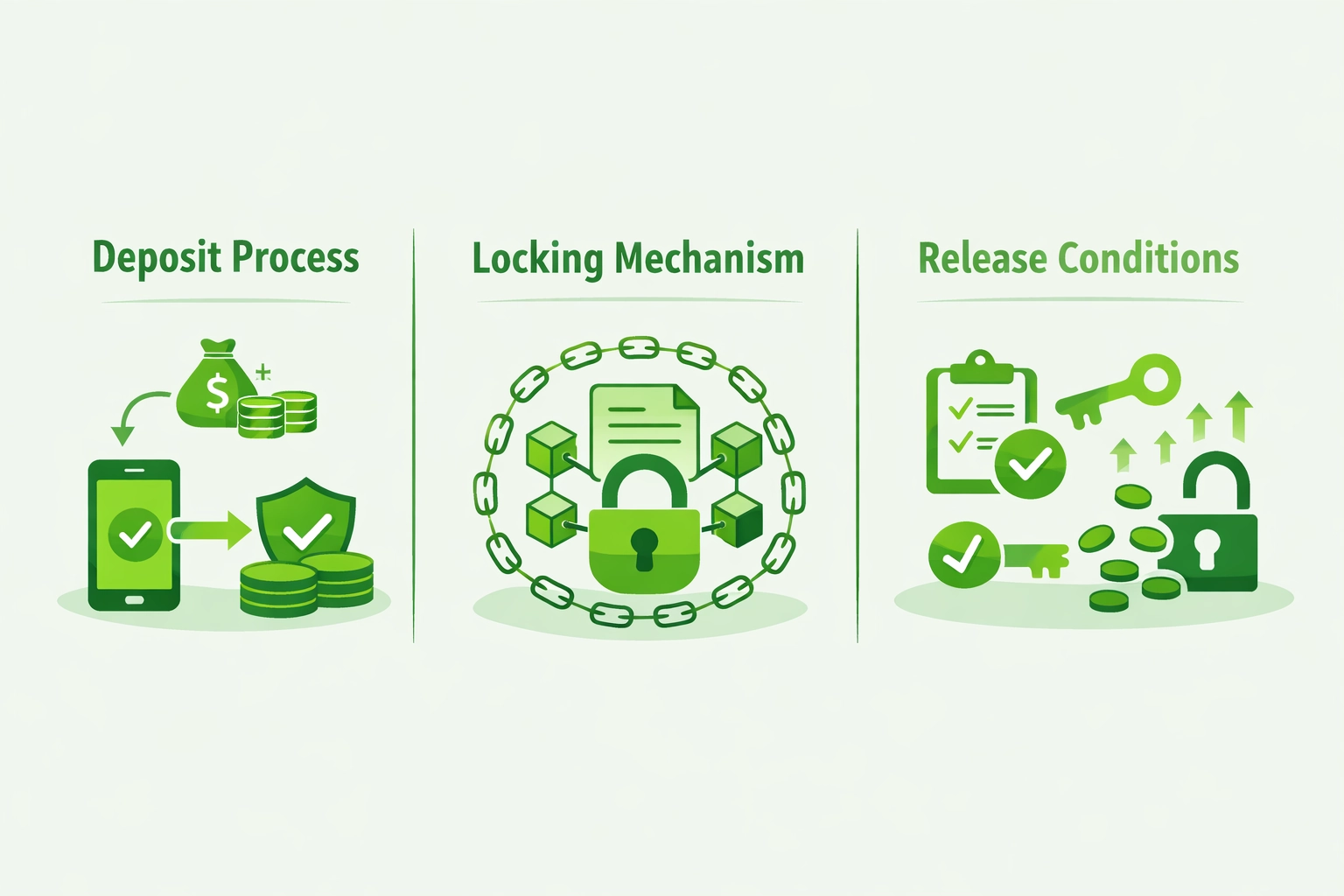
On-Chain Collateral Management and Locking Mechanisms
Deposit Process
- Asset approval transaction
- Transfer to contract vault
- Receipt token minting
- Collateral ratio calculation
Locking Mechanism
- Escrow contract custody
- Withdrawal restrictions
- Health factor monitoring
- Automated rebalancing
Release Conditions
- Full debt repayment
- Partial withdrawal rules
- Liquidation thresholds
- Grace period handling
Interest Rate Models Used in Lending Smart Contracts
Lending and borrowing contracts employ sophisticated algorithmic models to determine interest rates dynamically. The utilization rate, calculated as borrowed assets divided by total deposits, drives rate adjustments. When utilization is low, rates decrease to encourage borrowing. As utilization approaches optimal levels (typically 80%), rates increase sharply to incentivize new deposits. Compound pioneered the linear model, while Aave introduced jump rate models with kink points for more aggressive rate scaling.
Stable Rate Zone
Jump Rate Zone
Typical APY Range
Borrowing Logic: Loan Issuance, Repayment, and Liquidation Flow
The borrowing flow in lending and borrowing contracts follows a structured process. Users first deposit collateral, then borrow up to their allowed limit based on collateral factors. Interest accrues continuously using block timestamps. Repayment can occur partially or fully, with interest paid before principal. If collateral value drops causing the health factor to fall below 1.0, liquidators can repay debt and claim collateral at a discount. This mechanism ensures lenders remain protected regardless of borrower behavior.
Lending and Borrowing Contract Lifecycle
Pool Initialization
Deploy lending pool contracts with initial parameters for supported assets and risk settings.
Liquidity Provision
Lenders deposit assets into pools and receive interest-bearing receipt tokens representing their share.
Collateral Deposit
Borrowers deposit collateral assets and enable them for borrowing power calculation.
Loan Issuance
Smart contract validates collateral ratio and transfers borrowed assets to the borrower.
Interest Accrual
Lending and borrowing contracts calculate and compound interest continuously based on utilization.
Health Monitoring
Oracle price feeds update collateral values and trigger alerts when positions approach liquidation.
Repayment/Liquidation
Borrowers repay debt to reclaim collateral, or liquidators close unhealthy positions.
Withdrawal
Lenders redeem receipt tokens for principal plus earned interest from the lending pool.
Role of Oracles in Price Feeds and Risk Assessment
Oracles are critical infrastructure for lending and borrowing contracts, providing external price data needed for collateral valuation. Chainlink dominates the DeFi oracle space, aggregating data from multiple sources to resist manipulation. Lending protocols rely on accurate, timely price feeds to calculate health factors and trigger liquidations. Oracle failures or manipulation can lead to catastrophic losses, as seen in various DeFi exploits. Enterprise deployments across USA, UK, UAE, and Canada require robust oracle architecture with fallback mechanisms.
Smart Contract Security Considerations for Lending Platforms
| Risk Category | Threat Vector | Mitigation |
|---|---|---|
| Reentrancy | Recursive withdrawal exploits | Checks-effects-interactions |
| Oracle Manipulation | Price feed attacks | TWAP, multi-oracle |
| Flash Loan Attacks | Atomic exploitation | Block-based delays |
| Governance Attacks | Malicious proposals | Timelocks, thresholds |
Risk Management Strategies in Decentralized Lending Protocols
Effective risk management in lending and borrowing contracts requires multiple defensive layers. Collateral factors limit borrowing based on asset volatility, with stablecoins allowing higher leverage than volatile tokens. Liquidation incentives ensure rapid position closure during market crashes. Reserve factors accumulate protocol-owned liquidity for bad debt coverage. Supply and borrow caps prevent concentration risk. These mechanisms work together to maintain protocol solvency even during extreme market conditions.
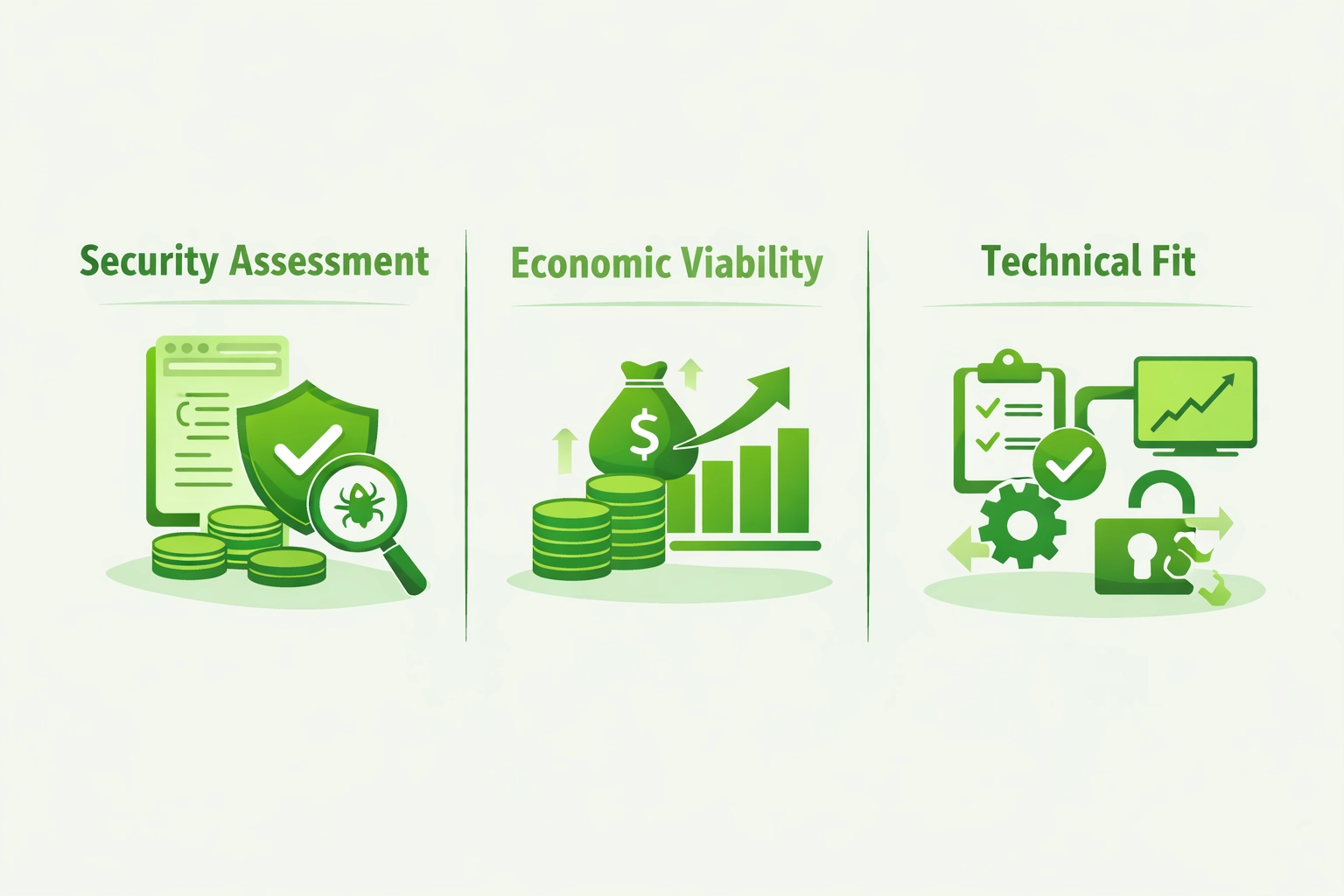
Lending Protocol Selection Criteria
Security Assessment
- Audit history review
- Bug bounty program
- Incident response track record
- Insurance coverage
Economic Viability
- Interest rate competitiveness
- Liquidity depth
- Fee structures
- Token incentives
Technical Fit
- Chain compatibility
- Asset support
- Integration complexity
- Upgrade mechanisms
Permissionless vs Permissioned Lending Contract Models
| Aspect | Permissionless | Permissioned |
|---|---|---|
| Access | Open to anyone | KYC/AML required |
| Users | Retail, DeFi native | Institutions, enterprises |
| Compliance | Minimal | Regulatory aligned |
| Examples | Aave, Compound | Aave Arc, Maple Finance |
Gas Optimization and Scalability Challenges in Lending Contracts
Lending and borrowing contracts face significant gas optimization challenges due to complex state updates during deposits, borrows, and liquidations. Interest accrual calculations, oracle calls, and multi-token accounting multiply transaction costs. Layer 2 deployments on Arbitrum, Optimism, and Polygon reduce costs by 90-95%. Optimizations include lazy interest calculation, batched oracle updates, and efficient storage patterns. Enterprise users across USA, UK, UAE, and Canada benefit from these scalability improvements enabling practical DeFi participation.
Compliance, Transparency, and Auditability in DeFi Lending
Transparency is a defining feature of lending and borrowing contracts. Every transaction, interest rate change, and liquidation is publicly recorded on-chain. This auditability enables real-time monitoring, regulatory compliance, and community oversight. Protocols publish dashboards showing TVL, utilization, and risk metrics. For institutional users requiring compliance, permissioned versions integrate identity verification while maintaining blockchain transparency benefits.
Industry Standards for Secure Lending and Borrowing Contracts
Standard 1: Require professional security audits from at least two independent firms before mainnet deployment.
Standard 2: Implement decentralized oracle solutions with fallback mechanisms for price feed reliability.
Standard 3: Maintain conservative collateral factors with regular review based on market volatility analysis.
Standard 4: Establish emergency pause mechanisms with multi-signature controls for rapid incident response.
Standard 5: Deploy gradual rollout strategies with supply caps increasing as protocol stability is demonstrated.
Standard 6: Maintain transparent governance with timelock delays for all parameter changes affecting user funds.
Future Evolution of Lending and Borrowing Contracts on Smart Contract Platforms
The future of lending and borrowing contracts includes significant innovations transforming DeFi capabilities. Cross-chain lending will enable borrowing on one chain using collateral on another. Real-world asset tokenization will bring traditional assets like real estate and invoices as collateral. Credit scoring based on on-chain history will enable under-collateralized loans. Privacy-preserving protocols will protect user positions while maintaining auditability.
With eight years of experience building DeFi infrastructure for enterprises across USA, UK, UAE, and Canadian markets, our agency sees lending and borrowing contracts becoming foundational infrastructure for the global financial system. Organizations investing in understanding and building these protocols position themselves at the forefront of financial innovation.
Build Secure Lending and Borrowing Contracts
Our DeFi architects design and implement production-ready lending protocols with enterprise-grade security and compliance.
Frequently Asked Questions
Q1.1. What are lending and borrowing contracts in DeFi?
Lending and borrowing contracts are smart contracts that enable decentralized financial services where users can deposit assets to earn interest or borrow against collateral. These contracts automate loan issuance, interest calculation, and liquidation without traditional bank intermediaries, operating transparently on blockchain networks.
Q2.2. How do lending and borrowing contracts determine interest rates?
Lending and borrowing contracts use algorithmic interest rate models based on supply and demand dynamics. When utilization rates increase (more borrowing), interest rates rise to incentivize deposits. Popular models include linear, jump rate, and curve-based algorithms used by protocols like Aave and Compound.
Q3.3. What collateral is required for borrowing in DeFi lending contracts?
Lending and borrowing contracts typically require over-collateralization, usually 125-150% of the borrowed amount. Acceptable collateral includes cryptocurrencies like ETH, WBTC, and stablecoins. Collateral factors vary by asset volatility, with stable assets allowing higher borrowing limits than volatile tokens.
Q4.4. How do liquidations work in lending and borrowing contracts?
Lending and borrowing contracts trigger liquidations when collateral value drops below required thresholds. Liquidators repay portions of the debt and receive collateral at a discount (typically 5-15%). This mechanism protects lenders and maintains protocol solvency during market volatility.
Q5.5. Are lending and borrowing contracts safe to use?
Lending and borrowing contracts carry risks including smart contract vulnerabilities, oracle manipulation, and liquidation during volatility. Established protocols like Aave and Compound have undergone extensive audits. Users should evaluate protocol track records, insurance options, and start with smaller amounts.
Q6.Lending and borrowing contracts carry risks including smart contract vulnerabilities, oracle manipulation, and liquidation during volatility. Established protocols like Aave and Compound have undergone extensive audits. Users should evaluate protocol track records, insurance options, and start with smaller amounts.
Both are leading lending and borrowing contracts, but differ in features. Aave offers flash loans, multiple rate options, and broader asset support. Compound pioneered cToken receipt mechanisms and governance tokens. Both serve enterprises across USA, UK, UAE, and Canada effectively.
Q7.7. Can lending and borrowing contracts be used for institutional purposes?
Yes, lending and borrowing contracts increasingly serve institutional needs. Protocols like Aave Arc and Compound Treasury offer permissioned versions with KYC/AML compliance for regulated entities. Enterprises in USA, UK, UAE, and Canada use these for treasury management and yield generation.
Explore Services
Related Services
Reviewed by

Aman Vaths
Founder of Nadcab Labs
Aman Vaths is the Founder & CTO of Nadcab Labs, a global digital engineering company delivering enterprise-grade solutions across AI, Web3, Blockchain, Big Data, Cloud, Cybersecurity, and Modern Application Development. With deep technical leadership and product innovation experience, Aman has positioned Nadcab Labs as one of the most advanced engineering companies driving the next era of intelligent, secure, and scalable software systems. Under his leadership, Nadcab Labs has built 2,000+ global projects across sectors including fintech, banking, healthcare, real estate, logistics, gaming, manufacturing, and next-generation DePIN networks. Aman’s strength lies in architecting high-performance systems, end-to-end platform engineering, and designing enterprise solutions that operate at global scale.