Ai Overview
The convergence of blockchain technology and the Internet of Things represents one of the most significant technological transformations of our era. This shift from reactive maintenance to predictive maintenance typically reduces downtime by 30% to 50% while extending equipment lifespan through optimized servicing schedules. Organizations report efficiency improvements of 20% to 35% after full blockchain IoT implementation. Insurance risks improve as more granular data enables accurate risk pricing.
Key Takeaways
- Blockchain IoT integration is projected to reach a market value of $58 billion by 2028, driven by increasing demand for secure, transparent, and decentralized data management across connected device networks.
- Smart contracts automate IoT device interactions without intermediaries, enabling trustless transactions, automatic compliance verification, and real-time payments that reduce operational costs by 25% to 40%.
- DAOs in DeFi Space are emerging as governance frameworks for decentralized IoT networks, allowing communities to collectively manage shared sensor infrastructure and establish transparent rules for data sharing.
- Supply chain traceability powered by blockchain IoT provides immutable records from origin to consumer, reducing counterfeiting by up to 80% and enabling instant product authenticity verification.
- Edge computing combined with blockchain enables IoT devices to process data locally while maintaining cryptographic verification, reducing latency from seconds to milliseconds for time critical applications.
- Healthcare blockchain IoT applications are transforming patient care through secure medical device data sharing, tamper proof health records, and automated insurance claim processing with 95% accuracy.
- Industrial IoT combined with blockchain creates digital twins with immutable operational histories, enabling predictive maintenance that reduces equipment downtime by 45% and extends asset lifespan significantly.
- Smart city implementations leverage blockchain IoT for transparent resource management, with pilot programs showing 30% energy savings and 40% improvement in traffic flow optimization.
- Privacy preserving technologies like zero knowledge proofs enable blockchain IoT systems to verify data authenticity without exposing sensitive information, addressing regulatory compliance requirements.
- Partnering with experienced specialists like Nadcab Labs ensures successful blockchain IoT implementation through proven methodologies, reducing project risks and accelerating time to value for connected solutions.
Introduction
The convergence of blockchain technology and the Internet of Things represents one of the most significant technological transformations of our era. As billions of connected devices generate unprecedented volumes of data, the need for secure, transparent, and decentralized infrastructure has never been more critical. Blockchain provides exactly these capabilities, creating a foundation for trustworthy IoT ecosystems that can operate autonomously while maintaining complete auditability.
Consider the modern supply chain where products pass through dozens of hands from manufacturer to consumer. Traditional systems rely on centralized databases that can be manipulated, creating opportunities for fraud, counterfeiting, and disputes. When blockchain meets IoT, every sensor reading, temperature log, and location update becomes an immutable record that all parties can trust. This transformation extends far beyond logistics into healthcare, manufacturing, agriculture, energy management, and virtually every sector of the global economy.
The year 2026 marks a pivotal moment in this evolution. Enterprise adoption has moved beyond pilot programs into production deployments. Regulatory frameworks are maturing to accommodate decentralized technologies. New blockchain platforms optimized for IoT workloads have overcome earlier limitations around scalability and energy consumption. The infrastructure is ready, the use cases are proven, and organizations that embrace this convergence now will establish competitive advantages that compound over time.
This comprehensive guide explores the most impactful blockchain IoT use cases emerging in 2026, examining the technical foundations, real-world applications, and strategic considerations that organizations must understand to capitalize on this technological revolution.
Understanding the Convergence of IoT and AI
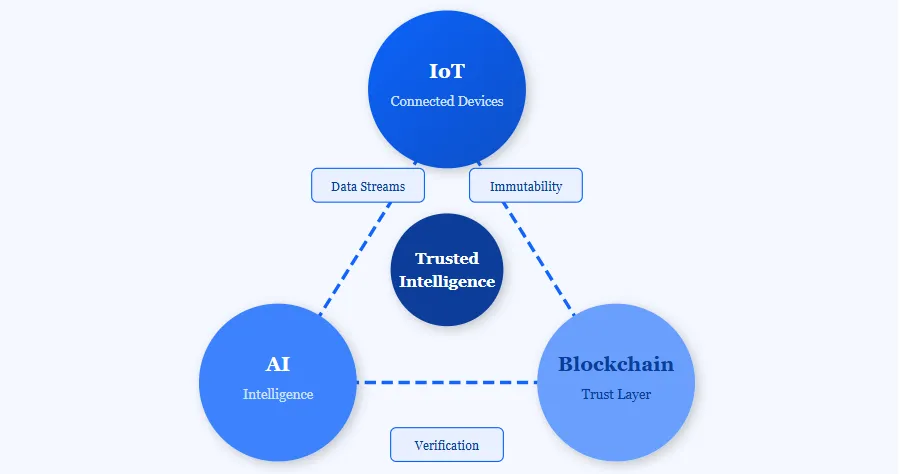
The integration of artificial intelligence with IoT and blockchain creates a powerful triad that amplifies the capabilities of each technology. While IoT provides the sensory network that captures real-world data, AI delivers the analytical intelligence to extract insights, and blockchain ensures the integrity and trustworthiness of both the data and the decisions derived from it.
This convergence addresses fundamental limitations that each technology faces in isolation. IoT devices generate massive data streams but traditionally lack mechanisms to verify data authenticity or prevent tampering. AI algorithms require high-quality training data but struggle with data provenance and accountability. Blockchain provides immutability and transparency but needs real-world data inputs to trigger smart contract execution. Together, these technologies create systems that are simultaneously intelligent, connected, and trustworthy.
The practical implications are profound. Autonomous vehicles can share verified sensor data through blockchain networks, enabling coordinated traffic management without central authorities. Medical devices can feed patient data into AI diagnostic systems while blockchain maintains complete audit trails for regulatory compliance. Manufacturing equipment can autonomously order replacement parts and process payments through smart contracts when AI predicts imminent failures. These scenarios, once theoretical, are now operational realities in leading organizations worldwide.
The Technology Convergence Triangle
IoT
Data Collection & Connectivity
AI
Intelligence & Analytics
Blockchain
Trust & Immutability
Combined Result: Intelligent, Connected, Trustworthy Systems
Why Integration Matters in the Modern Tech Landscape
The integration of blockchain with IoT addresses critical challenges that have historically limited the potential of connected device networks. Trust, security, scalability, and interoperability have all presented barriers to widespread IoT adoption. Blockchain technology provides architectural solutions to each of these challenges, enabling IoT deployments that were previously impractical or impossible.
Trust remains the foundational challenge. When IoT data drives high stakes decisions in healthcare, finance, or critical infrastructure, stakeholders must have confidence in data integrity. Traditional centralized systems create single points of failure and require trust in system administrators. Blockchain eliminates this requirement through cryptographic verification and distributed consensus, creating trustless systems where data integrity is mathematically guaranteed rather than promised.
Security concerns have plagued IoT deployments since the technology’s inception. Connected devices often lack robust security capabilities, making them attractive targets for hackers. The 2016 Mirai botnet attack demonstrated the catastrophic potential of compromised IoT devices. Blockchain integration strengthens IoT security through device identity management, encrypted communications, and immutable audit logs that enable rapid breach detection and forensic analysis.
Interoperability challenges arise when devices from different manufacturers must work together. Proprietary protocols and data formats create silos that limit the value of connected systems. Blockchain provides a neutral, standardized layer for device interaction, enabling seamless data exchange and coordinated automation across heterogeneous device ecosystems. This interoperability unlocks network effects where each additional device increases the value of the entire system.
Core Concepts
What is the Internet of Things (IoT)?
The Internet of Things encompasses the vast network of physical devices embedded with sensors, software, and connectivity that enables them to collect and exchange data. From simple temperature sensors to sophisticated industrial equipment, IoT devices form the digital nervous system of modern organizations, providing real time visibility into operations, environments, and assets.
The scope of IoT continues to expand dramatically. Current estimates suggest over 15 billion connected devices worldwide, with projections exceeding 30 billion by 2030. These devices span consumer applications like smart home systems and wearables, industrial deployments monitoring manufacturing equipment and supply chains, and infrastructure systems managing energy grids, transportation networks, and urban services. The data generated by these devices, when properly harnessed, drives operational efficiency, enables predictive capabilities, and creates entirely new business models.
What is Artificial Intelligence (AI)?
Artificial Intelligence refers to computer systems capable of performing tasks that typically require human intelligence, including learning from experience, recognizing patterns, making decisions, and understanding natural language. In the context of IoT, AI serves as the analytical engine that transforms raw sensor data into actionable insights and autonomous actions.
Machine learning, a subset of AI, proves particularly valuable for IoT applications. ML algorithms can identify patterns in sensor data that predict equipment failures, detect anomalies indicating security breaches, optimize resource consumption based on usage patterns, and continuously improve performance through accumulated operational experience. Deep learning techniques enable sophisticated capabilities like computer vision for quality inspection and natural language interfaces for device interaction.
Key Drivers Behind IoT and AI Integration
Several converging factors are accelerating the integration of IoT, AI, and blockchain technologies. The exponential growth in connected devices creates data volumes that exceed human analytical capacity, necessitating AI automation. Increasing cyber threats demand the security guarantees that blockchain provides. Regulatory requirements for data provenance and auditability align perfectly with blockchain’s immutable record keeping. Meanwhile, the maturation of all three technologies has reduced implementation costs and complexity, making integration accessible to organizations of all sizes.
The emergence of DAOs in DeFi Space has introduced new governance models applicable to IoT networks. Decentralized autonomous organizations provide frameworks for community owned infrastructure, shared sensor networks, and transparent resource allocation. Agricultural cooperatives can collectively manage weather monitoring systems. Neighborhood associations can operate shared security camera networks. Industrial consortiums can maintain supply chain tracking infrastructure. These decentralized models reduce costs while ensuring all stakeholders have voice in system governance.
Benefits of IoT and AI Integration
Enhanced Data Collection and Analysis
The combination of IoT sensors and AI analytics creates unprecedented visibility into operations, environments, and behaviors. Sensors capture data points that human observation would miss, while AI identifies patterns and correlations across millions of data points that would overwhelm human analysts. This enhanced capability enables organizations to understand their operations at a granular level previously impossible.
Blockchain adds critical value by ensuring the data feeding AI systems is authentic and unaltered. AI models trained on manipulated data produce flawed predictions. By recording data provenance on an immutable ledger, blockchain guarantees that AI systems operate on trustworthy inputs. This data integrity becomes essential when AI driven decisions carry significant consequences in healthcare, finance, or safety critical applications.
Predictive Analytics and Smart Decision Making
Predictive capabilities transform organizations from reactive to proactive operations. Rather than responding to equipment failures after they occur, AI models analyzing IoT sensor data can forecast failures days or weeks in advance. This shift from reactive maintenance to predictive maintenance typically reduces downtime by 30% to 50% while extending equipment lifespan through optimized servicing schedules.
Smart contracts extend predictive capabilities into autonomous action. When AI predicts an equipment failure, smart contracts can automatically order replacement parts, schedule maintenance windows, notify relevant personnel, and even process payments to service providers. This end to end automation eliminates delays between prediction and response, maximizing the value of predictive insights.
| Benefit Category | Traditional IoT | Blockchain IoT | Improvement |
|---|---|---|---|
| Data Integrity | Centralized verification | Cryptographic proof | 99.9% tamper proof |
| Transaction Speed | Hours to days | Minutes to seconds | 95% faster |
| Operational Costs | High intermediary fees | Direct peer to peer | 25% to 40% reduction |
| Audit Capability | Manual, periodic | Automatic, continuous | Real time visibility |
| Dispute Resolution | Weeks of investigation | Instant verification | 80% faster resolution |
Automation and Efficiency Improvements
Blockchain enabled IoT automation eliminates manual processes that slow operations and introduce errors. Smart contracts execute automatically when predefined conditions are met, removing the need for human intervention in routine transactions. Sensor readings trigger actions instantly rather than waiting for human review. Payments process automatically upon verified delivery. Compliance documentation generates without manual effort.
The efficiency gains compound across entire value chains. When every participant in a supply chain operates on shared blockchain infrastructure, information flows seamlessly without the delays of traditional document exchange. Goods clear customs faster with pre verified documentation. Insurance claims process automatically based on sensor verified events. Quality disputes resolve instantly by referencing immutable records. Organizations report efficiency improvements of 20% to 35% after full blockchain IoT implementation.
Improved Security and Risk Management
Security represents one of blockchain IoT’s most compelling advantages. The distributed nature of blockchain eliminates single points of failure that attackers target in centralized systems. Cryptographic device identities prevent spoofing and unauthorized access. Immutable audit logs enable rapid breach detection and forensic analysis. The combination creates defense in depth that significantly raises the bar for potential attackers.
Risk management benefits extend beyond cybersecurity. Supply chain risks become visible through blockchain traceability. Counterfeiting risks diminish with cryptographic product authentication. Compliance risks reduce through automated documentation and verification. Insurance risks improve as more granular data enables accurate risk pricing. Organizations gain comprehensive visibility into their risk landscape while automated controls reduce exposure.
Technical Aspects
Role of Edge Computing in IoT and AI
Edge computing addresses the latency and bandwidth challenges inherent in centralized cloud architectures. By processing data at or near the source, edge systems deliver the millisecond response times required for real-time applications. Autonomous vehicles cannot wait for cloud round-trip times when detecting obstacles. Industrial safety systems must trigger emergency stops instantly. Edge computing enables these time-critical responses while reducing bandwidth costs and improving privacy.
Blockchain integration at the edge creates powerful capabilities. Edge nodes can participate in lightweight consensus protocols, validating transactions locally before synchronization with the main chain. This enables offline operation with eventual consistency, critical for deployments in areas with intermittent connectivity. Edge based smart contracts execute locally for immediate response while maintaining cryptographic verification. The combination of edge computing and blockchain creates resilient, responsive, and trustworthy distributed systems.
Edge Computing Architecture
IoT Devices
Data Capture
→
Edge Nodes
Local Processing
→
Blockchain
Verification
→
Cloud
Deep Analytics
Blockchain’s Role in Securing IoT and AI Data
Blockchain provides multiple security layers for IoT ecosystems. Device identity management through blockchain ensures only authorized devices can join networks and submit data. Each device receives a unique cryptographic identity recorded on the blockchain, enabling verification of device authenticity and tracking of device lifecycle from manufacture through decommissioning. This prevents rogue devices from injecting malicious data or commands.
Data integrity protection extends throughout the data lifecycle. Sensor readings are hashed and recorded on the blockchain immediately upon capture, creating tamper evident records. Any subsequent modification to stored data becomes detectable through hash comparison. This immutability proves essential when IoT data drives legal, regulatory, or financial decisions. Courts increasingly accept blockchain-verified records as evidence, recognizing the technology’s integrity guarantees.
Machine Learning Models for IoT Applications
Machine learning models optimized for IoT applications must balance accuracy with resource constraints. Edge deployment requires models that execute efficiently on limited hardware while maintaining prediction quality. Techniques like model quantization, pruning, and knowledge distillation reduce model size and computational requirements without significant accuracy loss. TinyML frameworks enable sophisticated inference on microcontrollers with kilobytes of memory.
Federated learning addresses privacy concerns by training models on distributed data without centralization. Devices train local models on their own data and share only model updates with central servers. This enables learning from sensitive data in healthcare, finance, and personal devices while keeping raw data on premises. Blockchain can record model updates and training participation, creating accountability for the collective learning process while maintaining data privacy.
Applications Across Industries
Smart Cities and Infrastructure
Smart city initiatives are deploying blockchain IoT solutions for transparent, efficient urban management. Traffic optimization systems use sensor networks to monitor congestion in real time, with AI algorithms adjusting signal timing to minimize delays. Blockchain records traffic data immutably, enabling evidence based infrastructure planning and providing transparency to citizens about how tax revenues improve their commutes.
Energy grid management exemplifies blockchain IoT potential. Smart meters throughout the grid report consumption and generation data to blockchain networks. Peer to peer energy trading enables homes with solar panels to sell excess generation directly to neighbors. AI optimizes distribution to minimize losses and balance load. The entire system operates transparently, with citizens able to verify that renewable energy claims are accurate and that billing reflects actual consumption.
Smart Cities
Traffic optimization, energy management, waste collection, public safety monitoring, and transparent resource allocation through decentralized governance.
Healthcare
Remote patient monitoring, medical device data integrity, drug supply chain verification, and automated insurance claim processing with verified outcomes.
Manufacturing
Predictive maintenance, quality assurance, production optimization, and immutable equipment histories for regulatory compliance and resale value.
Supply Chain
End to end traceability, cold chain monitoring, counterfeit prevention, and automated compliance documentation across international shipments.
Agriculture
Precision farming, livestock monitoring, crop provenance verification, and automated agricultural insurance based on verified weather and yield data.
Energy
Grid optimization, renewable integration, peer to peer trading, carbon credit verification, and transparent sustainability reporting for ESG compliance.
Healthcare and Medical Devices
Healthcare blockchain IoT applications address critical needs for data integrity, patient privacy, and regulatory compliance. Medical devices from insulin pumps to cardiac monitors generate sensitive data that must be protected yet accessible to authorized caregivers. Blockchain provides granular access control with complete audit trails, enabling patients to share data selectively while maintaining visibility into who accessed their information.
Drug supply chain integrity has become a priority following high-profile contamination and counterfeiting incidents. Blockchain IoT enables track and trace from the pharmaceutical manufacturer through the distributor, pharmacy, and patient. Temperature sensors verify cold chain integrity throughout transit. Patients can scan products to verify authenticity and view complete chain of custody. Regulatory agencies gain visibility for rapid recall execution when safety issues arise.
Industrial IoT and Manufacturing
Manufacturing environments showcase blockchain IoT’s operational benefits. Equipment throughout production lines generates continuous sensor data, including vibration, temperature, power consumption, and acoustic signatures. AI models trained on this data predict failures with increasing accuracy as experience accumulates. Blockchain records both the sensor data and the AI predictions, creating accountability for maintenance decisions and enabling continuous model improvement.
Digital twins powered by blockchain IoT provide comprehensive virtual replicas of physical assets. Every maintenance event, operating parameter change, and performance measurement is recorded immutably. This complete operational history enables accurate valuation for equipment resale, supports warranty claims with verified usage data, and satisfies regulatory requirements for equipment documentation. Organizations can demonstrate compliance through verifiable records rather than paper documentation subject to loss or manipulation.
Supply Chain and Logistics Optimization
Supply chain traceability represents one of blockchain IoT’s most mature applications. From raw material sourcing through manufacturing, distribution, and retail, every product movement can be recorded on an immutable ledger. Consumers increasingly demand this transparency, wanting to verify ethical sourcing, environmental sustainability, and product authenticity. Brands differentiate through verified provenance that builds consumer trust.
Logistics optimization benefits from real time visibility across transportation networks. GPS sensors track shipment locations continuously. Environmental sensors monitor temperature, humidity, and shock exposure. Blockchain records this data with timestamps and location verification. Smart contracts execute automatically upon verified delivery, releasing payments without manual invoice processing. Disputes that previously required weeks of investigation resolve instantly through reference to immutable records.
Agriculture and Environmental Monitoring
Agricultural blockchain IoT applications span the entire food production cycle. Soil sensors monitor moisture, nutrients, and pH levels, enabling precision irrigation and fertilization that reduces resource consumption while improving yields. Weather stations provide hyperlocal forecasts for optimal planting and harvesting timing. Livestock monitors track animal health and location, improving welfare while reducing losses.
Environmental monitoring networks leverage blockchain for data integrity in regulatory and scientific contexts. Air quality sensors throughout urban areas create pollution maps that inform policy decisions. Water quality monitors in rivers and aquifers detect contamination events. Carbon sequestration measurements support carbon credit verification. The immutability of blockchain ensures that environmental data cannot be manipulated by parties with financial interests in particular outcomes.
Challenges and Considerations
Data Privacy, Security, and Compliance Issues
Privacy considerations require careful architectural decisions in blockchain IoT systems. While blockchain’s transparency provides auditability benefits, it can conflict with privacy requirements like GDPR’s right to erasure. Privacy preserving techniques including zero knowledge proofs, homomorphic encryption, and private channels enable verification without exposing sensitive data. Organizations must design systems that satisfy both transparency and privacy requirements for their specific regulatory context.
Security challenges evolve as blockchain IoT adoption increases. While blockchain itself provides robust security, the interfaces between IoT devices and blockchain networks present attack surfaces. Oracle problems arise when off chain data must be trusted for on chain execution. Consensus mechanism vulnerabilities differ across blockchain platforms. Security architecture must address the entire system holistically rather than assuming blockchain alone provides sufficient protection.
| Challenge | Impact | Mitigation Strategy |
|---|---|---|
| Data Privacy | Regulatory non compliance, customer trust erosion | Zero knowledge proofs, private channels, data minimization |
| Scalability | Performance degradation, increased costs | Layer 2 solutions, sharding, optimized consensus |
| Interoperability | Siloed systems, limited network effects | Cross chain bridges, standardized protocols, API gateways |
| Energy Consumption | Environmental concerns, operational costs | Proof of Stake, energy efficient hardware, renewable power |
| Talent Shortage | Implementation delays, suboptimal solutions | Training programs, strategic partnerships, managed services |
Integration Complexity and Interoperability Challenges
Integrating blockchain with existing IoT infrastructure presents significant technical challenges. Legacy devices may lack the computational capacity for cryptographic operations. Different blockchain platforms use incompatible protocols and data formats. Enterprise systems including ERP, CRM, and supply chain management software require integration for end to end automation. Organizations must plan for phased migration rather than expecting overnight transformation.
Interoperability between different blockchain networks remains an evolving challenge. Cross chain bridges enable asset and data transfer between networks but introduce security risks. Standards bodies are working toward common protocols but adoption takes time. Organizations often must support multiple blockchain platforms to accommodate different partner requirements, adding complexity to system architecture and operations.
Scalability and Cost Factors in IoT AI Systems
Scalability concerns arise as IoT deployments grow from pilot projects to enterprise scale. Blockchain transaction throughput, while improving, may not match the data volumes generated by large sensor networks. Layer 2 scaling solutions, sidechains, and selective on chain recording strategies help address throughput limitations. Architecture decisions made during pilots should consider eventual scale requirements to avoid costly rearchitecture later.
Cost considerations extend beyond initial implementation to ongoing operations. Blockchain transaction fees, cloud computing charges, connectivity costs, and device maintenance all contribute to total cost of ownership. ROI analysis should account for both direct benefits like reduced fraud and operational efficiency and indirect benefits including improved customer trust, regulatory compliance, and competitive differentiation. Most organizations achieve positive ROI within 18 to 24 months of full deployment.
Ready to Build Your Blockchain IoT Solution?
Partner with industry experts to implement secure, scalable, and transparent connected systems.
Future Trends and Emerging Opportunities
The blockchain IoT landscape continues evolving rapidly with several trends shaping the future. Decentralized physical infrastructure networks represent a new paradigm where communities collectively build and operate sensor networks, telecommunications infrastructure, and computing resources. Token incentives encourage participation while blockchain ensures transparent governance and fair resource allocation.
DAOs in DeFi Space are expanding beyond financial applications into physical world governance. These decentralized organizations can manage shared IoT infrastructure, allocate resources based on community voting, and distribute benefits fairly among participants. Agricultural cooperatives, neighborhood associations, and industrial consortiums are exploring DAO structures for collective IoT investment and management.
Artificial intelligence integration with blockchain IoT is becoming more sophisticated. AI agents operating autonomously on blockchain networks can manage device fleets, optimize operations, and execute transactions without human intervention. These agents combine the analytical power of AI with the trust guarantees of blockchain, enabling machine to machine economies where devices transact value directly.
Sustainability applications are gaining prominence as environmental concerns intensify. Carbon credit verification through blockchain IoT ensures emission reduction claims are accurate and auditable. Supply chain transparency enables consumers to choose products with verified sustainable sourcing. Energy trading platforms optimize renewable utilization across communities. Organizations face increasing stakeholder pressure to demonstrate sustainability, and blockchain IoT provides the verification infrastructure to do so credibly.
Emerging Blockchain IoT Trends 2026
DePIN Networks
Decentralized physical infrastructure owned and operated by communities
AI Agents
Autonomous AI managing IoT fleets and executing blockchain transactions
Green Verification
Carbon credit and sustainability claims verified through sensor data
Machine Economy
Device to device transactions and autonomous resource optimization
Final Thoughts: The Road Ahead for IoT and AI Integration
The convergence of blockchain, IoT, and AI represents a fundamental transformation in how organizations operate, compete, and create value. Connected devices provide unprecedented visibility into operations. AI delivers analytical intelligence that exceeds human capacity. Blockchain ensures the integrity and trustworthiness that enable high-stakes automation. Together, these technologies create systems that are simultaneously intelligent, connected, and trustworthy.
Organizations that embrace this convergence now will establish competitive advantages that compound over time. Early movers gain experience that accelerates subsequent implementations. Data assets grow more valuable as AI models improve through accumulated learning. Network effects strengthen as more participants join blockchain ecosystems. The cost of catching up increases as leaders extend their capabilities.
Success requires more than technology implementation. Organizations must develop new capabilities spanning blockchain architecture, IoT engineering, AI model development, and secure system operations. They must navigate complex decisions about platform selection, architecture design, and partner ecosystems. Change management ensures that organizational processes and culture evolve alongside technology capabilities.
Nadcab Labs brings over 8 years of specialized experience in blockchain architecture, IoT integration, and connected system implementation. Our team has successfully delivered blockchain IoT solutions across supply chain, healthcare, manufacturing, and smart city domains, helping clients achieve measurable improvements in security, transparency, and operational efficiency. We combine deep technical expertise with proven methodologies that reduce implementation risk and accelerate time to value. From initial strategy through production deployment and ongoing optimization, Nadcab Labs provides the partnership organizations need to succeed in the decentralized connected future. Our track record demonstrates consistent delivery of enterprise-scale blockchain IoT solutions that meet business objectives while maintaining the security, reliability, and scalability that mission-critical applications demand.
Frequently Asked Questions
Q1.What is the average cost of implementing a blockchain IoT solution for a small business?
Blockchain IoT implementation costs for small businesses typically range from $15,000 to $75,000 depending on complexity and scale. Basic solutions with limited sensors and standard blockchain integration start around $15,000. More sophisticated systems with custom smart contracts, multiple device networks, and advanced analytics can reach $50,000 to $75,000. Cloud based platforms offer subscription models starting at $500 monthly, reducing upfront investment requirements significantly.
Q2.How long does it take to see ROI from blockchain IoT investments?
Most organizations begin seeing measurable returns within 12 to 24 months of full deployment. Manufacturing companies often achieve faster ROI through reduced downtime and quality improvements within 8 to 12 months. Supply chain implementations may take 18 to 24 months due to partner onboarding requirements. Healthcare and agriculture sectors typically realize benefits within 15 to 20 months as data accumulates for predictive insights.
Q3.Can blockchain IoT systems work without constant internet connectivity?
Yes, modern blockchain IoT architectures support offline operations through edge computing and local consensus mechanisms. Devices store transactions locally and synchronize with the main blockchain when connectivity resumes. Some implementations use mesh networking between devices for local data sharing. Critical functions continue operating autonomously, with blockchain verification occurring during periodic sync windows rather than requiring constant connection.
Q4.What happens if a sensor in a blockchain IoT network malfunctions or gets compromised?
Blockchain IoT systems employ multiple redundancy and validation mechanisms to handle sensor failures. Consensus algorithms detect anomalous data by comparing readings across multiple sensors before recording to the blockchain. Smart contracts can automatically flag suspicious data patterns and trigger alerts. Compromised devices can be isolated through network segmentation while the immutable audit trail helps identify exactly when and how the breach occurred.
Q5.Which blockchain platform is best suited for IoT applications in 2026?
The optimal platform depends on specific use cases and requirements. Ethereum remains popular for complex smart contract applications despite higher transaction costs. Hyperledger Fabric excels in enterprise environments requiring permissioned networks. IOTA offers feeless transactions ideal for high volume IoT micropayments. Polygon and Solana provide faster throughput for real time applications. Many organizations adopt hybrid approaches combining multiple platforms.
Q6.How do blockchain IoT solutions handle the massive data volumes generated by sensors?
Blockchain IoT systems use tiered storage strategies rather than recording all raw data on chain. Only critical transaction hashes and verification proofs are stored on the blockchain itself. Raw sensor data resides in distributed storage systems like IPFS or traditional databases. Smart contracts reference this off chain data through cryptographic links, maintaining integrity verification while managing storage costs and blockchain performance.
Q7.Are there specific certifications or standards for blockchain IoT products?
Several standards and certifications are emerging for blockchain IoT implementations. ISO/IEC 27001 covers information security management relevant to both technologies. IEEE has published standards for blockchain and IoT interoperability. Industry specific certifications include HIPAA compliance for healthcare IoT and ISO 22000 for food supply chain applications. The Trusted IoT Alliance provides blockchain specific IoT security frameworks and certification programs.
Q8.How do smart contracts enhance IoT device automation compared to traditional programming?
Smart contracts provide tamper proof, transparent automation that executes exactly as programmed without intermediary intervention. Unlike traditional code running on centralized servers, smart contract logic is verified by the entire network. This eliminates single points of failure and manipulation risks. Automated payments, compliance verification, and multi party agreements execute instantly when IoT sensors trigger predefined conditions, reducing delays and disputes significantly.
Q9.
Successful blockchain IoT teams require diverse expertise spanning embedded systems programming, blockchain architecture, networking protocols, and data analytics. Essential skills include Solidity or similar smart contract languages, IoT protocols like MQTT and CoAP, cloud platform management, and cybersecurity. Organizations often combine internal IoT expertise with blockchain specialists or partner with experienced firms to bridge knowledge gaps during implementation phases.
Q10.
Modern blockchain IoT implementations increasingly prioritize sustainability through energy-efficient consensus mechanisms like Proof of Stake. IoT sensors themselves enable sustainability by optimizing resource consumption in buildings, agriculture, and manufacturing. Carbon footprint tracking through immutable blockchain records supports ESG reporting and carbon credit markets. Some platforms now offset their energy usage or use renewable-powered infrastructure exclusively for environmentally conscious deployments.
Explore Services
Related Services
Reviewed by

Aman Vaths
Founder of Nadcab Labs
Aman Vaths is the Founder & CTO of Nadcab Labs, a global digital engineering company delivering enterprise-grade solutions across AI, Web3, Blockchain, Big Data, Cloud, Cybersecurity, and Modern Application Development. With deep technical leadership and product innovation experience, Aman has positioned Nadcab Labs as one of the most advanced engineering companies driving the next era of intelligent, secure, and scalable software systems. Under his leadership, Nadcab Labs has built 2,000+ global projects across sectors including fintech, banking, healthcare, real estate, logistics, gaming, manufacturing, and next-generation DePIN networks. Aman’s strength lies in architecting high-performance systems, end-to-end platform engineering, and designing enterprise solutions that operate at global scale.