Ai Overview
The Web3 ecosystem has fundamentally transformed how individuals and businesses interact with digital assets. One of the most common questions we receive from clients in the USA, UK, and UAE is about the investment required for professional cryptocurrency wallet creation. A simple single-chain mobile wallet with basic send/receive functionality requires a smaller investment than a multi-chain platform with DeFi integrations, NFT support, and enterprise security features.
Key Takeaways
- Cryptocurrency wallet creation requires thorough planning across security architecture, blockchain integration, and user experience to deliver reliable digital asset management solutions.
- Multi-chain wallet support across Ethereum, Bitcoin, Solana, and Binance Smart Chain is now essential for competitive crypto wallet products in global markets.
- Non-custodial wallets give users full control over private keys, making them the preferred choice for security-conscious users in the USA and UK.
- Enterprise-grade cryptocurrency wallet creation costs range from $25,000 to $200,000 depending on features, integrations, and multi-platform deployment requirements.
- DeFi integration including token swapping, staking, and yield farming transforms basic wallets into comprehensive financial platforms for end users.
- Advanced security measures like multi-signature authentication, HSM integration, and biometric verification are non-negotiable for production-ready wallet applications.
- Regulatory compliance with KYC/AML standards varies significantly across the USA, UK, UAE, and Canada, requiring jurisdiction-specific implementation strategies.
- MPC wallets and account abstraction represent the next generation of wallet technology, eliminating single points of failure in key management.
- Choosing an experienced cryptocurrency wallet creation partner ensures proper architecture, compliance adherence, and long-term scalability for your product.
- Cross-chain interoperability and Web3 identity integration are rapidly becoming standard features that users expect from modern wallet solutions worldwide.
Introduction
The Web3 ecosystem has fundamentally transformed how individuals and businesses interact with digital assets. At the heart of this transformation lies the cryptocurrency wallet, a critical infrastructure component that bridges users to decentralized networks. Whether you are a startup in the USA looking to launch a fintech product, a financial institution in the UK exploring blockchain solutions, or an enterprise in Dubai preparing for the digital asset economy, understanding the cryptocurrency wallet creation process is essential for building secure and scalable solutions that users can trust.
With over 8 years of hands-on experience in blockchain engineering, our agency has delivered wallet solutions across multiple jurisdictions including the USA, UK, UAE, and Canada. We have witnessed firsthand how the cryptocurrency wallet creation landscape has evolved from simple key storage tools to sophisticated financial platforms supporting DeFi, NFTs, and smart contract interactions. This guide walks you through every critical phase of building a wallet that meets enterprise standards while delivering an exceptional user experience.
The demand for reliable wallet infrastructure continues to accelerate. According to industry reports, the global crypto wallet market is projected to exceed $48 billion by 2030, with major growth coming from North America, the Middle East, and Europe. Understanding each step of the cryptocurrency wallet creation process gives you a strategic advantage in capturing this growing market opportunity.[1]
What Is a Cryptocurrency Wallet?
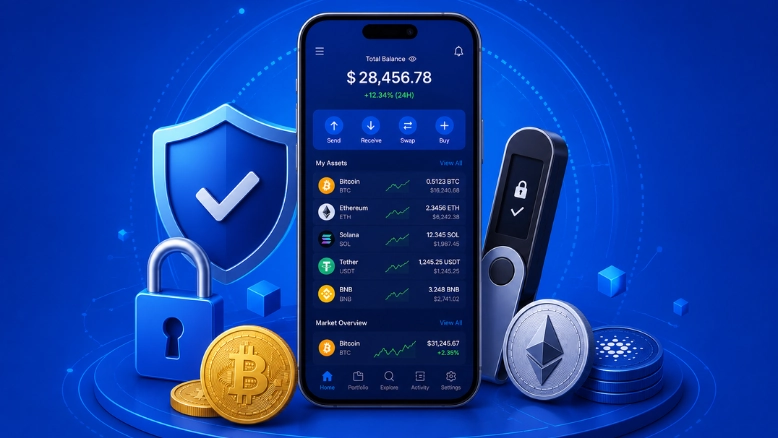
A cryptocurrency wallet is a software application or hardware device that enables users to store, manage, send, and receive digital assets such as Bitcoin, Ethereum, and thousands of other tokens. Unlike a traditional wallet that physically holds currency, a crypto wallet does not store coins directly. Instead, it securely manages the cryptographic keys that prove ownership of digital assets recorded on blockchain networks.
Every cryptocurrency wallet relies on a pair of cryptographic keys. The public key functions like a bank account number that others can use to send you funds. The private key serves as your password, granting full control over the assets associated with that public address. During the cryptocurrency wallet creation process, securely generating and storing these key pairs is the most critical engineering challenge. Any compromise to the private key results in irreversible loss of funds, making key management the foundation of wallet security.
Modern wallets go far beyond simple key storage. Today, businesses across the UK and Canada are building wallets that include built-in decentralized exchange (DEX) access, staking functionality, NFT galleries, and cross-chain bridges. The wallet has become the user’s gateway to the entire decentralized economy, and the cryptocurrency wallet creation process must account for this expanded scope from day one.
◆ Types of Cryptocurrency Wallets
Choosing the right wallet type is the first strategic decision in the cryptocurrency wallet creation process. Each category serves different user needs, security requirements, and market segments. Businesses in the UAE targeting institutional clients may lean toward hardware or multi-signature wallets, while consumer fintech apps in Canada often prioritize mobile-first hot wallets. Understanding these distinctions helps you architect a product that resonates with your target audience and complies with the regulatory expectations of your operating jurisdiction.
Also Read: How to Create a Mobile Wallet Application
Key Features Required in Cryptocurrency Wallet Creation
A successful cryptocurrency wallet creation project must incorporate a carefully selected set of features that balance functionality, security, and user experience. Through our work with clients in the USA, UK, and Dubai, we have identified the features that separate market-leading wallets from those that fail to gain user traction. Security is the non-negotiable foundation, but it must be complemented by intuitive design and powerful integrations that keep users engaged.
Private key management sits at the core of every wallet architecture. Whether you choose client-side key generation, secure enclave storage, or multi-party computation (MPC), the approach must protect user assets against both remote attacks and physical device compromise. Multi-currency support is equally critical, as users expect to manage Bitcoin, Ethereum, stablecoins, and Layer 2 tokens from a single interface. Backup and recovery options, including seed phrase generation and social recovery mechanisms, must be implemented to prevent permanent fund loss. Transaction history with real-time updates, push notifications, and fiat value conversion rounds out the core feature set that professional-grade wallets require.
Feature Priority Matrix
Step-by-Step Cryptocurrency Wallet Creation Process
The cryptocurrency wallet creation process follows a structured methodology that ensures every aspect of the product meets enterprise standards. Each stage builds upon the previous one, and skipping or rushing any phase increases the risk of security vulnerabilities, performance issues, or regulatory non-compliance. Our agency follows an eight-stage process refined through hundreds of blockchain projects delivered to clients in the USA, UK, UAE, and Canada.
This structured approach is especially critical given the financial nature of wallet applications. A bug in a social media app causes frustration. A bug in a cryptocurrency wallet can result in millions of dollars in irreversible losses. That reality demands engineering discipline, comprehensive testing, and rigorous security auditing at every stage.
Cryptocurrency Wallet Creation Lifecycle
Requirement Analysis
Define target users, supported blockchains, feature scope, compliance requirements, and business objectives for the wallet product.
Blockchain Network Selection
Choose blockchain protocols (Ethereum, Bitcoin, Solana, BSC) based on target market needs, transaction costs, and ecosystem compatibility.
Architecture Design
Design wallet architecture including key management strategy, data layer, API structure, and microservices for scalable performance.
UI/UX Design
Create intuitive, accessible interfaces with clear transaction flows, asset dashboards, and seamless onboarding experiences for all user levels.
Core Engineering
Build wallet core including key generation, transaction signing, blockchain node integration, and API connections for all supported networks.
Security Implementation
Implement encryption layers, multi-sig support, biometric authentication, 2FA, secure enclave integration, and anti-phishing measures.
Testing & QA
Conduct unit testing, integration testing, penetration testing, smart contract audits, and end-to-end user flow validation on testnets.
Deployment & Maintenance
Deploy to production with monitoring systems, set up continuous updates, bug fixes, blockchain protocol upgrades, and user support channels.
Also Read: How to Build a DeFi Wallet: Complete Guide
🔒
Security Measures in Cryptocurrency Wallet Creation
Security is the single most important pillar of any cryptocurrency wallet creation project. The irreversible nature of blockchain transactions means that stolen funds cannot be recovered through chargebacks or dispute processes. Our agency treats security as an architecture decision, not a feature to bolt on after the core product is built. Every component, from key generation to transaction signing to data storage, must be designed with defense-in-depth principles from the start.
Encryption forms the first line of defense. All private keys should be encrypted at rest using AES-256 or equivalent standards and stored within hardware-backed secure enclaves on mobile devices. Multi-signature wallets require multiple parties to approve transactions, dramatically reducing the risk of single-point compromise. This approach is particularly popular with institutional clients in the UK and UAE who manage large portfolios. Biometric authentication, including fingerprint and facial recognition, adds a user-friendly security layer without increasing friction.
Two-factor authentication (2FA) using time-based one-time passwords (TOTP) or hardware security keys provides an additional verification step. Secure seed phrase backup with encrypted cloud storage options gives users a reliable recovery path. Real-time transaction monitoring and anomaly detection systems can flag suspicious activity before funds leave the wallet. For enterprise wallets serving clients in regulated markets like Canada and the USA, integrating these security layers is not optional but a regulatory and competitive requirement.
Technology Stack Used for Cryptocurrency Wallet Engineering
Selecting the right technology stack is a foundational decision in the cryptocurrency wallet creation process that impacts everything from performance and scalability to maintenance costs and time-to-market. The stack must support secure cryptographic operations, reliable blockchain node communication, and a smooth cross-platform user experience. Based on our experience delivering wallet projects for fintech companies in the USA and UK, we recommend technology choices that balance maturity, community support, and performance.
Backend infrastructure typically runs on Node.js or Go for high-throughput API services, while Python serves well for blockchain data indexing and analytics. Frontend frameworks like React Native or Flutter enable cross-platform mobile deployment from a single codebase, reducing time-to-market significantly. Blockchain interaction relies on web3.js, ethers.js, and chain-specific SDKs. For secure key management, integration with platform-native secure enclaves (iOS Keychain, Android Keystore) is essential.
| Layer | Technologies | Purpose |
|---|---|---|
| Frontend Mobile | React Native, Flutter, Swift, Kotlin | Cross-platform mobile wallet interfaces |
| Frontend Web | React.js, Next.js, Vue.js | Web-based wallet dashboards and extensions |
| Backend | Node.js, Go, Python, Rust | API services, transaction processing, indexing |
| Blockchain SDKs | Web3.js, Ethers.js, BitcoinJS, Solana Web3 | Blockchain interaction and transaction signing |
| Security | HSM, Secure Enclave, AES-256, ECDSA | Key management and encryption |
| Database | PostgreSQL, MongoDB, Redis | Transaction caching, user data, metadata |
| Infrastructure | AWS, GCP, Docker, Kubernetes | Cloud hosting, scaling, and orchestration |
Cost and Time Required for Cryptocurrency Wallet Creation
One of the most common questions we receive from clients in the USA, UK, and UAE is about the investment required for professional cryptocurrency wallet creation. The honest answer is that costs vary significantly based on wallet type, feature complexity, blockchain integrations, and platform requirements. A simple single-chain mobile wallet with basic send/receive functionality requires a smaller investment than a multi-chain platform with DeFi integrations, NFT support, and enterprise security features.
For startups and mid-sized businesses, budgeting accurately from the start prevents scope creep and ensures the project delivers real value. We recommend a phased approach where the MVP focuses on core wallet functionality and subsequent releases add DeFi, NFT, and advanced features based on user feedback and market demand. This strategy optimizes both cost efficiency and time-to-market, which is crucial in the competitive crypto fintech space.
Cost Breakdown by Wallet Type
| Wallet Type | Estimated Cost (USD) | Timeline | Complexity |
|---|---|---|---|
| Basic Single-Chain Wallet | $25,000 – $50,000 | 2 – 3 Months | Low |
| Multi-Chain Mobile Wallet | $50,000 – $100,000 | 4 – 6 Months | Medium |
| DeFi-Integrated Wallet | $100,000 – $150,000 | 6 – 8 Months | High |
| Enterprise Multi-Platform Wallet | $150,000 – $200,000+ | 8 – 12 Months | Very High |
⚠
Common Challenges in Cryptocurrency Wallet Creation
The cryptocurrency wallet creation process comes with unique challenges that differ significantly from traditional software projects. The high-stakes nature of financial applications, the rapidly evolving blockchain landscape, and complex regulatory frameworks across different jurisdictions create obstacles that require specialized expertise to navigate. Understanding these challenges upfront helps teams plan mitigation strategies and avoid costly setbacks.
Scalability is a persistent concern, especially for wallets targeting high-volume markets. As user bases grow, the wallet must handle increasing transaction loads without degrading performance. Security vulnerabilities remain the most serious risk, with new attack vectors emerging regularly. Regulatory compliance adds another layer of complexity, as KYC/AML requirements differ between the USA (FinCEN), UK (FCA), UAE (VARA), and Canada (FINTRAC). Building a wallet that satisfies all these regulatory bodies requires jurisdiction-aware architecture from the planning phase. User trust is perhaps the most intangible challenge. In a space plagued by hacks and scams, convincing users that your wallet is safe requires transparent security practices, third-party audits, and a track record of reliability.
Security Vulnerabilities
New attack vectors like phishing, SIM swapping, and supply chain attacks require continuous security monitoring and regular audit cycles.
Regulatory Compliance
Navigating different KYC/AML frameworks across USA, UK, UAE, and Canada requires jurisdiction-specific compliance modules and legal advisory.
Blockchain Fragmentation
Supporting multiple chains with different protocols, token standards, and consensus mechanisms increases engineering complexity exponentially.
User Trust & Adoption
Building user confidence requires transparent security practices, third-party audits, responsive support, and consistent product reliability over time.
Wallet Model Selection Criteria
Before beginning the cryptocurrency wallet creation process, businesses must select the right wallet model based on their specific market requirements, target audience, and regulatory environment. The model you choose impacts everything from architecture complexity to security overhead and compliance costs. Here are the three critical evaluation steps we recommend.
Assess Target Audience and Use Case
Determine whether your wallet serves retail users, institutional investors, or enterprise clients. Retail users in the USA and Canada prefer simple non-custodial wallets with intuitive UX. Institutional clients in the UK and Dubai require multi-signature custody solutions with role-based access controls and compliance reporting.
Evaluate Security and Custody Model
Choose between custodial (centralized key management), non-custodial (user-controlled keys), or MPC (distributed key shares) models. Each has distinct trade-offs in security, usability, and regulatory compliance. MPC wallets are emerging as the preferred choice for businesses seeking to balance security with user experience.
Map Regulatory Requirements by Jurisdiction
Review KYC/AML mandates in each target market. The USA requires FinCEN compliance, the UK follows FCA guidelines, UAE mandates VARA registration, and Canada enforces FINTRAC reporting. Your wallet model must accommodate these frameworks natively without requiring major re-architecture for each market.
Why Choose a Professional Cryptocurrency Wallet Company
Building a cryptocurrency wallet in-house may seem cost-effective initially, but the complexity of blockchain engineering, cryptographic security, and regulatory compliance makes professional partnership the more strategic choice. A specialized cryptocurrency wallet creation agency brings years of accumulated expertise across multiple chains, security frameworks, and compliance standards. This experience translates directly into fewer vulnerabilities, faster delivery, and a more robust final product.
Our agency has delivered over 150 blockchain projects across the USA, UK, UAE, and Canada. That track record means we have already solved the engineering challenges that would take a new team months to figure out. We bring pre-built libraries for key management, transaction signing, and blockchain communication that accelerate the cryptocurrency wallet creation timeline without compromising quality. End-to-end support from architecture design through post-launch maintenance ensures your wallet remains secure, performant, and compliant as blockchain protocols evolve.
Real-world example: A fintech startup in Dubai engaged our team to build a multi-chain non-custodial wallet supporting Ethereum, BSC, and Solana. By leveraging our existing infrastructure and security modules, we delivered the MVP in 14 weeks instead of the 6 months estimated by their internal team, saving them over $80,000 in engineering costs while achieving SOC 2 Type II compliance readiness.
Smart Contract Integration Testing Lifecycle
Unit Testing
Test individual contract functions in isolation to verify basic logic and state changes work correctly.
Integration Testing
Verify multiple contracts interact properly and external system connections function as designed.
End-to-End Testing
Validate complete user workflows from frontend through smart contracts to backend systems.
Load & Security Testing
Test system performance under load and conduct security assessments of integration points.
Regression Testing
Ensure new code changes and upgrades do not break existing wallet functionality or security measures.
User Acceptance Testing
Validate that the wallet meets business requirements and delivers the expected user experience before launch.
Mainnet Staging
Deploy to a staging environment mirroring mainnet conditions to validate real-world transaction processing and network behavior.
Post-Launch Monitoring
Implement continuous monitoring, error tracking, and automated alerting to catch issues in production immediately.
Authoritative Industry Standards for Wallet Security
Standard 1:
Use hardware-backed secure enclaves (iOS Secure Enclave, Android StrongBox) for all private key generation and storage operations on mobile devices.
Standard 2:
Implement BIP-39 compliant seed phrase generation with cryptographically secure random number generators validated against NIST SP 800-90A standards.
Standard 3:
Frequently Asked Questions
Q1.What is cryptocurrency wallet creation?
Cryptocurrency wallet creation is the process of building a digital wallet that securely stores private keys and allows users to send, receive, and manage crypto assets.
Q2.How does a cryptocurrency wallet work?
A cryptocurrency wallet works by generating and storing private and public keys that enable users to interact with blockchain networks and authorize transactions.
Q3.What are the types of cryptocurrency wallets?
Common types include hot wallets, cold wallets, custodial wallets, non-custodial wallets, mobile wallets, web wallets, and hardware wallets.
Q4.Is cryptocurrency wallet creation secure?
Yes, when developed with strong encryption, secure key storage, multi-factor authentication, and regular security audits, wallet creation can be highly secure.
Q5.How long does cryptocurrency wallet creation take?
The development time depends on features and complexity but usually ranges from 4 to 12 weeks for a fully functional wallet.
Q6.What blockchains can be integrated during wallet creation?
Wallets can support blockchains like Bitcoin, Ethereum, Binance Smart Chain, Polygon, Solana, and other popular networks.
Q7.What is the cost of cryptocurrency wallet creation?
The cost varies based on wallet type, supported currencies, security features, and platform, typically ranging from basic to enterprise-level budgets.
Q8.What security features are essential in wallet creation?
Key features include private key encryption, seed phrase backup, biometric authentication, two-factor authentication, and multi-signature support.
Q9.Can a cryptocurrency wallet support multiple coins?
Yes, modern wallets are designed as multi-currency wallets, allowing users to store and manage multiple cryptocurrencies in one place.
Q10.Why should businesses choose professional wallet development services?
Professional developers ensure secure architecture, regulatory compliance, scalability, and long-term maintenance for reliable wallet performance.
Explore Services
Related Services
Reviewed by

Aman Vaths
Founder of Nadcab Labs
Aman Vaths is the Founder & CTO of Nadcab Labs, a global digital engineering company delivering enterprise-grade solutions across AI, Web3, Blockchain, Big Data, Cloud, Cybersecurity, and Modern Application Development. With deep technical leadership and product innovation experience, Aman has positioned Nadcab Labs as one of the most advanced engineering companies driving the next era of intelligent, secure, and scalable software systems. Under his leadership, Nadcab Labs has built 2,000+ global projects across sectors including fintech, banking, healthcare, real estate, logistics, gaming, manufacturing, and next-generation DePIN networks. Aman’s strength lies in architecting high-performance systems, end-to-end platform engineering, and designing enterprise solutions that operate at global scale.