Ai Overview
A crypto OTC desk provides specialized services for executing large cryptocurrency transactions away from public exchanges. Institutional crypto trading volumes doubled in 2024 and estimates suggest daily OTC trading now exceeds $39 billion, with some liquidity providers reporting figures above $100 billion. 6% of OTC spot trading volume, a sharp rise from 46% in 2024, highlighting how institutional investors are increasingly turning to private trading venues.
A crypto OTC desk provides specialized services for executing large cryptocurrency transactions away from public exchanges. Institutional crypto trading volumes doubled in 2024 and estimates suggest daily OTC trading now exceeds $39 billion, with some liquidity providers reporting figures above $100 billion. This guide covers how crypto OTC desks function, their benefits for large traders, trading strategies, regulatory considerations, and the settlement process that makes private high-volume transactions possible.
Stablecoins now make up 74.6% of OTC spot trading volume, a sharp rise from 46% in 2024, highlighting how institutional investors are increasingly turning to private trading venues. The evolution of token development solutions has broadened the spectrum of assets accessible through OTC channels, moving beyond Bitcoin and Ethereum to include stablecoins, tokenized securities, and a variety of specialized digital assets.
Stablecoins now account for 74.6% of OTC spot trades, up from 46% in 2024, demonstrating how institutional players increasingly rely on these private trading venues. The development of crypto token solutions has expanded the range of assets available through OTC channels beyond Bitcoin and Ethereum to include tokenized securities, stablecoins, and specialized digital assets.
Key Takeaways
- Crypto OTC desks facilitate private, high-volume cryptocurrency transactions away from public exchange order books
- Daily OTC volumes exceed $39 billion with some estimates above $100 billion, representing significant institutional activity
- Stablecoins dominate settlement at 74.6% of OTC spot trades, enabling near-instant cross-border transfers
- Principal and agency desk models offer different tradeoffs between execution speed and pricing transparency
- Regulatory compliance now requires KYC verification, AML screening, and licensing across major jurisdictions
- Market stability benefits from OTC trading during volatility events as institutions move to private venues
- Qualified custody and tri-party arrangements mitigate counterparty risk in high-value transactions
What is a Crypto OTC Desk?
A crypto OTC desk is a trading service that facilitates private, high-volume cryptocurrency transactions directly between parties without using public exchange order books. Unlike centralized exchanges where all buy and sell orders are visible, OTC desks connect buyers and sellers discreetly, enabling large trades to execute without affecting market prices or revealing trading intentions to other participants.
These desks evolved from informal arrangements among early Bitcoin miners and adopters into fully regulated, institutionally-driven market infrastructure. Today, major OTC desks operate under compliance frameworks across jurisdictions including the United States, European Union, Singapore, and United Arab Emirates, serving hedge funds, family offices, corporate treasuries, and high-net-worth individuals.
How OTC Desks Differ from Exchanges
On traditional cryptocurrency exchanges, large orders appear on public order books where other traders can see them. This visibility creates problems for institutional investors because market participants may front-run the order, driving prices against the large trader before execution completes. Additionally, exchanges often lack sufficient liquidity to fill massive orders at a single price, causing slippage that increases costs.
OTC desks solve these problems through private negotiation and deep liquidity networks. Understanding the distinction between digital currency vs. crypto helps traders appreciate why different transaction methods suit different asset types and regulatory requirements.
How Crypto OTC Desks Work
The OTC trading process begins when a client contacts the desk with a request to buy or sell a specific cryptocurrency amount. Minimum trade sizes typically start at $100,000 to $250,000, with many desks specializing in transactions exceeding $1 million. The desk then taps into its network of liquidity providers, market makers, and other counterparties to generate a competitive quote.
Once the client accepts the quoted price, the desk executes the trade. Principal desks use their own capital to fill orders immediately, while agency desks act as intermediaries matching buyers with sellers. Settlement occurs through secure custodial arrangements, with many trades settling via stablecoin transfers that complete within minutes rather than the days required for traditional wire transfers.
Types of OTC Desk Models
Principal desks purchase assets using their own funds before transferring them to clients, profiting from the spread between their buying price and the client’s price. This model offers faster execution since the desk can immediately fill orders from its inventory without waiting to locate a counterparty.
Agency desks function as brokers that connect buyers and sellers without taking positions themselves. They charge fees or commissions for their matching services while clients benefit from transparent pricing since agency desks have no incentive to manipulate quotes. Hybrid models combine both approaches depending on trade size and market conditions.
The Settlement Process
Settlement represents the final exchange of cryptocurrency and payment between parties. Modern OTC desks typically settle using stablecoins like USDC or USDT, which enable near-instant transfers at minimal cost compared to international wire transfers. On-chain settlement provides transparency since both parties can verify transaction completion in real-time on public blockchains.
Tri-party arrangements use neutral custodians to hold both assets until both legs of the trade clear, reducing counterparty risk. Qualified custody ensures client assets remain segregated from the desk’s operational funds, providing protection even if the trading firm experiences financial difficulties.
Who Uses Crypto OTC Desks
Institutional investors including hedge funds, pension funds, and sovereign wealth funds rely on OTC desks when building or liquidating large cryptocurrency positions. Bitcoin ETF issuers used OTC channels extensively when sourcing the underlying assets for their funds, with Coinbase Prime alone processing approximately $14 billion in USD-denominated OTC flows during the ETF launch period.
High-net-worth individuals use OTC services for privacy and personalized support that standard exchanges cannot provide. Corporate treasuries adding cryptocurrency to balance sheets prefer OTC execution to avoid market impact from their own orders. Mining operations also batch their block rewards and sell through OTC desks to receive fiat immediately without drip-feeding coins onto exchanges.
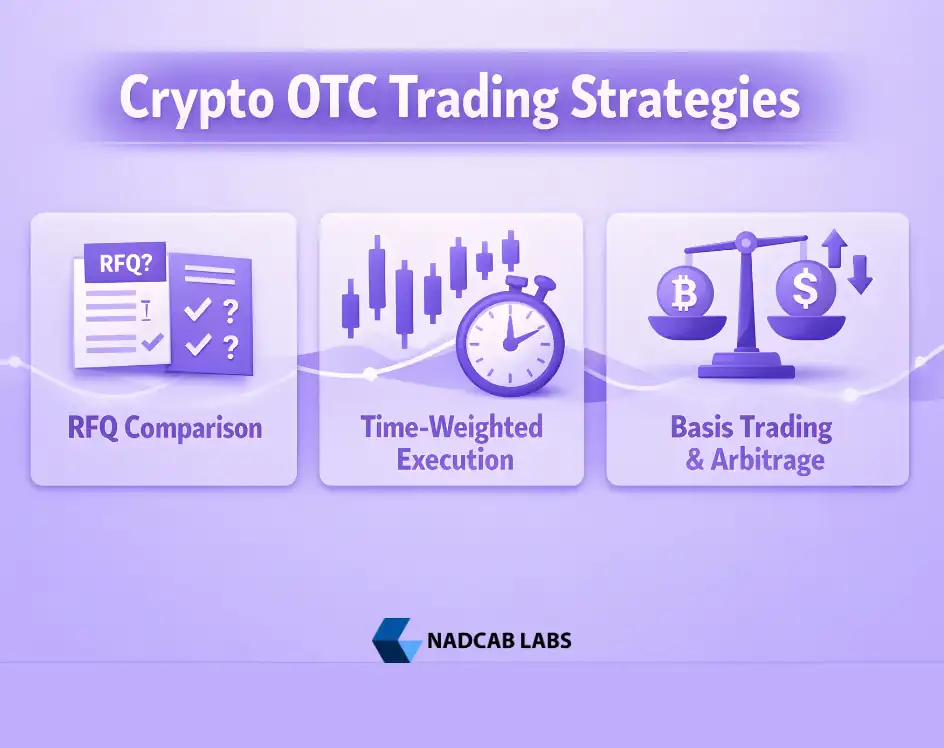
Crypto OTC Trading Strategies
Successful OTC trading requires strategies tailored to large transaction sizes and institutional requirements. These approaches help traders optimize execution while managing the unique risks associated with high-volume cryptocurrency transactions.
Request for Quote (RFQ) Comparison
Sophisticated traders request quotes from multiple OTC desks simultaneously before executing. Comparing prices across five or more desks while checking centralized exchange mid-prices helps identify the tightest spreads available. This competition benefits clients through better pricing while desks compete on service quality and execution speed.
Time-Weighted Execution
Rather than executing entire positions at once, traders may split large orders across multiple sessions to capture average prices over time. This strategy reduces timing risk when markets experience heightened volatility. OTC desks can structure these arrangements with guaranteed execution schedules while the client benefits from price averaging.
Basis Trading and Arbitrage
Professional traders use OTC desks for basis trades that capture price differences between spot markets and futures contracts. These strategies require simultaneous execution of multiple positions where the speed and discretion of OTC trading prevents other market participants from detecting and exploiting the arbitrage opportunity.
Structured Settlement Arrangements
OTC desks offer flexible settlement terms that exchanges cannot match. Clients may negotiate prefunding arrangements, delayed settlement, or payment in tranches depending on their treasury management needs. These customizations help businesses whose revenues arrive on-chain but whose expenses require fiat currency.
Benefits of Using a Crypto OTC Desk
OTC trading provides advantages that make it essential for institutional cryptocurrency market participants. These benefits explain why trading volumes continue growing despite the convenience of exchange-based alternatives.
Price Stability and Reduced Slippage
Large exchange orders move prices against the trader as they execute through multiple price levels in the order book. OTC desks lock in prices before execution, eliminating slippage and ensuring the quoted amount matches the final settlement. This predictability enables accurate financial planning and reporting.
Privacy and Discretion
OTC trades do not appear on public order books, keeping transaction details confidential. This privacy prevents competitors from detecting trading activity and protects investment strategies from front-running. For public companies or regulated entities, discretion also helps manage disclosure requirements.
Deep Liquidity Access
Major OTC desks maintain relationships with hundreds of liquidity providers, market makers, and institutional counterparties worldwide. This network enables them to fill orders that would overwhelm any single exchange while sourcing competitive prices across the entire market. When deciding to list a token or coin on various platforms, understanding how OTC liquidity complements exchange listing helps projects plan comprehensive market-making strategies.
Personalized Service
OTC clients receive dedicated account representatives who understand their specific needs and trading patterns. This white-glove service includes market intelligence, execution advice, and ongoing relationship management that automated exchange interfaces cannot replicate.
Regulatory Compliance and Risk Management
Regulatory frameworks for crypto OTC trading have matured significantly. In the United States, OTC platforms register as Money Services Businesses with FinCEN while the SEC or CFTC may exercise jurisdiction depending on asset classification. The GENIUS Act established stablecoin reserve requirements while the CLARITY Act provided jurisdictional clarity for digital asset transactions.
In the European Union, MiCA regulation requires OTC desks to obtain licenses, maintain stablecoin reserves, and comply with derivative trading rules under EMIR. Leading jurisdictions including Singapore, Switzerland, and the UAE have established crypto-friendly regulatory frameworks that enable compliant OTC operations while protecting market participants.
KYC and AML Requirements
All reputable OTC desks require full Know Your Customer verification before trading. Clients must provide identification documents, proof of address, and source of funds documentation. These requirements protect against money laundering while ensuring trades comply with sanctions screening obligations.
Counterparty Risk Mitigation
Counterparty risk remains the primary concern in OTC trading since transactions depend on both parties fulfilling their obligations. Segregated custody keeps client assets separate from operational funds. Escrow arrangements through qualified custodians ensure neither party can default after agreeing to terms. Insurance coverage provides additional protection against custody failures.
Explore Institutional Crypto OTC Trading
During periods of extreme volatility, institutions shift to OTC desks to execute large trades privately, reducing panic-driven exchange activity and helping stabilize broader crypto markets.
Market Stability Role
Crypto OTC desks serve as shock absorbers during market volatility, containing panic-driven selling that could destabilize prices. During the October 2025 liquidation event, when Bitcoin dropped from $122,000 to $103,000 triggering $19 billion in liquidations, OTC trading volume in private rooms increased 107% week-over-week while centralized exchange volume grew only 48%.
This institutional flight to OTC during crises demonstrates how private trading venues provide stability that public exchanges cannot. Large holders can exit positions without amplifying market downturns, while buyers can accumulate without triggering momentum-driven rallies that attract speculation. While OTC desks handle institutional transactions, retail traders interested in smaller-scale projects might explore opportunities like launching a Solana meme coin through standard exchange listings.
Choosing an OTC Desk
Selecting the right OTC desk requires evaluating several factors beyond pricing. Regulatory status ensures the desk operates legally and maintains proper compliance controls. Liquidity depth determines whether the desk can handle your trade sizes without sourcing from less reliable counterparties. Custody arrangements should include segregation, insurance, and qualified custodian relationships.
Geographic presence matters for settlement timing and regulatory alignment with your jurisdiction. Service quality includes response times, market intelligence, and the experience level of assigned account representatives. Finally, the range of supported assets should match your trading needs, including stablecoins for settlement.
Final Thoughts
Crypto OTC desks have evolved from informal trading channels into essential market infrastructure serving institutional investors worldwide. Their ability to execute large transactions privately while maintaining price stability makes them indispensable for hedge funds, corporate treasuries, miners, and high-net-worth individuals moving significant cryptocurrency volumes.
As regulatory frameworks mature and institutional adoption continues, OTC trading will remain a critical component of cryptocurrency market structure. Understanding how these desks operate helps market participants make informed decisions about execution venues that match their transaction sizes, privacy requirements, and risk management needs.
Frequently Asked Questions
Q1.What is a crypto OTC desk?
A crypto OTC desk is a service facilitating private, high-volume cryptocurrency transactions away from public exchanges. It connects buyers and sellers directly, enabling large trades without affecting market prices or revealing trading intentions.
Q2.What is the minimum OTC trade size?
Minimum trade sizes typically range from $100,000 to $1 million depending on the desk. Some desks specialize in trades exceeding $5 million while others accommodate smaller institutional transactions starting around $50,000.
Q3.How do OTC desks prevent slippage?
OTC desks lock in prices before execution through direct negotiation with liquidity providers. Unlike exchange orders that execute through multiple price levels, OTC quotes guarantee the agreed price regardless of market movements.
Q4.Are crypto OTC desks regulated today?
Yes, reputable OTC desks operate under regulatory frameworks including FinCEN registration in the US, MiCA licensing in Europe, and similar requirements in Singapore and UAE. Compliance includes KYC verification and AML screening.
Q5.What is counterparty risk in OTC trading?
Counterparty risk is the possibility that the other party defaults on trade obligations. Reputable desks mitigate this through qualified custody, escrow arrangements, and tri-party agreements with neutral custodians.
Q6.What assets can be traded through OTC?
Major cryptocurrencies including Bitcoin, Ethereum, and stablecoins like USDC and USDT are most common. Many desks also support altcoins, tokenized securities, and fiat currency pairs depending on their liquidity network.
Explore Services
Related Services
Reviewed by

Aman Vaths
Founder of Nadcab Labs
Aman Vaths is the Founder & CTO of Nadcab Labs, a global digital engineering company delivering enterprise-grade solutions across AI, Web3, Blockchain, Big Data, Cloud, Cybersecurity, and Modern Application Development. With deep technical leadership and product innovation experience, Aman has positioned Nadcab Labs as one of the most advanced engineering companies driving the next era of intelligent, secure, and scalable software systems. Under his leadership, Nadcab Labs has built 2,000+ global projects across sectors including fintech, banking, healthcare, real estate, logistics, gaming, manufacturing, and next-generation DePIN networks. Aman’s strength lies in architecting high-performance systems, end-to-end platform engineering, and designing enterprise solutions that operate at global scale.