Ai Overview
The emergence of decentralized identity frameworks has fundamentally transformed how individuals and organizations manage digital credentials across blockchain networks. Credential holders in Web3 represent a paradigm shift from traditional identity systems where centralized authorities control user data to self-sovereign models where individuals maintain complete ownership of their verified information.
The emergence of decentralized identity frameworks has fundamentally transformed how individuals and organizations manage digital credentials across blockchain networks. Credential holders in Web3 represent a paradigm shift from traditional identity systems where centralized authorities control user data to self-sovereign models where individuals maintain complete ownership of their verified information. As organizations across the USA, UK, UAE, and Canada increasingly adopt Web3 solutions, understanding the role of credential holders becomes essential for building secure, privacy-preserving applications.
With over eight years of experience implementing decentralized identity infrastructure for enterprise clients globally, our agency has witnessed the transformative impact of credential holder systems on user privacy, security, and operational efficiency. The Web3 credential holders ecosystem enables individuals to receive digitally signed attestations from trusted issuers, store them securely in self-custodial wallets, and present cryptographic proofs to verifiers without exposing unnecessary personal information.
This comprehensive guide explores how credential holders work in Web3, their relationship with issuers and verifiers, storage mechanisms, security considerations, and real-world applications across DeFi, NFTs, DAOs, and regulatory compliance scenarios. Whether you are building identity infrastructure or evaluating Web3 credentials for your organization, this resource provides the authoritative insights needed to navigate this rapidly evolving landscape.
Key Takeaways
- Credential holders in Web3 maintain complete ownership of their digital credentials without relying on centralized authorities or intermediaries.
- The issuer, holder, verifier model creates a triangular trust framework enabling decentralized verification across blockchain networks globally.
- Decentralized identifiers provide globally unique, persistent identity anchors that credential holders control independently of any registry.
- Web3 wallet-based credential storage leverages encryption and hardware security to protect sensitive identity data from unauthorized access.
- Zero-knowledge proofs enable credential holders to verify attributes without revealing underlying personal information to service providers.
- Selective disclosure empowers holders to share only necessary credential attributes, minimizing data exposure during verification processes.
- Credential holders in Web3 ecosystem applications span DeFi access control, DAO membership verification, and decentralized KYC compliance.
- Interoperability standards ensure credentials issued on one blockchain network remain verifiable across multiple Web3 platforms seamlessly.
- Trust models enabled by credential holders eliminate centralized points of failure while maintaining cryptographic verification guarantees.
- The future of decentralized credential holders includes AI-powered verification, cross-chain portability, and enhanced privacy technologies.
What Is a Credential Holder in Web3?
A credential holder in Web3 represents an individual, organization, or entity that receives, stores, and controls verifiable credentials within decentralized identity ecosystems. Unlike traditional identity frameworks where institutions maintain databases of user information, Web3 credential holders possess complete sovereignty over their digital credentials, deciding when, how, and with whom to share verified information. This fundamental shift places users at the center of identity management rather than as subjects of centralized data collection.
What is a credential holder in Web3 becomes clearer when examining the operational mechanics. Holders receive cryptographically signed credentials from trusted issuers such as educational institutions, government agencies, or employers. These credentials contain claims about the holder, perhaps verifying their age, professional qualifications, or membership status. The digital signatures enable anyone to verify credential authenticity without contacting the original issuer, creating trustless verification pathways essential for decentralized systems.
The credential holder role empowers individuals across markets including the USA, UK, and UAE to participate in Web3 ecosystems while maintaining privacy. Rather than submitting copies of sensitive documents repeatedly, holders can present cryptographic proofs that verify specific attributes without exposing underlying data. This approach dramatically reduces identity theft risks while streamlining verification processes across multiple services and platforms.
Why Credential Holders Matter in Web3 Ecosystems?
Credential holders matter because they represent the essential bridge between real-world identity verification and blockchain-based applications. Without functional credential holder infrastructure, Web3 platforms cannot verify user attributes necessary for compliance, access control, or trust establishment. The benefits of credential holders in Web3 extend beyond individual privacy to enable entirely new categories of decentralized applications that require verified identity without centralized gatekeepers.
The decentralized credential holders model addresses fundamental limitations of current identity systems. Data breaches affecting centralized databases have exposed billions of personal records globally, creating massive fraud and identity theft costs. By distributing credential storage to individual holders rather than aggregating it in vulnerable databases, Web3 identity systems eliminate these honeypot targets that attract malicious actors and create systemic risks for entire populations.
Furthermore, credential holders enable censorship-resistant identity that operates beyond governmental or corporate control. Users in jurisdictions with authoritarian tendencies can maintain verified credentials that cannot be arbitrarily revoked or altered by hostile authorities. This resilience proves particularly valuable for activists, journalists, and marginalized communities who face identity-based persecution while needing to participate in global digital economies.
The Issuer-Holder-Verifier Model Explained
Issuer Role
- Creates verifiable credentials
- Digitally signs attestations
- Establishes trust anchors
- Maintains revocation registries
Holder Role
- Receives and stores credentials
- Controls sharing decisions
- Presents proofs to verifiers
- Manages credential lifecycle
Verifier Role
- Requests credential proofs
- Validates cryptographic signatures
- Checks revocation status
- Grants access based on verification
Understanding the difference between issuer holder and verifier is fundamental to grasping how credential holders work in Web3. This triangular trust model eliminates the need for direct communication between issuers and verifiers, enabling scalable verification across unlimited service providers. The cryptographic foundation ensures that holders cannot forge credentials while verifiers can independently confirm authenticity without relying on centralized databases or real-time issuer availability.
How Credential Holders Fit Into Decentralized Identity Systems?
Credential holders occupy the central position within decentralized identity architectures, serving as the nexus where verified claims meet user control. The role of credential holder in decentralized identity extends beyond simple storage to encompass active management of digital presence across Web3 ecosystems. Holders interact with decentralized identifier registries, credential wallets, and verification protocols to establish and maintain their identity across multiple platforms and services.
Decentralized identity systems built around credential holders eliminate the fragmented identity problem plaguing current internet architecture. Rather than maintaining separate accounts with duplicated personal information across hundreds of services, holders can leverage portable credentials that function universally. A professional certification verified once can be presented to any employer globally, while age verification completed for one service applies across all platforms accepting the credential format.
The integration between credential holders and blockchain infrastructure enables novel trust mechanisms impossible in traditional systems. Smart contracts can automatically verify holder credentials before executing transactions, enabling permissioned DeFi pools, compliant token transfers, and gated community access without human intervention. This programmable identity layer transforms how credential holders Web3 ecosystem participants interact with decentralized applications.
Decentralized identifiers provide the foundational addressing scheme that credential holders use to establish their identity across Web3 networks. DIDs are globally unique, persistent identifiers that holders control through associated cryptographic keys. When credentials are issued, they are bound to specific DIDs, ensuring only the legitimate holder can present them for verification. This cryptographic binding prevents credential theft or unauthorized sharing while enabling legitimate delegation when desired.
How Credential Holders Store and Manage Credentials?
Credential storage represents one of the most critical aspects of how credential holders work in Web3, as the security and accessibility of stored credentials directly impacts their utility. Modern credential management systems employ multiple layers of protection including encryption at rest, secure key derivation, and hardware-backed storage when available. These measures ensure that even if storage media is compromised, credential contents remain protected from unauthorized access.
Management interfaces enable holders to organize credentials by category, set expiration reminders, and configure sharing preferences. Advanced implementations support automatic credential refresh when issuers update attestations and alert holders to revocation events affecting their credentials. The user experience priorities balance security with convenience, recognizing that overly complex systems discourage adoption while insufficient security undermines trust in the entire ecosystem.
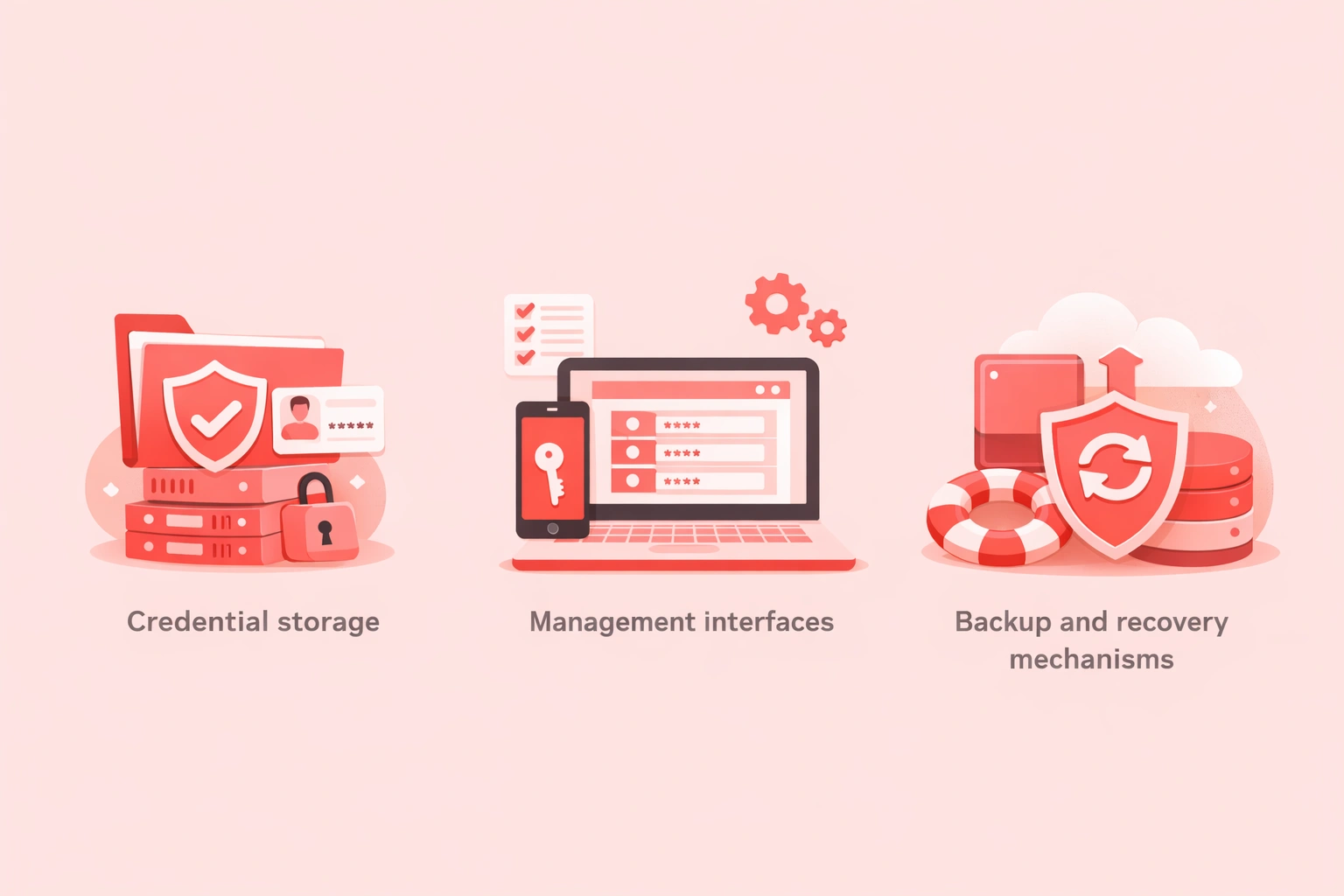
Backup and recovery mechanisms address the challenge of credential persistence across device changes and potential key loss scenarios. Social recovery systems enable holders to designate trusted contacts who can collectively restore access without any individual contact gaining unauthorized access. Multi-signature schemes and time-locked recovery processes provide additional options tailored to different security and convenience requirements across user populations in Canada, UK, and other markets.
Wallet-Based Credential Storage in Web3
| Wallet Type | Security Level | Best Use Case |
|---|---|---|
| Hardware Wallets | Highest security with isolated key storage | High-value credentials, enterprise use |
| Mobile Wallets | Strong with device encryption | Daily use credentials, accessibility |
| Browser Extensions | Moderate with password protection | Web application integration |
| Multi-Sig Wallets | Very high with distributed control | Organizational credentials, shared custody |
| Smart Contract Wallets | Programmable security policies | Automated credential management |
Wallet selection significantly impacts the security and usability of credential holder systems. Organizations must evaluate wallet options against their specific threat models, user populations, and operational requirements. Enterprise deployments commonly combine multiple wallet types, using hardware solutions for critical credentials while maintaining mobile access for routine verification scenarios.
Security and Privacy Considerations for Credential Holders
End-to-End Encryption: All credential data encrypted from issuance through storage to presentation, preventing interception or unauthorized access.
Minimal Disclosure: Holders share only required attributes rather than complete credentials, reducing exposure of unnecessary personal data.
Unlinkability: Presentation protocols prevent verifiers from correlating credential usage across different contexts or services.
Revocation Privacy: Checking credential validity without revealing holder identity or specific credential being verified.
Holder Binding: Cryptographic proof that presenter is legitimate holder prevents credential sharing or theft attempts.
Audit Resistance: Holders maintain records of credential presentations while preventing unauthorized tracking by third parties.
Zero-Knowledge Proofs and Selective Disclosure
Zero-knowledge proofs represent the most powerful privacy technology available to credential holders, enabling verification of claims without revealing any underlying information. A holder can prove they are over 21 years old without disclosing their exact birthdate, or demonstrate sufficient income without exposing specific salary figures. This capability transforms verification from data collection exercises into privacy-preserving attestation processes that respect holder sovereignty.
Selective disclosure extends zero-knowledge concepts to credential presentation scenarios where holders choose exactly which attributes to reveal. Rather than presenting entire credentials containing dozens of data points, holders can expose only the specific claims required for a particular verification. A job applicant might prove professional certification validity without revealing certification date, score, or other details irrelevant to the employer’s needs.[1]
These technologies prove particularly valuable in jurisdictions with strong privacy regulations including the UK and UAE where data minimization principles require limiting personal information collection. Organizations implementing credential holder systems with zero-knowledge support can achieve compliance while providing seamless user experiences that traditional verification approaches cannot match.
Real-World Use Cases of Credential Holders in Web3
Educational Credentials
Universities issue blockchain-verified degrees that graduates present to employers instantly without manual verification processes.
Healthcare Records
Patients control medical credential sharing, granting providers access to relevant health information while maintaining privacy.
Professional Licenses
Licensed professionals maintain portable credentials verifiable across jurisdictions, streamlining cross-border service delivery.
Age Verification
Adults prove age eligibility for restricted services without revealing birthdates or other personal identification details.
Credential Holders in DeFi, NFTs, and DAOs
Decentralized finance protocols increasingly leverage credential holders to enable compliant access to financial services. Permissioned lending pools can verify borrower creditworthiness through credentials without exposing complete financial histories. Institutional investors gain access to regulated DeFi products by presenting accreditation credentials that smart contracts verify automatically before permitting participation in otherwise restricted pools.
NFT ecosystems use credential holders to verify creator authenticity, collector status, and community membership. Artists can prove original creation through verifiable attestations that travel with their work across marketplaces. Collectors demonstrate ownership history and collection provenance through credential chains that enhance asset value and prevent fraud. Exclusive communities gate access using membership credentials that holders present for entry.
Decentralized autonomous organizations rely on credential holders for membership verification, voting eligibility, and role-based access control. Contributors prove their involvement through credentials documenting past contributions, enabling meritocratic governance systems. Specialized working groups verify member qualifications before granting access to sensitive resources or decision-making authority within the organization.
Credential Holders and Decentralized KYC Compliance
Verify Once, Use Everywhere
- Complete KYC process once
- Receive reusable credential
- Present across platforms
- Eliminate redundant checks
Privacy-Preserving KYC
- Minimal data exposure
- Zero-knowledge proofs
- Selective attribute sharing
- No centralized storage
Compliance Automation
- Smart contract verification
- Real-time compliance checks
- Automated access control
- Audit trail generation
Decentralized KYC represents one of the most impactful applications of credential holders in Web3, addressing regulatory requirements while respecting user privacy. Traditional KYC processes require users to submit sensitive documents repeatedly to each financial service, creating numerous copies of personal data scattered across organizational databases. Credential-based KYC consolidates verification while distributing control to holders who decide which services receive access.
Trust Models Enabled by Credential Holders
| Trust Model | Mechanism | Application |
|---|---|---|
| Issuer Trust | Verifiers trust specific credential issuers | Government ID, accredited certifications |
| Delegated Trust | Trust inherited through issuer hierarchies | Professional boards, educational accreditation |
| Web of Trust | Peer endorsements create trust networks | Community verification, reputation systems |
| Stake-Based Trust | Economic guarantees back issuer claims | Insurance bonds, slashing conditions |
Trust models enabled by credential holders create flexible frameworks adaptable to diverse verification requirements. Organizations can configure trust policies specifying which issuers they accept, required attestation levels, and additional verification criteria. This configurability enables credential systems to satisfy varying regulatory requirements across jurisdictions while maintaining interoperability through standardized credential formats.
Credential Holder Solution Selection Criteria
Step 1: Requirements Assessment
Evaluate credential types, security requirements, user experience expectations, and regulatory compliance needs for your specific deployment context.
Step 2: Platform Evaluation
Compare available credential holder solutions against requirements, assessing standards compliance, ecosystem support, and vendor reliability.
Step 3: Integration Planning
Design integration architecture addressing wallet connectivity, verification workflows, and user onboarding for successful implementation.
Industry Standards for Credential Holder Implementation
Standard 1: Implement W3C Verifiable Credentials Data Model for maximum interoperability across platforms and jurisdictions.
Standard 2: Use W3C Decentralized Identifiers specification for globally unique, persistent identity anchors controlled by holders.
Standard 3: Implement credential encryption meeting NIST guidelines for data protection at rest and in transit.
Standard 4: Support selective disclosure and zero-knowledge proof presentations for privacy-preserving verification.
Standard 5: Establish secure key management including generation, storage, rotation, and recovery procedures.
Standard 6: Integrate revocation checking using efficient privacy-preserving mechanisms like accumulator-based schemes.
Standard 7: Conduct security audits of wallet implementations and credential handling code by qualified assessors.
Standard 8: Document user consent and data handling practices compliant with GDPR, CCPA, and regional regulations.
Credential Holder Compliance and Governance Checklist
| Requirement | Status | Priority |
|---|---|---|
| W3C VC/DID standards compliance verified | ☐ | Critical |
| Encryption implementation audited | ☐ | Critical |
| Key recovery procedures tested | ☐ | High |
| Privacy policy documented and published | ☐ | High |
| Revocation checking implemented | ☐ | High |
| User consent workflows established | ☐ | Medium |
| Cross-chain interoperability tested | ☐ | Medium |
The Future of Credential Holders in Web3 Identity Ecosystems
The evolution of credential holders in Web3 continues accelerating as standardization efforts mature and adoption expands across enterprise and consumer applications. Emerging technologies including artificial intelligence will enhance credential verification by detecting anomalies, assessing trust scores, and automating compliance checks. These capabilities will enable more sophisticated use cases while maintaining the privacy and user control that define credential holder systems.
Cross-chain credential portability represents a critical frontier where holders can leverage credentials across diverse blockchain ecosystems seamlessly. Interoperability protocols will enable credentials issued on Ethereum to function on Solana, Polygon, or emerging networks without reissuance. This portability ensures credential investments retain value as the Web3 landscape evolves and users migrate between platforms based on performance, cost, or application requirements.
Regulatory frameworks continue developing to accommodate self-sovereign identity models, with jurisdictions in the USA, UK, UAE, and Canada exploring recognition of verifiable credentials for official purposes. As legal acceptance expands, credential holders will increasingly replace traditional identity documents for government services, financial applications, and regulated industries. Organizations investing in credential holder infrastructure today position themselves advantageously for this inevitable transition.
Final Thoughts
Credential holders in Web3 represent a fundamental reimagining of digital identity that places individuals at the center of their data ownership and sharing decisions. The issuer, holder, verifier model creates decentralized trust frameworks enabling verification without centralized intermediaries, while technologies like zero-knowledge proofs and selective disclosure protect privacy during credential presentations. These capabilities address longstanding limitations of traditional identity systems while enabling entirely new categories of applications.
Organizations across the USA, UK, UAE, and Canada increasingly recognize the strategic importance of credential holder infrastructure for competitive positioning in the evolving digital landscape. From DeFi compliance to DAO governance, from healthcare records to professional credentials, the applications span virtually every sector requiring verified identity. Early adopters building expertise and infrastructure today will capture significant advantages as credential-based verification becomes standard practice.
With over eight years of experience implementing decentralized identity solutions for enterprise clients globally, our agency has guided numerous organizations through successful credential holder deployments. The technology has matured significantly, with established standards, proven implementations, and growing ecosystem support making adoption increasingly practical. For organizations committed to Web3’s future, investing in credential holder infrastructure delivers both immediate operational benefits and long-term strategic positioning in the evolving digital identity landscape.
Ready to Implement Credential Holder Systems for Your Web3 Project?
Partner with our expert team to design and build secure credential holder infrastructure that empowers your users while enabling compliant operations.
Frequently Asked Questions
Q1.What is a credential holder in Web3?
A credential holder in Web3 is an individual or entity that receives, stores, and presents verifiable credentials within decentralized identity systems. Unlike traditional identity frameworks where institutions control user data, Web3 credential holders maintain complete ownership of their digital credentials in self-custodial wallets. They can selectively share verified information with service providers without exposing unnecessary personal details. This self-sovereign approach empowers users across the USA, UK, UAE, and Canada to manage their digital identities independently while maintaining privacy and security.
Q2.How do credential holders work in Web3 ecosystems?
Credential holders work by receiving digitally signed credentials from trusted issuers, storing them securely in Web3 wallets, and presenting proofs to verifiers when needed. The process leverages cryptographic signatures to ensure credential authenticity without requiring direct communication between issuers and verifiers. Holders use decentralized identifiers to establish their identity across platforms, enabling portable credentials that function across multiple services. This architecture eliminates centralized databases and gives users granular control over what information they share.
Q3.What is the difference between issuer, holder, and verifier in Web3?
The issuer, holder, and verifier represent three distinct roles in the verifiable credentials ecosystem. Issuers are trusted entities like universities, governments, or employers that create and sign credentials attesting to specific claims. Holders are individuals or organizations that receive and store these credentials, controlling when and how they are shared. Verifiers are service providers or platforms that request and validate credentials to grant access or provide services. This triangular trust model enables decentralized verification without centralized intermediaries.
Q4.How do credential holders store credentials in Web3?
Credential holders store credentials in specialized Web3 wallets designed for decentralized identity management. These wallets use encryption to protect credential data locally on user devices rather than centralized servers. Some implementations leverage hardware security modules for enhanced protection, while others utilize distributed storage solutions like IPFS with encryption layers. The storage mechanism ensures credentials remain accessible only to the holder while supporting selective disclosure features that enable privacy-preserving verification.
Q5.What are the benefits of credential holders in Web3?
Credential holders in Web3 enjoy numerous benefits including complete data ownership, enhanced privacy through selective disclosure, portability across platforms, and resistance to censorship. Unlike traditional systems where credentials can be revoked arbitrarily or data breached from centralized databases, Web3 credentials remain under holder control. Users can prove attributes without revealing underlying data using zero-knowledge proofs, reducing identity theft risks. The system also eliminates repeated verification processes, streamlining user experiences across DeFi, DAOs, and other Web3 applications.
Q6.Can credential holders use credentials across different blockchain networks?
Yes, credential holders can use credentials across different blockchain networks through interoperability standards and cross-chain protocols. The W3C Verifiable Credentials standard provides a blockchain-agnostic format that functions across Ethereum, Polygon, and other networks. Decentralized identifiers support multiple resolution methods, enabling credentials anchored on one chain to be verified elsewhere. This interoperability is crucial for users operating across diverse Web3 ecosystems, ensuring their verified credentials maintain validity regardless of which platform they interact with.
Q7.
Multiple security measures protect credential holders including end-to-end encryption, hardware wallet integration, multi-signature requirements, and cryptographic binding between credentials and holder identifiers. Zero-knowledge proofs enable verification without exposing sensitive data, while revocation registries ensure compromised credentials can be invalidated. Social recovery mechanisms help holders regain access if keys are lost, and selective disclosure prevents over-sharing of personal information. Together, these measures create robust protection exceeding traditional centralized identity systems.
Explore Services
Related Services
Reviewed by

Aman Vaths
Founder of Nadcab Labs
Aman Vaths is the Founder & CTO of Nadcab Labs, a global digital engineering company delivering enterprise-grade solutions across AI, Web3, Blockchain, Big Data, Cloud, Cybersecurity, and Modern Application Development. With deep technical leadership and product innovation experience, Aman has positioned Nadcab Labs as one of the most advanced engineering companies driving the next era of intelligent, secure, and scalable software systems. Under his leadership, Nadcab Labs has built 2,000+ global projects across sectors including fintech, banking, healthcare, real estate, logistics, gaming, manufacturing, and next-generation DePIN networks. Aman’s strength lies in architecting high-performance systems, end-to-end platform engineering, and designing enterprise solutions that operate at global scale.