Ai Overview
Before diving into the Snort vs Zeek comparison, it helps to understand what an intrusion detection system actually does. Think of it like a security camera system for your computer network. Just as cameras record who enters and leaves a building, an IDS watches all the data flowing through your network, looking for anything suspicious. Consider your budget for hardware, storage, and ongoing management when making your choice.
Key Takeaways
- Snort was created by Martin Roesch in 1998 and later acquired by Cisco through the Sourcefire purchase for 2.7 billion dollars, and it now has over 5 million downloads and 600,000 registered users worldwide.[1]
- Zeek was originally developed by Vern Paxson in 1995 at the Lawrence Berkeley National Laboratory under the name “Bro” and was renamed to Zeek in 2018 to reflect its expanded role in network security.[2]
- Snort works as a signature-based intrusion detection system that matches network traffic against predefined rules to catch known threats, while Zeek operates as a network analysis framework that generates detailed logs about all network activity for deeper investigation.
- Snort 3, released as open source in January 2021, introduced multi-threading support, allowing multiple packet processing threads within a single instance, which fixed the biggest performance complaint about the earlier single-threaded Snort 2.[3]
- Zeek generates structured logs for over 35 different network protocols, including HTTP, DNS, SSL, SSH, SMTP, and FTP, making it a powerful tool for forensic investigations and long-term network behavior analysis.[4]
- Snort can operate in three different modes, which are sniffer mode for reading packets, packet logger mode for recording traffic to disk, and intrusion detection mode for real-time threat monitoring and alerting.[5]
- Zeek does not block or prevent network traffic on its own because it is a passive monitoring tool, unlike Snort, which can function as both an IDS (detection only) and an IPS (detection plus prevention) when configured in inline mode.
When it comes to protecting computer networks from hackers and cyber attacks, two tools come up again and again in every discussion: Zeek and Snort. Both are free to use, open source, and trusted by security teams around the world. But they are not the same thing, and picking the wrong one can leave gaps in your defense.
The Zeek vs Snort debate is not about which tool is “better” in a general sense. It is about understanding what each one does well, where it falls short, and which one fits your particular situation. Some organizations need instant alerts when a known attack hits their network. Others need deep logs that help them understand exactly what happened during a breach, even weeks after the fact. And many organizations need both.
This guide walks you through everything you need to know about these two tools. We will cover how they were built, how they work under the hood, what kinds of threats they catch, and how they perform in real-world conditions. By the end, you will have a clear picture of which tool (or combination of tools) makes sense for your network security setup.
Understanding Network Intrusion Detection Systems
Before diving into the Snort vs Zeek comparison, it helps to understand what an intrusion detection system actually does. Think of it like a security camera system for your computer network. Just as cameras record who enters and leaves a building, an IDS watches all the data flowing through your network, looking for anything suspicious.
There are two main approaches to catching bad activity on a network. The first is called signature-based detection. This works like a “wanted poster” system. You have a list of known attack patterns (called signatures or rules), and the system checks every piece of network traffic against that list. If something matches, the system raises an alarm. This method is fast and accurate for threats that are already known, but it cannot catch brand new attacks that nobody has written a signature for yet.
The second approach is called anomaly-based detection or behavioral analysis. Instead of looking for specific known patterns, this method builds a picture of what “normal” looks like on your network and then flags anything that looks unusual. This can catch new and unknown attacks, but it also tends to produce more false alarms because legitimate activity sometimes looks unusual, too.
Network security tools like Zeek and Snort fall into the category of Network Intrusion Detection Systems (NIDS). They sit on your network, watching traffic flow past, and they look for problems. Some tools, like the Snort security tool, can also act as an Intrusion Prevention System (IPS), meaning they can actually block bad traffic instead of just warning about it. Others, like the Zeek security tool, focus purely on watching and recording, leaving the blocking to other tools in your security stack.
With cybercrime costs projected to reach 13.82 trillion dollars by 2028, the development of strong intrusion detection capabilities is no longer optional for any organization that takes security seriously. Choosing between Zeek network monitoring and the Snort intrusion detection system is one of the most important decisions a security team can make.
Recommended Reading:
The History and Origins of Snort and Zeek
Understanding where these tools came from helps explain why they work so differently. Both Snort and Zeek were born in the late 1990s, a time when the internet was growing fast but network security tools were still very basic. The people who built them had different problems to solve, and those original goals still shape how each tool works today.
1. How Snort Got Started
Martin Roesch created Snort in 1998 because affordable and accessible intrusion detection tools simply did not exist at the time. The existing options were expensive commercial products that small organizations could not afford. Roesch wanted to build something that anyone could download and use for free.
Snort started as a simple network sniffer, a tool that could read and display network packets. In 1999, Roesch added intrusion detection capabilities, turning it into one of the world’s first open source IDS tools. The development of Snort quickly attracted a large community of users and contributors. In 2001, Roesch founded a company called Sourcefire to create commercial products built on top of Snort. The original open source version remained free and available to everyone.
Sourcefire grew into a major cybersecurity company, and in 2013, Cisco acquired it for 2.7 billion dollars. Cisco continued to develop and maintain Snort, and the tool kept growing. Today, the Snort intrusion detection system has over 5 million downloads and more than 600,000 registered users, making it the most widely deployed IPS in the world. In 2009, Snort entered InfoWorld’s Open Source Hall of Fame, a recognition of its massive impact on network security.
2. How Zeek Got Started
Zeek has an academic origin story. Vern Paxson designed and built the first version in 1995 while working as a researcher at the Lawrence Berkeley National Laboratory (LBNL). He originally called it “Bro,” which he described as an “Orwellian reminder that monitoring comes hand in hand with the potential for privacy violations.”
LBNL first deployed the tool in 1996 for its own network security. Paxson published his paper on the system at the USENIX Security Symposium in 1998, where it won the Best Paper Award. That same paper received a “Test of Time Award” in 2022 for its lasting impact on the research community. The development of Zeek continued to grow through academic partnerships. In 2003, the National Science Foundation (NSF) began supporting research on the project at the International Computer Science Institute (ICSI). In 2012, Zeek added native IPv6 support, well ahead of many commercial monitoring tools.
In 2018, the project leadership team renamed Bro to Zeek to celebrate its expansion and continued development. The name “Zeek” actually came from the username the developers used to run their sensors at LBNL back in the 1990s. Today, Zeek network monitoring is used by Fortune 500 companies, major government agencies, and large research universities worldwide.
How Snort Works: A Detailed Breakdown
The Snort security tool is built around a simple but powerful idea: check every piece of network traffic against a set of rules that describe known attacks. If the traffic matches a rule, Snort takes action. This approach has made it the most popular open source IDS/IPS in the world.
1. The Three Operating Modes of Snort
Snort can run in three different modes depending on what you need it to do. In sniffer mode, it simply reads network packets and displays them on your screen, similar to what tools like tcpdump or Wireshark do. In packet logger mode, it records packets to disk for later analysis. And in network intrusion detection mode, which is how most people use it, it monitors traffic in real time, compares it against its rules, and sends alerts when it finds something suspicious.
2. The Rule-Based Detection Engine
At the heart of Snort is its detection engine, which uses a rule-based language to define what malicious traffic looks like. These rules can describe a wide range of attacks, from simple port scans to complex buffer overflow exploits. The development of these rules is a community effort. The Snort Community Ruleset is created by users worldwide and quality-checked by Cisco Talos. Paid subscribers get access to the Snort Subscriber Ruleset, which includes signatures for zero-day threats and is typically updated on Tuesdays and Thursdays.
3. Snort 3 and Multi-Threading
One of the biggest complaints about earlier versions of Snort was that it was single-threaded, meaning it could only use one CPU core at a time. This limited its performance on busy networks. Snort 3, which Cisco released as open source in January 2021, completely rewrote the engine in C++ and added multi-threading support. Now, multiple packet processing threads can run within a single Snort instance, sharing configuration and memory. This dramatically improved performance, and tests have shown that increasing the thread count by ten times results in roughly ten times more packets processed per second.
4. IDS and IPS Capabilities
Unlike many network monitoring tools, Snort can work in both IDS mode (detection only) and IPS mode (detection and prevention). In IPS mode, Snort sits inline with your network traffic and can actively block or drop packets that match its rules. This makes it a true active defense tool. However, running in IPS mode adds risk because if a rule misfires, it could block legitimate traffic and cause outages.
How Zeek Works: A Detailed Breakdown
The Zeek security tool takes a fundamentally different approach to network security. While Snort focuses on catching known bad traffic in real time, Zeek focuses on watching everything and creating detailed records of all network activity. Think of it this way: if Snort is a security guard who checks IDs at the door, Zeek is a detective who takes notes on everything happening inside the building.
1. The Event-Driven Architecture
Zeek is built on an event-driven architecture with two main components. The first is the event engine, which takes the incoming stream of network packets and turns them into higher-level events. For example, every HTTP request on the network becomes an HTTP request event that includes the IP addresses, ports, the URL being requested, and the HTTP version being used. But the event itself does not judge whether the request is good or bad. That is left to the second component.
2. The Policy Script Interpreter
The second component is the Policy Script Interpreter, which uses Zeek’s own scripting language (called Zeek Script, which is Turing-complete) to decide what to do with each event. By default, Zeek logs information about events to files. But security teams can write custom scripts to do much more, like sending emails, raising alerts, executing system commands, updating internal metrics, or calling other Zeek scripts. This level of flexibility is what sets Zeek network monitoring apart from simpler detection tools.
3. Protocol Analysis and Logging
Zeek captures detailed information about over 35 different network protocols. This includes HTTP sessions with requested URIs and server responses, DNS requests with replies, SSL certificates, SMTP session content, and much more. All of this information gets written into well-structured tab-separated or JSON log files. These logs are extremely valuable for forensic investigations. If a security incident occurs, having access to Zeek’s detailed logs helps teams understand exactly what happened, identify the source of the problem, and figure out how to prevent similar incidents in the future.
4. Passive Monitoring Only
One important thing to understand about Zeek is that it is purely a passive monitoring tool. It does not block traffic. It does not prevent attacks. It sits on a sensor (which can be hardware, software, virtual, or cloud-based) and quietly observes network traffic, creating records of everything it sees. This means Zeek is not a replacement for a firewall or an IPS. It is a complement to those tools. It provides the deep visibility and analysis that active defense tools often lack.
Recommended Reading:
Zeek vs Snort: Core Feature Comparison
The differences between Zeek and Snort become clearest when you put their features side by side. The following table breaks down the core capabilities of each tool across the areas that matter most for security teams when making a decision. This Snort vs Zeek comparison covers everything from detection methods to deployment complexity.
| Feature | Snort | Zeek |
|---|---|---|
| Primary Function | Intrusion Detection and Prevention System (IDS/IPS) | Network Security Monitor and Traffic Analyzer |
| Detection Method | Signature-based matching using predefined rules | Event-driven analysis using custom scripts and behavioral detection |
| Active Blocking | Yes, supports inline IPS mode to block malicious traffic | No, purely passive monitoring with no traffic blocking |
| Threading | Multi-threaded in Snort 3 (single-threaded in Snort 2) | Multi-process event-driven system |
| Ease of Setup | Easier to set up with prebuilt rule sets and simple configuration | Steeper learning curve, requires scripting knowledge for full use |
| Logging | Generates alerts and logs for matched rule events | Generates detailed structured logs for 35+ protocols |
| Maintained By | Cisco (Talos Intelligence Group) | Zeek Project with commercial support from Corelight |
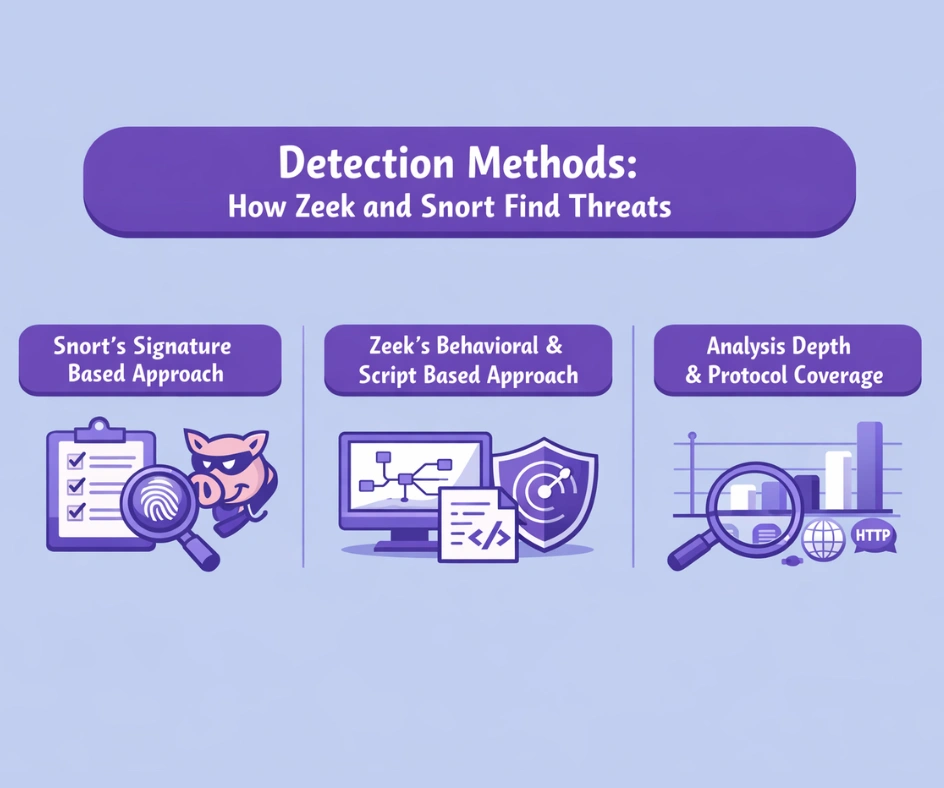
Detection Methods: How Zeek and Snort Find Threats
The way each tool identifies threats is probably the most important difference between them. The Snort vs Zeek detection approach shapes everything from what kinds of attacks they catch to how many false alarms they generate.
1. Snort’s Signature-Based Approach
The Snort intrusion detection system relies primarily on signatures. These are predefined patterns that describe specific attacks. When Snort sees network traffic that matches one of these patterns, it fires an alert. Snort rules are community-driven and updated frequently with new attack signatures covering things like SQL injection attempts, malicious payloads, and command execution patterns. The development of new rules happens constantly as new threats emerge.
The advantage of this approach is speed and accuracy. When a known attack hits your network, Snort catches it fast and with very few false positives. The disadvantage is that Snort cannot detect attacks for which nobody has written a signature yet. Brand new, never-before-seen attacks (called zero-day attacks) can slip past signature-based detection entirely.
2. Zeek’s Behavioral and Script-Based Approach
Zeek takes a completely different approach. Instead of matching traffic against known patterns, Zeek watches all network activity and generates detailed records of what is happening. Security analysts can then write custom scripts to identify suspicious patterns, unusual behaviors, or policy violations.
For example, a Zeek script could flag any case where a computer on your network makes DNS requests to domains that were registered in the last 24 hours (a common sign of malware communication). Or it could alert on any connection that transfers more than a certain amount of data to a foreign IP address outside business hours. These kinds of behavioral detections can catch attacks that no signature would ever match.
The trade-off is complexity. Writing effective Zeek scripts requires a deeper understanding of network protocols and the Zeek scripting language. It takes more expertise to set up and maintain than simply loading a pre-built rule set into Snort.
3. Analysis Depth and Protocol Coverage
When comparing Zeek vs Snort on analysis depth, Zeek wins clearly. Snort primarily focuses on the network layer for traffic inspection. It examines packets and compares them against rules, but it does not build a comprehensive picture of what is happening at the application layer. Zeek, on the other hand, performs multi-layered analysis that extends all the way up to the application layer. It understands HTTP conversations, tracks DNS request chains, parses SSL certificate details, and much more. This gives security teams a much richer view of network activity.
Performance and Resource Considerations
Performance matters a lot when choosing a network security tool. A tool that cannot keep up with your network traffic will miss threats, and that defeats the entire purpose. The Snort vs Zeek performance picture has changed significantly in recent times, especially with the release of Snort 3.
1. CPU and Processing Architecture
Snort 2 was single-threaded, meaning it could only use one CPU core. This was a major limitation on busy networks. Snort 3 fixed this by introducing multi-threading with shared memory, allowing multiple detection threads to work at the same time within a single process. Tests by Cisco showed that increasing the thread count by ten times produced roughly ten times more packets processed per second, with reduced execution time by the same factor.
Zeek uses a multi-process, event-driven system that distributes work across multiple processes. For large deployments, Zeek can use a cluster architecture where different processes handle different tasks (like packet capture, protocol analysis, and log writing). This approach scales well for large networks but requires more storage planning because of the detailed logs Zeek generates.
2. Memory Usage
Snort 3 improved memory usage significantly compared to Snort 2. The old version loaded configuration and network maps separately for each process, wasting memory on duplicate information. Snort 3 does this once and shares it across all threads, freeing up memory for more IPS rules and a larger network map. Academic research comparing Snort 3 and Suricata found that Snort 3 was generally less memory-intensive while maintaining similar CPU utilization levels.
Zeek’s memory usage depends heavily on the scripts being run and the volume of traffic being analyzed. For basic monitoring, memory requirements are moderate. But running complex scripts on high-volume networks can push memory usage up considerably. The development of efficient scripts is therefore a key part of deploying Zeek successfully.
3. Storage Requirements
This is one area where Snort has a clear advantage. Because Snort only logs events that match its rules, its storage footprint is relatively small. You get alert logs, and optionally the packets that triggered those alerts, but not much else.
Zeek, by contrast, logs everything. HTTP requests, DNS queries, SSL certificates, connection metadata, and much more. This comprehensive logging is Zeek’s greatest strength for forensics and threat hunting, but it also means Zeek needs significantly more storage. Organizations deploying Zeek network monitoring need to plan their storage carefully, including log rotation policies and potentially external indexing systems to keep log volumes manageable.
Zeek vs Snort: Deployment and Use Case Comparison
Different organizations have different security needs, and the right tool depends on what you are trying to accomplish. The following table breaks down common deployment scenarios and shows which tool is better suited for each one. This Zeek vs Snort use case analysis should help clarify where each tool fits best.
| Use Case | Best Tool | Reason |
|---|---|---|
| Real-Time Threat Blocking | Snort | Snort’s inline IPS mode can actively drop malicious packets in real time |
| Forensic Investigation | Zeek | Zeek’s comprehensive logging provides forensic-grade context for incident analysis |
| Quick Deployment with Minimal Expertise | Snort | Prebuilt rule sets allow fast setup without custom scripting |
| Threat Hunting | Zeek | Zeek’s detailed protocol logs allow proactive hunting for hidden threats |
| Low Budget / Small Network | Snort | Lower resource requirements and simpler management for smaller teams |
| Custom Automated Workflows | Zeek | Zeek’s scripting language enables complex automated security responses |
| SIEM Integration | Both | Both tools integrate well with SIEM platforms, ELK Stack, and other tools |
Strengths and Limitations of Each Tool
No security tool is perfect for every situation. Understanding the strengths and limitations of each tool helps you make a more informed decision. Let us look at what each tool does well and where it falls short in the Zeek vs Snort comparison.
1. Snort’s Strengths
The Snort intrusion detection system excels at catching known threats quickly. Its signature-based engine processes traffic fast and generates clear, specific alerts. The tool is relatively easy to deploy, especially for organizations that are new to IDS. With prebuilt community rules and commercial rulesets from Cisco Talos, you can have basic protection running in a short time. Snort’s ability to work as both an IDS and an IPS gives it flexibility that Zeek cannot match. The development of Snort 3 with multi-threading support has also addressed the performance limitations that used to hold it back.
2. Snort’s Limitations
Snort struggles with unknown attacks. If nobody has written a signature for a particular attack, Snort will not catch it. While Snort can detect some protocol anomalies, its primary strength is pattern matching, and that requires knowing the pattern in advance. Snort also provides limited context when it does fire an alert. It tells you “something bad matched a rule,” but does not give you the deep background information you need to fully understand what happened before and after the alert.
3. Zeek’s Strengths
The Zeek security tool provides unmatched network visibility. No other open source tool generates such detailed, structured logs about network activity. This makes Zeek invaluable for forensic investigations, compliance auditing, and long-term threat hunting. Zeek’s scripting language allows security teams to build highly customized detection logic that goes far beyond what static signatures can do. The development of custom Zeek scripts lets analysts automate complex workflows, like automatically downloading files seen on the network and submitting them for malware analysis.
4. Zeek’s Limitations
Zeek’s biggest limitation is complexity. Setting it up properly and writing effective scripts requires significant expertise. The learning curve is steeper than Snort’s, and organizations with small security teams may struggle to get full value from it. Zeek also cannot block traffic on its own, so it must be paired with other tools for active defense. The storage requirements for Zeek’s comprehensive logging can be substantial, requiring careful planning and management.
Recommended Reading:
Using Snort and Zeek Together
Here is something that many guides on the Snort vs Zeek debate miss: you do not always have to choose just one. In fact, many professional Security Operations Centers (SOCs) deploy both tools together because they complement each other so well.
The typical combined setup works like this. Snort sits inline on the network, watching traffic in real time and blocking known threats as they appear. When Snort fires an alert, that is your first signal that something suspicious is happening. But the alert alone does not always tell you the full story.
That is where Zeek comes in. Zeek sits on a network tap or SPAN port, passively recording everything. When Snort triggers an alert, the security team can turn to Zeek’s logs to understand the full context. What else did the suspicious IP address do on the network? What DNS queries did it make? What files were transferred? What SSL certificates were presented? All of this context from Zeek network monitoring helps the team understand whether the Snort alert is a real attack or a false positive, and if it is real, how far the damage extends.
This “detection plus context” approach gives organizations the best of both worlds. Snort provides the real time alerting and active blocking that catches known threats immediately. Zeek provides the deep analytical capabilities needed for thorough investigations, threat hunting, and understanding attack patterns that unfold over time. The development of this combined approach has become a best practice in enterprise security operations.
How to Choose the Right Tool for Your Organization
Choosing between Zeek and Snort depends on several factors specific to your organization. Here are the key questions to ask yourself when making this decision.
1. What Is Your Primary Security Goal?
If your main goal is to detect and block known attacks in real time, Snort is the better choice. Its signature-based engine and IPS capabilities are built for exactly this purpose. If your main goal is to gain deep visibility into network behavior for forensic analysis, threat hunting, or compliance, Zeek is the better fit.
2. What Is Your Team’s Expertise Level?
Snort is generally easier to get started with. A small team with basic networking knowledge can deploy Snort, load community rules, and start getting alerts fairly quickly. Zeek requires more expertise. You need analysts who understand network protocols deeply and can write or customize Zeek scripts to get the most value out of the tool. If your team is small and lacks specialized network security expertise, start with Snort. You can always add Zeek later as your team grows.
3. What Are Your Resource Constraints?
Snort has lower storage requirements because it only logs rule matches. Zeek needs significantly more storage because it logs everything. On the CPU side, both tools have improved their multi-threading capabilities, but Zeek cluster deployments can require more hardware for large networks. Consider your budget for hardware, storage, and ongoing management when making your choice.
4. Do You Need Active Prevention?
If you need a tool that can actually block attacks (not just detect them), Snort is the only option in this comparison. Zeek is a passive observer and cannot prevent attacks on its own. However, Zeek can be integrated with other tools to trigger automated responses through its scripting capabilities.
5. Are You Building a Full SOC?
If you are building or expanding a Security Operations Center, consider deploying both tools. The combination of Snort for real-time detection and Zeek for deep analysis is the approach used by many mature security organizations. The development of a layered security strategy that includes both tools gives your team the broadest possible coverage.
Network Security Tool Implementations in the Real World
The following projects show how network security principles, threat monitoring, and layered defense strategies are already being applied across blockchain and decentralized platforms. Each implementation uses the same security-first thinking discussed throughout this article, from real-time monitoring and automated threat detection to community-driven governance and multi-layered validation systems.
🔐
Tarality: Secure Crypto Trading Platform
Built a comprehensive crypto exchange platform with multi-sig wallets, real-time fraud detection, and continuous transaction monitoring. The platform uses layered security protocols to protect user assets during trading operations, demonstrating the same defense-in-depth approach used in network intrusion detection.
🛡️
Rubic: Cross-Chain Exchange with MEV Protection
Created a decentralized exchange aggregating 200+ DEXs across 80+ blockchains with Private RPC and MEV-bot protection built in. The platform prevents front-running and transaction manipulation through automated security monitoring, mirroring how network IDS tools watch for suspicious patterns in real time.
Strengthen Your Platform’s Network Security:
We bring deep blockchain and security development expertise to every project. Our specialized team handles everything from threat detection architecture to multi-layered monitoring systems, ensuring your platform is built with robust protection from the ground up. Whether you need custom security monitoring solutions or full-stack blockchain development with built-in defense mechanisms, we deliver results that work.
Final Thoughts
The Zeek vs Snort decision is not really about which tool is “better.” Each tool was built to solve a different problem, and both do their respective jobs extremely well. Snort gives you fast, accurate detection of known threats with the ability to block them in real time. The development of Snort 3 with multi-threading has made it faster and more efficient than ever. Zeek gives you deep visibility into everything happening on your network, with detailed logs that are invaluable for forensic investigations, compliance, and proactive threat hunting.
For most organizations, the best approach is to start with the tool that addresses your most pressing need. If you are facing a lot of known attacks and need immediate protection, start with Snort. If you need to understand what is happening on your network at a deep level or you are investigating past incidents, start with Zeek. As your security program matures, consider adding the other tool to create a complete detection and analysis stack. Many of the world’s most effective Security Operations Centers use both the Snort intrusion detection system and Zeek network monitoring together, getting the real-time alerting from one and the deep analytical power from the other. That combination gives security teams the best possible chance of catching threats, whether they are known attacks caught by signatures or unknown threats revealed through behavioral analysis.
Frequently Asked Questions
Q1.What is the main difference between Zeek and Snort?
Snort is primarily a signature-based intrusion detection and prevention system that matches traffic against known attack patterns and can block threats in real time. Zeek is a network analysis framework that generates detailed logs of all network activity, providing deep visibility and context for forensic investigation rather than active blocking.
Q2.Can Zeek and Snort be used together?
Yes, many Security Operations Centers deploy both tools together. Snort handles real-time alerting and active threat blocking, while Zeek provides the comprehensive network logs and contextual analysis needed for thorough investigations. This combined approach gives security teams both immediate detection and deep analytical capabilities.
Q3.Is Snort free to use?
Yes, Snort is free and open source. The community ruleset is available at no cost. However, the Snort Subscriber Ruleset, which includes the latest signatures and zero-day threat coverage, requires a paid subscription starting at 29 dollars per sensor for personal use and 399 dollars per sensor for commercial use.
Q4.Can Zeek block malicious traffic?
No, Zeek is a passive monitoring tool that does not block or prevent network traffic. It observes and logs network activity for analysis. To block malicious traffic, you would need to pair Zeek with an active defense tool like Snort, a firewall, or another intrusion prevention system.
Q5.Which tool is easier to set up?
Snort is generally easier to set up and configure, especially for teams that are new to network intrusion detection. It comes with prebuilt rule sets and straightforward configuration options. Zeek has a steeper learning curve because getting full value from it requires understanding its scripting language and network protocol analysis capabilities.
Q6.Does Snort 3 support multi-threading?
Yes, Snort 3 introduced full multi-threading support with multiple packet processing threads running within a single Snort instance. This was a major improvement over Snort 2, which was limited to a single thread and could only use one CPU core. The multi-threaded design in Snort 3 allows it to handle much higher traffic volumes on modern multi-core processors.
Explore Services
Related Services
Reviewed by

Aman Vaths
Founder of Nadcab Labs
Aman Vaths is the Founder & CTO of Nadcab Labs, a global digital engineering company delivering enterprise-grade solutions across AI, Web3, Blockchain, Big Data, Cloud, Cybersecurity, and Modern Application Development. With deep technical leadership and product innovation experience, Aman has positioned Nadcab Labs as one of the most advanced engineering companies driving the next era of intelligent, secure, and scalable software systems. Under his leadership, Nadcab Labs has built 2,000+ global projects across sectors including fintech, banking, healthcare, real estate, logistics, gaming, manufacturing, and next-generation DePIN networks. Aman’s strength lies in architecting high-performance systems, end-to-end platform engineering, and designing enterprise solutions that operate at global scale.