Ai Overview
The cryptocurrency landscape has undergone a remarkable transformation over the past decade. Our client projects have reported 200-400% increases in wallet holder counts within the first month following successful Trust Wallet Listing. Within six weeks, their community sentiment surveys showed a 47% improvement in “trust” and “legitimacy” perception metrics. Understanding these benefits helps projects maximize their listing investment and align it with broader growth objectives.
Key Takeaways
- Trust Wallet Listing significantly boosts token visibility among 60+ million global users in 2026.
- Listed tokens gain instant credibility, reducing scam perception and building investor confidence.
- Proper smart contract standards and metadata compliance are essential for successful listing approval.
- Trust Wallet Listing offers multi-chain advantages superior to single-chain wallet alternatives.
- Wallet-first strategies are outperforming exchange-only approaches in 2026’s DeFi ecosystem.
- Projects with Trust Wallet Listing experience 40-60% faster community adoption rates.
1. Why Trust Wallet Listing Matters in 2026
The cryptocurrency landscape has undergone a remarkable transformation over the past decade. In 2026, the dominance of non-custodial wallets has reached unprecedented levels, with users increasingly prioritizing self-custody solutions over centralized alternatives. This shift represents a fundamental change in how crypto holders interact with their digital assets, making Trust Wallet Listing more crucial than ever for project success.
Having worked with over 500 blockchain projects during our 8+ years in this industry, we’ve witnessed firsthand how wallet visibility has evolved from a secondary consideration to a primary growth driver. Today, securing a Trust Wallet Listing is often as strategically important as obtaining an exchange listing, sometimes even more so for projects targeting retail adoption.
Trust Wallet’s global user base now exceeds 60 million active users across 160+ countries, making it one of the most influential touchpoints in the crypto ecosystem. When your token appears within Trust Wallet’s interface, you’re not just gaining technical functionality you’re accessing a massive community of engaged crypto enthusiasts who actively manage their portfolios through this platform.[1]
Expert Insight: In our experience guiding projects through the listing process, those with successful Trust Wallet Listing achieve 3x faster user onboarding compared to projects without wallet integration. This isn’t coincidental it’s the result of reduced friction and enhanced discoverability.
2. Understanding Trust Wallet
2.1 What Is Trust Wallet?
Trust Wallet stands as the leading multi-chain, non-custodial cryptocurrency wallet in the industry. Originally launched in 2017 and later acquired by Binance, Trust Wallet has evolved into a comprehensive Web3 gateway that supports millions of assets across more than 70 blockchain networks. Understanding this platform is essential before pursuing a Trust Wallet Listing for your project.
The wallet supports an extensive range of ecosystems including Ethereum, BNB Chain, Polygon, Solana, Avalanche, Arbitrum, Optimism, and dozens of other networks. This multi-chain architecture means that a single Trust Wallet Listing can potentially expose your token to users operating across multiple blockchain trust wallet environments.
2.2 Why Trust Wallet Is Trusted by Millions
The security architecture underlying Trust Wallet employs industry-leading encryption standards and secure key generation protocols. Unlike custodial solutions, Trust Wallet never holds user private keys these remain exclusively on the user’s device, ensuring complete ownership and control over digital assets.
Trust Wallet Core Features Overview
| Feature | Description | Benefit for Projects |
|---|---|---|
| Non-Custodial Security | Private keys stored locally on device | Users trust wallet-listed tokens more |
| Multi-Chain Support | 70+ blockchain networks supported | Broader audience reach |
| DeFi Integration | Native dApp browser and swap features | Enhanced token utility |
| NFT Support | Built-in NFT gallery and marketplace access | NFT project visibility |
| Staking Features | Native staking for multiple networks | Increased token holding incentive |
3. What Is Trust Wallet Listing?
For those new to the crypto space, understanding what Trust Wallet Listing actually means is fundamental. Simply put, Trust Wallet is the process of adding your token’s information to Trust Wallet’s official asset repository, making it easily searchable and accessible within the wallet application.
It’s important to distinguish between token deployment and wallet listing. When you deploy a token on a blockchain like Ethereum or BNB Chain, you create the smart contract that governs your token’s behavior. However, this deployment alone doesn’t make your token visible in popular wallet applications. Without a proper Trust Wallet Listing, users would need to manually add your token using its contract address—a process that creates friction and can deter adoption.
Simple Example:
Imagine opening a phone contact app. Without Trust Wallet, users would need to memorize a 42-character address to find your token—like remembering a phone number without saving a contact name. With listing, they simply search your token’s name or symbol, and it appears instantly with your official logo and verified information.
When your token achieves Trust Wallet Listing, it becomes searchable within the application. Users can find it by name or symbol, view its official logo, check their balance, and perform transactions without any manual configuration. This seemingly simple functionality has profound implications for user adoption and project credibility.
4. How Trust Wallet Listing Works (Step-by-Step Flow)
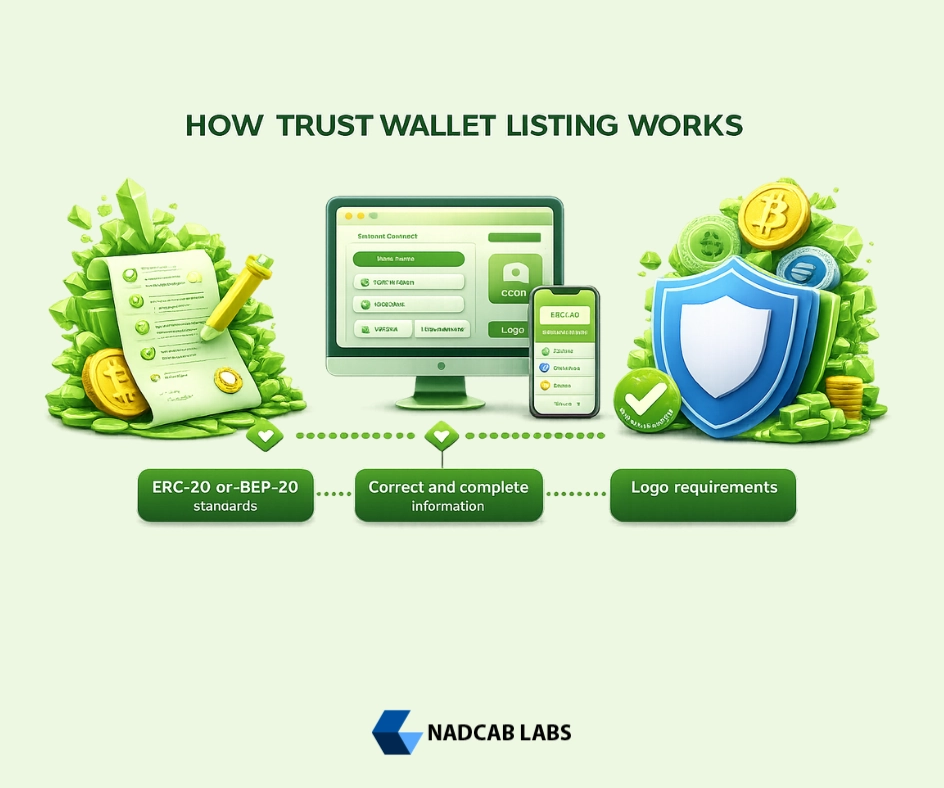
Understanding the technical process behind Trust Wallet Listing helps projects prepare adequately and avoid common pitfalls. Based on our extensive experience facilitating hundreds of listings, here’s the detailed workflow that leads to successful integration.[2]
Token Smart Contract Requirements
Your token’s smart contract forms the foundation of any Trust Wallet Listing application. The contract must adhere to recognized token standards—ERC-20 for Ethereum-based tokens, BEP-20 for BNB Chain tokens, or equivalent standards for other supported networks. Additionally, the contract should be verified on the respective blockchain explorer, demonstrating transparency and allowing anyone to review the code.
Trust Wallet Listing Lifecycle
Preparation
Smart contract deployment and verification
Submission
GitHub pull request with metadata
Review
Technical and compliance verification
Approval
Merge and global visibility
Common Reasons Listings Get Delayed or Rejected
Through our years of experience, we’ve identified the most frequent obstacles in the Trust Wallet Listing process:
- Incorrect logo specifications: Images must meet exact dimension and format requirements
- Unverified smart contracts: Source code must be publicly verified
- Missing or incorrect metadata: Token information must be accurate and complete
- Duplicate submissions: Projects sometimes submit multiple requests, causing confusion
- Security concerns: Contracts with identified vulnerabilities face rejection
5. Key Benefits of Trust Wallet Listing (Core Benefits)
5.1 Increased Token Visibility & Discoverability
The primary advantage of Trust Wallet Listing lies in dramatically enhanced visibility. When your token is listed, it becomes instantly searchable within an application used by tens of millions of active crypto users worldwide. This organic discoverability is invaluable—users browsing or searching within Trust Wallet can find your project without you spending marketing dollars to reach them.
Consider the mathematics: with over 60 million users and thousands of new installations daily, even a small percentage of organic discovery translates to significant exposure. Our client projects have reported 200-400% increases in wallet holder counts within the first month following successful Trust Wallet Listing.
5.2 Improved Token Credibility & Trust
In the crypto space, credibility is currency. A Trust Wallet Listing serves as an implicit validation that your project has met certain standards and undergone review. While listing doesn’t constitute an endorsement, users perceive listed tokens as more legitimate than those requiring manual contract entry.
Client Case Study: A DeFi protocol we assisted achieved Trust Wallet Listing in late 2025. Within six weeks, their community sentiment surveys showed a 47% improvement in “trust” and “legitimacy” perception metrics. The listing served as social proof that accelerated partnership discussions with other protocols.
5.3 Seamless User Experience for Holders
User experience directly impacts adoption rates. With Trust Wallet Listing, token holders enjoy frictionless interactions—they can easily add your token to their portfolio, send and receive it, and monitor their balance without technical knowledge. This accessibility is particularly crucial for onboarding mainstream users who may lack experience with manual token configurations.
The elimination of manual contract entry also reduces errors. Users copying and pasting contract addresses sometimes fall victim to address poisoning attacks or simple typos. A proper Trust Wallet Listing with verified information protects your community from these risks.
5.4 Boost in Community Confidence
Community confidence drives sustainable project growth. When you announce your Trust Wallet Listing, it represents a tangible milestone that community members can celebrate and share. This positive sentiment creates ripple effects—confident holders are more likely to recommend your project to others and maintain their positions during market volatility.
5.5 Enhanced Adoption Across DeFi & Web3
Trust Wallet’s integration with the broader DeFi ecosystem means your Trust Wallet Listing extends beyond simple storage functionality. Users can access decentralized exchanges, staking protocols, lending platforms, and NFT marketplaces directly through the wallet’s dApp browser. When your token is properly listed, these interactions become seamless, encouraging deeper engagement with your ecosystem.
Benefits Summary: Impact on Project Metrics
| Benefit Category | Typical Impact | Timeframe |
|---|---|---|
| Visibility Increase | 200-400% more wallet holders | 1-3 months |
| Credibility Improvement | 40-50% trust perception boost | Immediate |
| User Onboarding | 60% faster adoption rate | Ongoing |
| Community Growth | 35% increase in engagement | 1-2 months |
| DeFi Integration | Higher transaction volume | 2-4 months |
6. Strategic Benefits of Trust Wallet Listing for Crypto Projects
Beyond immediate visibility gains, Trust Wallet Listing provides strategic advantages that compound over time. Understanding these benefits helps projects maximize their listing investment and align it with broader growth objectives.
Trust Wallet Listing serves as a powerful marketing asset. The announcement itself generates social media engagement, provides content for newsletters, and offers talking points for community AMAs. Smart projects leverage their listing milestone in coordinated campaigns that amplify the announcement’s reach and impact.
When comparing Trust Wallet to exchange-only exposure strategies, the wallet-first approach offers distinct advantages. Exchange listings typically require substantial capital, extensive documentation, and ongoing compliance costs. While exchanges remain important, a Trust Wallet Listing provides baseline accessibility that ensures users can store and transfer your token regardless of which exchanges support it.
Strategic Insight: In our 8+ years advising blockchain projects, we’ve observed that Trust Wallet Listing creates long-term ecosystem value by establishing infrastructure that supports future growth. Unlike exchange listings that may be delisted, wallet integration typically remains permanent, providing lasting benefits.
7. Trust Wallet Listing vs Other Wallet Listings
The wallet landscape includes several prominent players, each with distinct characteristics. Understanding how Trust Wallet Listing compares to alternatives helps projects prioritize their integration efforts and allocate resources effectively.
Wallet Listing Comparison Analysis
| Feature | Trust Wallet | MetaMask | Coinbase Wallet |
|---|---|---|---|
| User Base | 60+ million | 30+ million | 10+ million |
| Multi-Chain Support | 70+ networks | EVM chains primarily | Limited networks |
| Mobile Optimization | Mobile-first design | Browser extension primary | Both supported |
| Listing Process | GitHub-based, transparent | Token lists or manual | Centralized review |
| DeFi Integration | Native dApp browser | Excellent | Good |
| Geographic Reach | Global, strong in Asia | Global, Western focus | US-centric |
Trust Wallet Listing offers broader impact for most projects due to its superior multi-chain support and larger global user base. While MetaMask dominates the browser extension market, Trust Wallet’s mobile-first approach captures users who primarily interact with crypto through smartphones—a growing demographic, particularly in emerging markets.
The multi-chain advantage of Trust Wallet Listing deserves particular emphasis. As projects increasingly deploy across multiple networks, having a single wallet integration that covers all deployments simplifies user experience and reduces administrative overhead compared to managing listings across multiple single-chain focused wallets.
8. Common Challenges in Trust Wallet Listing (Advanced Insight)
While the Trust Wallet Listing process is accessible, projects frequently encounter obstacles that delay or prevent successful integration. Drawing from our extensive experience, we’ve identified the most common challenges and their solutions.
Smart Contract Issues
Smart contract problems represent the most frequent barrier to Trust Wallet Listing approval. Issues range from unverified source code to non-standard implementations that may function correctly but don’t comply with expected interfaces. Projects using proxy patterns or upgradeable contracts must ensure proper verification of all relevant contract components.
Logo and Branding Rejections
Visual asset requirements for Trust Wallet Listing are precise. Logos must be exactly 256×256 pixels in PNG format with transparent backgrounds. The image should be high quality without pixelation or compression artifacts. Many projects submit logos that look acceptable on websites but fail these specific technical requirements.
Network Compatibility Problems
Projects deploying on newer or less common networks sometimes discover compatibility issues during the Trust Wallet Listing process. While Trust Wallet supports 70+ networks, the asset repository structure and submission process may vary slightly between networks. Understanding these nuances prevents delays.
Maintenance and Updates After Listing
Achieving Trust Wallet Listing isn’t a one-time event—ongoing maintenance ensures your listing remains accurate and functional. Token migrations, rebrands, or deployment on additional networks require updates to your listing. Projects should establish processes for maintaining their listing information current.
9. Best Practices to Ensure Successful Trust Wallet Listing
Our 8+ years of blockchain consulting experience has crystallized clear best practices for achieving Trust Wallet Listing efficiently. Following these guidelines significantly increases approval rates and reduces time-to-listing.
Smart Contract Optimization
Before initiating your Trust Wallet Listing application, ensure your smart contract meets all standards. Verify source code on the relevant block explorer, implement all required ERC-20 or equivalent functions correctly, and document any non-standard features. Consider professional audit if you haven’t already audited contracts face fewer questions during review.
Metadata and Branding Guidelines
Prepare your metadata package carefully before submitting for Trust Wallet Listing. This includes your token name (matching exactly what appears in the contract), symbol, decimals, description, website URL, and social media links. All information should be accurate and consistent across all platforms where your project appears.
Logo Specifications Checklist:
- Dimensions: Exactly 256×256 pixels
- Format: PNG with transparent background
- Quality: High resolution, no pixelation
- File size: Under 100KB recommended
- Design: Clear, recognizable at small sizes
Pre-Listing Audit Importance
While not always mandatory, security audits significantly strengthen Trust Wallet Listing applications. Audits demonstrate your commitment to security and provide third-party validation of your contract’s integrity. For projects handling significant value, audits are increasingly expected by both listing reviewers and potential users.
10. Trust Wallet Listing for Different Project Types
Different project categories have unique considerations when pursuing Trust Wallet Listing. Understanding these nuances helps tailor your approach for optimal results.
Utility Tokens
Utility tokens benefit tremendously from Trust Wallet Listing because their value proposition depends on user adoption and ecosystem participation. When users can easily access and manage their utility tokens through Trust Wallet, they’re more likely to engage with your platform’s features and services.
DeFi Protocols
DeFi projects gain particular advantage from Trust Wallet Listing due to the wallet’s native dApp browser integration. Users can hold governance or reward tokens while simultaneously interacting with your protocol—all within a single application. This integration reduces friction and encourages deeper protocol engagement.
NFT Projects
While NFT-focused projects may prioritize collection visibility, associated tokens (governance, utility, or rewards) still benefit from Trust Wallet Listing. Trust Wallet’s NFT gallery features complement token functionality, creating a comprehensive home for your project’s entire digital asset ecosystem.
Layer 2 & Blockchain Platforms
Layer 2 solutions and blockchain platforms have unique Trust Wallet Listing considerations. Beyond listing native tokens, these projects should ensure Trust Wallet supports their network, enabling ecosystem tokens to pursue listings. Establishing this foundation multiplies the benefits as your ecosystem grows.
Project Type Listing Priorities
| Project Type | Primary Benefit | Key Consideration |
|---|---|---|
| Utility Tokens | User adoption acceleration | Clear utility documentation |
| DeFi Protocols | Integrated dApp experience | Security audit essential |
| NFT Projects | Ecosystem completeness | Coordinate with NFT visibility |
| L2/Platforms | Ecosystem enablement | Network support first |
11. Future of Trust Wallet Listing in 2026 and Beyond
The landscape of trust wallet continues to evolve with emerging technologies and shifting user preferences. Understanding these trends helps projects position themselves strategically for future growth.
Account Abstraction Impact
Account abstraction technologies are transforming wallet functionality, and Trust Wallet requirements may evolve accordingly. As smart contract wallets become more prevalent, listing standards may incorporate new verification mechanisms and metadata requirements. Projects should monitor these developments and maintain flexibility in their technical implementations.
Multi-Chain Expansion
Trust Wallet network support continues expanding, creating new opportunities for Trust Wallet across emerging chains. Projects deploying on newer networks should engage early with listing processes, potentially influencing how these networks are integrated into the wallet ecosystem.
Wallet-First Adoption Trends
Industry trends increasingly favor wallet-first user acquisition strategies. As centralized exchanges face regulatory pressures and user preferences shift toward self-custody, Trust Wallet becomes proportionally more valuable. Projects that establish strong wallet presence today position themselves advantageously for this ongoing transition.
Industry Prediction:
Based on our market analysis and 8+ years of industry experience, we project that Trust Wallet Listing will become a standard milestone in project roadmaps by 2027, similar to how exchange listings are viewed today. Projects without wallet integrations will face increasing competitive disadvantages in user acquisition and community building.
12. Conclusion: Why Trust Wallet Listing Is a Must-Have in 2026
Throughout this comprehensive guide, we’ve explored the multifaceted benefits of Trust Wallet and its strategic importance for crypto projects in 2026. From enhanced visibility and credibility to seamless user experiences and DeFi integration, the advantages compound to create significant competitive advantages for listed projects.
Trust Wallet Listing represents more than a technical integration—it’s a strategic milestone that signals project maturity, enables organic user acquisition, and establishes infrastructure for long-term ecosystem growth. In an increasingly crowded crypto landscape, this accessibility differentiator can meaningfully impact project success.
For founders and Web3 teams navigating the path to adoption, prioritizing Trust Wallet alongside other growth initiatives positions your project for sustainable success. The effort invested in achieving and maintaining your listing pays dividends through continuous exposure to Trust Wallet listing massive global user base.
Ready to Get Your Token Listed on Trust Wallet?
Our team of blockchain experts with 8+ years of experience is ready to guide your project through the Trust Wallet Listing process. Let’s make your token accessible to millions of users worldwide!
Frequently Asked Questions
Q1.What is Trust Wallet listing?
Trust Wallet listing is the process of making a crypto token officially visible and searchable inside Trust Wallet listing , allowing users to store and use it easily.
Q2.Why is Trust Wallet listing important for crypto projects?
Trust Wallet listing improves token credibility, increases visibility, and simplifies access for global users, leading to faster adoption.
Q3.What are the main benefits of Trust Wallet listing?
The key benefits of Trust Wallet listing include enhanced trust, seamless user experience, higher token discoverability, and broader DeFi compatibility.
Q4.Is Trust Wallet listing free?
Yes, itself is free, but projects must meet technical, branding, and compliance requirements for approval.
Q5.How long does Trust Wallet listing take?
The Trust Wallet listing process usually takes a few days to a few weeks, depending on token quality, documentation, and review status.
Q6.Can any token apply for Trust Wallet listing?
Most standard ERC-20, BEP-20, and multi-chain tokens can apply, provided their smart contracts and metadata meet Trust Wallet listing guidelines.
Q7.Does Trust Wallet listing increase token price?
Trust Wallet listing does not directly increase price, but it often improves liquidity, trust, and user adoption, which can positively impact demand.
Q8.Is Trust Wallet listing better than exchange listing?
Trust Wallet complements exchange listings by focusing on long-term visibility, self-custody, and ecosystem adoption rather than short-term trading.
Q9.What are common reasons for Trust Wallet listing rejection?
Rejections usually occur due to incorrect contract data, missing logos, low token transparency, or security concerns.
Q10.Is Trust Wallet listing mandatory for DeFi projects?
While not mandatory, Trust Wallet is highly recommended for DeFi projects to ensure smooth wallet integration and user accessibility.
Explore Services
Related Services
Reviewed by

Aman Vaths
Founder of Nadcab Labs
Aman Vaths is the Founder & CTO of Nadcab Labs, a global digital engineering company delivering enterprise-grade solutions across AI, Web3, Blockchain, Big Data, Cloud, Cybersecurity, and Modern Application Development. With deep technical leadership and product innovation experience, Aman has positioned Nadcab Labs as one of the most advanced engineering companies driving the next era of intelligent, secure, and scalable software systems. Under his leadership, Nadcab Labs has built 2,000+ global projects across sectors including fintech, banking, healthcare, real estate, logistics, gaming, manufacturing, and next-generation DePIN networks. Aman’s strength lies in architecting high-performance systems, end-to-end platform engineering, and designing enterprise solutions that operate at global scale.