Ai Overview
The convergence of artificial intelligence and immersive virtual worlds has created one of the most exciting technology frontiers of our time. These typically cost between $20,000 and $80,000 to implement, depending on the volume and quality of training data available. Deep learning models for image and speech recognition are more resource intensive, often requiring GPU clusters for training that can cost $10,000 to $50,000 in compute alone.
Key Takeaways
- ✓Building an AI powered metaverse platform can cost anywhere from $50,000 for a basic MVP to over $5 million for an enterprise grade solution with full AI integration.
- ✓AI technologies like natural language processing, computer vision, and generative AI contribute 30% to 45% of the total platform budget.
- ✓Cloud computing and infrastructure expenses account for a significant recurring monthly cost between $5,000 and $50,000 depending on user scale.
- ✓3D world design and virtual environment creation alone can range from $30,000 to $500,000 based on complexity and level of interactivity.
- ✓Ongoing maintenance, AI model retraining, and platform updates typically cost 15% to 25% of the initial investment annually.
- ✓Leveraging pre built AI models and open source frameworks can reduce initial costs by 40% to 60% compared to building everything from scratch.
- ✓Security, privacy compliance, and data protection measures add $20,000 to $100,000 to the total project budget depending on regulatory requirements.
- ✓Third party API licensing, SDK fees, and platform royalties represent a recurring cost that businesses must plan for in their long term budget.
- ✓Companies that invest in scalable architecture from the beginning save 2x to 3x on future infrastructure overhaul costs.
- ✓Partnering with an experienced agency like Nadcab Labs ensures cost optimization, faster time to market, and access to proven AI and metaverse expertise.
Overview of AI Powered Metaverse Platform Investment
The convergence of artificial intelligence and immersive virtual worlds has created one of the most exciting technology frontiers of our time. An AI Application embedded within a metaverse environment transforms passive virtual spaces into intelligent, responsive, and deeply personalized experiences. However, the question that every business leader, entrepreneur, and investor asks first is straightforward: how much does it actually cost?
The answer is not a single number. It depends on dozens of variables including the complexity of AI features, the richness of 3D environments, the target audience scale, cloud infrastructure choices, and whether you build from scratch or leverage existing AI Platforms. In this comprehensive guide, we break down every major cost component so you can plan your investment with clarity and confidence. Whether you are building a social metaverse, an enterprise training simulation, or a gaming universe, this article covers the financial picture from end to end.
According to industry research, the global metaverse market is projected to exceed $936 billion by 2030, with AI driven features accounting for a rapidly growing share of that value. Companies investing in AI powered virtual platforms today are positioning themselves at the forefront of this massive opportunity. The investment can range from under $100,000 for a lean MVP to several million dollars for a feature rich, enterprise scale platform. Let us explore every dimension of this cost equation.[1]
What Is an AI Powered Metaverse Platform? (Cost Perspective)
An AI powered metaverse platform is a virtual, immersive digital environment where users interact through avatars, explore 3D worlds, and engage in social, commercial, or educational activities, all enhanced by artificial intelligence. From a cost perspective, it is the integration of AI technologies that distinguishes these platforms from traditional virtual worlds and significantly impacts the budget.
Unlike simple 3D environments, an AI Application within the metaverse enables intelligent NPCs (non player characters), real time content generation, personalized user experiences, voice and gesture recognition, and predictive analytics. Each of these capabilities requires specialized engineering talent, computational resources, and ongoing model training, all of which contribute to the total cost of ownership.
Think of it this way: a basic virtual world is like building a house, while an AI powered metaverse platform is like building a smart home with automated systems, learning algorithms, and adaptive environments. The “smart” layer is what drives both the value and the cost. Businesses building AI Platforms for metaverse use cases must account for this added complexity from the earliest planning stages.
Key Components That Drive Platform Cost
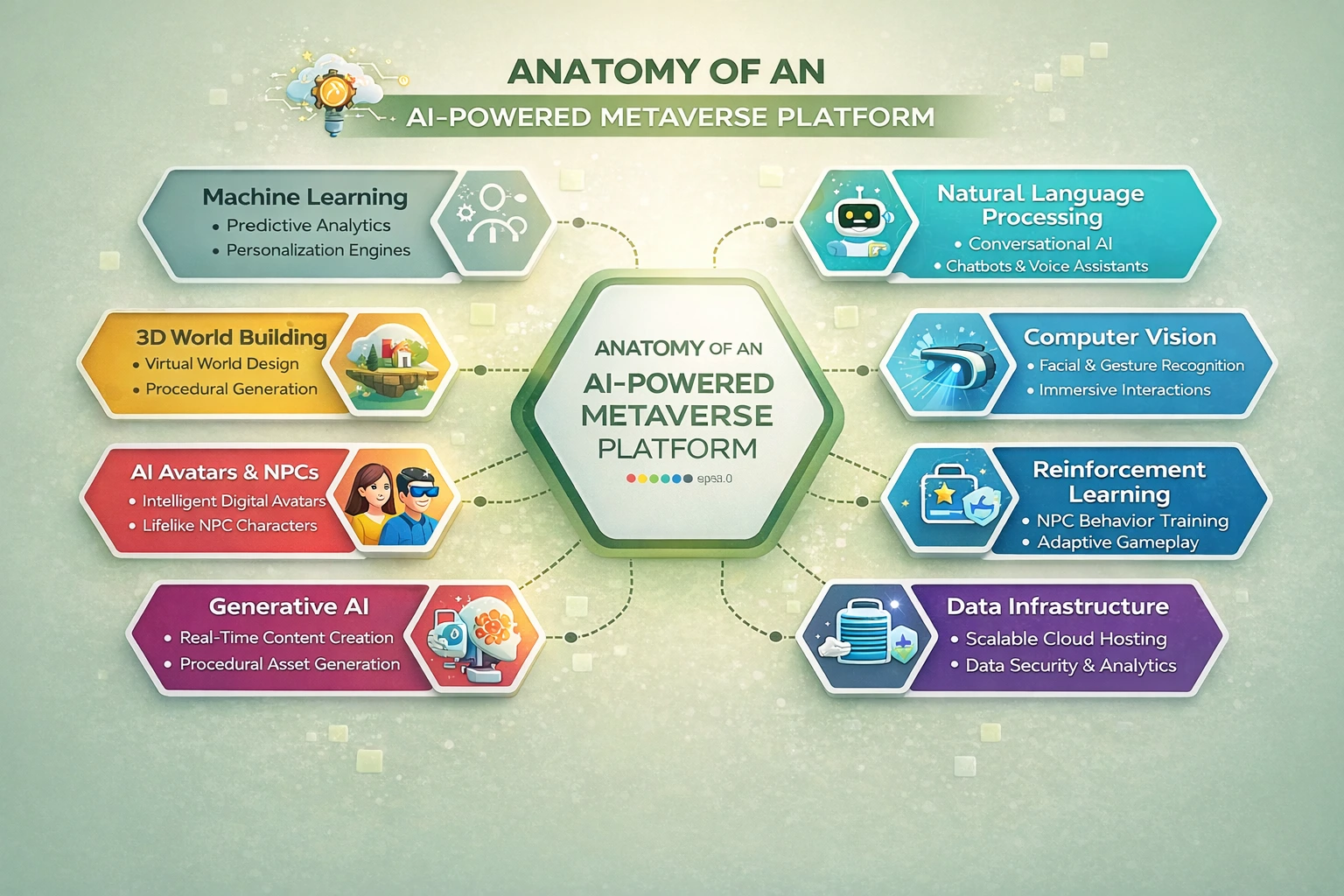
Understanding the individual cost components is critical for accurate budgeting. An AI powered metaverse platform is not a monolithic product; it is a collection of interconnected systems, each with its own engineering requirements, technology stack, and price tag. Below is a breakdown of the primary components and their typical cost ranges.
| Component | Estimated Cost Range | Cost Share |
|---|---|---|
| 3D World & Environment Design | $30,000 to $500,000 | 15% to 25% |
| AI & Machine Learning Integration | $40,000 to $600,000 | 20% to 35% |
| Backend Infrastructure & APIs | $20,000 to $200,000 | 10% to 15% |
| Cloud Hosting & Scalability | $5,000 to $50,000/month | 10% to 20% |
| Security & Compliance | $20,000 to $100,000 | 5% to 10% |
| UI/UX & Frontend Design | $15,000 to $120,000 | 5% to 10% |
| Testing & Quality Assurance | $10,000 to $80,000 | 5% to 8% |
As the table illustrates, AI and machine learning integration represents the largest single cost driver. This makes sense because training, deploying, and maintaining AI models requires specialized expertise and significant computational power. Companies should allocate their budgets with this reality in mind, ensuring the AI layer receives adequate investment while not neglecting foundational components like security and cloud infrastructure.
AI Technologies and Their Cost Impact
The specific AI technologies you choose to integrate into your metaverse platform have a direct and measurable impact on your total budget. Each AI Application capability, from basic chatbots to advanced real time gesture recognition, carries its own cost profile based on model complexity, data requirements, and inference compute needs.
Machine learning models for user behavior prediction and content recommendation are among the most common AI integrations. These typically cost between $20,000 and $80,000 to implement, depending on the volume and quality of training data available. Deep learning models for image and speech recognition are more resource intensive, often requiring GPU clusters for training that can cost $10,000 to $50,000 in compute alone. Reinforcement learning for NPC behavior in virtual environments pushes costs even higher, particularly when the game world requires complex adaptive behaviors.
For example, a metaverse platform designed for virtual retail might invest heavily in recommendation engines and visual search AI, while an educational metaverse would prioritize NLP for tutoring bots and speech recognition for classroom interactions. The cost is not just about the technology itself but about aligning the right AI capabilities with your platform’s core value proposition. Understanding real world AI use cases can help businesses make smarter investment decisions.
Metaverse Platform Architecture and Infrastructure Expenses
The architecture of your AI powered metaverse platform determines not only its performance and scalability but also its long term cost trajectory. A well designed architecture can save hundreds of thousands of dollars over the platform’s lifecycle, while a poorly designed one can lead to expensive overhauls and technical debt.
Most modern AI Platforms use a microservices architecture, where individual services (such as user authentication, AI inference, 3D rendering, and real time communication) are built, deployed, and scaled independently. This approach typically costs 20% to 30% more upfront compared to a monolithic architecture, but it pays dividends in scalability, maintainability, and fault tolerance.
Key infrastructure decisions include choosing between real time rendering on the server side versus the client side, implementing WebRTC or similar protocols for low latency communication, and designing the database layer to handle both structured data (user profiles, transactions) and unstructured data (3D assets, AI training data). Each of these decisions carries cost implications. For instance, server side rendering provides a more consistent user experience but requires significantly more cloud compute resources, increasing monthly hosting costs by 2x to 5x.
★ Pro Tip: Investing in a scalable microservices architecture from day one can save 2x to 3x on future infrastructure rebuilds. Companies that start with a monolithic approach often face costly migrations within 12 to 18 months as user demand grows.
Cost of 3D World Design and Virtual Environment Creation
The visual richness of your metaverse directly influences user engagement and retention, making 3D world design one of the most visible budget items. Creating immersive virtual environments requires skilled 3D artists, environment designers, texture specialists, and lighting engineers. The costs scale dramatically with the level of detail and interactivity required.
A basic low poly virtual space suitable for simple social interactions might cost $30,000 to $80,000. A mid fidelity environment with realistic textures, dynamic lighting, and interactive objects can range from $100,000 to $250,000. Photorealistic environments with physics simulation, destructible elements, and procedurally generated landscapes can exceed $500,000. When you factor in AI driven procedural generation tools, these costs can be partially offset. Generative AI tools can now create textures, terrain, and even entire building layouts, reducing manual 3D modeling time by 30% to 50%.
For example, platforms like Decentraland and The Sandbox invested heavily in their initial world design, while also providing user generated content tools that shift ongoing creation costs to the community. This hybrid approach, combining professional base environments with AI assisted user tools, is becoming a popular cost optimization strategy for metaverse platform builders.
AI Avatar and NPC Creation Cost
AI powered avatars and NPCs are the lifeblood of an engaging metaverse experience. Unlike static 3D characters, AI driven avatars can express emotions, respond to voice commands, learn user preferences, and adapt their behavior over time. The cost of creating these intelligent characters depends on the depth of AI integration and the quality of visual representation.
Basic avatar systems with preset animations and limited customization typically cost $15,000 to $40,000. Mid range systems with facial expression mapping, lip syncing, and basic conversational AI cost $50,000 to $150,000. Advanced AI avatars with real time emotion recognition, full body motion tracking integration, and adaptive personality engines can cost $200,000 to $400,000 or more. Each NPC with unique AI behavior patterns adds $5,000 to $25,000 depending on complexity.
The growing availability of ready made AI avatar SDKs from companies like Ready Player Me and Inworld AI has reduced costs significantly. Integrating these third party solutions typically costs $10,000 to $50,000, compared to building from scratch. However, customization limitations mean that platforms requiring truly unique avatar experiences may still need significant custom work.
Cost of Real Time Personalization and Recommendation Engines
Personalization is what transforms a generic virtual world into a compelling, sticky experience. AI powered recommendation engines analyze user behavior, preferences, social connections, and engagement patterns to deliver tailored content, products, events, and interactions in real time. This capability is essential for monetization and user retention.
Building a custom recommendation engine from scratch typically costs $40,000 to $150,000, including data pipeline setup, model training, A/B testing infrastructure, and integration with the platform’s content management system. Ongoing costs for model retraining and inference compute add $3,000 to $15,000 monthly. Alternatively, cloud based personalization services from AWS Personalize, Google Recommendations AI, or similar providers offer lower upfront costs but higher per request pricing that scales with user volume.
The thesis here is clear: personalization drives revenue. Platforms that invest in robust AI recommendation systems see 2x to 4x higher engagement rates and 30% to 50% higher monetization per user. The cost of NOT implementing personalization, measured in lost user engagement and revenue, often exceeds the cost of building it.
Natural Language Processing and Voice AI Integration Costs
Natural Language Processing (NLP) enables metaverse platforms to understand, interpret, and generate human language. This powers everything from in world chatbots and virtual assistants to real time translation for global user bases. Voice AI adds another dimension, allowing users to interact with the virtual environment through spoken commands and natural conversation.
The cost of NLP integration depends heavily on whether you use pre built APIs or train custom models. Using OpenAI, Google Cloud Natural Language, or AWS Comprehend for basic text understanding and sentiment analysis typically costs $10,000 to $30,000 for integration, plus ongoing API fees of $0.002 to $0.06 per 1,000 tokens depending on the model. Custom NLP models trained on domain specific data (such as gaming terminology or industry jargon) require $50,000 to $200,000 for training and deployment.
Voice AI integration using services like Amazon Polly, Google Text to Speech, or ElevenLabs for realistic voice synthesis adds $15,000 to $60,000 in integration costs. Real time speech recognition using Whisper or similar models costs an additional $10,000 to $40,000. For platforms targeting multilingual audiences, translation and localization AI adds further expense, but is critical for global reach. Leading AI Platforms invest in multilingual NLP as a competitive differentiator.
Computer Vision and Gesture Recognition Cost Factors
Computer vision and gesture recognition transform how users interact with the metaverse, enabling natural, intuitive experiences that go far beyond keyboard and mouse. These technologies power hand tracking, facial expression capture, body pose estimation, object recognition, and spatial mapping. They are particularly essential for VR and AR based AI Platforms.
Implementing basic gesture recognition using pre built SDKs like MediaPipe or the Meta Interaction SDK costs $15,000 to $40,000. Advanced custom computer vision models for real time facial expression mapping, gaze tracking, or full body motion capture can cost $80,000 to $250,000. The compute requirements for real time inference are significant, as these models must process camera feeds at 30 to 60 frames per second with minimal latency.
Training custom computer vision models also requires large labeled datasets, which can cost $10,000 to $50,000 to acquire and annotate. Edge computing solutions that process visual data locally on user devices can reduce cloud compute costs but require optimization for diverse hardware, adding to engineering complexity. The decision between cloud based and edge based processing is one of the most impactful architectural choices for platforms prioritizing computer vision features.
Generative AI for Content Creation: Pricing Considerations
Generative AI is revolutionizing content creation within metaverse platforms. Instead of manually designing every texture, building, avatar outfit, or dialogue tree, platforms can use generative models to produce vast amounts of content at a fraction of the traditional cost. Careful integration of a blog post template can further streamline content creation workflows within these AI-driven processes..
Text generation using large language models powers dynamic quest narratives, NPC dialogue, lore creation, and user communication. Image generation using models like Stable Diffusion or DALL·E creates textures, concept art, and in world imagery. 3D model generation is an emerging capability that can produce objects and environments from text descriptions. For creators building metaverse content on tighter budgets, accessible tools like AI voice generation platforms can produce quality NPC voiceovers and character dialogue at a fraction of custom voice actor costs
The costs for generative AI integration range from $20,000 to $100,000 for setup and fine-tuning, plus ongoing inference costs that vary widely based on usage volume. A platform generating 10,000 pieces of AI content daily might spend $2,000 to $8,000 monthly on inference alone. The ROI, however, is substantial: generative AI can reduce content creation costs by 60% to 80% compared to fully manual approaches, making it one of the best investments in the entire project budget.
Cloud Computing, Hosting, and Scalability Costs
Cloud computing is the backbone of any AI powered metaverse platform. It provides the compute, storage, networking, and AI infrastructure needed to deliver seamless experiences to users worldwide. The choice of cloud provider, instance types, and scaling strategy directly impacts both performance and cost.
| Cloud Provider | Best For | Monthly Cost (Mid Scale) | AI Tools Strength |
|---|---|---|---|
| AWS | Broadest service ecosystem | $10,000 to $35,000 | ★★★★☆ |
| Google Cloud | AI and ML workloads | $8,000 to $30,000 | ★★★★★ |
| Microsoft Azure | Enterprise integration | $9,000 to $32,000 | ★★★★☆ |
| Multi Cloud/Hybrid | Cost optimization | $12,000 to $40,000 | Varies |
Beyond basic hosting, AI powered metaverse platforms require GPU instances for real time AI inference, content delivery networks (CDNs) for global 3D asset delivery, and auto scaling configurations to handle peak user loads. Reserved instances and spot pricing can reduce costs by 30% to 60%, but require careful capacity planning. Platforms expecting rapid growth should budget for elastic scaling from day one rather than facing emergency infrastructure upgrades during user surges.
Data Management, Storage, and Analytics Expenses
Data is the fuel that powers every AI system within a metaverse platform. Collecting, storing, processing, and analyzing user behavior data, 3D asset metadata, AI training datasets, and real time interaction logs requires a robust data infrastructure. The costs scale with the volume and velocity of data your platform generates.
Storage costs for 3D assets can be significant. A single high quality 3D environment can require gigabytes of texture, geometry, and animation data. Multiply that across an entire virtual world with thousands of assets, and storage costs can reach $2,000 to $10,000 monthly on cloud object storage services like S3 or GCS. Database costs for user profiles, transaction records, and AI feature stores add another $1,000 to $5,000 monthly for managed database services.
Analytics infrastructure for tracking user behavior, measuring AI model performance, and generating business intelligence typically costs $10,000 to $50,000 to set up, plus $2,000 to $8,000 monthly for tools like BigQuery, Snowflake, or custom data pipelines. Real time analytics, essential for live personalization and dynamic pricing, require additional investment in stream processing technologies like Apache Kafka or AWS Kinesis. Companies building scalable AI solutions must treat data infrastructure as a core budget priority.
Security, Privacy, and Compliance Cost Considerations
Security and compliance are non negotiable for any AI powered metaverse platform. These platforms handle sensitive user data including biometric information (facial scans, voice prints, gesture data), financial transactions, personal communications, and behavioral patterns. The regulatory landscape across GDPR, CCPA, COPPA, and emerging AI specific regulations adds complexity and cost.
Core security measures including encryption, authentication, access control, and DDoS protection typically cost $20,000 to $50,000 to implement. Regular penetration testing and security audits add $10,000 to $30,000 annually. AI specific security concerns, such as model poisoning, adversarial attacks, and data privacy in AI training, require specialized expertise that commands premium rates of $150 to $300 per hour for security consultants.
Compliance with data protection regulations requires dedicated legal counsel, privacy impact assessments, and often a Data Protection Officer. These costs range from $15,000 to $50,000 annually for mid scale platforms. For platforms operating globally, multi jurisdictional compliance can push these costs significantly higher. The consequences of non compliance, including fines, lawsuits, and reputation damage, far exceed the investment in proper security and privacy measures.
Third Party API, SDK, and Platform Licensing Fees
Very few metaverse platforms build every component from scratch. Most leverage a combination of third party APIs, SDKs, and platform licenses to accelerate work and reduce costs. However, these integrations carry their own pricing structures that must be factored into the total budget.
Game engines like Unreal Engine and Unity charge royalties or subscription fees. Unreal Engine is free until your product earns $1 million in revenue, after which a 5% royalty applies. Unity offers subscription plans starting at $2,040 annually per seat for the Pro tier. AI APIs from OpenAI, Anthropic, Google, and others charge per token or per request, with costs that can scale rapidly with user volume. Payment processing APIs, identity verification services, analytics platforms, and communication tools each add $500 to $5,000 monthly depending on usage.
The key is to carefully evaluate the total cost of ownership for each third party integration, considering not just the direct fees but also the engineering time required for integration, maintenance, and vendor lock in risks. A well planned technology stack balances cost, flexibility, and reliability. Some companies find that building critical components in house provides better long term economics, while non core functions are best handled by specialized AI Application providers.
Ongoing Maintenance, Updates, and AI Model Training Costs
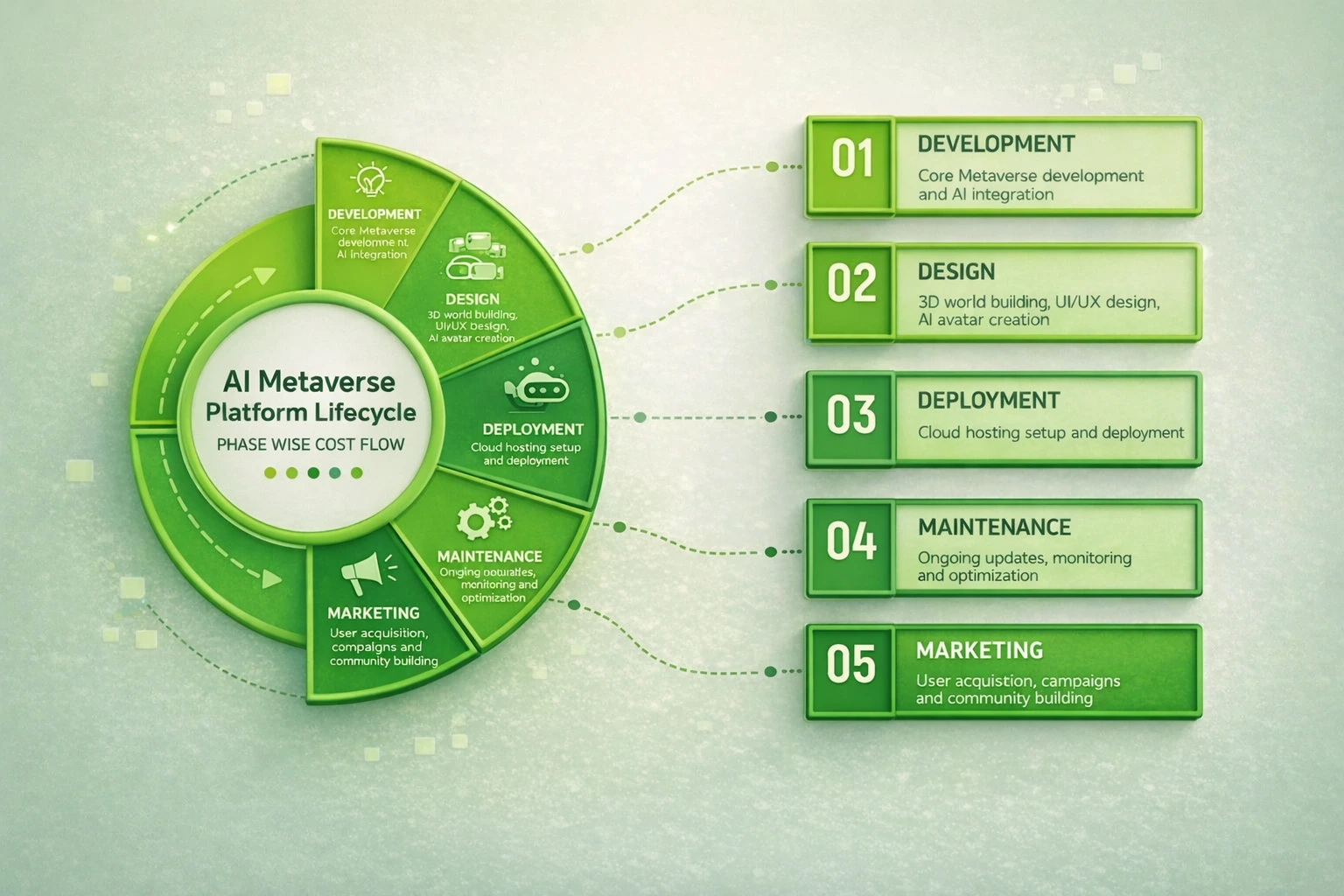
The launch of your AI powered metaverse platform is just the beginning. Ongoing costs for maintenance, feature updates, bug fixes, performance optimization, and AI model retraining represent a significant and permanent budget item. Industry standards suggest allocating 15% to 25% of the initial project cost annually for ongoing operations.
AI model retraining is particularly important. User behavior evolves, new content is added, and model accuracy degrades over time (a phenomenon known as model drift). Retraining schedules vary by model type: recommendation engines may need monthly updates, while NLP models might be retrained quarterly. Each retraining cycle costs $2,000 to $20,000 depending on model size and data volume. Failing to retrain regularly results in declining user experience and engagement.
Platform updates including new features, content expansions, compatibility updates for new devices, and performance improvements are essential for user retention. A typical update cycle involves 2 to 4 major releases per year and monthly minor patches. The engineering team required to sustain this cadence typically costs $200,000 to $500,000 annually for a mid scale platform. This is why many companies partner with specialized agencies that offer ongoing support packages rather than maintaining large internal teams.
Estimated Total Cost Ranges for AI Powered Metaverse Platforms
Now let us bring all the pieces together. The total cost of building an AI powered metaverse platform varies enormously based on scope, feature depth, target audience, and technology choices. Below is a comprehensive comparison across three platform tiers that helps businesses align their ambitions with realistic budgets.
| Parameter | Basic (MVP) | Mid Range | Enterprise Grade |
|---|---|---|---|
| Total Cost | $50K to $150K | $200K to $800K | $1M to $5M+ |
| Timeline | 3 to 6 months | 8 to 14 months | 14 to 24+ months |
| AI Features | Basic chatbot, simple NPC | NLP, personalization, voice | Full AI stack including vision |
| 3D Quality | Low to mid poly | Mid to high fidelity | Photorealistic |
| User Capacity | Up to 1,000 | Up to 50,000 | Millions |
| Cloud Cost (Monthly) | $500 to $2,000 | $5,000 to $20,000 | $20,000 to $50,000+ |
| Annual Maintenance | $10K to $30K | $50K to $150K | $200K to $500K+ |
The comparison table above makes it clear that the range is vast. A small team building an MVP to test market demand faces a very different financial picture than an enterprise launching a full-scale virtual platform for millions of users. The most important thing is to match your investment level to your business goals, target audience, and growth timeline. Many successful platforms start at the MVP tier and progressively invest in advanced AI features as they validate their market and generate revenue.
5 Proven Cost Optimization Strategies
Use Open Source Frameworks
Save 40% to 60%
Spot & Reserved Instances
Save 30% to 60%
Pre Built AI APIs
Save 50% upfront
MVP First Approach
Reduce risk 70%
Expert Agency Partner
Faster 2x delivery
ROI Expectations and Cost Optimization Strategies
Understanding return on investment is crucial for justifying the significant expenditure involved in building an AI powered metaverse platform. The good news is that well executed platforms demonstrate strong revenue potential across multiple monetization channels including virtual goods, subscriptions, advertising, enterprise licensing, and event hosting.
Industry data suggests that metaverse platforms with AI driven personalization achieve 2x to 4x higher average revenue per user (ARPU) compared to platforms without AI. Platforms targeting enterprise use cases such as virtual training, product visualization, or remote collaboration often achieve breakeven within 18 to 24 months. Consumer facing platforms with strong network effects may take 2 to 4 years to reach profitability but offer significantly larger scale potential.
Cost optimization strategies that deliver the greatest impact include starting with an MVP and iterating based on user feedback, leveraging open source AI frameworks like TensorFlow, PyTorch, and Hugging Face to reduce model training costs, using serverless architectures for variable workloads to avoid paying for idle resources, implementing AI driven content generation to reduce manual content creation expenses, and partnering with experienced agencies that bring pre built components and proven architectures. Each of these strategies can reduce total project costs by 20% to 50% individually, and their combined effect can be transformative.
The most successful companies view their metaverse investment not as a one time project cost but as a platform for continuous value creation. By building with scalability and modularity in mind, each dollar invested today creates infrastructure that supports growth, new features, and new revenue streams for years to come.
Why Nadcab Labs Is Your Trusted Partner for AI-Powered Metaverse Platforms
When it comes to building sophisticated AI Platforms and immersive metaverse experiences, experience matters more than anything. Nadcab Labs brings over 8+ years of proven expertise in AI application engineering, metaverse architecture, blockchain integration, and enterprise software solutions. Our team has successfully delivered complex projects across industries including gaming, education, healthcare, real estate, and enterprise collaboration.
What sets Nadcab Labs apart is our deep understanding of both the AI and metaverse ecosystems. We do not just write code; we architect intelligent virtual worlds that drive real business outcomes. Our portfolio includes AI powered recommendation engines, real time NLP chatbots, generative content pipelines, computer vision systems, and scalable cloud infrastructures that serve thousands of concurrent users. We have helped startups launch MVPs in under 6 months and supported enterprises in deploying platforms that handle millions of interactions daily.
Our approach is rooted in cost optimization without compromising quality. We leverage open source frameworks, pre built AI modules, and our proprietary accelerators to reduce time to market by up to 40%. Whether you need a complete AI Application for a new metaverse venture or want to integrate AI capabilities into an existing virtual platform, Nadcab Labs delivers with authority, precision, and a commitment to your success. Our clients trust us because we combine technical excellence with transparent pricing, agile execution, and long term partnership that goes beyond the initial launch.
Frequently Asked Questions
Q1.Can a small startup afford to build an AI powered metaverse platform?
es, a small startup can begin with an MVP (Minimum Viable Product) version of an AI powered metaverse platform. By focusing on core features like basic 3D environments and limited AI interactions, startups can launch with a budget between $50,000 and $150,000. Scaling features like advanced NPC behavior or real time personalization can be added later as funding grows. Strategic use of open source tools and cloud services further reduces initial investment.
Q2.How long does it typically take to build an AI powered metaverse platform from scratch?
The timeline varies based on complexity. A basic AI Application with simple virtual spaces may take 6 to 9 months. A mid range platform with AI avatars, NLP, and personalization engines can require 12 to 18 months. Enterprise grade AI Platforms with full computer vision, generative AI, and cross platform support may take 24 months or more. Parallel work on AI modules and 3D assets can shorten the overall schedule.
Q3.Is it cheaper to use pre built AI models or train custom ones for a metaverse?
Pre built AI models from providers like OpenAI or Google Cloud are cheaper upfront and ideal for standard tasks such as chatbots or basic recommendations. However, custom trained models offer better accuracy and unique user experiences tailored to your platform. The choice depends on your budget and differentiation goals. Many platforms use a hybrid approach, combining pre built models for general tasks and custom models for specialized features.
Q4.What are the hidden costs most companies overlook when building a metaverse?
Companies often overlook costs like AI model retraining, data labeling, compliance audits, user support infrastructure, and content moderation tools. Bandwidth costs for real time 3D streaming can spike unexpectedly during user growth. Licensing fees for third party SDKs and APIs also add up over time. Regular security patches and updates to match evolving regulations create ongoing expenses that should be factored into long term budgets.
Q5.Can I integrate existing AI tools like ChatGPT or Gemini into my metaverse platform?
Absolutely. Integrating existing AI tools like ChatGPT, Gemini, or Claude into your metaverse platform is a cost effective approach. These APIs handle natural language processing, content generation, and conversational AI without requiring you to build models from scratch. Integration costs typically range from $5,000 to $30,000 depending on complexity. However, API usage fees are recurring, so you should plan for monthly costs based on user volume.
Q6.What is the cost difference between a web based metaverse and a VR based metaverse?
A web based metaverse accessible through browsers is significantly cheaper, typically ranging from $100,000 to $400,000 for AI integrated versions. VR based platforms that support headsets like Meta Quest or Apple Vision Pro require specialized 3D rendering, spatial audio, and hardware optimization, pushing costs to $500,000 or more. Many businesses start with a web based version and later expand to VR to manage initial costs effectively.
Q7.Do I need a dedicated AI team or can I outsource metaverse AI work?
Both approaches work depending on your strategy. An in house AI team offers better control and faster iteration but costs $300,000 or more annually in salaries alone. Outsourcing to a specialized agency provides access to experienced professionals at lower costs, typically $50 to $150 per hour. Many companies use a hybrid model with a small core team for oversight and an outsourced partner for heavy work on AI and metaverse systems.
Q8.How do AI powered metaverse platforms generate revenue to recover costs?
Revenue models include virtual real estate sales, in platform advertising, premium subscriptions, NFT marketplaces, virtual goods and avatar customization, event hosting fees, and enterprise licensing. AI enhances monetization through personalized product recommendations and targeted experiences. Most platforms achieve breakeven within 2 to 4 years depending on user adoption. Diversifying revenue streams early is key to faster ROI.
Q9.What cloud provider is most cost effective for hosting an AI powered metaverse?
AWS, Google Cloud, and Microsoft Azure all offer competitive pricing for AI and 3D workloads. AWS is popular for its broad service ecosystem, Google Cloud excels in AI and machine learning tools, and Azure integrates well with enterprise solutions. Costs typically range from $5,000 to $50,000 monthly depending on user base and compute needs. Comparing reserved instances and spot pricing across providers can yield significant savings.
Q10.How much does it cost to add blockchain or NFT features to an AI metaverse platform?
Adding blockchain integration for NFTs, digital ownership, or decentralized identity typically costs between $30,000 and $150,000. This includes smart contract creation, wallet integration, and marketplace building. Ongoing costs include gas fees (or Layer 2 solutions to minimize them), node maintenance, and security audits. Blockchain adds value by enabling true digital ownership but should be integrated only when it aligns with your platform’s monetization strategy.
Explore Services
Related Services
Reviewed by

Aman Vaths
Founder of Nadcab Labs
Aman Vaths is the Founder & CTO of Nadcab Labs, a global digital engineering company delivering enterprise-grade solutions across AI, Web3, Blockchain, Big Data, Cloud, Cybersecurity, and Modern Application Development. With deep technical leadership and product innovation experience, Aman has positioned Nadcab Labs as one of the most advanced engineering companies driving the next era of intelligent, secure, and scalable software systems. Under his leadership, Nadcab Labs has built 2,000+ global projects across sectors including fintech, banking, healthcare, real estate, logistics, gaming, manufacturing, and next-generation DePIN networks. Aman’s strength lies in architecting high-performance systems, end-to-end platform engineering, and designing enterprise solutions that operate at global scale.