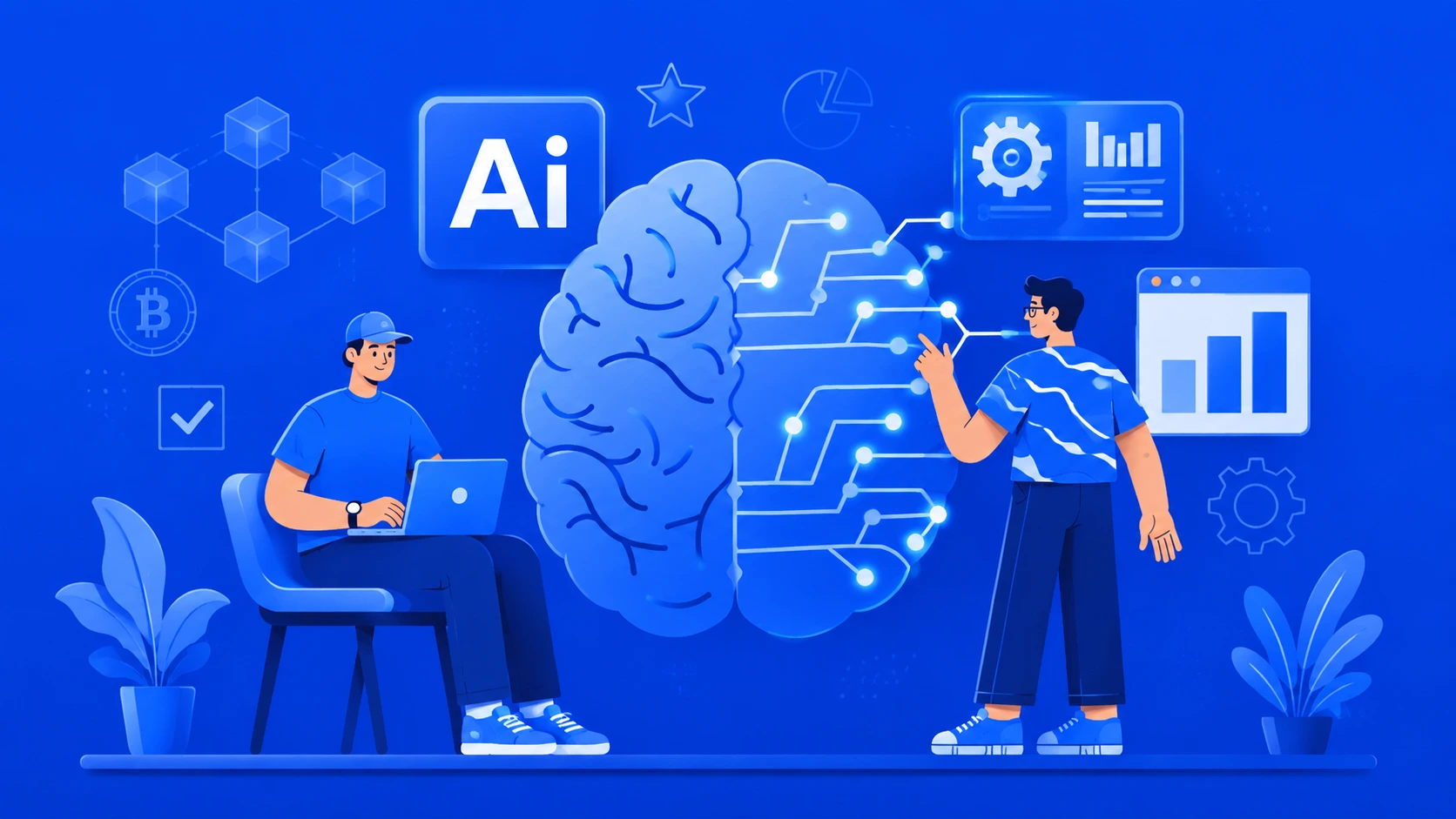
Ai Overview
If you have followed technology news in the last five years, you have heard these three terms constantly: artificial intelligence, machine learning, and deep learning. They often get used interchangeably, which is understandable but inaccurate. Each term means something specific, and understanding the difference helps you ask better questions, make smarter technology decisions, and cut through the marketing noise.
Key Takeaways
The most important concepts from this complete guide on AI vs ML vs deep learning.
INTRO
Introduction to AI, Machine Learning, and Deep Learning
If you have followed technology news in the last five years, you have heard these three terms constantly: artificial intelligence, machine learning, and deep learning. They often get used interchangeably, which is understandable but inaccurate. Each term means something specific, and understanding the difference helps you ask better questions, make smarter technology decisions, and cut through the marketing noise.
Our team has spent over eight years building AI systems for clients across healthcare, finance, e-commerce, and logistics. We have watched companies overpay for AI they did not need and underprepare for the data infrastructure that any real AI system requires. In most cases, the confusion started right here at the definition level. People who cannot clearly explain the difference between AI, ML, and deep learning make poor technical decisions downstream.
This guide fixes that. We explain each concept in plain language, show how they connect, compare their strengths and limits, and give you a practical framework for deciding which approach fits your specific situation. No unnecessary jargon. No oversimplification. Just a clear, honest picture of three technologies that are reshaping every industry on earth.
LAYER 1
What Is Artificial Intelligence (AI)?
Artificial intelligence is the broadest of the three concepts. It refers to the entire field of research and engineering aimed at creating systems that can perform tasks requiring human-like intelligence. This includes everything from a simple rule-based chatbot to a self-driving car to a medical diagnosis system.
The term was coined by John McCarthy in 1956 at the famous Dartmouth Conference where the field was formally launched. Early AI was built entirely on handcrafted rules. Programmers would encode expert knowledge directly into systems, telling the computer exactly what to do in every situation. This worked well in narrow, predictable domains but collapsed under real-world complexity. What is artificial intelligence today is something far richer: systems that can perceive, reason, plan, and communicate in ways that were impossible just fifteen years ago.
LAYER 2
What Is Machine Learning (ML)?
Machine learning is a method of building AI where systems learn from data instead of following explicit rules. The phrase “machine learning” was coined by Arthur Samuel in 1959. His definition still holds up: machine learning gives computers the ability to learn without being explicitly programmed for every possible situation.
Here is how it actually works. You give a machine learning model a large dataset of examples. The model finds patterns in those examples mathematically. Then when it sees new data it has never encountered, it uses those patterns to make predictions or decisions. According to IBM Insights, A spam filter learns from thousands of labeled emails. A credit scoring model learns from millions of loan records. A recommendation engine learns from billions of user interactions.
How Machine Learning Works: The Core Loop
What is machine learning at its core is optimization. The model adjusts its internal settings, called parameters, until its predictions match the training data as closely as possible. The measure of how wrong the model is at any moment is called the loss. Training is the process of minimizing that loss over millions of iterations until the model generalizes well to new unseen examples.
LAYER 3
What Is Deep Learning (DL)?
Deep learning is a specific type of machine learning built around artificial neural networks with many layers. The “deep” in deep learning refers to the depth of the network, meaning the number of layers stacked between the raw input and the final output. A network with two or three layers is shallow. A network with dozens or hundreds of layers is deep.
The key insight that makes deep learning special is that the network learns its own features automatically from raw data. In classical machine learning, a human expert has to manually decide which features of the data matter, which is time-consuming and often limits performance. Deep learning removes this bottleneck entirely. Given raw pixels from an image, a deep network figures out on its own that edges matter, then shapes, then textures, then objects, layer by layer, without any human instruction about what to look for.
Simplified Neural Network Architecture
Google’s DeepMind used deep learning in AlphaFold to predict the 3D structure of proteins. This problem had stumped scientists for fifty years. AlphaFold solved it with an accuracy that matched experimental methods. The system processed amino acid sequences through a deep transformer network with hundreds of layers, learning patterns from millions of known protein structures. This is the kind of problem that classical machine learning cannot touch.
HISTORY
Evolution of AI, ML, and Deep Learning
The relationship between the three concepts evolved over seven decades. Early AI in the 1950s and 1960s had nothing to do with machine learning. It was pure symbolic logic and handcrafted rules. Machine learning emerged as a distinct approach in the late 1950s but remained in the background for decades. Deep learning was proposed in the 1980s but lacked the data and computing power to work properly until the 2010s.
The 2012 AlexNet breakthrough at the ImageNet competition was the turning point. A deep convolutional neural network cut image recognition error rates nearly in half compared to the best classical machine learning development services approaches. From that moment, the AI vs machine learning vs deep learning conversation shifted permanently. Deep learning became the dominant approach for most ambitious AI problems, and the entire field reorganized around it.
COMPARE
Key Differences Between AI, ML, and DL
| Factor | Artificial Intelligence | Machine Learning | Deep Learning |
|---|---|---|---|
| Scope | Broadest field | Subset of AI | Subset of ML |
| Data Needed | Varies widely | Moderate datasets | Very large datasets |
| Feature Engineering | Manual or auto | Mostly manual | Fully automatic |
| Interpretability | Depends on method | Often explainable | Black box problem |
| Compute Required | Variable | Moderate | Very high (GPUs) |
| Best Data Type | Any | Structured tabular | Images, text, audio |
| Training Time | Variable | Minutes to hours | Hours to weeks |
| Key Examples | Siri, Chess engines | Spam filters, fraud detection | ChatGPT, Stable Diffusion |
MECHANICS
How Machine Learning Works in AI Systems
Every machine learning system shares a common structure regardless of whether it is a simple logistic regression or a billion-parameter deep network. Understanding this structure helps demystify what AI actually does under the hood.
Supervised Learning
- Trained on labeled examples
- Learns input to output mapping
- Classification and regression tasks
- Email spam, image recognition
- Needs expensive labeled data
Unsupervised Learning
- Finds patterns without labels
- Clustering and grouping data
- Customer segmentation
- Anomaly and fraud detection
- Works with raw unlabeled data
Reinforcement Learning
- Learns through trial and error
- Agent, environment, rewards
- Game playing, robotics
- AlphaGo, ChatGPT RLHF
- Complex to design and train
Role of Neural Networks in Deep Learning
Neural networks are the computational structures that power all deep learning systems. They are loosely inspired by the human brain but work on completely different mathematical principles. Each artificial neuron takes numerical inputs, multiplies them by learned weights, applies an activation function, and passes the result to the next layer.
Modern architectures include Convolutional Neural Networks for images, Recurrent Neural Networks for sequences, and Transformer networks for language. The 2017 Transformer architecture from Google was the most significant leap in network design history. It enabled parallelization of training that was impossible with previous sequential architectures, making it practical to train models with hundreds of billions of parameters.
TYPES
Types of Machine Learning Models
| Model Type | Category | Best For | Example Use |
|---|---|---|---|
| Decision Tree | Supervised ML | Rule-based classification | Loan approval screening |
| Random Forest | Supervised ML | Tabular data classification | Fraud detection systems |
| Gradient Boosting | Supervised ML | Kaggle competitions, structured data | Credit risk scoring |
| CNN | Deep Learning | Image and video processing | Medical image diagnosis |
| Transformer | Deep Learning | Text and language tasks | ChatGPT, translation |
| K-Means Clustering | Unsupervised ML | Grouping without labels | Customer segmentation |
USES
Applications of AI, ML, and Deep Learning
Understanding the applications of AI, machine learning applications, and specifically deep learning applications across industries helps teams identify where each approach genuinely delivers value versus where it is being oversold.
IMPACT
Benefits of AI, ML, and Deep Learning
CHALLENGES
Challenges in AI and Deep Learning Development
Challenge 1: Data Quality and Volume Deep learning systems require enormous quantities of clean, labeled data. Most real-world datasets are messy, incomplete, and biased. Building and maintaining quality training data is often the most expensive and time-consuming part of any AI project.
Challenge 2: Black Box Interpretability Deep learning models cannot explain their reasoning in human terms. In regulated industries like healthcare and finance, this creates serious compliance problems. Doctors and regulators want to know why a model made a decision, not just what the decision was.
Challenge 3: Compute and Energy Cost Training large deep learning models costs millions of dollars in cloud compute and consumes enormous amounts of electricity. GPT-3 training was estimated at over $4 million. This creates a significant barrier for organizations without large infrastructure budgets.
Challenge 4: Bias and Fairness Models trained on historical data inherit the biases present in that data. A hiring model trained on past employees may discriminate. A facial recognition system trained on non-diverse datasets may perform poorly across different demographic groups with serious ethical consequences.
Challenge 5: Talent Shortage Skilled ML engineers and deep learning researchers are in extremely short supply globally. Demand for AI talent far exceeds supply, driving salaries to levels that most small and mid-sized companies cannot sustain. This creates an unequal playing field.
Challenge 6: Regulatory Uncertainty The EU AI Act, US executive orders, and regulations across Asia are still being written and interpreted. Organizations building AI systems today are working in a fast-moving compliance landscape where rules can change significantly before their products launch or scale.
EXAMPLES
Real-World Examples of AI Technologies
Tesla Autopilot
Uses convolutional neural networks processing camera feeds in real time to detect lanes, vehicles, and pedestrians. A pure deep learning application handling unstructured visual data at millisecond speed.
Spotify Recommendations
Uses collaborative filtering, a classical machine learning technique, combined with audio analysis deep learning models to match 600 million users to songs they will love within seconds of opening the app.
Google Translate
Migrated from statistical machine translation to Transformer-based deep learning in 2016. Translation quality improved more in that single year than it had in the previous ten years of incremental machine learning improvements combined.
Amazon Fraud Detection
Uses gradient boosting and random forest machine learning models to flag suspicious transactions in real time. Amazon processes billions of transactions per year with false positive rates low enough to avoid frustrating legitimate customers.
FUTURE
Future Trends in AI, ML, and Deep Learning
The next five years in AI and machine learning will be defined by efficiency, multimodality, and autonomy. Models will get smaller and faster while becoming more capable. They will process text, images, audio, and code together as a single unified system rather than separate specialized tools.
Agentic AI systems that plan, use tools, and complete multi-step tasks without constant human input are already emerging from research labs. Regulation will become a significant shaping force. The EU AI Act is already in effect. Similar frameworks are coming in the US, UK, and Asia. Organizations that build responsible AI governance now will have a significant competitive advantage as compliance requirements tighten globally in the next twenty-four months.
DECISION
Choosing the Right Technology for Business Use
Three practical steps our team uses when helping clients decide between AI approaches.
Audit Your Data First
Before choosing any technology, understand your data. How much do you have? Is it labeled? Is it structured rows and columns or unstructured images and text? Small labeled structured datasets point toward classical ML. Large unstructured data points toward deep learning. Never pick a model before mapping the data.
Define Your Constraints
Do you need to explain your model’s decisions to regulators or customers? If yes, classical machine learning with interpretable models is safer than deep learning. Do you have GPU infrastructure or cloud budget? If not, start with efficient classical models. Knowing your constraints eliminates half the options before you start.
Start Simple and Prove Value
The biggest mistake teams make is jumping to complex deep learning before proving a simpler approach does not work. A logistic regression model that is 90% accurate and deployed is worth more than a deep network that is 95% accurate and still in training. Prove business value with the simplest viable model, then upgrade if the evidence demands it.
AI Adoption Governance Checklist
| Governance Item | When | Status |
|---|---|---|
| Define AI problem and business metric clearly | Before any model work | Required |
| Audit training data for bias and quality | Before training | Required |
| Choose interpretable model if decisions are regulated | Model selection phase | Conditional |
| Set up model performance monitoring post-launch | At deployment | Required |
| Document model decisions for regulatory audit trail | Continuously | Recommended |
| Plan model retraining schedule with trigger conditions | Before launch | Good Practice |
Frequently Asked Questions
Q1.What is the difference between AI, ML, and deep learning?
Artificial intelligence is the broadest concept, covering any system that mimics human thinking. Machine learning is a subset of AI where systems learn from data without being explicitly programmed. Deep learning is a further subset of machine learning that uses layered neural networks to process complex patterns. Think of them as three nested circles, each more specialized than the last.
Q2.Is deep learning better than machine learning?
Not always. Deep learning excels at handling unstructured data like images, audio, and text. However, it needs massive datasets and heavy computing power. Traditional machine learning models work better with smaller, structured datasets and are easier to interpret. The right choice depends on your data type, volume, and the problem you are trying to solve.
Q3.What are the main applications of deep learning?
Deep learning powers image recognition, speech-to-text, language translation, medical diagnosis, autonomous vehicles, and recommendation engines. Platforms like Netflix, Google Translate, and medical imaging tools all rely on deep learning to deliver accurate, real-time results at scale across millions of users every single day.
Q4.What is artificial intelligence in simple terms?
Artificial intelligence refers to machines or software that can perform tasks that normally require human intelligence. This includes recognizing speech, making decisions, translating languages, and solving problems. AI is not just one technology but a broad field that includes machine learning, deep learning, robotics, and natural language processing working together.
Q5.How does machine learning work?
Machine learning works by feeding large amounts of data into an algorithm that identifies patterns and makes predictions. The model improves over time as it processes more data. There are three main learning styles: supervised, unsupervised, and reinforcement learning. Each suits different types of problems depending on whether labeled training data is available.
Q6.What are the types of machine learning?
The three main types are supervised learning, unsupervised learning, and reinforcement learning. Supervised learning trains on labeled data. Unsupervised learning finds hidden patterns in unlabeled data. Reinforcement learning trains agents through a reward and penalty system. Semi-supervised and self-supervised learning are newer variations gaining traction in modern AI research.
Q7.What is a neural network in deep learning?
A neural network is a system of connected layers of nodes, loosely inspired by the human brain. In deep learning, these networks have many hidden layers that allow the model to learn complex, hierarchical representations of data. Each layer extracts increasingly abstract features, enabling tasks like face recognition or language understanding.
Q8.Why is deep learning important for business?
Deep learning allows businesses to automate complex tasks, extract insights from massive unstructured data, personalize customer experiences, and detect fraud in real time. Industries like healthcare, finance, retail, and logistics are using deep learning to cut costs, increase accuracy, and gain competitive advantages that traditional software simply cannot match.
Explore Services
Related Services
Reviewed by

Aman Vaths
Founder of Nadcab Labs
Aman Vaths is the Founder & CTO of Nadcab Labs, a global digital engineering company delivering enterprise-grade solutions across AI, Web3, Blockchain, Big Data, Cloud, Cybersecurity, and Modern Application Development. With deep technical leadership and product innovation experience, Aman has positioned Nadcab Labs as one of the most advanced engineering companies driving the next era of intelligent, secure, and scalable software systems. Under his leadership, Nadcab Labs has built 2,000+ global projects across sectors including fintech, banking, healthcare, real estate, logistics, gaming, manufacturing, and next-generation DePIN networks. Aman’s strength lies in architecting high-performance systems, end-to-end platform engineering, and designing enterprise solutions that operate at global scale.